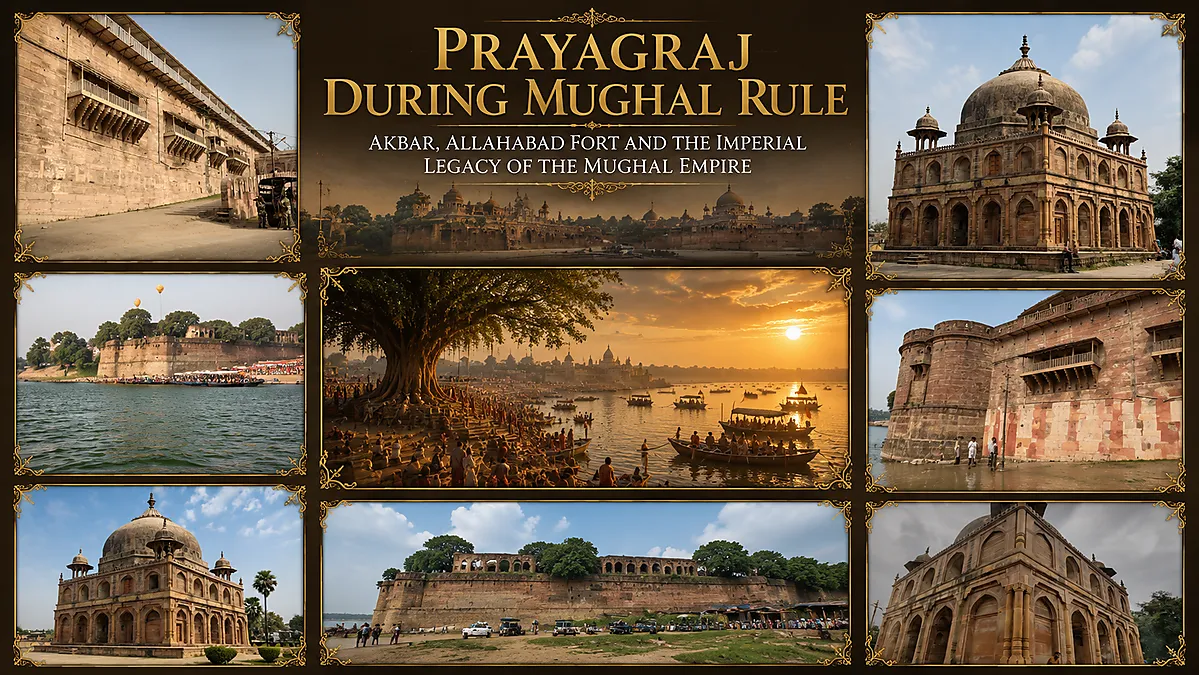
Akbar's Allahabad Fort overlooking the Triveni Sangam during the Mughal period in Prayagraj

Prayagraj During Mughal Rule: Akbar, Allahabad Fort and the Imperial Legacy of the Mughal Empire

The story of Prayagraj as a major imperial city begins with one of the most consequential decisions in Indian history. In 1583, the Mughal emperor Akbar stood at the sacred confluence of the Ganga and Yamuna and envisioned a fortress that would forever change the destiny of this ancient land.

Prayagraj During Mughal Rule: Akbar, Allahabad Fort and the Imperial Legacy of the Mughal Empire Read More »

Medieval Prayagraj showing Triveni Sangam pilgrimage traditions between Harsha and Mughal rule

Prayagraj in Medieval Indian History: From Harsha’s Empire to the Dawn of Mughal Rule (647–1526 CE)

After Harsha‘s death in 647 CE, Prayag became part of the Gurjara-Pratihara Empire, which dominated northern India from the 8th to the 11th centuries. It was later ruled by the Gahadavala dynasty, the Ghurids, and the Delhi Sultanate.

Prayagraj in Medieval Indian History: From Harsha’s Empire to the Dawn of Mughal Rule (647–1526 CE) Read More »

Chinese pilgrim Xuanzang observing Emperor Harsha's grand religious assembly at Prayag Sangam

Xuanzang (Hiuen Tsang) in Prayag: What the Great Chinese Pilgrim Saw in Ancient India‘s Holiest City

In 644 CE, Chinese monk Xuanzang arrived at Prayag and witnessed one of the greatest religious gatherings in ancient India. His detailed observations provide a rare glimpse into the spiritual, cultural, and political life of Prayagraj during the reign of Emperor Harsha.

Xuanzang (Hiuen Tsang) in Prayag: What the Great Chinese Pilgrim Saw in Ancient India‘s Holiest City Read More »

Samudragupta overlooking ancient Prayag with the Ashokan Pillar and Gupta Empire at its height

The Gupta Dynasty and Prayagraj: How Samudragupta Turned Prayag into an Imperial Capital of Ancient India

Discover how Samudragupta transformed sacred Prayag into the political heart of the Gupta Empire. Explore the Prayag Prashasti, Ashokan Pillar, Gupta coins, and the golden age of ancient India.

The Gupta Dynasty and Prayagraj: How Samudragupta Turned Prayag into an Imperial Capital of Ancient India Read More »

Three sacred Shakti Peethas of Prayagraj including Alopi Devi Lalita Devi and Kalyani Devi temples

Shakti Peethas and Devi Temples of Prayagraj: The Three Divine Shrines of the Mother Goddess in Tirtharaj Prayag

Explore the sacred Shakti Peethas of Prayagraj—Alopi Devi, Lalita Devi and Kalyani Devi. Discover their mythology, history, darshan timings, festivals and spiritual significance in this complete pilgrimage guide.

Shakti Peethas and Devi Temples of Prayagraj: The Three Divine Shrines of the Mother Goddess in Tirtharaj Prayag Read More »

Ancient sages describing Tirtharaj Prayag and Triveni Sangam in the Hindu Puranas

Prayagraj in the Puranas: How the Sacred Texts of Hinduism Describe Tirtharaj Prayag

Why do the Puranas call Prayag the King of Tirthas? Explore ancient Sanskrit verses from the Matsya, Skanda, Padma and other Puranas that reveal the spiritual significance of Triveni Sangam, Akshayavat and the sacred geography of Prayagraj.

Prayagraj in the Puranas: How the Sacred Texts of Hinduism Describe Tirtharaj Prayag Read More »

Devotees gathered outside Shri Bade Hanuman Mandir in Prayagraj, one of the most famous Hanuman temples near Triveni Sangam

Shri Bade Hanuman Ji Mandir: The Unique Reclining Hanuman Temple of Prayagraj

The first light of dawn is just beginning to touch the sky over Prayagraj. The air is cool and filled with the scent of incense as you make your way through the narrow lane leading from the Triveni Sangam. Somewhere ahead, the gentle ring of temple bells mingles with the soft chanting of “Jai Bajrang

Shri Bade Hanuman Ji Mandir: The Unique Reclining Hanuman Temple of Prayagraj Read More »

Scroll to Top

Enquiry