
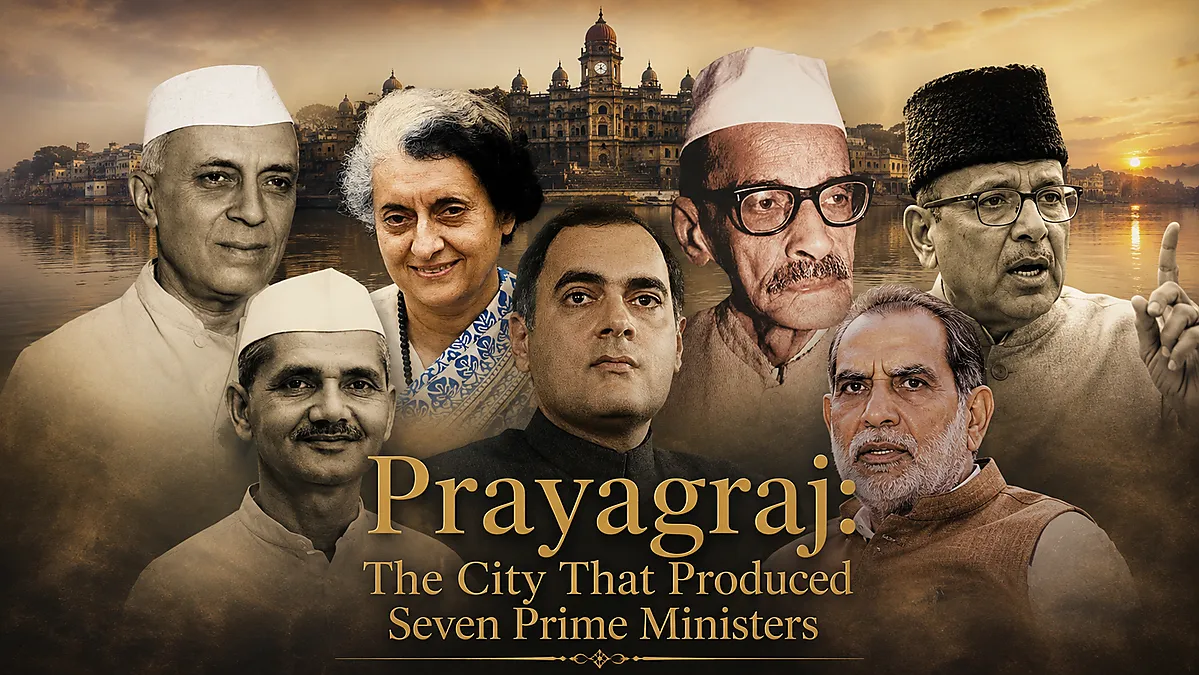
Prayagraj—the ancient city of pilgrimage, the sacred confluence of the Ganga, Yamuna, and the mythical Saraswati—is known to the world as a spiritual capital. But beneath its layers of faith and devotion lies another, equally remarkable identity: the political cradle of modern India. No other city in the country can claim to have nurtured, educated, or elected as many Prime Ministers as this unassuming city on the banks of the holy rivers.
From the freedom struggle to the highest office in the land, Prayagraj has been a crucible of leadership. Its historic Anand Bhavan, its venerable university, its bustling constituencies, and its intellectual atmosphere have produced or shaped no fewer than seven Prime Ministers of India. This is the story of that remarkable legacy—of the leaders who walked its streets, studied in its halls, and carried its spirit to the corridors of power in New Delhi.
Table of Contents
🏛️ Why Prayagraj Became India‘s Political Cradle
Before we turn to the individuals, we must understand the city that shaped them. Prayagraj’s political significance is no accident. Several factors combined to make it a nursery of national leadership:
- Anand Bhavan and Swaraj Bhavan: The ancestral home of the Nehru family was the de facto headquarters of the Indian National Congress. Countless historic meetings, strategising sessions, and freedom movement decisions took place within its walls.
- Allahabad University: Known as the “Oxford of the East,” this institution attracted brilliant minds from across the country and provided a platform for political debate, student activism, and intellectual ferment.
- The Freedom Movement: Prayagraj was a nerve centre of India‘s struggle for independence. From the Non-Cooperation Movement to the Quit India Movement, the city’s students, lawyers, and citizens were at the forefront.
- The Press and Intellectual Environment: The city was home to influential newspapers like The Leader and Abhyudaya, which shaped public opinion and nationalist discourse.
- The Judiciary and Administration: As the seat of the Allahabad High Court and a major administrative centre, the city attracted legal and bureaucratic talent from across the country.
This unique combination of factors created an environment where political leadership could flourish—and flourish it did.
👑 Prime Ministers Connected to Prayagraj
- 1947 – Nehru becomes PM
- 1964 – Shastri becomes PM
- 1966 – Indira becomes PM
- 1984 – Rajiv becomes PM
- 1989 – V.P. Singh becomes PM
- 1990 – Chandra Shekhar becomes PM
1. Jawaharlal Nehru (1889–1964) – The First Prime Minister
Jawaharlal Nehru, India‘s first and longest-serving Prime Minister, was born in Prayagraj (then Allahabad) on 14 November 1889. His birthplace, Anand Bhavan, was the home of his father, the eminent lawyer and freedom fighter Motilal Nehru.
Nehru’s connection to Prayagraj was not merely one of birth. It was a relationship of deep and enduring significance:
- Anand Bhavan as a Political Hub: The family mansion became the nerve centre of the Indian freedom movement. Mahatma Gandhi, Sardar Patel, Maulana Azad, and other national leaders held countless meetings in its rooms.
- Chairman of Allahabad Municipality: Nehru served as the fourth chairman of the Allahabad Municipality, gaining invaluable administrative experience at the grassroots level.
- MP from Phulpur: Nehru was elected to the Lok Sabha from the Phulpur constituency, located in the Prayagraj district, in 1952, 1957, and 1962. This constituency, with its roots in the rural hinterland of the city, remained his electoral base throughout his prime ministership.
- The Tryst with Destiny: It was from this city that Nehru carried the ideals of the freedom struggle to the national stage, delivering his famous “Tryst with Destiny” speech on the eve of independence.
Nehru‘s legacy in Prayagraj is preserved at Anand Bhavan, now a museum dedicated to his life and the freedom movement. The building, donated to the nation by Indira Gandhi in 1970, remains a pilgrimage site for those who wish to walk in the footsteps of India‘s founding father.
2. Lal Bahadur Shastri (1904–1966) – The Second Prime Minister
Lal Bahadur Shastri, India‘s second Prime Minister, was not born in Prayagraj. But his political career was deeply intertwined with the city.
- Chairman of Allahabad Municipality: Following in Nehru‘s footsteps, Shastri served as the chairperson of the Allahabad Municipality. This grassroots experience honed his administrative skills and deepened his connection to the city.
- MP from Allahabad: Shastri was elected to the Lok Sabha from the Allahabad constituency in 1957 and 1962. He represented the city in Parliament during the crucial years of India‘s post-independence consolidation.
- The Slogan of Jai Jawan Jai Kisan: It was at a public gathering in Prayagraj that Shastri gave the immortal slogan “Jai Jawan, Jai Kisan” during the 1965 war with Pakistan. This simple yet powerful phrase captured the spirit of a nation and became a defining slogan of his leadership.
Shastri‘s legacy in Prayagraj is remembered with affection. The city still bears the marks of his electoral campaigns, including wall writings preserved from his 1957 campaign in the old Chowk market.
3. Indira Gandhi (1917–1984) – The Iron Lady
Indira Gandhi, India‘s first and only woman Prime Minister, was born in Prayagraj on 19 November 1917. She was the daughter of Jawaharlal Nehru and the granddaughter of Motilal Nehru.
- Anand Bhavan as Her Home: Indira Gandhi spent her childhood at Anand Bhavan, surrounded by the leaders of the freedom movement. The mansion was not just a home but a political classroom.
- Marriage at Anand Bhavan: Her marriage to Feroze Gandhi took place at Anand Bhavan, further cementing the house‘s place in the family‘s personal and political history.
- Donation of Anand Bhavan: In a gesture of remarkable generosity, Indira Gandhi donated Anand Bhavan to the Indian government in 1970, ensuring that the legacy of the Nehru family would be preserved for future generations.
- Political Rise: Her connection to Prayagraj gave her a deep understanding of the grassroots political realities of northern India, which she carried into her prime ministership.
Indira Gandhi‘s association with Prayagraj is a testament to the city‘s role as the crucible of the Nehru-Gandhi political dynasty.
4. Rajiv Gandhi (1944–1991) – The Youngest Prime Minister
Rajiv Gandhi, India‘s youngest Prime Minister, was not born in Prayagraj (he was born in Mumbai). But his family roots in the city were profound.
- Family Connection: His mother, Indira Gandhi, was born in Prayagraj, and his grandfather, Jawaharlal Nehru, was born and raised in the city. Anand Bhavan was his ancestral home.
- Childhood Visits: Rajiv Gandhi spent many summers and family gatherings at Anand Bhavan, soaking in the political atmosphere that had shaped his family.
- The Anand Bhavan Legacy: The mansion, donated by his mother to the nation, remains a symbol of the Nehru-Gandhi family‘s enduring connection to Prayagraj.
Rajiv Gandhi‘s association with Prayagraj was one of heritage and memory, connecting him to the political legacy that had shaped modern India.
5. Gulzarilal Nanda (1898–1998) – The Acting Prime Minister
Gulzarilal Nanda served as the acting Prime Minister of India twice—first in 1964 after Nehru‘s death, and again in 1966 after Shastri‘s death. His connection to Prayagraj was primarily academic.
- Education at Allahabad University: Nanda studied at Allahabad University in the early 1920s. He worked as a research scholar on labour problems at the university from 1920 to 1921.
- Intellectual Foundation: His time at the university shaped his intellectual outlook and his lifelong commitment to labour welfare and social justice.
- Political Career: Though he did not represent Prayagraj in Parliament, his educational connection to the city places him in the illustrious list of Prime Ministers associated with Prayagraj.
Nanda‘s association with Prayagraj is a reminder that the city‘s influence extends beyond electoral politics to the shaping of ideas and intellectual leadership.
6. Vishwanath Pratap Singh (1931–2008) – The Seventh Prime Minister
Vishwanath Pratap Singh, India‘s seventh Prime Minister, was born in Prayagraj on 25 June 1931. His connection to the city was both personal and political.
- Birth in Prayagraj: Singh was born into a royal family of Manda, but his birth in Prayagraj gave him a lifelong association with the city.
- Education at Allahabad University: He was a student at Allahabad University and was actively involved in student politics. This experience honed his political skills and deepened his understanding of the grassroots.
- MP from Phulpur and Allahabad: Singh was elected to the Lok Sabha from the Phulpur constituency (twice) and from the Allahabad constituency (thrice). He represented the people of Prayagraj in Parliament for several terms.
- Prime Ministership: Singh went on to become Prime Minister in 1989, leading a coalition government.
Singh‘s journey from a student at Allahabad University to the Prime Minister of India is a powerful example of how Prayagraj nurtured political talent.
7. Chandra Shekhar (1927–2007) – The Eighth Prime Minister
Chandra Shekhar, India‘s eighth Prime Minister, was not born in Prayagraj, but his political and intellectual formation took place in the city.
- Education at Allahabad University: Chandra Shekhar studied at Allahabad University, where he became a prominent student leader and trade union activist.
- Student Politics: His time at the university was formative. He was deeply influenced by the socialist and nationalist ideas that flourished on the campus.
- Political Career: Though he did not represent Prayagraj in Parliament, his educational connection to the city places him among the Prime Ministers associated with Prayagraj.
Chandra Shekhar‘s association with Prayagraj is a testament to the city‘s role as a nursery of political talent and ideas.
🎓 Allahabad University – The Cradle of Prime Ministers
Allahabad University, known as the “Oxford of the East,” has been a crucible of political talent. Three Prime Ministers studied on its campus: Gulzarilal Nanda, Vishwanath Pratap Singh, and Chandra Shekhar.
- Intellectual Environment: The university provided a space for debate, discussion, and political activism. Its students were exposed to the ideas of nationalism, socialism, and democracy.
- Student Politics: The Allahabad University Students Union (AUSU) was a platform for future leaders to hone their oratory and organisational skills.
- Legacy: The university continues to produce political leaders, judges, and administrators who shape the destiny of the nation.
🏡 Anand Bhavan – The Political Nursery of India
Anand Bhavan, the ancestral home of the Nehru family, was more than a residence. It was a political nursery that nurtured three Prime Ministers: Jawaharlal Nehru, Indira Gandhi, and Rajiv Gandhi.
- Freedom Movement Hub: The house hosted meetings of the Indian National Congress, strategy sessions for the freedom movement, and visits by national leaders like Mahatma Gandhi.
- A Museum of History: Today, Anand Bhavan is a museum that preserves the personal belongings, photographs, and documents of the Nehru family. It is a pilgrimage site for those interested in India‘s political history.
- Donation to the Nation: Indira Gandhi donated the mansion to the Indian government in 1970, ensuring that its legacy would be preserved.
📊 The City of Prime Ministers: A Statistical Summary
| Prime Minister | Connection to Prayagraj | Nature of Connection |
| Jawaharlal Nehru | Born in Prayagraj (1889) | Birth, education, political base |
| Lal Bahadur Shastri | MP from Allahabad (1957, 1962) | Electoral representation |
| Indira Gandhi | Born in Prayagraj (1917) | Birth, family home |
| Rajiv Gandhi | Family roots | Ancestral home |
| Gulzarilal Nanda | Studied at Allahabad University | Education |
| Vishwanath Pratap Singh | Born in Prayagraj (1931) | Birth, education, political base |
| Chandra Shekhar | Studied at Allahabad University | Education |
Source:
🌍 Why So Many National Leaders Emerged from Prayagraj
The concentration of Prime Ministers in Prayagraj is not a coincidence. Several factors explain this remarkable phenomenon:
- Anand Bhavan as a Political Nursery: The Nehru family‘s home was a hub of political activity, attracting leaders from across the country.
- Allahabad University as an Intellectual Crucible: The university provided a platform for political debate, student activism, and intellectual ferment.
- The Freedom Movement: Prayagraj was a nerve centre of the independence struggle, producing leaders who went on to shape the nation.
- The Press and Intellectual Environment: The city‘s newspapers and literary circles shaped public opinion and nationalist discourse.
- The Judiciary and Administration: As the seat of the Allahabad High Court, the city attracted legal and bureaucratic talent.
- Strategic Location: Situated at the heart of the Gangetic plain, Prayagraj was a natural crossroads for political and commercial activity.
🏛️ Visiting the Political Heritage of Prayagraj
For those who wish to walk in the footsteps of these leaders, Prayagraj offers several must-visit sites:
- Anand Bhavan: The ancestral home of the Nehru family, now a museum.
- Swaraj Bhavan: The original family home, donated to the nation by Motilal Nehru.
- Allahabad University: The campus where three Prime Ministers studied.
- Chandrashekhar Azad Park: The site of the revolutionary‘s martyrdom, a reminder of the city‘s role in the freedom struggle.
- Allahabad Museum: Houses artifacts related to the freedom movement and the Nehru family.
❓ Frequently Asked Questions (FAQs)
1. How many Prime Ministers are connected to Prayagraj? Seven Prime Ministers have been connected to Prayagraj: Jawaharlal Nehru, Lal Bahadur Shastri, Indira Gandhi, Rajiv Gandhi, Gulzarilal Nanda, Vishwanath Pratap Singh, and Chandra Shekhar.
2. Which Prime Ministers were born in Prayagraj? Jawaharlal Nehru (1889), Indira Gandhi (1917), and Vishwanath Pratap Singh (1931) were born in Prayagraj.
3. Which Prime Ministers studied at Allahabad University? Gulzarilal Nanda, Vishwanath Pratap Singh, and Chandra Shekhar studied at Allahabad University.
4. Which Prime Ministers represented Prayagraj in Parliament? Lal Bahadur Shastri represented the Allahabad constituency in 1957 and 1962. Vishwanath Pratap Singh represented both Phulpur and Allahabad constituencies. Jawaharlal Nehru represented the Phulpur constituency.
5. What is Anand Bhavan? Anand Bhavan is the ancestral home of the Nehru family in Prayagraj. It was the residence of Jawaharlal Nehru and the political hub of the Indian freedom movement.
6. Who donated Anand Bhavan to the nation? Indira Gandhi donated Anand Bhavan to the Indian government in 1970.
7. What is the connection between Lal Bahadur Shastri and Prayagraj? Shastri was elected as MP from Allahabad in 1957 and 1962, and served as chairperson of the Allahabad Municipality. He also gave the slogan “Jai Jawan, Jai Kisan” at a public gathering in Prayagraj.
8. Why is Prayagraj called the “City of Prime Ministers”? Prayagraj is called the “City of Prime Ministers” because seven out of 15 Prime Ministers of India have had strong ties to the city through birth, education, or electoral representation.
9. Which constituency did Jawaharlal Nehru represent? Jawaharlal Nehru represented the Phulpur constituency in the Prayagraj district.
10. Which constituency did Lal Bahadur Shastri represent? Lal Bahadur Shastri represented the Allahabad constituency.
11. Which constituency did V.P. Singh represent? V.P. Singh represented both the Phulpur and Allahabad constituencies.
12. What is the political significance of Anand Bhavan? Anand Bhavan was the nerve centre of the Indian freedom movement and hosted countless meetings of national leaders.
13. What is the political significance of Allahabad University? Allahabad University has produced three Prime Ministers and numerous other political leaders, judges, and administrators.
14. Did any Prime Minister serve as chairperson of Allahabad Municipality? Yes, both Jawaharlal Nehru and Lal Bahadur Shastri served as chairperson of the Allahabad Municipality.
15. Is there a museum dedicated to the Prime Ministers in Prayagraj? Anand Bhavan serves as a museum dedicated to the Nehru family and the freedom movement. The Allahabad Museum also houses artifacts related to the political history of the city.
16. What is the connection between Gulzarilal Nanda and Prayagraj? Gulzarilal Nanda studied at Allahabad University in the early 1920s.
17. What is the connection between Chandra Shekhar and Prayagraj? Chandra Shekhar studied at Allahabad University and was a prominent student leader there.
18. What is the connection between Rajiv Gandhi and Prayagraj? Rajiv Gandhi‘s family roots were in Prayagraj; his mother Indira Gandhi was born there, and his grandfather Jawaharlal Nehru was born and raised there.
19. Which Prime Ministers were born in Prayagraj? Jawaharlal Nehru, Indira Gandhi, and Vishwanath Pratap Singh were born in Prayagraj.
20. Why did so many Prime Ministers emerge from Prayagraj? Prayagraj‘s unique combination of a politically active family (the Nehrus), a premier educational institution (Allahabad University), and its role in the freedom movement created an environment conducive to political leadership.
💎 Conclusion: The City That Shaped a Nation
Prayagraj is more than a city of pilgrimage. It is a city of leadership. Its streets have been walked by some of the most consequential figures in Indian history. Its institutions have shaped the minds of leaders who went on to govern the world‘s largest democracy.
From the freedom struggle to the highest office in the land, the city‘s contribution to India‘s political heritage is unparalleled. No other city can claim to have nurtured, educated, or elected as many Prime Ministers. The seven leaders who called Prayagraj their home, their alma mater, or their electoral base carried the spirit of this city to the corridors of power in New Delhi.
As you walk through the halls of Anand Bhavan, stroll across the campus of Allahabad University, or stand in the constituencies that sent leaders to Parliament, you are walking in the footsteps of history. Prayagraj is not merely a city; it is a living testament to the leadership that shaped modern India.
“The city that gave India its first Prime Minister, its first woman Prime Minister, and several others besides, continues to inspire generations of leaders. Prayagraj is not just a political cradle—it is a political legacy.”
🚶 Walk in the footsteps of Prime Ministers with our “Prayagraj Political Heritage Tour” – a guided journey covering Anand Bhavan, Allahabad University, Phulpur, and other landmarks associated with India‘s leaders.
📞 Phone/WhatsApp: +91-9555313526
📧 Email: contact@prayagtourism.com
🌐 Website: PrayagTourism.com
This article is part of a series exploring the historical and cultural heritage of Prayagraj.
Prayag Tourism
May your journey be peaceful, safe, and historically enriching.