
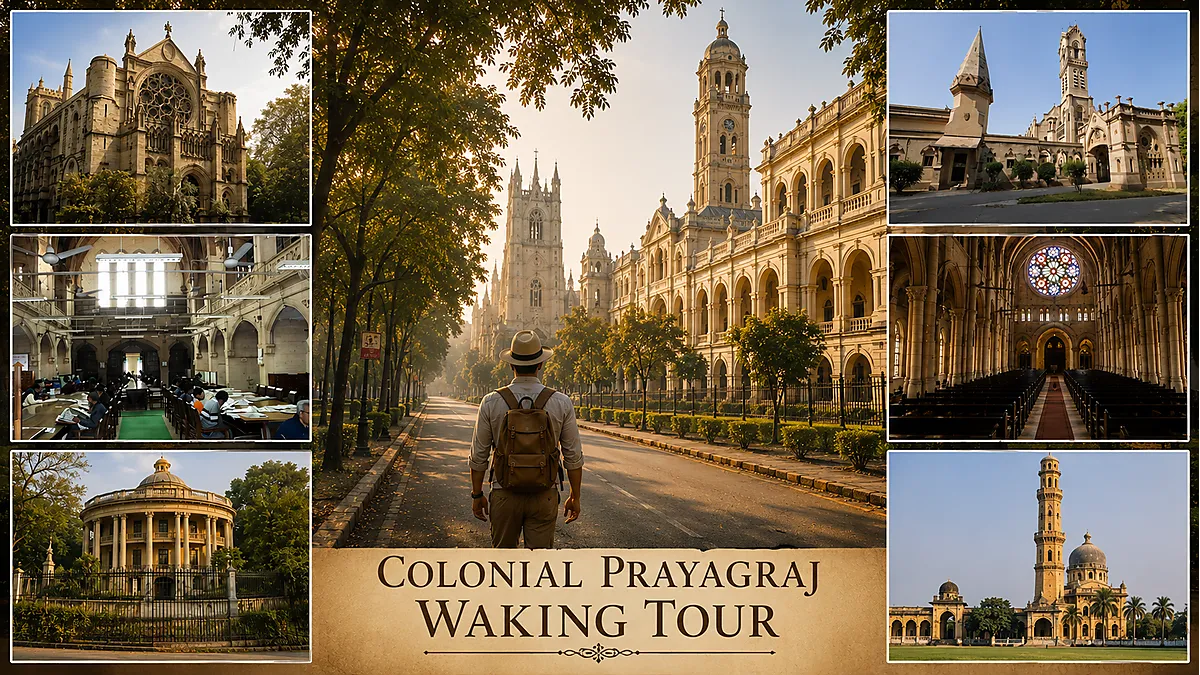
The wide, tree‑lined avenues of Civil Lines offer a quiet refuge from Prayagraj‘s vibrant chaos. Here, the city speaks a different language: the language of sandstone, spires, and imperial ambition. An afternoon walk along Sarojini Naidu Marg is a journey into the heart of the British Raj, where Victorian Gothic cathedrals, Scottish baronial libraries, and Indo‑Saracenic university halls stand as monuments to a vanished era.
Long before the Kumbh Mela draws millions to the Sangam, Prayagraj – then Allahabad – had become one of the most important colonial cities in northern India. After the 1857 Rebellion, the British chose this holy city to be the new capital of the North‑Western Provinces. They built a brand‑new suburb, Civil Lines, a planned town of wide roads, elegant bungalows, churches, clubs and public buildings that was the most ambitious town‑planning project in India before the creation of New Delhi.
Today, those same avenues offer one of the finest urban heritage walks in the country. This guide will lead you through the colonial heart of Prayagraj, past the city‘s most magnificent Victorian and Edwardian buildings, revealing the stories of the architects, administrators, soldiers and nationalists who shaped this remarkable city.
🏛️ How Allahabad Became a Colonial Capital
The British connection with Prayagraj began in 1801, when the East India Company took direct control of the city from the Nawab of Awadh. But it was the cataclysmic events of 1857 that permanently transformed the city‘s destiny.
In the aftermath of the Indian Rebellion, the British were determined to consolidate their control over the Gangetic plain. Allahabad’s strategic location at the confluence of the Ganga and Yamuna made it an ideal administrative centre. The city was made the capital of the newly‑formed North‑Western Provinces, and a massive building program began.
The old cantonments were transformed, and a completely new suburb was designed from scratch. This was Civil Lines – a planned colonial town intended to be the permanent administrative and residential heart of British power in the region. Legal courts were moved from Agra to Allahabad in stages between 1858 and 1866, and in 1869 the High Court was formally established in the city.
By the end of the 19th century, Allahabad had become the political, judicial and educational capital of northern India – a city that British officials proudly called the “Oxford of the East.”
🏘️ Understanding Civil Lines: The British Town in India
Civil Lines is not a single building but an entire colonial district – the finest surviving example of British urban planning in Uttar Pradesh and one of the most important in India.
Built from 1857 onward under the supervision of architect Cuthbert Bensley Thornhill, Civil Lines was the largest town‑planning project undertaken in India before the creation of New Delhi. Its wide, straight avenues were laid out on a grid, lined with large bungalows set in compounds of lush greenery. The area was deliberately separated from the crowded “native” city, creating a distinct European quarter with its own clubs, churches, markets and administrative buildings.
The neighbourhoods of Civil Lines, Georgetown, and Tagoretown were built during the British era and still reflect colonial architecture. Today, a walk through Civil Lines feels like stepping back a century: the broad roads, the old bungalows, the magnificent public buildings and the quiet gardens all evoke the vanished world of the British Raj.
🧭 Walking Tour Overview – Practical Information
| Detail | Information |
| Starting Point | All Saints Cathedral (Sarojini Naidu Marg) |
| Ending Point | Allahabad High Court (MG Marg / Sarojini Naidu Marg junction) |
| Total Walking Distance | Approximately 3–4 km (the core route) |
| Duration (exploring) | 2–3 hours for a quick tour; 4–5 hours for a detailed exploration |
| Best Time | Early morning (8:00 AM – 10:00 AM) or late afternoon (3:00 PM – 5:00 PM) |
| Best Season | October – March (winter) |
| What to Bring | Comfortable walking shoes, water bottle, camera, hat (if sunny), sunscreen |
| Photography Gear | Wide‑angle lens for architecture; polarising filter for skies |
The walking route follows a logical order, beginning at the grand cathedral in the heart of Civil Lines, then heading north to the university precincts, before looping back through the city‘s most historic parks. All the stops are within walking distance of each other, though a short auto‑rickshaw ride can be taken between the university and the High Court if needed.
💡 Pro Tip: The best way to experience this walk is to start early – 8:00 AM – when the morning light is soft, the streets are quiet, and the buildings glow with a warm, golden hue.
⛪ Stop 1: All Saints Cathedral (Patthar Girjaghar)
Your walk begins at the most magnificent colonial building in Prayagraj: All Saints Cathedral, known locally as Patthar Girjaghar – the “Stone Church”.
History and Architecture
The cathedral was designed by the celebrated British architect Sir William Emerson, who later designed the Victoria Memorial in Kolkata. Modelled after 13th‑century Gothic churches, it is among the finest Gothic Revival buildings built by the British in Asia.
The foundation stone was laid by Lady Muir on 1 April 1871. The cathedral was consecrated in 1887 and completed four years later. The building is constructed of cream sandstone with red sandstone dressings, creating a striking polychromatic effect. Its tower rises 103 feet (31 m), and the total length of the building is 240 feet (73 m).
What to See
- Gothic Revival exterior: Flying buttresses, pointed arches, gargoyles and a magnificent central tower.
- Stained‑glass windows: Vibrant biblical scenes in jewel colours, best viewed in the morning light.
- Interior features: A marble inlaid altar, an alabaster pulpit, and memorial plaques commemorating British residents of the United Provinces.
The cathedral is at the centre of a large open space at the crossing of two principal roads – MG Marg and Sarojini Naidu Marg – making it the architectural anchor of Civil Lines. It continues to be an active place of worship, belonging to the Church of North India, with regular services held on Sundays.
- Timings: 8:30 AM – 5:30 PM (daily).
- Entry fee: Free.
- Photography: Allowed; avoid flash during services.
📚 Stop 2: Allahabad Public Library (Thornhill Mayne Memorial)
A short walk north along Sarojini Naidu Marg brings you to one of the most beautiful library buildings in India: the Allahabad Public Library, also known as the Thornhill Mayne Memorial.
History
The library was established in 1864, making it the largest public library in Uttar Pradesh. The present building was completed in 1870 at a cost of approximately ₹94,222, designed by the architect Richard Roskell Bayne. It was funded by the Commissioner of Allahabad, Mr. Mayne, and opened as a memorial to Cuthbert Bensley Thornhill, a member of the Bengal Civil Service.
Before being converted into a library in 1879, the building served as the house of the legislative assembly when Allahabad was the capital of the United Provinces.
Architectural Style
The building is a magnificent example of Scottish Baronial Revival architecture, a style rare in India. It features:
- Sharp pillars and turrets of granite and sandstone
- Structural polychromy (the use of different coloured stones)
- Lofty towers and arcaded cloisters
- A dramatic silhouette dominating the park landscape
Collections
The library holds approximately 125,000 books, 40 magazines, and 28 newspapers in Hindi, English, Urdu and Bangla, as well as 21 Arabic manuscripts. Its collection of old government publications, parliamentary papers and 19th‑century “blue books” is invaluable for historians.
The building is situated within Chandrashekhar Azad Park (formerly Alfred Park), a beautiful green space that adds to its tranquillity.
- Timings: 9:00 AM – 5:00 PM (closed on Mondays).
- Entry fee: Free (park entry may have a nominal fee).
- Note: The library is a working public library; visitors are asked to maintain silence.
🎓 Stop 3: Allahabad University – The Oxford of the East
Continue north from the library, and you will soon reach the grand campus of Allahabad University – the fourth oldest modern university in India, established on 23 September 1887.
Muir Central College
The university‘s origins lie in Muir Central College, founded in 1873 and named after Sir William Muir, the Lt. Governor of the North‑Western Provinces. The foundation stone was laid by Governor‑General Lord Northbrook on 9 December 1873.
The college building was designed by Sir William Emerson, the same architect who designed All Saints Cathedral and the Victoria Memorial. It is a unique blend of Indo‑Saracenic, Egyptian and Gothic styles, with elements borrowed from Fatehpur Sikri and even an Australian city.
The Oxford of the East
Allahabad University was the fifth university established in colonial India, after Calcutta, Bombay, Madras and Lahore‘s Punjab university. In 1921, with the enactment of the Allahabad University Act, Muir Central College merged with the university, which was reorganised as a unitary teaching and residential university.
Its high academic standards, beautiful campus and reputation as a centre of learning earned it the affectionate nickname the “Oxford of the East.”
What to See on Campus
- Muir College building: The original college building, a masterpiece of eclectic architecture combining Gothic, Indian, Egyptian and Persian elements.
- The Clock Tower: A prominent landmark visible from across the city.
- The arcaded quadrangles: Covered walkways ideal for photography.
- Timings: The campus is open during daylight hours.
- Entry fee: Free.
🏛️ Stop 4: Senate Hall and University Precincts
Within the university campus, the Senate Hall is the most important administrative and ceremonial building. It was opened by the Lieutenant‑Governor, Sir John Hewett, in 1912.
The Senate Hall is the venue for university convocations and high‑level academic meetings. Its architecture complements Emerson‘s original college buildings, with spacious halls and elegant arches.
Tip for visitors: If the building is open, admire the high‑ceilinged hall and the sense of academic tradition that pervades the space. The campus is also home to several old hostels, including Muir Hostel (now Dr. Amara Natha Jha Hostel), which date back to the early 20th century.
🌳 Stop 5: Chandrashekhar Azad Park (Alfred Park)
From the university, retrace your steps slightly and enter the large green expanse of Chandrashekhar Azad Park – formerly known as Alfred Park and, during the Company Raj, Company Bagh.
History
The park was built in 1870 to commemorate the visit of Prince Alfred, the Duke of Saxe‑Coburg and Gotha, to the city. With an area of 54 hectares (133 acres), it is the largest park in Prayagraj.
The park‘s name was changed after Independence to honour the revolutionary Chandrashekhar Azad, who sacrificed his life here on 27 February 1931 during a gunfight with British police.
Landmarks Within the Park
- Chandrashekhar Azad Memorial: The exact spot where Azad fell, marked by a memorial. The Colt pistol he used is displayed in the nearby Allahabad Museum.
- Victoria Memorial Canopy: A large canopy made of Italian limestone, dedicated to Queen Victoria. It was opened on 24 March 1906 by James Digges La Touche. The canopy once contained a statue of the Queen, which has since been removed.
- The Bandstand: Once used by British Army bands to entertain colonial officers and Indian elites, donated by liquor baron Babu Nilkamal Mitra.
- Allahabad Museum: A national‑level museum (see below).
- Park timings: Open daily, sunrise to sunset.
- Entry fee: Nominal (approximately ₹5).
Allahabad Museum
Located within the park, the Allahabad Museum was established in 1931. It is a national‑level museum funded by the Ministry of Culture. The foundation stone of the present building was laid by Jawaharlal Nehru on 14 December 1947, and it was opened to the public in 1954.
It boasts the largest collection of prehistoric paintings in India (dating from 14,000 B.C. to 2,000 B.C.). It also houses the Gandhi Smriti Vahan, the Ford truck on which Gandhi‘s ashes were immersed in the Triveni Sangam, and rare exhibits on the Nehru family.
- Timings: 10:30 AM – 4:30 PM (closed Mondays).
- Entry fee: ₹20 (Indian citizens), ₹500 (foreign tourists).
🌅 Stop 6: Minto Park (Madan Mohan Malaviya Park)
A short distance from the main Civil Lines area, on the banks of the Yamuna River, lies Minto Park, officially renamed Madan Mohan Malaviya Park.
The Proclamation of 1858
This park is one of the most historically significant sites in all of India. On 1 November 1858, Earl Canning, the Governor‑General of India, read out Queen Victoria‘s Proclamation. This document transferred the control of India from the East India Company directly to the British Crown, formally marking the beginning of the British Raj.
The Proclamation Pillar
In 1908, a marble pillar was erected in the park to commemorate the 50th anniversary of the proclamation. It was originally topped with marble busts of Queen Victoria and King Edward VII; after Independence, these were replaced with the Ashokan Lion Capital, India‘s national emblem. In 1910, the park was officially named Minto Park after the then Viceroy, Lord Minto.
The Modern Park
Today, the park is a peaceful riverfront space, ideal for evening walks and sunset views over the Yamuna.
- Timings: Open daily, sunrise to sunset.
- Entry fee: Free.
⚖️ Stop 7: The High Court of Allahabad
The final stop on your heritage walk is the Allahabad High Court, one of the oldest high courts in India.
History
The High Court was established in 1869, having been moved from Agra to Allahabad after the Rebellion of 1857. It first sat in a building on Sarojini Naidu Marg (then Queen‘s Road).
The present court building, an impressive structure in the Indo‑Gothic style with striking red sandstone exteriors, was built between 1914 and 1916 and opened by Lord Chelmsford, the Viceroy.
Architectural and Historical Significance
The High Court is a prestigious judicial institution and a landmark of colonial architecture. The building‘s legal museum has a collection of rare documents, including four‑hundred‑ to five‑hundred‑year‑old judgments, decrees and orders. A British emblem carved in wood – originally in the Chief Justice‘s court before Independence – is also preserved.
- Timings: The court is a working judicial institution. The exterior can be viewed at any time; entry to the building is restricted.
- Location: At the junction of MG Marg and Sarojini Naidu Marg, near All Saints Cathedral.
🏘️ Other Colonial Landmarks
While the main stops cover the highlights, several other colonial‑era buildings are worth exploring if you have extra time:
| Landmark | Location | Significance |
| Mayo Memorial Hall | Civil Lines | Built in 1879 by R. Roskell Bayne; a meeting hall with a 180‑foot tower |
| St. Peter‘s Church | Muirabad | Historic Anglican church with ties to British colonial history; Gothic architecture |
| Old High Court Building | Sarojini Naidu Marg | The mid‑Victorian building where the High Court first sat (1869‑1916) |
| Old Bungalows of Civil Lines | Throughout Civil Lines | Sprawling colonial‑era residences, many still in use |
| Railway Heritage | Near Prayagraj Junction | Stations and railway quarters dating from the British era |
🎨 Architectural Styles of Colonial Prayagraj
The colonial architecture of Prayagraj is remarkably varied. A single walk can introduce you to several distinct styles:
| Style | Example | Key Features |
| Gothic Revival | All Saints Cathedral | Pointed arches, flying buttresses, gargoyles, vertical emphasis |
| Scottish Baronial Revival | Allahabad Public Library | Turrets, sharp pillars, structural polychromy, castellated details |
| Indo‑Saracenic | Allahabad University (Muir College) | Fusion of Gothic, Indian (Mughal and Rajput) and Egyptian elements |
| Indo‑Gothic | Allahabad High Court | Red sandstone exteriors, pointed arches, European detailing adapted to Indian materials |
| Italianate / Neo‑Classical | Victoria Memorial Canopy | Symmetry, columns, domes, classical proportions |
The range of styles reflects the different tastes and functions of colonial architecture – from sacred and educational to administrative and memorial – and makes Prayagraj a rewarding destination for architecture enthusiasts.
🕰️Life in Colonial Allahabad – A Glimpse into a Bygone Era
A heritage walk is not only about buildings; it is also about imagining the lives once lived within them.
In its heyday, Allahabad was a city of horse‑drawn carriages, evening band performances in the park, club dinners, and cricket matches on the Company Bagh grounds. British officers lived in spacious bungalows, served by a large Indian staff. The Indian elite – lawyers, judges, journalists, and university professors – also made their homes in Civil Lines, giving the area a social and cultural dynamism that went beyond purely British circles.
The Allahabad of the Raj was also a city of education and letters. The University of Allahabad was the “Oxford of the East,” attracting students from across India. Literary figures such as Rudyard Kipling (who wrote The Man Who Would Be King in the veranda of a villa in the city) and poets like Harivansh Rai Bachchan and Firaq Gorakhpuri were part of Allahabad‘s intellectual ferment.
At the same time, Allahabad was a crucible of the Indian freedom movement. The Nehru family‘s home, Anand Bhavan, and the meetings of the Indian National Congress in the city kept the spirit of nationalism alive. The renaming of Alfred Park to Chandrashekhar Azad Park is a powerful reminder of how the city‘s colonial spaces were reclaimed and reimagined after Independence.
📸 Photography Guide – Capturing the Colonial Era
Prayagraj‘s colonial architecture is extremely photogenic. Here are some tips:
| Location | Best Time | What to Capture |
| All Saints Cathedral | Morning (9‑11 AM) for interior stained glass; late afternoon (4‑5 PM) for exterior golden glow | The Gothic spire, flying buttresses, the rose window |
| Allahabad Public Library | Morning (8‑9 AM) or late afternoon (4‑5 PM) | Turrets and cloisters, the building framed by park greenery |
| Muir College | Morning (8‑10 AM) for soft light on the red sandstone | The domes and arches, the clock tower, the arcaded quadrangles |
| Chandrashekhar Azad Park | Golden hour (just after sunrise / before sunset) | The Victoria Canopy, the wide lawns and heritage trees |
| Minto Park | Sunset (5‑6 PM) | The Proclamation Pillar with the Yamuna in the background |
| Civil Lines Avenues | Late afternoon (4‑5 PM) for long shadows | Tree‑lined streets with colonial bungalows |
Gear recommendations: A wide‑angle lens (16‑35mm) for capturing entire buildings and interiors; a telephoto lens (70‑200mm) for architectural details such as gargoyles, turrets, and carvings. A polarising filter helps reduce glare and deepen the sky.
🗺️ Self‑Guided Heritage Walk Itineraries
2‑Hour Express Tour (1.5 km, 2 hours)
- Start: All Saints Cathedral (20 minutes).
- Walk to: Allahabad Public Library (20 minutes).
- Quick walk through: Chandrashekhar Azad Park (30 minutes).
- End: View Minto Park from the outside (10 minutes).
Half‑Day Detailed Tour (3‑4 km, 4 hours)
- Start: All Saints Cathedral (30 minutes).
- Visit: Allahabad Public Library (30 minutes).
- Walk to: Allahabad University Campus (30 minutes).
- Explore: Muir College and Senate Hall (45 minutes).
- Walk to: Chandrashekhar Azad Park (15 minutes).
- Explore: Park and Allahabad Museum (1 hour).
- End: Quick visit to Minto Park (20 minutes).
Full‑Day Comprehensive Tour (adds the High Court and other landmarks)
- Morning (9 AM – 12 PM): Cathedral, Library, University Campus, Senate Hall.
- Lunch break: Civil Lines market or Indian Coffee House.
- Afternoon (1:30 PM – 4:30 PM): Chandrashekhar Azad Park, Allahabad Museum, Minto Park.
- Late afternoon (4:30 PM – 5:30 PM): Walk past the High Court, view other colonial landmarks.
🤝Why Book a Guided Heritage Walk with PrayagTourism.com?
While this guide is designed for self‑guided exploration, there are many advantages to booking a guided heritage walk with PrayagTourism.com.
The Challenges of Going Solo
- Navigation: Civil Lines is spread out, and finding the best routes between sites can be confusing.
- Timing: Without local knowledge, you may arrive at a site when it‘s closed or miss the best light for photography.
- Context: The stories behind the buildings – the scandals, the intrigues, the architectural details – are often missed without a knowledgeable guide.
- Fatigue: A 4‑hour walk can be tiring, especially in the heat; a guided tour ensures a well‑paced itinerary with rest stops.
What You Get with a Guided Tour
- 🧭 Expert Guide: Our guides are local historians who know the colonial era inside out. They will bring the buildings to life with stories of architects, administrators, and the people who shaped the city.
- 🚗 Comfort: Pick‑up and drop‑off from your hotel are included, along with a vehicle for the longer stretches.
- ⏰ Timing: We know the best times to visit each site for the best light and smallest crowds.
- 📸 Photography Assistance: Our guides know the best angles and can help you capture the perfect shot.
- 🍽️ Refreshments: A stop at the legendary Indian Coffee House is included.
Book Your Heritage Walk Today
📞 Phone/WhatsApp: +91-9555313526
📧 Email: contact@prayagtourism.com
🌐 Website: PrayagTourism.com
❓Frequently Asked Questions (FAQs)
1. What are the best colonial buildings to see in Prayagraj?
The must‑see colonial buildings are All Saints Cathedral, Allahabad Public Library, Muir Central College (Allahabad University), and the High Court. Chandrashekhar Azad Park and Minto Park are important colonial‑era landscapes.
2. Why is Civil Lines famous?
Civil Lines is famous for being the largest planned colonial township built in India before New Delhi. Its wide, tree‑lined avenues, bungalows and public buildings survive as one of the finest urban heritage districts in the country.
3. What is the “Oxford of the East”?
“Oxford of the East” is the nickname given to Allahabad University, the fourth oldest modern university in India. The nickname reflects its high academic standards, residential character, and beautiful campus.
4. Who designed All Saints Cathedral?
The cathedral was designed by Sir William Emerson, the British architect who also designed the Victoria Memorial in Kolkata.
5. What is the Allahabad Public Library famous for?
The library is famous for its unique Scottish Baronial Revival architecture, its rare collection of 125,000 books and 21 Arabic manuscripts, and its history as the former legislative assembly of the United Provinces.
6. Can I take a heritage walk in Prayagraj by myself?
Yes. The walk described in this article is designed to be self‑guided. All the locations are safe and accessible, and the distances between them are manageable on foot.
7. What is the best time of year for a heritage walk?
The winter months (October to March) are ideal, with pleasant temperatures and clear skies.
8. Is there an entry fee for the colonial buildings?
All Saints Cathedral and the university campus are free. The Allahabad Museum has a nominal entry fee, and there is a small fee for Chandrashekhar Azad Park.
9. Are these buildings still in use?
Yes. All Saints Cathedral is an active church. The library is a working public library. Allahabad University is a functioning university. The High Court is a working court. The parks are popular public spaces.
10. How long does the full walking tour take?
Depending on your pace and how much time you spend at each stop, the full tour takes between 4 and 6 hours.
11. Is the Allahabad Museum worth visiting?
Yes. It houses the largest collection of prehistoric rock art in India, the Colt pistol of Chandrashekhar Azad, and the Ford truck used to carry Gandhi‘s ashes.
12. What is the significance of Minto Park?
Minto Park is the site where, on 1 November 1858, Queen Victoria‘s Proclamation was read, formally transferring control of India from the East India Company to the British Crown.
13. Are there guided tours available?
PrayagTourism.com offers guided heritage tours of Colonial Prayagraj, including expert commentary on the history and architecture of the buildings.
14. What is the architecture of Allahabad University?
The university‘s Muir College building is a unique blend of Indo‑Saracenic, Egyptian and Gothic styles, designed by Sir William Emerson.
15. Can I enter the Allahabad High Court?
The High Court is a working court. The exterior can be viewed, but entry for tourists is restricted.
16. What is the story behind the Victoria Canopy in Azad Park?
The canopy was built in 1906 to commemorate Queen Victoria. It once held her statue (now removed), and is a fine example of colonial memorial architecture.
17. What is Patthar Girjaghar?
Patthar Girjaghar is the local name for All Saints Cathedral. It means “Stone Church” in Hindi, referring to its construction from sandstone.
18. Is the Allahabad Public Library open on Sundays?
The library is typically closed on Mondays. It is advisable to check current timings before visiting.
19. Where can I have lunch during the heritage walk?
The Indian Coffee House in Civil Lines, located near the library, is a historic café and an excellent choice for lunch. There are also several restaurants on MG Marg.
20. What is the best way to get to the starting point of the walk?
All Saints Cathedral is a landmark in Civil Lines. From Prayagraj Junction, it is a 10‑minute taxi or auto‑rickshaw ride. From the Triveni Sangam, it is about 20 minutes by auto.
🏁 Conclusion: The Enduring Legacy of the Raj
As you finish your walk, the evening light softening the sandstone of the High Court, it is worth reflecting on what you have seen. These buildings are not merely picturesque; they are the physical remains of a vanished empire that left an indelible mark on India.
Yet, the story of colonial Prayagraj is not one of foreign domination alone. The same buildings that housed British administrators now serve an independent India‘s judiciary, education system and public life. The parks that were once reserved for white officers are now enjoyed by all. The library built in memory of a British civil servant is now a repository of Indian scholarship. The cathedral remains a centre of Christian worship, but it is also a heritage landmark cherished by people of all faiths.
The colonial architecture of Prayagraj is a reminder that history is not erased; it is layered. The city‘s story includes the Mauryas and Guptas, the Mughals and the British, and finally, independent India. To walk through Civil Lines is to walk through that layered history – and to see, in stone and stained glass, the enduring legacy of an age that still shapes the city we know today.
A walk through Colonial Prayagraj is a journey through a fascinating chapter of India‘s history – where grand cathedrals, elegant libraries, prestigious universities, and tree‑lined avenues continue to tell the story of a city that once stood at the heart of the British Raj.
🚶 Walk in the footsteps of history with our “Colonial Prayagraj Heritage Walk” – a guided journey covering All Saints Cathedral, the Allahabad Public Library, Allahabad University, and other landmarks associated with the city‘s colonial past.
📞 Phone/WhatsApp: +91-9555313526
📧 Email: contact@prayagtourism.com
🌐 Website: PrayagTourism.com
This article is part of a series exploring the heritage and tourism of Prayagraj.
Prayag Tourism
May your journey be peaceful, safe and historically enriching – and may the stones of the Raj whisper their stories to you.