
The aroma of freshly brewed tea mingles with the scent of old books and the faint perfume of ink. Inside the Indian Coffee House on Mahatma Gandhi Marg, the air is thick with the murmur of voices debating poetry, politics, and philosophy. At a corner table, a young poet scribbles verses on a napkin. Across the room, a professor of English holds court over a circle of students. The afternoon light streams through the windows, illuminating the dust motes that dance above the heads of these men and women—writers, thinkers, dreamers who have gathered in this unassuming café, just as their predecessors have done for nearly a century.
This is the literary heart of Prayagraj.
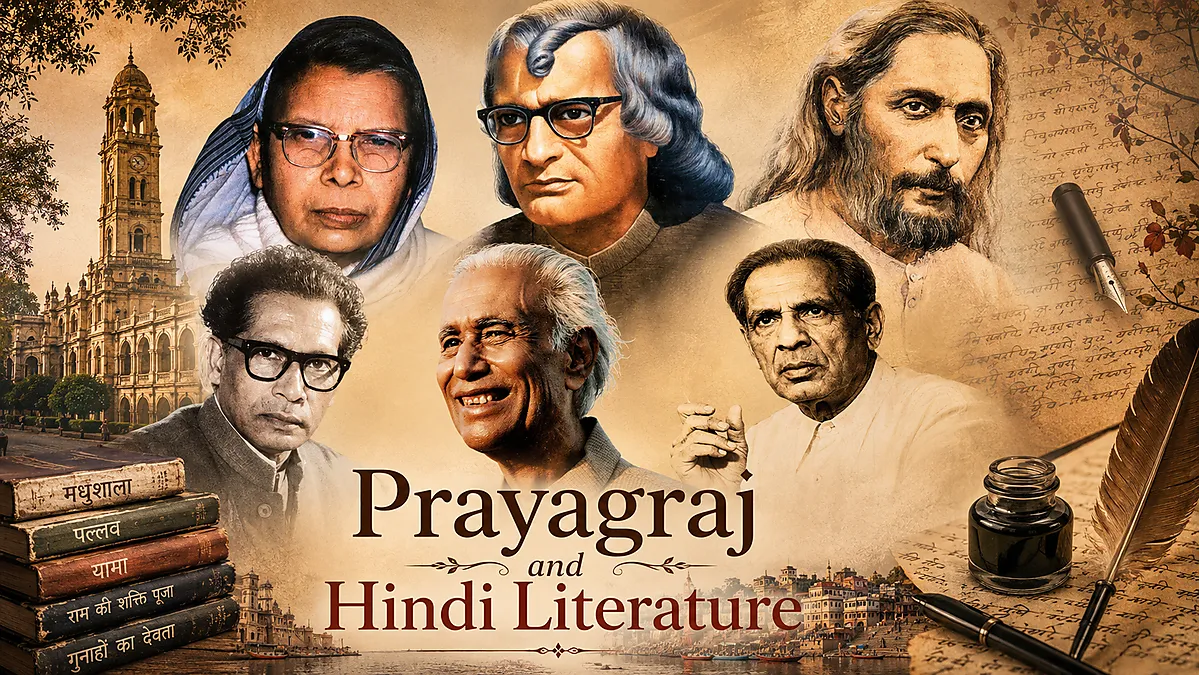
For over two centuries, this city—known to history as Allahabad—has been one of India‘s most fertile grounds for literary creativity. From the Urdu satire of Akbar Allahabadi to the romantic poetry of Mahadevi Varma, from the revolutionary verses of Suryakant Tripathi Nirala to the haunting refrains of Harivansh Rai Bachchan’s Madhushala, Prayagraj has nurtured a remarkable constellation of literary genius.
Few places in India have given as many luminous stars to the world of literature as has Allahabad or Prayagraj. It has a rich literary history, serving as a major centre for Hindi and Urdu literature, particularly in the 19th and 20th centuries. To understand why this city became the literary capital of Hindi India is to understand the confluence of education, publishing, intellectual debate, and cultural synthesis that defined modern India.
Table of Contents
🏛️ Why Prayagraj Became the Capital of Hindi Literature
Prayagraj‘s rise as a literary capital was not accidental. It was the result of a unique combination of factors that created an environment where literary talent could flourish.
Strategic Location and Intellectual Environment
Situated at the confluence of the Ganga and Yamuna, Prayagraj was already a sacred city when the British made it the capital of the North‑Western Provinces in the 19th century. This administrative importance attracted lawyers, judges, civil servants, and educators—a literate, articulate class that formed the backbone of a literary culture.
Educational Institutions
The establishment of Muir Central College (later Allahabad University) in 1873 created a vibrant intellectual atmosphere. The university attracted students and faculty from across India, fostering a culture of debate, discussion, and literary experimentation. Its reputation as the Oxford of the East drew the brightest minds of the era, many of whom would go on to shape Hindi and Urdu literature.
Publishing and Journalism
Prayagraj was home to some of India‘s most influential publishing houses and literary journals. The Indian Press, established in the late 19th century, published Saraswati—the first Hindi literary magazine that set new standards for prose and poetry. This magazine provided a national platform for emerging writers and helped standardize modern Hindi prose.
The Freedom Movement
The struggle for independence was intimately connected to the literary ferment of Prayagraj. Writers saw their work as part of a larger national awakening. The Nehru family‘s Anand Bhavan was not only a political headquarters but also a gathering place for intellectuals, writers, and artists.
Ganga-Jamuni Tehzeeb
Prayagraj‘s unique cultural synthesis—the Ganga-Jamuni tehzeeb—allowed Hindi, Urdu, Sanskrit, and Persian traditions to coexist and enrich one another. This syncretic culture produced poets who wrote in multiple languages and drew from multiple traditions.
📚 The Literary Environment of Allahabad
Prayagraj‘s literary environment was shaped by several key institutions and spaces that nurtured writers and thinkers.
Allahabad University – The Oxford of the East
Established in 1887, Allahabad University became the intellectual powerhouse of northern India. Its alumni include some of the most important figures in Hindi literature:
- Mahadevi Varma – MA in Sanskrit (1933)
- Sumitranandan Pant – studied and later graduated from Allahabad University
- Harivansh Rai Bachchan – BA from Allahabad University
- Dharamvir Bharati – MA in Hindi (1946)
- Firaq Gorakhpuri – lecturer in English literature
The university‘s English Department was famous across the country, and its Hindi Department produced generations of scholars and writers.
Indian Coffee House – The Writers‘ Parliament
The Indian Coffee House in Civil Lines was the unofficial parliament of Prayagraj‘s literary community. Writers, poets, journalists, and intellectuals gathered here to debate literature, politics, and philosophy. It was here that Harivansh Rai Bachchan, Firaq Gorakhpuri, and other literary giants held court, their conversations as influential as their published works.
Publishing Houses
Prayagraj was home to several major publishing houses that shaped Hindi literature:
- Bharati Bhandar – published works by Sumitranandan Pant and others
- Kitab Mahal – published Nirala‘s works
- Lokbharti Prakashan – published Nirala‘s Bela
- Indian Press – published Saraswati magazine
Literary Journals
Saraswati, launched in Allahabad in 1900, was the first Hindi literary magazine to set new standards for prose and poetry. It provided a platform for writers across India and helped establish Hindi as a modern literary language. Other journals, such as Chand (edited by Mahadevi Varma), also emerged from the city.
🌸 Mahadevi Varma – The Nightingale of Hindi Literature
Mahadevi Varma (1907‑1987) is generally considered the greatest Hindi woman poet of the twentieth century. Though born in Farrukhabad, her life and work were inseparable from Prayagraj.
Life in Prayagraj
Varma took an MA in Sanskrit from Allahabad University in 1933. She was appointed as the first headmistress of Allahabad (Prayag) Mahila Vidyapeeth in 1933, a private college established to impart cultural and literary education to girls through the Hindi medium. She later became the residential principal and, subsequently, the vice‑chancellor of this pioneering institution.
Literary Contributions
Varma was one of the four pillars of the Chhayavad movement in Hindi poetry. Her major poetry collections include:
- Nihar (1930)
- Rashmi (1932)
- Nirja (1933)
- Yama (1939)
- Deepshikha (1942)
Her prose works include reminiscences, pen portraits, essays on women‘s predicament (Shrinkhla ki Kariyan, 1942), and works of literary criticism (Sahityakar ki Astha, 1962).
Awards and Recognition
- Padma Bhushan (1956)
- First woman to be made a fellow of the Sahitya Akademi (1979)
- Jnanpith Award (1982)
- Padma Vibhushan (1988, posthumous)
She also edited several journals, most notably the women‘s magazine Chand.
Her Legacy
Varma‘s poetry is characterized by its lyrical quality, emotional depth, and feminist consciousness. She wrote about love, loss, nature, and the condition of women with a sensitivity that has rarely been equaled. Her influence on Hindi poetry remains profound.
🌄 Sumitranandan Pant – The Poet of Nature
Sumitranandan Pant (1900‑1977) is one of the major poets of the Chhayavad movement, known for his nature poetry and romantic sensibility.
Association with Prayagraj
Pant pursued his education at Allahabad University, where he graduated and later obtained a master‘s degree in Sanskrit. He also wrote a thesis and his work was published in Allahabad. His collection Gunjan was published by Bharati Bhandar in Allahabad.
Literary Contributions
Pant‘s poetry is characterized by:
- Deep appreciation of nature
- Romantic and mystical sensibility
- Influence of the Chhayavad movement
- Use of Sanskritized Hindi
His major works include Pallav, Gunjan, Veena, and Granth. He received the Jnanpith Award in 1968 for his collection Chidambara.
His Legacy
Pant‘s poetry captured the beauty of the Himalayan landscape and the spiritual yearning of the human soul. His influence on Hindi poetry is immense, and he remains one of the most beloved poets of modern Hindi.
⚔️Suryakant Tripathi ‘Nirala‘ – The Revolutionary Poet
Suryakant Tripathi ‘Nirala‘ (1899‑1961) is one of the four major pillars of the Chhayavad period in Hindi literature. He was a poet, writer, composer, and sketch artist who wrote in Hindi.
Allahabad Years
Nirala spent his last years in Allahabad and died there on 15 October 1961. A statue of Nirala is located on the Allahabad University campus, where litterateurs, teachers, and researchers lay wreaths and flowers on his death anniversary. His last days and behavior in Allahabad can be felt through his letters, dialogues, and writings.
Literary Contributions
Nirala‘s poetry is characterized by:
- Revolutionary spirit
- Creative daring
- Rejection of convention
- Exploration of human suffering and joy
- Mystical and spiritual themes
His major works include Anamika, Parimal, Geetika, and Kukurmutta. His works were published by several Allahabad‑based publishers, including Lokbharti Prakashan and Kitab Mahal.
His Legacy
Nirala‘s poetry broke new ground in Hindi literature. He was both admired and reviled during his lifetime, but today he is recognized as one of the most important figures in modern Hindi poetry. His influence on subsequent generations of poets has been immense.
🍷 Harivansh Rai Bachchan – The Poet of Madhushala
Harivansh Rai Bachchan (1907‑2003) was an Indian poet and writer of the Nayi Kavita literary movement. He is best known for his early work Madhushala.
Allahabad Roots
Bachchan was born in Allahabad in 1907. He graduated from Allahabad University, and from 1941 to 1957, he taught in the English Department at Allahabad University. He then spent the next two years at St Catharine‘s College, Cambridge, completing a PhD.
Madhushala and Its Impact
Madhushala (1935) is a collection of poems that uses the metaphor of a tavern to explore themes of life, death, love, and spirituality. The poem‘s haunting refrains and philosophical depth made it an instant classic. It remains one of the most beloved works in Hindi literature.
Awards and Recognition
- Padma Bhushan (1976)
His Legacy
Bachchan‘s influence extends far beyond literature. His son, Amitabh Bachchan, became one of India‘s most famous actors, but Harivansh Rai‘s poetry continues to inspire readers with its philosophical depth and lyrical beauty.
📖 Dharamvir Bharati – The Novelist of Gunahon Ka Devta
Dharamvir Bharati (1926‑1997) was a renowned Hindi poet, author, playwright, and social thinker.
Born in Allahabad
Bharati was born in Allahabad in 1926. He did his MA in Hindi from Allahabad University in 1946 and won the Chintamani Ghosh Award for securing the highest marks in Hindi. He was appointed lecturer in Hindi at Allahabad University.
Major Works
- Gunahon Ka Devta (1949) – a novel that became a classic of Hindi literature
- Suraj ka Satwan Ghoda (1952) – a unique experiment in story‑telling, later made into a National Film Award‑winning movie
- Andha Yug (1953) – a play set immediately after the Mahabharata war, a classic of Hindi drama
Career
Bharati left his teaching post in 1960 to join as Chief Editor of the Hindi weekly magazine Dharmayug. He remained in this role until 1987.
Awards and Recognition
- Padma Shri (1972)
- Sangeet Natak Akademi Award (1989)
🗣️ Firaq Gorakhpuri and the Urdu Connection
Firaq Gorakhpuri (1896‑1982), born Raghupati Sahay, was a master of Urdu poetry and a significant figure in Hindi literature.
Allahabad University
Firaq passed his BA from Central College Allahabad. He later joined Allahabad University as a lecturer in English literature. The English Department of Allahabad University was famous across the country at that time.
Literary Contributions
It was at Allahabad University that Firaq wrote most of his Urdu poetry, including his magnum opus Gul-e-Naghma. This work earned him the Jnanpith Award (1969) and the Sahitya Akademi Award (1960).
His Legacy
Firaq was one of the most influential and electrifying poets of his time. He wrote in Urdu, Hindi, and English, proving how prolific he was as a writer. His poetry is known for its emotional intensity, intellectual depth, and linguistic virtuosity.
📜 Other Important Writers Associated with Prayagraj
Prayagraj‘s literary landscape is vast and diverse. Many other important writers have been associated with the city.
Munshi Premchand
Though not born in Prayagraj, Premchand has strong associations with the city. He was associated with the Hindi Sahitya Sammelan, which was founded in Allahabad in 1910. Many prominent writers, including Premchand, are associated with Prayagraj.
Subhadra Kumari Chauhan
Born in Nihalpur village near Prayagraj (1904), Subhadra Kumari Chauhan is celebrated for her emotionally charged poem Jhansi ki Rani, one of the most recited and sung poems in Hindi literature.
Upendranath Ashk
Upendranath Ashk (1910‑1996), a pioneering Hindi dramatist, settled in Allahabad in the late 1940s. He became the first Hindi playwright to receive the Sangeet Natak Akademi Award (1965). His association with Prayagraj is significant.
Ram Kumar Verma
Ram Kumar Verma (1905‑1990) was a renowned poet, critic, and one‑act playwright who taught Hindi at Allahabad University and served as department chairman.
Amrit Rai
Amrit Rai (1921‑1996), the son of Munshi Premchand, was a prolific writer who died in Allahabad. His biography of his father, Kalam ka Sipahi, won the Sahitya Akademi Award (1971).
Shamsur Rehman Faruqi
The illustrious Urdu writer-translator Shamsur Rehman Faruqi was also associated with Prayagraj.
Akbar Allahabadi
Akbar Allahabadi (1846‑1921) is one of the greatest satirists in Urdu literature. His name is synonymous with Allahabad. The city‘s literary atmosphere shaped his sharp wit and criticism of Western culture.
Tegh Allahabadi and Rashid Allahabadi
Other Urdu poets like Tegh Allahabadi and Rashid Allahabadi also carried the city‘s name in their pen names.
🌅 The Chhayavad Movement and Prayagraj
The Chhayavad movement (c. 1914‑1938) was a literary movement of romanticism in modern Hindi poetry. It was characterized by:
- Mysticism and spirituality
- Romanticism and emotional intensity
- Exploration of nature and beauty
- Use of Sanskritized Hindi
- Emphasis on individuality and subjectivity
The Four Pillars of Chhayavad
The movement had four major poets:
- Jaishankar Prasad – though associated with Varanasi
- Mahadevi Varma – associated with Prayagraj
- Sumitranandan Pant – associated with Prayagraj
- Suryakant Tripathi Nirala – associated with Prayagraj
Prayagraj was the centre of the Chhayavad movement, providing the intellectual and cultural environment that nurtured these poets.
🎓 Allahabad University‘s Contribution to Hindi
Allahabad University has been central to the development of Hindi literature and scholarship.
Departments and Professors
The university‘s Hindi Department produced generations of scholars and writers. Professors like Dhirendra Verma mentored students like Dharamvir Bharati. The English Department was famous across the country.
Alumni and Scholars
The university‘s alumni include some of the most important figures in Hindi literature:
- Mahadevi Varma
- Sumitranandan Pant
- Harivansh Rai Bachchan
- Dharamvir Bharati
- Ram Kumar Verma
Student Literary Culture
The Allahabad University Students Union (AUSU) was a platform for literary debate and political activism. The university‘s literary societies and magazines nurtured young talent.
📰 The Golden Age of Hindi Journalism in Prayagraj
Prayagraj was a powerhouse of Hindi journalism in the late 19th and early 20th centuries.
Saraswati – The First Modern Hindi Magazine
On 4 February 1900, the first issue of Saraswati was published by the Indian Press in Allahabad. It was the first Hindi literary magazine to set new standards for prose and poetry. It provided a national platform for Hindi writers and helped standardize the language.
The Role of the Indian Press
The Indian Press, established by Babu Chintamani Ghosh (1854‑1928), was a major publishing house. Ghosh, a Bengali who had been domiciled in the United Provinces since childhood, found his true calling in publishing.
Other Journals
Journals like Chand (edited by Mahadevi Varma) and Dharmayug (edited by Dharamvir Bharati) further enriched Prayagraj‘s literary culture.
☕ Indian Coffee House – The Unofficial Parliament of Writers
The Indian Coffee House in Civil Lines was the heart of Prayagraj‘s literary life. It was here that writers, poets, journalists, and intellectuals gathered to debate and discuss.
Literary Meetings
The Coffee House was where Harivansh Rai Bachchan, Firaq Gorakhpuri, and other literary giants held court. Their conversations were as influential as their published works. It was a place where young writers could meet established authors and learn from them.
Cultural Significance
The Coffee House was not merely a place to eat; it was a space for the exchange of ideas. It represented the intellectual ferment that made Prayagraj a literary capital.
🏛️ Literary Landmarks to Visit in Prayagraj
Prayagraj is dotted with landmarks that commemorate its literary heritage.
Allahabad University
The campus where Mahadevi Varma, Sumitranandan Pant, Harivansh Rai Bachchan, and Dharamvir Bharati studied or taught. The statue of Nirala on the campus is a must‑visit.
Indian Coffee House
The café where generations of writers gathered to debate and discuss. It remains a symbol of Prayagraj‘s intellectual culture.
Mahadevi Varma‘s Residence
While the exact location may not be open to the public, the Prayag Mahila Vidyapeeth where she served as principal and vice‑chancellor is a significant landmark.
Allahabad Public Library
The library houses a vast collection of Hindi and Urdu literature, including rare manuscripts and first editions.
Hindi Sahitya Sammelan
Founded in Allahabad in 1910, this organization played a key role in the development of Hindi literature. Its headquarters and archives are in the city.
Anand Bhavan
While primarily a political landmark, Anand Bhavan also hosted literary gatherings and was the home of the Nehru family, who were patrons of the arts.
🌱 Prayagraj‘s Contribution to Hindi After Independence
Prayagraj‘s literary tradition continued after independence, though its influence gradually spread beyond the city.
New Literary Movements
The Nayi Kavita movement, which included Harivansh Rai Bachchan, emerged from Prayagraj. The city continued to produce poets, novelists, and critics who shaped Hindi literature.
Literary Awards
Prayagraj‘s writers continued to receive national recognition. Mahadevi Varma received the Jnanpith Award in 1982. Firaq Gorakhpuri received the Jnanpith Award in 1969. Dharamvir Bharati received the Padma Shri in 1972.
Publishing and Journalism
Allahabad‑based publishers like Bharati Bhandar, Kitab Mahal, and Lokbharti Prakashan continued to publish important works.
The Literary Park Project
In 2025, the Prayagraj Municipal Corporation announced the construction of a literary park to celebrate the city‘s rich heritage. The park will feature statues of 16 major Hindi litterateurs, an amphitheatre, a library, and a book‑selling centre. The project, costing over ₹12 crore, is a testament to the city‘s enduring literary legacy.
🌊 Prayagraj and the Ganga-Jamuni Tehzeeb
The literary culture of Prayagraj was shaped by the Ganga-Jamuni tehzeeb—the syncretic culture of the Gangetic plain where Hindu and Muslim traditions coexisted and enriched each other.
Hindi, Urdu, Sanskrit, and Persian
Prayagraj produced poets and writers who wrote in multiple languages. Firaq Gorakhpuri wrote in Urdu, Hindi, and English. Akbar Allahabadi wrote in Urdu but his satire engaged with Hindi culture. The city‘s literary culture was multilingual.
A Meeting of Traditions
The Ganga-Jamuni tehzeeb allowed for a free exchange of ideas between different communities. This environment nurtured writers who could draw from multiple traditions and create something new.
📅 Timeline of Prayagraj‘s Literary History
| Period | Event |
| 1846 | Birth of Akbar Allahabadi |
| 1873 | Establishment of Muir Central College (later Allahabad University) |
| 1893 | Establishment of Nagari Pracharini Sabha |
| 1896 | Birth of Firaq Gorakhpuri |
| 1899 | Birth of Suryakant Tripathi Nirala |
| 1900 | Launch of Saraswati magazine in Allahabad |
| 1900 | Birth of Sumitranandan Pant |
| 1904 | Birth of Subhadra Kumari Chauhan |
| 1907 | Birth of Mahadevi Varma |
| 1907 | Birth of Harivansh Rai Bachchan |
| 1910 | Founding of Hindi Sahitya Sammelan |
| 1926 | Birth of Dharamvir Bharati |
| 1930 | Publication of Mahadevi Varma‘s Nihar |
| 1935 | Publication of Harivansh Rai Bachchan‘s Madhushala |
| 1941‑1957 | Harivansh Rai Bachchan teaches at Allahabad University |
| 1949 | Publication of Dharamvir Bharati‘s Gunahon Ka Devta |
| 1960 | Firaq Gorakhpuri receives Sahitya Akademi Award |
| 1961 | Death of Suryakant Tripathi Nirala |
| 1969 | Firaq Gorakhpuri receives Jnanpith Award |
| 1982 | Mahadevi Varma receives Jnanpith Award |
| 1987 | Death of Mahadevi Varma |
| 1997 | Death of Dharamvir Bharati |
| 2025 | Literary Park project announced |
❓ Frequently Asked Questions (FAQs)
1. Why is Prayagraj called the literary capital of Hindi?
Prayagraj is called the literary capital of Hindi because it has been home to some of the most important figures in Hindi literature, including Mahadevi Varma, Sumitranandan Pant, Suryakant Tripathi Nirala, Harivansh Rai Bachchan, and Dharamvir Bharati. It was also the centre of the Chhayavad movement and home to influential publishers and literary journals.
2. Which famous poets lived in Allahabad?
Several famous poets lived in Allahabad, including Mahadevi Varma, Sumitranandan Pant, Suryakant Tripathi Nirala, Harivansh Rai Bachchan, Firaq Gorakhpuri, and Akbar Allahabadi.
3. What is the connection between Mahadevi Varma and Prayagraj?
Mahadevi Varma took an MA in Sanskrit from Allahabad University, served as principal and vice‑chancellor of Prayag Mahila Vidyapeeth, and spent most of her life in Prayagraj.
4. Why is Indian Coffee House famous among writers?
Indian Coffee House in Civil Lines was the unofficial parliament of Prayagraj‘s literary community, where writers, poets, and intellectuals gathered to debate literature, politics, and philosophy. It was here that Harivansh Rai Bachchan, Firaq Gorakhpuri, and other literary giants held court.
5. Which literary movements originated in Prayagraj?
Prayagraj was the centre of the Chhayavad movement, a literary movement of romanticism in modern Hindi poetry (c. 1914‑1938). The city also nurtured the Nayi Kavita movement.
6. Did Mahadevi Varma receive the Jnanpith Award?
Yes, Mahadevi Varma received the Jnanpith Award in 1982.
7. Did Firaq Gorakhpuri receive the Jnanpith Award?
Yes, Firaq Gorakhpuri received the Jnanpith Award in 1969 for his magnum opus Gul-e-Naghma.
8. What is the significance of the Chhayavad movement?
Chhayavad was a literary movement of romanticism in modern Hindi poetry. Its four major poets were Jaishankar Prasad, Mahadevi Varma, Sumitranandan Pant, and Suryakant Tripathi Nirala.
9. Is there a statue of Nirala in Prayagraj?
Yes, a statue of Suryakant Tripathi Nirala is located on the Allahabad University campus.
10. What is the Ganga-Jamuni tehzeeb?
The Ganga-Jamuni tehzeeb is the syncretic culture of the Gangetic plain where Hindu and Muslim traditions coexisted and enriched each other. This culture shaped Prayagraj‘s literary environment.
11. What is the Hindi Sahitya Sammelan?
The Hindi Sahitya Sammelan is a literary organization founded in Allahabad in 1910 that played a key role in the development of Hindi literature.
12. What is the significance of Saraswati magazine?
Saraswati was the first Hindi literary magazine to set new standards for prose and poetry. It was launched in Allahabad in 1900.
13. Which publishing houses were based in Allahabad?
Several major publishing houses were based in Allahabad, including Bharati Bhandar, Kitab Mahal, Lokbharti Prakashan, and the Indian Press.
14. Did Harivansh Rai Bachchan teach at Allahabad University?
Yes, Harivansh Rai Bachchan taught in the English Department at Allahabad University from 1941 to 1957.
15. What is the Literary Park project?
In 2025, the Prayagraj Municipal Corporation announced the construction of a literary park featuring statues of 16 major Hindi litterateurs, an amphitheatre, a library, and a book‑selling centre.
16. Who was Akbar Allahabadi?
Akbar Allahabadi (1846‑1921) was one of the greatest satirists in Urdu literature. His name is synonymous with Allahabad.
17. What is the connection between Dharamvir Bharati and Prayagraj?
Dharamvir Bharati was born in Allahabad, studied at Allahabad University, and taught there.
18. Which Urdu poets were associated with Prayagraj?
Urdu poets associated with Prayagraj include Akbar Allahabadi, Firaq Gorakhpuri, Tegh Allahabadi, Rashid Allahabadi, and Shamsur Rehman Faruqi.
19. What is the role of Allahabad University in Hindi literature?
Allahabad University has produced and nurtured some of the most important figures in Hindi literature, including Mahadevi Varma, Sumitranandan Pant, Harivansh Rai Bachchan, and Dharamvir Bharati.
20. When was Saraswati magazine launched?
Saraswati magazine was launched in Allahabad on New Year‘s Day, 1900.
💎 Conclusion
Prayagraj‘s contribution to Hindi and Urdu literature is unparalleled. No other city in India can claim to have nurtured such a remarkable constellation of literary genius. From the romantic verses of Mahadevi Varma to the revolutionary poetry of Nirala, from the haunting refrains of Madhushala to the timeless prose of Gunahon Ka Devta, the city‘s literary legacy is woven into the fabric of modern Indian literature.
The city‘s intellectual environment—shaped by Allahabad University, its publishing houses, its literary journals, its coffee house culture, and its unique Ganga-Jamuni tehzeeb—created a fertile ground for writers to flourish. The Chhayavad movement, which defined modern Hindi poetry, was centred in Prayagraj. The first modern Hindi literary magazine, Saraswati, was launched here. The Hindi Sahitya Sammelan, which played a key role in the development of the language, was founded here.
While Prayagraj is known worldwide for the Sangam and the Kumbh Mela, it also occupies a sacred place in India‘s intellectual and literary history. The city nurtured generations of poets, novelists, critics, editors, and thinkers whose works shaped modern Hindi literature. From Akbar Allahabadi to Firaq Gorakhpuri, from Mahadevi Varma to Harivansh Rai Bachchan, from Sumitranandan Pant to Dharamvir Bharati—the city‘s literary sons and daughters have enriched Indian culture beyond measure.
The upcoming Literary Park, featuring statues of 16 major Hindi litterateurs, is a fitting tribute to this legacy. It will ensure that future generations remember Prayagraj not only as a city of pilgrimage but as one of India‘s greatest literary capitals.
“Few places in India have given as many luminous stars to the world of literature as has Allahabad or Prayagraj. The city‘s literary atmosphere has had a profound impact on a number of contemporary authors.”
🚶 Walk in the footsteps of poets and writers with our “Prayagraj Literary Heritage Walk” – a guided journey covering Allahabad University, Indian Coffee House, the Hindi Sahitya Sammelan, and other landmarks associated with the city‘s literary legends.
📞 Phone/WhatsApp: +91-9555313526
📧 Email: contact@prayagtourism.com
🌐 Website: PrayagTourism.com
This article is part of a series exploring the cultural and intellectual heritage of Prayagraj.
Prayag Tourism
May your journey be peaceful, safe, and spiritually enriching – and may the words of Prayagraj‘s poets inspire you long after you leave.