
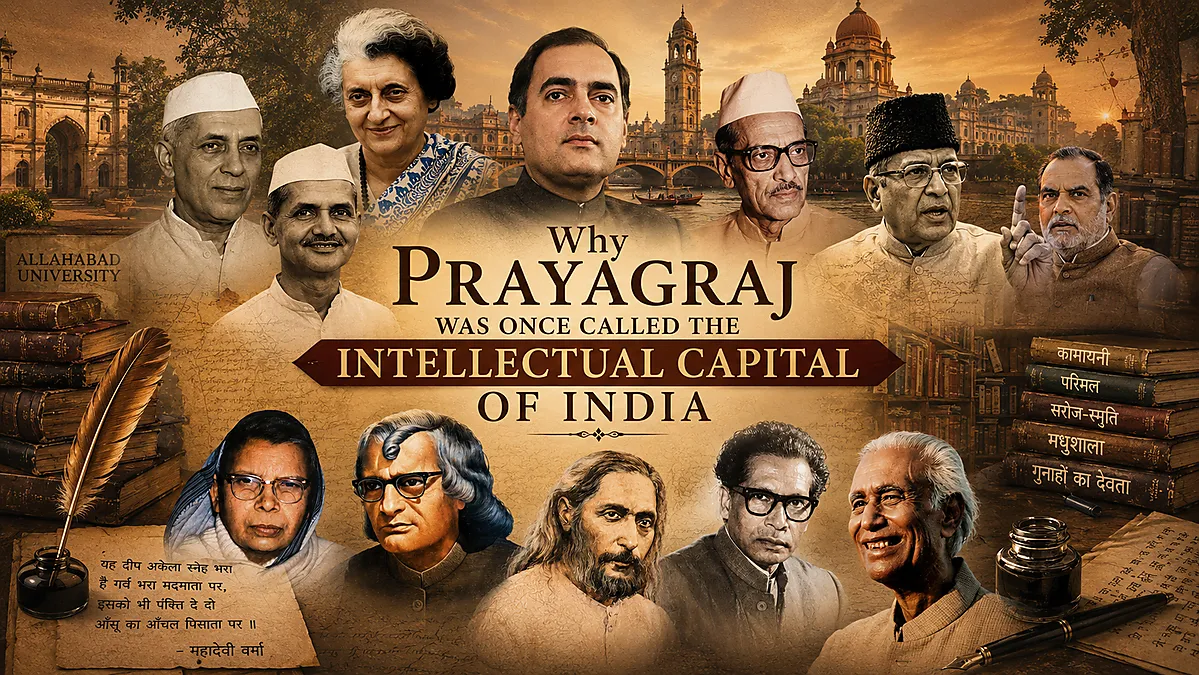
The year is 1955. The afternoon sun filters through the trees lining the campus of Allahabad University, casting dappled shadows on students hurrying to their next lecture. At the Indian Coffee House on Mahatma Gandhi Marg, a group of professors debate the finer points of Marxist theory while poets scribble verses on napkins. Across town, in the corridors of the Allahabad High Court, judges deliberate on cases that will shape the constitutional destiny of a young nation. And at Anand Bhavan, the ancestral home of the Nehru family, the echoes of freedom movement discussions still linger in the air, reminders of a city that once served as the nerve centre of Indian nationalism.
This was Allahabad in its prime—a city where ideas mattered more than wealth, where intellectual debate was the currency of social life, and where the brightest minds of the nation converged to shape the destiny of India. Known by various epithets—the “City of Prime Ministers”, the “Literary Capital of India”, and most famously, the “Intellectual Capital of India”—Allahabad occupied a unique place in the Indian imagination.
But what exactly made this city on the banks of the Ganga and Yamuna the intellectual heartbeat of a nation? How did a provincial town transform into a crucible of ideas that produced poets, prime ministers, jurists, and thinkers who would define modern India?
Table of Contents
🏛️ The Geography of Greatness – Why Prayagraj Became an Intellectual Hub
Prayagraj’s rise as an intellectual centre was rooted in its geography and history. Located at the confluence of the Ganga, Yamuna, and the mythical Saraswati, the city had been a pilgrimage destination for over two millennia. But it was during the colonial period that Allahabad shed its identity as “another dusty north Indian town” and emerged as one of the premier cities of the Raj and the capital of the North-West Provinces.
The Colonial Catalyst
Allahabad’s transformation was, ironically, brought about by colonial rule. The British recognised the city’s strategic location and made it the capital of the North-Western Provinces. This administrative importance attracted lawyers, judges, civil servants, and educators—a literate, articulate class that formed the backbone of an intellectual culture.
The Confluence of Cultures
The city’s location at the confluence of rivers also brought together different cultures. The Ganga-Jamuni tehzeeb—the syncretic culture of the Gangetic plain—allowed Hindi, Urdu, Sanskrit, and Persian traditions to coexist and enrich one another. This cultural synthesis created an environment where writers could draw from multiple traditions and create something new.
A Centre for Knowledge
As Chief Justice of India DY Chandrachud observed in 2024, “Allahabad has remained a centre for knowledge and exchange of ideas for centuries”. The city was home to the University of Allahabad, which remained a beacon of knowledge for 137 years.
🎓 Allahabad University – The Oxford of the East
At the heart of Allahabad’s intellectual reputation was its university. Established on 23 September 1887, the University of Allahabad is the fourth oldest modern university in India. Its origins lie in the Muir Central College, named after Sir William Muir, who suggested the idea of a Central University at Allahabad in 1873.
The “Oxford of the East”
The university earned the nickname the “Oxford of the East” due to its high academic standards, residential character, and beautiful campus. The title was more than just a fancy nickname; the university’s degree was recognised as equivalent to Oxford University’s. The classrooms had high vaults and were lined with textbooks from wall to roof, reflecting the institution’s claim to being the Oxford of the East.
A Crucible of Ideas
Allahabad University was not just a place of learning; it was a crucible of ideas with space for differing ideologies—the centrist Congress, the socialists, the centre-right, the left and the far-left. The university attracted students from far and wide and became a nursery of leadership.
Distinguished Alumni
The university’s alumni list reads like a Who’s Who of modern India. From politics and law to science and literature, the University of Allahabad nurtured visionaries across generations:
- Prime Ministers: Gulzarilal Nanda (acting PM), Vishwanath Pratap Singh, and Chandra Shekhar
- Presidents: Shankar Dayal Sharma
- Chief Justices of India: At least four
- Chief Ministers: ND Tiwari, Madan Lal Khurana, and others
- Literary Giants: Mahadevi Varma, Sumitranandan Pant, Harivansh Rai Bachchan, Dharamvir Bharati, and Firaq Gorakhpuri
- Freedom Fighters: Madan Mohan Malaviya, Purushottam Das Tandon
The university also had honorary members like Jawaharlal Nehru and Netaji Subhash Chandra Bose, who were honorary members of its students’ union. Nepal’s BP Koirala also studied at Allahabad University.
The Intellectual Foundation
Teachers like A N Jha, Sir P C Banerjee, and Tej Bahadur Sapru brought the city on the academic map of the world with their intellectual and academic prowess. The university’s fertile environment nurtured intellectuals who earned it the distinction of being the “Oxford of the East”.
👑 The City of Prime Ministers – A Political Crucible
Allahabad’s intellectual reputation was closely tied to its political influence. The city produced or shaped an astonishing number of national leaders, earning it the nickname the “City of Prime Ministers” .
The Nehru-Gandhi Dynasty
Allahabad was the home of the Nehru family. Jawaharlal Nehru, India’s first Prime Minister, was born in Allahabad in 1889. His daughter, Indira Gandhi, was also born in the city in 1917. Anand Bhavan, the Nehru family home, was the de facto headquarters of the Indian National Congress and the nerve centre of the freedom movement. The mansion was where the most influential vision of India’s modernity—and socialism—was born.
Prime Ministers Connected to Prayagraj
Allahabad’s political legacy is unparalleled:
| Prime Minister | Connection to Allahabad |
| Jawaharlal Nehru | Born in Allahabad (1889); represented Phulpur |
| Lal Bahadur Shastri | MP from Allahabad (1957, 1962); Allahabad Municipality chairperson |
| Indira Gandhi | Born in Allahabad (1917) |
| Rajiv Gandhi | Ancestral home in Allahabad |
| Gulzarilal Nanda | Studied at Allahabad University |
| Vishwanath Pratap Singh | Born in Allahabad (1931); studied at AU; represented Allahabad |
| Chandra Shekhar | Studied at Allahabad University |
In total, Allahabad has produced 7 out of 14 Prime Ministers of India.
A Nursery of Leaders
The city’s political influence extended beyond the Prime Minister’s office. Leaders like ND Tiwari, H N Bahuguna, Arjun Singh, Madan Lal Khurana, Janeshwar Mishra, and Mohan Singh were all associated with Allahabad University. The BJP’s Murli Manohar Joshi was a student and a teacher at AU besides being a three-time MP from Allahabad.
The Allahabad University Students Union (AUSU) was a training ground for future leaders. Aspiring and elected union members would take a pledge in the name of martyr Lal Padmdhar Singh to defend the university’s “glorious” traditions. This political culture created an environment where national leadership was nurtured from a young age.
📚 The Capital of Hindi Literature – Poets Who Shaped a Language
Allahabad was the epicentre of modern Hindi literature. The city produced or nurtured some of the most important figures in Hindi literary history, earning it the title “Literary Capital of India” .
The Chhayavad Movement
The Chhayavad movement (c. 1914-1938) was a literary movement of romanticism in modern Hindi poetry. Its four major poets—Jaishankar Prasad, Mahadevi Varma, Sumitranandan Pant, and Suryakant Tripathi Nirala—were all associated with Prayagraj in significant ways.
- Mahadevi Varma took an MA in Sanskrit from Allahabad University and served as principal and vice-chancellor of Prayag Mahila Vidyapeeth. She received the Jnanpith Award in 1982.
- Sumitranandan Pant pursued his education at Allahabad University and received the Jnanpith Award in 1968.
- Suryakant Tripathi Nirala spent his last years in Allahabad and died there in 1961. A statue of Nirala is located on the Allahabad University campus.
- Harivansh Rai Bachchan was born in Allahabad in 1907, graduated from Allahabad University, and taught in the English Department from 1941 to 1957. His work Madhushala (1935) became one of the most beloved poems in Hindi literature.
- Dharamvir Bharati was born in Allahabad in 1926, did his MA in Hindi from Allahabad University, and taught there. His novel Gunahon Ka Devta (1949) became a classic of Hindi literature.
The Literary Environment
Munshi Premchand, though from Banaras, was an Allahabad University student. The city was also home to legendary litterateurs like Firaq Gorakhpuri, who taught English at Allahabad University. His magnum opus Gul-e-Naghma earned him the Jnanpith Award in 1969.
The Magazine Culture
Allahabad was a powerhouse of literary publishing. The Indian Press published Saraswati, the first Hindi literary magazine that set new standards for prose and poetry. Mahadevi Varma edited the women’s magazine Chand. Dharamvir Bharati was the Chief Editor of Dharmayug.
🗣️ The Urdu Connection – Firaq Gorakhpuri and the Ganga-Jamuni Tehzeeb
Allahabad’s intellectual culture was bilingual. The city was as important for Urdu literature as it was for Hindi.
Firaq Gorakhpuri
Firaq Gorakhpuri (1896-1982), born Raghupati Sahay, was one of the most influential Urdu poets of the 20th century. He joined Allahabad University as a lecturer in English literature. It was at Allahabad University that Firaq wrote most of his Urdu poetry, including his magnum opus Gul-e-Naghma, which earned him the Jnanpith Award (1969) and the Sahitya Akademi Award (1960).
Akbar Allahabadi
Akbar Allahabadi (1846-1921) was one of the greatest satirists in Urdu literature. His name is synonymous with Allahabad. The city’s literary atmosphere shaped his sharp wit and criticism of Western culture.
The Ganga-Jamuni Tehzeeb
The Ganga-Jamuni tehzeeb—the syncretic culture of the Gangetic plain where Hindu and Muslim traditions coexisted—was a defining feature of Allahabad’s intellectual life. This culture allowed for a free exchange of ideas between different communities and nurtured writers who could draw from multiple traditions.
Rekhta and Rekhti
Allahabad also had a rich tradition of Urdu poetry. The city’s literary journals and gatherings attracted poets from across North India.
☕ The Indian Coffee House – The Unofficial Parliament of Thinkers
The Indian Coffee House in Civil Lines was the heart of Allahabad’s intellectual life. It was here that writers, poets, journalists, and intellectuals gathered to debate and discuss.
A Socio-Intellectual Nerve Centre
The Coffee House became the new socio-intellectual nerve centre, replacing the neighbourhood tea shops and creating an entirely different social space. It was a place where the educated middle class gathered for addas—informal meetings that combined intellectual discussion with social interaction.
Famous Gatherings
Harivansh Rai Bachchan, Firaq Gorakhpuri, and other literary giants held court at the Coffee House. Their conversations were as influential as their published works. It was a place where young writers could meet established authors and learn from them.
A Space for Ideas
The Coffee House was not merely a place to eat; it was a space for the exchange of ideas. It represented the intellectual ferment that made Allahabad a literary capital.
📰 The Role of Journalism – From The Leader to Saraswati
Prayagraj was a powerhouse of journalism in the late 19th and early 20th centuries.
The Leader
The Leader (24 October 1909 – 6 September 1967) was one of the most influential English-language newspapers in India during the British Raj. Founded by Madan Mohan Malviya, the paper was published in Allahabad. Under C. Y. Chintamani, a dynamic editor from 1909 to 1934, it acquired a large readership in North India. Indian National Congress leader Motilal Nehru was the first Chairman of the Board of Directors. Many of Mahatma Gandhi’s writings were also published in it.
Saraswati – The First Modern Hindi Magazine
On 4 February 1900, the first issue of Saraswati was published by the Indian Press in Allahabad. It was the first Hindi literary magazine to set new standards for prose and poetry. It provided a national platform for Hindi writers and helped standardize the language.
Other Journals
Journals like Chand (edited by Mahadevi Varma) and Dharmayug (edited by Dharamvir Bharati) further enriched Prayagraj’s literary culture.
⚖️ Allahabad High Court – The Intellectualism of the Law
The Allahabad High Court, established in 1866, was one of the most important judicial institutions in post-independence India. It was the fourth oldest High Court in the country.
A Centre of Legal Scholarship
The court produced distinguished judges like Syed Mahmood, Sir John Edge, Straight, Sulaiman, and Niamatullah, who bequeathed “new tracks” on which future jurists could tread.
Landmark Judgments
The court delivered several landmark judgments that shaped Indian jurisprudence:
- Indira Gandhi vs Raj Narain (1975): A judgment of great courage that shook the nation.
- Triple Talaq Judgment (2016): Declared the practice of triple talaq unconstitutional.
- Chauri Chaura and Meerut Conspiracy Cases: Memorable judgments upholding the concept of liberty.
A Lawyer’s Hub
The Allahabad High Court attracted legal talent from across the country. As CJI Chandrachud noted, lawyers have significantly contributed to nation-building.
🏡 Anand Bhavan and Swaraj Bhavan – The Political Nursery of India
Anand Bhavan, the ancestral home of the Nehru family, was more than a residence. It was a political nursery that nurtured three Prime Ministers: Jawaharlal Nehru, Indira Gandhi, and Rajiv Gandhi.
The “Abode of Bliss”
Anand Bhavan was constructed by Motilal Nehru in the 1930s to serve as the residence of the Nehru family when the original mansion Swaraj Bhavan was transformed into the local headquarters of the Indian National Congress.
A Hub of Freedom Movement
For half a century, Anand Bhavan was the spiritual hub of India’s anti-colonialism and the organisational anchor of the Congress Party. It was the venue of heated discussions, important meetings and rallies. It was here that the most influential vision of India’s modernity—and socialism—was born.
A Museum of History
Today, Anand Bhavan is a historic house museum that attracts visitors from across the country. It remains a symbol of the city’s enduring connection to India’s political history.
📜 The Hindi Sahitya Sammelan – A Literary Institution
The Hindi Sahitya Sammelan was founded in Allahabad in 1910 under the auspices of the Nagari Pracharini Sabha.
A Literary Archive
The Sammelan periodically organised literary functions and awarded literary prizes for writing in Hindi. Its main building in Allahabad houses a substantial library which is a treasure trove for scholars interested in Hindi writing from the early twentieth century onwards.
Promoting Hindi
The Sammelan played a key role in the development of Hindi literature. It organised annual conferences at different venues across the country.
🔥 The Freedom Movement as an Intellectual Revolution
The freedom movement was not merely a political struggle; it was an intellectual revolution. Allahabad was at the centre of this revolution.
A Hub of Nationalist Activities
Allahabad became one of the most important centres of revolutionary activities. Revolutionary leaders paid their visits to Allahabad and held consultations with young men at 56, Chowk Gangadas, the office of the newspaper “Karmyogi” and the residence of Pandit Sunder Lal.
The 1857 Revolt
Allahabad played a significant role in the 1857 revolt. Maulvi Liyaqat Ali, a Muslim intellectual, accelerated the pace of the movement.
Congress Sessions
The fourth and eighth sessions of the Indian National Congress were held in the city in 1888 and 1892, respectively.
The Kumbh Mela as a Platform
After 1858, Allahabad became a hub of political activities, and the Kumbh Mela became a platform for staging nationalist sentiments through religious activities.
🌟 Why Great Minds Were Attracted to Allahabad
Several factors made Allahabad a magnet for great minds:
- Education: Allahabad University was one of the oldest and most prestigious universities in India.
- Politics: The city was a centre of the freedom movement and the home of the Nehru family.
- Literature: The city was the epicentre of modern Hindi and Urdu literature.
- Journalism: The city was a powerhouse of printing and publishing.
- Law: The Allahabad High Court attracted legal talent from across the country.
- Intellectual Freedom: The city’s Ganga-Jamuni tehzeeb created an environment of cultural synthesis.
- The Coffee House Culture: The Indian Coffee House provided a space for intellectual exchange.
📉 The Decline of the “Intellectual Capital”
The decline of Allahabad as an intellectual capital was gradual but discernible.
Political Changes
The capital of Uttar Pradesh shifted to Lucknow in 1949, and the political centre of gravity moved to Delhi. The city’s administrative importance diminished.
Educational Shifts
New educational centres emerged, and Allahabad University struggled to maintain its reputation. The university failed to secure a place in the top-200 institutions in the NIRF rankings.
Migration of Talent
The intellectual energy that colonialism generated has all but disappeared. The bungalows have gone, and so have the last of those who inhabited them.
A Changed Identity
Allahabad was renamed Prayagraj in 2018, a change that some argue has disrupted the city’s historical identity. As one commentator noted, “In its rechristening and in the dissolution of its intellectualism is a story of the dismantling of the emotional architecture of one of my ancestral homes”.
🌱 Is Prayagraj Experiencing an Intellectual Revival?
Despite the decline, there are signs of revival.
Smart City Projects
Prayagraj has been selected as a Smart City under the government’s Smart Cities Mission. Projects include model parks, a robotics park, water sports, and AI-enabled surveillance.
Cultural Institutions
The Allahabad Museum, the Public Library, and the Hindi Sahitya Sammelan continue to preserve the city’s intellectual heritage.
The Literary Park Project
In 2025, the Prayagraj Municipal Corporation announced the construction of a literary park featuring statues of 16 major Hindi litterateurs, an amphitheatre, a library, and a book-selling centre.
A New Generation
A new generation of writers, scholars, and thinkers is emerging from the city, determined to revive its intellectual legacy.
🗺️ Walking Through Intellectual Allahabad – A Heritage Circuit
For those who wish to walk in the footsteps of the city’s intellectuals, Prayagraj offers several must-visit sites:
- Allahabad University: The campus where three Prime Ministers studied and literary giants taught.
- Indian Coffee House: The café where generations of writers gathered.
- Allahabad Public Library: A treasure trove of rare books and manuscripts.
- Anand Bhavan: The ancestral home of the Nehru family.
- Swaraj Bhavan: The original family home, donated to the nation.
- Allahabad High Court: The seat of legal intellectualism.
- Hindi Sahitya Sammelan: The headquarters of the literary institution.
- Chandrashekhar Azad Park: The site of revolutionary activity.
❓ 16. Frequently Asked Questions (FAQs)
1. Why was Allahabad called the intellectual capital of India? Allahabad was called the intellectual capital of India because it was home to a premier university, a thriving literary culture, a powerful judiciary, a vibrant press, and a political environment that nurtured national leaders.
2. Which famous writers lived in Allahabad? Allahabad was home to Mahadevi Varma, Sumitranandan Pant, Suryakant Tripathi Nirala, Harivansh Rai Bachchan, Dharamvir Bharati, Firaq Gorakhpuri, and Akbar Allahabadi, among others.
3. Why is Allahabad University called the Oxford of the East? Allahabad University was called the Oxford of the East due to its high academic standards, residential character, and its degree being recognised as equivalent to Oxford University‘s.
4. Which Prime Ministers were associated with Allahabad? Jawaharlal Nehru, Lal Bahadur Shastri, Indira Gandhi, Rajiv Gandhi, Gulzarilal Nanda, Vishwanath Pratap Singh, and Chandra Shekhar were all connected to Allahabad.
5. What role did the Indian Coffee House play in intellectual life? The Indian Coffee House was the unofficial parliament of Allahabad‘s intellectuals, where writers, poets, journalists, and thinkers gathered for debates and discussions.
6. What is the Ganga-Jamuni tehzeeb? The Ganga-Jamuni tehzeeb is the syncretic culture of the Gangetic plain where Hindu and Muslim traditions coexisted and enriched each other.
7. Which literary movement originated in Allahabad? The Chhayavad movement, a literary movement of romanticism in modern Hindi poetry, was centred in Allahabad.
8. What is the Hindi Sahitya Sammelan? The Hindi Sahitya Sammelan is a literary organisation founded in Allahabad in 1910 that promoted Hindi literature and language.
9. Did Allahabad High Court deliver landmark judgments? Yes, the Allahabad High Court delivered several landmark judgments, including the 1975 verdict against Indira Gandhi and the triple talaq judgment.
10. What is Anand Bhavan? Anand Bhavan is the ancestral home of the Nehru family in Allahabad, now a museum.
11. Why did Allahabad’s intellectual status decline? The shift of the state capital to Lucknow, the rise of new educational centres, and the migration of talent contributed to the decline.
12. Is Prayagraj experiencing an intellectual revival? There are signs of revival, including Smart City projects, the Literary Park project, and the emergence of a new generation of writers and thinkers.
13. Which newspapers were published in Allahabad? The Leader, Saraswati, and other influential newspapers and journals were published in Allahabad.
14. Who were the major poets of the Chhayavad movement? The four major poets of the Chhayavad movement were Jaishankar Prasad, Mahadevi Varma, Sumitranandan Pant, and Suryakant Tripathi Nirala.
15. What is the significance of the Allahabad University Students Union? The AUSU was a training ground for future leaders and played a key role in student politics and the freedom movement.
16. Which Urdu poets were associated with Allahabad? Firaq Gorakhpuri, Akbar Allahabadi, and other Urdu poets were associated with Allahabad.
17. What is the role of the Indian Press in Allahabad? The Indian Press published Saraswati, the first Hindi literary magazine, and other influential publications.
18. How did the freedom movement impact Allahabad’s intellectual culture? The freedom movement turned Allahabad into a hub of nationalist activities and intellectual debate, attracting leaders and thinkers from across India.
19. What is the Literary Park project? The Literary Park project in Prayagraj will feature statues of 16 major Hindi litterateurs, an amphitheatre, a library, and a book-selling centre.
20. Why is Allahabad called the “City of Prime Ministers”? Allahabad is called the “City of Prime Ministers” because seven out of 14 Prime Ministers of India have had strong ties to the city.
💎 Conclusion
Allahabad was once more than a city; it was a university without walls, a parliament of ideas, and one of the greatest intellectual centers in Indian history. Its streets were walked by poets who shaped a language, by leaders who shaped a nation, by jurists who shaped a constitution, and by thinkers who shaped a civilization.
The city’s intellectual culture was not a product of any single institution but of a unique confluence of factors: a premier university, a thriving literary culture, a powerful judiciary, a vibrant press, a syncretic culture, and a political environment that nurtured national leadership. The Indian Coffee House, the Allahabad High Court, Anand Bhavan, and the Hindi Sahitya Sammelan were all part of an ecosystem that produced some of the most important figures in modern Indian history.
While the city’s intellectual status has declined, its legacy endures. The names of Mahadevi Varma, Harivansh Rai Bachchan, Firaq Gorakhpuri, Jawaharlal Nehru, and countless others are forever associated with Allahabad. Their works and their ideas continue to shape India.
Today, as Prayagraj, the city is undergoing a transformation. Smart City projects, the Literary Park, and a new generation of writers and thinkers suggest that the city’s intellectual tradition may yet experience a revival. But whatever the future holds, the city’s place in India’s intellectual history is secure.
“In its rechristening and in the dissolution of its intellectualism is a story of the dismantling of the emotional architecture of one of my ancestral homes”. Yet, that architecture, though diminished, has not been entirely dismantled. It lives on in the books, the buildings, and the memories of a city that was once the intellectual capital of India.
🚶 Walk in the footsteps of poets, prime ministers, and thinkers with our “Prayagraj Intellectual Heritage Walk” – a guided journey covering Allahabad University, the Indian Coffee House, the Hindi Sahitya Sammelan, and other landmarks associated with the city’s intellectual legends.
📞 Phone/WhatsApp: +91-9555313526
📧 Email: contact@prayagtourism.com
🌐 Website: PrayagTourism.com
This article is part of a series exploring the cultural and intellectual heritage of Prayagraj.
Prayag Tourism
May your journey be peaceful, safe, and intellectually enriching – and may the words of Prayagraj’s poets and thinkers inspire you long after you leave.