
The wide, tree‑lined avenues of Civil Lines offer a quiet refuge from Prayagraj‘s vibrant chaos. Here, the city speaks a different language: the language of sandstone, spires, and imperial ambition. An afternoon walk along Sarojini Naidu Marg is a journey into the heart of the British Raj, where Victorian Gothic cathedrals, Scottish baronial libraries, and Indo‑Saracenic university halls stand as monuments to a vanished era.
This is the story of how a sacred pilgrimage city was transformed into the administrative, judicial, and intellectual capital of northern India. It is a story of ambition, architecture, education, and resistance—a story that continues to shape the city‘s identity today.
A Walk Through Colonial Prayagraj
Imagine standing in Civil Lines in the early 1900s. Horse‑drawn carriages move through broad avenues shaded by large trees. Students carrying books walk toward Muir Central College, their footsteps echoing on the stone pathways. Lawyers in black coats and white wigs enter the High Court, their voices low as they discuss the finer points of law. The bells of All Saints Cathedral ring in the distance, their sound carrying across the quiet streets. The scent of old books drifts from the Public Library, where scholars pore over rare manuscripts.
This was Allahabad—not merely a city, but the nerve centre of British power in northern India. It was the capital of the North‑Western Provinces, the seat of the High Court, the home of one of India‘s oldest universities, and the intellectual heart of the nation. For nearly a century, Allahabad stood at the crossroads of empire, education, and nationalism. And its legacy is still visible today, in the sandstone and spires that define its skyline.
From Mughal Frontier to British Stronghold
The British connection with Prayagraj began long before the empire reached its zenith. In 1801, the East India Company took direct control of the city from the Nawab of Awadh. But it was the cataclysmic events of 1857 that permanently transformed Prayagraj‘s destiny.
The city‘s strategic location at the confluence of the Ganga and Yamuna made it an ideal administrative centre. After the Rebellion of 1857, the British were determined to consolidate their control over the Gangetic plain. Allahabad was made the capital of the newly‑formed North‑Western Provinces, and a massive building program began.
The old cantonments were transformed, and a completely new suburb was designed from scratch. This was Civil Lines – a planned colonial town intended to be the permanent administrative and residential heart of British power in the region. Legal courts were moved from Agra to Allahabad in stages between 1858 and 1866, and in 1869 the High Court was formally established in the city.
By the end of the 19th century, Allahabad had become the political, judicial, and educational capital of northern India – a city that British officials proudly called the “Oxford of the East.”
The Treaty of Allahabad (1765) – The Turning Point
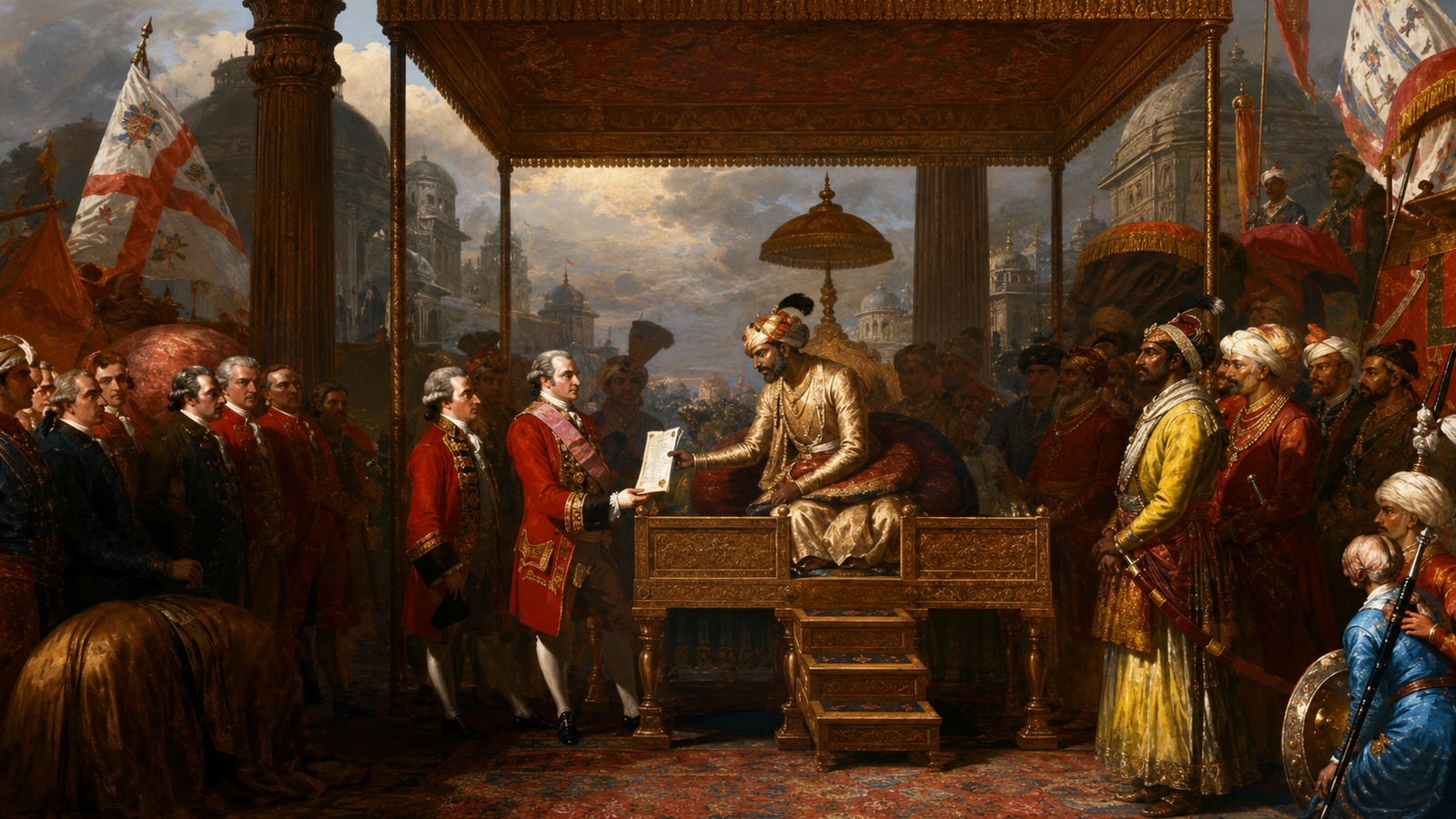
The Treaty of Allahabad, signed on 16 August 1765, marks the formal beginning of British political involvement in India. It was signed between the Mughal Emperor Shah Alam II and Robert Clive of the East India Company, in the aftermath of the Battle of Buxar (22 October 1764).
Based on the terms of the agreement, Shah Alam granted the East India Company Diwani rights – the right to collect taxes on behalf of the Emperor from the eastern provinces of Bengal, Bihar, and Orissa. In return, the Company paid an annual tribute of twenty‑six lakh rupees while securing for Shah Alam the districts of Kora and Allahabad.
The treaty marked the political and constitutional involvement of the British in India. It was a turning point that set the stage for the eventual establishment of British rule over the entire subcontinent. Allahabad, at the heart of this agreement, would become a symbol of British power and ambition.
The Revolt of 1857 in Allahabad
The Indian Rebellion of 1857 was a watershed moment in the history of Allahabad. The city became one of the epicentres of the uprising, and the British response was swift and brutal.
On 6 June 1857, Indian soldiers in Allahabad refused to obey their British officers and rose in rebellion. The British army, under the command of Colonel James Neill, attacked Allahabad on 11 June and took control of the boat bridge at Daraganj.
Colonel Neill‘s reprisals were merciless. He executed thousands in Allahabad, flogged mutineers or suspected mutineers, and made them lick blood from the slaughterhouse floor before hanging them. The village in the centre of the city was reduced to ruins, and later Alfred Park (now Chandrashekhar Azad Park) was built over it. Over 600 freedom fighters were killed.
The rebellion was crushed, but it left an indelible mark on the city and its people. The British, determined to prevent another uprising, rebuilt Allahabad as a symbol of their power and control.
The Proclamation of 1858 – The Beginning of the Raj
On 1 November 1858, a historic event took place in Allahabad that would change the course of Indian history. Earl Canning, the Governor‑General of India, read out the declaration of Queen Victoria‘s Proclamation at a park on the banks of the Yamuna River.
The proclamation resulted in the complete transfer of control over India from the East India Company to the government of Britain. It marked the formal beginning of the British Raj – the period of direct Crown rule over India.
The park where this historic proclamation was read was later named Minto Park after the Earl of Minto, who installed a proclamation pillar there in 1908 to commemorate the 50th anniversary of the event. The marble pillar was originally topped with busts of Queen Victoria and Edward VII. After independence, the busts were replaced by the Ashokan Lion Capital, and the park was renamed Madan Mohan Malaviya Park.
Today, Minto Park stands as a reminder of the transition from Company rule to the British Raj – and of the city‘s central role in that transition.
How the British Rebuilt Allahabad
In the aftermath of the 1857 rebellion, the British undertook one of the most ambitious urban planning projects in colonial India. They built a brand‑new suburb, Civil Lines, designed to be a model of European urban planning and a symbol of British power.
Civil Lines – The White Town
Civil Lines was built in 1858, under the supervision of architect Cuthbert Bensley Thornhill. It was the largest town‑planning project carried out in India before the establishment of New Delhi. Its wide, straight avenues were laid out on a grid, lined with large bungalows set in compounds of lush greenery.
During the early period of its development, Civil Lines was referred to as the “White Town” of the city, as it was predominantly inhabited by the British, with very few Indians allowed. It was deliberately separated from the crowded “native” city, creating a distinct European quarter with its own clubs, churches, markets, and administrative buildings.
Administrative Infrastructure
The British also built a grandiose law court (the Allahabad High Court), a railway station, and several churches that are marvellous examples of Gothic architecture. The city‘s infrastructure was designed to support the administrative and military needs of the empire.
The Cantonment
Allahabad also became home to one of the largest British cantonments in northern India. The cantonment provided military security and housed the troops needed to maintain British control over the region.
The Architectural Legacy of Colonial Prayagraj
The British left behind a rich architectural legacy in Prayagraj. The city‘s colonial buildings are among the finest examples of Victorian and Edwardian architecture in India.
All Saints Cathedral (Patthar Girjaghar)
The most magnificent colonial building in Prayagraj is All Saints Cathedral, known locally as Patthar Girjaghar – the “Stone Church”. Designed by the celebrated British architect Sir William Emerson, who also designed the Victoria Memorial in Kolkata, it was modelled after 13th‑century Gothic churches and is among the finest Gothic Revival buildings in Asia.
The foundation stone was laid by Lady Muir on 1 April 1871. The cathedral was consecrated in 1887 and completed four years later. The building is constructed of cream sandstone with red sandstone dressings, creating a striking polychromatic effect. Its tower rises 103 feet (31 m), and the total length of the building is 240 feet (73 m).
The cathedral continues to be an active place of worship, belonging to the Church of North India, with regular services held on Sundays.
Allahabad Public Library (Thornhill Mayne Memorial)
A short walk from the cathedral brings you to the Allahabad Public Library, also known as the Thornhill Mayne Memorial. Established in 1864, it is the biggest library in the state of Uttar Pradesh. The present building was completed in 1870 at a cost of approximately ₹94,222, designed by the architect Richard Roskell Bayne.
The building is a magnificent example of Scottish Baronial Revival architecture, a style rare in India. It features sharp pillars and turrets of granite and sandstone, structural polychromy, lofty towers, and arcaded cloisters.
Before being converted into a library in 1879, the building served as the house of the legislative assembly when Allahabad was the capital of the United Provinces. Today, it houses approximately 125,000 books, 40 magazines, and 28 newspapers, as well as 21 Arabic manuscripts.
Muir Central College and Allahabad University
The university‘s origins lie in Muir Central College, founded in 1872 by Sir William Muir. The buildings (1872–1886) were designed by Sir William Emerson, combining Gothic, Indian, Egyptian, and Persian elements.
The college was affiliated with the University of Calcutta. In 1921, as a result of the Allahabad University Act, it was merged into the University of Allahabad.
Allahabad High Court
The High Court was established in 1866 under Letters Patent of 17 March 1866. Its seat was shifted from Agra to Allahabad in 1869. The present court building, an impressive structure in the Indo‑Gothic style with striking red sandstone exteriors, was built between 1914 and 1916.
Mayo Memorial Hall
The Mayo Memorial Hall, designed by Richard Roskell Bayne and completed in 1879, was built as a memorial to the assassinated Viceroy, Lord Mayo. It was meant for public meetings, balls, and receptions. The hall has a 180‑foot‑high tower.
Allahabad University – The Oxford of the East
Allahabad University, established on 23 September 1887, is the fourth oldest modern university in India. Its origins lie in the Muir Central College, named after Sir William Muir, who suggested the idea of a Central University at Allahabad.
The university earned the nickname the “Oxford of the East” due to its high academic standards, residential character, and beautiful campus. Its Department of English was famous across the country.
The university‘s alumni include some of the most important figures in Indian history, including Prime Ministers, Presidents, Chief Justices, poets, and scientists. It was a crucible of ideas, where students and professors debated literature, politics, and philosophy.
The Intellectual Capital of India
Allahabad was not merely an administrative centre; it was the intellectual capital of India. The city was home to a thriving literary culture that produced some of the most important figures in Hindi and Urdu literature.
The Giants of Hindi Literature
Mahadevi Varma took an MA in Sanskrit from Allahabad University and became the residential principal (later, vice‑chancellor) of Prayag Mahila Vidyapeeth. She is generally considered the greatest woman poet to have written in Hindi in the twentieth century.
Harivansh Rai Bachchan was born in Allahabad in 1907 and studied at Allahabad University. From 1941 to 1957, he taught in the English Department at Allahabad University. His most famous work, Madhushala (1935), became an instant classic.
Suryakant Tripathi ‘Nirala‘ spent his last years in Allahabad, and a statue of him is located on the Allahabad University campus.
Sumitranandan Pant pursued his education at Allahabad University.
Dharamvir Bharati was born in Allahabad in 1926 and did his MA in Hindi from Allahabad University.
The Urdu Tradition
Firaq Gorakhpuri joined Allahabad University as a lecturer in English literature. It was there that he wrote most of his Urdu poetry, including his magnum opus Gul‑e‑Naghma, which earned him the Jnanpith Award. The English Department of Allahabad University was famous across the country at that time.
Akbar Allahabadi, one of the greatest satirists in Urdu literature, was born in Allahabad and served as a sessions judge in Allahabad High Court.
The Coffee House Culture
The Indian Coffee House in Civil Lines was the unofficial parliament of Allahabad‘s intellectuals. Writers, poets, journalists, and thinkers gathered there for debates and discussions. It was a space where ideas were exchanged freely, and where the future of India was often debated over a cup of filter coffee.
Allahabad and the Freedom Movement
Allahabad was not just a city of empire; it was also a crucible of resistance. The city played a central role in the Indian freedom movement, producing leaders who would shape the destiny of the nation.
Anand Bhavan and Swaraj Bhavan
Anand Bhavan (now Swaraj Bhavan) was the ancestral home of the Nehru family. Built in the 1930s by Motilal Nehru, it served as the residence of the Nehru family when Swaraj Bhavan became the headquarters of the Indian National Congress.
The house was a hub of political activity, hosting meetings of the Congress Working Committee and visits from Mahatma Gandhi and other national leaders.
Chandrashekhar Azad and Alfred Park
On 27 February 1931, the revolutionary Chandrashekhar Azad made his final stand in Alfred Park (now Chandrashekhar Azad Park). Cornered by British police, he fought valiantly and, when only one bullet remained, shot himself to avoid capture. His martyrdom transformed Alfred Park into a shrine of Indian freedom.
Other Freedom Fighters
Allahabad was also home to Kamala Nehru, Vijayalakshmi Pandit, Purushottam Das Tandon, and many other freedom fighters who contributed to the struggle for independence.
Colonial Life in Allahabad
Life in colonial Allahabad was a blend of British and Indian cultures. The Civil Lines society was dominated by British officers, who lived in spacious bungalows and participated in club dinners, cricket matches, and evening band performances in the park.
The Indian elite – lawyers, judges, journalists, and university professors – also made their homes in Civil Lines, giving the area a social and cultural dynamism that went beyond purely British circles.
The city was also a centre of education and letters. The University of Allahabad attracted students from across India. Literary figures such as Rudyard Kipling (who wrote The Man Who Would Be King in the veranda of a villa in the city) and poets like Harivansh Rai Bachchan and Firaq Gorakhpuri were part of Allahabad‘s intellectual ferment.
Walking Tour of Colonial Prayagraj
For those who wish to experience the colonial heritage of Prayagraj, a walking tour is the best way to explore. The route covers the city‘s most magnificent colonial buildings, revealing the stories of the architects, administrators, and nationalists who shaped the city.
Start: All Saints Cathedral (Sarojini Naidu Marg) End: Allahabad High Court (MG Marg / Sarojini Naidu Marg junction) Distance: Approximately 3‑4 km Duration: 2‑3 hours for a quick tour; 4‑5 hours for a detailed exploration
The Route:
- All Saints Cathedral (Patthar Girjaghar): The Gothic Revival masterpiece designed by Sir William Emerson.
- Allahabad Public Library (Thornhill Mayne Memorial): The Scottish Baronial Revival library.
- Muir Central College (Allahabad University): The Indo‑Saracenic heart of the “Oxford of the East.”
- Chandrashekhar Azad Park (Alfred Park): The site of Azad‘s martyrdom, featuring the Victoria Memorial Canopy.
- Minto Park (Madan Mohan Malaviya Park): The site of Queen Victoria‘s Proclamation of 1858.
- Allahabad High Court: The Indo‑Gothic landmark of colonial judiciary.
What Remains of Colonial Prayagraj Today?
Many of the colonial buildings of Prayagraj survive today, though their functions have changed. All Saints Cathedral remains an active church. The Allahabad Public Library is still a working public library. Allahabad University continues to be a premier institution of higher learning.
However, the city‘s colonial heritage faces challenges. Some buildings have fallen into disrepair, and others have been demolished or altered. Efforts are underway to preserve and restore these buildings, but more needs to be done.
The renaming of Allahabad to Prayagraj in 2018 has also changed the city‘s identity. While the name change reflects the city‘s ancient roots, it also marks a break from the colonial past.
Life Lessons & Historical Reflections
The colonial history of Prayagraj offers several lessons for the present:
- Urban Planning: Civil Lines is a testament to the power of thoughtful urban planning. Its grid layout, wide roads, and green spaces remain a model for modern cities.
- Education: Allahabad University‘s reputation as the “Oxford of the East” reminds us of the importance of education and intellectual freedom.
- Rule of Law: The Allahabad High Court‘s role in upholding the law, even during the Emergency, demonstrates the importance of an independent judiciary.
- National Awakening: The city‘s role in the freedom movement shows how ideas of justice and liberty can take root even in the heart of empire.
- Preservation of Heritage: The colonial buildings of Prayagraj are not just relics of the past; they are a living heritage that deserves to be preserved for future generations.
Frequently Asked Questions (FAQs)
1. Why was Allahabad important to the British? Allahabad was strategically located at the confluence of the Ganga and Yamuna, making it an ideal administrative and military centre. It became the capital of the North‑Western Provinces and the seat of the High Court.
2. What happened in Allahabad during the Revolt of 1857? Allahabad was a centre of the rebellion. The British, under Colonel Neill, crushed the revolt mercilessly, killing thousands of freedom fighters.
3. What is the Treaty of Allahabad? The Treaty of Allahabad (1765) was signed between the Mughal Emperor Shah Alam II and Robert Clive. It granted the East India Company Diwani rights over Bengal, Bihar, and Orissa.
4. Why is Allahabad University called the Oxford of the East? Allahabad University earned the nickname due to its high academic standards, residential character, and beautiful campus.
5. Which colonial buildings can still be visited? All Saints Cathedral, the Allahabad Public Library, Muir Central College, Chandrashekhar Azad Park, Minto Park, and the Allahabad High Court can all be visited.
6. What is the significance of Minto Park? Minto Park is the site where, on 1 November 1858, Queen Victoria‘s Proclamation was read, formally transferring control of India from the East India Company to the British Crown.
7. Who designed All Saints Cathedral? The cathedral was designed by Sir William Emerson, who also designed the Victoria Memorial in Kolkata.
8. What is the Allahabad Public Library famous for? The library is famous for its unique Scottish Baronial Revival architecture, its rare collection of 125,000 books, and its history as the former legislative assembly of the United Provinces.
9. Who was Chandrashekhar Azad? Chandrashekhar Azad was a revolutionary who made his final stand in Alfred Park (now Chandrashekhar Azad Park) on 27 February 1931, shooting himself to avoid capture.
10. Which literary figures were associated with Allahabad? Allahabad was home to Mahadevi Varma, Harivansh Rai Bachchan, Suryakant Tripathi Nirala, Sumitranandan Pant, Dharamvir Bharati, Firaq Gorakhpuri, and Akbar Allahabadi.
Conclusion: The Enduring Legacy of Colonial Prayagraj
Colonial Prayagraj was not merely a city built by the British. It became the stage upon which modern India‘s legal, educational, intellectual, and political identity was forged.
The British built Civil Lines, the High Court, and the university. But they also created the conditions for the rise of Indian nationalism. The same classrooms that educated colonial administrators also produced freedom fighters. The same courtrooms that dispensed colonial justice also upheld the rule of law. The same libraries that housed British knowledge also nurtured Indian intellectual traditions.
Today, the colonial buildings of Prayagraj stand as reminders of a complex past—a past of empire and resistance, of education and nationalism, of ambition and aspiration. They are not merely relics of a bygone era; they are a living heritage that continues to shape the city‘s identity.
As you walk through Civil Lines, past the Gothic spires and the red sandstone halls, you are walking through history. You are following in the footsteps of poets, judges, revolutionaries, and ordinary citizens who, together, shaped the destiny of a nation.
A walk through Colonial Prayagraj is a journey through a fascinating chapter of India‘s history – where grand cathedrals, elegant libraries, prestigious universities, and tree‑lined avenues continue to tell the story of a city that once stood at the heart of the British Raj.
🚶 Walk in the footsteps of history with our “Colonial Prayagraj Heritage Walk” – a guided journey covering All Saints Cathedral, the Allahabad Public Library, Allahabad University, and other landmarks associated with the city‘s colonial past.
📞 Phone/WhatsApp: +91-9555313526
📧 Email: contact@prayagtourism.com
🌐 Website: PrayagTourism.com
This article is part of a series exploring the heritage and tourism of Prayagraj.
Prayag Tourism
May your journey be peaceful, safe, and historically enriching – and may the stones of the Raj whisper their stories to you.