
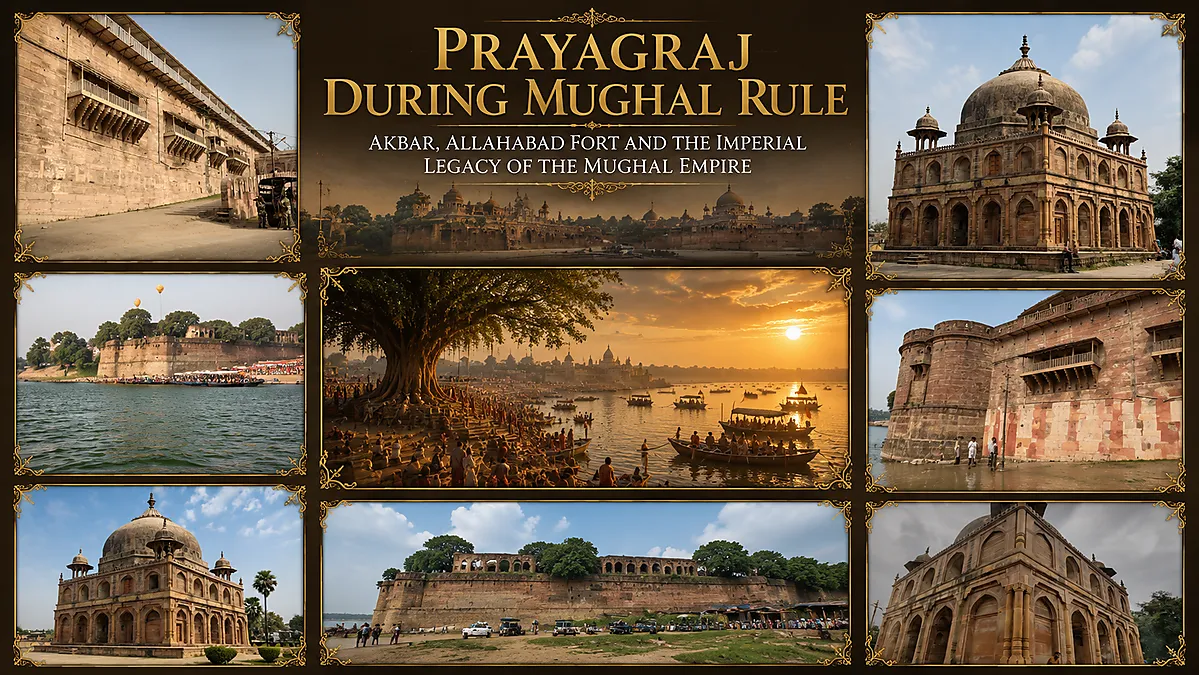
The story of Prayagraj During Mughal Rule as a major imperial city begins with one of the most consequential decisions in Indian history. In 1583, the Mughal emperor Akbar stood at the sacred confluence of the Ganga and Yamuna and envisioned a fortress that would forever change the destiny of this ancient land. His choice of this strategic site was not accidental. The rivers that had drawn pilgrims for millennia were now being harnessed for imperial ambition.
What did Akbar see that others had missed? Why did he choose this holy ground to build one of his largest forts? And how did the Mughal presence transform Prayagraj from a sacred pilgrimage centre into a political and military powerhouse?
Join me as we walk through the stone corridors of the Allahabad Fort, explore the tragic gardens of Khusro Bagh, and uncover the story of how the Mughals shaped the city we now call Prayagraj.
Table of Contents
🏛️ Prayag Before the Mughals: A Sacred Crossroads
Long before the Mughals arrived, Prayag was already one of the holiest places in India. Known as Prayaga in ancient texts, it was celebrated as the site of the Triveni Sangam – the confluence of the Ganga, Yamuna and the mythical Sarasvati. The Manusmriti describes the region between Prayag and Vinasana as the sacred heartland of Aryavarta.
By the time of the Mauryan emperor Ashoka in the 3rd century BCE, Prayag‘s importance was well established. The polished sandstone pillar that stands today inside the Allahabad Fort originally bore Ashoka‘s edicts, making it one of the earliest surviving inscriptions of the subcontinent. Later, the Gupta emperor Samudragupta added his famous Prayag Prashasti to the same pillar, turning it into a record of his conquests.
The Delhi Sultanate period saw Prayag included in the iqtā‘ (fief) of Kara‑Manikpur, serving as an administrative centre. But it was the Mughals who would transform the sacred town into a true imperial capital.
⚔️ The Mughal Struggle for the Doab
The Mughals did not inherit Prayag peacefully. Babur, the founder of the empire, recognised that control of the Ganga‑Yamuna Doab was essential for dominating northern India. The Afghans had entrenched themselves in the region, and Babur fought continuous battles to assert Mughal supremacy. He could not, however, bring lasting peace.
After Humayun‘s death, the region once again became a haven for rebellious Afghan chiefs and self‑proclaimed independent rulers. Many Mughal officers stationed in the area had their own vested interests and did not hesitate to revolt against the centre. It was only under Akbar that the Mughals finally consolidated their control over the Doab and established a firm administrative presence.
👑 Akbar‘s Vision: Why He Chose Prayag
Emperor Akbar (reigned 1556–1605) was not content merely to conquer; he sought to build. His decision to construct a major fort at Prayag was driven by a combination of strategic, economic and symbolic considerations.
Strategic Geography
Prayag‘s location at the confluence of two great rivers gave it unparalleled military advantages. The Ganga and Yamuna served as natural moats, and the fort’s position allowed the Mughals to control riverine trade routes and military movements across the Doab. The city‘s central location made it an ideal base for projecting power in all directions.
Economic Importance
The Triveni Sangam attracted tens of thousands of pilgrims annually, creating a steady flow of revenue from pilgrims, merchants and traders. Akbar, however, had abolished the pilgrim tax in 1563, so his motivation went beyond mere taxation. He saw the potential for turning Prayag into a thriving commercial hub that would connect the rich agricultural hinterland with the larger Mughal network.
Symbolic Power
Prayag‘s ancient sanctity gave the Mughal presence a powerful symbolic dimension. By building a great fort at the very confluence, Akbar was placing his imperial imprint on one of Hinduism‘s most sacred spaces. The Akbarnama records his intention:
“For a long time [Akbar‘s] desire was to found a great city in the town of Piyag [Prayag], where the rivers Ganges and Jamna join, and which is regarded by the people of India with much reverence, and which is a place of pilgrimage for the ascetics of that country, and to build a choice fort there.”
— Abu‘l‑Fazl, Akbarnama
This passage reveals Akbar‘s deep understanding of Indian religious sensibilities and his willingness to engage with them on their own terms.
🏰 The Foundation of Ilahabad (1583)
In 1583, Akbar ordered the construction of a new fortress city at the confluence. He named it Ilahabas – “blessed by Allah” – a name that later evolved into Allahabad (“City of God”), which remained the city‘s official name until 2018, when it was reverted to Prayagraj.
The fort was strategically positioned on the high banks of the Yamuna, near its confluence with the Ganga. It was the largest fort Akbar ever built, an ambitious project that required enormous resources and labour.
According to the contemporary English traveller William Finch, the construction of the Allahabad Fort employed between 5,000 and 20,000 workers over a period of forty years. The scale of the project testifies to Akbar‘s determination to make Allahabad a permanent Mughal stronghold.
The fort was deliberately constructed in such a way that it enclosed the sacred Akshayavat (indestructible banyan tree) and the ancient pilgrimage routes. This policy of incorporating existing sacred sites within imperial architecture was characteristic of Akbar‘s inclusive approach to governance.
🛡️ Allahabad Fort: The Largest Fortress of Akbar‘s Reign
The Allahabad Fort was an architectural and military marvel. Covering an area of approximately 173 acres, with a circumference of about 2.5 km, it was the largest fort built by Akbar, surpassing even the Agra Fort and Fatehpur Sikri in size.
Defensive Features
The fort was built with high walls and three massive gateways, with the additional protection of the rivers along which it is set. The Yamuna served as a natural moat, and the fort‘s position at the confluence gave it a near‑impregnable defensive position. The ramparts were equipped with bastions, watchtowers and secret tunnels that allowed for communication and escape during sieges.
Architectural Layout
The fort had four gates, each with distinct characteristics:
- East gate (Delhi Gate): The main entrance to the fort, facing toward the imperial capital.
- West gate: The oldest gate, featuring a mosque with a courtyard and fountain.
- South gate: The smallest gate, with a simple archway and a staircase leading to the river.
- North gate: The newest gate, constructed by the British in 1856, used by British officers.
Palace and Administrative Buildings
Inside the fort, Akbar built a magnificent palace complex. Thomas Daniell‘s 1795 watercolour depicts a square palace pavilion, probably part of the women‘s quarters, subdivided into nine rectangular apartments and enclosed by a deep veranda. The building was typical of Akbar‘s experimentation with indigenous architectural styles, akin to the palaces at Fatehpur Sikri built a decade earlier. Art historian Ebba Koch has noted that it was “one of the finest of Indian halls, comparable to that built by Man Singh in the Amber Palace in the 1620s”.
The Chalis Satun (Hall of Forty Pillars)
A notable structure within the fort was the Chalis Satun – the Hall of Forty Pillars. This was a pleasure pavilion with no walls, cooled by water circulating in channels in the building and fountains playing around. Such pavilions represented the pinnacle of Mughal summer architecture, designed for comfort as much as for grandeur.
Later Modifications
Subsequent rulers added their own touches to the fort. Jahangir enhanced it with a zenana palace and added a tomb for his wife. Aurangzeb demolished parts of the temple and palace, replacing them with a mosque and a Rang Mahal. The Marathas restored structures and added the Moti Mahal and Diwan‑i‑Khas. The East India Company, after the Battle of Buxar in 1764, seized the fort and used it as a military base. Finally, the Indian Army took control after Independence in 1947, and it remains an active military installation to this day.
🌿 Inside the Fort: The Patalpuri Temple, Akshayavat and the Ashokan Pillar
One of the most fascinating aspects of the Allahabad Fort is that it encloses sacred sites that have been venerated for millennia.
The Akshayavat (Indestructible Banyan Tree)
Within the fort stands the Akshayavat, an ancient banyan tree believed to be indestructible. According to Hindu tradition, this tree survived the great cosmic flood (pralaya), making it a symbol of eternity and liberation (moksha). The tree was already a pilgrimage site long before the Mughals arrived. Akbar chose to enclose it within his fort, either out of reverence or to control access to the powerful pilgrimage site.
The Patalpuri Temple
Located underground near the Akshayavat, the Patalpuri Temple is a subterranean shrine of great antiquity. According to tradition, Lord Rama, Sita and Lakshmana visited this temple during their exile. The temple‘s name – Patalpuri – means “city of the underworld,” referring to its underground location. Within the temple complex lies the Saraswati Koop, a well whose water is believed to be from the mythical Sarasvati River.
The Ashokan Pillar
The most historically significant artifact within the fort is the Ashokan Pillar. Standing 35 feet (10.7 m) high, this single shaft of polished sandstone originally carried the edicts of Emperor Ashoka from the 3rd century BCE. Later, the Gupta emperor Samudragupta added his Prayag Prashasti to the same pillar. Even later, the Mughal emperor Jahangir added his own Persian inscription, commemorating his accession to the throne.
Some scholars believe Akbar moved the pillar from its original location at Kaushambi and installed it within his fort. However, this theory is disputed by other scholars who point to the absence of confirmatory evidence and pre‑Mughal inscriptions indicating that the pillar was already present at its current location. Regardless, the pillar‘s presence within the fort symbolises the continuity of Indian power from the Mauryas to the Guptas to the Mughals.
👑 Jahangir‘s Counter‑Court in Allahabad (1599–1604)
The Allahabad Fort played a dramatic role in the succession struggle that marked the end of Akbar‘s reign. Prince Salim, the future Emperor Jahangir, chafed under his father‘s long rule. In 1599, when Akbar left the capital to campaign in the Deccan, Salim saw his opportunity. He declared himself emperor, established a parallel imperial court in the Allahabad Fort, and began issuing decrees and minting coins in his own name.
From 1599 to 1604, Allahabad served as the headquarters of the rebellious prince. Salim‘s counter‑court attracted disaffected nobles and officials who were tired of waiting for Akbar‘s long reign to end. The prince‘s behaviour was increasingly erratic, marked by excessive drinking and opium consumption, but his defiance shook the Mughal empire to its core.
Ultimately, Akbar‘s diplomacy – and Salim‘s own realisation that he could not sustain his rebellion – brought about a reconciliation. But the episode established Allahabad as a major political centre in its own right, a city capable of hosting an imperial court.
After Salim’s accession as Emperor Jahangir in 1605, he continued to patronise Allahabad. He added a zenana palace and a tomb for Jodhabai inside the fort. He also left his own Persian inscription on the Ashokan pillar, which begins: “In the reign of the exalted Emperor Jahangir…”
💔 Prince Khusro and the Tragedy of Mughal Succession
The most tragic chapter in Prayagraj‘s Mughal history involves Prince Khusro Mirza, the eldest son of Jahangir and heir apparent. Khusro was born in 1587 to Shah Begum (born Manbhawati Bai), a Rajput princess and the sister of Raja Man Singh, Akbar‘s trusted general.
Akbar, who was never fully satisfied with his son Salim‘s carefree and rebellious behaviour, favoured his grandson Khusro as a successor. This favouritism planted seeds of resentment that would later bear bitter fruit.
In April 1606, just six months after Jahangir‘s accession, Khusro fled Agra on the pretext of visiting Akbar‘s tomb. He quickly assembled an army of 12,000 men, funded by 100,000 rupees seized from an imperial treasure caravan, and besieged the governor of the Punjab at Lahore.
The rebellion failed. Jahangir‘s forces crushed Khusro‘s army, and the prince was captured and brought before his father in chains. The punishment was brutal: Khusro was blinded – a common Mughal punishment designed to disqualify a prince from the throne.
Khusro was first imprisoned within the garden that would later bear his name – the Khusro Bagh in Allahabad. He remained there, a broken and blinded prince, until his death in 1622. According to some accounts, he was killed on the orders of his younger brother Khurram, the future Emperor Shah Jahan, who saw the blinded prince as a continuing threat.
The Mother‘s Suicide
Shah Begum, caught between her husband the emperor and her beloved son, could not bear the discord. Distressed beyond measure, she committed suicide in 1605 by swallowing a fatal dose of opium. Her tomb was the first of the great mausoleums built in what would become Khusro Bagh.
🌹 Khusro Bagh: A Garden of Royal Sorrow
Khusro Bagh is a large, walled garden located in Khuldabad, close to the Prayagraj Junction railway station. Spread over 40 acres and shaped like a quadrangle, it is one of the finest surviving examples of a Mughal charbagh (four‑garden) layout.
The garden contains four sandstone mausoleums, each an exquisite example of Mughal architecture:
1. Shah Begum‘s Tomb (built 1606)
Shah Begum‘s tomb was designed by Aqa Reza, Jahangir‘s principal court artist. It is a three‑storey terrace plinth without a central dome – a unique design that invites comparisons with the architecture of Fatehpur Sikri. A large chhatri surmounts the topmost terrace.
The tomb‘s decoration is the work of Mir Abdullah Mushkin Qalam, Jahangir‘s most celebrated calligrapher. The arabesque inscriptions carved into the red sandstone are masterpieces of Islamic calligraphy.
2. Nithar Begum‘s Tomb (built 1624–1625)
Sultan‑un‑Nissa Begum (popularly known as Nithar Begum) was Khusro‘s sister and Jahangir‘s daughter. She built this tomb on her own instructions, but remarkably, it is empty – she was never buried here, and the exact location of her grave remains unknown.
Architecturally, this is the most elaborate of the three tombs. It stands on a raised platform, adorned with panels depicting the scalloped arch motif. The ceilings of the rooms within the plinth are painted with stars in concentric circles, and the central room‘s walls feature floral decorations depicting Persian cypresses, wine vessels, flowers and plants.
3. Khusrau Mirza‘s Tomb (completed 1622)
Khusrau‘s tomb is the last of the three, probably commissioned by his sister Nithar Begum. It is a single‑storey structure built of red sandstone around a rubble core. The walls feature excellently carved stone jali (fretwork) screens, through which light filters, casting beautiful patterns on the floor inside.
According to local tradition, a smaller grave next to the tomb is that of Khusrau‘s favourite mare, buried alongside her master – a moving testament to the bond between the prince and his faithful animal.
4. Bibi Tamolon‘s Tomb
A fourth tomb lies at the western end of the complex. Much less is known about Bibi Tamolon – she may have been a woman associated with the royal household, perhaps a nurse or a servant.
The Garden as a Living Monument
Today, Khusro Bagh is protected by the Archaeological Survey of India and also serves as a beloved public park. Locals come for morning and evening walks, children play on the lawns, and heritage travellers admire the exquisite Mughal architecture.
The garden was originally a true charbagh, with water channels and fountains (now dried up) and fruit trees such as mango and guava. Its peaceful atmosphere belies the tragic history that unfolded within its walls.
🏛️ Mughal Administration and the Subah of Allahabad
Under Akbar, the Mughal Empire was divided into twelve subahs (provinces). Allahabad was one of these twelve, along with Agra, Awadh, Bengal, Delhi, Kabul, Lahore, Malwa, Multan and others.
The Ain‑i‑Akbari, the great administrative manual composed by Abul‑Fazl, contains detailed information about the Subah of Allahabad. It records the length of the province from Sinjhauli in the Jaunpur district to the southern hills as 160 krosh (approximately 300 km), and its breadth from Chausa ferry to Chatampur as 122 krosh (approximately 220 km).
The Subah of Allahabad included districts such as Fatehpur, Kara, Chunar and portions of the Bundelkhand region. It was a prosperous agricultural region, and the Ain‑i‑Akbari gives the rates of government demand per bigha for various crops.
The subah was governed by a Subahdar (governor) appointed by the emperor, supported by a Diwan (revenue officer), a Faujdar (military commander) and a Qazi (judge). The system ensured that the Mughal court maintained tight control over even distant provinces.
Allahabad‘s importance as a provincial capital continued throughout the Mughal period. When the empire began to fragment in the 18th century, the city remained a strategic prize contested by rival powers – the Nawabs of Awadh, the Marathas and eventually the British.
💰 Economy and Daily Life in Mughal Allahabad
The Mughal presence transformed the economic landscape of Prayagraj During Mughal Rule. The construction of the fort and the establishment of a provincial administration brought a steady influx of officials, soldiers, merchants and artisans.
Trade and Commerce
Allahabad‘s position at the confluence made it a natural hub for riverine trade. Grain, textiles, indigo and other goods were transported along the Ganga and Yamuna, connecting the city to the great markets of Agra, Delhi, Patna and Bengal. The pilgrim traffic to the Triveni Sangam also fuelled a thriving religious economy, with priests, boatmen, food sellers and shopkeepers serving the thousands who came for the holy dip.
Crafts and Industries
The Mughal court‘s presence attracted skilled artisans. Metalworkers, stone carvers, calligraphers, weavers and painters settled in the city, producing goods for the nobility and for export. The Allahabad Fort itself was a showcase of the finest craftsmanship available.
The Pilgrim Economy
Despite Akbar‘s abolition of the pilgrim tax in 1563, the sheer volume of pilgrims visiting the Triveni Sangam generated substantial economic activity. The Magh Mela and the Kumbh Mela (every 12 years) brought tens of thousands of pilgrims, creating a seasonal boom that supported many local families.
🏛️ The Mughal Legacy in Prayagraj‘s Architecture
The Mughal period left a lasting architectural imprint on Prayagraj. While the city has many layers of history – ancient, medieval, colonial and modern – the Mughal contribution remains among its most visible and beautiful.
Surviving Mughal Structures
- Allahabad Fort: The largest fort built by Akbar, still standing at the confluence, though much of it is restricted military territory.
- Khusro Bagh: The best‑preserved Mughal garden complex in Prayagraj, with four exquisite sandstone tombs.
- Ashokan Pillar Inscriptions: The pillar itself may be Mauryan, but the inscriptions added by Jahangir are Mughal.
- Gates and Bridges: Remnants of Mughal period gates and bridges can still be seen scattered through the old city.
Architectural Fusion
The Mughals did not impose their architecture on a blank slate. They incorporated existing structures – the Patalpuri Temple, the Akshayavat, the ancient pilgrimage routes – into their imperial landscape. This fusion of Islamic and indigenous elements created a distinctive architectural character that sets Prayagraj apart from purely Mughal cities like Agra or Fatehpur Sikri.
The Garden as a Metaphor
Khusro Bagh, with its charbagh layout, water channels (now dry) and fruit trees, represents the Mughal ideal of paradise on earth – a walled garden where the soul could find peace. That this paradise was built over the bodies of a tortured family adds a layer of tragic poignancy that makes the site deeply moving.
⚔️ The Decline of Mughal Power and the Rise of New Rulers
By the 18th century, the Mughal Empire was in terminal decline. The Subah of Allahabad, like other provinces, became a battleground for regional powers.
The Nawabs of Awadh extended their influence over the region, but their control was contested by the resurgent Marathas. The Marathas captured the Allahabad Fort in 1750 and restored some of the temples and palaces that Aurangzeb had demolished. They also added the Moti Mahal and Diwan‑i‑Khas to the fort.
In 1764, the Battle of Buxar decisively shifted the balance of power. The East India Company defeated the combined forces of the Nawab of Awadh, the Nawab of Bengal and the Mughal emperor Shah Alam II. By the Treaty of Allahabad (1765), the Mughal emperor granted the Company the Diwani rights (revenue collection) over Bengal, Bihar and Orissa, while the Emperor was granted the districts of Allahabad and Kora.
The arrangement was short‑lived. The Company soon took direct control of the city, and in 1801, Allahabad was formally ceded to the British. The Mughal era in Prayagraj had come to an end.
🗺️ Exploring Mughal Heritage in Prayagraj Today
For heritage travellers, Prayagraj offers a rich collection of Mughal-era monuments. Here is a practical guide:
Allahabad Fort
- Location: On the banks of the Yamuna, near the Triveni Sangam.
- Access: The fort is an active military installation under the Indian Army. Limited areas are open to the public, and special permission is required. Contact local authorities in advance.
- What to see: The Ashokan Pillar (with inscriptions), the Patalpuri Temple, the Akshayavat tree and the Saraswati Koop.
- Best time: During the Kumbh Mela and Magh Mela, the fort is more accessible to pilgrims.
Khusro Bagh
- Location: Khuldabad, near Prayagraj Junction railway station.
- Timings: Open daily, sunrise to sunset.
- Entry fee: Free.
- What to see: The four sandstone tombs – Shah Begum‘s, Nithar Begum‘s, Khusrau Mirza‘s and Bibi Tamolon‘s. The garden‘s lawns and pathways.
- Best time: Early morning (7:00 AM – 9:00 AM) for soft light and fewer crowds; late afternoon (4:00 PM – 5:30 PM) for warm golden tones on the sandstone.
Suggested Heritage Walk
For a self‑guided tour of Prayagraj‘s Mughal heritage:
- Start at Khusro Bagh (1 hour). Explore the tombs and the garden.
- Visit the Allahabad Fort (1 – 1.5 hours, permission permitting). See the Ashokan Pillar and Patalpuri Temple.
- Walk along the Yamuna Riverfront towards the Triveni Sangam (30 minutes). See the ghats and the confluence.
- Conclude at the Allahabad Museum (1 – 2 hours). The museum houses a collection of Mughal artifacts, including coins, manuscripts and architectural fragments. The museum is closed on Mondays.
Visitor Tips
- Permissions: For the Allahabad Fort, you must obtain permission from the Army authorities. Carry a valid ID.
- Photography: Permitted in Khusro Bagh and the museum. Photography in the fort is restricted in certain areas.
- Respect: Khusro Bagh is a protected monument and a place of burial. Maintain silence and respect.
- Best season: October–March (winter) for pleasant walking weather.
📋 Frequently Asked Questions (FAQs)
1. Why did Akbar build the Allahabad Fort?
Akbar built the Allahabad Fort in 1583 to strengthen Mughal control over the strategic Ganga‑Yamuna Doab, to house a provincial administration and to symbolically place his imperial imprint on a sacred Hindu pilgrimage site. It was the largest fort he ever built.
2. What was Prayagraj called during the Mughal period?
Akbar named the new fortress city Ilahabas (“blessed by Allah”), which later evolved into Allahabad (“City of God”). The city retained the name Allahabad until 2018, when it was officially renamed Prayagraj.
3. Who was Prince Khusro?
Prince Khusro Mirza was the eldest son of Emperor Jahangir and the heir apparent to the Mughal throne. He rebelled against his father in 1606, was defeated, blinded and imprisoned in Allahabad, and later killed on the orders of his brother Khurram (the future Emperor Shah Jahan).
4. What is Khusro Bagh famous for?
Khusro Bagh is a 40‑acre walled Mughal garden containing four sandstone tombs: of Shah Begum (Jahangir‘s first wife), Khusrau Mirza (their rebellious son), Nithar Begum (their daughter) and Bibi Tamolon. It is one of the finest surviving examples of Mughal garden architecture in North India.
5. What is inside the Allahabad Fort?
Inside the fort are the ancient Patalpuri Temple (an underground shrine), the Akshayavat (the “indestructible” banyan tree), the Saraswati Koop (a sacred well) and the Ashokan Pillar with inscriptions from Ashoka, Samudragupta and Jahangir.
6. Why is the Ashokan Pillar inside the Allahabad Fort?
The pillar is a single shaft of polished sandstone dating to the 3rd century BCE. It originally stood near Kaushambi. Some scholars believe Akbar moved it to his fort; others argue it was already there. The pillar bears inscriptions from Ashoka, Samudragupta and Jahangir.
7. Did Jahangir have a court in Allahabad?
Yes. From 1599 to 1604, while still Prince Salim, Jahangir rebelled against his father Akbar and established a parallel imperial court in the Allahabad Fort, issuing decrees and minting coins in his own name.
8. What is the Akshayavat?
The Akshayavat (“indestructible banyan tree”) is a sacred tree inside the Allahabad Fort. According to Hindu tradition, it survived the great cosmic flood (pralaya). The tree is believed to grant moksha (liberation) to those who worship it.
9. What is Patalpuri Temple?
Patalpuri Temple is an ancient underground temple located within the Allahabad Fort. It is a subterranean shrine of great antiquity, traditionally associated with Lord Rama, Sita and Lakshmana. The temple also contains the Saraswati Koop, a sacred well.
10. How long did the Mughals rule Prayagraj?
The Mughals controlled Prayagraj from Akbar‘s founding of the fort in 1583 until the British took formal control in 1801, a period of approximately 218 years.
11. What happened to Allahabad Fort after the Mughals?
The fort was captured by the Marathas (c. 1750), then by the East India Company after the Battle of Buxar (1764). The British used it as a military base and prison. After Independence in 1947, the Indian Army took control and it remains an active military installation.
12. What other Mughal monuments are there in Prayagraj?
The most prominent is Khusro Bagh. Additionally, the Ashokan Pillar (with Jahangir‘s inscription) and the gates of the Allahabad Fort are Mughal. The Allahabad Museum houses Mughal coins, manuscripts and architectural fragments.
13. What is the Chalis Satun?
The Chalis Satun (“Hall of Forty Pillars”) was a pleasure pavilion inside the Allahabad Fort, designed with no walls and cooled by water channels. It represented the pinnacle of Mughal summer architecture.
14. How can I visit the Allahabad Fort?
The fort is an active military installation. Limited areas are open to the public, but special permission is required. It is easiest to visit during the Kumbh Mela or Magh Mela, when the Army sometimes relaxes access for pilgrims.
15. When is the best time to visit Khusro Bagh?
The best time is early morning (7:00 AM – 9:00 AM) for soft light and fewer crowds, or late afternoon (4:00 PM – 5:30 PM) for warm golden light on the sandstone. The garden is open daily from sunrise to sunset.
16. What is the architecture of Shah Begum‘s tomb?
Shah Begum‘s tomb is a three‑storey terrace plinth without a central dome, topped with a large chhatri. It is designed by Aqa Reza, Jahangir‘s principal court artist, and its calligraphy is by Mir Abdullah Mushkin Qalam, Jahangir‘s greatest calligrapher.
17. Why is Nithar Begum‘s tomb empty?
Nithar Begum built the tomb on her own instructions between 1624 and 1625, but she was never buried there. The exact location of her grave remains unknown.
18. What is the significance of the Kumbh Mela in Mughal Prayagraj?
The Kumbh Mela continued to be held at the Triveni Sangam throughout the Mughal period, attracting massive crowds. Akbar‘s fort was built overlooking the very site of the Kumbh, and Mughal administrators managed the pilgrim traffic.
19. What happened to the Mughal buildings after the British took over?
The British used the Allahabad Fort as a military base, converting some buildings into barracks and even an arsenal. The Daniells noted that the beautiful palace pavilions were desecrated: “It was turned into an arsenal; a brick wall was run up between its outer colonnades… and its curious pavilions and other accompaniments removed.”
20. Why should I visit Khusro Bagh?
Khusro Bagh is one of the best‑preserved Mughal garden complexes in North India, offering a unique combination of exquisite architecture, tragic history and peaceful greenery. It is a hidden gem that many tourists overlook, making it an ideal spot for heritage travellers seeking solitude.
🔗 Related Articles
To deepen your understanding of Prayagraj‘s rich history, explore these related articles:
- Allahabad Fort: History, Architecture & Complete Visitor Guide – An in‑depth look at Akbar‘s greatest fort and its many secrets.
- Khusro Bagh: The Mughal Garden of Royal Tragedy, Architecture & Heritage – A detailed guide to the beautiful garden complex and its four sandstone tombs.
- The Ashokan Pillar and Prayag Prashasti: The Stone That Preserved an Empire – The story of the pillar inside the fort and the inscriptions it carries.
- Exploring Prayagraj‘s Historical Layers: From Ancient Empires to Colonial Legacy – A broader journey through the city‘s 5,000‑year history.
- The Gupta Dynasty and Prayagraj: How Samudragupta Turned Prayag into an Imperial Capital – Discover how the Guptas used Prayag as a power base before the Mughals.
- Top Places to Visit in Prayagraj: The Complete Travel Guide – A comprehensive overview of the city‘s attractions, including Mughal sites.
- Allahabad Museum: Complete Visitor Guide – See Mughal artifacts, coins and manuscripts on display.
- Chandrashekhar Azad Park and Minto Park: Heritage Spaces in Civil Lines – Explore other historic gardens and public spaces in the city.
🏁 Conclusion: The Mughal Chapter in Prayagraj‘s Eternal Story
The Mughal period transformed Prayagraj. What had been an ancient pilgrimage centre – sacred but politically insignificant – became a provincial capital, a military stronghold, a centre of imperial politics and a stage for one of the Mughal dynasty‘s most tragic family dramas.
The walls of the Allahabad Fort still stand, rising above the confluence where Akbar chose to build his grandest fortress. The gardens of Khusro Bagh still bloom, sheltering the tombs of a mother, a son and a daughter whose lives were torn apart by the brutal logic of Mughal succession. The Ashokan Pillar, with its layered inscriptions from Maurya, Gupta and Mughal emperors, symbolises the continuity of power through the ages.
When you visit Prayagraj, you are not merely seeing a holy city. You are walking through centuries of history, where the sacred and the political, the ancient and the medieval, the spiritual and the tragic, all intertwine.
The Mughal rulers recognised what earlier empires had long understood – that Prayag was more than a sacred city. It was a strategic crossroads of rivers, commerce, politics and culture. Through the walls of Allahabad Fort and the gardens of Khusro Bagh, the Mughal legacy continues to shape the identity of modern Prayagraj.
This article is part of a series on the historical heritage of Prayagraj. For more information on planning your heritage tour, please contact us.
Prayag Tourism
📞 Phone/WhatsApp: +91-9555313526
📧 Email: contact@prayagtourism.com
🌐 Website: PrayagTourism.com
May your journey be peaceful, safe and historically enriching.
This response is AI-generated and for reference purposes only.