
Table of Contents
1. The Human Experience: Dawn at Shringverpur
The first light of dawn touches the Ganga at Shringverpur, turning the gentle currents into streams of liquid gold. The air is cool, carrying the scent of wet earth, marigolds, and the distant smoke from temple incense. A small wooden boat rests on the riverbank, swaying softly with the current.
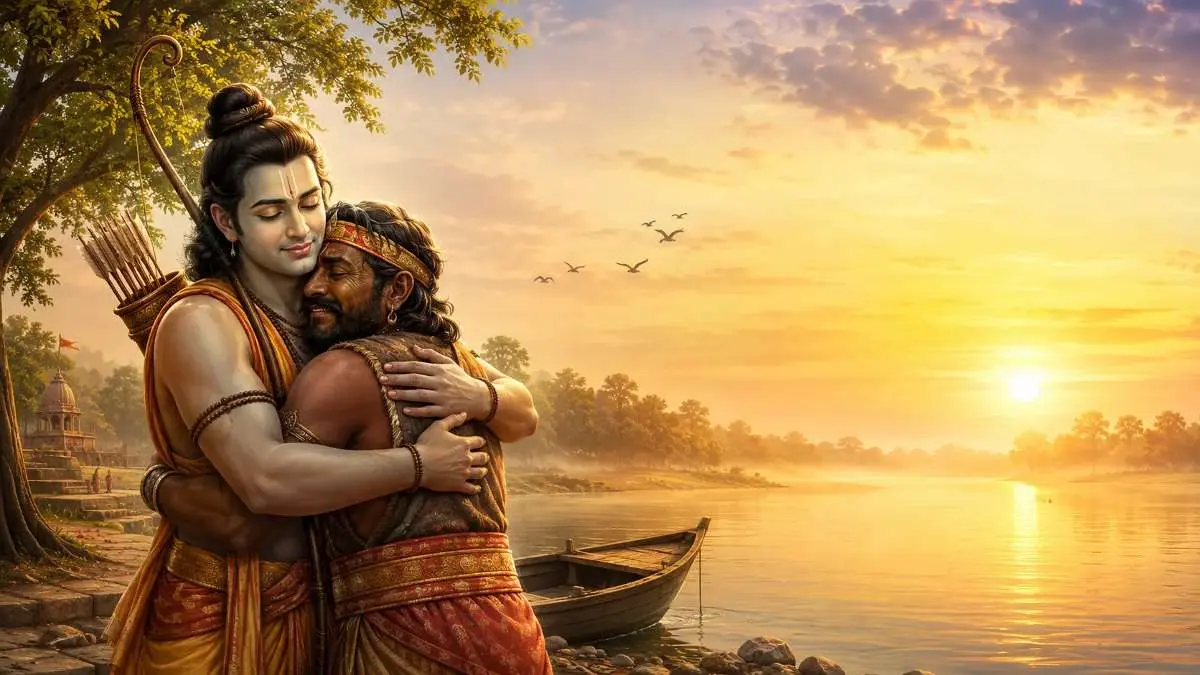
Standing on the banks of this ancient river, you close your eyes and imagine. You see three figures—a prince, his brother, and his beloved wife—stepping onto this very shore, weary from their long journey from Ayodhya. You see a king of the Nishada people, his eyes filled with tears of joy, rushing forward to embrace them as if they were his own family.
You hear the splash of oars, the chant of “Jai Shri Ram,” and the laughter of pilgrims who have come to walk the same path, to stand on the same soil, to feel the same devotion that filled Guha’s heart thousands of years ago.
What kind of friendship makes a king embrace a tribal chief as his brother? What kind of devotion makes a boatman refuse to carry the Lord until he has washed his feet and drunk the sacred water?
The story of Nishadraj Guha and Lord Rama is not merely an episode from the Ramayana. It is a living lesson in humility, loyalty, devotion, and the profound truth that spiritual greatness transcends all social divisions.
2. Quick Facts: Shringverpur at a Glance
| Attribute | Details |
| Name | Shringverpur (also spelled Shringaverpur, Śṛṅgiverapura, Singraur) |
| Location | Prayagraj District, Uttar Pradesh, India |
| Coordinates | 25°35′14″N 81°38′30″E |
| Distance from Prayagraj | Approximately 33–45 km (varying sources) |
| River | Ganga (Ganges) |
| Mythological Significance | Capital of the Kingdom of Nishadraj Guha; the place where Lord Rama crossed the Ganga during his exile |
| Key Figure | Nishadraj Guha (King of the Nishadas, friend and ally of Lord Rama) |
| Scriptural References | Valmiki Ramayana (Ayodhya Kanda, Sargas 50–52, 85–86); Ramcharitmanas (Ayodhya Kand) |
| Current Status | Declared a pilgrimage site in December 2024; part of the Ram Van Gaman Path |
| Key Attractions | Nishadraj Tourist Park, 51-foot statue of Rama embracing Nishadraj, Ram Ghat, ancient ruins |
| Best Time to Visit | October to March (winter months); during Kumbh Mela for grand celebrations |
3. Who Was Nishadraj Guha? – The King of the Fishermen
Nishadraj Guha (Sanskrit: गुह) was the king of Śṛṅgiverapura, the nation of the Nishadas, as described in the Hindu epic Ramayana. The Nishadas were a community traditionally associated with hunting, fishing, and living in harmony with the forests and rivers. Guha was not merely a boatman or a local chieftain; he was a powerful ruler who commanded a substantial army and a fleet of boats on the sacred Ganga.
In the Valmiki Ramayana, he is described as Rama’s “ātma-sama” mitra—a very dear friend, like his own soul. This is a profound expression of friendship, one that places Guha at the very heart of Rama’s journey into exile.
When Guha saw the royal chariot arriving, he immediately realized that it was the prince of Ayodhya. The Ramayana tells us that he was overjoyed and rushed to welcome Rama, not as a ruler to a subordinate, but as an old friend and a devoted ally.
One of the most beautiful aspects of Guha’s character is that he stood guard through the night while Rama rested under a tree. Though Rama refused all royal comforts—food, fine beds, and entertainment—he did not refuse Guha’s love. And Guha, in turn, proved his love not by what he could give, but by his willingness to protect his friend with his own life.
Later, when Bharata arrived in search of Rama, Guha, uncertain of Bharata’s intentions, prepared his army and his boats, ready to defend Rama against any threat. When he learned that Bharata came with love and sorrow, not with hostility, Guha welcomed him as well.
Guha’s story is a powerful reminder that true friendship and devotion are not measured by wealth or status, but by the depth of one’s commitment and the purity of one’s heart.
4. Shringverpur – The Ancient Capital of the Nishadas
Shringverpur is situated on the banks of the sacred Ganga, approximately 33 to 45 kilometers from the city of Prayagraj. It finds mention in the Hindu epic Ramayana as the capital of the royal kingdom of Nishadraj, the king of fishermen.
According to legend, the village was named after Shringi Rishi, a sage mentioned in ancient texts. Excavations at Shringverpur have unearthed a temple dedicated to this sage, lending archaeological weight to the local tradition.
The city is located in the Soraon tehsil of Prayagraj district, about three kilometers off the Allahabad-Lucknow highway towards the Ganga. Its official name is Sigraur, but it is widely known as Shringverpur due to its Ramayana association.
The strategic location of Shringverpur on the Ganga made it a significant center of trade and defense in ancient times. The ruins of the fort of King Guha can still be seen here. The site is also connected to the story of King Dasharatha, who, according to local folklore, visited Shringverpur on the advice of Sage Vashishtha and performed the Putrakameshti Yajna here, a ritual that led to the birth of Lord Rama and his three brothers.
5. Lord Rama’s Journey to Shringverpur – The First Night of Exile
The story begins in Ayodhya. After being exiled by his father King Dasharatha for fourteen years, Lord Rama, accompanied by his wife Sita and his brother Lakshmana, departed from the royal city.
According to the Valmiki Ramayana (Ayodhya Kanda, Sargas 50–52), the trio traveled in a chariot driven by Sumantra, the royal charioteer. As they crossed the borders of Kosala and entered the forest regions, the landscape began to change. Grand roads gave way to wild paths. The sounds of the city were replaced by the calls of peacocks and the rustling of trees.
By the time they reached the banks of the Ganga, night had fallen. It was at this point that they arrived at Shringverpur, the capital of Nishadraj Guha.
The Ramayana states that Guha, upon hearing of Rama’s arrival from his scouts, came out of the city with great enthusiasm to receive him. He offered Rama and his companions a variety of foods, drinks, and the comforts of the royal palace.
In one of the most touching verses of the epic, Guha then turns to Lakshmana and offers to guard the trio through the night.
Verse 1: Guha’s Welcome to Rama
Source: Valmiki Ramayana, Ayodhya Kanda, Sarga 51, Verses 8–9
Devanagari:
यदर्थमागमस्तेऽत्र राजपुत्र महाबल।
तत्सर्वं कर्तुमिच्छामि प्रियाख्यानपरोऽस्म्यहम्॥
धन्योऽस्म्यनुगृहीतोऽस्मि यस्य मे वेश्मनि स्थितम्।
रामं विदितकल्याणं सीतया सह लक्ष्मणः॥
IAST Transliteration:
yadarthamāgamaste’tra rājaputra mahābala |
tatsarvaṃ kartumicchāmi priyākhyānaparo’smyaham ||
dhanyo’smyanugṛhīto’smi yasya me veśmani sthitam |
rāmaṃ viditakalyāṇaṃ sītayā saha lakṣmaṇaḥ ||
Exact Source Citation: Valmiki Ramayana, Ayodhya Kanda (2.51.8–9)
Word-by-Word Meaning:
| Devanagari | IAST | Meaning |
| यदर्थम् | yadartham | for which purpose |
| आगमः | āgamaḥ | the arrival |
| ते | te | of you |
| अत्र | atra | here |
| राजपुत्र | rājaputra | O prince |
| महाबल | mahābala | O greatly powerful one |
| तत्सर्वम् | tatsarvam | all of that |
| कर्तुम् | kartum | to do |
| इच्छामि | icchāmi | I wish |
| प्रियाख्यानपरः | priyākhyānaparaḥ | devoted to your service |
| अस्मि | asmi | I am |
| अहम् | aham | I |
| धन्यः | dhanyaḥ | blessed |
| अस्मि | asmi | I am |
| अनुगृहीतः | anugṛhītaḥ | favoured, blessed |
| अस्मि | asmi | I am |
| यस्य | yasya | of whom |
| मे | me | my |
| वेश्मनि | veśmani | in the house |
| स्थितम् | sthitam | is staying |
| रामम् | rāmam | Rama |
| विदितकल्याणम् | viditakalyāṇam | known to be supremely auspicious |
| सीतया | sītayā | with Sita |
| सह | saha | together with |
| लक्ष्मणः | lakṣmaṇaḥ | Lakshmana |
Translation:
“O greatly powerful prince! I wish to carry out that purpose for which you have come here. I am devoted to your service. I am blessed, I am favoured, for in my house, Rama, known to be supremely auspicious, is staying together with Sita and Lakshmana.”
Traditional Interpretation:
This verse captures the profound humility and devotion of Nishadraj Guha. He does not treat Rama as a prince who has lost his kingdom; he treats him as a divine guest whose presence sanctifies everything it touches. The word dhanyaḥ (blessed) is repeated, emphasizing that Guha considers himself the most fortunate person in the world for hosting Rama, Sita, and Lakshmana. This reflects the ancient Indian tradition of atithi devo bhava—the guest is God.
Pilgrimage Lesson:
The pilgrim visiting Shringverpur is invited to adopt Guha’s attitude of humility. The sacred site is not merely a place to see; it is a place to serve, to welcome the divine into one’s heart, and to feel blessed by the very act of pilgrimage.
6. The Meeting of Rama and Nishadraj – A Brotherhood Beyond Status
When Rama, Sita, and Lakshmana arrived at Shringverpur, Guha did not treat them as ordinary guests. He rushed to welcome them, offered them the finest food and drink, and begged them to accept his hospitality.
However, Rama, who had resolved to live the life of an ascetic during his exile, declined all luxuries. He stated that he would live on the forest’s natural produce, wear bark garments, and sleep on the bare ground.
Undeterred, Guha shifted his approach. He offered to have the palace gardens prepared for Rama’s stay, ensuring that the environment resembled the forest so that Rama would not feel any discomfort.
When Rama declined even this, Guha’s devotion took on a new form. He decided to stand guard through the night to protect Rama, Sita, and Lakshmana from any dangers that the forest might present.
The Ramayana tells us that Guha, despite being a king himself, gathered his men and placed them on high alert. He took a blade of kusa grass and a bow and sat at the foot of the tree under which Rama was sleeping, vowing not to sleep himself.
Verse 2: Guha’s Proposal to Lakshmana
Source: Valmiki Ramayana, Ayodhya Kanda, Sarga 51, Verses 10–15
Devanagari:
पर्याप्तं शयनं चात्र शय्यायोग्यमिदं तव।
निवसैकपदे राम प्रतीक्षन् प्रतिवासरम्॥
IAST Transliteration:
paryāptaṃ śayanaṃ cātra śayyāyogyamidaṃ tava |
nivasaikapade rāma pratīkṣan prativāsaram ||
Exact Source Citation: Valmiki Ramayana, Ayodhya Kanda (2.51.10–15; condensed)
Word-by-Word Meaning:
| Devanagari | IAST | Meaning |
| पर्याप्तम् | paryāptam | sufficient, adequate |
| शयनम् | śayanam | bed, resting place |
| च | ca | and |
| अत्र | atra | here |
| शय्यायोग्यम् | śayyāyogyam | suitable for resting |
| इदम् | idam | this |
| तव | tava | for you |
| निवस | nivasa | stay, reside |
| एकपदे | ekapade | in one place, for a time |
| राम | rāma | O Rama |
| प्रतीक्षन् | pratīkṣan | waiting, expecting |
| प्रतिवासरम् | prativāsaram | each day |
Translation:
“Here is a sufficient bed suitable for your rest. O Rama, please stay here for some time, waiting each day (for your exile period to begin).”
Traditional Interpretation:
Guha’s words reveal his concern for Rama’s well-being. He does not want the prince to rush into the wilderness unprepared. He offers his palace as a sanctuary, a place of transition from the comforts of Ayodhya to the challenges of the forest. His hospitality is not mere formality; it is heartfelt.
Pilgrimage Lesson:
The pilgrim is reminded that true devotion is not passive but active. Guha did not simply offer prayers; he offered action, protection, and service. Pilgrimage to Shringverpur invites one to embody this active devotion.
Verse 3: Guha’s Description of the Forest Perils
Source: Valmiki Ramayana, Ayodhya Kanda, Sarga 51, Verses 18–23
Devanagari:
गजाश्च मत्ता विकृताः शार्दूला महिषास्तथा।
व्याघ्राश्च निहनिष्यन्ति भूतानि च निशाचराः॥
IAST Transliteration:
gajāśca mattā vikṛtāḥ śārdūlā mahiṣāstathā |
vyāghrāśca nihaniṣyanti bhūtāni ca niśācarāḥ ||
Exact Source Citation: Valmiki Ramayana, Ayodhya Kanda (2.51.18–23; condensed)
Word-by-Word Meaning:
| Devanagari | IAST | Meaning |
| गजाः | gajāḥ | elephants |
| च | ca | and |
| मत्ता | mattāḥ | maddened, in rut |
| विकृताः | vikṛtāḥ | fierce, deformed |
| शार्दूलाः | śārdūlāḥ | tigers, leopards |
| महिषाः | mahiṣāḥ | buffaloes |
| तथा | tathā | as well as |
| व्याघ्राः | vyāghrāḥ | tigers |
| च | ca | and |
| निहनिष्यन्ति | nihaniṣyanti | will kill |
| भूतानि | bhūtāni | spirits, demons |
| च | ca | and |
| निशाचराः | niśācarāḥ | night-wanderers (evil spirits) |
Translation:
“Maddened and fierce elephants, tigers, buffaloes, and other wild animals will (attack). Spirits and night-wandering demons will also kill.”
Traditional Interpretation:
Guha’s warning is not merely descriptive; it is an expression of his protective concern. He outlines the dangers of the forest not to frighten Rama but to emphasize his willingness to guard him. Guha is essentially saying, “I know these dangers; let me protect you from them.”
Pilgrimage Lesson:
The pilgrim is reminded that spiritual journeys are not without challenges. The forest of exile represents the difficulties of life. Guha’s presence reminds us that devotion can provide protection and support on even the most arduous path.
7. Guha’s All-Night Vigil – Loyalty Without Sleep
Rama, however, refused all offers of comfort and protection. He told Lakshmana and Guha that he would rest under a tree, as was befitting an ascetic. And then, in a moment of sublime humility, he asked them also to rest.
But Guha would not rest. Instead, he stood guard through the night, an act of loyalty that has resonated through centuries.
The Valmiki Ramayana tells us that Guha spoke to Lakshmana, assuring him that he and his men would remain awake to protect them. He said, “I will keep standing here, holding my bow and arrow. The roars and sounds of wild animals and evil spirits cannot frighten me. I will keep all the Nishadas armed and stationed at all four directions.”
He then declared that he would not sleep at all through the night. His words capture the essence of his devotion: “This is my dharma. My life is nothing compared to your safety. Please sleep peacefully, knowing that I am watching.”
This all-night vigil is one of the most beautiful expressions of loyalty and devotion in the entire Ramayana. Guha, a king in his own right, placed himself as a sentinel for his beloved friend.
8. The Kevat Tradition in the Ramcharitmanas – A Devotion Beyond Measure
In the Ramayana tradition, the story of the boatman (Kevat) who helped Rama cross the Ganga is best known from Tulsidas’s Ramcharitmanas. It is a devotional masterpiece, elevating the simple act of ferrying across the river into a sublime metaphor for the soul’s journey to God.
In the Ramcharitmanas, when Rama, Sita, and Lakshmana arrive at the Ganga, they call for a boatman. The boatman, however, is hesitant. He has heard the stories: he knows that the dust of Rama’s feet turned the stone Ahalya back into a woman. He fears that if Rama steps into his humble wooden boat, his boat, too, might transform into a woman.
He refuses to take Rama across unless he is allowed to first wash Rama’s feet and drink the sacred water. His reasoning is both humble and profound: he wants the Lord’s blessings before he carries him.
Verse 4: The Ferryman’s Doubt – Rama’s Sacred Dust
Source: Ramcharitmanas, Ayodhya Kand, Chaupai preceding Doha 137 (popular paraphrase)
Devanagari (Approximate Reconstruction):
मोहि कहा सुत जानि जग जोगू।
तव चरन रज रचित अभागू॥
तव चरन रज हरइ सब पापा।
प्रथम पूज तुम्हार पद आपा॥
IAST Transliteration:
mohi kahā suta jāni jaga jogū |
tava carana raja racita abhāgū ||
tava carana raja harai saba pāpā |
prathama pūja tumhāra pada āpā ||
Word-by-Word Meaning:
| Devanagari | IAST | Meaning |
| मोहि | mohi | to me |
| कहा | kahā | what (need) |
| सुत | suta | O son |
| जानि | jāni | knowing |
| जग | jaga | the world |
| जोगू | jogū | the true nature |
| तव | tava | your |
| चरन | carana | feet |
| रज | raja | dust |
| रचित | racita | created |
| अभागू | abhāgū | unfortunately |
| तव | tava | your |
| चरन | carana | feet |
| रज | raja | dust |
| हरइ | harai | removes |
| सब | saba | all |
| पापा | pāpā | sins |
| प्रथम | prathama | first |
| पूज | pūja | worship |
| तुम्हार | tumhāra | your |
| पद | pada | feet |
| आपा | āpā | self |
Translation:
“What do I know of the world’s true nature, O son? I am unfortunate, having been created from the dust of your feet. The dust of your feet removes all sins. Let me first worship your feet before anything else.”
Traditional Interpretation:
The Kevat’s words are a profound expression of devotional theology. He acknowledges that Rama’s divine essence is beyond his understanding. Yet he understands one thing: the dust of the Lord’s feet is the most sacred substance in existence, capable of destroying sin and granting liberation. His request to wash Rama’s feet is not a demand but a humble supplication for the Lord’s grace.
Pilgrimage Lesson:
This verse teaches the pilgrim that true devotion is not transactional; it is relational. The Kevat does not ask for anything in return. He simply wants to serve, to touch the divine, to receive the Lord’s grace in the most direct way possible.
Verse 5: The Ferryman’s Supplication – Washing the Lord’s Feet
Source: Ramcharitmanas, Ayodhya Kand, Chaupai (continuation)
Devanagari (Approximate Reconstruction):
मुनि कहुँ श्रवन सुनाएहु धीरा।
तुम्ह पद पंकज कहुँ कर चीरा॥
कह निषादपति आयसु दीजै।
चरन धोइ पाइअ परतीजै॥
IAST Transliteration:
muni kahũ śravana sunāehu dhīrā |
tumha pada paṅkaja kahũ kara cīrā ||
kaha niṣādapati āyasu dījai |
carana dhoi pāia paratījai ||
Word-by-Word Meaning:
| Devanagari | IAST | Meaning |
| मुनि | muni | to the sages |
| कहुँ | kahũ | even |
| श्रवन | śravana | ears |
| सुनाएहु | sunāehu | you have narrated |
| धीरा | dhīrā | patience, fortitude |
| तुम्ह | tumha | your |
| पद | pada | feet |
| पंकज | paṅkaja | lotus |
| कहुँ | kahũ | to them |
| कर | kara | hand |
| चीरा | cīrā | torn |
| कह | kaha | says |
| निषादपति | niṣādapati | the lord of Nishadas |
| आयसु | āyasu | command |
| दीजै | dījai | please give |
| चरन | carana | feet |
| धोइ | dhoi | washing |
| पाइअ | pāia | obtaining |
| परतीजै | paratījai | trust, assurance |
Translation:
“Even the sages, hearing your story, remain patient. For your lotus feet, they tear their hands (in devotion). So says the lord of the Nishadas: please give me your command. Let me wash your feet and obtain your assurance.”
Traditional Interpretation:
The Kevat draws a parallel between the sages who yearn for a glimpse of the Lord’s lotus feet and his own humble desire. He is not asking for anything extraordinary; he is simply asking to do what even the greatest sages long to do: to touch the divine and receive the Lord’s assurance of grace.
Pilgrimage Lesson:
This verse breaks down all barriers between the scholar and the simple devotee. In the eyes of the Lord, the pure-hearted devotion of a boatman is as precious as the learned worship of a sage. Shringverpur teaches that spiritual eligibility is not determined by social status but by the sincerity of one’s heart.
9. Rama’s Compassionate Response – The Lord Who Removes Fear
Lord Rama, moved by the boatman’s pure devotion, grants his request. He allows the Kevat to wash his feet, drink the sacred water, and then ferry them across the Ganga.
Rama’s response is a powerful testament to his compassion and humility. He does not stand on ceremony or remind the boatman of his lowly status. Instead, he accepts his devotion, embraces his love, and grants him the highest blessing: to be touched by the divine.
Verse 6: Rama’s Assurance to the Ferryman
Source: Ramcharitmanas, Ayodhya Kand, Chaupai (conclusion)
Devanagari (Approximate Reconstruction):
राम कृपालु कोमल बहु भाषी।
बोले करि हृदयँ अति हर्षी॥
तव नाव कबहुँ न होइ तिय नावाँ।
मोरें भरोस न सोच सतावाँ॥
IAST Transliteration:
rāma kṛpālu komala bahu bhāṣī |
bole kari hṛdayam̐ ati harṣī ||
tava nāva kabahum̐ na hoi tiya nāvām̐ |
morem̐ bharosa na soca satāvām̐ ||
Word-by-Word Meaning:
| Devanagari | IAST | Meaning |
| राम | rāma | Lord Rama |
| कृपालु | kṛpālu | compassionate |
| कोमल | komala | gentle |
| बहु | bahu | many |
| भाषी | bhāṣī | speaking |
| बोले | bole | spoke |
| करि | kari | having done |
| हृदयँ | hṛdayam̐ | in his heart |
| अति | ati | very |
| हर्षी | harṣī | delighted |
| तव | tava | your |
| नाव | nāva | boat |
| कबहुँ | kabahum̐ | ever |
| न | na | not |
| होइ | hoi | becomes |
| तिय | tiya | woman |
| नावाँ | nāvām̐ | as a boat |
| मोरें | morem̐ | in me |
| भरोस | bharosa | trust |
| न | na | not |
| सोच | soca | worry |
| सतावाँ | satāvām̐ | let afflict |
Translation:
“Lord Rama, the compassionate and gentle one, speaking many words, spoke with great delight in his heart: ‘Your boat will never turn into a woman. Trust in me. Do not let worry afflict you.'”
Traditional Interpretation:
Rama’s response is not a mere permission; it is a blessing. He reassures the Kevat, removes his fear, and grants him the confidence to proceed. The Lord’s compassion is boundless; he does not use his divine power to terrify but to reassure. This is the essence of Rama’s character: he is kṛpālu (compassionate) and komala (gentle).
Pilgrimage Lesson:
The pilgrim who approaches Shringverpur is invited to trust in the Lord’s compassion. Just as Rama removed the Kevat’s fear, he removes the fear of all who approach him with sincerity. The sacred site is a place where anxiety dissolves into devotion.
10. The Crossing of the Ganga – Entering the Wilderness
After washing Rama’s feet, the Kevat ferried the trio across the Ganga. This crossing is deeply symbolic. The river represents the boundary between the known world of Ayodhya and the unknown world of the forest—between comfort and challenge, security and uncertainty.
Rama, Sita, and Lakshmana did not cross the river alone. They were accompanied by Sumantra, the royal charioteer, who brought the chariot to the banks of the Ganga and watched as the prince of Ayodhya stepped into a new life.
The Ramayana tells us that Rama then sent Sumantra back to Ayodhya with a message for King Dasharatha, one that would break the old king’s heart.
Verse 7: Rama Instructs Lakshmana – Crossing with Care
Source: Valmiki Ramayana, Ayodhya Kanda, Sarga 52, Verse 75
Devanagari:
पूर्वं नावमधिष्ठाय ततो सीतामनन्तराम्।
लक्ष्मण त्वमुपास्वैनां गृहीत्वा सह मातरम्॥
IAST Transliteration:
pūrvaṃ nāvamadhiṣṭhāya tato sītāmanantarām |
lakṣmaṇa tvamupāsvaināṃ gṛhītvā saha mātaram ||
Exact Source Citation: Valmiki Ramayana, Ayodhya Kanda (2.52.75)
Word-by-Word Meaning:
| Devanagari | IAST | Meaning |
| पूर्वम् | pūrvam | first |
| नावम् | nāvam | the boat |
| अधिष्ठाय | adhiṣṭhāya | having boarded |
| ततः | tataḥ | then |
| सीताम् | sītām | Sita |
| अनन्तराम् | anantarām | next, after that |
| लक्ष्मण | lakṣmaṇa | O Lakshmana |
| त्वम् | tvam | you |
| उपास्व | upāsva | help, serve |
| एनाम् | enām | her |
| गृहीत्वा | gṛhītvā | taking (by the hand) |
| सह | saha | together with |
| मातरम् | mātaram | (as) mother |
Translation:
“Boarding the boat first, O Lakshmana, you should then help Sita, taking her by the hand as you would your own mother.”
Traditional Interpretation:
Rama’s instruction to Lakshmana is a powerful lesson in conduct and compassion. He ensures that Sita, his beloved wife, is treated with the highest respect—as a mother. This verse is often cited as an example of Rama’s exemplary treatment of women. The instruction to board first himself is not a sign of self-importance but an act of leadership: he ensures the boat is stable before Sita steps in.
Pilgrimage Lesson:
The pilgrim is reminded that devotion to the divine is inseparable from compassion for others. True spirituality manifests in how we treat those around us—with respect, care, and love.
11. Nishadraj in the Later Ramayana – The Loving Ally
After ferrying Rama, Sita, and Lakshmana across the Ganga, Guha did not simply return to his kingdom. He remained a steadfast ally, appearing again later in the epic.
When Bharata, Rama’s younger brother, arrived at Shringverpur with a vast army in search of Rama, Guha was initially uncertain of Bharata’s intentions. He prepared his army and his fleet, ready to defend Rama against any potential threat.
The Ramayana tells us that Guha hid the boats and placed armed guards along the riverbanks. Only when he was assured that Bharata had come not to harm but to grieve—to beg Rama to return to Ayodhya—did Guha relax his guard.
He then welcomed Bharata as he had welcomed Rama, offering him hospitality and guidance.
Verse 8: Bharata Sends Sumantra to Guha
Source: Valmiki Ramayana, Ayodhya Kanda, Sarga 86, Verse 4
Devanagari:
गत्वा गुहमवोचस्त्वं ब्रूहि वाक्यमिदं मम।
रामप्रेष्यं न जानीषे भ्रातरं दशरथस्य च॥
IAST Transliteration:
gatvā guhamavocastvaṃ brūhi vākyamidaṃ mama |
rāmapreṣyaṃ na jānīṣe bhrātaraṃ daśarathasya ca ||
Exact Source Citation: Valmiki Ramayana, Ayodhya Kanda (2.86.4)
Word-by-Word Meaning:
| Devanagari | IAST | Meaning |
| गत्वा | gatvā | having gone |
| गुहम् | guham | to Guha |
| अवोचः | avocaḥ | you said |
| त्वम् | tvam | you |
| ब्रूहि | brūhi | speak, tell |
| वाक्यम् | vākyam | message |
| इदम् | idam | this |
| मम | mama | of me |
| रामप्रेष्यम् | rāmapreṣyam | servant of Rama |
| न | na | not |
| जानीषे | jānīṣe | you know |
| भ्रातरम् | bhrātaram | the brother |
| दशरथस्य | daśarathasya | of Dasharatha |
| च | ca | and |
Translation:
“Having gone to Guha, you shall speak this message of mine: ‘Do you not know that I am a servant of Rama and the brother of Dasharatha?'”
Traditional Interpretation:
This verse is spoken by Bharata as he instructs Sumantra to approach Guha. Bharata’s words acknowledge Guha’s position as a gatekeeper to Rama—a testament to Guha’s loyalty and importance in the epic. By identifying himself as a “servant of Rama” and “the brother of Dasharatha,” Bharata seeks to establish his credibility with Guha, recognizing that Guha’s primary loyalty is to Rama alone.
Pilgrimage Lesson:
This verse highlights the theme of loyalty as a central virtue in the Ramayana. Guha’s unwavering loyalty to Rama sets a standard for all who seek to follow the path of devotion. The pilgrim is invited to reflect on their own loyalties and to cultivate unwavering commitment to the divine.
12. The Brotherhood of Rama and Guha – A Timeless Model
The story of Rama and Guha is often held up as a timeless model of friendship beyond all barriers of caste and class. Rama, a prince of the solar dynasty and an incarnation of Vishnu, embraced Guha, a tribal king, as his own brother.
In Valmiki’s Ramayana, Guha is described as Rāmasya ātmasamo mitraḥ — a friend equal to Rama’s own soul. This is the highest praise a text can bestow on a friendship, implying that Guha and Rama shared a bond of the deepest love and trust.
Guha’s actions speak louder than words:
- He offered Rama the comforts of his palace, even though Rama refused them.
- He stood guard through the night, ready to sacrifice his life for Rama’s safety.
- He mobilized his entire army to protect Rama against any potential threat.
- He later welcomed Bharata with equal hospitality, recognizing the bond of brotherhood.
In return, Rama embraced Guha as his equal. There is no scene in the Ramayana where Rama speaks down to Guha or reminds him of his lower status. Instead, Rama accepts Guha’s devotion, allows him to wash his feet, and calls him a friend.
This is not merely a story of a king and a subject; it is a story of a human being and a human being, bound together by something more powerful than social convention: by love, by loyalty, and by the recognition of the divine in each other.
13. The Hidden Wisdom of the Story – Lessons for a Lifetime
The story of Nishadraj Guha and Lord Rama is a treasure trove of spiritual wisdom. Beneath its surface simplicity lie profound lessons that are relevant to every pilgrim, regardless of their background.
1. Devotion Is Not About Status, It Is About the Heart:
Guha was not a Brahmin priest or a learned sage. He was a tribal king, a hunter, a fisherman—a person whom society might have considered “low.” Yet his devotion to Rama was pure, selfless, and unwavering. This teaches us that the divine does not measure us by our birth or profession but by the sincerity of our love.
2. True Friendship Transcends Social Boundaries:
In a world increasingly divided by caste, class, and religion, the friendship of Rama and Guha stands as a beacon of hope. It reminds us that true friendship recognizes no barriers—only the shared humanity of the two individuals.
3. Service Is the Highest Form of Worship:
Guha did not simply chant Rama’s name; he served him. He offered him food, shelter, and protection. He put his own body between Rama and any possible danger. This teaches us that devotion is not merely an internal feeling but an external action.
4. The Lord Responds to Sincere Love:
The Ramayana tells us that Rama accepted Guha’s devotion, embraced him, and allowed him to wash his feet. This is a powerful reminder that the divine is not distant but responsive. When we offer our love with sincerity, the divine meets us where we are.
5. Protecting the Vulnerable Is a Sacred Duty:
Guha’s all-night vigil is a powerful symbol of protective love. He guarded Rama, Sita, and Lakshmana not because they asked him to but because his love compelled him to. This teaches us that protecting those who are vulnerable—the old, the young, the sick, the poor—is a sacred duty that the divine blesses.
14. Nishadraj Across Ramayana Traditions – Many Voices, One Devotion
The story of Nishadraj Guha is told in various ways across different Ramayana traditions. These variations enrich our understanding of the story and highlight different aspects of Guha’s character.
In the Valmiki Ramayana:
Guha appears as a powerful king, a ruler of the Nishadas, who commands a substantial army and a fleet of boats. His welcome to Rama is regal; he offers the prince the hospitality of a royal palace. He is an ally, a friend, and a guardian. The emphasis is on Guha’s stature and his unwavering loyalty.
In the Ramcharitmanas:
Guha appears as a humble boatman (Kevat), a simple devotee whose love for Rama is so intense that he fears the Lord’s divine power might transform his boat. The emphasis is on Guha’s humility and his bhakti (devotion). The story of the Kevat washing Rama’s feet and drinking the water is a devotional masterpiece that has touched millions of hearts.
In regional Ramayana traditions:
Guha is often depicted as a beloved figure, a symbol of the marginalized communities’ deep connection to Rama. His story is celebrated in folk songs, dances, and dramas across India.
The common thread:
Across all traditions, Guha is portrayed as a figure of profound devotion and loyalty. Whether a powerful king or a humble boatman, he represents the ideal devotee—one whose love for the divine is pure, selfless, and unwavering.
15. Shringverpur in History and Archaeology – Between Myth and Reality
The Archaeological Survey of India (ASI) conducted extensive excavations at Shringverpur between 1977 and 1986, documented in the ASI’s Memoir No. 88: Excavations at Sringaverapura (1977–86).
The excavations revealed:
- A temple of Shringi Rishi: This discovery supports the local belief that the city was named after this ancient sage.
- Antiquities dating to ancient periods: The findings include copper vessels and other artifacts, indicating a long history of human settlement at the site.
- Ruins of the fort of King Guha: Remnants of the ancient fort can still be seen near the riverbank.
The ASI has classified the nearby excavated site as a protected monument, though the Shringverpur Dham itself is not currently an ASI-protected monument.
The site’s location on the Ganga, combined with its mention in the Ramayana, suggests that Shringverpur was an important center of trade and culture in ancient times. The river would have provided a highway for commerce and travel, connecting the region to the rest of northern India.
16. Shringverpur Today – A Pilgrimage Site Reborn
In recent years, Shringverpur has undergone a remarkable transformation. Once a neglected village, it is now being developed into a major pilgrimage destination.
A Pilgrimage Site Declared:
On December 12, 2024, Prime Minister Narendra Modi declared Shringverpur Dham an official pilgrimage site, just ahead of the 2025 Maha Kumbh Mela in Prayagraj.
Nishadraj Tourist Park:
A magnificent 6-hectare park has been developed at Shringverpur at a cost of over ₹37 crore. The park features:
- A 51-foot-tall bronze statue of Lord Ram embracing Nishadraj Guha—a powerful symbol of the bond between the two.
- A gallery, meditation center, cafeteria, pathways, parking, and an open-air stage.
- Plants and trees of the Ramayana era, creating an immersive spiritual environment.
The Boat Museum:
A unique boat-shaped museum is being constructed on the banks of the Ganga over an area of approximately 2 hectares at a cost of ₹19.58 crore. Visitors will be taken inside the museum in a chariot and will experience the Treta Yuga through audio-visual presentations.
Infrastructure Development:
As part of the Ram Van Gaman Path project, a six-lane bridge is being built on the Ganga at Shringverpur to ease access for pilgrims. New ghats have been built along the river, and roads have been widened.
Village Tourism:
The government is also promoting village tourism in Shringverpur, encouraging local residents to build homestays and offer traditional cuisine to visitors.
17. Shringverpur in the Ramayana Circuit – A Sacred Pilgrimage Path
Shringverpur is a crucial stop on the Ram Van Gaman Path—the sacred route that Lord Rama took during his 14-year exile.
The Ram Van Gaman Path stretches from Ayodhya to Chitrakoot, covering a distance of approximately 210 kilometers. The route passes through:
- Ayodhya → Shringverpur → Prayagraj → Chitrakoot
The Uttar Pradesh government has undertaken a massive project to develop this route, including:
- A 210 km road connecting Ayodhya to Chitrakoot via Shringverpur.
- A six-lane bridge on the Ganga at Shringverpur.
- Development of 44 religious spots associated with Lord Rama along the route.
The total cost of the project is estimated at ₹4,200 crore.
18. Practical Travel Guide – How to Reach Shringverpur Dham
| Travel Mode | Details |
| By Road | Shringverpur is approximately 45 km from Prayagraj. Buses, taxis, and auto-rickshaws are available from Prayagraj city. |
| By Rail | The nearest railway station is Prayagraj Junction. From there, hire a taxi or take a bus to Shringverpur. |
| By Air | The nearest airport is Prayagraj Airport (IXD), about 50 km away. |
Suggested Itinerary (Half-Day):
- Depart Prayagraj early morning (around 7:00 AM).
- Reach Shringverpur by 8:30 AM.
- Visit the 51-foot statue of Rama embracing Nishadraj.
- Explore the Nishadraj Tourist Park and the Boat Museum (under construction).
- Walk along Ram Ghat and take in the serene view of the Ganga.
- Visit the ancient temple of Shringi Rishi and the ruins of Guha’s fort.
- Spend time in meditation on the banks of the Ganga.
- Return to Prayagraj by mid-afternoon.
Best Time to Visit:
The winter months (October to March) are the most pleasant. The site is particularly vibrant during the Kumbh Mela in Prayagraj, when special arrangements are made for pilgrims.
Pilgrimage Etiquette:
- Dress modestly—simple cotton or traditional attire is preferred.
- Remove shoes before entering any temple.
- Ask for permission before photographing saints or sacred images.
- Maintain cleanliness on the ghats and in the park.
- Be mindful of the environment; do not litter.
19. Why the Story of Nishadraj Still Matters Today
In a world increasingly fractured by social divisions, the story of Nishadraj Guha and Lord Rama is more relevant than ever.
- Caste and Class: The narrative breaks down the barriers that have historically divided human beings. It shows that the divine does not judge by birth but by the heart’s devotion.
- Friendship: The deep and abiding friendship between a prince and a tribal king offers a model for authentic human connection in an age of transactional relationships.
- Loyalty: Guha’s unwavering loyalty to Rama, even when Rama had lost his kingdom and his status, is a reminder of the value of standing by those we love, especially in their darkest hours.
- Humility: Both Rama and Guha exhibit profound humility. Rama, the Lord of the Universe, accepts service from a boatman. Guha, a king, sleeps on the ground to guard his friend.
The story also speaks powerfully to the modern seeker:
- In a world of anxiety, Guha’s devotion offers a model of surrender. He trusted Rama completely and placed his entire life in the Lord’s hands.
- In a world of division, the friendship of Rama and Guha offers a model of unity. They did not see each other as “high” or “low”; they saw each other as souls connected by love.
- In a world of noise, Guha’s silent vigil offers a model of presence. He did not need to speak great words; he simply showed up, stayed awake, and protected.
20. Frequently Asked Questions (FAQs)
1. Who was Nishadraj Guha?
Nishadraj Guha was the king of Shringverpur, the capital of the Nishada people. In the Ramayana, he was Rama’s first ally during his exile and is described as a dear friend equal to Rama’s own soul.
2. Where is Shringverpur located?
Shringverpur is located in the Prayagraj district of Uttar Pradesh, approximately 33–45 km from the city of Prayagraj, on the banks of the Ganga river.
3. What happened at Shringverpur in the Ramayana?
Rama, Sita, and Lakshmana arrived at Shringverpur on the first night of their exile. Guha welcomed them with great hospitality, stood guard through the night, and arranged for them to be ferried across the Ganga the next morning.
4. Did Lord Rama stay at Shringverpur?
Yes, according to the Ramayana, Rama, Sita, and Lakshmana spent one night at Shringverpur before crossing the Ganga and entering the Dandaka forest.
5. What is the Kevat story in the Ramcharitmanas?
In Tulsidas’s Ramcharitmanas, a boatman (Kevat) refuses to carry Rama across the Ganga unless he is allowed to first wash Rama’s feet and drink the sacred water, fearing that Rama’s divine power might transform his boat into a woman. Rama grants his request with compassion.
6. Is Shringverpur historically important?
Yes, the Archaeological Survey of India conducted excavations at Shringverpur from 1977 to 1986, revealing a temple of Shringi Rishi and other ancient artifacts, confirming the site’s antiquity.
7. How far is Shringverpur from Prayagraj?
Shringverpur is approximately 33–45 km from Prayagraj, depending on the route. It takes about 1–1.5 hours by road.
8. Is Shringverpur developed for tourism?
Yes, Shringverpur has been developed as a pilgrimage site with a 51-foot statue of Rama embracing Nishadraj, a tourist park, new ghats, and a unique boat-shaped museum under construction.
9. What is the Ram Van Gaman Path?
The Ram Van Gaman Path is the sacred route that Lord Rama took during his exile. It stretches from Ayodhya to Chitrakoot and includes Shringverpur as a major stop. The Uttar Pradesh government is developing this route as a religious tourism circuit.
10. Why is the story of Nishadraj important today?
The story breaks down social barriers, teaches profound lessons in friendship and loyalty, and offers a model of pure devotion that transcends status and birth.
21. Related Sacred Journeys
- Prayag Mahatmya: The complete glorification of Prayagraj as Tirtharaja.
- Triveni Sangam: The sacred confluence of Ganga, Yamuna, and Saraswati in Prayagraj.
- Kumbh Mela: The largest spiritual gathering in the world, held every 12 years in Prayagraj.
- Bharadwaj Ashram: Where Sage Bharadwaja lived; visited by Lord Rama during his exile.
- Akshayavat: The immortal banyan tree in the Allahabad Fort.
- Chitrakoot: Where Lord Rama spent a significant part of his exile.
- Ayodhya: The birthplace of Lord Rama.
- Ram Van Gaman Path: The complete route of Lord Rama’s exile, connecting Ayodhya to Chitrakoot.
May your journey to Shringverpur be blessed. May you feel the warmth of Guha’s devotion and the compassion of Lord Rama. May the sacred Ganga wash away your worries and fill your heart with peace. And may the eternal friendship of Rama and Guha inspire you to see the divine in every human being you meet. 🙏
This comprehensive guide is based on the Valmiki Ramayana (Ayodhya Kanda, Sargas 50–52, 85–86), Tulsidas’s Ramcharitmanas (Ayodhya Kand), archaeological reports of the Archaeological Survey of India, and contemporary travel and pilgrimage resources.