
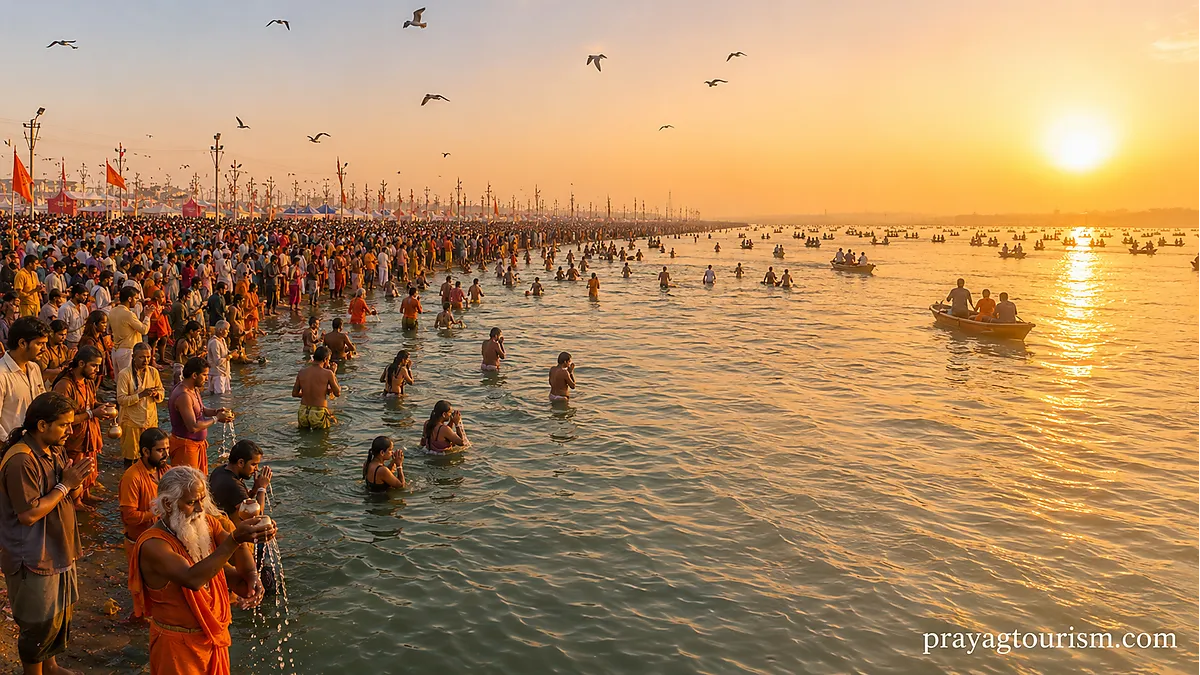
A Sacred Pilgrimage Through the Heart of Sanatana Dharma
Table of Contents
Quick Facts
| Attribute | Details |
| Name | Prayag Mahatmya |
| Sacred Place | Prayagraj (formerly Allahabad) |
| Primary Significance | Tirtharaja (King of Tirthas) |
| Sacred Rivers | Ganga, Yamuna, Saraswati (Triveni) |
| Major Festivals | Kumbh Mela (every 12 years), Ardh Kumbh (every 6 years), Magh Mela (annual) |
| Core Themes | Pilgrimage, Purification, Devotion, Sacred Geography, Liberation |
| Scriptural Sources | Mahabharata (Vana Parva), Matsya Purana, Skanda Purana, Padma Purana, Kurma Purana |
| Key Sacred Sites | Triveni Sangam, Akshayavat, Patalpuri Temple, Bharadwaj Ashram, Alopi Devi Temple, Nag Vasuki Temple, Twelve Madhavas |
| Best Time to Visit | October–March; Magh Mela (Jan–Feb); Kumbh Mela years |
| Estimated Reading Time | 25–30 Minutes |
The Eternal Call: An Introduction to Prayagraj
Before the first ray of the sun touches the horizon, the ghats of Prayagraj come alive. A gentle mist rises from the confluence of the Ganga and Yamuna, carrying with it the scent of marigolds, incense, and the damp earth of centuries of devotion. In the pre-dawn darkness, a million small oil lamps begin to flicker, their flames dancing on the water’s surface like stars descended from heaven.
This is Prayagraj. This is the Triveni Sangam.
The air resonates with the deep, resonant chants of “Har Har Gange!” as pilgrims, saints, and seekers wade into the sacred waters. The winter chill of Magh is biting, yet no one shivers. The cold is not a discomfort; it is a blessing, a purification, a tangible reminder that the body is temporary but the spirit is eternal.
The Chinese traveller Hsuan Tsang, who visited in the 7th century CE, described witnessing a magnificent religious fair at this very confluence, where hundreds of thousands would bathe to wash away their sins. If he were to return today, he would see the same devotion, the same faith, the same timeless river of humanity flowing toward the Sangam.
What makes millions travel across India—across the world—to bathe at this sacred confluence? Why does the ancient city of Prayagraj, known as the Tirtharaja (King of Pilgrimage Sites), continue to draw seekers in the age of airplanes and smartphones?
The answer lies not merely in the cool water, but in the ancient stories, the scriptures, and the divine geography that declares this place to be the holiest of all. This is the Prayag Mahatmya—the eternal glory of Prayagraj.
What is Prayag Mahatmya? – The Glory of the King of Tirthas
The word Mahatmya comes from the Sanskrit root mahat (महत्), meaning “great,” “glorious,” or “magnificent.” In the context of Hindu pilgrimage literature, a Mahatmya is a sacred text or a section of a Purana that magnifies the spiritual significance, mythology, and merits of a particular sacred place, deity, or ritual. It is a glorification—a celestial guidebook that does not simply describe a place but reveals its divine essence.
The Prayag Mahatmya is the collective body of hymns, legends, and scriptural injunctions found across the Mahabharata, the Matsya Purana, the Skanda Purana, the Padma Purana, the Kurma Purana, and other ancient texts, all glorifying Prayagraj as the supreme pilgrimage destination.
The very name Prayag is deeply significant. It is derived from the combination of Pra (प्र, meaning “excellent”) and Yag (याग, meaning “sacrifice”). According to ancient belief, Lord Brahma, the creator of the universe, performed the greatest of all yajnas (sacrifices) here, thereby consecrating the land and infusing it with an eternal, primordial sacredness.
The Skanda Purana opens its glorification of Prayag with a verse that defines the very essence of this sacred place:
Verse 1: The Definition of Prayag – Superior to All Sacrifices
Source: Skanda Purana, Prabhasa Khanda, Chapter 7, Verse 49
Devanagari:
प्रकृष्टं सर्वयागेभ्यः प्रयागमिति गीयते ।
यज्वनां पुनरावृत्तिर्न प्रयागार्द्रवर्ष्मणाम् ॥
IAST Transliteration:
prakṛṣṭaṃ sarvayāgebhyaḥ prayāgamiti gīyate |
yajvanāṃ punarāvṛttirna prayāgārdravarṣmaṇām ||
Word-by-Word Meaning with Devanagari & IAST:
| Devanagari | IAST | Meaning |
| प्रकृष्टम् | prakṛṣṭam | excellent, superior, most eminent |
| सर्वयागेभ्यः | sarvayāgebhyaḥ | from all sacrifices |
| प्रयागम् | prayāgam | Prayag |
| इति | iti | thus |
| गीयते | gīyate | is sung, is praised, is called |
| यज्वनाम् | yajvanām | of performers of sacrifices |
| पुनरावृत्तिः | punarāvṛttiḥ | return (to worldly existence), rebirth |
| न | na | not |
| प्रयागार्द्रवर्ष्मणाम् | prayāgārdravarṣmaṇām | of those whose bodies are moistened by Prayag |
Translation:
“Prayag is celebrated as being superior to all sacrifices. For those whose bodies have been moistened by Prayag, there is no return (to worldly existence).”
Traditional Interpretation:
This verse from the Skanda Purana establishes the theological supremacy of Prayag over the most elaborate Vedic rituals (yajnas). The term prakṛṣṭa (superior) is carefully chosen—it does not negate the value of sacrifices but places the pilgrimage to Prayag on a higher plane. The phrase prayāgārdravarṣmaṇām (those whose bodies are moistened by Prayag) refers to those who have bathed in the Triveni Sangam. Just as the sacrificial fire sanctifies the performer, the sacred waters of Prayag sanctify the pilgrim, making them worthy of liberation.
Pilgrimage Lesson:
A single sincere bath at the Triveni Sangam is spiritually equivalent to performing a lifetime of complex sacrifices. The pilgrim need not worry about their inability to perform elaborate rituals; the waters of Prayag offer a simpler, more accessible path to the same ultimate goal—freedom from the cycle of birth and death.
Scriptural Foundations of Prayag Mahatmya
The glory of Prayagraj is not a folk tradition; it is woven into the most authoritative scriptures of Sanatana Dharma. Here are the primary textual sources that establish Prayag as the Tirtharaja:
📜 The Mahabharata (Vana Parva)
The great epic contains one of the earliest and most detailed descriptions of Prayag’s spiritual greatness. In the Tirthayatra Parva of the Vana Parva (Book of the Forest), the sage Lomasha and the royal priest Dhaumya guide the exiled Pandavas through the sacred geography of India, and Prayag occupies a place of supreme honour.
The specific sections where the greatness of Prayag is dwelt upon include Mahabharata, Vana Parva 85.69-97 and 87.18-20. The epic describes the confluence of the two rivers—Ganga and Yamuna—and declares that those who abandon their bodies at this sacred site attain immortality or moksha (liberation).
The Mahabharata also provides the narrative frame for the Prayag Mahatmya through the dialogue between the grief-stricken King Yudhishthira and the immortal sage Markandeya. After the horrors of the Kurukshetra war, Yudhishthira is consumed by guilt and sorrow. Markandeya consoles him and guides him toward the ultimate solution for spiritual cleansing: a pilgrimage to Tirtharaja Prayag.
📜 The Matsya Purana
The Matsya Purana contains one of the most extensive Prayag Mahatmyas, spanning chapters 103 to 112 (comprising approximately 260 verses). It is in this Purana that Prayag is explicitly and repeatedly called Tirtharaja (Matsya Purana 109.15). The Purana further declares that at the very sight of Prayag, simply by taking its name, or by applying its sacred clay to one’s body, a person becomes free from sin.
📜 The Skanda Purana (Kashi Khanda)
The Skanda Purana, one of the largest of the eighteen Mahapuranas, also glorifies Prayag within its Kashi Khanda (Chapter 7.45-65). The Purana echoes the title Tirtharaja for Prayag (Skanda Purana, Kashi Khanda 7.45). According to tradition, even during the cosmic dissolution (pralaya), all the gods, sages, and sacred rivers gather at Prayag near the immortal Akshayavat banyan tree.
📜 The Padma Purana (Uttarakhanda)
The Padma Purana, particularly the Uttarakhanda, contains beautiful verses extolling Prayag as the supreme pilgrimage site. The Māghamāhātmya section of the Uttarakhanda (Chapter 67) deals with the sacredness of bathing at Prayag during the month of Magh. The refrain at the end of each verse in Padma Purana VI.23.27-35 declares: “sa tīrtharājo jayati prayāgaḥ” (Victory to Prayag, the King of Tirthas).
📜 The Kurma Purana
The Kurma Purana (I.36-39, 121 verses) also contains a Prayag Mahatmya and proclaims: “It is the sacred spot of Prajāpati; those who bathe here go to heaven and those who die here are not born again.”
Why Prayagraj is Called Tirtharaja – The King of Pilgrimage Sites
The title Tirtharaja is not bestowed lightly. It is earned through a unique combination of geographical, mythological, and theological factors that no other tirtha can claim. The Padma Purana captures this truth in a refrain that echoes through the Prayaga-stotra:
Verse 2: Prayag is Crowned Tirtharaja
Source: Padma Purana, Uttarakhanda, Chapter 23 (Prayaga-stotra)
Devanagari:
स तीर्थराजो जयति प्रयागः
IAST Transliteration:
sa tīrtharājo jayati prayāgaḥ
Word-by-Word Meaning:
| Devanagari | IAST | Meaning |
| स | sa | that (one) |
| तीर्थराजः | tīrtharājaḥ | the King of Tirthas (King of Pilgrimage Sites) |
| जयति | jayati | triumphs, is victorious, is glorious |
| प्रयागः | prayāgaḥ | Prayag |
Translation:
“Victory to that Prayag, the King of Tirthas!”
Traditional Interpretation:
This simple yet profound refrain is not merely a poetic flourish but a theological declaration. In the Prayāga-stotra, which runs for several verses (from verse 28 to verse 40), each stanza culminates in this triumphant proclamation. The verb jayati (conquers, triumphs) is significant—it personifies Prayag as a divine entity that conquers the sins of those who approach it. The title Tirtharaja is thus not a human invention but a scriptural truth, reaffirmed in every stanza.
Pilgrimage Lesson:
When the pilgrim chants “Sa tīrtharājo jayati prayāgaḥ,” they are not merely reciting words but participating in an ancient act of scriptural affirmation. This mantra reminds the pilgrim that Prayag is not just one holy place among many—it is the supreme crossing place, the ford between the material and the spiritual.
The Four Pillars of Prayag’s Supremacy
1. The Triveni Sangam – The Confluence of Three Rivers
The primary and most obvious reason for Prayag’s supremacy is its location at the sangam—the sacred meeting point—of the Ganga and the Yamuna. In Hindu thought, a tirtha is a “crossing place,” a ford between the worldly and the divine. The confluence of two holy rivers multiplies this power exponentially.
2. The Invisible Saraswati – The Hidden Third River of Wisdom
This is the unique, hidden treasure of Prayag. It is not a Dwiveni (meeting of two) but a Triveni, where the mystical, invisible Saraswati River joins her sisters. According to the Rigveda, the Saraswati once flowed as a mighty river but is now believed to flow underground.
3. The Site of Brahma’s Sacrifice
Lord Brahma performed his greatest yajna at this very spot. The land is thus not merely a place of pilgrimage but a living yajna-vedi (sacrificial altar).
4. The Seat of the Gods During Pralaya
During cosmic dissolution, all gods, sages, and sacred rivers gather at Prayag near the immortal Akshayavat banyan tree.
The Divine Origin of Prayag – When Brahma’s Yajna Created the Holiest Land
The text, Asali Prayag Mahatmya, offers a fascinating etymology for the name Prayag. While it is often translated as “place of sacrifice,” the text provides a deeper, more intimate story. It tells us that the ancient name of Prayag was once “Prajapati Chetra” (the land of the Lord of Creation).
The narrative unfolds with Lord Brahma, the creator of the universe, performing a magnificent yajna (sacrifice) here. The scale of this event was so immense, its spiritual vibrations so powerful, that the place became known as Prayag: the “excellent sacrifice”. This act of the creator consecrated the land, infusing it with a primordial sacredness that predates all other tirthas.
This story establishes that Prayag is not a place that became holy because of a later saint or a chance event. It was holy from the very beginning, sanctified by the creator’s own hand.
Triveni Sangam – The Sacred Confluence of Three Goddesses
The heart of Prayag beats at the Triveni Sangam. It is not merely a geographical location but a living goddess. The water here is not just H₂O; it is the physical manifestation of the divine.
The Mahatmya in our text urges the pilgrim to look closely:
“Jahan sitasit artharth neela aur safed jal dikhai de, jal mein sheetalta tatha ushnata prateet ho use hi sangam kehte hain.”
(Where blue and white water can be seen, and where both cold and warmth are felt in the water, that is called the sangam.)
The cooler, clearer waters of the Ganga merge with the warmer, greener waters of the Yamuna in a visible embrace, while the mythical Saraswati, believed to flow underground, completes the trinity.
Verse 6: Triveni Sangam – Where Fear of Sin Disappears
Source: Triveni Mahatmya (excerpted from Puranic literature)
Devanagari:
त्रिवेणीसङ्गमो यत्र तत्र पापभयं कुतः ।
गङ्गा च यमुना चैव यत्र गुप्ता सरस्वती ॥
IAST Transliteration:
triveṇīsaṅgamo yatra tatra pāpabhayaṃ kutaḥ |
gaṅgā ca yamunā caiva yatra guptā sarasvatī ||
Word-by-Word Meaning with Devanagari & IAST:
| Devanagari | IAST | Meaning |
| त्रिवेणीसङ्गमः | triveṇīsaṅgamaḥ | the Triveni confluence |
| यत्र | yatra | where |
| तत्र | tatra | there |
| पापभयम् | pāpabhayam | fear of sin |
| कुतः | kutaḥ | from where? how can there be? |
| गङ्गा | gaṅgā | the Ganga river |
| च | ca | and |
| यमुना | yamunā | the Yamuna river |
| च | ca | and |
| एव | eva | indeed, certainly |
| यत्र | yatra | where |
| गुप्ता | guptā | hidden, secret, invisible |
| सरस्वती | sarasvatī | the Saraswati river |
Translation:
“Where the Triveni confluence is, how can there be any fear of sin there? (For) there are the Ganga and Yamuna, and there, indeed, is the hidden Saraswati.”
Traditional Interpretation:
The rhetorical question pāpabhayaṃ kutaḥ (how can there be fear of sin?) is a declaration of absolute purification. The verse establishes the theological uniqueness of Prayag: while other sacred confluences may involve two rivers, Triveni involves three—the visible Ganga and Yamuna, and the invisible Saraswati. The term guptā (hidden, secret) reminds the pilgrim that not everything sacred is visible to the physical eye.
Pilgrimage Lesson:
The pilgrim should approach the Sangam with the understanding that what they see with their eyes is only a fraction of the spiritual reality. The invisible Saraswati represents the hidden grace of the divine that flows beneath the surface of ordinary perception.
Verse 12: The Supreme Refrain – Tirtharaja Prayer
Source: Padma Purana, Uttarakhanda (Prayaga-stotra, closing stanza)
Devanagari:
सितासिते यत्र तरङ्गसङ्गते नद्यौ विभाते मुनिभानुकन्यके ।
लीलातपत्रं वट एव साक्षात् स तीर्थराजो जयति प्रयागः ॥
IAST Transliteration:
sitāsite yatra taraṅgasaṅgate nadyau vibhāte munibhānukanyake |
līlātapatraṃ vaṭa eva sākṣāt sa tīrtharājo jayati prayāgaḥ ||
Word-by-Word Meaning with Devanagari & IAST:
| Devanagari | IAST | Meaning |
| सितासिते | sitāsite | white and black, the two (rivers) |
| यत्र | yatra | where |
| तरङ्गसङ्गते | taraṅgasaṅgate | with joined waves, united in their currents |
| नद्यौ | nadyau | the two rivers |
| विभाते | vibhāte | shine, appear beautiful |
| मुनिभानुकन्यके | munibhānukanyake | the daughters of the sage (Jahnu) and of the sun |
| लीलातपत्रम् | līlātapatram | a play-umbrella, a canopy for sport/delight |
| वटः | vaṭaḥ | the banyan tree |
| एव | eva | indeed, certainly |
| साक्षात् | sākṣāt | directly, visibly, in person |
| स | sa | that (one) |
| तीर्थराजः | tīrtharājaḥ | the King of Tirthas |
| जयति | jayati | triumphs, is glorious |
| प्रयागः | prayāgaḥ | Prayag |
Translation:
“Where the two rivers, the white and the black (Ganga and Yamuna), with their currents meeting, shine forth as the daughters of the sage (Jahnu) and of the sun—where the banyan tree itself serves as a play-canopy—that Prayag, the King of Tirthas, triumphs in glory.”
Traditional Interpretation:
This closing verse of the Prayaga-stotra paints a visual and mythological portrait of Prayag. The Ganga and Yamuna are poetically identified as munibhānukanyake—the Ganga as the daughter of the sage Jahnu, and the Yamuna as the daughter of the sun god Surya. Their waters are described as sitāsita (white and black). The banyan tree (the Akshayavat) is described as a līlātapatram—a play-umbrella for the divine sport (līlā) of the gods.
Pilgrimage Lesson:
This verse invites the pilgrim to see Prayag as a living theatre of the divine. The rivers are not merely bodies of water but goddesses who play at the confluence. The pilgrim who sees with the eyes of faith witnesses not just a place but a sacred drama unfolding.
Verse 3: The Result of Bathing at Prayag – Attaining Shiva’s Abode
Source: Skanda Purana, Kashi Khanda, Chapter 31, Verse 90
Devanagari:
प्रयागे तु नरः स्नात्वा प्रयागेशं तु पश्यति ।
सर्वलोकानतिक्रम्य शिवलोके महीयते ॥
IAST Transliteration:
prayāge tu naraḥ snātvā prayāgeśaṃ tu paśyati |
sarvalokānatikramya śivaloke mahīyate ||
Word-by-Word Meaning with Devanagari & IAST:
| Devanagari | IAST | Meaning |
| प्रयागे | prayāge | in Prayag |
| तु | tu | indeed (emphatic) |
| नरः | naraḥ | a man, a person |
| स्नात्वा | snātvā | having bathed |
| प्रयागेशम् | prayāgeśam | the Lord of Prayag (Shiva/Prayageshwar) |
| तु | tu | indeed |
| पश्यति | paśyati | sees, beholds, worships |
| सर्वलोकान् | sarvalokān | all worlds, all celestial realms |
| अतिक्रम्य | atikramya | having surpassed, having crossed beyond |
| शिवलोके | śivaloke | in the world of Shiva (Kailasa) |
| महीयते | mahīyate | is honored, is worshipped, attains greatness |
Translation:
“The person who, having bathed in Prayag, then worships the Lord of Prayag (Prayageshwar), having surpassed all (other) worlds, attains greatness and honor in the world of Shiva.”
Pilgrimage Lesson:
The Sangam bath is the beginning, not the end. One must also visit the temples, offer prayers to the presiding deities, and complete the parikrama (circumambulation) of sacred sites to fully realize the spiritual benefits.
The Sacred Geography of Prayagraj
The Prayag Mahatmya is not just about the Sangam. The text maps an entire sacred geography, insisting that a true pilgrim must visit the various tirthas (sacred fords) and temples that form the city’s spiritual fortress.
The text Asali Prayag Mahatmya boldly declares:
“Sath karor dash hazaar tirtha Prayagraj ke samip hain.”
(60 crores and 10 thousand tirthas are located near Prayagraj.)
This theological number suggests that Prayag contains the essence of all holy places.
1. Triveni Sangam – The Heart of Prayag
A bath here is the central ritual. The uploaded text states:
“Triveni par abhishek karne se rajsuya aur ashwamegh yajna ke saman phal milta hai.”
(By performing an abhishek at the Triveni, one attains the same merit as performing the Rajasuya and Ashwamedha sacrifices.)
2. Akshayavat – The Indestructible Banyan Tree
The Akshayavat (अक्षयवट) is the most venerated site after the Sangam. The name Akshayavat literally means “the indestructible banyan tree”—Akshaya (eternal, undecaying) and Vata (banyan tree).
According to the uploaded text:
“Achchyavrat ke pas vas karne aur pran tyag karne se Mudda Lok milta hai.”
(By living near the Akshayavat and giving up one’s life there, one attains a heavenly realm.)
Verse 10: The Akshayavat – The Tree of Immortality
Source: Matsya Purana, Prayaga Mahatmya (Chapters 103-112)
Devanagari:
वटं समाश्रितो यस्तु याति विष्णोः परं पदम् ।
अक्षयं पदमाप्नोति यत्र यान्ति महर्षयः ॥
IAST Transliteration:
vaṭaṃ samāśrito yastu yāti viṣṇoḥ paraṃ padam |
akṣayaṃ padamāpnoti yatra yānti maharṣayaḥ ||
Word-by-Word Meaning:
| Devanagari | IAST | Meaning |
| वटम् | vaṭam | the banyan tree (Akshayavat) |
| समाश्रितः | samāśritaḥ | having completely taken refuge in |
| यः | yaḥ | he who, whoever |
| तु | tu | indeed |
| याति | yāti | goes, attains |
| विष्णोः | viṣṇoḥ | of Lord Vishnu |
| परम् | param | highest, supreme |
| पदम् | padam | abode, state, position |
| अक्षयम् | akṣayam | undecaying, immortal, imperishable |
| पदम् | padam | abode, state |
| आप्नोति | āpnoti | attains, obtains |
| यत्र | yatra | where |
| यान्ति | yānti | go, attain |
| महर्षयः | maharṣayaḥ | the great sages |
Translation:
“He who takes complete refuge in (or dwells under) the banyan tree attains the supreme abode of Vishnu. He attains the imperishable state where the great sages go.”
Pilgrimage Lesson:
The Akshayavat reminds the pilgrim that liberation is not only attainable through action (karma) or knowledge (jnana) but also through dwelling in a sacred space saturated with the presence of the divine.
3. Patalpuri Temple – The Underground Shrine
Adjacent to the Akshayavat is the Patalpuri Temple—a unique, underground shrine that descends into the earth like a journey into the netherworld (patala). Built during the reign of Emperor Akbar in the 16th century, the temple is 84 feet long and 50 feet wide, with seven rows of pillars supporting a stone roof.
4. Bharadwaj Ashram – The Hermitage of the Ancient Sage
The Bharadwaj Ashram is associated with Lord Rama. During his 14-year exile, Lord Rama, Sita, and Lakshmana crossed the Ganga and made their first stop at this ashram. The sage welcomed them with great honour.
5. Alopi Devi Temple – The Shakti Peetha of the Disappeared Goddess
The Alopi Devi Temple is one of the most unique temples in India. It is considered one of the 51 Maha-Shakti Peethas. According to legend, the right hand of Sati fell here and disappeared—alop ho gaya. Because the goddess’s body part disappeared, there is no idol; instead, a wooden doli (palanquin) is worshipped.
6. Nag Vasuki Temple – The Abode of the Serpent King
The Nag Vasuki Temple is dedicated to Vasuki, the king of serpents. According to legend, after the Samudra Manthan, Lord Vasuki sought rest at this sacred site. The mere sight of Nag Vasuki during the Maha Kumbh is believed to dispel the Kalsarp Dosh.
7. Bade Hanuman Temple – The Reclining Protector
Located just across from the Sangam, the Bade Hanuman Temple houses a 20-foot-long reclining idol of Lord Hanuman—a rare posture in Hanuman iconography.
8. The Twelve Madhavas – The Dwadash Madhav Parikrama
Unique to Prayagraj is the tradition of the Dwadash Madhava (Twelve forms of Lord Vishnu). These twelve shrines act as the city’s divine guardians:
- Shri Veni Madhava (city deity)
- Shri Adi Madhava (original form)
- Shri Manohar Madhava
- Shri Bindu Madhava
- Shri Gada Madhava
- Shri Chakra Madhava
- Shri Shankh Madhava
- Shri Akshay Vat Madhava
- Shri Sankasthar Madhava
- Shri Anant Madhava
- Shri Asi Madhava
- Shri Padma Madhava
The Kumbh Mahatmya – The Festival of the Nectar of Immortality
The Kumbh Mela is the ultimate manifestation of the Prayag Mahatmya on Earth. It is the largest peaceful congregation of humanity on the planet, a UNESCO-recognized Intangible Cultural Heritage of Humanity.
1. The Legend of Samudra Manthan
According to the Vishnu Purana and Bhagavata Purana, the Devas (gods) and Asuras (demons) churned the cosmic ocean to obtain amrita—the nectar of immortality. Using Mount Mandara as the churning rod and Vasuki as the rope, they churned until the nectar emerged in a magnificent Kumbha (pot).
2. The Celestial Journey of the Kumbha
A fierce battle ensued. Lord Vishnu, disguised as Mohini, whisked the pot away. During the celestial chase of twelve divine days (twelve human years), drops of nectar spilled at four locations: Prayagraj, Haridwar, Ujjain, and Nashik.
The Maha Kumbh Mela 2025 at Prayagraj was held from January 13 to February 26, 2025, with key Shahi Snan dates on Makar Sankranti (Jan 14), Mauni Amavasya (Jan 29), Basant Panchami (Feb 3), and others.
Makar Snan and Magh Mela – The Month of Spiritual Austerity
Even beyond the grand Kumbh, the month of Magh (January–February) is considered a perpetually auspicious time for pilgrimage. The annual Magh Mela attracts millions of pilgrims every year.
Verse 5: The Nectar Bath – Destroying Sins of a Yuga
Source: Padma Purana, Uttarakhanda, Chapter 118, Verse 47
Devanagari:
प्रयागो माघमासे तु पुष्करं कार्तिके तथा ।
अवंती माधवे मासि हन्यात्पापं युगार्जितम् ॥
IAST Transliteration:
prayāgo māghamāse tu puṣkaraṃ kārtike tathā |
avaṃtī mādhave māsi hanyātpāpaṃ yugārjitam ||
Word-by-Word Meaning:
| Devanagari | IAST | Meaning |
| प्रयागः | prayāgaḥ | Prayag (bathing at Prayag) |
| माघमासे | māghamāse | in the month of Magha |
| तु | tu | indeed |
| पुष्करम् | puṣkaram | Pushkara |
| कार्तिके | kārtike | in Kartika |
| तथा | tathā | also |
| अवंती | avaṃtī | Avanti (Ujjain) |
| माधवे | mādhave | in Madhava (Vaishakha) |
| मासि | māsi | in the month |
| हन्यात् | hanyāt | would destroy |
| पापम् | pāpam | sin |
| युगार्जितम् | yugārjitam | accumulated over a yuga |
Translation:
“Bathing at Prayag in the month of Magha, at Pushkara in Kartika, and at Avanti (Ujjain) in the month of Madhava (Vaishakha) destroys sin accumulated over an entire yuga.”
Pilgrimage Lesson:
Timing matters in pilgrimage. While Prayag is sacred at all times, its spiritual potency multiplies during the month of Magha.
Verse 9: Magha Snan – The Month of Supreme Purification
Source: Mahabharata, Vana Parpa (Tirthayatra Parva)
Devanagari:
माघे मासि नरः स्नात्वा प्रयागे नियतेन्द्रियः ।
अश्वमेधस्य यज्ञस्य फलं प्राप्नोति मानवः ॥
IAST Transliteration:
māghe māsi naraḥ snātvā prayāge niyatendriyaḥ |
aśvamedhasya yajñasya phalaṃ prāpnoti mānavaḥ ||
Word-by-Word Meaning
| Devanagari | IAST | Meaning |
| माघे | māghe | in Magha |
| मासि | māsi | in the month |
| नरः | naraḥ | a person |
| स्नात्वा | snātvā | having bathed |
| प्रयागे | prayāge | in Prayag |
| नियतेन्द्रियः | niyatendriyaḥ | with controlled senses |
| अश्वमेधस्य | aśvamedhasya | of the Ashvamedha sacrifice |
| यज्ञस्य | yajñasya | of the sacrifice |
| फलम् | phalam | the fruit |
| प्राप्नोति | prāpnoti | attains |
| मानवः | mānavaḥ | a human being |
Translation:
“The person who, in the month of Magha, bathes in Prayag with his senses under control, obtains the fruit of the Ashvamedha sacrifice.”
Pilgrimage Lesson:
The phrase niyatendriyaḥ (with senses under control) is crucial. The Magh Snan is not merely a physical act; it is a spiritual discipline requiring fasting, celibacy, and restraint.
Verse 11: The Mantra for Makar Snan
Source: Asali Prayag Mahatmya with Makar and Kumbha Mas Mahatmya
Devanagari:
मकरस्थे रवौ माघे गोविन्दाच्युत माधवः ।
स्नानेनानेन मे देव यथोक्त फलदो भवः ॥
IAST Transliteration:
makarasthe ravau māghe govindāchyuta mādhavaḥ |
snānenānena me deva yathokta phalado bhavaḥ ||
Word-by-Word Meaning:
| Devanagari | IAST | Meaning |
| मकरस्थे | makarasthe | the sun being in Makara |
| रवौ | ravau | in the sun |
| माघे | māghe | in Magha |
| गोविन्द | govinda | O Govinda! |
| अच्युत | acyuta | O Achyuta! |
| माधवः | mādhavaḥ | O Madhava! |
| स्नानेन | snānena | by this bath |
| अनेन | anena | by this |
| मे | me | my, for me |
| देव | deva | O God |
| यथोक्त | yathokta | as described |
| फलदः | phaladaḥ | fruit-giving |
| भवः | bhavaḥ | you become |
Translation:
“When the sun is in the sign of Makara (Capricorn) and the month of Magha has arrived, O Govinda, O Achyuta, O Madhava! O Lord, by this bath of mine, please become the bestower of the fruits as described (in the scriptures).”
Pilgrimage Lesson:
This mantra teaches the attitude of the ideal pilgrim—one who performs the external ritual but understands that the ultimate result depends on divine grace.
Kalpavas – A Month of Discipline
Kalpavas is a month-long period of spiritual discipline observed on the banks of the Ganga from Paush Purnima to Maghi Purnima. The Kalpavasi wakes before dawn, bathes in the icy river twice daily, meditates, chants, and eats one simple meal. It is said that by observing Kalpavas, a devotee overcomes the sins of previous births.
The Universal Presence of Gods at Prayag
Verse 7: The Universal Nature of Prayag – Home to All Gods
Source: Kurma Purana
Devanagari:
विष्णुः शिवश्च ब्रह्मा च सर्वे देवाः समासतः ।
प्रयागे तिष्ठते नित्यं तस्मात्तीर्थोत्तमं स्मृतम् ॥
IAST Transliteration:
viṣṇuḥ śivaśca brahmā ca sarve devāḥ samāsataḥ |
prayāge tiṣṭhate nityaṃ tasmāttīrthottamaṃ smṛtam ||
Word-by-Word Meaning:
| Devanagari | IAST | Meaning |
| विष्णुः | viṣṇuḥ | Lord Vishnu |
| शिवः | śivaḥ | Lord Shiva |
| च | ca | and |
| ब्रह्मा | brahmā | Lord Brahma |
| च | ca | and |
| सर्वे | sarve | all |
| देवाः | devāḥ | gods |
| समासतः | samāsataḥ | in short, together |
| प्रयागे | prayāge | in Prayag |
| तिष्ठते | tiṣṭhate | dwells |
| नित्यम् | nityam | eternally |
| तस्मात् | tasmāt | therefore |
| तीर्थोत्तमम् | tīrthottamam | the best of Tirthas |
| स्मृतम् | smṛtam | is declared |
Translation:
“Vishnu, Shiva, and Brahma, together with all the gods, eternally dwell in Prayag. Therefore Prayag is declared the best of all Tirthas.”
Pilgrimage Lesson:
The pilgrim from any sectarian background can approach Prayag with confidence, knowing that their chosen deity resides there.
Liberation Through Refuge at Prayag
Verse 8: Eternal Residence at Prayag – Beyond Rebirth
Source: Padma Purana, Uttarakhanda
Devanagari:
प्रयागमाश्रितो यस्तु सर्वपापैः प्रमुच्यते ।
जन्मप्रभृति यत्किञ्चित्कृतं पापं विनश्यति ॥
IAST Transliteration:
prayāgamāśrito yastu sarvapāpaiḥ pramucyate |
janmaprabhṛti yatkiñcitkṛtaṃ pāpaṃ vinaśyati ||
Word-by-Word Meaning:
| Devanagari | IAST | Meaning |
| प्रयागम् | prayāgam | Prayag |
| आश्रितः | āśritaḥ | having taken refuge in |
| यः | yaḥ | he who |
| तु | tu | indeed |
| सर्वपापैः | sarvapāpaiḥ | from all sins |
| प्रमुच्यते | pramucyate | is completely liberated |
| जन्मप्रभृति | janmaprabhṛti | from birth onward |
| यत्किञ्चित् | yatkiñcit | whatever |
| कृतम् | kṛtam | done |
| पापम् | pāpam | sin |
| विनश्यति | vinaśyati | is destroyed |
Translation:
“He who takes refuge in Prayag is completely liberated from all sins. Whatever sin has been committed from birth onward is destroyed.”
Pilgrimage Lesson:
The power of Prayag is not transactional but transformative. The pilgrim’s duty is simply to approach with śraddhā (faith) and bhakti (devotion).
The Hidden Wisdom of Pilgrimage
Verse 4: Prayag’s Glory – The Meeting of Two Divine Rivers
Source: Triveni Dasakam (attributed to Adi Shankaracharya)
Devanagari:
श्रुतिः प्रमाणं स्मृतयः प्रमाणं पुराणमव्यक्तपरं प्रमाणम् ।
यत्रास्ति गङ्गायमुने प्रमाणं स तीर्थराजो जयति प्रमाणम् ॥
IAST Transliteration:
śrutiḥ pramāṇaṃ smṛtayaḥ pramāṇaṃ purāṇamavyaktaparaṃ pramāṇam |
yatrāsti gaṅgāyamune pramāṇaṃ sa tīrtharājo jayati pramāṇam ||
Word-by-Word Meaning:
| Devanagari | IAST | Meaning |
| श्रुतिः | śrutiḥ | the Vedas |
| प्रमाणम् | pramāṇam | authority |
| स्मृतयः | smṛtayaḥ | the Smritis |
| प्रमाणम् | pramāṇam | authority |
| पुराणम् | purāṇam | the Puranas |
| अव्यक्तपरम् | avyaktaparam | having the unmanifest as supreme |
| प्रमाणम् | pramāṇam | authority |
| यत्र | yatra | where |
| अस्ति | asti | there is |
| गङ्गा | gaṅgā | the Ganga |
| यमुने | yamune | O Yamuna |
| प्रमाणम् | pramāṇam | authority |
| स | sa | that |
| तीर्थराजः | tīrtharājaḥ | the King of Tirthas |
| जयति | jayati | triumphs |
| प्रमाणम् | pramāṇam | as the ultimate authority |
Translation:
“The Vedas are authority, the Smritis are authority, the Puranas are authority. Where the Ganga and Yamuna are present—that indeed is the ultimate authority. That Tirtharaja triumphs as the very embodiment of authority.”
Pilgrimage Lesson:
Prayag is not merely a place described in scriptures—it is a living scripture. The experience of standing at the confluence is an unmediated encounter with the divine.
Complete Prayag Mahatmya Pilgrimage Route
📌 Suggested Duration: 3 to 4 Days
📍 Day 1: The Sangam and the Fort
- Early Morning (4:30 AM – 7:00 AM): Proceed to the Triveni Sangam. Take the sacred snan (holy dip) as the sun rises. Chant the Makar Snan mantra.
- Morning (8:00 AM – 11:00 AM): Visit the Bade Hanuman Temple.
- Afternoon (12:00 PM – 4:00 PM): Enter the Allahabad Fort. Visit Patalpuri Temple and offer prayers at Akshayavat.
📍 Day 2: The Western Bank – Temples of Daraganj
- Morning (7:00 AM – 12:00 PM): Visit Shri Veni Madhava Temple and Nag Vasuki Temple.
- Afternoon (1:00 PM – 4:00 PM): Visit Alopi Devi Temple in Alopibagh.
📍 Day 3: The Eastern Bank – Ashrams of Jhunsi and Arail
- Morning (7:00 AM – 12:00 PM): Visit Bharadwaj Ashram.
- Afternoon (1:00 PM – 4:00 PM): Undertake the Dwadash Madhav Parikrama in Arail.
Prayagraj for the Modern Pilgrim – A Practical Guide
🛕 Best Time to Visit
- October–March: Most pleasant weather.
- Magh Mela (January–February): Most spiritually potent.
- Kumbh Mela (every 12 years): Ultimate pilgrimage.
✈️ How to Reach
- By Air: Prayagraj Airport (Bamrauli).
- By Rail: Prayagraj Junction (major railway hub).
- By Road: Connected to Varanasi (120 km), Lucknow (200 km).
🛡️ Pilgrimage Etiquette
- Dress modestly (saffron, white, or simple cotton).
- Remove shoes before entering any temple.
- Ask for permission before photographing saints.
- Maintain cleanliness of the ghats and river.
- Be patient during festivals.
Why Prayag Still Matters Today
In a world of increasing anxiety, why does an ancient pilgrimage still hold such power? Because the human need for purification—for a fresh start—is eternal.
At the Sangam, a king and a beggar are indistinguishable. The sacred tirtha washes away all social distinctions. Standing at the confluence of two mighty rivers that have flowed since time immemorial, one feels a profound sense of perspective.
As the sun sets over the Sangam, a father helps his son light a diya that floats on a leaf into the twilight. A sadhu meditates by the water’s edge. An elderly couple takes their final dip of the day.
In that moment, they are not just people visiting a place. They are participants in an eternal story.
Prayag is not merely a place on a map. It is a meeting point of rivers, traditions, seekers, and the eternal quest for spiritual purification.
Frequently Asked Questions (FAQs)
1. What is the Prayag Mahatmya?
The collective body of hymns, legends, and scriptural injunctions in the Mahabharata, Matsya Purana, Skanda Purana, Padma Purana, and Kurma Purana glorifying Prayagraj as the supreme pilgrimage destination.
2. Why is Prayagraj called Tirtharaja?
Because of its unique Triveni Sangam, association with Brahma’s primordial sacrifice, and status as the place where all gods gather during cosmic dissolution. The title is explicitly given in Matsya Purana 109.15 and Skanda Purana, Kashi Khanda 7.45.
3. What is the importance of Triveni Sangam?
The holy confluence of Ganga, Yamuna, and invisible Saraswati. Bathing here absolves sins and grants merit equal to Rajasuya and Ashwamedha sacrifices.
4. Who are the Twelve Madhavas?
Twelve forms of Lord Vishnu worshipped through twelve shrines across Prayagraj, including Veni Madhava, Adi Madhava, Chakra Madhava, and others.
5. What is Akshayavat?
The Indestructible Banyan Tree inside the Allahabad Fort, believed to grant liberation to those who take refuge under it.
6. What is Kalpavas?
A month-long period of austerity during Magh Mela, where devotees live on the riverbanks, bathe twice daily, and dedicate themselves to prayer.
7. When is the best time to visit Prayagraj?
October–March, especially during Magh Mela (January–February) or Kumbh Mela (every 12 years).
8. What is the difference between Magh Mela and Kumbh Mela?
Magh Mela is an annual festival; Kumbh Mela is a larger festival every 12 years based on specific astrological conjunctions.
9. What are the Shahi Snan dates?
For Maha Kumbh 2025: Makar Sankranti (Jan 14), Mauni Amavasya (Jan 29), Basant Panchami (Feb 3), etc.
10. Is the Saraswati River real?
Believed to flow underground, joining the Ganga and Yamuna at the Triveni Sangam. Geological surveys have identified a paleochannel consistent with this tradition.
Related Sacred Journeys
- Kumbh Mela: The ultimate festival of faith at Prayagraj.
- Magh Mela: The annual winter pilgrimage.
- Kashi (Varanasi): The city of Lord Shiva (120 km).
- Chitrakoot: Where Lord Rama spent his exile (130 km).
- Ayodhya: The birthplace of Lord Rama (160 km).
- Ramayana Pilgrimage Circuit: Connecting all major sites from the epic.
May your journey to Tirtharaja Prayagraj be blessed. May the sacred waters of the Triveni Sangam purify your body, mind, and soul. May the chants of “Har Har Gange” resonate in your heart long after you have returned home. 🙏
This comprehensive guide is based on traditional scriptures, including the Mahabharata (Vana Parva), Matsya Purana (Chapters 103–112), Skanda Purana (Kashi Khanda, Prabhasa Khanda), Padma Purana (Uttarakhanda), Kurma Purana, and the uploaded text “Asali Prayag Mahatmya with Makar and Kumbha Mas Mahatmya” (Jagannath Prasad Sharma, Murari Lal Mathura).