
Table of Contents
The Temple Where Devotees Whisper Their Deepest Wishes
As the first light of dawn filters through the trees lining the Yamuna River, a gentle hum begins to rise from the banks of Saraswati Ghat. The air, still cool from the night, carries the fragrance of fresh flowers, burning camphor, and sacred incense. Somewhere in the distance, a conch shell sounds. Then another. Soon, the ringing of temple bells joins the chorus, calling the faithful to prayer.
You walk along the riverfront, past the tranquil waters reflecting the pink and orange sky. Ahead, a modest yet profoundly sacred structure emerges — the Mankameshwar Temple. The sound of ‘Om Namah Shivaya’ fills the air as devotees, young and old, climb the steps with offerings of milk, water, and bel leaves. Their faces are illuminated not only by the rising sun but by the quiet hope that burns in their hearts.
Inside the sanctum, a magnificent black stone Shiva Lingam stands as a silent witness to centuries of whispered prayers. A young couple seeks blessings for a harmonious marriage. An elderly woman, her eyes closed in deep concentration, asks for the health and long life of her family. A student, clutching a small notebook, prays for success in his examinations.
All of them come with one common belief — that Lord Shiva, as Mankameshwar, listens to every sincere prayer and grants the heartfelt wishes of those who worship him with devotion.
For centuries, this temple has been a beacon of hope for countless pilgrims. For centuries, the faithful have walked these steps, seeking not just a blessing, but a transformation — a tangible change in their lives that can only come from divine grace.
Why has this ancient Shiva shrine remained one of the most beloved temples in Prayagraj, drawing devotees from across India year after year? The answer lies in its name, its legend, and the unwavering faith of millions who have witnessed their wishes fulfilled.
What Does ‘Mankameshwar’ Mean?
The name Mankameshwar (मनकामेश्वर) is a beautiful Sanskrit compound that reveals the very essence of the temple’s spiritual identity.
- Man (मन) — Heart, mind, inner self, soul
- Kam (काम) — Desire, wish, longing, aspiration
- Eshwar (ईश्वर) — Lord, God, supreme ruler
Together, Mankameshwar means “the Lord who fulfills the desires of the heart.” It is a name that perfectly captures the unique role of Lord Shiva in this sacred space — not merely as the destroyer of evil or the lord of meditation, but as the compassionate bestower who hears the silent prayers of his devotees.
According to the temple’s traditions, the name is derived from a profound belief: that any devotee who worships Lord Shiva at Mankameshwar Temple with a pure heart and unwavering faith will see their deepest desires come to fruition. Unlike temples where specific material requests are sometimes discouraged, Mankameshwar Temple is explicitly associated with wish‑fulfillment. This is why pilgrims from across India — and even from abroad — make their way to this sacred site on the banks of the Yamuna.
The name also carries a deeper spiritual meaning. In Hindu philosophy, the heart (man) is considered the seat of consciousness and devotion. By coming to Mankameshwar, devotees are not merely asking for external boons; they are learning to align their personal desires with the cosmic will of Lord Shiva. The fulfillment of a wish is seen as a sign of divine grace — a moment when the individual soul’s longing meets the compassionate response of the Supreme.
The Sacred Legend: Lord Rama and the Fulfillment of Sita’s Wish
The most celebrated and widely accepted legend associated with Mankameshwar Temple connects it directly to the Ramayana, one of India’s greatest epics.
According to the story passed down through generations and recorded in temple traditions, Lord Rama, Sita, and Lakshmana, during their fourteen years of exile, arrived at the sacred city of Prayag. After paying their respects at the Triveni Sangam — the holy confluence of the Ganga, Yamuna, and the invisible Saraswati — Sita expressed a heartfelt desire. Having taken a ritual bath at the Sangam, she wished to offer her prayers to Lord Shiva.
In Hindu tradition, it is customary and highly meritorious to worship Lord Shiva after a sacred bath at a pilgrimage site. Sita, in her devotion, longed to perform Jalabhishek (ritual offering of water) and seek the blessings of the Destroyer of Evil.
However, there was no Shiva temple nearby. Not wanting his beloved consort’s wish to remain unfulfilled, Lord Rama — ever the devoted and chivalrous husband — immediately set about creating a solution. According to the legend, he established a Shiva Lingam at this very spot on the banks of the Yamuna. He then, along with Sita and Lakshmana, worshipped Lord Shiva with great devotion and performed the Abhishek ceremony.
Thus, Sita’s wish was fulfilled, and the temple that arose at that site was named Mankameshwar — the Lord who fulfills the desires of the heart.
It is also believed that Lord Rama rested under the sacred Akshayavat tree (the indestructible banyan tree near the Triveni Sangam) while on his way to Chitrakoot, and the establishment of the Shiva Lingam took place during that period.
This divine act — a husband fulfilling his wife’s spiritual longing — is seen as a model of devotion, love, and dharma. It also established Mankameshwar as a place where heartfelt wishes are granted. It is still widely believed that wishes made at this temple, especially those made with a sincere heart, are never left unanswered.
The History of Mankameshwar Temple
The history of the Mankameshwar Temple is as ancient as it is fascinating. While the current structure has seen renovations over the centuries, the site itself has been a centre of worship for millennia.
Antiquity and Vedic Connections
The city of Prayagraj (formerly known as Prayag) has been one of the oldest pilgrimage centers in India, with its references in ancient scriptures such as the Vedas and the Mahabharata. The Mankameshwar Temple is believed to be a part of this ancient sacred landscape.
Some traditions hold that the temple is mentioned in the Shiva Purana, Padma Purana, Skanda Purana, and Prayag Mahatmya under the name ‘Kameshwar Tirtha’. This indicates that the site has been recognized as a sacred tirtha (crossing place) for thousands of years.
The Treta Yuga Origins
According to temple tradition, the original Shivalingam enshrined in the temple is believed to be ‘swayambhu’ (self‑manifested) and emerged during the Treta Yuga, the second of the four great epochs in Hindu cosmology. This places the divine presence at this site far back in mythological time, long before recorded history.
The Shankaracharya Connection
The Mankameshwar Temple is also recognized as a ‘siddha peeth’ (a seat of spiritual accomplishment) of Jagadguru Shankaracharya. The temple is managed by the trust of Swami Swaroopanand Saraswati, the Shankaracharya of Dwarka Sharda Peetham and Jyotirmath of Badrinath Dham. This connection to the great philosopher‑saint who revived Sanatana Dharma in the 8th century CE adds another layer of spiritual authenticity and reverence to the shrine.
The temple also serves as a camp for the Shankaracharya’s visits, further solidifying its importance in the religious hierarchy of the region.
Medieval and Modern Era
During the Mughal period, the Mankameshwar Temple, like many other temples in North India, faced challenges. However, the temple survived, and its traditions continued uninterrupted. The temple shows a blend of traditional Hindu temple architecture with intricate Mughal-style carvings — a visible testament to the syncretic architectural influences that shaped Prayagraj‘s heritage over the centuries.
In the modern era, especially ahead of the Maha Kumbh Mela 2025, the Government of Uttar Pradesh allocated a significant budget for the renovation and beautification of the temple. The Shri Mankameshwar Mahadev Temple was one of ten major temples in the district to be renovated, with beautification work, new entrance gates, and improved facilities for devotees.
Today, the temple stands as a serene and powerful place of worship, drawing hundreds of devotees daily and thousands during festival seasons.
Mankameshwar Temple in Hindu Scriptures
The spiritual importance of Mankameshwar Temple is reflected in its mention in several revered Hindu scriptures. The temple is believed to be referenced in the Shiva Purana, Padma Purana, Skanda Purana, and the Prayag Mahatmya under the ancient name ‘Kameshwar Tirtha’.
These references indicate that the site was already an established pilgrimage destination by the time these Puranas were composed. The Prayag Mahatmya, a section of the Matsya Purana, describes the sacred geography of Prayag and lists the most important tirthas within the region. The inclusion of Kameshwar Tirtha in this list confirms the antiquity and importance of the shrine.
The Mahabharata, which contains extensive descriptions of pilgrimage sites in northern India, also refers to Prayag and its sacred geography. While not naming Mankameshwar directly, the epic‘s references to Shiva worship in the Prayag region affirm that the tradition of venerating Lord Shiva here is of great antiquity.
Thus, the temple is not a recent establishment but a living continuation of a worship tradition that stretches back thousands of years.
The Divine Presence of Lord Shiva in Prayag
Prayagraj, known as Tirtharaj (the King of Pilgrimage Sites), is most famously associated with Lord Vishnu, particularly through the Dwadash Madhav (the twelve Madhav temples) that encircle the holy city.
However, Prayagraj also boasts several special Shiva temples, each with its own unique significance. Prominent among these is the Shri Mankameshwar Mahadev Temple, which is sometimes referred to as the “first Shiv temple of the universe”.
Lord Shiva‘s presence in Prayag is not an afterthought; it is deeply woven into the city’s sacred fabric. After all, Prayag is located at the confluence of the Ganga (associated with Lord Vishnu) and the Yamuna (associated with Lord Krishna), and the third, invisible river Saraswati (associated with knowledge). Lord Shiva, as the great yogi and destroyer of evil, completes the trinity of divine energies that converge here.
Other important Shiva temples in Prayag include:
- Brahmeshwar Mahadev Temple in Daraganj, mentioned in the Puranas as the “first Shiv temple of the universe”
- Shool Tankeshwar Mahadev Temple
- Koteshwar Mahadev Temple
- Takshakeshwar Mahadev Temple
- Padila Mahadev Temple
- Someshwar Mahadev Temple on the Arail side of the Ganga
Together, these temples form a sacred network of Shiva worship that complements the Vaishnava traditions of the Dwadash Madhav.
Architecture of Mankameshwar Temple
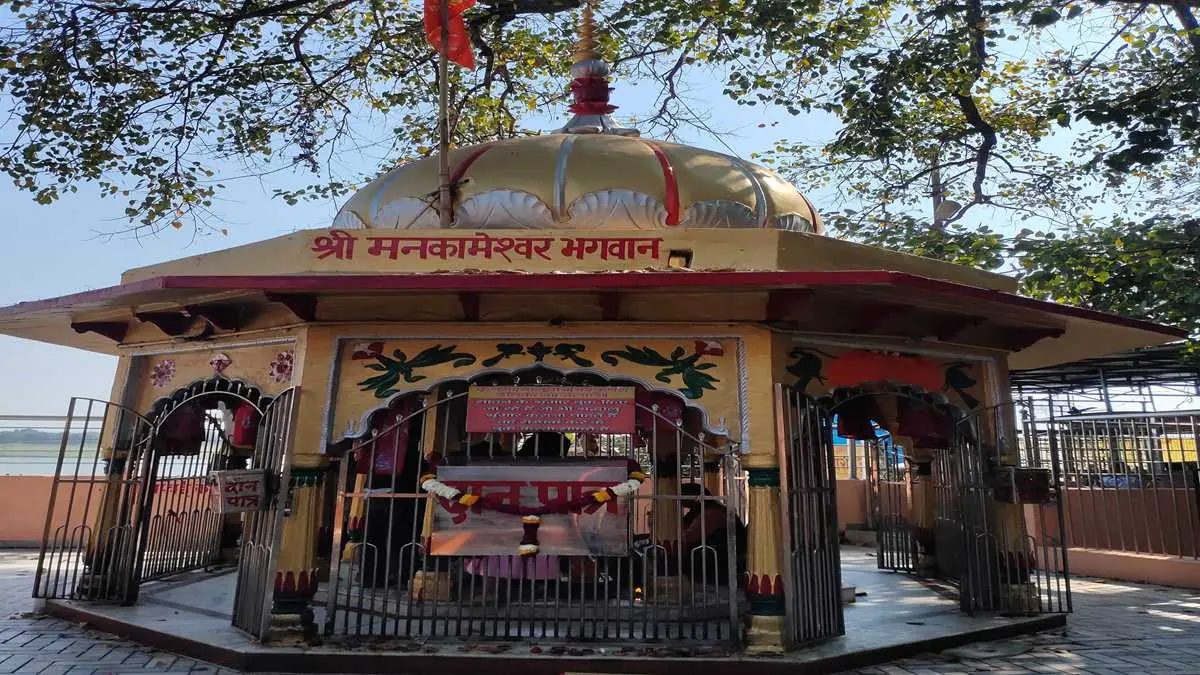
The Mankameshwar Temple is not grand in scale, but its architectural features are both distinctive and spiritually resonant.
Location and Setting
The temple is located on the banks of the Yamuna River, near the tranquil Saraswati Ghat, in the Cantonment area of Prayagraj. It is situated opposite Minto Park (Madan Mohan Malaviya Park) and is quite close to the Allahabad Fort and the Triveni Sangam.
Its riverfront location offers a serene and panoramic view of the Yamuna, making it a peaceful setting for prayer and meditation.
Architectural Style
The temple exhibits a beautiful blend of traditional Hindu temple architecture and intricate Mughal-style carvings. This fusion reflects the rich, layered history of Prayagraj, which has been shaped by Hindu, Mughal, and British influences over the centuries.
The structure is modest but elegant. The sanctum sanctorum (garbha griha) houses the main deity. The temple complex includes open spaces where devotees can sit, meditate, and participate in rituals.
The Sanctum Sanctorum
Inside the main sanctum, the central object of worship is the black stone Shiva Lingam. The Lingam is approximately three and a half feet in height and is believed to extend much deeper underground. According to temple tradition, the Lingam is ‘swayambhu’ — self‑manifested — and holds immense spiritual power.
In the temple complex, visitors can also see shrines and idols dedicated to:
- Nandi (Lord Shiva‘s divine bull)
- Lord Ganesha (remover of obstacles)
- Lord Hanuman (symbol of strength and devotion)
- A sacred Banyan and Peepal tree (venerated in Hindu tradition)
- Rann Mukteshwar Shivlinga, believed to absolve devotees of debts and loans
The Sacred Shiva Lingam
The heart of the Mankameshwar Temple is its sacred Shiva Lingam, a three-and-a-half-foot black stone representation of Lord Shiva‘s formless, all-pervasive energy.
Symbolism of the Shiva Lingam
In Hindu philosophy, the Lingam represents the union of the masculine and feminine principles: the vertical pillar symbolizes Lord Shiva (pure consciousness), while the circular base (yoni) represents Goddess Shakti (creative energy). Together, they signify the source of all creation — the cosmic point from which the universe emerges, exists, and dissolves.
The black stone of the Lingam at Mankameshwar is particularly revered. Black stone is associated with stability, grounding, and the absorption of negative energies. The Lingam is said to be self‑manifested (swayambhu), meaning it was not carved by human hands but appeared naturally at this sacred spot. This belief greatly amplifies the spiritual potency of the shrine.
The Depth of the Lingam
According to temple sources, the visible portion of the Lingam — three and a half feet — is only the tip. The Lingam is believed to extend much deeper underground, symbolizing the infinite, unmanifest nature of Lord Shiva. This depth also signifies that the roots of this sacred site reach far back into antiquity, connecting the present moment to the very origins of creation.
Spiritual Power
Devotees believe that the Lingam‘s spiritual power is intensified by the presence of three sacred energies converging at this site: the nearby Triveni Sangam, the flow of the Yamuna, and the ancient penance of saints and sages. When a devotee performs Jalabhishek (ritual pouring of water) on this Lingam, the offering is believed to reach Lord Shiva directly, carrying the devotee’s prayers and wishes to the divine realm.
Daily Rituals and Worship
The dinacharya (daily schedule) of the Mankameshwar Temple follows a traditional Vedic routine designed to take the devotee from the outer world into the inner sanctum of devotion.
Temple Timings
| Detail | Information |
| Opening Time | 5:00 AM |
| Closing Time | 10:00 PM |
| Mangala Aarti | 4:00 AM |
| Sandhya Aarti | 9:30 PM |
| Rudrabhishek | 11:00 AM – 5:00 PM |
The temple remains open every day of the week, with no entry fee for devotees.
Morning Rituals
The day begins well before dawn. At 4:00 AM, the temple‘s doors are opened for the Mangala Aarti. This is the first wake‑up call to the deity. The atmosphere is charged with spiritual energy as priests chant Vedic hymns, ring bells, and offer camphor to the Lingam.
After the aarti, devotees begin to arrive for early morning darshan. Many perform Jalabhishek — pouring water, milk, and other sacred liquids over the Lingam — accompanied by the chanting of Om Namah Shivaya.
Midday and Afternoon
Between 11:00 AM and 5:00 PM, priests perform Rudrabhishek for devotees who have booked this special ritual in advance. Rudrabhishek involves the chanting of the Rudram (a powerful Vedic hymn) while offering water, milk, curd, honey, ghee, sugar, and other sacred substances to the Lingam. This ritual is believed to bring peace, prosperity, and divine blessings to the devotee.
During this time, the temple remains quieter, allowing visitors to sit in meditation and absorb the peaceful atmosphere.
Evening Aarti
As the sun sets over the Yamuna, the temple prepares for its most spectacular ceremony — the Sandhya Aarti at 9:30 PM. Priests dressed in traditional attire wave multi‑tiered brass lamps before the Lingam while conch shells sound and bells ring in synchrony. The sound of the aarti, accompanied by the chanting of Shiva bhajans, fills the night air.
After the aarti, the temple doors close for the night, only to reopen at 4:00 AM the next morning.
Pradusha Pooja
On Saturdays, the temple conducts the Pradusha Pooja. This ritual is performed during the twilight period between sunset and nightfall, which is considered especially auspicious for Lord Shiva worship. Devotees believe that prayers offered during Pradusha are answered more quickly.
Mondays – Special Significance
Mondays are considered the most special day for Lord Shiva worship. The temple attracts a large number of devotees on Mondays, with queues forming as early as 4:00 AM. Many devotees observe a fast on Mondays and break it only after offering prayers at the temple.
Maha Shivaratri at Mankameshwar Temple
Maha Shivaratri — the Great Night of Shiva — is the most important festival at the Mankameshwar Temple. The temple celebrates this auspicious occasion with immense fervour and devotion.
The Significance of Maha Shivaratri
Maha Shivaratri is believed to be the night when Lord Shiva performed the Tandava, the cosmic dance of creation, preservation, and destruction. It is also said to be the night when Lord Shiva and Goddess Parvati were married. For devotees, this is the most powerful night of the year for seeking Lord Shiva‘s blessings.
Celebrations at the Temple
On Maha Shivaratri, the temple is beautifully decorated with flowers and lights. Special abhishekams are performed on the Shiva Lingam throughout the night. Priests chant the Rudram and other Vedic hymns continuously, creating a powerful spiritual atmosphere.
Devotees flock to the temple from early morning. Many observe a day‑long fast and break it only after offering prayers at midnight. The temple remains open all night, with devotees singing bhajans and performing Jalabhishek.
The festival also includes processions of the temple‘s deities, with devotees carrying the sacred images through the surrounding streets. Special bhandaras (community meals) are organized for pilgrims.
Pilgrimage Context
During Maha Shivaratri, Prayagraj is already bustling with pilgrims who have come to take a holy dip at the Triveni Sangam during the Magh Mela. Many of these pilgrims head directly to Mankameshwar Temple after their Sangam snan to offer Jalabhishek to Lord Shiva. The combination of a sacred bath at the confluence and worship at Mankameshwar is considered highly meritorious.
Shravan Month Celebrations
The month of Shravan (July–August) is the holiest month in the Hindu calendar for Lord Shiva worship. During this sacred period, the Mankameshwar Temple becomes a major spiritual hub, drawing lakhs of devotees.
The Auspicious Month
Shravan is considered the month when Lord Shiva is most accessible and responsive to his devotees‘ prayers. The entire month is observed as a period of fasting, penance, and special worship. According to astrologers, planetary alignments during Shravan enhance the benefits of spiritual practices.
Four Auspicious Mondays
During Shravan, the Mondays (Shravan Somwar) are considered especially favourable for offering prayers to Lord Shiva. In 2025, the four auspicious Mondays fell on July 14, 21, 28, and August 4. On these days, queues at the temple formed as early as 4:00 AM and lasted late into the night.
Kanwar Pilgrims
Prayagraj is a major stop for Kanwariyas — Shiva devotees who travel on foot to collect holy water from the Ganga and offer it at Shiva temples. The newly paved ghats at Daraganj and other locations, constructed at a cost of Rs 45 crore for the Maha Kumbh, serve Kanwariyas during their pilgrimage to Kashi Vishwanath Temple in Varanasi.
Guidelines for Devotees
During Shravan, the temple administration has issued specific guidelines to maintain sanctity and discipline:
- Photography and videography are prohibited on the temple premises during Shravan. The chief priest, Acharya Swami Shridharanand Brahmachari, stated, “Worship and darshan should be done with faith and humility, not for social media likes”.
- Dress code: Male devotees must wear a dhoti with a shirt or kurta. Female devotees must wear a saree or salwar suit.
- Prohibition of intoxicants: Priests are strictly prohibited from consuming gutkha, paan, and tobacco during rituals. Any priest found violating this rule faces suspension.
- Offering items: Devotees are encouraged to offer bhasma (sacred ash), bilva leaves, dhatura, bhang, shami leaves, sandalwood, fruits, and flowers to Lord Shiva.
Why Devotees Visit Mankameshwar Temple
Devotees come to Mankameshwar Temple for a wide range of reasons, reflecting the comprehensive blessings that Lord Shiva bestows:
Wish Fulfillment
The temple‘s primary reputation is that of a wish‑fulfilling shrine. Devotees believe that sincere prayers offered at Mankameshwar reach Lord Shiva directly, and that he grants the desires of those who worship him with devotion. This is why the temple is especially popular among:
- Couples seeking a happy marriage
- Childless couples praying for children
- Students asking for academic success
- Business people seeking prosperity
- Anyone facing obstacles in their personal or professional life
Removal of Debts
Within the temple complex, there is a special shrine known as Rann Mukteshwar Shivlinga, which literally means the great God who absolves debts. Devotees visit this Lingam to seek liberation from financial debts and other burdens.
Protection from Negative Energies
The temple is also known as Pishach Mochan Tirtha — a place that protects devotees from evil spirits and negative energies. The term Pishach refers to malevolent entities, and Mochan means liberation. Devotees believe that sincere worship at Mankameshwar Temple can shield them from unseen harms.
Health and Healing
Many devotees come with health‑related prayers. The Rudrabhishek ritual is considered especially beneficial for healing and for removing obstacles related to illness.
Spiritual Growth
Beyond material wishes, the temple also serves as a place for spiritual seekers to deepen their practice. The peaceful atmosphere, proximity to the Yamuna, and the ancient spiritual energy of the site make it ideal for meditation and introspection.
Mankameshwar Temple and the Pilgrimage Circuit of Prayag
Mankameshwar Temple is an integral part of the sacred pilgrimage circuit of Prayagraj. Many pilgrims combine a visit to the temple with other holy sites in the city, especially during the Kumbh Mela and Magh Mela.
The Complete Pilgrimage Route
A spiritually enriching day in Prayagraj might include:
- Triveni Sangam — A holy bath at the confluence of the Ganga, Yamuna, and Saraswati
- Mankameshwar Temple — Offering Jalabhishek and seeking wish fulfillment
- Bade Hanuman Ji Temple — Paying respects to the reclining Lord Hanuman
- Alopi Devi Mandir — The unique Shakti Peetha where a cradle is worshipped
- Nagvasuki Temple — The sacred Naga temple
- Shri Beni Madhav Temple — The presiding deity of Prayagraj
- Akshayavat and Patalpuri Temple — The indestructible banyan tree and the underground temple
- Allahabad Fort — The historic Mughal fortress
During Kumbh and Magh Mela
During the Kumbh Mela and Magh Mela, the Mankameshwar Temple witnesses a massive influx of pilgrims. After taking a holy dip at the Sangam, many devotees head directly to the temple to offer Jalabhishek to Lord Shiva, seeking the fulfillment of their wishes.
The temple administration and police authorities make special arrangements to manage the crowds, ensuring that every devotee can have a peaceful and meaningful darshan.
A Virtual Darshan of the Temple
Let us take a moment to walk through the temple together, as if you were there in person.
You arrive at the temple early in the morning, just as the first rays of the sun are beginning to warm the waters of the Yamuna. The air is fresh and cool. You remove your shoes at the entrance, leaving behind the dust of the outside world.
As you step into the temple courtyard, the sound of bells greets you. A priest is ringing a large brass bell suspended from the ceiling, calling devotees to prayer. The fragrance of incense and camphor fills the air, mingling with the faint sweetness of marigold garlands.
Ahead, the sanctum sanctorum glows with the soft light of oil lamps. You join the queue of devotees, each person holding their offerings — a copper pot of milk, a coconut, a handful of bilva leaves, a red thread tied with a silent wish.
As you approach the sanctum, you see the black stone Shiva Lingam, its form simple yet infinitely profound. Water and milk are gently poured over its surface, flowing down into the copper basin below. The priest chants the sacred mantra “Om Namah Shivaya“ in a low, rhythmic voice.
You step forward, your hands folded in prayer. For a moment, the world fades away. You whisper your deepest wish — for your family, for your work, for your soul. You pour a small amount of milk over the Lingam, and you feel a sense of peace settle over you.
You step back, and another devotee takes your place. You walk to the corner of the courtyard, sit for a few minutes, and watch the Yamuna flow by. The river seems to carry your prayer with it, downstream, toward the Sangam, toward the infinite.
You are not the same person who entered this temple. Something has shifted. Whether your wish will be granted, you do not yet know. But you leave with something equally precious — the quiet certainty that you have been heard.
Life Lessons from Lord Shiva
Beyond the rituals and the requests for wish fulfillment, Lord Shiva offers profound life lessons that every visitor to Mankameshwar Temple can carry home.
1. Patience (Shiva as the Great Yogi)
Shiva is depicted as the supreme meditator, seated in perfect stillness on Mount Kailash. His patience teaches us to remain calm in the face of life‘s turmoil, to trust the timing of the universe, and to wait for the right moment to act.
2. Detachment (Shiva with the Serpent Around His Neck)
Shiva wears a serpent around his neck — a symbol of fear and death. By adorning the serpent as an ornament, Shiva teaches that true spiritual advancement comes from detachment. Do not let fear control you. Master it.
3. Compassion (Shiva Consuming the Poison)
When the ocean was churned and the deadly Halahala poison emerged, Shiva consumed it to save the universe. This act of supreme compassion teaches us to protect others, even at personal cost, and to transform toxic situations into opportunities for grace.
4. Simplicity (Shiva‘s Ash-Smeared Body)
Shiva covers his body in the ashes of the cremation ground — a stark reminder of life‘s impermanence. He owns nothing, desires nothing, yet contains everything. His simplicity teaches us to distinguish between what we truly need and what we merely crave.
5. Inner Strength (Shiva the Destroyer of Evil)
Shiva is the destroyer of evil, but his destruction is not wanton; it clears the path for new creation. When you visit Mankameshwar, pray not only for external wishes to be fulfilled but also for the inner strength to let go of your own “demons” — anger, greed, envy, and fear.
Important Shiva Verses
Here are some of the most sacred verses dedicated to Lord Shiva, recited by devotees at temples like Mankameshwar.
Verse 1: Om Namah Shivaya
Devanagari:
ॐ नमः शिवाय
IAST:
Om Namah Shivaya
Word‑by‑Word Meaning:
- Om — The primordial sound; the essence of the universe
- Namaḥ — Salutations / I bow
- Śivāya — To Lord Shiva (the auspicious one)
Translation:
“I bow to Lord Shiva, the auspicious one.”
Traditional Interpretation:
This five‑syllable mantra (Na-Ma-Śi-Vā-Ya) is considered the most powerful and accessible way to connect with Lord Shiva. It requires no ritual preparation, no offerings — only the sincere repetition of the name.
Practical Takeaway:
Whenever you feel stressed, fearful, or uncertain, close your eyes and chant Om Namah Shivaya slowly, with attention. At Mankameshwar Temple, let this mantra be the rhythm of your prayers.
Verse 2: The Shiva Mahimna Stotra
Devanagari:
न च प्रियो प्रियो मम मोक्ष एवेष्टो महेश्वरि।
न च धर्मो न चार्थो वा कामो वा मम देवते॥
(Adapted; original Mahimna Stotra is longer)
Source:
Shiva Mahimna Stotra (composed by Pushpadanta), verse 7 (approximately).
Translation:
“Neither liberation nor worldly pleasures are dear to me, O Lord. Neither righteousness nor wealth nor desire — only you, my Lord.”
Practical Takeaway:
At Mankameshwar, while you may come with specific wishes, remember that the highest blessing is not the fulfillment of any single desire but the steady presence of Lord Shiva‘s grace in your life.
Visitor Guide
Here is everything you need to know for a smooth and spiritually fulfilling visit to Mankameshwar Temple.
| Detail | Information |
| Temple Name | Mankameshwar Mahadev Temple |
| Location | Fort Road, Kydganj, Cantonment Area, Prayagraj, Uttar Pradesh, 211003 |
| Nearby Landmark | Saraswati Ghat, Yamuna River, Minto Park |
| Distance from Triveni Sangam | Approximately 3–4 km |
| Distance from Prayagraj Junction | Approximately 6 km |
| Temple Timings | 5:00 AM – 10:00 PM daily |
| Aarti Timings | Mangala Aarti: 4:00 AM; Sandhya Aarti: 9:30 PM |
| Entry Fee | Free |
| Best Time to Visit | October–March (winter), also auspicious during Shravan (July–August) and Maha Shivaratri |
| Recommended Duration | 45–90 minutes |
| Dress Code | Male: dhoti with shirt or kurta; Female: saree or salwar suit |
| Photography | Prohibited inside the sanctum; during Shravan, photography is banned temple‑wide to maintain sanctity |
| Wheelchair Access | Limited; the temple entrance has steps |
| Parking | Limited street parking near the temple |
| Prasad/Offerings | Available from shops near the temple entrance |
How to Reach Mankameshwar Temple
By Air: Prayagraj Airport (IXD) — approximately 12–14 km. Take a taxi or auto‑rickshaw to the Cantonment area.
By Train: Prayagraj Junction — 6 km. From the station, auto‑rickshaws and e‑rickshaws are readily available. Tell the driver: “Mankameshwar Temple, Kydganj“ or “near Saraswati Ghat.”
By Road: The temple is well‑connected by road. You can take an auto‑rickshaw or city bus to the Cantonment area.
Tips for a Smooth Darshan
- Arrive early — The temple is least crowded between 6:00 AM and 8:00 AM.
- Follow the dress code — Out of respect for the sanctity of the temple, adhere to the recommended modest attire.
- Carry offerings — Milk, bilva leaves, flowers, coconuts, and incense are appropriate offerings. These can be purchased from shops near the temple.
- Book Rudrabhishek in advance — If you wish to perform this special ritual, contact the temple office ahead of time.
- Be patient during festivals — During Maha Shivaratri and Shravan, crowds are massive. Plan extra time.
- Respect the rules — Photography is restricted. Mobile phones should be silenced inside the sanctum.
Frequently Asked Questions (FAQs)
1. Where is Mankameshwar Temple located?
Mankameshwar Temple is located on Fort Road, Kydganj, in the Cantonment area of Prayagraj, on the banks of the Yamuna River.
2. Why is Mankameshwar Temple famous?
The temple is famous as a wish‑fulfilling Shiva shrine. It is believed that Lord Mankameshwar grants the heartfelt wishes of devotees who worship him with sincere devotion.
3. Which deity is worshipped at Mankameshwar Temple?
The temple is dedicated to Lord Shiva, worshipped here as Mankameshwar — the Lord who fulfills desires.
4. What does Mankameshwar mean?
Mankameshwar means “the Lord who fulfills the desires of the heart.” It is derived from the Sanskrit words man (heart), kam (desire), and eshwar (lord).
5. What is the legend associated with the temple?
According to legend, after Sita took a ritual bath at the Triveni Sangam, she wished to pray to Lord Shiva. Since there was no Shiva temple nearby, Lord Rama established a Shiva Lingam at this spot to fulfill her wish — and the temple was named Mankameshwar.
6. Is Mankameshwar Temple near the Triveni Sangam?
Yes, the temple is approximately 3–4 km from the Triveni Sangam, a short auto‑rickshaw ride away.
7. What are the temple timings?
The temple is open from 5:00 AM to 10:00 PM daily. Mangala Aarti is at 4:00 AM, and Sandhya Aarti at 9:30 PM.
8. Is there an entry fee?
No, entry to Mankameshwar Temple is free.
9. What is the best time to visit Mankameshwar Temple?
The best time is during the winter months (October–March). Spiritually, the most auspicious times are during Maha Shivaratri and the month of Shravan.
10. Is there a dress code for the temple?
Yes. Male devotees must wear a dhoti with a shirt or kurta. Female devotees must wear a saree or salwar suit.
11. Can I take photographs inside the temple?
Photography inside the sanctum is prohibited. During the month of Shravan, photography and videography are banned temple‑wide to maintain the sanctity of worship.
12. What is Rudrabhishek?
Rudrabhishek is a Vedic ritual in which the Rudram hymn is chanted while offering water, milk, curd, honey, ghee, and other sacred substances to the Shiva Lingam. It is believed to bring peace, prosperity, and divine blessings.
13. How can I perform Rudrabhishek at the temple?
Rudrabhishek is conducted between 11:00 AM and 5:00 PM. Contact the temple office in advance to book a time.
14. What offerings are appropriate at Mankameshwar Temple?
Common offerings include milk, water, bilva (bel) leaves, dhatura, bhang, sandalwood paste, fruits, flowers, and incense.
15. Is Mankameshwar Temple mentioned in Hindu scriptures?
Yes, the temple is believed to be referenced in the Shiva Purana, Padma Purana, Skanda Purana, and the Prayag Mahatmya under the ancient name Kameshwar Tirtha.
16. What is the significance of the Rann Mukteshwar Shivlinga?
This special Lingam within the temple complex is believed to absolve devotees of debts and loans.
17. Why is Mankameshwar called the “first Shiv temple of the universe”?
Some traditions refer to Mankameshwar as the first Shiva temple of the universe, a recognition of its divine origin and self‑manifested Lingam.
18. How can I reach the temple from Prayagraj Junction?
Prayagraj Junction is about 6 km from the temple. Auto‑rickshaws and e‑rickshaws are available outside the station. Tell the driver “Mankameshwar Temple, near Saraswati Ghat.”
19. Is there any special significance to Mondays at this temple?
Yes. Mondays are considered highly auspicious for Lord Shiva worship, and the temple attracts significantly larger crowds on this day.
20. What other attractions are near Mankameshwar Temple?
Nearby attractions include Saraswati Ghat, Minto Park, Allahabad Fort, the Triveni Sangam, Patalpuri Temple, and Akshayavat (the indestructible banyan tree).
Related Sacred Journeys
After your visit to Mankameshwar Temple, deepen your spiritual journey in Prayagraj by exploring these sacred destinations:
- Triveni Sangam — The holy confluence of the Ganga, Yamuna, and Saraswati, where pilgrims bathe to wash away sins
- Bade Hanuman Ji Temple — The famous reclining Hanuman temple, considered the Kotwal (guardian) of Prayagraj
- Akshayavat — The indestructible banyan tree within Allahabad Fort
- Patalpuri Temple — The ancient underground shrine located within the fort complex
- Alopi Devi Mandir — A unique Shakti Peetha where a cradle is worshipped instead of an idol
- Nagvasuki Mandir — The sacred Naga temple dedicated to the serpent king Vasuki
- Shri Beni Madhav Temple — The presiding deity of Prayagraj, a key Vishnu shrine
- Bharadwaj Ashram — The ancient hermitage where Lord Rama, Sita, and Lakshmana stayed during their exile
Conclusion — The Lord Who Listens to Every Whispered Prayer
As you walk back down the steps of Mankameshwar Temple, the sounds of the city slowly returning to you — the hum of traffic, the chatter of passers‑by, the distant whistle of a train. But something has changed. The quiet peace of the sanctum still lingers in your heart. The gentle rhythm of Om Namah Shivaya still echoes in your mind.
You have stood where Lord Rama once stood, fulfilling the wish of his beloved consort. You have offered prayers at a shrine that has been a beacon of hope for countless generations. You have whispered your deepest desires into the sacred space where, it is believed, Lord Shiva himself listens.
Will your wish be granted? The faithful do not doubt. But even beyond the fulfillment of any single prayer, there is a greater gift — the knowledge that you are not alone, that your hopes are seen, and that the divine presence at Mankameshwar Temple continues to offer solace, strength, and grace to all who approach with an open heart.
In the sacred city of Prayagraj, where rivers meet and faith flows endlessly, Mankameshwar Temple stands as a timeless reminder that sincere prayers, offered with devotion and humility, always find their way to Lord Shiva.
This article is part of a series on the sacred temples and pilgrimage sites of Prayagraj. For more information on planning your spiritual journey, please contact us.
Prayag Tourism
📞 Phone/WhatsApp: +91-9555313526
📧 Email: contact@prayagtourism.com
🌐 Website: PrayagTourism.com
May your journey be peaceful, safe, and spiritually enriching — and may Lord Mankameshwar bless you with the fulfillment of your heartfelt wishes.