
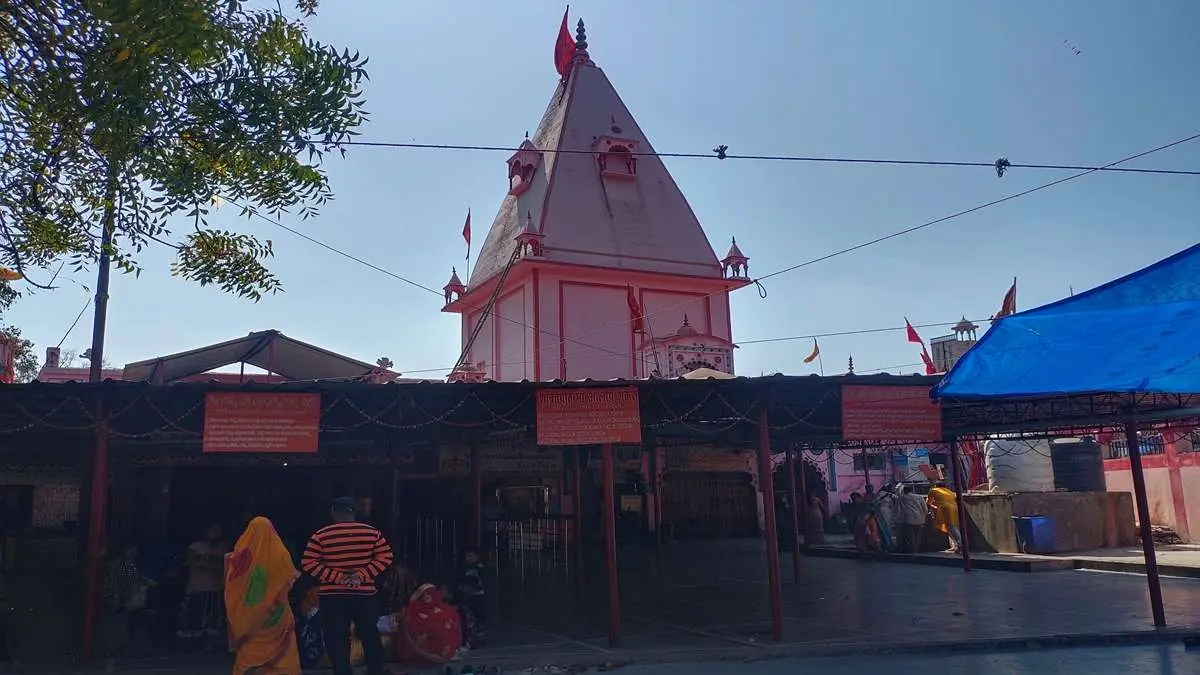
The air is thick with the fragrance of incense and fresh flowers. The soft ringing of temple bells and the gentle chant of mantras create a serene soundtrack. You have just left the bustling energy of the Triveni Sangam behind and entered the peaceful precincts of a temple unlike any other. As you step into the sanctum, you look for the familiar idol of the Goddess. But there is none.
Instead, suspended from the ceiling on an elevated platform, you see a simple wooden cradle, draped in a red cloth. Below it, a small well (kund) glimmers with water. Devotees bow their heads before this empty cradle. They whisper their wishes, tie a sacred thread (Rakshasutra) at the temple, and leave carrying a deep sense of peace. This is the heart of Alopi Devi Mandir.
Located in the Alopibagh locality of Prayagraj, this ancient Shakti Peetha stands as a testament to a profound spiritual truth: that the divine cannot be confined to a single form. Dedicated to Maa Sati, this is perhaps the only temple in India where no deity is worshipped. Instead, the presence of the Goddess is symbolized by a cradle. Her name, “Alopi,” means “the one who disappeared.” Her story is one of love, loss, and the mysterious nature of divine power.
Quick Facts at a Glance
| Detail | Information |
| Temple Name | Alopi Devi Mandir (also known as Alop Shankari Devi Mandir / Alopshankari Siddhipeeth) |
| Location | Alopibagh, Prayagraj, Uttar Pradesh (Near Triveni Sangam) |
| Religious Tradition | Shakta (Goddess worship) |
| Associated Goddess | Maa Sati (Alopi Devi / Alop Shankari) |
| Known For | Unique worship of a sacred cradle (doli/palna) instead of an idol; one of the 51 Shakti Peethas |
| Significance | Symbolizes the spot where the last part of Goddess Sati’s body (the right hand) disappeared |
| Distance from Sangam | Approximately 5–6 km |
| Daily Darshan Timings | 5:00 AM – 9:30 PM |
| Aarti Timings | Mangala Aarti (5:00 AM); Shringar Darshan (8:00 AM); Rajbhog Aarti (12:00 PM); Sandhya Aarti (7:00 PM) |
| Best Time to Visit | Navratri (especially October 2026), Magh Mela, Kumbh Mela, winter months (October–March) |
| Entry Fee | Free |
| Recommended Duration | 45–90 minutes |
Table of Contents
The Cradle of Faith
The unique spiritual identity of the Alopi Devi Mandir is captured in the simple fact that it has no idol. According to the temple’s mahant (chief priest), Yamuna Puri of the Sri Panchayati Akhada MahaNirvani, the temple does not have any idol, but this fact fails to hamper the religious feelings of the divine place, which is believed to belong to Satyug and was refurbished around 80 years ago. According to him, “The deity lives in the ‘Palna’ (swing) as the entire world is her children.”
What is Alopi Devi Mandir?
Alopi Devi Mandir (also known as Alop Shankari Devi Mandir) is an ancient Hindu temple situated in the Alopibagh locality of Prayagraj, near the holy Triveni Sangam where the Ganges, Yamuna, and the legendary Sarasvati rivers meet. It is one of the most important Shakti Peethas (sacred seats of the Goddess) in India. However, unlike conventional temples, the shrine does not house an idol of its central deity. Instead, its sanctum contains a wooden ‘doli’ or ‘palna’ (cradle), which is symbolically worshipped as the presence of the Goddess.
The temple’s simplicity and serene spiritual atmosphere have drawn pilgrims and scholars for centuries. It is a cornerstone of the Shakta tradition, revered as a Siddhipeeth (a seat of spiritual accomplishment) and one of the 18 Maha-Shaktipeeths mentioned in the Devi Bhagwatam. Its modest architecture, lacking opulence, directs a visitor’s attention entirely to the spiritual symbolism of the cradle and the well.
The Goddess Sati and Lord Shiva: A Tale of Love and Sacrifice
The foundation of Alopi Devi Mandir, like all Shakti Peethas, lies in one of the most poignant stories in Hindu mythology.
According to the Puranas, King Daksha, the father of Goddess Sati, performed a grand Yajna (fire sacrifice) but deliberately did not invite his daughter and her husband, Lord Shiva. Sati was deeply hurt by this insult. Despite Shiva’s protests, she went to her father’s palace. At the Yajna, Daksha humiliated Lord Shiva in front of all the assembled gods and sages. Unable to bear the insult to her husband, the proud and devoted Sati self-immolated herself in the sacred fire.
When Lord Shiva learned of this, he was consumed with grief and rage. He picked up Sati’s charred body and began the Tandava, the cosmic dance of destruction, threatening to unmake the universe. To calm Shiva and protect creation, Lord Vishnu used his Sudarshana Chakra (divine discus) to cut Sati’s body into 51 pieces. As the pieces fell to Earth, each became a Shakti Peetha – a sacred site where the Goddess’s power is eternally present, worshipped alongside a Bhairava (a form of Shiva). The Alopi Devi Mandir is the place where the last part of Maa Sati’s body fell, her right hand or paw, which then vanished into the earth.
Why is She Called “Alopi”? The Legend of the Disappearing Goddess
The name “Alopi” (अलोपी) comes from the Hindi/Sanskrit word “Alop,” which means “to disappear” or “to vanish.” There are two powerful traditions explaining this name.
The Shakti Peetha Legend: The Disappearance of the Body Part
As the story goes, the piece of Maa Sati’s body that fell at this site – her right hand (or paw) – did not remain visible. According to the Puranas, the palm of Maa Sati’s right hand fell into a pond and then vanished, leading to the temple being named Devi Alopshankari. Because the organ of the Goddess disappeared here, the Shakti Peetha was named “Alopi” (where disappearance was concluded). This is the primary belief held by the temple priests and the Mahanirvani Akhara that manages the temple.
The Folk Legend: The Bride Who Disappeared
Another popular version from oral tradition narrates a different story. It dates back to when the region was covered with dense forests and infested with dacoits. A marriage procession was passing through the forest. Suddenly, a gang of robbers attacked them. In the ensuing chaos, the newlywed bride, who was in a wooden carriage (doli), mysteriously disappeared. The terrified groom and his family began searching for her. The bride’s strange disappearance was deemed a miracle. The locals, believing she was a divine incarnation, erected a temple at the same site to worship the “disappeared bride,” who came to be known as Alopi Devi. This is why a wooden doli (carriage) or palna (cradle) came to be worshipped in the sanctum instead of an idol.
The Sacred Cradle: Heart of the Temple
The central focus of worship at Alopi Devi Mandir is not an idol but a suspended cradle (jhoola/palna) on an elevated platform, beautifully adorned with a red cloth. Beneath the cradle lies a small well or kund. A symbol of the sacred pond where the goddess’s body part fell and vanished. The water of this kund is considered to have miraculous healing properties.
Devotees do not offer prasad or flowers directly to an idol. Instead, they place their offerings in the well or over the kund. They touch the cradle, offer prayers, and whisper their heartfelt wishes. Alopi Devi is the Kul Devi (family goddess) of the natives of the Sangam city.
Alopi Devi as a Shakti Peetha: A Sacred Geography of Power
Alopi Devi Mandir is recognized as one of the 51 Shakti Peethas, making it a site of immense spiritual power. In this sacred geography, the Goddess is worshipped as Alopi Devi or Alop Shankari (the consort of Lord Shankar, who disappeared). Her Bhairava (the form of Shiva guarding the site) is known as Laliteshwar Mahadev. The temple is also referred to as one of the 18 Maha-Shaktipeeths, underscoring its supreme significance in the Shakta tradition. A Mahakumbh document describes Alopidevi Temple as the spot where the last fragment of Sati’s body disappeared, solidifying its status as the final Shakti Peetha. In a 2024 interview, Mahant Yamuna Puri specifically mentioned the temple as ‘Lalitalopshankri’, cited in the Puranas as the place one “kose” from the holy Sangam, towards the west and north-west direction from the Akshayvat tree.
Spiritual Significance: The Mystical Presence of the Goddess
The Worship of the Invisible
The most profound teaching of the temple is that the Divine cannot be contained in any form. The deity here is a “never-ending and beginning-less source of energy.” This is a powerful expression of the Nirguna Brahman (the formless, attributeless ultimate reality) within the path of devotion (Bhakti). The worshipper is forced to look beyond the physical object and connect with the divine through faith alone.
The Maternal Energy of the Goddess
The cradle is a powerful symbol. A mother soothes her child in a cradle. By worshipping the cradle, devotees are, in essence, connecting with the maternal, nurturing energy of the Goddess. She is the universal mother caring for all her children. The swinging motion of the cradle represents the eternal cycle of creation and preservation.
The Power of the Sacred Well (Kund)
The well (kund) beneath the cradle is central to the temple’s rituals. Water is the source of life and the primary medium for purification. The water of the well is believed to have miraculous healing powers. As pilgrims offer water to the Goddess, they are symbolically returning a small part of the cosmic energy back to its source, completing a spiritual circuit of giving and receiving.
The Sacred Thread (Rakshasutra)
A unique tradition at this temple is the offering and tying of the Rakshasutra (a sacred, often yellow or red, thread). The holy thread, when tied on the wrists, is believed to offer powerful protection against evil and to carry the power to grant all wishes. It is a physical manifestation of the divine bond between the devotee and the Goddess, a constant reminder of her protective grace.
The Temple‘s Unique Architecture
The architecture of the Alopi Devi Mandir is relatively simple and modest, especially when compared to the grand, sprawling temples of South India.
The temple reflects the Nagara style of architecture, characteristic of North India. It features a distinct shikhara (temple spire), a majestic entry gate, and a paved, purified courtyard leading to the central sanctum sanctorum (garbhagriha). Recent renovations (2024) have seen the construction of a new Mandapam (pillared hall) inspired by South Indian temple architecture, as well as a new yagya kund (fire altar) and a huge platform to enhance the spiritual experience for large gatherings. Instead of a single idol, the sanctum focuses on the suspended cradle on an elevated platform and the well below, symbolizing the invisible divine presence.
The temple premises also include a Shankaracharya Peeth and smaller shrines for other deities, a testament to the unity of the broader Hindu tradition. The statues of Lord Ganesha, Lord Shiva, Kartikeya, and Lord Hanuman are present outside the main shrine.
Other Deities and Shrines Within the Complex
While the main sanctum is dedicated to the formless Alopi Devi, the temple complex houses smaller shrines that are equally revered:
- Lord Ganesha: The remover of obstacles, who is always worshipped first.
- Lord Shiva (Laliteshwar Mahadev): The Bhairava of this Shakti Peetha is Bhavya bharav Laliteshwar mahadev.
- Lord Hanuman: One can see the idol of Lord Hanuman on the temple premises, representing strength and selfless service.
- Nava Durga: The idols of the nine forms of Goddess Durga are also present.
Daily Rituals and Worship: A Pilgrim’s Guide
The temple management, under the Sri Panchayati Akhada MahaNirvani, conducts daily worship. It is unique as it involves aarti, offerings, and rituals directed towards the cradle rather than an idol. The key daily aartis are:
| Aarti | Timing | Description |
| Mangala Aarti | 5:00 AM | The first aarti of the day, awakening the divine presence. |
| Shringar Darshan | 8:00 AM | The cradle is adorned and devotees can have a special darshan. |
| Rajbhog Aarti | 12:00 PM | The midday offering and aarti. |
| Sandhya Aarti | 7:00 PM | The grand evening aarti, a deeply moving experience. |
Daily Darshan: The temple is open for general darshan from 5:00 AM to 9:30 PM.
Offerings (Prasad/Upay): You can offer flowers, sindoor (vermilion), and coconut. Married women often offer sindoor to the Goddess, wishing for the longevity and fortune of their husbands. A unique offering is the Rakshasutra (sacred thread). Rather than placing offerings on an idol, you will leave your offerings in the small well (kund) beneath the cradle.
Special Days: Tuesdays and Fridays are considered especially auspicious for worshipping the Goddess, drawing a significant number of devotees.
Navratri at Alopi Devi Mandir
The most vibrant and spiritually charged time to visit Alopi Devi Mandir is during Navratri, the nine-night festival celebrating the Divine Mother.
The temple becomes a vibrant center of spiritual energy, with thousands of devotees gathering for darshan. Despite the absence of a ceremonial idol, all forms of the Goddess (Shailaputri, Brahmacharini, Chandraghanta, Kushmanda, Skandamata, Katyayani, Kalaratri, Mahagauri, and Siddhidatri) are honored through chanting the Durga Saptashati, fasting, and prayers.
Ashtami and Navami (the eighth and ninth nights) are the peak days, witnessing massive crowds. Devotees perform rigorous fasts and engage in continuous worship. One of the most beautiful rituals is Kanya Puja, where young girls are worshipped as living embodiments of the Goddess, offered food, gifts, and blessings.
Upcoming Navratri Dates:
- Shardiya Navratri 2026: October 11 – October 20
- Chaitra Navratri 2026: March 19 – March 27
Alopi Devi During Kumbh Mela and Magh Mela
The temple’s importance soars during the Kumbh Mela and Magh Mela. Its proximity to the Triveni Sangam means millions of pilgrims come to bathe at the confluence of the holy rivers. It is considered incomplete for many to not also offer their prayers to the region’s Kul Devi.
Due to its spiritual significance, special pujas are held, and the temple management, with government support, has undertaken massive renovation projects to prepare for the millions of pilgrims. The government invested Rs 7 crore in its reconstruction to enhance the spiritual experience of visitors. The temple draws devotees from all over the country and abroad, and its status is reinforced as a unique and spiritually significant destination.
The Temple’s Role in Prayagraj’s Sacred Geography
Alopi Devi Mandir is not an isolated shrine; it is an integral part of the sacred landscape of Tirtharaj Prayagraj. Alopi Devi is the Kul Devi (family goddess) of the natives of the Sangam city, which underscores her deep connection to the region.
From here, you can easily visit:
- Triveni Sangam (approx. 5–6 km away)
- Akshayavat and Patalpuri Temple (within Allahabad Fort)
- Bade Hanuman Mandir
- Bharadwaj Ashram
- Allahabad Museum
How to Visit Alopi Devi Mandir: Timings, Entry & Aarti Schedule
The temple is open every day of the year. There is no entry fee.
| Detail | Information |
| Daily Darshan Timings | 5:00 AM – 9:30 PM |
| Mangala Aarti | 5:00 AM |
| Shringar Darshan | 8:00 AM |
| Rajbhog Aarti | 12:00 PM |
| Sandhya Aarti | 7:00 PM |
| Entry Fee | Free |
| Best Time to Visit | Morning (for aarti), Navratri (October/November, March/April), Magh Mela (Jan–Feb), Kumbh Mela (next in 2031) |
Dress Code: Modest attire as it is a place of worship.
Photography: Allowed in the courtyard but be discreet and respectful inside the sanctum. Avoid using flash.
How to Reach: A Complete Pilgrim Guide
Address: Alopibagh, Prayagraj, Uttar Pradesh 211006
- By Air: Prayagraj Airport (Bamrauli Airport) , approx. 12–14 km away. Hire a cab or auto from there.
- By Train: Nearest station: Prayagraj Junction (Allahabad) , approx. 6 km from the temple. From outside the station, take a local auto-rickshaw or taxi to Alopibagh. Many e-rickshaws also ply this route.
- By Road: The temple is well-connected by road. It’s best to take an auto-rickshaw or a cab from anywhere in the city (Civil Lines, Sangam, etc.).
- Local Conveyance: Tell your driver: “Alopibagh mandir” or “Alopi Devi Mandir”.
Distances:
- Prayagraj Junction – 6 km
- Triveni Sangam – 5–6 km
- Civil Lines (city centre) – 5–6 km
- Anand Bhavan – 5–6 km
Life Lessons from Alopi Devi: Faith Beyond Form
- The Divine is Within You: The temple’s lack of a physical idol is its greatest teaching. It reminds us that the ultimate truth is not in an external form but is a living presence within. The Goddess, the divine mother, is not “out there” in a stone statue; she is an omnipresent, nurturing force.
- Faith Requires No Proof: The cradle is worshipped not because it is a deity, but because it is a symbol of a profound faith. Devotees do not need to see the Goddess to believe she is there. It is a lesson in moving beyond the superficial to the substance of faith.
- Life is About Letting Go: The name “Alopi” means disappearance – not loss, but transcendence. The shrine teaches us that sometimes the most powerful acts are not of acquisition but of release.
Frequently Asked Questions (FAQs)
1. Why is Alopi Devi Mandir famous?
Alopi Devi Mandir is famous for being one of the 51 Shakti Peethas in India, but what sets it apart is that it does not house an idol of the Goddess. Instead, a sacred cradle is worshipped, and the temple is dedicated to the “disappeared” bride.
2. Why is there no idol in this temple?
Because the temple is built on the spot where the last part of Goddess Sati’s body (her right hand) fell and disappeared. As the deity is invisible, no physical representation is worshipped.
3. Is Alopi Devi a Shakti Peetha?
Yes, Alopi Devi Mandir is one of the 51 Shakti Peethas, and one of the 18 Maha-Shaktipeeths. It is where Maa Sati’s right hand is believed to have fallen.
4. What is the meaning of “Alopi” in Alopi Devi?
“Alopi” is derived from the Hindi/Sanskrit word “Alop,” which literally means “to disappear” or “to vanish.”
5. What is special about the cradle (palna) in the temple?
The cradle symbolises the eternal cradle of the Goddess, representing that she is the mother of the entire world. It replaces a traditional idol, and devotees offer their prayers and wishes to this sacred cradle.
6. Is there an entry fee for Alopi Devi Mandir?
No, the entry to the temple is completely free for all devotees.
7. What are the temple timings at Alopi Devi Mandir?
The temple is open daily from 5:00 AM to 9:30 PM.
8. When is the best time to visit Alopi Devi Mandir?
The best time is during the Navratri festival, during the Kumbh Mela and Magh Mela, or during the pleasant winter months between October and March.
9. What is the distance from Triveni Sangam to Alopi Devi Mandir?
The temple is approximately 5 to 6 kilometres from the Triveni Sangam, a short auto-rickshaw ride away.
10. What is Alopi Devi’s connection to the Kumbh Mela?
During the Kumbh Mela, millions of pilgrims who bathe at the Sangam also visit Alopi Devi Mandir because she is considered the “family deity” of the Sangam city.
11. Are there any rituals to tie a sacred thread at this temple?
Yes, the temple is famous for the Rakshasutra (sacred thread). It is believed that tying this thread at the temple protects the devotee and fulfills their wishes.
12. What should I wear when visiting the Alopi Devi Temple?
Visitors are requested to dress modestly out of respect for the temple’s sanctity.
13. What are the aarti timings at Alopi Devi Mandir?
The four main aartis are at 5:00 AM (Mangala Aarti), 8:00 AM (Shringar Darshan), 12:00 PM (Rajbhog Aarti), and 7:00 PM (Sandhya Aarti).
14. Are there any other deities worshipped in the temple complex?
Yes, there are separate shrines and idols for Lord Ganesha, Lord Shiva, Lord Kartikeya, Lord Hanuman, and the Nava Durga.
15. Is photography allowed inside the Alopi Devi Mandir?
Photography inside the main sanctum is generally discouraged to maintain the sanctity. Photography in the outer courtyard may be allowed with permission.
16. What is the unique offering at this temple?
Instead of offering items directly to an idol, the offerings (like flowers, prasad, and sindoor) are placed in the small well (kund) that is located beneath the sacred cradle.
17. How far is Alopi Devi Mandir from the railway station?
The temple is approximately 6 km from Prayagraj Junction (the city’s main railway station).
Related Sacred Journeys
- Triveni Sangam
- Akshayavat
- Patalpuri Temple
- Bade Hanuman Ji Mandir
- Bharadwaj Ashram
- Temples of Prayagraj
The Eternal Cradle of Faith
As you leave the peaceful courtyard of the Alopi Devi Mandir, the chants and the scent of incense still linger with you. You have come to a temple without a deity and left with an experience of the divine that is formless, vast, and deeply personal. You have witnessed the sacred cradle swing on a platform, a mother’s promise to all her children. You have seen a well of water, a symbol of the eternal power that is both born of this earth and beyond it.
Alopi Devi Mandir is not merely a temple. It is a living symbol of faith, maternal grace, divine protection, and the mysterious presence of Shakti in the sacred land of Prayag.
May the formless energy of the Mother guide your steps. May the sacred cradle always remind you that you are never alone, but always held in the arms of the divine.
This article is part of a series on the sacred pilgrimage sites and Shakti Peethas of North India.
Prayag Tourism
📞 Phone/WhatsApp: +91-9555313526
📧 Email: contact@prayagtourism.com
🌐 Website: PrayagTourism.com
May your journey be peaceful, safe, and spiritually enriching – and may you feel the invisible presence of the Mother, wherever you go.