
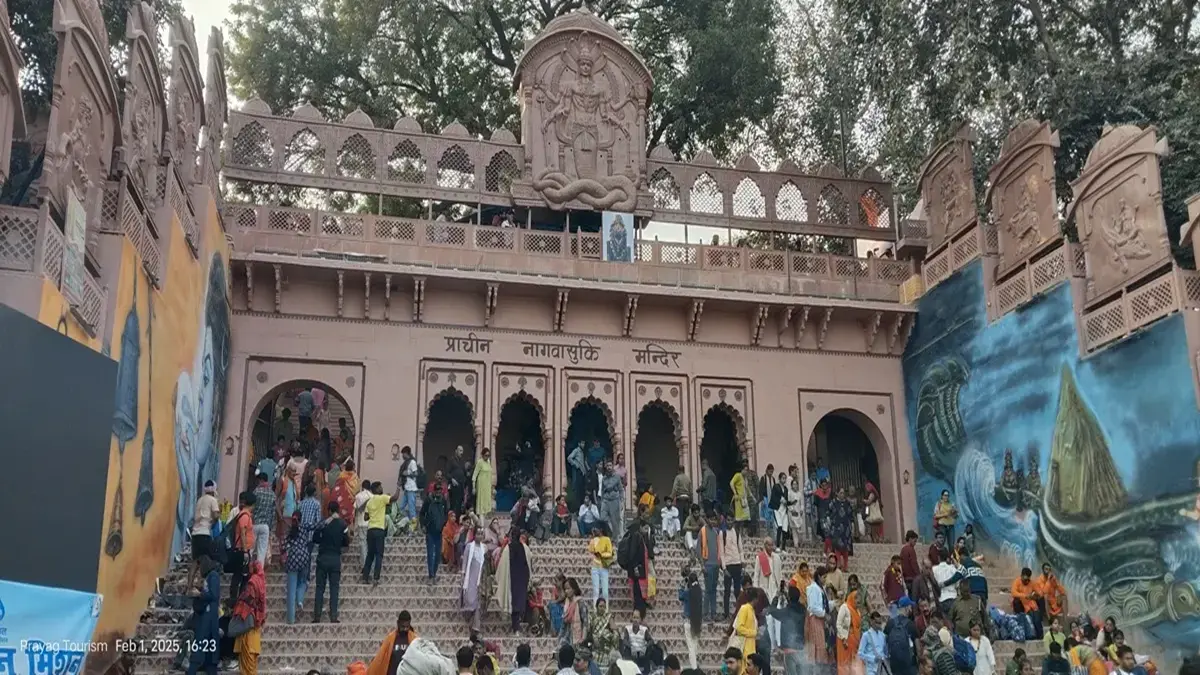
The first light of dawn is just beginning to touch the waters of the holy Ganga. As you walk along the northern edge of the Daraganj ghat, the sounds of the waking city fade behind you. The river breeze is cool against your skin. Somewhere ahead, a temple bell rings softly, carried in the morning air. You are approaching one of the most sacred and unique places of worship in all of Prayagraj: the Nagvasuki Mandir.
Here, in a sanctum overlooking the sacred river, resides Lord Vasuki — the Serpent King, whose body was once used as the cosmic rope in the churning of the ocean of milk. His temple on the banks of the Ganga is a testament to an ancient faith, a pilgrimage destination for devotees from across India, and a place of profound spiritual power. It is said that without bowing your head here, your yatra to Tirtharaj Prayag remains incomplete.
Table of Contents
Quick Facts at a Glance
| Detail | Information |
| Temple Name | Nagvasuki Mandir |
| Location | Daraganj, Prayagraj, Uttar Pradesh |
| Primary Deity | Nagvasuki (King of Serpents) |
| Associated Deity | Lord Shiva, Goddess Parvati, Lord Ganesha, Bhishma Pitamah |
| Religious Tradition | Sanatana Dharma (Shakta / Saiva) |
| Known For | Naga Worship, Remedy for Kaal Sarp Dosh |
| Major Festival | Nag Panchami |
| Nearby Landmark | Triveni Sangam (approx. 3.4 km) |
| Estimated Visit Duration | 45–90 minutes |
The Human Experience
It is the month of Shravan. The monsoon rains have drenched the ghats, and the Ganga is full and flowing strong. You climb the stone steps to the temple entrance. The air is thick with the fragrance of incense, milk, and fresh flowers. Inside the sanctum, a black stone idol with five hoods and four coils gazes out with serene authority. Devotees pour milk over the image, their lips moving in silent prayer.
Outside, the river flows on, the same water that has witnessed the churning of the ocean, the penance of sages, and the footsteps of millions of pilgrims. You stand in a space where mythology is not merely story but living faith, where the cosmic serpent still receives offerings, and where every prayer is a plea for protection, transformation, and peace.
What is Nagvasuki Mandir?
Nagvasuki Mandir is a Hindu temple located in the Daraganj locality of Prayagraj, situated on the banks of the Ganga River. It is dedicated to Vasuki, the king of serpents in Hinduism. The temple is a significant pilgrimage site, particularly known for its association with the Samudra Manthan (churning of the ocean) and its role in mitigating the astrological condition known as Kaal Sarp Dosh. It is one of only two temples in the world (the other being in Nasik) where special rituals are performed to alleviate this dosha.
According to priests, no journey to Prayagraj is complete without paying homage to Nagvasuki. The temple holds special significance for the city as the local belief is that the pilgrimage to Prayag is incomplete without seeking the darshan of Nagvasuki after a holy bath at the Triveni Sangam.
Who is Nagvasuki? The Serpent King in Hindu Tradition
In Hindu tradition, Vasuki is the second king of the serpents (Nagas). He is a powerful deity who, along with his brother Shesha (the serpent on whom Lord Vishnu rests), plays a crucial role in the cosmic order. Unlike his brother Shesha, whose role is to support the universe, Vasuki is the king of the Patala Loka (the netherworld) and is intimately associated with Lord Shiva, who wears him as a sacred ornament around his neck.
Ancient Hindu texts — including the Skanda Purana, Padma Purana, Bhagavata Purana, and the Mahabharata — describe Nagvasuki‘s importance. He is considered the most dedicated devotee of Lord Shiva. The name ‘Vasuki‘ itself means “one with a great and powerful body” — a reference to his immense cosmic form, capable of wrapping itself around a mountain.
The Samudra Manthan: How Nagvasuki Became the Cosmic Rope
The most famous legend associated with Nagvasuki is his role in the Samudra Manthan (the churning of the ocean of milk) — an epic event described in the Puranas where gods (Devas) and demons (Asuras) churned the primordial ocean to obtain the nectar of immortality (Amrita).
Here is how the story unfolds:
The Churning of the Cosmic Ocean
The Devas, having lost their strength, sought the help of the Asuras to churn the ocean of milk and extract the Amrita. They needed a churning rod and a churning rope. Mount Mandara was used as the rod, and the serpent king Vasuki was summoned to serve as the rope.
Vasuki willingly offered his immense body for the task. The Devas held his tail, and the Asuras grasped his head. As they pulled back and forth, the mountain spun, churning the ocean for a thousand years.
The Agony of the Serpent King
The friction of the mountain against the serpent‘s body was unbearable. Vasuki’s scales were scraped raw, and he suffered intense burning pain. Blood flowed from his wounds. The poison that arose from his body during the churning became the deadly Halahala poison, which Lord Shiva later consumed to save the universe.
The Healing at Prayagraj
After the churning was complete, the exhausted and wounded Vasuki could not find relief from his suffering. He approached Lord Vishnu, who advised him to go to Prayagraj and bathe in the cool, sacred waters of the Triveni Sangam, where the Ganga, Yamuna, and Sarasvati meet. When Vasuki arrived and took his dip, the waters soothed his burning body and healed his wounds.
The Promise to Reside
As Vasuki prepared to leave, the gods and sages present requested him to stay in Prayagraj permanently. Vasuki agreed, but on two conditions:
- That every devotee‘s pilgrimage to Prayagraj would be complete only after having his darshan following a holy bath in the Triveni Sangam.
- That he would be specially worshipped on Nag Panchami day in the month of Shravan.
This legend forms the spiritual foundation of the Nagvasuki Mandir and explains why the temple is considered an essential stop on the Prayagraj pilgrimage circuit.
Lord Shiva and the Serpents: The Master of Fearlessness
Why does Lord Shiva wear serpents around his neck, wrists, and arms? The iconography of Shiva as the master of serpents is not merely decorative — it is deeply symbolic.
Fearlessness in the Face of Death
The serpent represents fear, death, and the unknown. By adorning himself with cobras, Lord Shiva demonstrates that he has conquered fear. The serpent is also a symbol of the primal energy (Kundalini) that lies coiled at the base of the spine. Shiva, as the supreme yogi, has mastered this energy and wears it as an ornament.
Vasuki: The Most Beloved Serpent
Among all the serpents that adorn Lord Shiva, Vasuki holds a special place. According to temple tradition, Lord Shiva accepted Vasuki as his most obedient and dedicated devotee. When Nagvasuki was wounded and exhausted after the Samudra Manthan, it was not only Lord Vishnu‘s advice that guided him but also the compassionate grace of Lord Shiva that accepted him as a companion.
For this reason, at the Nagvasuki Mandir, Lord Shiva is also worshipped alongside the Serpent King. Devotees come not only to seek the blessing of Nagvasuki but also to honour the Lord who masters all fear.
Serpent Worship in Sanatana Dharma: Ancient Roots and Meaning
Worship of serpents (Naga) is one of the oldest and most widespread forms of religious practice in India. Archaeological evidence from the Indus Valley Civilization shows serpent motifs, and the tradition continues to this day across the subcontinent.
Ancient Origins
The worship of Nagas predates the Puranas and is mentioned in the earliest Vedic texts. The Nagas are considered the guardians of treasures (both material and spiritual), the keepers of underground water sources, and the protectors of the earth‘s fertility. The Mahabharata and the Puranas contain extensive lists of Naga lineages and their kings, among whom Vasuki is pre‑eminent.
Symbolism of the Naga
- Fertility: Serpents are associated with rain, water, and agricultural abundance. They are worshipped for the fertility of the land and the growth of crops.
- Guardianship: Nagas are the guardians of hidden treasures and secret knowledge. They are protectors of the earth‘s subterranean energies.
- Transformation: The serpent‘s ability to shed its skin makes it a powerful symbol of rebirth, regeneration, and the release of old patterns.
- Healing: In many traditions, serpents are associated with medicinal power and healing. The staff of the god of medicine features a serpent.
- Kundalini: The coiled serpent at the base of the spine represents the dormant spiritual energy that, when awakened, rises through the chakras to unite with supreme consciousness.
The Naga Temples of India
While there are many snake temples across India — including the Nagchandreshwar Temple in Ujjain and the Sheshavtar Shri Laxman Temple in Ayodhya — the Nagvasuki Mandir in Prayagraj stands out for its unique role in alleviating Kaal Sarp Dosh and for the sheer scale of its Nag Panchami celebrations. It is widely considered the most prominent center for Naga worship in northern India.
History of Nagvasuki Mandir: From the 10th Century to Today
The Ancient Origins (10th Century CE)
The origins of Nagvasuki Mandir trace back to the 10th century CE. A temple existed on this site even then, perhaps the original structure. However, due to the passage of time, invasions, and natural calamities, the ancient temple fell into disrepair.
The 18th-Century Reconstruction by Shridhar Bhonsle
The present structure of the Nagvasuki Mandir was built in the 18th century by the Maratha king Shridhar Bhonsle. He is also credited with renovations to the nearby ghats.
According to local tradition, King Shridhar Bhonsle had developed leprosy and was suffering terribly. The royal priest (Raj Pandit) told the king that if he renovated the Nagvasuki Temple on the banks of the Ganga and restored the ghats, he would be healed. The king, moved by faith, undertook the massive renovation. Miraculously, he was cured of his affliction. As a mark of gratitude, he not only rebuilt the temple but also constructed the pucca ghat that still stands today.
Aurangzeb and the Legend of the Undestroyable Deity
There is a fascinating local legend about the Mughal emperor Aurangzeb. According to the temple tradition, Aurangzeb‘s soldiers attempted to destroy the Nagvasuki Mandir but were unable to. The more they tried, the more the deity‘s form seemed to resist their efforts. When Aurangzeb himself came to the temple to destroy it, the deity appeared before him in a terrifying form, causing the emperor to fall unconscious. Frightened, Aurangzeb abandoned his plan and the temple remained unharmed. This story is told by the temple priests as a testament to the divine protection surrounding the shrine.
Modern Renovation for Maha Kumbh 2025
In 2024, as part of the preparations for the Maha Kumbh Mela 2025, the Government of Uttar Pradesh allocated Rs 4.76 crore for the renovation of the Nagvasuki Temple. The temple‘s shikhara (spire) was adorned with vibrant red stones from Rajasthan, known for their beauty, durability, and resistance to temperature changes. The renovation was completed on time, ahead of the massive influx of pilgrims, ensuring that the temple would stand as a shining landmark for the millions who came to bathe at the Sangam.
The temple also underwent major flood protection work. During the monsoon, the Ganga‘s rising water level used to reach the temple‘s stairs, but after the renovation, the structure has been reinforced against the annual rise in water levels. In the month of Shravan, devotees can bathe at the temple‘s shrine if they wish.
Temple Architecture: A Medieval Gem on the Ganga
The Nagvasuki Mandir is a fine example of medieval Hindu temple architecture. Built primarily of stone and brick, the temple exudes a sense of ancient strength and sacred simplicity. Its shikhara (spire) is coloured yellow and orange, making it visible from a distance along the riverbank.
Exterior
The temple‘s main gate is adorned with traditional motifs — lotus flowers, elephants, and conch shells — inviting pilgrims into a space of deep spirituality. The outer walls are carved with images of serpents, symbols of the deity within.
Interior and Sanctum (Garbhagriha)
Inside the sanctum sanctorum, the black stone idol of Lord Vasuki is placed at the centre of the temple. The idol is five‑hooded and has four coils in his body. This five‑hooded form is a powerful symbol of the deity‘s cosmic authority, representing mastery over the five elements of nature.
Darshan and Atmosphere
The atmosphere inside the sanctum is one of quiet reverence. The air is thick with the smoke of sambrani (benzoin resin), which is burned continuously at the entrance, purifying the space and creating a meditative mood. The temple is clean, well‑maintained, and accessible via a short flight of stairs. The sounds of river flow and temple bells merge into a single prayer.
The Sacred Ganga and Nagvasuki: A Divine Confluence
The location of the Nagvasuki Mandir is not accidental. It sits on a high cliff overlooking the Ganga, at the northern end of the Daraganj locality, approximately 2 km north of the Triveni Sangam.
The River as Healer
According to the Padma Purana, after Vasuki was wounded during the Samudra Manthan, he came to Prayagraj and bathed in the waters of the Sarasvati River (the third, invisible river of the Sangam) to heal himself. This legend establishes the Ganga‘s sacred waters as a source of rejuvenation and healing — a belief that continues to draw millions of pilgrims to the riverbanks.
The Flood Tradition
Every monsoon, when the Ganga rises, the water reaches the steps of the Nagvasuki Mandir. During the Shravan month, devotees consider it auspicious to bathe at the shrine itself, believing that the water which touches the temple‘s steps is blessed by the presence of Nagvasuki.
The View from the Temple
Standing on the temple premises, you can see the Ganga flowing towards the distant Triveni Sangam. The sunset view is especially beautiful, with the river‘s waters reflecting the colours of the sky and the temple‘s spire standing silhouetted against the horizon.
The Idol of Nagvasuki: Five Hoods and Four Coils
The central idol of the Nagvasuki Mandir is a masterpiece of religious art. It is carved from black stone and depicts Lord Vasuki with five hoods and four coils. The five hoods represent the deity‘s mastery over the five elements: earth, water, fire, air, and ether. The four coils symbolize the four directions — indicating that Vasuki‘s reach extends to the ends of the universe.
The Material and the Legend
The black stone idol is said to be extremely ancient. According to local tradition, the idol was installed by the Manasaputras — the mind‑born sons of Lord Brahma — making the sanctum an object of worship from the very beginning of creation. The stone itself is believed to have miraculous properties, including the power to remove the effects of the Kaal Sarp Dosh.
The Worship of the Murti
Devotees approach the idol with offerings of milk, water, flowers, and incense. The ritual of pouring milk (abhishekam) over the idol is believed to cool the deity and, by extension, bring peace and healing to the devotee‘s life.
Other Deities and Shrines in the Temple Complex
In addition to the main sanctum of Lord Vasuki, the Nagvasuki Mandir complex includes several smaller shrines that are equally revered by pilgrims.
Lord Shiva (Mahadev)
As Nagvasuki is the most devoted follower of Lord Shiva, the temple naturally includes a shrine dedicated to Mahadev — often in the form of a Shiva Linga. Devotees offer water and bilva leaves, seeking Lord Shiva‘s blessings alongside those of the Serpent King.
Goddess Parvati
The temple also honours Goddess Parvati, the consort of Lord Shiva, who represents divine feminine energy and the nurturing aspect of the universe.
Lord Ganesha
A shrine to Lord Ganesha, the remover of obstacles, is present near the entrance. Devotees typically offer prayers to Ganesha before proceeding into the main sanctum.
The Reclining Bhishma Pitamah
One of the most unique features of the Nagvasuki Mandir is the presence of a reclining statue of Bhishma Pitamah. Bhishma, the grand patriarch of the Mahabharata, is said to have been connected to Lord Vasuki through a boon. According to temple tradition, Bhishma was originally a serpent king named Vasu, who was later born as a human due to a curse. This Mahabharata connection adds a rich, epic layer to the temple‘s spiritual tapestry.
Daily Worship and Temple Rituals: A Pilgrim‘s Guide
The daily worship at Nagvasuki Mandir follows a traditional schedule of aartis (ceremonial rituals with fire) and abhishekams (ritual bathing of the deity). The temple is open for darshan from 5:00 AM to 9:00 PM. The temple also has certain midday closures.
The Aarti Schedule
The main aartis are held at the following times:
| Aarti | Timing | Description |
| Mangala Aarti | Early morning (approx. 5:00 AM) | The first aarti of the day, awakening the deity. |
| Shringar Aarti | Mid‑morning (approx. 8:00 AM) | The deity is adorned with fresh clothes, flowers, and jewellery. |
| Rajbhog Aarti | 12:00 PM | The midday offering of food to the deity. |
| Sandhya Aarti | Sunset (approx. 6:30 PM) | The grand evening aarti, the most beautiful and well‑attended. |
Daily Offerings
Devotees commonly offer:
- Milk: Poured over the idol in a ritual known as abhishekam.
- Flowers: Especially red flowers, garlands, and hibiscus.
- Incense: Fragrant sticks burned at the temple‘s entrance.
- Coconut: Offered as a symbol of surrender and purity.
- Sindoor (vermilion): Applied to the deity‘s forehead as a mark of auspiciousness.
Shravan Month Specials
During the holy month of Shravan (July–August), special rituals are performed every Monday (Shravan Somvar). These include:
- Rudrabhishek
- Mahabhisheka
- Special pujas for Kaal Sarp Dosh
Nag Panchami: The Grand Festival at Nagvasuki Mandir
The most important festival celebrated at the Nagvasuki Mandir is Nag Panchami, which falls on the fifth day (Panchami) of the bright fortnight (Shukla Paksha) of the Hindu month of Shravan (July–August).
The Significance of the Day
Nag Panchami is a festival dedicated to the worship of all snakes and serpents. On this day, the serpent king Nagvasuki is honoured with special rituals. It is believed that worship on this day removes the fear of snakebite, brings prosperity to the family, and grants protection to all devotees.
The Celebrations at the Temple
On Nag Panchami, the temple is thronged by thousands of devotees from early morning. They come carrying trays of milk, flowers, vermilion, and coins. The atmosphere is one of joyous devotion, with the sounds of bells, conch shells, and chants filling the air.
Highlights of the festival include:
- Milk Abhishekam: Devotees pour milk over the five‑hooded idol of Vasuki in a continuous stream.
- Special Pujas: Priests perform elaborate rituals to honour Nagvasuki and all Nagas.
- Fasting: Many devotees observe a fast on Nag Panchami, breaking it only after the evening rituals.
- Nag Panchami Fair: A grand fair is organized outside the temple, with stalls selling religious items, sweets, and traditional crafts.
The Promise of Vasuki
According to the legend, Nagvasuki promised to be specially worshipped on Nag Panchami day. By honouring him on this sacred day, devotees believe they are fulfilling the ancient condition set by the Serpent King and thereby earning his eternal protection.
Nagvasuki Mandir During Kumbh Mela and Magh Mela
The Kumbh Mela (held at Prayagraj every 12 years, with the next in 2031) and the Magh Mela (held annually in January–February) draw tens of millions of pilgrims to the Triveni Sangam. For these pilgrims, the Nagvasuki Mandir is an essential stop.
The Pilgrim‘s Path: Sangam First, Then Vasuki
According to the temple‘s tradition, no pilgrimage to Prayagraj is complete without two acts:
- A holy bath at the Triveni Sangam.
- A darshan of Nagvasuki following that bath.
This sequence is not merely a suggestion but a requirement — it was one of the conditions that Nagvasuki himself set when he agreed to reside in Prayagraj. As a result, during the Kumbh Mela and Magh Mela, the temple sees huge crowds of pilgrims who have just bathed at the Sangam and are now making their way north to Daraganj to complete their pilgrimage.
The Proximity to the Sangam
The Nagvasuki Mandir is located approximately 3.4 km north of the Triveni Sangam. This makes it easily accessible by auto‑rickshaw or taxi from the Kumbh Mela grounds.
Special Arrangements for Kumbh
For the Maha Kumbh Mela 2025, the government completed the renovation of the Nagvasuki Mandir months in advance, ensuring that the temple was ready to receive the massive influx of pilgrims. The authorities also made special transport arrangements to help pilgrims travel easily between the Sangam and the temple.
The Faith of the Pilgrims
As stated in the Mahabharata: “tatra bhogavati nama, vasuki tirtha uttamam / tatraabhishekam yah kuryaat, sah ashwamedha phalam labhet” — “In the Prayaga Kshetra there exists a prominent tirtha by the name of Vasuki. Those who take holy bath there avail the punya of performing the Ashwamedha Yajna”. This ancient verse continues to inspire millions of pilgrims to include Nagvasuki Mandir in their Kumbh itinerary.
The Mystic Rite: Resolving Kaal Sarp Dosh
One of the primary reasons devotees flock to the Nagvasuki Mandir is to seek relief from Kaal Sarp Dosh — an inauspicious planetary alignment in a person’s horoscope.
What Is Kaal Sarp Dosh?
According to Vedic astrology, Kaal Sarp Dosh occurs when all the planets in a birth chart are hemmed between Rahu and Ketu (the north and south lunar nodes). This astrological condition is believed to cause obstacles, delays, financial problems, health issues, and other difficulties in a person‘s life.
Why Nagvasuki Mandir is Special
The Nagvasuki Mandir in Prayagraj is one of only two temples in the world (the other being in Nashik, Maharashtra) where special rituals are performed to mitigate the effects of Kaal Sarp Dosh. Devotees who perform the prescribed pujas here believe that the dosha is neutralized.
The Rituals for Kaal Sarp Dosh
The temple priests perform several specific rites for those seeking relief from Kaal Sarp Dosh:
- Abhishek of Nagvasuki Idol: Devotees pour milk, water, and holy substances over the five‑hooded idol.
- Feeding of Brahmins (Brahmin Bhoj): Feeding a group of Brahmins is considered an essential part of the ritual.
- Donation of Silver Snakes (Nag Nagin): Some devotees offer small silver snake figurines to the temple as a form of atonement.
- Performance of Pind Daan for Pitris: Ancestral rituals are also performed at the temple, as resolving Kaal Sarp Dosh often involves appeasing the ancestors.
The priests of the temple — who belong to a long lineage — guide pilgrims through these complex rituals, ensuring that the ancient traditions are followed correctly.
The Belief of the Faithful
Lakhs of pilgrims visit the Nagvasuki Mandir every year specifically to perform Kaal Sarp Dosh pujas. The temple‘s reputation for resolving astrological afflictions has grown over centuries, and many devotees return to the temple after experiencing positive changes in their lives.
Spiritual Lessons of the Serpent: Transformation and Renewal
The serpent (Naga) is more than a mythological creature; it is a symbol of deep spiritual truths.
Transformation (Moulting of Skin)
The serpent‘s ability to shed its skin is one of nature‘s most powerful metaphors for transformation and renewal. In the same way, a devotee who worships Nagvasuki seeks to shed the old patterns of thought, behaviour, and karma that bind him. The serpent reminds us that we are not trapped by our past — we can grow, change, and emerge renewed.
Fearlessness
A serpent‘s venom can be deadly, yet the yogi learns to handle the serpent without fear. Lord Shiva wears serpents around his neck as ornaments — a symbol of his complete mastery over fear, poison, and death. The devotee who worships Nagvasuki prays for the strength to face life‘s challenges without fear, trusting in the protection of the divine.
Protection
In many parts of rural India, snakes are considered guardians of the land — protectors of the hidden treasures beneath the earth. Nagvasuki, as the king of serpents, is the supreme guardian. Devotees pray to him for protection from physical harm, from evil intentions, and from the “venom” of jealousy, anger, and hatred.
The Kundalini Power
The coiled serpent at the base of the spine represents the Kundalini Shakti — the primordial cosmic energy that lies dormant in every human being. When this energy awakens, it rises through the chakras, leading to spiritual enlightenment. The five‑hooded Nagvasuki is a symbol of the awakened Kundalini, its five heads representing the control over the five elements and the five senses.
Nagvasuki in the Sacred Landscape of Prayagraj
The Nagvasuki Mandir is an integral part of the sacred geography of Tirtharaj Prayag. It sits in a network of holy sites that pilgrims traditionally visit during their journey to the Sangam.
The Pilgrimage Circuit
A complete pilgrimage to Prayagraj typically includes darshan at:
- Triveni Sangam — holy bath and prayers at the confluence of the Ganga, Yamuna, and Sarasvati.
- Nagvasuki Mandir — to seek the blessing of the Serpent King.
- Bade Hanuman Ji Mandir — to pay respects to the guardian (kotwal) of Prayagraj.
- Akshayavat — the indestructible banyan tree inside the Allahabad Fort.
- Patalpuri Temple — the ancient underground shrine.
- Alopi Devi Mandir — the unique Shakti Peetha.
- Bharadwaj Ashram — the ancient hermitage visited by Lord Rama.
Distance from Other Sites
| Site | Distance from Nagvasuki Mandir |
| Triveni Sangam | Approx. 3.4 km |
| Dashashwamedh Ghat | Approx. 2.5 km |
| Alopi Devi Mandir | Approx. 4 km |
| Bade Hanuman Ji Mandir | Approx. 3 km |
All of these sites are within a short distance of each other, making it easy for pilgrims to visit them in a single day.
How to Reach Nagvasuki Mandir
Address: Daraganj Ghat (near Rameshwar Mandir), Daraganj, Prayagraj, Uttar Pradesh 211006
| Mode | Details |
| By Air | Prayagraj Airport (Bamrauli) — approximately 12–14 km. Take a taxi or auto‑rickshaw from the airport to Daraganj. |
| By Train | Prayagraj Junction — approximately 5 km. Auto‑rickshaws and e‑rickshaws are readily available outside the station. Taxis can also be hired. |
| By Road | The temple is well‑connected by road. You can take an auto‑rickshaw or a city bus to Daraganj. |
| By E‑rickshaw | The most convenient way to reach the temple from anywhere in the city, especially during the Kumbh Mela. |
Local Landmark: Tell your auto‑rickshaw driver “Nagvasuki Mandir, Daraganj” or “Daraganj Ghat near Rameshwar Mandir.”
Visitor Guide: Timings, Entry, Best Time to Visit
Temple Timings
The Nagvasuki Mandir is open daily. Timings vary slightly according to the season. The temple is open for darshan from 5:00 AM to 12:00 PM and 3:00 PM to 9:30 PM.
| Day | Morning Darshan | Afternoon Break | Evening Darshan |
| Monday – Sunday | 5:00 AM – 12:00 PM | 12:00 PM – 3:00 PM | 3:00 PM – 9:30 PM |
Please note that timings may vary on festival days and during the Kumbh Mela.
Aarti Timings
- Mangala Aarti: 5:00 AM
- Shringar / Rajbhog Aarti: 12:00 PM
- Sandhya Aarti: Sunset (approx. 6:30 PM, varies by season)
Entry Fee
There is no entry fee to visit the Nagvasuki Mandir.
Best Time to Visit
| Season | Experience |
| Winter (October – February) | Pleasant weather. The best time for a comfortable visit. |
| Summer (March – June) | Hot and humid, but early mornings are still good for darshan. |
| Monsoon (July – September) | The Ganga is in full flow; the temple‘s steps may be flooded. |
Best Time of Day: The early morning (just after 5:00 AM) is the quietest and most peaceful time for darshan. The evening aarti is the most beautiful.
What to Wear
Modest, respectful clothing is recommended. As the temple is a place of active worship, shoulders and knees should be covered.
What to Carry
- A small water bottle
- A camera (photography is generally allowed, but be discreet and avoid using flash inside the sanctum)
- Offerings (milk, flowers, coconuts) — available near the temple entrance
- A donation for the temple’s upkeep (not compulsory)
Visitor Tips
- Arrive early to avoid the crowds, especially during festival seasons.
- Photography is allowed in the courtyard but check with the priests before taking pictures inside the sanctum.
- Remove your shoes before entering the main temple area.
- Be respectful of devotees who are in deep prayer.
- Beware of touts offering to “guide” you through the rituals. The temple priests are the proper guides.
- Carry cash for offerings and donations.
- Check the water level if you are visiting during the monsoon (July–September), as the temple steps can be flooded.
Safety Tips
- The temple is generally safe, but keep your valuables secure in crowded situations.
- The steps can be slippery, especially during the rainy season. Walk carefully.
Frequently Asked Questions (FAQs)
1. Why is Nagvasuki Mandir famous?
The temple is famous for being one of only two temples in the world where special rituals are performed to remove the negative effects of Kaal Sarp Dosh. It is also the most prominent centre for Nag Panchami celebrations in northern India.
2. Who is Nagvasuki?
Nagvasuki is Vasuki, the king of serpents in Hindu tradition. He played a crucial role in the Samudra Manthan (churning of the ocean), where he served as the cosmic rope. He is the most dedicated devotee of Lord Shiva.
3. Is Nagvasuki Mandir a Shakti Peetha?
No. The Nagvasuki Mandir is not a Shakti Peetha. It is a Naga (serpent) temple dedicated to Vasuki, the king of serpents. The Shakti Peetha in Prayagraj is the Alopi Devi Mandir.
4. What is the story of Nagvasuki and the Samudra Manthan?
During the churning of the ocean, Vasuki was used as the rope. He suffered immense pain from the friction of the mountain. After the churning, Lord Vishnu advised him to bathe in the sacred waters of the Triveni Sangam in Prayagraj, which healed his wounds. He then agreed to reside in Prayagraj on two conditions: that pilgrims visit him after bathing at the Sangam, and that he be specially worshipped on Nag Panchami.
5. Why is Nag Panchami celebrated at Nagvasuki Mandir?
Nag Panchami is celebrated to honour Nagvasuki and all serpents. It is one of the two conditions Vasuki set when he agreed to reside in Prayagraj. The festival is celebrated with great fervour, with thousands of devotees offering milk and flowers to the deity.
6. Can non‑Hindus visit Nagvasuki Mandir?
Yes. The temple is open to visitors of all faiths. Visitors are expected to dress modestly and behave respectfully.
7. What is the darshan timing of Nagvasuki Mandir?
The temple is open for darshan from 5:00 AM to 12:00 PM and 3:00 PM to 9:30 PM daily.
8. Is there any entry fee for Nagvasuki Mandir?
No, there is no entry fee.
9. How do I reach Nagvasuki Mandir?
The temple is located in Daraganj, Prayagraj, on the banks of the Ganga. It is approximately 3.4 km north of the Triveni Sangam. You can reach it by auto‑rickshaw, taxi, or e‑rickshaw from any part of the city.
10. What is the best time to visit Nagvasuki Mandir?
The best time is during the winter months (October to February). The best time of day is early morning (just after 5:00 AM) or during the evening aarti (around sunset).
11. Is Nagvasuki Mandir near the Triveni Sangam?
Yes, it is approximately 3.4 km north of the Sangam — a short auto‑rickshaw ride away.
12. What should I offer at Nagvasuki Mandir?
Common offerings include milk (for abhishek), flowers (especially red flowers), coconuts, incense, and sindoor (vermilion).
13. Is photography allowed inside the temple?
Photography is generally allowed in the courtyard. Inside the sanctum, it is best to ask permission from the priest and avoid using flash.
14. What is the significance of the five hoods on the Nagvasuki idol?
The five hoods represent the deity‘s mastery over the five elements (earth, water, fire, air, and ether), signifying his cosmic authority.
15. Are there any other deities in the Nagvasuki Mandir complex?
Yes, there are shrines dedicated to Lord Shiva, Goddess Parvati, Lord Ganesha, and a reclining statue of Bhishma Pitamah from the Mahabharata.
16. Is there a parking facility at Nagvasuki Mandir?
Parking is limited. Auto‑rickshaws and e‑rickshaws are the most convenient modes of transport.
17. How do I perform the Kaal Sarp Dosh puja at the temple?
You should contact the temple priests for guidance. The ritual typically involves abhishek of the Nagvasuki idol, feeding Brahmins (Brahmin Bhoj), and offering donations of silver snake figurines.
18. What is the role of Nagvasuki Mandir during the Kumbh Mela?
During the Kumbh Mela, the temple is an essential stop for pilgrims who have bathed at the Triveni Sangam. According to tradition, a pilgrimage to Prayagraj is incomplete without a darshan of Nagvasuki.
19. Is the temple wheelchair accessible?
The temple is accessible via a short flight of stairs, which may be challenging for wheelchair users. Assistance may be required.
20. Why should I visit Nagvasuki Mandir?
You should visit Nagvasuki Mandir because it is one of the most unique and spiritually powerful temples in Prayagraj. It offers a rare opportunity to connect with the ancient tradition of Naga worship, seek relief from astrological afflictions, and complete your pilgrimage to Tirtharaj Prayag.
The Eternal Guardian of the Sacred Rivers
As the evening aarti concludes and the lamps are extinguished, the river flows on, carrying the echoes of devotion into the gathering dusk. The Nagvasuki Mandir stands on the bank, as it has for centuries, offering shelter to all who seek the protection of the Serpent King.
The serpent — feared by many, revered by the faithful — guards the secrets of the earth, the waters beneath, and the kundalini energy within. At Nagvasuki Mandir, the serpent is not a creature of terror but a divine guardian, a healer, and a symbol of the eternal cycle of death and rebirth.
To visit this temple is to step into the ancient world — a world where gods and demons churned the ocean for nectar, where serpents served as ropes, and where a wounded king found healing in the waters of the Sangam. It is to stand on a bank of the Ganga and feel the weight of a faith that has flowed uninterrupted for centuries.
May Nagvasuki protect you on your journey. May his five hoods shield you from harm. May his coils embrace you with the strength of renewal. And may your yatra to Prayagraj be complete and blessed.
This article is part of a series on the sacred temples and pilgrimage sites of Prayagraj.
Prayag Tourism
📞 Phone/WhatsApp: +91-9555313526
📧 Email: contact@prayagtourism.com
🌐 Website: PrayagTourism.com
May your journey be peaceful, safe, and spiritually enriching – and may the blessings of the Serpent King be with you always.