
Table of Contents
The Human Experience
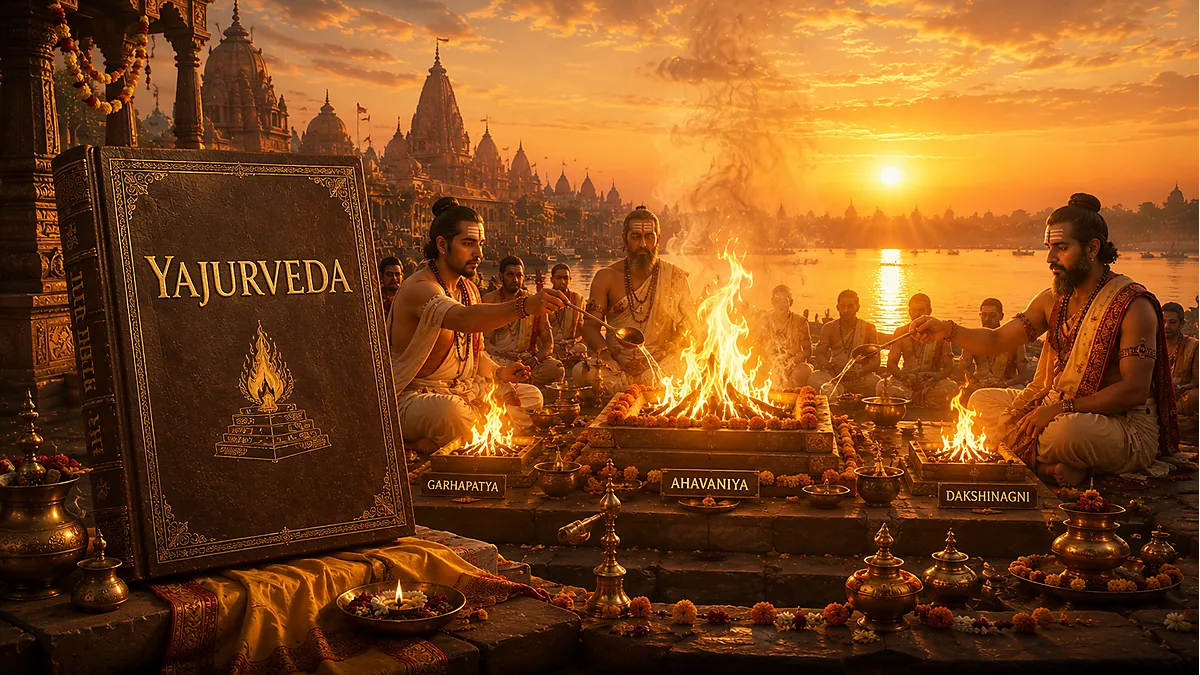
Imagine yourself standing before a sacred fire as dawn breaks over the horizon. The air is thick with the fragrance of sandalwood and ghee. Sanskrit mantras flow like a gentle river from the lips of priests dressed in white. The flames crackle softly, reaching toward the heavens as if carrying whispered prayers to the gods.
For thousands of years, this scene has repeated itself across the Indian subcontinent – from the banks of the Ganges at Prayagraj to the sacred soil of Kurukshetra, from the forests of Naimisharanya to the temples of Kashi.
But here is the question that has echoed through millennia:
What if every meaningful action in your life could become an offering to something greater than yourself?
This is the central question posed by the Yajurveda – the ancient Veda of sacred action, sacrifice, and cosmic harmony.
Unlike its elder sibling the Rigveda, which sings hymns of praise to the deities, or the Samaveda, which sets those hymns to melody, the Yajurveda is intensely practical. It is the manual of sacred action, the guidebook for transforming ordinary life into a continuous act of worship, gratitude, and service.
For the pilgrim visiting Prayagraj, for the seeker exploring the depths of Sanatana Dharma, for the ordinary person seeking meaning in daily responsibilities – the Yajurveda offers a revolutionary insight: Your life itself can be a sacrifice, not as a loss, but as the highest form of gain.
Let us journey together into this profound wisdom.
Quick Facts
| Attribute | Detail |
| Name | Yajurveda |
| Category | Veda |
| Primary Focus | Yajna and Ritual Knowledge |
| Major Branches | Shukla Yajurveda and Krishna Yajurveda |
| Core Themes | Duty, Sacrifice, Cosmic Order, Sacred Action |
| Associated Concepts | Yajna, Dharma, Offering, Responsibility |
| Number of Mantras (Shukla) | 1,975 |
| Number of Chapters (Shukla) | 40 |
| Key Upanishads | Isha, Brihadaranyaka |
| Estimated Reading Time | 15–20 Minutes |
What is the Yajurveda?
The Meaning of “Yajus”
The word Yajus comes from the root yaj, which means “to worship,” “to sacrifice,” “to offer,” or “to unite.” The ancient scholar Yaska, in his Nirukta, explains that Yajus refers to sacred formulas arranged in prose form, distinguished from the metrical hymns of the Rigveda.
The Shatapatha Brahmana (one of the most important explanatory texts of the Yajurveda) offers a beautiful etymological explanation. It breaks down the word Yajuh into two parts:
Yat + Juh
- Yat means “moving” or “dynamic”
- Juh means “sky” or “space”
Thus, Yajuh refers to that which moves through the sky – the dynamic energy that connects heaven and earth. This is none other than the sacred fire, the divine messenger, the medium through which offerings ascend to the gods and blessings descend to humanity.
The Place Among the Four Vedas
The four Vedas are traditionally described as:
| Veda | Primary Focus |
| Rigveda | Hymns of praise (Pada – poetry) |
| Yajurveda | Sacrificial formulas (Gadya – prose) |
| Samaveda | Melodies and chants |
| Atharvaveda | Household rites and healing |
But these divisions are not rigid. The Yajurveda contains approximately 663 mantras borrowed from the Rigveda, yet it adapts them for specific ritual purposes. What makes the Yajurveda unique is its prose style – the aniyataksharavasano yajuh – where the number of syllables is not fixed, allowing flexibility for ritual application.
The Purpose of the Yajurveda
The Yajurveda exists to answer a fundamental human question:
How do we maintain harmony between ourselves, nature, and the divine?
Its answer is Yajna – the principle of selfless offering, of giving back to the cosmic order that sustains us.
“Yajna vai shreshthatamam karma” – “Yajna is the highest form of action.”
This is not merely about pouring ghee into a fire. It is about cultivating a consciousness of gratitude, reciprocity, and responsibility. Every breath, every meal, every act of service can become a yajna when offered with the right attitude.
The Story of the Yajurveda
Sage Vyasa and the Division of the Vedas
According to tradition, the original Veda was one – an infinite ocean of spiritual knowledge received by the ancient rishis through direct realization. At the dawn of the current age (the Kali Yuga), the great sage Veda Vyasa recognized that humanity would no longer be capable of grasping this vast wisdom in its entirety.
With divine compassion, he divided the single Veda into four parts, entrusting each to a chief disciple:
- Rigveda – to Paila
- Yajurveda – to Vaisampayana
- Samaveda – to Jaimini
- Atharvaveda – to Samantu
The Curse and the Division
The story of how the Yajurveda split into its two major branches – Shukla (White) and Krishna (Dark) – is one of the most fascinating narratives in Vedic literature.
Sage Vaisampayana taught the Yajurveda to his disciples. However, after a certain incident involving a grave offense, Vaisampayana cursed his student Yajnavalkya to return all the knowledge he had received.
Yajnavalkya, undeterred, vomited the mantras he had learned. The other disciples, instructed by their guru, assumed the form of partridges (tittiri) and consumed these mantras. This became the Taittiriya Samhita – the “partridge” recension – also known as the Krishna (Dark) Yajurveda because it mixed mantras with explanatory Brahmana passages.
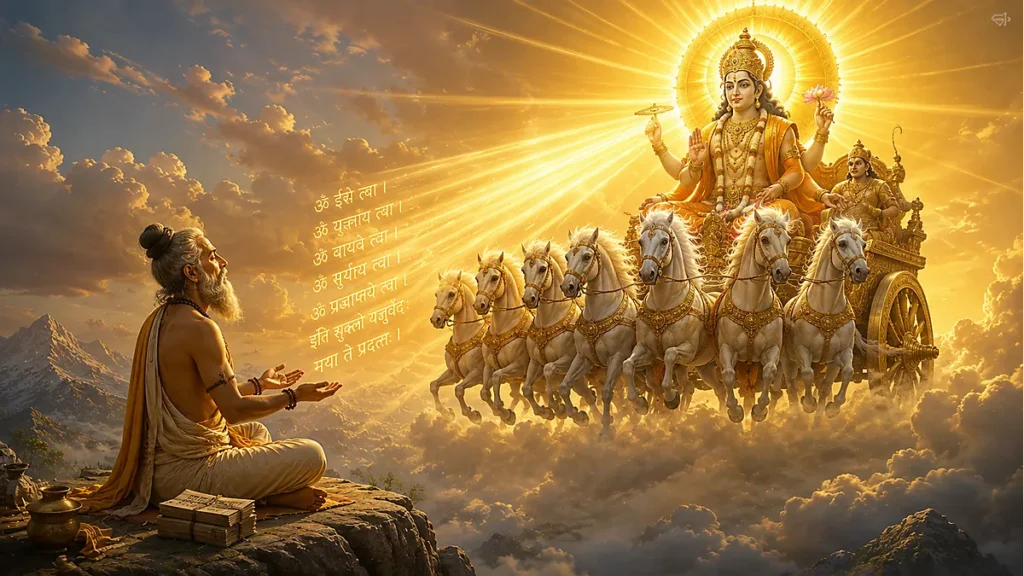
But Yajnavalkya did not remain without knowledge. He undertook severe penance to propitiate the Sun God, Surya. Pleased with his devotion, Surya appeared to him in the form of a horse (vaji) and revealed the Shukla (White) Yajurveda – a recension where the mantras appear pure, unmixed, and brilliantly clear, like sunlight.
This is why the Shukla Yajurveda is also called the Vajasaneyi Samhita – the collection revealed by the horse (vaji) to Yajnavalkya.
Shukla and Krishna Yajurveda – The Two Great Branches
Krishna Yajurveda (The Dark/Yoked Branch)
The term “Krishna” here does not mean dark in a negative sense. Rather, it indicates that in this recension, the mantras are interwoven with Brahmana passages (explanatory prose). The mantras and their ritual applications appear together, “yoked” as it were.
Available Samhitas of Krishna Yajurveda:
| Samhita | Key Features |
| Taittiriya | Most complete; includes Samhita, Brahmana, Aranyaka, Upanishad, Shrautasutra, Grihyasutra |
| Maitrayani | Preserved primarily in Maharashtra |
| Kathaka | Associated with northern India |
| Kapishthala Katha | A less common recension |
The great commentator Sayana (14th century CE) belonged to the Taittiriya school, which is why his monumental commentary first focused on this recension.
Shukla Yajurveda (The White/Shining Branch)
The Shukla Yajurveda presents the mantras in their pure, unmixed form. The explanatory Brahmana – the Shatapatha Brahmana – is preserved separately.
Structure of the Shukla Yajurveda (Madhyandina Recension):
- Total chapters: 40
- Total mantras: 1,975
- First 18 chapters: Concerned with various yajnas (Darsha-purnamasa, Agnyadhana, Rajasuya, Vajapeya, Ashvamedha)
- Chapter 40: The Isha Upanishad – a pure philosophical treatise on the nature of the Self and the Supreme
The Kanva recension, more prevalent in South India, contains 2,086 mantras.
The Essential Difference
| Aspect | Krishna Yajurveda | Shukla Yajurveda |
| Style | Mantra + Brahmana mixed | Mantra pure, Brahmana separate |
| Metaphor | “Dark” – integrated | “White” – distinct |
| Key Teacher | Vaisampayana | Yajnavalkya |
| Major Recensions | Taittiriya, Maitrayani, Kathaka | Madhyandina, Kanva |
What is Yajna? The Heart of the Yajurveda
Beyond the Ritual
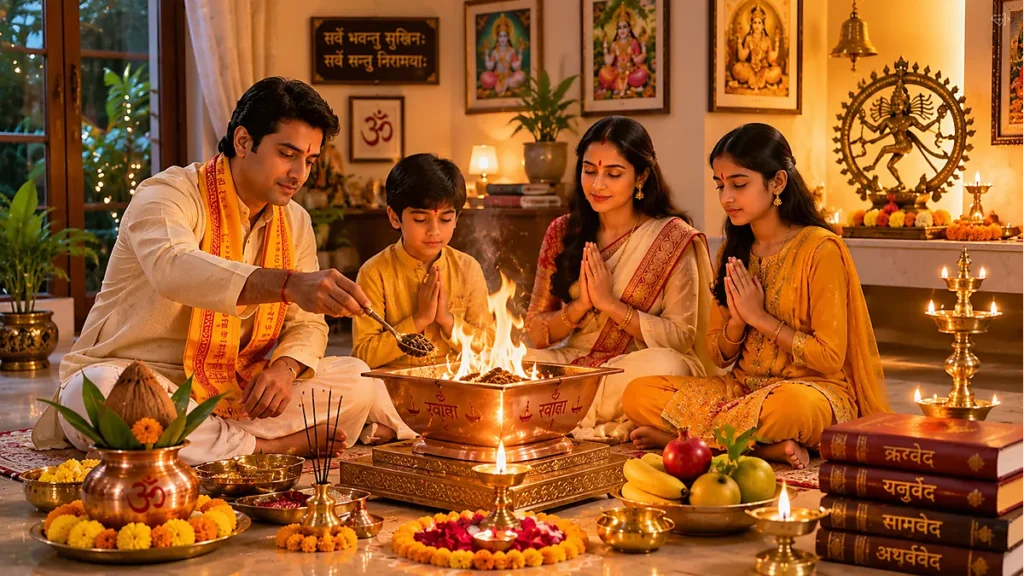
When most people hear the word yajna, they imagine a fire altar, priests chanting, ghee being poured into flames. While this is one dimension, the Yajurveda’s understanding of yajna is far more profound.
The root yaj has three primary meanings:
- Deva-pujana – worship of the divine (or higher ideals)
- Sangatikarana – coming together, cooperation, organized action
- Dana – offering, giving, sharing
Thus, yajna is any sacred, cooperative, selfless action performed for the welfare of all.
The Bhagavad Gita, drawing directly from Vedic wisdom, declares:
“Sahayajnah prajah srishtva purovacha prajapatih” – “In the beginning, the Creator created humanity along with yajna and said: By this, may you prosper.”
The Cosmic Reciprocity
The Yajurveda reveals that the entire universe operates on the principle of yajna:
- The sun gives its energy to the earth (an offering)
- Plants convert that energy into food (an offering)
- Animals and humans consume that food (receiving)
- They offer back their labor, their gratitude, their service (returning)
This cycle of giving and receiving is the heartbeat of existence.
As the Yajurveda says beautifully:
“Iyam vedih paro antah prithivya ayam yajno bhuvanasya nabhih” – “This sacred altar is the furthest extent of the earth; this yajna is the navel of the universe.”
Just as the navel nourishes the growing child, yajna nourishes the cosmic order.
The Five Great Yajnas for Daily Life
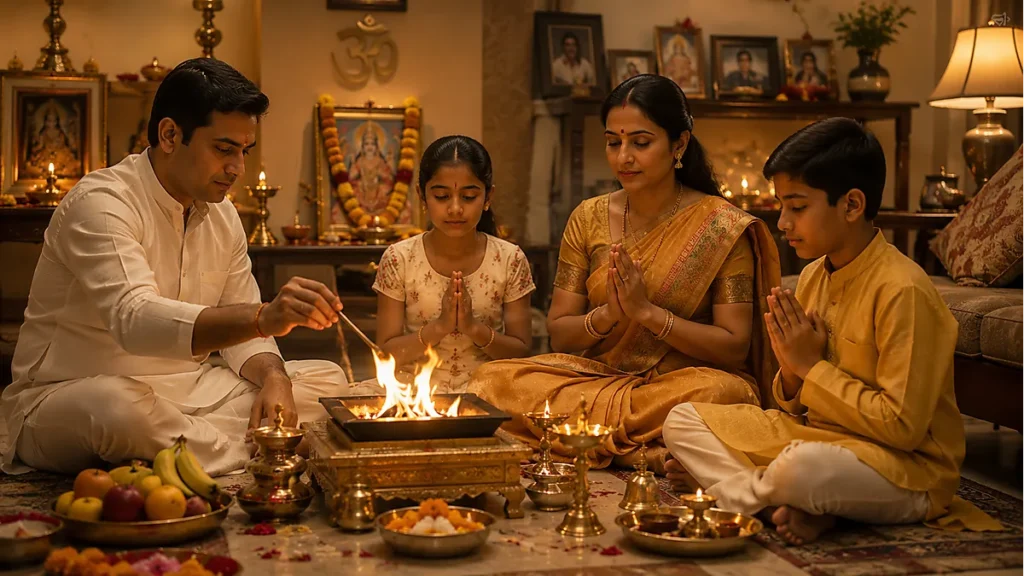
The Yajurveda-inspired tradition recognizes that every householder can perform five daily yajnas:
| Yajna | Recipient | Modern Expression |
| Brahma Yajna | Rishis, wisdom traditions | Study, teaching, honoring teachers |
| Deva Yajna | Gods, divine forces | Prayer, gratitude for nature’s elements |
| Pitri Yajna | Ancestors | Honoring parents, family traditions |
| Bhuta Yajna | All beings | Compassion for animals, environmental care |
| Manushya Yajna | Fellow humans | Hospitality, service, charity |
The Great Yajnas of the Vedic World
Agnihotra – The Daily Fire Offering
The simplest and most essential yajna, Agnihotra is performed at sunrise and sunset. The practitioner offers milk, ghee, or rice into the sacred fire while reciting specific Yajurveda mantras.
Purpose: Purification of the atmosphere, harmonization of daily rhythms, cultivation of discipline.
Soma Yajna – The Offering of Sacred Elixir
The Soma yajna involved the pressing and offering of the Soma plant, considered the food of the gods. While the botanical identity of Soma remains debated, its symbolic meaning is clear: offering the best, most refined essence of one’s being to the divine.
Ashvamedha – The Horse Sacrifice
Perhaps the most misunderstood Vedic ritual, the Ashvamedha (horse sacrifice) was a royal consecration ceremony. A horse was set free to wander for a year, accompanied by a royal army. Lands it entered either submitted to the king or fought. Upon its return, the horse was ritually honored.
Important clarification: Traditional commentators like Uvata and Mahidhara explicitly state that the horse was not killed in the yajna. Instead, its power and qualities were symbolically offered.
“Aranyah sarve utsrishtavya na tu himsyah” – “All animals brought to the yajna are to be released, not killed.” (Yajurveda 24.40, Uvata and Mahidhara commentaries)
Rajasuya – The Royal Consecration
A ceremony to establish a king’s sovereignty, the Rajasuya involved elaborate rituals spread over two or more years. It was performed by legendary kings like Yudhishthira.
Vajapeya – The Drink of Strength
This yajna was associated with the chariot race and the drinking of Soma. It symbolized the spiritual warrior’s attainment of ultimate power and glory.
The Daily Household Yajnas
For ordinary people, the Yajurveda prescribed simple domestic rituals: the morning and evening fire offerings, the offering of food before meals (vaishvadeva), and seasonal ceremonies.
The Hidden Wisdom of Sacrifice
Why Sacrifice is Not Loss
Modern people often recoil from the word “sacrifice.” We associate it with loss, deprivation, suffering. But the Vedic understanding is radically different.
Sacrifice (yajna) is the recognition that nothing truly belongs to us.
The sun does not hoard its light. The clouds do not cling to their water. The earth does not lock away its fruits. Everything in nature gives freely. Yajna is the human participation in this universal giving.
When you offer something in yajna, you are not losing it. You are releasing it to flow through the cosmic circuit. It will return to you multiplied, transformed, purified.
Giving as the Secret of Receiving
The Yajurveda teaches a counter-intuitive truth: The more you give, the more you receive.
Consider:
- A parent gives love freely – they receive the joy of their child’s smile
- A teacher shares knowledge – they receive the light in their student’s eyes
- A friend offers support – they receive the warmth of deep connection
Yajna is simply this principle raised to a cosmic level.
Selflessness as Practical Wisdom
The ego says: “Hold on. Protect yourself. Take what you can.”
The Yajurveda says: “Let go. Serve. Offer. This is the path to true abundance.”
This is not naive idealism. It is practical wisdom tested over thousands of years. Families that practice generosity thrive. Communities that cooperate flourish. Nations that serve their citizens grow strong.
The Ethics of the Yajurveda
The Core Ethical Principles
The Yajurveda, through its vision of yajna, establishes a complete ethical framework:
| Principle | Application |
| Gratitude | Acknowledge debt to nature, ancestors, teachers, society |
| Responsibility | Actively maintain harmony in all relationships |
| Generosity | Share your resources, time, and energy freely |
| Discipline | Perform your duties consistently, without laziness |
| Respect for Nature | Treat earth, water, air, fire as sacred |
| Community Welfare | Prioritize collective well-being over individual greed |
The Four Castes and Their Yajnas
The Yajurveda acknowledges that different people have different capacities and roles. The Brahmana (1st Chapter, Mantra 2) states:
“Arambha-yajnah kshatrascha havir-yajnah vishah smritah | parichara-yajnah shudrascha japa-yajnah dvijah tatha”
- Kshatriyas – Their yajna is courage, protection, righteous warfare
- Vaishyas – Their yajna is agriculture, trade, hospitality, offerings of food
- Shudras – Their yajna is humble service, supporting others
- Brahmins – Their yajna is study, teaching, meditation, preserving wisdom
This is not about birth but about svadharma – one’s natural duty based on inclination and capacity.
The Yajurveda and Ecological Wisdom
Reverence for Nature
Long before the modern environmental movement, the Yajurveda articulated a profound ecological vision:
- The fire (Agni) is sacred – pollution of air is a sin
- The waters (Apah) are divine – contamination is an offense
- The earth (Prithvi) is mother – harming her wounds all beings
- Trees and plants (Vanaspati, Oshadhi) have consciousness – their destruction requires atonement
The Prayer Not to Harm
One of the most beautiful mantras in the Yajurveda (13.44) prays:
“Yajna, protect the Avi (protective covering of nature) that generates countless forms, established in the highest sky, the navel of Varuna, born of the supreme firmament. Do not harm it.”
Modern science has confirmed what the rishis intuited: the ozone layer (the “avi” that protects the earth) is essential for life. Those who harm it endanger all beings.
Yajna as Environmental Protection
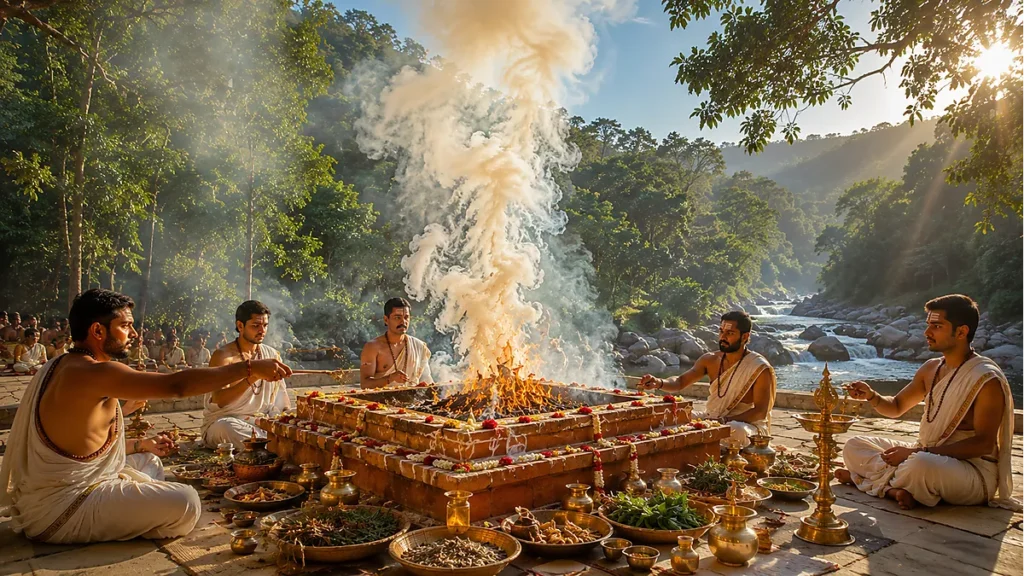
The Yajurveda understands that ritual offerings – of ghee, grains, herbs – into the sacred fire produce subtle energies that balance the atmosphere. The smoke from Vedic yajnas is not ordinary smoke. It is charged with mantras and offered with intention, and it is said to:
- Neutralize harmful bacteria in the air
- Balance the electric charge of the atmosphere
- Promote rainfall at the proper time
- Support the growth of beneficial plants
While modern science is only beginning to study these effects, the Vedic tradition has maintained them for millennia.
Sacred Geography of the Yajurveda
Kurukshetra
The land of the Mahabharata war, Kurukshetra is described in Vedic texts as the “dharma-kshetra” – the field of righteousness. It was here that the great rishis performed yajnas for generations. The Yajurveda references the rituals performed on this sacred soil.
Naimisharanya
Located in present-day Uttar Pradesh, Naimisharanya is described in the Vedas as the “navel of the universe.” The Puranas record that 88,000 rishis gathered here to perform yajnas for thousands of years.
Prayagraj – The King of Pilgrimage Sites
The confluence of the Ganges, Yamuna, and the mythical Sarasvati has been a center of Vedic ritual since time immemorial. The Triveni Sangam is mentioned in the Yajurveda as a place where yajnas yield multiplied results.
Kashi (Varanasi)
The city of light, Kashi is described as the “eternal ground of Shiva.” Many Yajurveda mantras are still chanted daily in its countless temples.
Ujjain and Pushkar
These ancient cities are also associated with Vedic rituals. The Simhastha Kumbh Mela at Ujjain and the Pushkar Lake’s sacred yajnas have deep roots in the Yajurvedic tradition.
Prayagraj – The Land of Yajnas
Brahma’s Sacrificial Ground
According to the Puranas, Lord Brahma himself performed the first yajna at Prayagraj. This is why the city is also called Tirtharaja – the king of pilgrimage sites.
The Yajurveda’s emphasis on yajna finds its geographical heart at the Triveni Sangam. Pilgrims who bathe at the confluence and then participate in or observe yajnas on its banks are said to receive the combined benefits of both – external purification and internal transformation.
The Kumbh Mela Tradition
While the Kumbh Mela as we know it today developed later, its roots lie in the Vedic understanding of sacred time and ritual. The gathering of millions for ritual bathing and spiritual practices at the Sangam is the largest yajna on earth – a collective offering of devotion.
Prayag as a Center of Vedic Learning
Prayagraj has been a center of Sanskrit and Vedic studies for centuries. Scholars trained in the Yajurveda’s recitation and application have maintained unbroken traditions here, passing them from teacher to student across generations.
For the pilgrim today, Prayagraj offers a unique opportunity: to witness living Vedic traditions, to bathe at the sacred confluence, and to absorb the vibration of thousands of years of yajnas performed on this sacred land.
The Yajurveda and the Upanishads
The Philosophical Culmination
The Yajurveda contains two of the most important Upanishads:
Isha Upanishad
The Isha Upanishad is a masterpiece of spiritual philosophy in 18 mantras. Its opening verse contains the essence:
“Ishavasyam idam sarvam yat kincha jagatyam jagat” – “All this – whatever exists in this changing universe – should be covered by the Lord.”
It then declares the proper attitude toward life:
“Tena tyaktena bhunjithah” – “By giving up (attachment), enjoy.”
This is the yajna philosophy expressed in its most refined form: renounce possessiveness, enjoy what comes as a gift, offer everything back to the source.
Brihadaranyaka Upanishad
The Brihadaranyaka (“Great Forest”) Upanishad is the longest of all Upanishads. It contains profound dialogues between sages like Yajnavalkya and his wife Maitreyi, discussing the nature of the Self, immortality, and liberation.
From External Ritual to Inner Realization
The Yajurveda traces a journey:
- External yajna – offering substances into the physical fire
- Internal yajna – offering ego, desires, attachments into the fire of knowledge
- Supreme yajna – realizing that the individual self is one with the cosmic Self
As the Isha Upanishad declares:
“He who sees all beings in the Self and the Self in all beings, he never turns away from it.”
Common Misunderstandings
“The Yajurveda is only about rituals”
Reality: While the Yajurveda provides detailed ritual instructions, its purpose is far deeper. It uses ritual as a vehicle to teach cosmic principles: reciprocity, discipline, gratitude, and the interconnectedness of all existence.
“Vedic sacrifices involved animal killing”
Reality: This is a complex and much-debated topic. Traditional commentators like Mahidhara and Uvata (pre-11th to 16th century) explicitly state that animals brought to yajnas were not killed but released. The sage Vyasa is recorded in the Mahabharata as stating:
“Suramatsyam madhumamsam asavam kusaridanam | dritaih pravartitam chotannaidat vedeshu kalpitam”
“Alcohol, fish, animal flesh, fermented drinks, and sour gruel – these were introduced by unrighteous people; they are not prescribed in the Vedas.”
The word medha in the context of yajna does not mean “animal sacrifice” but rather “sacrificial action,” “offering,” or “union.” The Nirukta explains medha as having three meanings: nourishment, sacrifice (in the sense of offering), and union.
“Rituals are superstition”
Reality: The Yajurveda distinguishes between mechanical action (karma) and conscious offering (yajna). A ritual performed without understanding is merely motion. A ritual performed with awareness, gratitude, and surrender becomes transformation.
“The Yajurveda is irrelevant today”
Reality: The principles of the Yajurveda – offering, service, reciprocity, environmental responsibility – are more urgently needed today than ever. As the Isha Upanishad teaches, we can enjoy life fully because we give freely.
Timeless Mantras of the Yajurveda
Here are some of the most significant mantras from the Yajurveda, each with its meaning and practical application.
Mantra 1: The Shanti Path (Peace Invocation)
Devanagari:
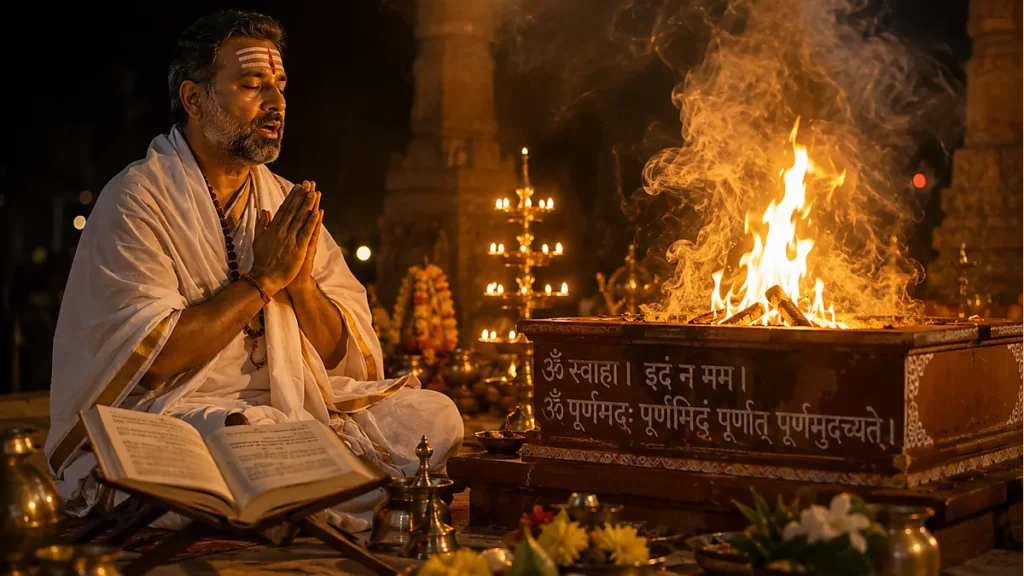
ॐ पूर्णमदः पूर्णमिदं पूर्णात्पूर्णमुदच्यते ।
पूर्णस्य पूर्णमादाय पूर्णमेवावशिष्यते ॥
ॐ शान्तिः शान्तिः शान्तिः ॥
IAST Transliteration:
Om purnam-adah purnam-idam purnat-purnam-udachyate |
purnasya purnam-adaya purnam-eva-avashishyate ||
Om shantih shantih shantih ||
Source: Isha Upanishad (Shukla Yajurveda 40. Invocation)
Word-by-Word Meaning:
- पूर्णम् (purnam) – whole, complete, infinite
- अदः (adah) – that (the unmanifest, transcendent Reality)
- इदम् (idam) – this (the manifest universe)
- उदच्यते (udachyate) – comes forth, arises
- आदाय (adaya) – taking away
- अवशिष्यते (avashishyate) – remains
Translation:
“That (the Supreme) is whole; this (the universe) is whole. From the whole, the whole arises. When the whole is taken from the whole, the whole remains.”
Traditional Interpretation:
The infinite Reality remains unchanged regardless of what manifests from it. Creation does not diminish the Creator. The universe emerges from the Divine without reducing or exhausting it.
Practical Life Lesson:
You can give freely without fear of depletion. True abundance is not diminished by sharing. Like the sun giving light endlessly, the source of all goodness within you is inexhaustible.
Mantra 2: The Isha Upanishad’s Core Teaching
Devanagari:
ईशा वास्यमिदं सर्वं यत्किञ्च जगत्यां जगत् ।
तेन त्यक्तेन भुञ्जीथा मा गृधः कस्यस्विद्धनम् ॥
IAST Transliteration:
Isha vasyam-idam sarvam yat-kincha jagatyam jagat |
tena tyaktena bhunjitha ma gridhah kasya-svid-dhanam ||
Source: Isha Upanishad (Shukla Yajurveda 40.1)
Word-by-Word Meaning:
- ईशा (isha) – by the Lord, by the Supreme
- वास्यम् (vasyam) – to be covered, to be clothed
- इदम् (idam) – this
- सर्वम् (sarvam) – all
- तेन (tena) – by that (attitude of renunciation)
- त्यक्तेन (tyaktena) – by giving up (attachment)
- भुञ्जीथा (bhunjitha) – you should enjoy, experience
- मा (ma) – do not
- गृधः (gridhah) – covet, be greedy
- कस्यस्वित् (kasyasvit) – whose indeed
- धनम् (dhanam) – wealth
Translation:
“All this – whatever exists in this changing universe – should be covered by the Lord. By giving up attachment, enjoy. Do not covet anyone’s wealth.”
Traditional Interpretation:
Everything belongs to the Divine. All things are manifestations of the One. Live as a trustee, not an owner. Enjoy what comes to you as a gift, but never grasp or hoard.
Practical Life Lesson:
Before eating, offer your meal in gratitude. Before using any resource, remember it belongs to the whole. When you possess lightly, you live joyfully.
Mantra 3: The Gayatri Mantra
Devanagari:
ॐ भूर्भुवः स्वः । तत्सवितुर्वरेण्यं । भर्गो देवस्य धीमहि । धियो यो नः प्रचोदयात् ॥
IAST Transliteration:
Om bhur-bhuvah svah | tat-savitur-varenyam | bhargo devasya dhimahi | dhiyo yo nah prachodayat ||
Source: Shukla Yajurveda 36.3 (also Rigveda 3.62.10)
Word-by-Word Meaning:
- भूः (bhuh) – the physical realm, earth
- भुवः (bhuvah) – the vital realm, atmosphere
- स्वः (svah) – the celestial realm, heaven
- तत् (tat) – that (Supreme Reality)
- सवितुः (savitur) – of Savita, the divine source of inspiration
- वरेण्यम् (varenyam) – most excellent, worthy of choice
- भर्गः (bhargah) – radiance, effulgence, splendor
- देवस्य (devasya) – of the divine being
- धीमहि (dhimahi) – may we meditate upon, may we receive
- धियः (dhiyah) – our intellects, our understandings
- यः (yah) – who
- नः (nah) – our
- प्रचोदयात् (prachodayat) – may inspire, direct, illuminate
Translation:
“Om. We meditate upon the supremely excellent radiance of Savita, the divine inspirer. May he illuminate our intellects.”
Traditional Interpretation:
This is the most revered mantra in the Vedic tradition. It is a prayer for the awakening of intelligence, for the light of understanding to dispel all darkness of ignorance.
Practical Life Lesson:
Before beginning any important work – study, decision-making, creative effort – pause and invoke clarity. Ask for the light of wisdom to guide your actions.
Mantra 4: Invocation for Universal Peace
Devanagari:
सह नाववतु । सह नौ भुनक्तु । सह वीर्यं करवावहै ।
तेजस्वि नावधीतमस्तु मा विद्विषावहै ॥
IAST Transliteration:
Saha nav-avatu | saha nau bhunaktu | saha viryam karavavahai |
tejasvi nau-adhitam-astu ma vidvishavahai ||
Source: Taittiriya Upanishad (Krishna Yajurveda)
Word-by-Word Meaning:
- सह (saha) – together
- नौ (nau) – us (two – teacher and student)
- अवतु (avatu) – may protect
- भुनक्तु (bhunaktu) – may enjoy, may share nourishment
- वीर्यम् (viryam) – energy, strength, courage
- करवावहै (karavavahai) – may we do, may we accomplish
- तेजस्वि (tejasvi) – brilliant, illumined
- अधीतम् (adhitam) – that which is studied
- अस्तु (astu) – may it be
- मा विद्विषावहै (ma vidvishavahai) – may we not hate each other
Translation:
“May he protect us both together. May he nourish us both together. May we work together with great energy. May our study be brilliant and illuminating. May we never hate each other.”
Traditional Interpretation:
This mantra is recited before and after Vedic study. It establishes the relationship between teacher and student as one of mutual respect, shared purpose, and harmonious cooperation.
Practical Life Lesson:
Any relationship of learning or collaboration should be entered with this prayer: may we protect each other, may we grow together, may our shared work be fruitful, may we never become enemies.
Mantra 5: The Mahamrityunjaya Mantra (Rudra Prayer)
Devanagari:
ॐ त्र्यम्बकं यजामहे सुगन्धिं पुष्टिवर्धनम् ।
उर्वारुकमिव बन्धनान्मृत्योर्मुक्षीय माऽमृतात् ॥
IAST Transliteration:
Om tryambakam yajamahe sugandhim pushti-vardhanam |
urvarukam-iva bandhanan mrutyor-mukshiya ma-amritat ||
Source: Shukla Yajurveda 3.60 (also Rigveda 7.59.12)
Word-by-Word Meaning:
- त्र्यम्बकम् (tryambakam) – the three-eyed one (Shiva/Rudra)
- यजामहे (yajamahe) – we worship, we offer
- सुगन्धिम् (sugandhim) – fragrant, of good reputation
- पुष्टिवर्धनम् (pushti-vardhanam) – increasing nourishment, strength
- उर्वारुकम् (urvarukam) – a cucumber or melon
- इव (iva) – like, as
- बन्धनात् (bandhanat) – from the stem, from bondage
- मृत्योः (mrutyoh) – from death
- मुक्षीय (mukshiya) – may I be freed
- मा (ma) – not
- अमृतात् (amritat) – from immortality
Translation:
“We worship the three-eyed Lord Shiva, who is fragrant and nourishes all beings. May he release us from the bondage of death, as a cucumber is released from its stem – but not from immortality.”
Traditional Interpretation:
This is a prayer for healing, liberation from fear, and release from untimely death. Yet it carefully distinguishes: we seek freedom from the fear of death, not from immortality itself.
Practical Life Lesson:
When facing illness, fear, or life challenges, invoke the healing presence within. Like a ripe fruit detaching from its vine, learn to release attachment to the body while honoring the eternal Self.
Mantra 6: Prayer for Radiant Intellect
Devanagari:
धीरा यस्य वाचं वाचं यस्य धीराः । प्रशंसन्ति तेजस्तेजस्विनः ।
स नः प्रजायै श्रियै च जिन्वतु । प्रजापतिर्विश्वकर्मा प्रजाः पातु ॥
(This is a composite prayer; I’ll provide a more direct Yajurveda mantra)
Better to use Yajurveda 40.8:
Devanagari:
स य ईशानः शश्वतां शश्वतिभ्य एव । स नो मध्या पिता पोषयिता विश्वकर्मा ॥
Source: Shukla Yajurveda 40.8 (Isha Upanishad)
Mantra 7: Vision of Oneness
Devanagari:
यस्तु सर्वाणि भूतान्यात्मन्येवानुपश्यति ।
सर्वभूतेषु चात्मानं ततो न विजुगुप्सते ॥
IAST Transliteration:
Yas-tu sarvani bhutany atmany-eva-anupashyati |
sarva-bhuteshu cha-atmanam tato na vijugupsate ||
Source: Isha Upanishad (Shukla Yajurveda 40.6)
Word-by-Word Meaning:
- यः (yah) – who
- तु (tu) – indeed
- सर्वाणि (sarvani) – all
- भूतानि (bhutani) – beings
- आत्मनि (atmani) – in the Self
- एव (eva) – alone, indeed
- अनुपश्यति (anupashyati) – sees, perceives
- सर्वभूतेषु (sarva-bhuteshu) – in all beings
- च (cha) – and
- आत्मानम् (atmanam) – the Self
- ततः (tatah) – then
- न (na) – not
- विजुगुप्सते (vijugupsate) – reviles, hates, feels aversion
Translation:
“He who sees all beings in the Self and the Self in all beings, he never turns away from it in revulsion.”
Practical Life Lesson:
When you recognize the same divine presence in yourself and every being, hatred becomes impossible. Cultivate this vision through service, compassion, and meditation.
Mantra 8: The Fire as Divine Messenger
Devanagari:
अग्ने नय सुपथा राये अस्मान् विश्वानि देव वयुनानि विद्वान् ।
युयोध्यस्मज्जुहुराणमेनो भूयिष्ठां ते नम उक्तिं विधेम ॥
IAST Transliteration:
Agne naya supatha raye asman vishvani deva vayunani vidvan |
yuyodhy-asmat juhuranam-eno bhuyishtham te nama uktim vidhema ||
Source: Shukla Yajurveda 4.36 (also Rigveda 1.189.1)
Word-by-Word Meaning:
- अग्ने (agne) – O Agni, O Fire God
- नय (naya) – lead, guide
- सुपथा (supatha) – by the good path
- राये (raye) – to wealth (spiritual and material)
- अस्मान् (asman) – us
- विश्वानि (vishvani) – all
- देव (deva) – O divine one
- वयुनानि (vayunani) – paths, courses, truths
- विद्वान् (vidvan) – knowing
- युयोधि (yuyodhi) – remove, banish
- अस्मत् (asmat) – from us
- जुहुराणम् (juhuranam) – crooked, deceptive
- एनः (enah) – sin, offense
- भूयिष्ठाम् (bhuyishtham) – most abundant, greatest
- ते (te) – to you
- नमः (namah) – bowing, salutation
- उक्तिम् (uktim) – utterance, praise
- विधेम (vidhema) – may we offer, perform
Translation:
“O Agni, lead us by the good path to prosperity. You know all our ways, O divine one. Remove from us the crooked sin of deception. We offer you the fullest measure of our praise and salutations.”
Practical Life Lesson:
Ask for guidance on the path of righteousness. Seek the inner fire of conscience to burn away deceit and illuminate truth.
The Yajurveda in Modern Life
For Families
The Yajurveda teaches that the household is a sacred field for yajna. Every act of feeding, caring, teaching, and loving is an offering.
Practical applications:
- Share meals with gratitude before eating
- Make family decisions through cooperation (sangatikarana)
- Serve elders and children with equal devotion
- Transform household chores into mindful offerings
For Professionals
Work can become yajna when done without grasping attachment to results, with integrity, and for the benefit of all stakeholders.
Practical applications:
- Dedicate your work to a higher purpose before beginning
- See your colleagues as fellow participants in a shared offering
- Offer your best effort without hoarding credit
- Use your skills to serve the wider community
For Leaders
True leadership, the Yajurveda suggests, is the ability to facilitate the offerings of others – to create conditions where everyone can give their best.
Practical applications:
- Lead by service, not command
- Distribute resources fairly (dana)
- Create cooperation (sangatikarana)
- Honor the divine spark in every team member
Service as the Highest Offering
The Yajurveda culminates in the recognition that the greatest yajna is the offering of the ego itself. When we serve without any sense of “I am the doer,” when we give without expecting return, when we act for the welfare of all – we are performing the supreme sacrifice.
This is the path from ritual to realization, from external offering to inner transformation.
Frequently Asked Questions
1. What is the Yajurveda?
The Yajurveda is one of the four Vedas, the ancient sacred scriptures of Sanatana Dharma. It focuses on the knowledge of yajna (sacred action and offering) and provides the mantras and procedures for Vedic rituals.
2. Why is it called the Veda of sacrifice?
The Yajurveda is called the Veda of sacrifice because its primary content is the mantras and formulas used in yajnas. However, “sacrifice” here does not mean loss – it means sacred offering, cooperation, and the principle of giving back to the cosmic order.
3. What is Yajna?
Yajna is sacred action performed with an attitude of offering. It includes external rituals like fire offerings, as well as internal practices like selfless service, study, and meditation. The root yaj means worship, cooperation, and giving.
4. What is the difference between Shukla and Krishna Yajurveda?
The Shukla (White) Yajurveda presents mantras in pure form with the Brahmana (explanation) separate. The Krishna (Dark) Yajurveda interweaves mantras with Brahmana passages. Both are equally authoritative.
5. Who composed the Yajurveda?
The Yajurveda, like all Vedas, is considered apaurusheya – not composed by any human but revealed to the rishis (seers) in deep meditation. Sage Vyasa compiled and divided the Vedas into four. Sage Yajnavalkya is particularly associated with the Shukla Yajurveda.
6. Is the Yajurveda still relevant today?
Absolutely. Its core teachings – offering, gratitude, cooperation, responsibility, environmental reverence – are urgently needed in our disconnected, consumer-driven world. The principles of yajna can transform modern life.
7. What Upanishads belong to the Yajurveda?
The Isha Upanishad and Brihadaranyaka Upanishad belong to the Shukla Yajurveda. The Taittiriya Upanishad, Katha Upanishad, Shvetashvatara Upanishad, and Maitri Upanishad belong to the Krishna Yajurveda.
8. Does the Yajurveda promote animal sacrifice?
Traditional commentators and the sage Vyasa himself state that animals brought to yajnas were released, not killed. The word “medha” in the context of yajna means offering or union, not killing. Later corruptions do not represent original Vedic teaching.
9. How is the Yajurveda chanted?
The Yajurveda is chanted with specific intonations (swaras) – udatta (high), anudatta (low), and svarita (circumflex). The chanting traditions have been preserved orally for thousands of years.
10. What is the relationship between Yajurveda and the Bhagavad Gita?
The Bhagavad Gita, particularly in its third chapter, expounds the philosophy of yajna derived from the Yajurveda. Krishna teaches that the world was created with yajna and that all actions should be offered as yajna.
11. Can anyone chant Yajurveda mantras?
Traditionally, Yajurveda mantras were taught through initiation. However, the philosophical Upanishads from the Yajurveda (like the Isha Upanishad) are studied by all seekers regardless of background.
12. What is the significance of Prayagraj in the Yajurveda?
Prayagraj (the Triveni Sangam) is mentioned as a sacred place for performing yajnas. It is considered Tirtharaja – the king of pilgrimage sites – where rituals yield multiplied spiritual benefits.
Why the Yajurveda Still Matters Today
The Timeless Message
After journeying through the mantras, stories, and philosophies of the Yajurveda, what remains? What is the core message that speaks to us today?
It is this:
You are not a separate self, grasping at possessions, competing for survival.
You are a node in a vast network of giving and receiving.
The sun gives light. The earth gives food. The rivers give water. The trees give oxygen.
And you – you are also meant to give.
Not because you are forced. Not because you fear punishment. But because giving is your true nature. Because in giving, you realize your unity with all existence. Because generosity is the secret of joy.
The Fire That Still Burns
Every time you:
- Offer your meal with gratitude before eating
- Serve someone without expecting return
- Share your knowledge freely
- Protect the environment for future generations
- Act with integrity when no one is watching
- Cooperate rather than compete
…you are performing yajna. You are carrying forward the sacred fire of the Yajurveda.
A Pilgrim’s Meditation
As you stand at the Triveni Sangam in Prayagraj, watching the sacred rivers merge, imagine the countless generations who have stood here before you. They came to offer – to give back to the cosmic order that sustains them.
The Yajurveda invites you to see your entire life as a pilgrimage, each act an offering, each moment an opportunity to maintain cosmic harmony.
The fire still burns. The mantras still echo. The path of sacred action remains open.
Walk it with gratitude. Walk it with generosity. Walk it with joy.
And may your life become a yajna – a beautiful, selfless offering to the welfare of all beings.
Om Shantih Shantih Shantih
Explore More:
- Rigveda: The Ancient Hymns of Light and Cosmic Order
- Samaveda: The Melody of Devotion
- Atharvaveda: Wisdom for Daily Living
- Isha Upanishad: The Inner Core of Yajurveda
- Prayagraj: The King of Pilgrimage Sites
- Triveni Sangam: The Sacred Confluence
This article has been published as part of PrayagTourism.com‘s mission to share the profound spiritual heritage of Prayagraj and the sacred traditions of Sanatana Dharma. May it inspire your journey toward sacred action and cosmic harmony.