
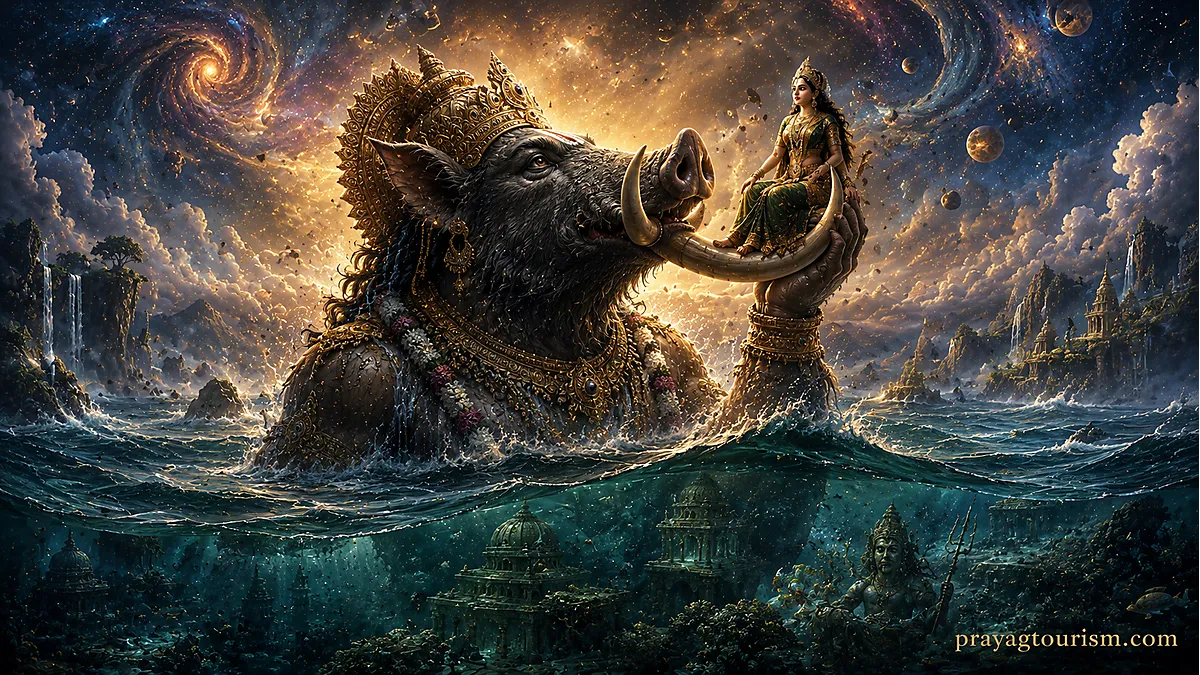
The third Avatār of Viṣṇu, the defeat of Hiraṇyākṣa, and the esoteric science of ecological theology.
Table of Contents
From Cosmic Ocean to Sacred Soil
Imagine a pre-dawn Braj morning along the Yamunā.
Mist hangs low over the water, temple bells ring in the distance, and the first priests step out barefoot onto the cool, damp stone. They touch the earth gently, whispering a quiet apology to the Mother they are about to walk upon.
In the Daśāvatāra narrative, we have already traversed the primordial waters with Matsya and rested on the amphibious back of Kūrma. Now, in Varāha Avatār, the story comes crashing onto solid land. Existence demands a stable, habitable surface; life must have ground on which to grow, to farm, to build, to love, and to worship.
The crisis is stark: Bhūdevī, Mother Earth herself, is dragged down into the abyss of the cosmic ocean by the asura Hiraṇyākṣa. Without her, no dharma can be practiced, no yajña can be performed, and no living being has a place to stand. The problem is not abstract; it is brutally physical: where will we live, and can this planet be saved?
The meaning of “Varāha”
The Sanskrit term Varāha (वराह) is commonly rendered as “boar.” Traditional etymologies link it to roots such as vṛ (to cover, protect, or enclose) or interpret it as a compound of vara (excellent, boon) and aha (day), suggesting “He who brings the excellent day” – the one whose intervention inaugurates a new, auspicious era.
The Avatāra form is not symbolic in the superficial sense of a mere metaphor. It is very precisely chosen: the boar is the primal land animal, the one who knows the soil with his snout, tusks, and hooves; who is unafraid of mud, roots, and the dense, resistant world of earth. In the ladder of Daśāvatāra, Varāha marks the sanctification of the Pṛthvī Tattva – the earth principle. Where Matsya and Kūrma are concerned with the waters of potentiality, Varāha is concerned with the ground of actuality.
From an evolutionary lens, if Matsya evokes the earliest aquatic life and Kūrma the amphibious transition, Varāha corresponds to the age when great mammals claimed the land – the rise of powerful, warm-blooded beings who could range across forests, plains, and mountains. The boar, sturdy and fearless, becomes an icon of life that has fully taken ownership of solid earth.
Varāha’s message is simple and revolutionary: the Divine is not allergic to matter. The Lord is willing to plunge into mud and darkness for the sake of a threatened world. The soil under our feet, the field we plough, the garden we water, the land we inherit – all of this is sacred territory.
Vedic Roots and Purāṇic Blossoming
Long before Varāha appears as a personal, four-armed form of Viṣṇu in the Purāṇas, the boar strides across the earliest Vedic imagination as a cosmic agent of creation.
Veda and Brāhmaṇa: Prajāpati as the Boar
In the Taittirīya Saṁhitā of the Kṛṣṇa Yajurveda and the Taittirīya Brāhmaṇa, Prajāpati, the creator, gazes out on a universe that is nothing but water. He sees a lotus leaf upon the waters and intuits that something must support it from below. Taking the form of a boar (varāha / emūṣa), he dives into the depths, discovers the earth beneath, breaks off a portion, and rises to the surface, spreading it out to create the terrestrial world.
The Śatapatha Brāhmaṇa similarly speaks of the earth as once only a span in size, raised up by a boar called Emūṣa and rewarded by Prajāpati, Lord of the Earth. In these early layers, the boar is not yet “Viṣṇu’s incarnation” in the later sense. He is the cosmogonic mover – the one who makes a world from undifferentiated water.
Already, two important features appear:
- The problem is submersion – earth lost in water.
- The solution is descent and lifting – diving, grasping, and raising.
What the Purāṇas later do is to gather this cosmogonic boar into the person of Viṣṇu and wrap the entire act in love, battle, and bhakti.
From Abstract Boar to Viṣṇu’s Avatāra
By the time we reach the Mahābhārata and the great Purāṇas, especially the Viṣṇu Purāṇa and the Śrīmad Bhāgavatam, the boar is no longer only Prajāpati’s creative tool. He is Bhagavān Himself, a fully personal Avatāra who roars Vedic hymns, wields weapons, embraces Bhūdevī as consort, and slays the demon Hiraṇyākṣa to restore the balance of the cosmos.
The Bhāgavatam (Canto 3, Chapter 13) portrays Varāha emerging from the nostril of Brahmā, first as a tiny thumb-sized creature, then rapidly expanding until His bristles brush against the higher regions and His body fills the sky. The sages, initially uncertain whether this wonder is some extraordinary entity or the Lord Himself, break into praises as they realize that this boar is none other than the Supreme Personality of Godhead, come to rescue the Earth.
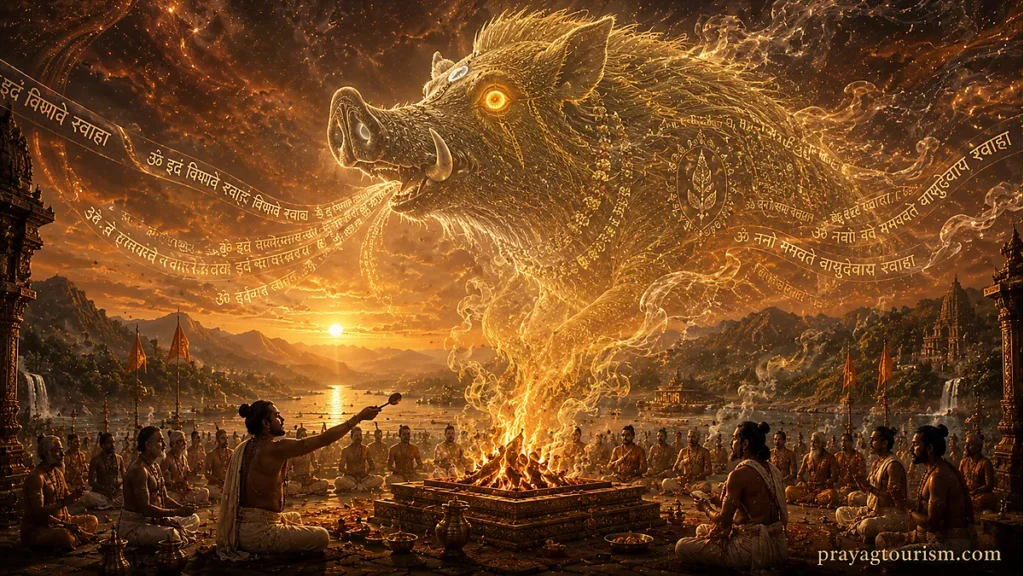
Purāṇic theology adds yet another layer: Yajña-Varāha, the Sacrificial Boar. His body is imagined as an enormous cosmic altar:
- His bristles – Kuśa grass.
- His tusks – sacrificial stakes.
- His legs – the four Vedas.
- His breath – the chanting of Sāma.
- His tongue – the sacred fire.
The boar who once simply lifted the earth now becomes the living embodiment of Vedic ritual. Creation, sacrifice, and salvation converge in one form.
Jayadeva’s Poetic Vision
No description captures this aesthetic fusion better than Śrī Jayadeva Gosvāmī in his Gīta Govinda, Daśāvatāra Stotram:
- Devanagari Script
वसति दशनशिखरे धरणी तव लग्ना।
शशिनि कलङ्ककलेव निमग्ना॥
केशव धृतसूकररूप जय जगदीश हरे॥ - IAST Transliteration
vasati daśana-śikhare dharaṇī tava lagnā |
śaśini kalaṅka-kaleva nimagnā ||
keśava dhṛta-sūkara-rūpa jaya jagadīśa hare || - Source: Gīta Govinda, Daśāvatāra Stotram, Verse 3.
- Word-by-Word Meaning
- वसति (vasati) – rests, dwells
- दशन-शिखरे (daśana-śikhare) – upon the tip of (Your) tusk
- धरणी (dharaṇī) – the earth
- तव (tava) – Your
- लग्ना (lagnā) – attached, fixed
- शशिनि (śaśini) – in the moon
- कलङ्क-कला (kalaṅka-kalā) – faint blemish or spot
- इव (iva) – like
- निमग्ना (nimagnā) – immersed, appearing as if merged
- केशव (keśava) – O Keśava
- धृत (dhṛta) – who has assumed
- सूकर (sūkara) – of a boar
- रूप (rūpa) – form
- जय (jaya) – all glories
- जगदीश (jagad-īśa) – O Lord of the universe
- हरे (hare) – O Hari
- Translation & Brief Bhāṣya
“O Lord Keśava, who has assumed the form of a boar, all glories to You, O Lord of the universe! The Earth rests upon the tip of Your tusk, appearing as delicate and small as the faint blemish upon the face of the moon.”
Jayadeva uses the alankāra of proportion: the same Earth that overwhelms our imagination shrinks to a moon-spot on the tusk of the Infinite. The rescue is not a struggle; it is effortless grace.
The Grand Narrative: Hiraṇyākṣa, Bhūdevī, and the Descent of Varāha
Every Avatāra arises in response to a crisis. Varāha’s crisis is cosmic, ecological, and moral at once.
Jaya–Vijaya and the Birth of the Daityas
The Bhāgavatam tells us that the gatekeepers of Vaikuṇṭha, Jaya and Vijaya, are cursed by the four Kumāra sages to be born in the material world. Accepting this as the Lord’s arrangement, they incarnate as the powerful Daitya brothers Hiraṇyākṣa and Hiraṇyakaśipu. In the Varāha episode, it is Hiraṇyākṣa – “golden-eyed” – who becomes the immediate antagonist.
Hiraṇyākṣa’s Crime: The Kidnapping of the Earth
Hiraṇyākṣa terrorizes the devas and roams the worlds in a frenzy of conquest. His “golden eye” sees value only in terms of wealth, possession, and extraction. In a supreme act of adharma, he drags Bhūdevī, Mother Earth, away from her rightful orbit and plunges her into the Garbhodaka Ocean, the deep cosmic waters that fill the lower half of the universe.
Creation is halted. Without earth, there is no stable field for karma, dharma, or evolution. Brahmā, charged with secondary creation, stands helpless. He cannot complete his task when the very platform of existence has vanished under the waves.
The Emergence of Varāha
As Brahmā contemplates the Lord in desperation, something astonishing happens:
- From his nostril emerges a tiny boar, no larger than a thumb.
- Before the assembled sages can decide what this strange being is, it begins to grow.
- It becomes as large as an elephant, then as a mountain, then unimaginably vast, until its body seems to fill the sky.
The sages wonder: Is this some mysterious creature, or is it Bhagavān Himself? Their doubt dissolves as they behold the boar’s beauty: eyes red like dawn, tusks gleaming white like crystal, limbs adorned with divine ornaments, roar resonant with Vedic syllables.
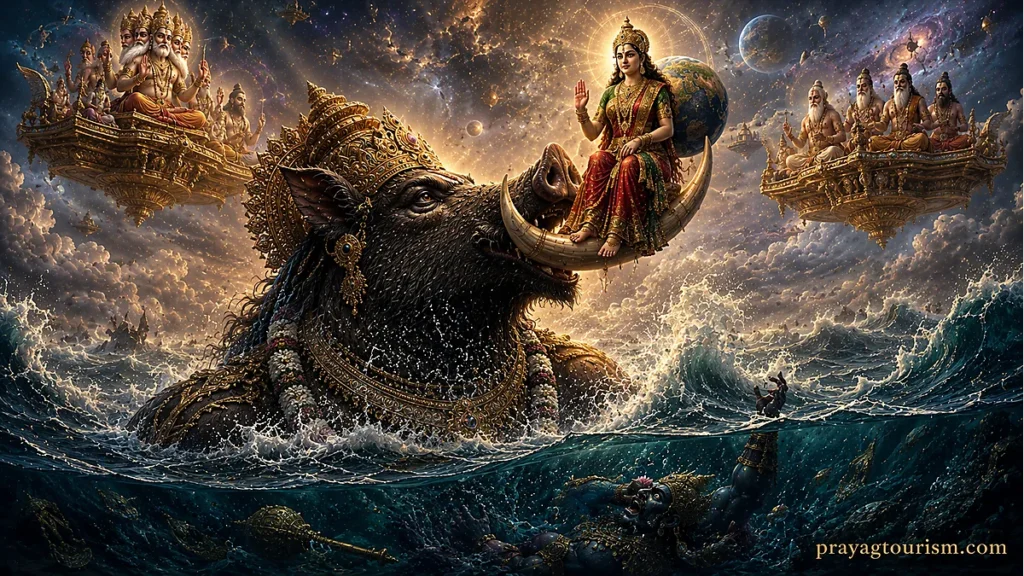
Recognizing Him as Viṣṇu, they offer Vedic hymns. Then, with a roar that shakes the worlds, Varāha plunges headlong into the cosmic ocean.
The Battle in the Abyss
In the dark depths, Varāha locates Bhūdevī, submerged and terrified, and tenderly places her upon His tusks. But Hiraṇyākṣa is waiting. What follows is an apocalyptic combat described in the Bhāgavatam:
- Hiraṇyākṣa hurls mountains, astras, and storms.
- The ocean boils and the directions quake.
- Varāha parries his blows almost playfully, as a lion toys with lesser prey.
At last, the Lord strikes the demon behind the ear – a single, precise, devastating blow that ends Hiraṇyākṣa’s tyranny. The imagery that follows is among the most tender in the tradition. A celebrated verse addresses Vidura:
- Devanagari Script
तमालनीलं सितदन्तकोट्या
क्ष्मामुत्क्षिपन्तं गजलीलयाङ्ग।
प्रज्ञाय बद्धाञ्जलयोऽनुवाकैर्
विरिञ्चमुख्या उपतस्थुरीशम्॥ - IAST Transliteration
tamāla-nīlaṃ sita-danta-koṭyā
kṣmām utkṣipantaṃ gaja-līlayāṅga |
prajñāya baddhāñjalayo ’nuvākair
viriñca-mukhyā upatasthur īśam || - Source: Śrīmad Bhāgavatam, broadly Chapter 13.
- Word-by-Word Meaning
- तमाल-नीलम् (tamāla-nīlam) – dark blue like a Tamāla tree
- सित-दन्त-कोट्या (sita-danta-koṭyā) – by the sharp edge of His white tusks
- क्ष्माम् (kṣmām) – the Earth
- उत्क्षिपन्तम् (utkṣipantam) – lifting up
- गज-लीलया (gaja-līlayā) – with the effortless play of an elephant
- अङ्ग (aṅga) – O dear one (Vidura)
- प्रज्ञाय (prajñāya) – understanding (His identity)
- बद्ध-अञ्जलयः (baddha-añjalayaḥ) – with folded hands
- अनुवाकैः (anuvākaiḥ) – with Vedic hymns
- विरिञ्च-मुख्याः (viriñca-mukhyāḥ) – headed by Brahmā
- उपतस्थुः (upatasthuḥ) – offered worship
- ईशम् (īśam) – unto the Supreme Lord
- Translation & Brief Bhāṣya
“O Vidura, seeing the Supreme Lord – dark like a Tamāla tree, lifting the Earth upon the tip of His white tusks with the playful ease of an elephant – Lord Brahmā and the chief sages understood His identity, folded their hands, and worshipped Him with Vedic hymns.”
The paradox is exquisite: a terrible boar with diamond tusks, yet lifting the Earth like a lotus bud; a roar that terrifies demons, yet reassures the devas and Bhūdevī like a mother’s voice.
Esoteric Symbolism and Ecological Dharma
Underneath the mythic battle lies a piercing critique of how we treat the Earth.
Hiraṇyākṣa as the Golden-Eyed Extractor
“Hiraṇyākṣa” literally means “gold-eyed” – one whose vision is completely coloured by gold. He does not see Bhūmi; he sees ore, minerals, oil, property, and profit. He drags the Earth down to the lowest regions, turning a luminous, life-bearing planet into a hostage of his greed.
Read this way, Hiraṇyākṣa is the archetype of a civilisation that:
- drills without limit,
- hoards wealth beneath the surface,
- treats rivers, forests, and soils as mere “resources”,
- and is willing to sacrifice planetary stability for short-term gain.
The cosmic submersion becomes a prescient image of ecological collapse: rising waters, destabilised climates, and a world literally drowning under the consequences of human avarice.
Varāha’s Message: Matter is not Mleccha
In many human societies, the pig or boar is considered impure, associated with filth and lowly environments. Varāha Avatāra overturns that prejudice. The Supreme Lord willingly takes the form of a creature that lives in mud to declare an uncompromising truth:
- Matter is not evil.
- The earth is not a prison to be fled, but a mother to be honoured.
- Spirituality is not escape from the world, but loving service to it.
Varāha’s snout buried in the cosmic mud is a declaration that the Divine is not afraid of darkness, filth, or complexity. The Lord is prepared to enter any depth to rescue what is innocent and essential.
Divine Power as Protective, Not Predatory
Notice the contrast:
- Hiraṇyākṣa’s strength is predatory. He uproots, drags down, and imprisons.
- Varāha’s strength is protective. He dives, lifts up, and restores.
The same capacity for force is channelled in opposite directions. This becomes an ethical criterion for all human power:
Strength is divine only when it serves life.
Strength becomes demonic when it treats life as expendable.
Every time we use technology, science, policy, or wealth, we implicitly choose between Hiraṇyākṣa and Varāha.
The Inner Ecology: Earth as Mūlādhāra
On a subtle level, Bhūdevī corresponds to the Mūlādhāra Chakra, the root energy centre associated with stability, grounding, and survival. When our inner “earth” is dragged down into fear, anxiety, and greed, our lives feel flooded and unstable.
To meditate on Varāha is to invite the Lord to:
- dive into our subconscious “ocean”,
- slay the inner Hiraṇyākṣa (compulsion, greed, hoarding),
- and lift our sense of self back into light and usefulness.
Thus, Varāha is both an ecological and a psychological Avatāra.
Sacred Geography: Walking the Footsteps of Varāha
For the pilgrim, Varāha is not only a story but a journey across India’s sacred landscape, where rock, river, and sculpture preserve His memory.
1. Śrī Bhu Varāha Swāmy Temple, Srimushnam (Tamil Nadu)
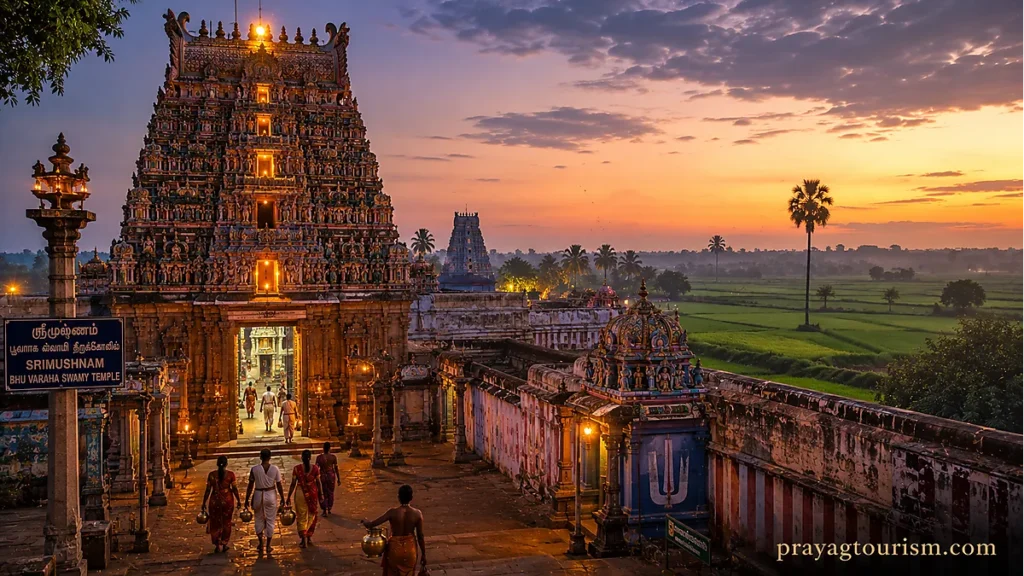
Situated near Cuddalore in Tamil Nadu, Bhu Varāha Swamy temple at Srimushnam is one of the eight swayambhu (self-manifest) kṣetras of Viṣṇu and is regarded as an Abhimāna Kṣetram in the Vaiṣṇava tradition. The mūlavar is a Saligrāma idol of Bhu Varāha, said to have manifested on His own at the spot where He restored the Earth.
The temple layout is classic Drāviḍa: a granite prakāra (enclosure wall), a seven-tiered rājagopuram, and inner courtyards that gradually draw the pilgrim into intimacy with the Lord. An unusual feature: Varāha’s boar face is turned slightly to the South, while His human body faces West toward the devotees – a frozen reminder that His gaze eternally challenges the defeated asura in the South even as His heart remains turned to His bhaktas.
Ritual texture
The temple observes six daily pūjās – from the early Uṣatkālam at dawn to Ardha-jāmam late at night – each consisting of alaṅkāram (decoration), naivedyam (offering), and dīpa ārātrī (waving of lamps). Nādhasvaram and tavil weave through the corridors as priests chant Vedic mantras; devotees prostrate on the stone floor, seeking not other-worldly escape but very this-worldly blessings: fertile land, resolved property disputes, stable livelihoods.
The temple’s great car festival (ratha yātrā) in the month of Vaikāsi (April–May) not only celebrates Varāha’s majesty but is renowned as a symbol of Hindu–Muslim harmony: the chariot’s flag is traditionally offered by local Muslims, who receive prasāda and carry it in their own sacred spaces.
Pilgrim tip
Take a moment to sit quietly by the temple tank, watching the reflections of the gopuram ripple in the water. Meditate on the idea that the Earth we walk on is itself a temple courtyard, and Varāha is the unseen guardian beneath our feet.
2. Varāha Cave Temple, Mahabalipuram (Tamil Nadu)
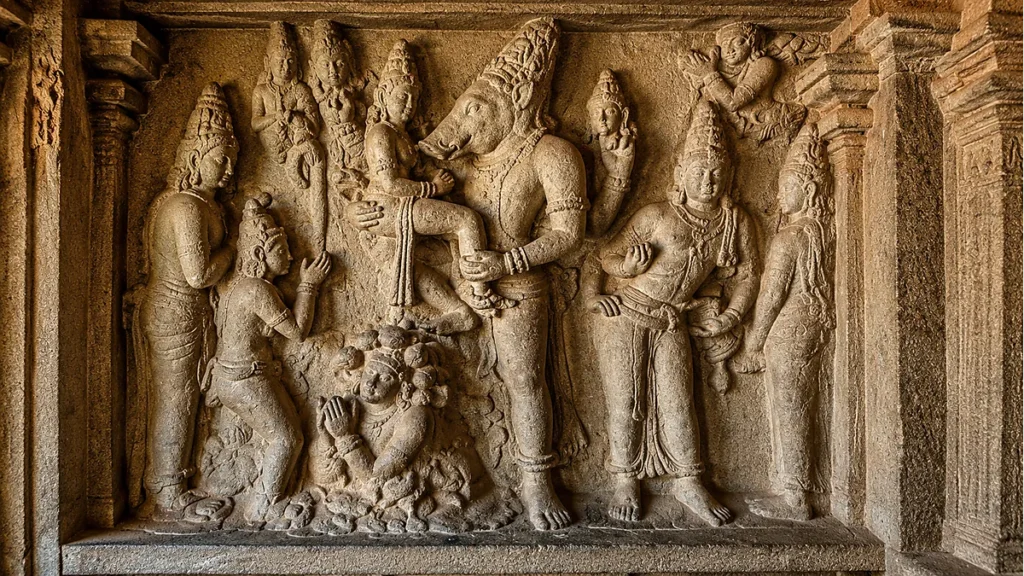
On the seashore of Mahabalipuram (Mamallapuram), among Pallava rock-cut marvels, lies the Varāha Cave Temple, a seventh-century masterpiece. Here, the Lord is carved in mid-rescue:
- Varāha stands with powerful, upright boar head and human body.
- Bhūdevī rests upon His raised thigh, gazing at Him with palpable gratitude.
- The Nāga king coils beneath His foot, representing the conquered depths of the waters.
The Pallava sculptors capture both muscular vigor and divine tenderness: veins in the Lord’s arms, but softness in His hand as it supports the Earth goddess. The scene teaches in granite what the Purāṇas teach in words: that the strongest hands are those that lift rather than crush.
Pilgrim tip
Visit in the late afternoon when the low sun grazes the relief. Shadows will deepen the carving, and Varāha’s face seems to emerge out of the rock itself. Stand before the panel and silently bring to mind one “submerged” aspect of your life – something you wish the Lord to lift out of darkness.
3. Varāha Ghāṭ, Mathurā (Uttar Pradesh)
On the banks of the Yamunā in Mathurā, ancient tradition reveres Varāha Ghāṭ as a site where the Lord reassured the Earth after a primordial flood. Pilgrims here bathe not only with the intention of washing away sins, but especially to be freed from the inner tendency to hoard, extract, and exploit.
As you descend the steps:
- Notice the worn stone – the result of countless bare feet over centuries.
- See how the ghāṭ binds water and stone, river and earth.
- Recite the Bhū Sūktas or the morning Earth prayer, consciously surrendering the Hiraṇyākṣa tendencies in your own life.
Sādhana of the Earth: Daily Practices for the Varāha Age
We are living in an era eerily reminiscent of Hiraṇyākṣa’s time. Our technologies drill deep, our economies chase endless extraction, and our collective “golden eye” often sees forests, rivers, and mountains only as inventories and assets.
To worship Varāha today is therefore to adopt a spiritual ecology: a dharmic lifestyle that honours Bhūdevī as a conscious mother.
1. Re-framing the Earth: From “Resource” to “Rasamayī Devī”
The first practice is purely cognitive. Train your language and thought:
- Stop saying “natural resources” as your default.
- Start saying “Bhūdevī”, “Mother Earth”, “Pṛthvī Mā”.
Language silently shapes consciousness. When you call soil “Mother” rather than “material”, your relationship with her shifts from exploitation to reciprocity.
2. Grounding (Earthing) as Varāha Meditation
Spend at least a few minutes daily in direct contact with the Earth:
- Walk barefoot on grass, sand, or unpaved soil.
- If you live in a city, place your hands on a potted plant’s soil or on a tree trunk.
- As you do so, visualise Varāha beneath the surface, holding the planet steady.
Mentally repeat a simple line:
“O Varāha, may Your tusks lift my mind from fear and greed, just as You lifted the Earth from darkness.”
3. The Morning Earth Prayer
A traditional verse, recited before stepping out of bed, encapsulates the Varāha ethos:
- Devanagari Script
समुद्रवसने देवि पर्वतस्तनमण्डले।
विष्णुपत्नि नमस्तुभ्यं पादस्पर्शं क्षमस्व मे॥ - IAST Transliteration
samudra-vasane devi parvata-stana-maṇḍale |
viṣṇu-patni namastubhyaṁ pāda-sparśaṁ kṣamasva me || - Source: Traditional Smṛti verse, widely used as a morning prayer.
- Word-by-Word Meaning
- समुद्र-वसने (samudra-vasane) – O You who wear the oceans as garments
- देवि (devi) – O Goddess
- पर्वत-स्तन-मण्डले (parvata-stana-maṇḍale) – whose breasts are the mountains
- विष्णु-पत्नि (viṣṇu-patni) – O consort of Viṣṇu
- नमः (namaḥ) – I bow
- तुभ्यं (tubhyaṁ) – to You
- पाद-स्पर्शं (pāda-sparśam) – the touch of my feet
- क्षमस्व (kṣamasva) – please forgive
- मे (me) – mine
- Translation & Short Bhāṣya
“O Mother Earth, draped by the oceans as by a garment and adorned with mountains as Your breasts, O eternal consort of Lord Viṣṇu! I bow to You. Please forgive me for the offense of touching You with my feet.”
This single verse transforms a mechanical morning into an act of humility and gratitude. It reverses the Hiraṇyākṣa posture of domination and replaces it with the attitude of a child asking permission from its mother.
4. The Varāha Vratam: Ecological Tapasya
You may wish to institute a Varāha Vratam in your personal life – a conscious vow inspired by this Avatāra:
- One day a week without buying anything non-essential.
- One local tree or patch of ground that you protect, water, or clean.
- One recurring expense redirected each month to genuine ecological or go-seva projects.
Accompany these actions with remembrance of Varāha. Let every small act of protection become an imitation of His descent and rescue.
5. Family and Community Practice
- Teach children to bow to the Earth before leaving home for school.
- At family gatherings, narrate the Varāha story not just as an old myth, but as a mirror for climate anxiety and ecological responsibility.
- Encourage community temple events – tree planting, cleaning local ponds, banning plastic at festivals – explicitly in honour of Varāha.
In this way, your bhakti for the Divine Boar becomes a living force that protects soil, water, and future generations.
Key Sanskrit Verses, Mantras, and Meditations
To conclude this master-guide, we gather a small Varāha Sādhana Toolkit – verses and contemplations you can practically incorporate into daily life.
7.1 Daśāvatāra Verse for Japa and Kīrtan
Use Jayadeva’s Varāha verse (already presented in Phase 2) as a daily japa or kīrtan refrain. Chant slowly, visualising the Earth as a small, luminous orb resting lightly on the Lord’s tusk.
- Begin with three deep breaths.
- Chant the verse once loudly, three times softly, then sit in silence for a minute.
- Offer one worry about the state of the world to the Lord and imagine Him lifting it.
7.2 A Simple Varāha Mantra
You may adopt a short invocation such as:
Devanagari
ॐ श्रीवराहाय भूधराय नमः।
IAST
oṁ śrī-varāhāya bhūdharāya namaḥ |
Sense: “Salutations to Śrī Varāha, the bearer of the Earth.”
Repeat this mentally while walking on the street, climbing stairs, or working in your garden.
7.3 Contemplative Visualization
Once a week, set aside 10–15 minutes for a quiet visualization:
- Sit comfortably, spine erect, feet touching the ground.
- Become aware of the contact between your feet and the floor.
- Imagine, layer by layer, the ground beneath you – stone, soil, rock, magma, the planet’s core.
- At the very centre, visualise Varāha – immense, radiant, silently supporting the entire globe upon His tusks.
- See your anxieties, fears, and ecological grief resting along with the Earth on those tusks.
- Allow a single sentence to arise:
“He has not abandoned this world; He holds it even now.”
7.4 Linking Varāha to Narasiṁha: The Next Threshold
Varāha secures the ground of existence. Once the Earth is safe, life can flourish. But new forms of adharma arise that are more psychological and social than purely physical. They will no longer be defeated by animal strength alone.
Thus the narrative turns toward Narasiṁha, the Man-Lion who shatters the boundaries of species and timing to protect Prahlāda. In Daśāvatāra sequence, Varāha and Narasiṁha stand like two pillars:
- Varāha – defending the planet from being dragged into darkness.
- Narasiṁha – defending the heart that clings to dharma in a hostile world.
Varāha teaches us to love and protect the Earth. Narasiṁha will teach us to fearlessly protect devotion itself. Together, they form a blazing commentary on how the Divine answers both ecological and existential crises.
FREQUENTLY ASKED QUESTIONS
What is the Varaha Avatar?
Varaha Avatar is the third incarnation of Lord Vishnu who rescued Bhudevi (Mother Earth) from the cosmic ocean after the demon Hiranyaksha dragged her into the depths.
Why did Lord Vishnu take the form of a boar?
The boar symbolizes strength, courage, and the ability to recover what is buried. Vishnu assumed this form to lift the Earth from the cosmic waters and restore creation.
Who was Hiranyaksha?
Hiranyaksha was a powerful Daitya demon who disturbed cosmic order by submerging the Earth into the primordial ocean, prompting Vishnu’s descent as Varaha.
What does Varaha Avatar symbolize?
Varaha symbolizes divine protection, ecological responsibility, restoration of balance, and the sacred relationship between humanity and the Earth.
Which scripture describes the Varaha Avatar?
The story is primarily found in the Bhagavata Purana, Vishnu Purana, Mahabharata, and several other Puranic texts.
Which are the most famous Varaha temples in India?
Important Varaha temples include Sri Bhu Varaha Swamy Temple at Srimushnam, the Varaha Cave Temple at Mahabalipuram, and Varaha shrines in Mathura and Tirumala.
The Varāha Avatāra reveals a Sanātana Dharma that refuses escapism. It is a dharma in which God dives into the mud, confronts the golden-eyed demon of greed, and lifts a drowning world back into the light. To walk with Varāha is to let that same movement happen through us – in our lifestyles, our economies, our pilgrimages, and our prayers.
Hari Om Tat Sat.
⁂
References:
- https://www.hindu-blog.com/2018/08/story-of-origin-of-earth-in-taittiriya.html
- https://en.wikisource.org/wiki/Page:The_Mythology_of_All_Races_Vol_6_(Indian_and_Iranian).djvu/111
- https://sacred-texts.com/hin/hmvp/hmvp21.htm
- https://harikathas.com/?canto=3&chapter=13
- https://gaudiya.redzambala.com/srimad-bhagavatam/srimad-bhagavatam-canto-3-chapter-13.html
- https://krishna.com/avatar/varaha-the-boar-avatar/
- https://en.wikipedia.org/wiki/Bhu_Varaha_Swamy_temple
- https://cuddalore.nic.in/tourist-place/bhu-varaha-swamy-temple/
- https://www.poojn.in/post/18458/bhu-varaha-swamy-temple-exploring-unique-local-rituals-and-beliefs
- https://www.krishna.com/varaha-boar-avatar
- https://en.wikipedia.org/wiki/Taittirīya_Brāhmaṇa