
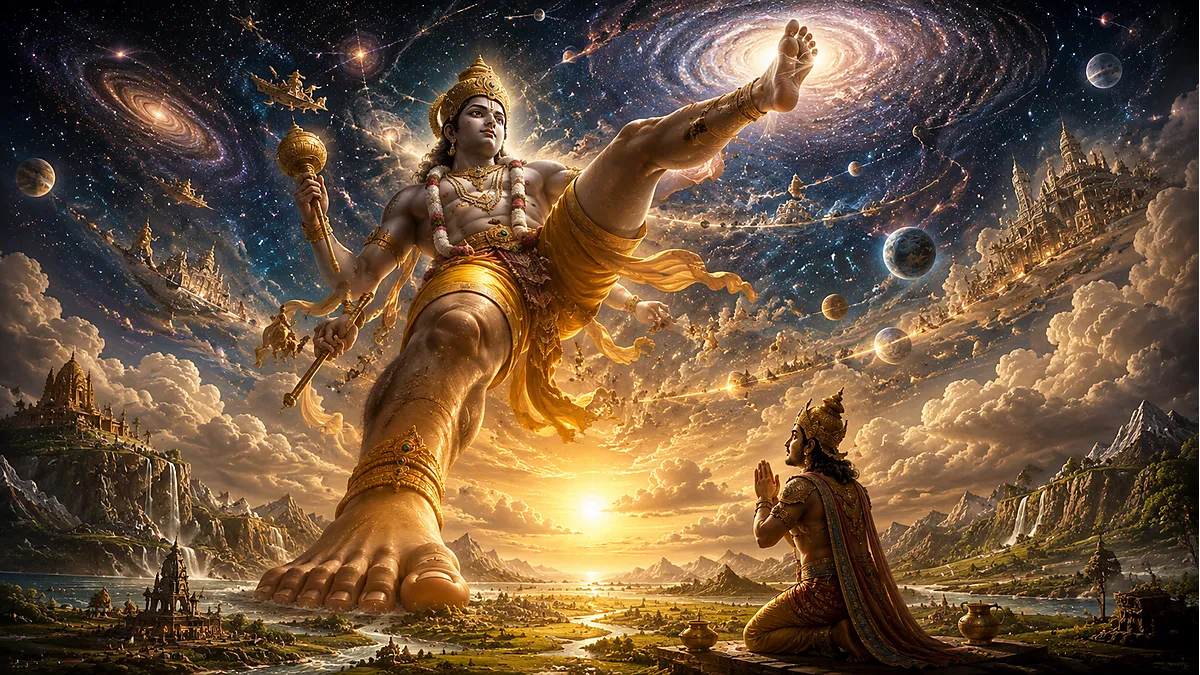
A master-guide to the fifth Avatāra of Lord Vishnu, the subjugation of Mahābali, and the esoteric science of cosmic proportion.
Table of Contents
About Vamana Avatar
Vamana Avatar is the fifth incarnation of Lord Vishnu who appeared as a dwarf Brahmin to restore cosmic balance and reclaim the three worlds from King Mahabali.
After the roaring liminality of Narasiṃha, the Daśāvatāra story quietens into a scene that feels almost domestic.
No cosmic ocean churns; no demon is torn apart in a pillar of blood and light. Instead, we see a sacrificial arena, a generous king, and a soft-spoken brahmacārī dwarf asking for “just three steps of land.”
The Sanskrit word Vāmana (वामन) means “dwarf,” “short in stature,” the small one. It suggests compressed scale, condensed presence, the deliberate choice to appear as less than one’s actual capacity. Philosophically, Vāmana is the Avatāra of Vinaya—humility not as weakness, but as controlled power.
The Upaniṣadic formula captures this paradox: the Divine is aṇor aṇīyān—smaller than the smallest—and simultaneously mahato mahīyān—greater than the greatest. Vāmana is that macrocosm choosing to appear in microcosmic form. Where Varāha and Narasiṃha employ physical force and ferocity, Vāmana employs intellect, dharma, and the mathematics of space. He wins not with a weapon, but with a footprint.
In human terms, Vāmana teaches that true intelligence does not need to shout. The most powerful presence in a room is often the quiet, unassuming person who knows exactly who they are and what they are there to do. Vāmana is the Lord as understatement.
Vedic Roots and Trivikrama in Śruti
Long before the Purāṇas speak of a dwarf Brahmin visiting Mahābali, the Ṛgveda already sings of Viṣṇu as the wide-striding measurer of the worlds—Trivikrama.
The Three Strides of Viṣṇu
A celebrated mantra from Ṛgveda 1.22.17 declares:
- Devanagari Script
इदं विष्णुर्विचक्रमे त्रेधा निदधे पदम्।
समूढमस्य पांसुरे॥ - IAST Transliteration
idaṃ viṣṇur vicakrame tredhā nidadhe padam |
samūḍham asya pāṃsure || - Sense and Bhāṣya
“Viṣṇu traversed this (world); he placed his foot down in three ways, and the whole universe was gathered within the dust of his footsteps.”
In the Vedic imagination, these three strides mark earth, atmosphere, and heaven; Viṣṇu’s movement is not just physical but cosmic, ensuring the stability of ṛta—the underlying order of reality. The hymn is part of the Viṣṇu Sūkta, often recited to invoke protection and the Lord’s all-embracing presence.
Notice that in Ṛgvedic context, Viṣṇu is not yet described as “dwarf” or “boy.” He is the cosmic strider, known by his feet more than by a specific human form. Only later will this abstract “measure of the three worlds” be personified as the charming, paradoxical Vāmana.
From Śruti to Smṛti: Trivikrama Becomes Vāmana
As the tradition moves from the Vedic ritual focus into the more narrative and devotional world of the Purāṇas, the three cosmic steps of Viṣṇu are anthropomorphised in the story of Mahābali. The Śrīmad Bhāgavatam (Canto 8), Viṣṇu Purāṇa, and other texts preserve the full narrative: the dwarfish Brahmin boy, the promise of three paces, the sudden expansion into Trivikrama, and the final act of Bali’s surrender.
In this evolution from Śruti to Smṛti:
- The cosmic measurer becomes the humble mendicant.
- The abstract three realms become the three steps of land requested in a royal assembly.
- The distant Viṣṇu of the sky becomes a guest at a king’s sacrifice, asking politely for alms.
This literary and theological move makes the vastness of Viṣṇu emotionally accessible, turning a cosmological fact into a heart-level drama.
The Grand Narrative of Vāmana and Mahābali
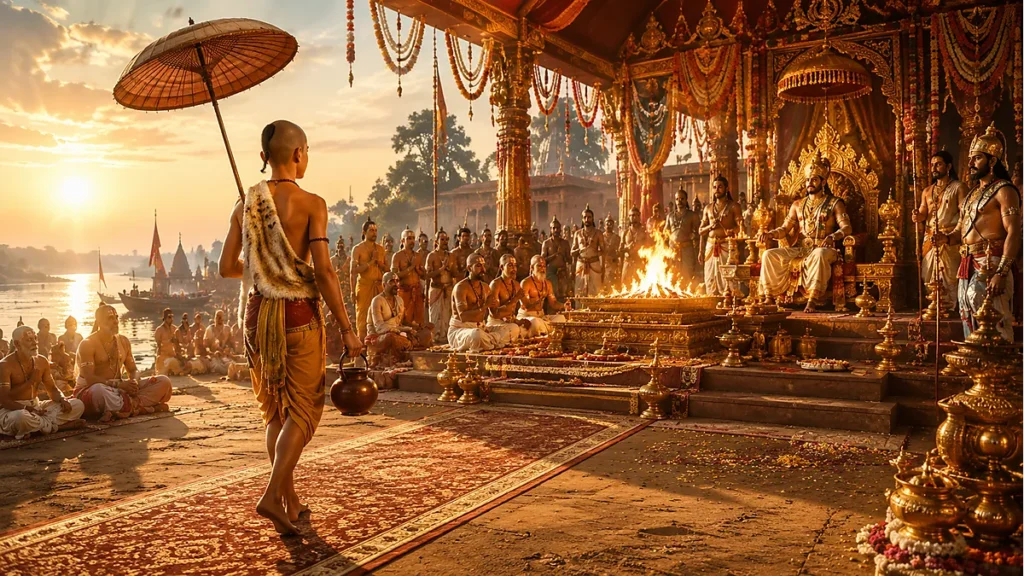
The Vāmana Avatāra unfolds as an ethical drama where everyone is, in some sense, right—the devas, Mahābali, his guru Śukrācārya, and the Lord Himself. It is not a simple tale of good versus evil, but of scale, jurisdiction, and surrender.
Mahābali: The Almost-Perfect King
Mahābali is the grandson of Prahlāda, the great devotee of Narasiṃha. He inherits his grandfather’s courage, generosity, and devotion but expresses them through sovereignty and conquest. Under his rule:
- there is no theft or poverty,
- citizens are content and prosperous,
- and his fame rivals that of the devas.
Yet, by strength of tapas and arms, Bali has seized dominion over all three worlds—Bhūr, Bhuvaḥ, and Svaḥ—displacing Indra and the devas from their rightful loka. His goodness to his subjects does not erase the cosmic imbalance created by a Daitya occupying deva-jurisdiction.
Aditi’s Tears and the Birth of Vāmana
Unable to regain their realms, the devas turn to Aditi, the mother of gods, whose sorrow and prayers reach Viṣṇu. Moved by her distress, the Lord agrees to incarnate as her son. He appears as Vāmana, a radiant dwarf Brahmin—small in form, vast in presence.
He approaches Mahābali during the peak of a great Aśvamedha Yajña, when the king is in a mood of supreme generosity. The entire scene is designed as a confrontation between outer splendour and inner radiance: gold, flags, and chariots on one side; a single umbrella and kamaṇḍalu on the other.
Śukrācārya’s Warning and Bali’s Decision
When Vāmana requests “three steps of land as measured by my own feet,” Mahābali laughs gently. What can such a tiny boy possibly claim with three small strides? He offers much more.
But Bali’s guru, Śukrācārya, is not deceived. With his yogic insight, he recognises Viṣṇu beneath the disguise and warns:
“This is no ordinary Brahmin. This is Viṣṇu Himself, come to deprive you of your dominion. Do not grant this request.”
Bali now stands at his own threshold moment. His entire identity as the unfailingly generous giver is at stake. If he withdraws his promise, he remains powerful but breaks his core dharma. If he keeps it, he likely loses everything.
He chooses dharma over security. He says, in effect:
“What is the meaning of ‘Mahābali’ without integrity? Let the Lord take what He wishes. My vow of generosity must stand.”
He washes Vāmana’s small feet, pours water into the boy’s hands, and seals the vow.
The Expansion into Trivikrama
The moment the water falls, reality bends. The “dwarf” begins to grow:
- His head rises above the sacrificial pavilion.
- His body towers over mountains and clouds.
- His feet span continents; his stride cuts through heaven.
Vāmana has become Trivikrama. With the first step, He covers the entire earth. With the second, He encompasses the heavens and all celestial regions. The Rgvedic image has now become visible.
There is no space left for a third step.
Bali’s Surrender: “Place Your Foot on My Head”
Bound by his own word and fully aware of what has happened, Mahābali refuses to claim helplessness. Instead, he speaks one of the most moving declarations of self-surrender in the Bhāgavatam:
- Devanagari Script
यद्युत्तमश्लोक भवान् मयेरितं
वचो व्यलीकं सुरवर्य मन्यते।
करोम्यृतं तन्न भवेत् प्रलम्भनं
पदं तृतीयं कुरु शीर्ष्णि मे निजम्॥ - IAST Transliteration
yady uttamaśloka bhavān mayeritaṃ
vaco vyalīkaṃ sura-varya manyate |
karomy ṛtaṃ tan na bhavet pralambhanaṃ
padaṃ tṛtīyaṃ kuru śīrṣṇi me nijam || - Source: Śrīmad Bhāgavatam 8.22.2.
- Word-by-Word Meaning
- यदि (yadi) – if
- उत्तम-श्लोक (uttama-śloka) – O Lord praised by excellent hymns
- भवान् (bhavān) – You
- मया (mayā) – by me
- ईरितम् (īritam) – spoken
- वचः (vacaḥ) – words
- व्यलीकम् (vyalīkam) – false, deceptive
- सुर-वर्य (sura-varya) – O chief of the devas
- मन्यते (manyate) – You consider
- करोमि (karomi) – I shall make
- ऋतम् (ṛtam) – true
- तत् (tat) – that
- न (na) – not
- भवेत् (bhavet) – should be
- प्रलम्भनम् (pralambhanam) – cheating
- पदम् (padam) – step, foot
- तृतीयम् (tṛtīyam) – third
- कुरु (kuru) – please place
- शीर्ष्णि (śīrṣṇi) – on the head
- मे (me) – my
- निजम् (nijam) – Your own
- Translation & Bhāṣya
“O Lord praised by the choicest hymns, if You consider the words I have spoken to be false, then I shall make them true so that I am not a cheater. Please therefore place Your third step upon my head.”
Here, Bali’s greatness fully reveals itself. He does not beg for the return of his kingdom. He does not accuse the Lord of trickery. Instead, he elevates his own promise above his possessions and invites the Divine foot onto his very identity—his head.
Vāmana/Trivikrama accepts. Placing His foot on Bali’s head, He sends the king to Sutala, a subterranean loka crafted more beautifully than heaven, granting Bali eternal fame and promising to stand as his personal doorkeeper. In this, we see that Vāmana’s act is not annihilation but reallocation with honour.
Esoteric Science of Scale and Svadharma
The Vāmana narrative is sometimes misunderstood as a “divine trick” played on a good king to restore deva privilege. A deeper reading shows a far subtler teaching about scale, domain, and proportion.
Cosmic Jurisdiction and Svadharma
According to dharmic cosmology, different beings have different svadharmas and corresponding jurisdictions:
- Devas govern higher lokas and subtle forces.
- Humans inhabit Bhūloka, the earth-plane.
- Daityas and other beings have their own allotted realms.
Mahābali’s righteousness as a king of his people is real. But by occupying Devaloka, a Daitya has stepped beyond his cosmic mandate, creating a misalignment in the structure of the universe. The problem is not “Bali vs. Viṣṇu.” The problem is disproportion—a power occupying more space than is appropriate for its nature.[5]
Vāmana’s three steps are a recalibration of cosmic proportion:
- Earth and heaven are measured and reassigned.
- Bali is not destroyed but relocated to Sutala, the perfect scale for his tapas, virtue, and asuric lineage.[5]
- The devas return to their rightful roles, not as superior individuals, but as functionally necessary parts of the cosmic ecology.
The result is not the humiliation of Bali nor the blind victory of the devas, but the restoration of right relationship.
Humility as the Highest Form of Intelligence
Why does Viṣṇu come as a dwarf instead of a warrior? Because the lesson here is not about raw power—it is about how consciousness handles power.
- In Varāha, the Earth itself needed lifting.
- In Narasiṃha, bhakti needed protection from tyranny.
- In Vāmana, ego and domain need resizing.
A sword cannot correct scale; it can only cut. Only intellect and humility can re-measure the universe without tearing it apart. Vāmana’s smallness is therefore not decorative; it is the only fitting vector for this kind of intervention.
Evolutionary Symbolism
From an evolutionary-symbolic lens, Vāmana corresponds to humanity’s emergence as a cognitively distinct species:
- small physical body relative to many predators,
- limited raw strength,
- but unprecedented symbolic and spatial intelligence.
This is the epoch in which early humans begin to:
- map territory,
- conceptualise distance,
- navigate by stars,
- and gradually comprehend their place in a much larger world.
Vāmana’s three steps can be read as mythic encoding of this shift: the mental measurement of earth, mid-space, and sky becomes a spiritual act. Humanity is no longer just inhabiting space; it is understanding it.
In this light, Vāmana is the Lord walking alongside the early human mind, teaching it how to live proportionately within a universe it can finally imagine.
Sacred Geography: Vāmana in the Land of Onam and Beyond
The story of Vāmana and Mahābali is not confined to texts; it is woven into India’s geography, festivals, and temple architecture—especially in Kerala and Tamil Nadu.
1. Thrikkakara Vamanamoorthy Temple, Kerala – Epicentre of Onam
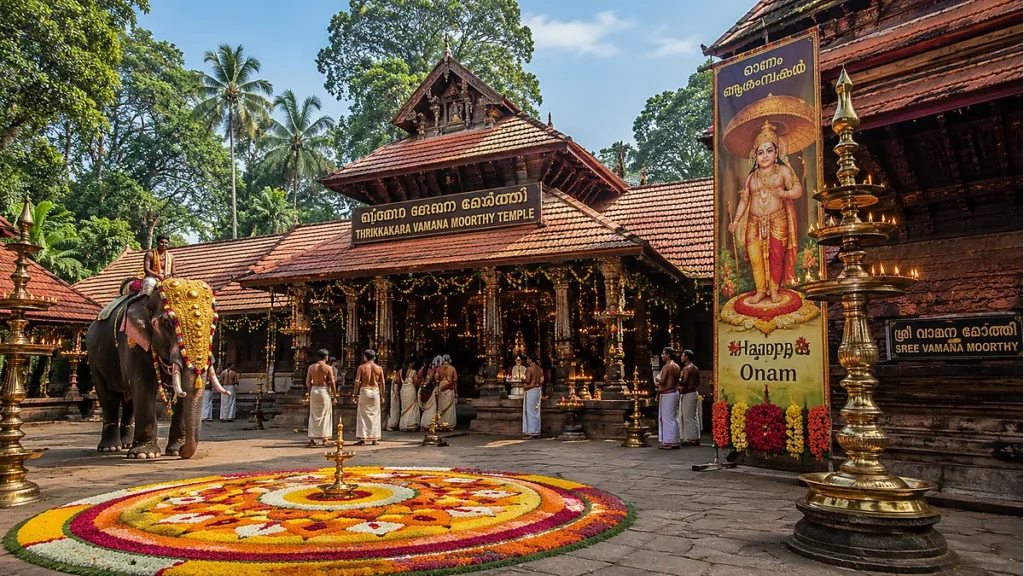
Near Kochi in Kerala lies Thrikkakara Vamanamoorthy Temple, revered as the very spot where Vāmana placed His foot on Mahābali and consigned him to the netherworld. The name “Thrikkakara” is traced to Thiru-kāl-kara—“the holy place of the divine foot.”
This temple is:
- the only major temple in Kerala dedicated specifically to Vāmana,
- counted among the 108 Divya Desams in some traditions, and
- intimately linked to the origin of the Onam festival.
According to local legend and Kerala’s living memory:
- Mahābali ruled righteously from this region;
- after Vāmana sent him to the netherworld, the Lord granted him permission to visit his people once a year on Thiruvonam day in the month of Chingam;
- Onam is celebrated as that joyful homecoming, not as a mourning of his fall.
During Onam, Thrikkakara becomes an epicentre of festivities:
- grand Onasadya (feast) served to all who gather,
- intricate pūkkalams (floral mandalas),
- processions (Seeveli, Pakalpooram) and traditional arts.
The temple complex spans about 10 acres and also houses a Śiva shrine and an image of Mahābali himself, reflecting the integrated nature of Kerala’s religious culture. Historical accounts suggest the site hosted royal assemblies under Chera rulers, and inscriptions and literary references place its significance back many centuries.
Pilgrim insight:
At Thrikkakara, you stand in a place where a “defeated” king is still honoured each year with love. The theology here is subtle: Vāmana’s act did not erase Bali; it gave rise to a festival where both Lord and king are remembered in affection.
2. Ulagalantha Perumal Temple, Kanchipuram – The Colossal Trivikrama
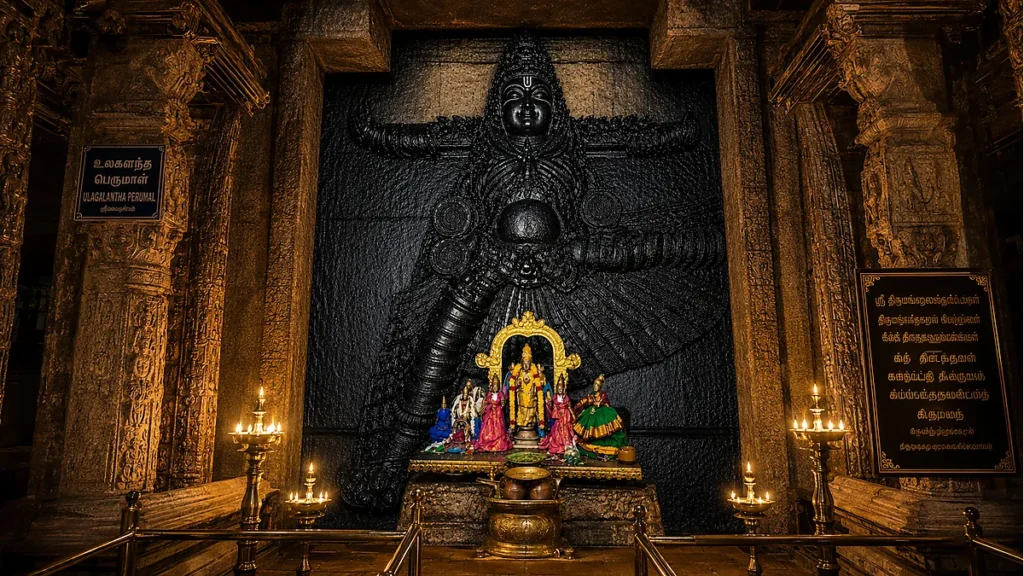
In Kanchipuram, Tamil Nadu, the Ulagalantha Perumal Temple (Thiru Ooragam) offers one of the most awe-inspiring images of Vāmana in his expanded Trivikrama form. Recognised as a Divya Desam and celebrated in the Nālayira Divya Prabandham, it is also one of the oldest temple complexes in the city, with inscriptions dating back to at least the ninth century CE.
Here, the main deity:
- stands approximately 35 feet tall and about 24 feet wide, making it one of the largest Viṣṇu icons in South India;
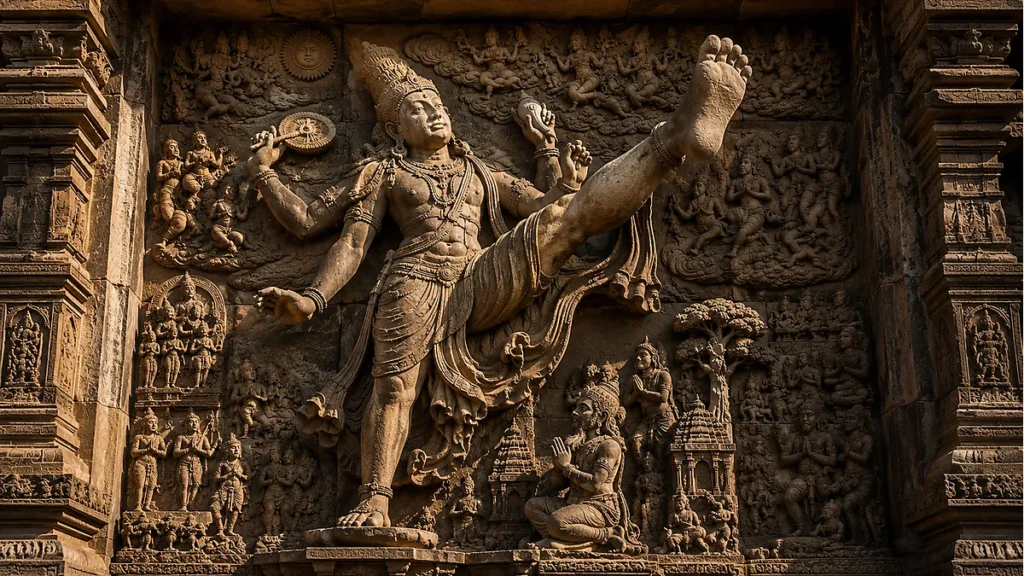
- places one foot firmly on the ground while the other is raised horizontally at a right angle, representing the second cosmic step;
- extends two fingers on one hand (indicating the two completed steps) and one finger on the other (posing the unanswered question of the third step).
Miniature figures of Mahābali and his royal court are carved near the Lord’s feet, illustrating the exact moment of surrender and the offering of the head. Within the same temple complex, four Divya Desams—Thiru Karvaanam, Thiru Kaaragam, Thiru Ooragam, and Thiru Neeragam—are enshrined, each linked to facets of Viṣṇu’s presence.
Pilgrims come here especially when life feels overwhelmingly constrained or blocked—trusting that the Lord who stretched across the universe in two steps can just as easily stretch across their personal difficulties.
3. Other Vāmana-Trivikrama Kṣetras
Beyond these two major centres:
- Various Viṣṇu temples across India include Trivikrama panels in their gopurams and sanctums, visually encoding the three steps motif.
- At Tirupati, traditions connect certain festivals and iconography with Trivikrama, and some scholars note parallels between Thrikkakara and Tirumala lore regarding the timing of Vāmana-related festivities.
These scattered references remind us that Vāmana’s story is not regional; it is pan-Indian, imprinting the idea of measured humility and cosmic scale wherever Viṣṇu is adored.
Modern Spiritual Practice: Humility, Limits, and Surrender
What does the Vāmana Avatāra say to a world obsessed with “limitless growth,” personal branding, and endless conquest?
Practicing Sacred Proportion
Bali’s downfall was not a lack of virtue, but a lack of proportion. He did too much of a good thing—extending his domain beyond what was dharmically appropriate. Modern life often praises such overreach: “More market share, more followers, more influence—at any cost.”
Vāmana offers a counter-ethos:
- Recognise your svadharma—the domain where your gifts naturally belong.
- Fulfil it excellently, but resist the temptation to seize spaces that are not yours to inhabit.
- Understand that peace and power both emerge from right sizing, not from perpetual expansion.
A simple practice:
- Periodically list your current “territories”: roles, projects, possessions.
- Ask: “Which of these are genuinely mine to hold? Which may I have outgrown—or overreached?”
- Offer the overreach mentally at Vāmana’s feet, inviting Him to “re-measure” your life.
The Weapon of Humility
In a roomful of loud egos, the quiet, centred person often wields the most real influence. Vāmana’s unimposing stature hides cosmic capability. For modern seekers:
- Humility is not thinking poorly of yourself; it is knowing your true size in relation to the Infinite.
- It frees you from the exhausting job of defending a false image.
- It allows you to move like water—precisely where you are needed, unblocked by constant self-assertion.
In meetings, family conflicts, and social media spaces, practice what we might call Vāmana-Vinaya: speak when needed, listen deeply, and let your integrity—not your volume—carry your presence.
Bali’s Head: Atmanivedanam for Our Times
Bali’s offering of his head symbolises Ātmanivedanam—total self-surrender. Practically, this means:
- surrendering the idea that we can or must control every aspect of our world;
- admitting that we cannot always see the larger cosmic map;
- trusting that allowing the Divine to “place a foot” on our ego may feel like loss but is actually a relocation to a more truthful, blessed state.
A daily micro-practice:
- At the end of the day, sit quietly and visualise Vāmana/Trivikrama before you.
- Place an imaginary crown on your own head—made of your day’s achievements, anxieties, and roles.
- Then mentally lift that crown off and place your head at the Lord’s feet, repeating inwardly:
“O Vāmana, if my words and self-definitions have been untrue, place Your step on my head and make them right.”
This is Bali’s prayer, translated into inner life.
Key Verses, Mantras, and Meditations
To complete this master-guide, here is a small Vāmana sādhana toolkit you can integrate into personal practice.
The Trivikrama Mantra from Ṛgveda
Re-using the Ṛgvedic line as a personal mantra connects you to the oldest layer of Vāmana’s mystery:
IAST
idaṃ viṣṇur vicakrame tredhā nidadhe padam |samūḍham asya pāṃsure ||
Chant slowly, reflecting:
- “This universe, He has traversed.”
- “He placed three steps.”
- “Everything I worry about is already within the dust of His feet.”
A Simple Vāmana Invocation
For daily remembrance:
Devanagari
ॐ श्रीवामनाय त्रिविक्रमाय नमः।
IAST
oṁ śrī-vāmanāya trivikramāya namaḥ |
Sense: “Salutations to Śrī Vāmana, who is also the great Trivikrama.”
Chant this 11 times each morning, especially before entering spaces associated with measurement and scale—business decisions, financial planning, architectural projects—inviting the Lord to infuse right proportion.
Meditation on the Three Steps
A short, guided visualization:
- Sit comfortably, spine upright.
- Visualise a small, radiant boy-Brahmin standing before you, umbrella and kamaṇḍalu in hand.
- See Him take His first step—it covers your immediate world: home, work, relationships. Offer these to Him.
- See the second step cover your wider world: city, country, planet, the systems you cannot control. Offer these too.
- When He asks, “Where shall I place the third step?”, imagine bowing your head and saying:
“Here, on my identity; let even my idea of ‘me’ be measured by You.” - Rest in silence for a minute, noticing how your worries shift when re-scaled within His stride.
Festival Practice: Onam as Spiritual Reminder
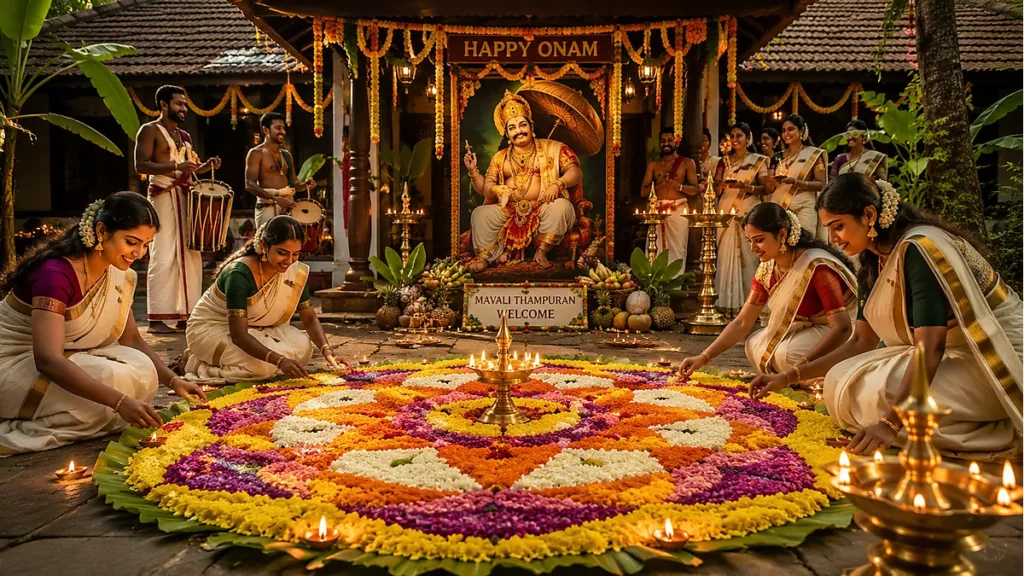
If you observe Onam, consciously connect its cultural joy with its spiritual root:
- As you lay down a floral pūkkalam, remember that it is a welcome carpet for a king who accepted loss to preserve integrity.
- As you partake of the Onasadya, recall that true abundance is not the size of your kingdom but the quality of your character—Bali kept his vow even when everything else was taken.
- Offer a silent bow to both Mahābali and Vāmana—one as the exemplar of surrendered kingship, the other as the gentle Avatāra who measures us back into truth.
Vāmana Avatāra shows us a universe governed not merely by brute strength or legalistic boons, but by subtle proportion, moral integrity, and divine humility. He is the Lord who arrives as the smallest person in the room and quietly, almost playfully, reveals that all rooms, all worlds, all scales of existence are already within His stride.
FREQUENTLY ASKED QUESTIONS
What is the Vamana Avatar?
Vamana Avatar is the fifth incarnation of Lord Vishnu who appeared as a dwarf Brahmin to restore cosmic balance and reclaim the three worlds from King Mahabali.
Why did Lord Vishnu take the form of Vamana?
Vishnu assumed the humble form of Vamana to teach that wisdom, humility, and dharma can achieve what force alone cannot.
Who was King Mahabali?
Mahabali was a righteous and generous Asura king whose growing power extended across the three worlds, creating a cosmic imbalance despite his virtues.
What are the three steps of Trivikrama?
The first step covered Earth, the second covered Heaven, and the third was placed upon Mahabali’s head when no space remained.
What is the connection between Vamana Avatar and Onam?
The Onam festival celebrates the annual return of King Mahabali to visit his people, a blessing granted by Lord Vamana after Bali’s surrender.
Which temple is most associated with Vamana Avatar?
Thrikkakara Vamana Moorthy Temple in Kerala is traditionally regarded as the most important Vamana temple and the spiritual center of Onam celebrations.
Where Varāha secured the earth, and Narasiṃha defended devotion, Vāmana restores proportion—teaching us that our greatness lies not in how much we seize, but in how exactly we fit into the Divine measurement of things.
Hari Om Tat Sat.
⁂
References
- https://vedsearch.org/rigved/1/22/17
- https://www.wisdomlib.org/hinduism/book/rig-veda-english-translation/d/doc829111.html
- https://ramanuja.org/sri/BhaktiListArchives/Article?p=oct2002%2F0054.html
- https://www.scribd.com/document/946244879/Idam-Vishnu-Vichakrame
- https://thevedavox.wordpress.com/2021/05/21/three-steps-of-vishnu/
- https://timesofindia.indiatimes.com/city/kochi/the-many-legends-of-onam-vamana-and-thrikkakara/articleshow/71034079.cms
- https://inditales.com/thrikkakara-vamana-moorthy-temple-kochi/
- https://www.keralatourism.org/destination/vamanamoorthy-temple-ernakulam/204/
- https://www.keralatourism.org/onam/history/thrikkakara-charitham
- https://www.mystreal.com/temples/tamilnadu/ulagalantha-perumal-temple-kanchipuram/
- https://www.holydham.com/sri-ulagalantha-perumal-temple-or-thiru-ooragam/
- https://www.incredibleindia.gov.in/en/tamil-nadu/kanchipuram/sri-ulagalantha-perumal-temple
- https://www.tamilnadutourism.com/blog/ulagalantha-perumal-temple-kanchipuram