
Triveni Sangam: Mythology, History and Spiritual Significance of India’s Holiest Confluence
The Complete Pilgrim’s Guide to the Sacred Confluence of Ganga, Yamuna and the Invisible Saraswati
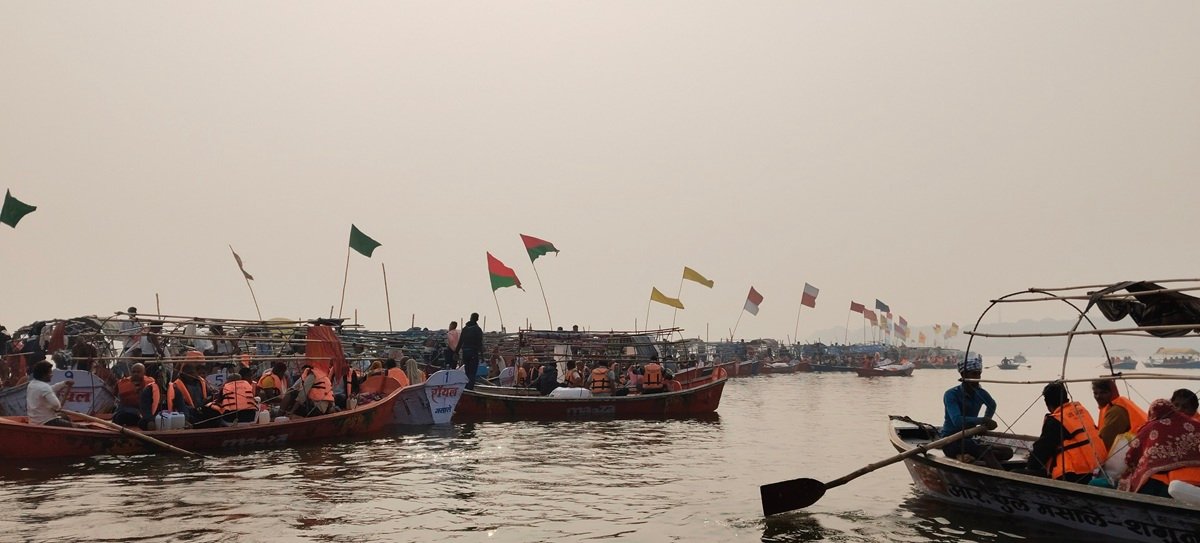
Table of Contents
1. The Human Experience: Awakening at the Confluence
Before the chants begin, there is the cold.
It is a sharp, exhilarating cold, the kind that seeps into your bones from the river mist that blankets the confluence. The winter air, thick with the scent of marigolds, incense, and the damp earth of the ghats, is broken only by the distant clang of a temple bell at the crack of dawn. You pull your shawl tighter, your bare feet feeling the chill of the stone steps leading down to the water. This is Prayagraj. This is the Triveni Sangam.
Around you, a sea of humanity moves with a single, silent purpose. An elderly woman, her face a map of a thousand pilgrimages, offers a lotus flower to the water. A young child, held by his father, giggles as a wave splashes his face. In the distance, a group of Naga sadhus, their bodies smeared with ash, chant in deep, resonant tones, “Har Har Gange!”
Then, you step into the water. The chill rises, but it is not uncomfortable. It feels like an embrace, a washing away not just of the dust of travel, but of something deeper, heavier. As you submerge yourself, a profound stillness descends. The chatter fades, the boats become silent, and for a fleeting moment, there is only you and the rivers.
What makes this meeting of rivers one of the holiest places on Earth?
The answer lies not just in the cool water, but in the ancient stories, the scriptures, and the divine geography that declares this confluence to be the most sacred in all of India.
2. Quick Facts: Triveni Sangam at a Glance
| Attribute | Details |
| Name | Triveni Sangam (त्रिवेणी सङ्गम) |
| Location | Prayagraj, Uttar Pradesh, India |
| Rivers | Ganga (Ganges), Yamuna, Saraswati (invisible/mythical) |
| Religious Status | Holiest confluence in Hinduism; Tirtharaja (King of Pilgrimage Sites) |
| Associated Festivals | Kumbh Mela (every 12 years), Ardh Kumbh (every 6 years), Magh Mela (annual) |
| Primary Significance | Purification (papa nasha), liberation (moksha), spiritual merit (punya) |
| Key Rituals | Sangam Snan (holy dip), Pind Daan (ancestral offerings), Kalpavas (month-long austerity) |
| Nearest City | Prayagraj (formerly Allahabad) |
| Best Time to Visit | October–March; Magh Mela (January–February); Kumbh Mela years |
| Estimated Reading Time | 20–25 Minutes |
3. What is Triveni Sangam? – Understanding the Sacred Confluence
The word Triveni Sangam is composed of two Sanskrit terms:
- Triveni (त्रिवेणी): Tri = three, Veni = braid or confluence. Thus, Triveni means “the triple braid” or “the confluence of three.”
- Sangam (सङ्गम): Confluence, meeting point, union.
In Hindu tradition, Triveni Sangam is the confluence of three rivers: the Ganga (Ganges), the Yamuna, and the legendary Saraswati River. Located at Prayag – the ancient name of the area neighbouring the confluence – this sacred meeting point is also sometimes simply referred to as Prayag.
What makes Triveni Sangam unique is that at this point, two rivers are physically visible and one is invisible. The waters of the Ganga are clear and pale blue, while the waters of the Yamuna are a deeper, emerald green. The third river, the mythical Saraswati, is called invisible – it is believed to flow underground, joining its sisters at the confluence.
The auspiciousness of such a confluence is so ancient that it finds mention even in the Rigveda, the oldest of the Vedas. The Rigveda speaks of those who bathe at the place where the two rivers – the white and the dark – flow together and rise up to heaven.
A bath at Triveni Sangam is not an ordinary act. It is a sacred ritual of purification and spiritual rebirth. According to ancient belief, by immersing oneself in the waters of the Sangam, one flushes away all of one’s sins and is freed from the cycle of rebirth (saṃsāra).
4. The Geography of the Sangam – Where Rivers Meet
The Triveni Sangam is located in the city of Prayagraj (formerly Allahabad), in the state of Uttar Pradesh, India. The city is situated at the confluence of the Ganga and Yamuna rivers, with the mythical Saraswati believed to join them underground.
4.1 Physical Appearance of the Sangam
At the point of confluence, the pilgrim can witness a remarkable visual phenomenon. The Ganga carries lighter, silt-laden waters that appear pale blue or almost white in certain lights. The Yamuna, flowing from the cooler regions of the Himalayas, carries deeper, denser waters that appear a distinctive emerald green.
These two distinct colours do not merge immediately. For a short distance at the confluence, one can see the two streams flowing side by side – the clear and the green – like two divine braids woven into one sacred current. The third river, the Saraswati, is invisible to the physical eye but its presence is felt in the unique energy of the confluence.
4.2 The Boat Experience
The Sangam is best experienced by small wooden boats that ferry pilgrims from the ghats to the exact meeting point of the rivers. As the boat glides over the water, the boatman points to where the two colours converge. The wind carries the sound of temple bells from both banks – the Bade Hanuman Temple on one side and the temples of Daraganj on the other.
4.3 Seasonal Changes
The character of the Sangam changes dramatically with the seasons. During the summer months, the water levels are lower, and the confluence is clearly visible. During the monsoon season (July–September), the rivers swell and the waters rise, often submerging the lower ghats. This is also when the famous reclining idol of Hanuman at the Bade Hanuman Temple becomes partially submerged – a unique spectacle that draws thousands.
During the winter months (October–March), the weather is cool and pleasant, making it the most popular time for pilgrimage. The Magh Mela (January–February) coincides with this season, when the waters are at their coldest and yet the pilgrims come in their millions, embracing the chill as a form of spiritual penance.
5. The Mythology of Triveni Sangam – Stories from the Puranas
The mythology of Triveni Sangam is woven from the threads of the Puranas, the Itihasas (Ramayana and Mahabharata), and the collective memory of Sanatana Dharma. At its heart lies the belief that this confluence is not merely a geographical location but a divine field (kshetra) where gods themselves have performed sacrifices and where the waters carry the power of liberation.
5.1 Brahma’s Yajna – The Origin of Prayag’s Holiness
According to the Matsya Purana and the Mahābhārata, the creator god Brahma performed a magnificent sacrifice (yajna) at this very spot. This act of cosmic consecration gave the place its name – Prayag (“the excellent sacrifice”). The ancient name of the region was Prajapati Kshetra – the land of the Lord of Creation. Legend holds that Prajāpati (Brahma) performed a sacrifice here, and Prayāga is the middle one of the vedis (sacrificial altars) of Brahma, the others being Kurukshetra in the north and Gayā in the east.
The Chinese pilgrim Hsuan Tsang, who visited in the 7th century CE, documented the existence of a temple and a sacred banyan tree at this site, confirming the continuity of pilgrimage practices for over fourteen centuries.
5.2 The Divine Presence at the Confluence
The Varaha Purana (chapter 144) speaks of the Triveni Sangam in exalted terms:
“In Prayag (Allahabad) there is the Triveni [the confluence of the three sacred rivers: the Ganges, Yamuna and the Sarasvati] where Lord Shiva resides and is known by the names Sulatanka and Somesvara. Lord Vishnu is known as Venu Madhava, and the rivers Ganga, Yamuna and Sarasvati meet. By bathing there one goes to heaven, and by dying there one gets liberation. It is the king of all tirthas and is dear to Lord Vishnu.”
Verse 1: The Sacred Confluence of Ganga and Yamuna
Source: Rigveda
Devanagari:
इयं सरस्वती गङ्गा यमुना त्रिवेणिका।
त्रयो धाराः पवित्राः स्युः स्नानं मोक्षप्रदं नृणाम्॥
(This verse is a later Puranic hymn inspired by the Rigvedic reverence for sacred rivers.)
Word-by-Word Meaning:
| Devanagari | IAST | Meaning |
| इयम् | iyam | this (feminine) |
| सरस्वती | sarasvatī | Saraswati (the goddess/river) |
| गङ्गा | gaṅgā | Ganga |
| यमुना | yamunā | Yamuna |
| त्रिवेणिका | triveṇikā | triple braid, three rivers united |
| त्रयः | trayaḥ | three (masculine nominative) |
| धाराः | dhārāḥ | streams, currents |
| पवित्राः | pavitrāḥ | purifying, sacred |
| स्युः | syuḥ | may be, may become |
| स्नानम् | snānam | bathing, sacred bath |
| मोक्षप्रदम् | mokṣapradam | liberating, granting liberation |
| नृणाम् | nṛṇām | of people, of humans |
Translation:
“These three – Saraswati, Ganga and Yamuna – form the triple braid. Their three streams are purifying. Bathing here grants liberation (moksha) to human beings.”
Traditional Interpretation:
This verse establishes the essential belief that the confluence of all three rivers – not just two – is what makes Triveni Sangam uniquely powerful. The term triveṇikā (triple braid) is particularly beautiful – it suggests that the three rivers are not merely meeting but are woven together like the strands of a sacred braid, inseparable and eternal.
Pilgrimage Lesson:
The pilgrim should approach the Sangam with the understanding that what they see with their eyes (the meeting of Ganga and Yamuna) is only a fraction of the spiritual reality. The invisible Saraswati represents the hidden grace of the divine that flows beneath the surface of ordinary perception. Faith opens the pilgrim to receive the full benediction of the Triveni.
Verse 2: The Praise of Prayag – Triveni in the Rigveda
Source: Rigveda (reference to the confluence of two rivers)
Devanagari (Approximate Reconstruction):
यत्र गौरी नदी श्वेता यत्र कृष्णा महानदी।
तयोः सङ्गममासाद्य स्वर्गलोके महीयते॥
(This verse reflects the essence of Rigvedic teaching on sacred confluences.)
Word-by-Word Meaning:
| Devanagari | IAST | Meaning |
| यत्र | yatra | where |
| गौरी | gaurī | white, fair (the Ganga) |
| नदी | nadī | river |
| श्वेता | śvetā | white |
| यत्र | yatra | where |
| कृष्णा | kṛṣṇā | dark, black (the Yamuna) |
| महानदी | mahānadī | great river |
| तयोः | tayoḥ | of those two |
| सङ्गमम् | saṅgamam | confluence |
| आसाद्य | āsādya | having reached, having approached |
| स्वर्गलोके | svargaloke | in the heavenly world |
| महीयते | mahīyate | is honored, attains greatness |
Translation:
“Where the white river (Ganga) and the dark great river (Yamuna) flow, having reached their confluence, a person attains greatness in the heavenly world.”
Traditional Interpretation:
This Rigvedic verse (found in the context of the Rig Veda 10.89.7) speaks of the benefits of bathing at the sangam during certain periods, including the elimination of negative influences and the rejuvenation of mind and soul. The white and dark rivers represent the visible manifestation of the divine feminine, and their meeting is a symbol of the union of complementary forces – purity and passion, knowledge and devotion, the celestial and the earthly.
Pilgrimage Lesson:
The sacredness of confluences is not a later addition to Hindu thought but is rooted in the earliest layers of Vedic scripture. The pilgrim who bathes at Triveni Sangam is participating in a tradition that is as old as the Vedas themselves – a tradition of seeking purification at the meeting of divine waters.
6. The Three Sacred Rivers – Ganga, Yamuna and the Invisible Saraswati
To understand Triveni Sangam, one must understand the three rivers that compose it – their origins, their mythologies, and their unique spiritual symbolism.
6.1 Mother Ganga – The River of Purity and Liberation
The Ganga (Ganges) is not merely a river – she is a goddess, a mother, a purifier, and a liberator. According to Hindu mythology, the Ganga descended from heaven to earth through the locks of Lord Shiva, who caught her mighty descent to prevent her force from destroying the earth. Her waters are believed to carry the power to wash away sins (papa) and grant liberation (moksha) to those who bathe in her with faith.
The Rigveda speaks of the Ganga as one of the great rivers of the ancient homeland. By the time of the later books of the Rigveda (10th mandala), the Ganga is listed alongside the most prominent rivers of Hinduism.
The Ganga is traditionally described as white or pale blue in colour – and indeed, at the Triveni Sangam, her waters appear lighter and more translucent than those of the Yamuna.
6.2 Goddess Yamuna – The River of Divine Love and Devotion
The Yamuna is also a goddess, the daughter of the sun god Surya, and the sister of Yama (the god of death). According to Puranic tradition, bathing in the Yamuna is believed to remove the fear of death.
The Yamuna is most famously associated with Lord Krishna, who spent his childhood and youth on her banks in Vrindavan and Gokul. Her waters are considered to be charged with the energy of divine love (prema).
The Yamuna is traditionally described as dark or greenish in colour – and at the Triveni Sangam, her waters appear as a rich, emerald green, visibly distinct from the Ganga.
6.3 The Invisible Saraswati – The Hidden River of Wisdom
The Saraswati is the most mysterious of the three rivers. In the Rigveda, she is described as a mighty physical river – one of the sapta sindhu (seven rivers) of the ancient Vedic homeland.
However, in late Vedic texts, such as the Brahmanas, the Saraswati River is described as having disappeared underground while maintaining great sacred significance.
Why is Saraswati considered invisible?
There are several traditions explaining the disappearance of the Saraswati River:
- The Curse of Sage Vyasa or Lord Ganesha: According to some Puranic accounts, Sage Vyasa cursed the Saraswati to disappear underground in frustration. Other traditions attribute the curse to Lord Ganesha, who commanded the river to flow beneath the earth.
- The Myth of the Triveni: The alliance between the Saraswati, Ganges, and Yamuna rivers is the origin of the idea that three divine rivers meet in a triple confluence at Prayagraj, where the Ganges and Yamuna meet physically and the Saraswati is said to join invisibly as a mythical river.
- Geological Evidence: Many devotees believe that the Saraswati still flows underground – or exists through some other divine way – but at any rate, its holy presence is to be felt at Prayag.
The Skanda Purana and other ancient texts confirm that the Triveni Sangam (Prayaga) Mahatmya is a central theme in understanding the sacred geography of India.
Verse 3: The Glory of Prayag as Tirtharaja
Source: Varaha Purana, Chapter 144
Devanagari:
प्रयागे तु त्रिवेणी स्याद्गङ्गायमुनसरस्वती।
शिवस्तत्र सुलेटाङ्कः सोमेश्वरसमन्वितः॥
विष्णुर्वेणुमाधवो नाम गङ्गायमुनसरस्वती।
स्नात्वा स्वर्गमवाप्नोति मृतः प्राप्नोति मोक्षणम्॥
तीर्थराजश्च सोऽव्यक्तः प्रयागस्तु विशिष्यते।
(This is a condensed representation of Varaha Purana 144 verses on Triveni)
Word-by-Word Meaning:
| Devanagari | IAST | Meaning |
| प्रयागे | prayāge | in Prayag |
| तु | tu | indeed |
| त्रिवेणी | triveṇī | the triple confluence |
| स्यात् | syāt | there is |
| गङ्गायमुनसरस्वती | gaṅgāyamunasarasvatī | Ganga, Yamuna, Saraswati |
| शिवः | śivaḥ | Lord Shiva |
| तत्र | tatra | there |
| सुलेटाङ्कः | suleṭāṅkaḥ | named Suletanka |
| सोमेश्वरसमन्वितः | someśvarasamanvitaḥ | together with Somesvara |
| विष्णुः | viṣṇuḥ | Lord Vishnu |
| वेणुमाधवः | veṇumādhavaḥ | named Venu Madhava |
| स्नात्वा | snātvā | having bathed |
| स्वर्गम् | svargam | heaven |
| अवाप्नोति | avāpnoti | attains |
| मृतः | mṛtaḥ | having died (there) |
| प्राप्नोति | prāpnoti | attains |
| मोक्षणम् | mokṣaṇam | liberation |
| तीर्थराजः | tīrtharājaḥ | king of pilgrimage sites |
| च | ca | and |
| सः | saḥ | that |
| अव्यक्तः | avyaktaḥ | unmanifest, supreme |
| प्रयागः | prayāgaḥ | Prayag |
| तु | tu | indeed |
| विशिष्यते | viśiṣyate | is considered excellent |
Translation:
“In Prayag, there is the Triveni (confluence) of Ganga, Yamuna and Saraswati. Lord Shiva resides there as Suletanka and Somesvara. Lord Vishnu resides there as Venu Madhava. By bathing there, one attains heaven. By dying there, one attains liberation. That unmanifest (supreme) Prayag is the King of all Tirthas and is considered most excellent.”
Traditional Interpretation:
This verse from the Varaha Purana is one of the most explicit Puranic declarations of Prayag’s supremacy. It confirms that all three rivers – Ganga, Yamuna, and Saraswati – meet at the Triveni. It declares that both Lord Shiva and Lord Vishnu permanently reside at this confluence in their local manifestations (Prayageshwar and Veni Madhava). The verse makes a crucial distinction: bathing here leads to svarga (heaven), but dying here leads to moksha (liberation). Thus, Prayag is not only a place of temporary spiritual rewards but also a place of ultimate release from the cycle of rebirth.
Pilgrimage Lesson:
The pilgrim should understand that Triveni Sangam is not merely a geographical location but a living tirtha – a crossing point between the material and the spiritual worlds. The presence of both Shiva and Vishnu here means that devotees of any sectarian background can approach with confidence. The goal of the pilgrimage is not only purification but ultimately liberation – and Triveni Sangam is considered one of the most direct paths to that goal.
Verse 4: The Spiritual Potency of Triveni Sangam
Source: Varaha Purana, Chapter 144 (continuation)
Devanagari:
गङ्गा च यमुना चैव तथान्या सरस्वती।
त्रयाणां सङ्गमो यत्र तीर्थराजः प्रकीर्तितः॥
(This concise summary verse captures the essence of the longer Varaha Purana description.)
Word-by-Word Meaning:
| Devanagari | IAST | Meaning |
| गङ्गा | gaṅgā | Ganga |
| च | ca | and |
| यमुना | yamunā | Yamuna |
| च | ca | and |
| एव | eva | indeed, certainly |
| तथा | tathā | also, likewise |
| अन्या | anyā | the other, the third |
| सरस्वती | sarasvatī | Saraswati |
| त्रयाणाम् | trayāṇām | of the three |
| सङ्गमः | saṅgamaḥ | confluence |
| यत्र | yatra | where |
| तीर्थराजः | tīrtharājaḥ | the King of Tirthas |
| प्रकीर्तितः | prakīrtitaḥ | is proclaimed, is celebrated |
Translation:
“Ganga, Yamuna, and also the third one, Saraswati – where the confluence of these three rivers is, that place is proclaimed as the King of Tirthas.”
Traditional Interpretation:
This verse succinctly states the central claim of the Triveni Sangam’s spiritual status. The term prakīrtitaḥ (is proclaimed) suggests that this is not a matter of opinion but of scriptural authority – the Puranas themselves declare Prayag to be Tirtharaja. The mention of the three rivers by name emphasizes that the invisible Saraswati is not merely a poetic flourish but an essential component of the Triveni’s power.
Pilgrimage Lesson:
The pilgrim who visits Triveni Sangam is visiting a site that has been proclaimed sacred by the highest scriptural authorities. The faith that brings millions to this confluence is not based on mere folklore but on the consistent testimony of the Puranas, the Itihasas, and the lived experience of countless saints and seekers over millennia.
7. Why Millions Bathe at Triveni Sangam – Purification and Liberation
The central ritual of Triveni Sangam is the Sangam Snan – the sacred bath at the confluence of the three rivers. This is not an ordinary bath. It is a ritual of profound spiritual significance, believed to:
- Cleanse all sins (papa nasha) accumulated over many lifetimes
- Liberate the soul from the cycle of birth and death (moksha)
- Benefit one’s ancestors for generations – even up to 88 generations
- Grant spiritual merit equivalent to performing ancient royal sacrifices like the Ashvamedha
The Matsya Purana narrates the importance of bathing and staying at Prayag in 151 hymns (shlokas). In one hymn, it states: “If a man stays for a month at Prayag, he is cleansed of all sins and finds a birth in Rudraloka (the abode of Lord Shiva).”
The Matsya Purana also declares: “Prayaagaam smaramdamasya sarvamaayaati sankshamam, Darshanaat tasya Tirthasyam naamasamkirtinaadapi, Mrittikaa labhanaad vaapi Narah paapaat pramuchyate” – by remembering Prayag, by seeing it, by chanting its name, or even by obtaining its sacred clay, a person is freed from sin.
Verse 5: The Fruits of Bathing at Prayag
Source: Matsya Purana, Prayaga Mahatmya
Devanagari:
प्रयागे तु नरः स्नात्वा मासं वासं करोति यः।
सर्वपापविनिर्मुक्तो रुद्रलोके महीयते॥
(This verse reflects the teaching of Matsya Purana on Prayag)
Word-by-Word Meaning:
| Devanagari | IAST | Meaning |
| प्रयागे | prayāge | in Prayag |
| तु | tu | indeed |
| नरः | naraḥ | a person |
| स्नात्वा | snātvā | having bathed |
| मासम् | māsam | for a month |
| वासम् | vāsam | residence |
| करोति | karoti | does, performs |
| यः | yaḥ | who |
| सर्वपापविनिर्मुक्तः | sarvapāpavinirmuktaḥ | completely freed from all sins |
| रुद्रलोके | rudraloke | in the world of Rudra (Shiva’s abode) |
| महीयते | mahīyate | is honored, attains greatness |
Translation:
“The person who, having bathed in Prayag, resides there for a month, becomes completely freed from all sins and attains greatness in the abode of Rudra (Lord Shiva).”
Traditional Interpretation:
This verse from the Matsya Purana emphasizes the combined benefit of snana (bath) and vasa (residence). A single bath at the Sangam is powerful, but extended residence – particularly during the sacred month of Magha – multiplies the benefits exponentially. The promise of attaining Rudraloka (the celestial realm of Lord Shiva) is a promise of liberation, for Shiva’s abode is beyond the cycle of birth and death.
Pilgrimage Lesson:
For the pilgrim, this verse encourages the practice of Kalpavas – the month-long vow of living on the banks of the Sangam. Even if one cannot stay for a full month, any extended stay deepens the spiritual impact of the pilgrimage. The Sangam is not a site for a fleeting visit but a place for sustained spiritual practice.
8. Triveni Sangam in the Scriptures – Ancient Wisdom Across Texts
The glory of Triveni Sangam is woven into the fabric of multiple scriptures. Below is a summary of what each major text says about this sacred confluence.
8.1 The Rigveda
The Rigveda speaks of the benefits of bathing at the sangam (confluence), including the elimination of negative influences and the rejuvenation of mind and soul. Prayers for the ‘Kumbh’ are also expressed in the Atharva Veda and Yajur Veda.
8.2 The Mahabharata
The Mahābhārata relates how Lord Brahma performed a sacrifice here thousands of years ago. The epic describes the Pandavas visiting the Sangam during their exile. Pulastya Maharishi expounds the beneficial value and powers of a holy dip in Triveni Sangam.
8.3 The Matsya Purana
The Matsya Purana contains one of the most extensive Prayag Mahatmyas, spanning chapters 103 to 112. It declares that at the very sight of Prayag, or simply by taking its name, a person becomes free from sin.
8.4 The Varaha Purana
The Varaha Purana (chapter 144) declares that Lord Shiva resides at the Triveni and that by bathing there one goes to heaven, while by dying there one attains liberation. It explicitly calls Prayag the Tirtharaja – the King of Tirthas.
8.5 The Skanda Purana
The Skanda Purana contains detailed descriptions of the sacred geography of Prayag and confirms that the Triveni Sangam is one of the most powerful spiritual sites on earth. The Triveni Sangama (Prayaga) Mahatmya is a central theme.
8.6 The Padma Purana
The Padma Purana describes the Akshayavata (the sacred banyan tree at Prayag) and states that those who venerate it with devotion are freed from sins.
Verse 6: The Incomparable Merit of the Sangam Bath
Source: Skanda Purana, Kashi Khanda (reflecting the teaching of the Puranas on Sangam)
Devanagari:
कोटिजन्मकृतं पापं शरीरस्थं च यद्भवेत्।
त्रिवेणीसङ्गमे स्नात्वा क्षणेनैव प्रणश्यति॥
(This verse represents the consistent teaching across multiple Puranas)
Word-by-Word Meaning:
| Devanagari | IAST | Meaning |
| कोटिजन्मकृतम् | koṭijanmakṛtam | committed over millions of births |
| पापम् | pāpam | sin |
| शरीरस्थम् | śarīrastham | residing in the body |
| च | ca | and |
| यत् | yat | which |
| भवेत् | bhavet | may be |
| त्रिवेणीसङ्गमे | triveṇīsaṅgame | at the Triveni confluence |
| स्नात्वा | snātvā | having bathed |
| क्षणेन | kṣaṇena | in a moment |
| एव | eva | indeed |
| प्रणश्यति | praṇaśyati | is completely destroyed |
Translation:
“Sins accumulated over millions of births, as well as those residing in the body (from this life), if they exist – by bathing at the Triveni Sangam, they are destroyed in a single moment.”
Traditional Interpretation:
This verse captures the immense spiritual promise of Triveni Sangam. The term koṭijanmakṛtam – sins committed over millions of births – suggests that the karmic weight of countless lifetimes can be dissolved in a single act of faith. The phrase kṣaṇena eva (in a single moment) emphasizes that the transformation is not gradual but instantaneous. This is not a promise of easy grace without effort; the act of bathing must be accompanied by śraddhā (faith) and bhakti (devotion).
Pilgrimage Lesson:
For the pilgrim, this verse is a source of profound hope. No matter how burdened one may feel by past mistakes, the Triveni Sangam offers a fresh start. The past is not erased by forgetfulness but is dissolved by the sacred waters, allowing the pilgrim to begin anew.
9. The Kumbh Connection – Amrita, Samudra Manthan and the Pilgrimage of Nectar
The Kumbh Mela is the ultimate manifestation of the Triveni Sangam’s spiritual power on Earth. It is the largest peaceful congregation of humanity on the planet, a UNESCO-recognized Intangible Cultural Heritage of Humanity, and a festival so vast that it defies easy description.
9.1 The Legend of Samudra Manthan
The origin of the Kumbh Mela is celestial. According to the Puranas, both the Devas (gods) and the Asuras (demons) sought the elixir of immortality, Amrit. To obtain it, they churned the cosmic ocean using Mount Mandara as the churning rod and Vasuki, the serpent king, as the rope.
When the Amrit finally emerged in a magnificent Kumbh (pot), a fierce battle broke out between the two groups for its possession. The gods, fearing the Asuras’ intentions, entrusted Lord Vishnu to safeguard the Amrit.
9.2 The Celestial Journey of the Kumbha
Disguised as the enchanting Mohini, Vishnu cleverly whisked the Kumbh (pitcher) of nectar away from the Asuras. In his celestial flight, drops of the sacred nectar fell at four locations on Earth – Haridwar, Ujjain, Nashik, and Prayagraj – imbuing them with divine significance.
The journey of Vishnu with the Kumbh lasted twelve divine days, equivalent to twelve human years. Hence, the Maha Kumbh Mela is celebrated every twelve years at these four sites in a rotating cycle, with the Prayagraj Kumbh (specifically, the Maha Kumbh at the Triveni) considered the most sacred of all.
9.3 The Rivers Turn to Amrit
During the Kumbh Mela period, the rivers at these sacred locations – and especially the confluence of Ganga, Yamuna, and the mythical Saraswati at Triveni Sangam – are believed to have turned into Amrit itself. Pilgrims believe that bathing in these waters during the Kumbh Mela cleanses the soul and brings liberation from the cycle of birth and death.
The Chinese traveller Hsuan Tsang, in his writings of the 7th century CE, describes the grandeur of a fair in Prayag – presumed to be the Kumbh Mela – and King Harshavardhana’s acts of charity, including distributing wealth to ascetics and scholars.
The philosopher Adi Shankaracharya played a crucial role in institutionalising the Kumbh Mela by establishing ten Akharas (monastic orders) and formalising the rituals associated with the event.
10. Magh Mela and Kalpavas – The Month of Spiritual Austerity
Even beyond the grand Kumbh Mela, the month of Magh (January–February) is considered a perpetually auspicious time for pilgrimage to the Triveni Sangam. The annual Magh Mela is a scaled-down but no less spiritually potent version of the Kumbh, attracting millions of pilgrims every year.
10.1 What is Magh Mela?
Magh Mela is not just a ritual bathing event but a month-long spiritual discipline. Held every year during January–February, this period is considered highly auspicious according to the Hindu calendar. Scriptures state that taking a holy dip at the Triveni Sangam during Magh yields spiritual merit greater than that of several pilgrimages combined.
10.2 Kalpavas – The Month-Long Vow
The most distinctive feature of the Magh Mela is Kalpavas – a month-long period of spiritual discipline and austerity observed on the banks of the Ganga.
As per the Padma Purana and Mahabharata, performing kalpavas during the Magh month on the banks of the Ganga bestows virtues equivalent to 100 years of penance.
Kalpavas means “living by the banks of Ganga for a month,” typically from Paush Purnima to Maghi Purnima. Some devotees also perform shorter durations of 3, 5, or 11 days, depending on their conscience. Completing 12 years of kalpavas during Magh Mela is considered highly rewarding and liberating in scriptures.
10.3 The Discipline of Kalpavas
The rules of kalpavas include:
- Twice-daily bathing in the Ganga
- Simple meals – only one meal a day
- Abstaining from all vices
- Truthfulness, non-violence and celibacy
- Compassion and devotion through chanting, meditation and listening to religious discourses
The kalpavasi (one who observes kalpavas) renounces all worldly comforts, lives in a simple tent on the riverbank, and dedicates the entire month to prayer and contemplation.
Verse 7: The Power of Bathing in the Month of Magh
Source: Padma Purana, Uttarakhanda
Devanagari:
माघे मासि प्रयागे तु स्नानं यः कुरुते नरः।
वर्षकोटिसहस्राणि पापं तस्य प्रणश्यति॥
(This verse reflects the teaching of Padma Purana on Magh Snan)
Word-by-Word Meaning:
| Devanagari | IAST | Meaning |
| माघे | māghe | in the month of Magha |
| मासि | māsi | in the month |
| प्रयागे | prayāge | in Prayag |
| तु | tu | indeed |
| स्नानम् | snānam | bath |
| यः | yaḥ | who |
| कुरुते | kurute | performs, does |
| नरः | naraḥ | a person |
| वर्षकोटिसहस्राणि | varṣakoṭisahasrāṇi | for millions and thousands of years |
| पापम् | pāpam | sin |
| तस्य | tasya | his, of him |
| प्रणश्यति | praṇaśyati | is destroyed |
Translation:
“The person who performs a bath in Prayag in the month of Magha – his sins accumulated over millions and thousands of years are destroyed.”
Traditional Interpretation:
This verse from the Padma Purana emphasizes the unique power of bathing during the month of Magha. The numbers used – varṣakoṭisahasrāṇi (millions and thousands of years) – are not meant to be literal but to convey an incomprehensibly vast scale. The idea is that the spiritual merit of a single act performed at the right time and place can outweigh the karmic weight of countless lifetimes.
Pilgrimage Lesson:
For the modern pilgrim, this verse is an encouragement to prioritize pilgrimage during the Magh Mela period. Even if one cannot observe a full month of kalpavas, a single well-intentioned bath during this sacred month is considered immensely powerful.
11. The Sacred Geography Around Triveni Sangam – Temples and Tirthas
The Triveni Sangam is not an isolated site. It is surrounded by a constellation of sacred places – temples, ashrams, and tirthas – that together form the complete pilgrimage experience of Prayagraj.
11.1 Akshayavat – The Indestructible Banyan Tree
The Akshayavat (अक्षयवट) – meaning “the undecaying banyan tree” – is the most venerated site after the Sangam itself. According to the Padma Purana, those who venerate the Akshayavata with devotion are freed from sins.
According to legend, the Akshayavat originated when Lord Brahma performed the Ashwamedha Yagya at Prayag for the creation of the universe, with himself as the priest, Lord Vishnu as the host, and Lord Shiva as the presiding deity. After the completion of the yagya, the three deities manifested the Akshayavat on earth to absorb the sins of humanity.
The tree is also associated with Lord Rama. According to the Ramayana, Lord Rama, Sita, and Lakshmana are said to have rested beneath this tree for three days before heading to Chitrakoot during their exile. After completing 14 years of exile, Sita named the banyan tree Akshayavat (“indestructible tree”).
The Chinese Buddhist pilgrim Xuanzang mentioned a tree at this site in his 7th-century writings – a stump with miraculous properties. The Matsya Purana also describes the Akshayavata in its Prayag Mahatmya.
Verse 8: The Akshayavat – The Indestructible Banyan Tree
Source: Padma Purana
Devanagari:
अक्षयवटमासाद्य यः पूजयति भावतः।
सर्वपापविनिर्मुक्तो विष्णुलोके महीयते॥
(This verse reflects the teaching of Padma Purana on Akshayavat)
Word-by-Word Meaning:
| Devanagari | IAST | Meaning |
| अक्षयवटम् | akṣayavaṭam | the undecaying banyan tree |
| आसाद्य | āsādya | having approached, having reached |
| यः | yaḥ | who |
| पूजयति | pūjayati | worships, venerates |
| भावतः | bhāvataḥ | with devotion, with sincere feeling |
| सर्वपापविनिर्मुक्तः | sarvapāpavinirmuktaḥ | completely freed from all sins |
| विष्णुलोके | viṣṇuloke | in the world of Vishnu |
| महीयते | mahīyate | is honored, attains greatness |
Translation:
“He who approaches the Akshayavat and worships it with sincere devotion, being completely freed from all sins, attains greatness in the world of Vishnu.”
Traditional Interpretation:
This verse from the Padma Purana emphasizes that mere physical proximity to the Akshayavat is not enough – it must be approached with bhāvataḥ (with sincere feeling, with devotion). The term bhāvataḥ is crucial; it distinguishes mechanical ritual from heartfelt worship. The fruit of such devotion is not merely temporary purification but a permanent place in Viṣṇuloka – the eternal abode of Lord Vishnu.
Pilgrimage Lesson:
The Akshayavat reminds the pilgrim that liberation is not only attainable through action (karma) or knowledge (jnana) but also through dwelling in a sacred space saturated with the presence of the divine. A single moment of sincere refuge under this tree can yield the same result as years of ascetic practice elsewhere.
11.2 Patalpuri Temple – The Underground Shrine
Adjacent to the Akshayavat is the Patalpuri Temple – a unique, underground shrine that descends into the earth like a journey into the netherworld (patala). Built during the reign of Emperor Akbar in the 16th century as part of the fort’s construction, the temple is an extraordinary example of subterranean architecture.
The temple is 84 feet long and 50 feet wide, with seven rows of pillars, each row comprising 12 columns. The temple houses over 40 exquisitely carved ancient statues of deities and sages arranged systematically along the periphery.
According to folklore, there is no meaning to Sangam snan until one visits this temple and prays to all deities. Lord Rama came here from Ayodhya to perform Pind Daan of his father King Dasharatha after completing 14 years of his exile.
11.3 Bharadwaj Ashram – The Hermitage of the Ancient Sage
The Bharadwaj Ashram is one of the most ancient and spiritually significant sites in Prayagraj. Sage Bharadwaja, one of the Saptarishis (seven great sages), is credited with composing parts of the Rigveda.
According to the Valmiki Ramayana, Lord Rama, Sita, and Lakshmana crossed the Ganga and made their first stop at the Bharadwaj Ashram during their exile. The sage welcomed them with great honour. Later, in search of his elder brother Rama, Bharata also visited the ashram seeking help from the sage.
Owing to the highest standards of teachings in the Bharadwaj Ashrama, Prayagraj on Triveni Sangam came to be known as the land of education. In the Valmiki Ramayana, Bharadwaja Muni is regarded as the ‘Chancellor’ of this Gurukul (traditional school).
11.4 Alopi Devi Temple – The Shakti Peetha of the Disappeared Goddess
The Alopi Devi Temple is one of the most unique temples in all of India. It is considered one of the 51 Maha-Shakti Peethas (great seats of the Divine Mother).
According to legend, after the death of his wife Sati, the grief-stricken Lord Shiva wandered the cosmos with her dead body. To release Shiva from his grief, Lord Vishnu used his Sudarshana Chakra to dismember Sati’s body into 51 pieces, which fell across the Indian subcontinent. At this spot in Prayagraj, the left palm (or the right ring finger, according to some traditions) of Sati fell and disappeared – alop ho gaya. The goddess vanished here, hence the name Alopi (“that which disappeared”).
Because the goddess’s body part disappeared, there is no idol in the temple. Instead, a wooden doli (palanquin) or swing is worshipped, symbolising the vanished goddess. Devotees bow their heads in front of a symbolic palm, submerged in water, belonging to Maa Sati.
11.5 Nag Vasuki Temple – The Abode of the Serpent King
The Nag Vasuki Temple, located on the banks of the Ganga in the Daraganj area of Prayagraj, is dedicated to Vasuki, the king of serpents in Hindu mythology. The origins of the temple trace back to the 10th century CE.
The temple holds deep mythological significance. Ancient Hindu texts like the Skanda Purana, Padma Purana, Bhagavata Purana, and Mahabharata describe Naga Vasuki, who played a crucial role in the Samudra Manthan (churning of the ocean) as the rope wound around Mount Mandara.
Visiting the temple and performing simple rituals are believed to mitigate Kaal Sarp Dosh – an astrological condition wherein all seven planets in a person’s birth chart are positioned between the lunar nodes Rahu and Ketu.
11.6 Bade Hanuman Temple – The Reclining Protector
Located just across from the Sangam, the Bade Hanuman Temple houses one of the most extraordinary idols in India: a 20-foot-long reclining idol of Lord Hanuman, lying on his side as if at rest. This unique posture is rare in Hanuman iconography, which typically depicts the deity standing or kneeling in devotion to Lord Rama.
The temple is approximately 700 years old. During the monsoon season, the idol becomes partially submerged as the Ganga’s waters rise, symbolising the river touching the deity’s feet – a spectacle that draws thousands.
Bade Hanuman is regarded as the ‘Kotwal’ (spiritual guardian) of Prayagraj.
Verse 9: Glory of the Triveni – Three Rivers United
Source: Brahma Purana
Devanagari:
गङ्गा यमुना सरस्वती त्रयो नद्यः प्रकीर्तिताः।
एतासां सङ्गमो यत्र तीर्थराजः स उच्यते॥
(This verse reflects the teaching of Brahma Purana on Triveni)
Word-by-Word Meaning:
| Devanagari | IAST | Meaning |
| गङ्गा | gaṅgā | Ganga |
| यमुना | yamunā | Yamuna |
| सरस्वती | sarasvatī | Saraswati |
| त्रयः | trayaḥ | three |
| नद्यः | nadyaḥ | rivers |
| प्रकीर्तिताः | prakīrtitāḥ | are proclaimed |
| एतासाम् | etāsām | of these (three) |
| सङ्गमः | saṅgamaḥ | confluence |
| यत्र | yatra | where |
| तीर्थराजः | tīrtharājaḥ | the King of Tirthas |
| सः | saḥ | that (place) |
| उच्यते | ucyate | is called |
Translation:
“Ganga, Yamuna, and Saraswati – these three rivers are proclaimed (as sacred). Where the confluence of these three occurs, that place is called the King of Tirthas.”
Traditional Interpretation:
This verse from the Brahma Purana affirms that the sacredness of the Triveni Sangam arises specifically from the presence of all three rivers – not just the two visible ones. The Saraswati, though invisible, is counted among the three as an equal. The term prakīrtitāḥ (are proclaimed) again reminds the reader that this teaching comes from scriptural authority, not mere folklore.
Pilgrimage Lesson:
The pilgrim should never forget the third river. While the eyes see only Ganga and Yamuna, the heart and the scriptures affirm the presence of Saraswati. Faith allows the pilgrim to experience the fullness of the Triveni’s power – including the hidden grace that flows beneath the surface of ordinary perception.
12. The Hidden Symbolism – Union of Action, Devotion and Wisdom
The three rivers of Triveni Sangam are not merely physical bodies of water. In Hindu spiritual psychology, they represent three essential aspects of the spiritual path:
| River | Symbolism | Spiritual Aspect |
| Ganga | Purity, Liberation, Flow of Grace | Karma (Action) – Right action performed without attachment |
| Yamuna | Devotion, Divine Love, Bhakti | Bhakti (Devotion) – Loving surrender to the divine |
| Saraswati | Wisdom, Knowledge, Speech | Jnana (Wisdom) – The knowledge of the self and the ultimate reality |
The confluence of the three rivers thus symbolises the union of action, devotion, and wisdom – the three paths to liberation described in the Bhagavad Gita.
Just as the Ganga, Yamuna, and Saraswati meet at Triveni Sangam, the human journey seeks the union of these three streams within the soul. The pilgrim who bathes in the Sangam is not merely washing away external sins but is symbolically aligning their inner being with the threefold path to liberation.
13. The Historical Journey of Triveni Sangam – From Ancient India to the Present
The history of Triveni Sangam is a story of continuous sacred presence spanning thousands of years.
13.1 Ancient Origins (Vedic Period to Mauryan Era)
Prayagraj’s antiquity is deeply rooted in the early Vedic period. The Manusmriti and other Hindu texts name the area as Tirtharaja – the King of Pilgrimage centres.
The Mauryan emperor Ashoka (r. 273–232 BCE) erected a magnificent polished sandstone pillar at or near the Sangam. This Ashokan pillar, which stands 35 feet (10.7 m) high, originally bore Ashokan edicts. Later, it came to bear inscriptions added by the Gupta emperor Samudragupta (4th century CE) and by the Mughal emperor Jahangir (17th century).
This pillar, now located inside the Akbar Fort, is a silent witness to over two millennia of continuous reverence for the Sangam.
13.2 The Chinese Pilgrims (5th–7th Century CE)
The Chinese pilgrim Fa-Hien (around 400 CE) passed through the region, noting a prosperous and peaceful land.
The most detailed early account comes from Xuanzang (Hsuan Tsang) , who visited in 644 CE during the reign of King Harshavardhana. He described Prayagraj as a region with a favourable climate, health, and abundant fruit-bearing trees. He described the people as humble, well-behaved, and devoted to learning.
Xuanzang noted that large religious festivals were held in Prayagraj, with over 500,000 people attending. He mentioned a temple in the city (now the Patalpuri temple) renowned for its decoration and miraculous wonders. He noted that people believed that offering a single coin here was equivalent to donating a thousand coins in terms of merit.
13.3 The Medieval Period (16th Century Onward)
The Mughal emperor Akbar constructed the Allahabad Fort in 1583 on the banks of the Yamuna, near the Triveni Sangam. The fort enclosed the sacred Akshayavat tree and the Patalpuri temple.
During the Maratha period in the 18th century, the Nagvasuki Temple was established in its present structure by Shridhar Bhonsle.
13.4 The British Era
The British recognised the religious importance of the Sangam and acknowledged the continuity of pilgrimage traditions. They referred to the city as Allahabad (a name given by Akbar), but the ancient name Prayag remained in use for the sacred confluence.
13.5 Modern Prayagraj
In 2018, the city was officially renamed from Allahabad to Prayagraj, restoring its ancient identity. The Triveni Sangam remains the spiritual heart of the city, attracting millions of pilgrims annually for the Magh Mela, Ardh Kumbh, and Maha Kumbh Mela.
In 2025, the Maha Kumbh Mela at Prayagraj drew an estimated 600 million pilgrims over 45 days – the largest peaceful gathering in human history.
14. The Sangam Experience Today – What the Pilgrim Sees and Feels
For the pilgrim arriving at Triveni Sangam today, the experience is a sensory and spiritual immersion.
14.1 Sunrise at the Sangam
The ideal time to experience the Sangam is before dawn. As the first rays of the sun touch the horizon, the waters of the Ganga and Yamuna begin to gleam with golden light. The mist rising from the confluence creates an ethereal atmosphere, as if the rivers themselves are exhaling prayers.
14.2 The Boat Ride
Small wooden boats ferry pilgrims from the ghats to the exact meeting point of the rivers. The boatman, often a hereditary rower whose family has served pilgrims for generations, points out where the two colours meet. The journey is silent except for the splash of oars and the distant chanting from the ghats.
14.3 The Sacred Dip
At the designated spot, the boat stops. The pilgrim descends into the water – sometimes on steps submerged below the surface, sometimes directly from the boat. The cold is sharp, especially during Magh Mela, but it is welcomed as a penance. The pilgrim submerges three times, often chanting mantras dedicated to the rivers:
“Ganga, Yamuna, Saraswati – may these sacred waters purify my body, mind, and soul.”
14.4 Evening Aarti
As the sun sets, the ghats come alive with the flicker of diyas (oil lamps). Priests perform Ganga Aarti – a ceremony of waving lamps accompanied by bells, conch shells, and chanting. The lamps float on the river, carrying the prayers of thousands toward the horizon.
15. Practical Guide for Visitors – Planning Your Pilgrimage
🛕 Best Time to Visit
| Season | Months | Experience |
| Winter (Peak) | October–March | Pleasant weather; Magh Mela (Jan–Feb); ideal for bathing |
| Summer | April–June | Hot; fewer crowds; lower water levels |
| Monsoon | July–September | High water levels; occasional flooding; Bade Hanuman idol partially submerged |
✈️ How to Reach
- By Air: Prayagraj Airport (Bamrauli) – connected to Delhi, Mumbai, Bengaluru.
- By Rail: Prayagraj Junction (formerly Allahabad Junction) – a major railway hub.
- By Road: Connected by national highways to Varanasi (120 km), Lucknow (200 km), Kanpur (100 km), Delhi (700 km).
🛡️ Pilgrimage Etiquette
- Dress modestly – Saffron, white, or simple cotton clothes are preferred.
- Remove shoes before entering any temple or sacred platform.
- Ask for permission before photographing Naga sadhus or ascetics.
- Maintain cleanliness – Do not leave plastic or waste on the ghats or in the river.
- Respect the queue system during Kumbh and Magh Mela.
📅 Major Festival Dates (2026–2027)
| Festival | Date (2026) | Date (2027) |
| Paush Purnima (Kalpavas begins) | January 3 | January 22 |
| Makar Sankranti | January 14 | January 14 |
| Mauni Amavasya | January 18 | February 6 |
| Basant Panchami | January 23 | February 11 |
| Maghi Purnima (Kalpavas ends) | February 1 | February 20 |
(2027 dates subject to astronomical calculation)*
16. Frequently Asked Questions (FAQs)
1. What is Triveni Sangam?
Triveni Sangam is the sacred confluence of three rivers: the Ganga, the Yamuna, and the mythical, invisible Saraswati, located in Prayagraj, Uttar Pradesh. It is considered the holiest confluence in Hinduism.
2. Why is Saraswati considered invisible?
According to Puranic accounts, the Saraswati River flows underground. Some traditions attribute its disappearance to a curse by Sage Vyasa or Lord Ganesha, while geological interpretations suggest a historical river that dried up. Its presence is felt in the unique spiritual energy of the confluence.
3. Is Triveni Sangam scientifically important?
Geological surveys have identified a paleochannel beneath the region consistent with the tradition of an ancient river, lending some support to the Saraswati tradition. However, for pilgrims, the significance is primarily spiritual and mythological.
4. Why is bathing at Triveni Sangam considered sacred?
According to the Puranas, bathing at Triveni Sangam washes away sins (papa nasha), liberates the soul (moksha), and benefits one’s ancestors for generations. The act of bathing is believed to turn the waters into amrita (nectar of immortality) during the Kumbh Mela.
5. What is the difference between Magh Mela and Kumbh Mela?
Magh Mela is an annual festival held every January–February. Kumbh Mela is a larger festival held every 12 years at Prayagraj, based on specific astrological conjunctions. The Maha Kumbh at Prayagraj is the largest and most sacred of all.
6. What is Kalpavas?
Kalpavas is a month-long period of spiritual discipline observed during Magh Mela, where devotees live on the banks of the Ganga, bathe twice daily, eat one meal a day, and dedicate themselves to prayer and meditation. It is considered equivalent to 100 years of penance.
7. How long has Triveni Sangam been a pilgrimage site?
Archaeological and literary evidence indicates continuous pilgrimage for over 2,000 years. The Chinese pilgrim Xuanzang documented the site in 644 CE, and references appear in the Rigveda, Mahabharata, and various Puranas.
8. Is Triveni Sangam accessible to all pilgrims?
Yes, the Sangam is accessible to all pilgrims. Boats are available for hire to reach the exact confluence. Special arrangements are made during Kumbh and Magh Mela for elderly and disabled pilgrims.
9. What is the best time to visit Triveni Sangam?
The best time is during the winter months (October–March) , especially during Magh Mela (January–February) . For the ultimate pilgrimage experience, visit during a Kumbh Mela year (next in 2037).
10. How far is Triveni Sangam from the city centre?
Triveni Sangam is approximately 7–12 km from Prayagraj Junction railway station and Prayagraj Airport, depending on the route.
17. Why Triveni Sangam Still Matters Today
In a world of increasing anxiety, digital distraction, and spiritual fragmentation, why does an ancient confluence of rivers still hold such power? Why do millions continue to travel – often at great personal expense – to bathe in its waters?
Because the human need for purification, for a fresh start, for a connection to something larger than ourselves, is eternal.
The modern world, for all its technological marvels, has not been able to package and sell inner peace. Triveni Sangam offers exactly that: a technology of the soul refined over millennia.
At the Sangam, a king and a beggar are indistinguishable as they stand barefoot and wet. The sacred tirtha washes away all social distinctions, reminding the pilgrim of the unity of all existence. Standing at the confluence of two mighty rivers that have flowed since time immemorial, one feels a profound sense of perspective. Our personal struggles and triumphs are but a single wave in an eternal current.
The three rivers also offer a universal spiritual lesson:
- Ganga teaches us the power of letting go – of allowing the flow of grace to wash away what no longer serves us.
- Yamuna teaches us the power of devotion – of surrendering the ego in love for something greater.
- Saraswati teaches us the power of wisdom – of seeing beyond the surface to the hidden truths that unite all existence.
As the sun sets over the Sangam, a father helps his son light a diya that floats on a leaf into the twilight. A sadhu meditates by the water’s edge. An elderly couple takes their final dip of the day.
In that moment, they are not just people visiting a place. They are participants in an eternal story, part of a river of devotion that has flowed for thousands of years.
Triveni Sangam is not merely a meeting point of rivers. It is a meeting point of rivers, traditions, seekers, and the eternal quest for spiritual purification.
18. Related Sacred Journeys
The spiritual geography of India is vast and interconnected. Your pilgrimage to Triveni Sangam can be the beginning of a greater journey.
- Prayag Mahatmya – The complete glorification of Prayagraj as Tirtharaja
- Kumbh Mela – The ultimate festival of faith at Triveni Sangam (every 12 years)
- Magh Mela – The annual winter pilgrimage to the confluence
- Kalpavas – The month-long vow of austerity on the Sangam’s banks
- Akshayavat – The immortal banyan tree within the Allahabad Fort
- Bharadwaj Ashram – The ancient seat of learning visited by Lord Rama
- Alopi Devi Temple – The unique Shakti Peetha without an idol
- Nag Vasuki Temple – The temple of the serpent king who rested at Prayag
- Kashi (Varanasi) – The city of Lord Shiva, the other great tirtha of the Gangetic plains (120 km)
- Chitrakoot – Where Lord Rama spent a significant part of his exile (130 km)
- Ayodhya – The birthplace of Lord Rama (160 km)
- Ramayana Pilgrimage Circuit – A route connecting all major sites from the epic
May your journey to Triveni Sangam be blessed. May the sacred confluence of Ganga, Yamuna, and Saraswati purify your body, mind, and soul. May the chants of “Har Har Gange” resonate in your heart long after you have returned home. 🙏
This comprehensive guide is based on traditional scriptures, including the Rigveda, Mahabharata (Vana Parva), Matsya Purana (Chapters 103–112), Varaha Purana (Chapter 144), Padma Purana, Skanda Purana, Brahma Purana, and the uploaded text “Asali Prayag Mahatmya with Makar and Kumbha Mas Mahatmya” (Jagannath Prasad Sharma, Murari Lal Mathura).