
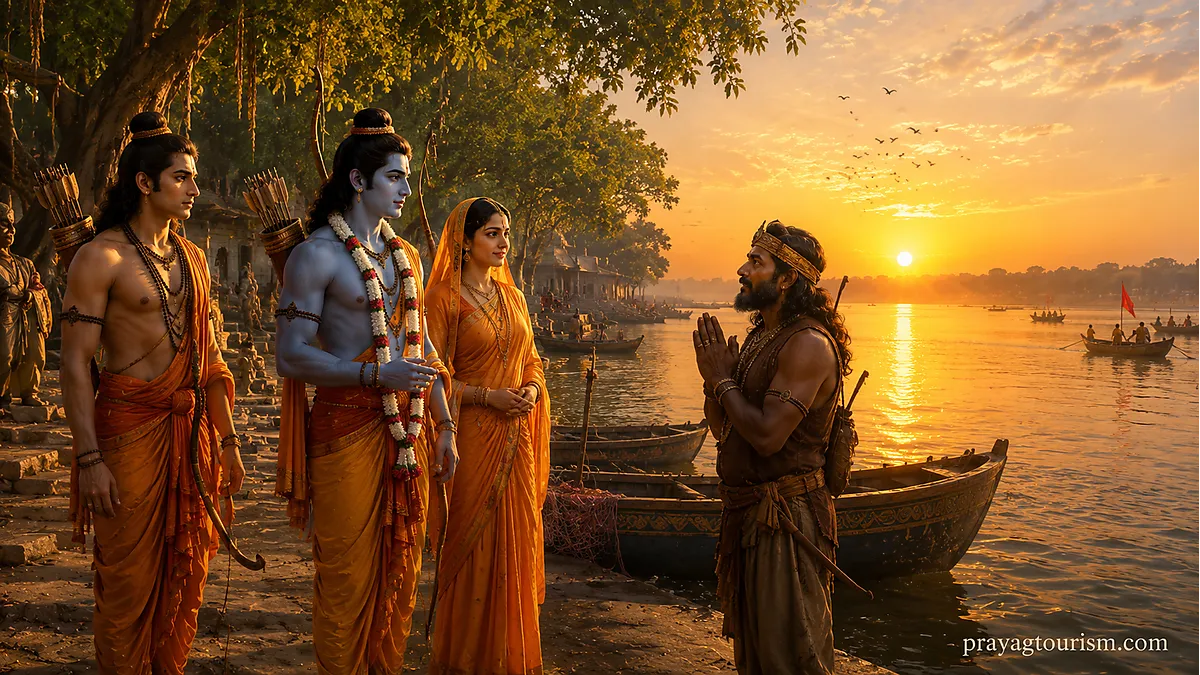
A sacred journey to the banks of the Ganga where Lord Rama first stepped into exile
Table of Contents
Journey into the Ramayana
The road from Prayagraj winds gently through the rural countryside of Soraon, past emerald fields and clusters of village huts. The air grows cooler, carrying a faint whisper of the sacred river long before you see it. As the car approaches Shringverpur Dham, the modern world seems to melt away. The hum of the city is replaced by the rustle of leaves, the call of river birds, and the distant echo of temple bells.
You step out onto the banks of the Ganga. The river flows quietly here, wide and majestic, its waters glinting in the golden light of the late afternoon. A small wooden boat rests on the shore, swaying gently with the current. You close your eyes and imagine.
It is the same river. The same sacred Ganga that flowed when three figures – weary, exiled, heavy of heart – stood on this very bank. Lord Rama, his beloved wife Sita, and his devoted brother Lakshmana. They had walked for days from Ayodhya, leaving behind a kingdom, a throne, and a father’s tear-filled eyes. And here, at Shringverpur, they found their first sanctuary – and their first friend.
A king of the Nishadas, Guha by name, rushed to meet them. Not as a ruler greeting a ruler, but as a devotee welcoming the divine. He offered them his palace, his food, his protection. And when Rama refused all comforts, Guha did something remarkable. He took a blade of grass and a bow, sat at the foot of a tree, and stood guard through the night – watching, waiting, protecting.
What makes this quiet riverside settlement one of the most important yet overlooked Ramayana destinations in India?
The answer lies not in grand temples or towering monuments. It lies in a story – a story of friendship, loyalty, humility, and the profound truth that the divine does not measure us by our status but by the sincerity of our love.
Quick Facts – Shringverpur Dham at a Glance
| Attribute | Details |
| Name | Shringverpur Dham (also spelled Shringaverpur, Śṛṅgiverapura, Singraur) |
| Location | Soraon Tehsil, Prayagraj District, Uttar Pradesh, India |
| Coordinates | 25°35′14″N 81°38′30″E |
| Distance from Prayagraj | Approximately 35–45 km (multiple sources: 35 km, 40 km, 45 km) |
| Distance from Ayodhya | Approximately 151 km |
| River | Ganga (Ganges) |
| Primary Significance | Capital of Nishadraj Guha’s kingdom; meeting place of Lord Rama during exile |
| Key Figure | Nishadraj Guha (King of the Nishadas, friend and devotee of Lord Rama) |
| Scriptural References | Valmiki Ramayana (Ayodhya Kanda, Sargas 50–52, 85–86); Ramcharitmanas |
| Development Status | Declared pilgrimage site in December 2024; Nishadraj Tourist Park (6 hectares) inaugurated |
| Key Attractions | 52-foot statue of Rama embracing Nishadraj; Ram Ghat; ancient ruins; Shringi Rishi Temple |
| Best Time to Visit | October–March; particularly during Magh Mela and Kumbh Mela |
What is Shringverpur Dham? – Gateway to Rama’s Exile
Shringverpur Dham is a sacred pilgrimage site located on the banks of the holy Ganga, approximately 35–45 kilometers from Prayagraj city. It is mentioned in the Hindu epic Ramayana as the capital of the royal kingdom of Nishadraj – the King of the Fishermen.
According to folklore, the village was named after the revered Shringi Rishi, a sage mentioned in ancient texts. Excavations at Shringverpur have unearthed a temple dedicated to this sage, lending archaeological weight to the local tradition.
Shringverpur is not merely a geographical location. It is a Dham – a sacred abode, a crossing point between the mythological world of the Ramayana and the lived reality of the pilgrim. This is the place where Lord Rama, Sita, and Lakshmana spent their first night of exile. This is where they met Nishadraj Guha, the king who became Rama’s first ally and dearest friend.
For the pilgrim, visiting Shringverpur Dham is an opportunity to walk on the same soil where these ancient stories unfolded, to sit by the same river where Rama once rested, and to feel the presence of devotion that has flowed through this land for millennia.
Shringverpur in the Ramayana – The Sacred Narrative
The story of Shringverpur unfolds in the Ayodhya Kanda of the Valmiki Ramayana, primarily in Sargas 50–52 and later in Sargas 85–86.
After being exiled by his father King Dasharatha, Lord Rama – accompanied by Sita and Lakshmana – left Ayodhya in a chariot driven by Sumantra, the royal charioteer. They traveled southward, crossing the borders of Kosala and entering the forest regions. By the time they reached the banks of the Ganga, night had fallen.
According to the Ramayana, the trio arrived at Śṛṅgiverapura – the capital of Nishadraj Guha. The Nishadas were a community traditionally associated with hunting and fishing, living in harmony with the forests and rivers. Guha was their king, a powerful ruler who commanded a substantial army and a fleet of boats on the Ganga.
The Ramayana tells us that Guha, upon hearing of Rama’s arrival from his scouts, came out of the city with great enthusiasm to receive him. He offered Rama, Sita, and Lakshmana a variety of foods, drinks, and the comforts of the royal palace. He treated them not as exiles but as divine guests whose presence sanctified everything they touched.
This meeting at Shringverpur marks a crucial turning point in the Ramayana. It is the first time Rama encounters an ally outside the royal circles of Ayodhya. And it is here that the epic introduces one of its most beloved characters – a king who measured his worth not by his throne but by his devotion.
Verse 1: Guha’s Emotional Welcome to Rama
Source: Valmiki Ramayana, Ayodhya Kanda, Sarga 51, Verses 8–9
Devanagari:
यदर्थमागमस्तेऽत्र राजपुत्र महाबल।
तत्सर्वं कर्तुमिच्छामि प्रियाख्यानपरोऽस्म्यहम्॥
धन्योऽस्म्यनुगृहीतोऽस्मि यस्य मे वेश्मनि स्थितम्।
रामं विदितकल्याणं सीतया सह लक्ष्मणः॥
IAST Transliteration:
yadarthamāgamaste’tra rājaputra mahābala |
tatsarvaṃ kartumicchāmi priyākhyānaparo’smyaham ||
dhanyo’smyanugṛhīto’smi yasya me veśmani sthitam |
rāmaṃ viditakalyāṇaṃ sītayā saha lakṣmaṇaḥ ||
Word-by-Word Meaning:
| Devanagari | IAST | Meaning |
| यदर्थम् | yadartham | for which purpose |
| आगमः | āgamaḥ | the arrival |
| ते | te | of you |
| अत्र | atra | here |
| राजपुत्र | rājaputra | O prince |
| महाबल | mahābala | O greatly powerful one |
| तत्सर्वम् | tatsarvam | all of that |
| कर्तुम् | kartum | to do |
| इच्छामि | icchāmi | I wish |
| प्रियाख्यानपरः | priyākhyānaparaḥ | devoted to your service |
| अस्मि | asmi | I am |
| अहम् | aham | I |
| धन्यः | dhanyaḥ | blessed |
| अस्मि | asmi | I am |
| अनुगृहीतः | anugṛhītaḥ | favoured, blessed |
| अस्मि | asmi | I am |
| यस्य | yasya | of whom |
| मे | me | my |
| वेश्मनि | veśmani | in the house |
| स्थितम् | sthitam | is staying |
| रामम् | rāmam | Rama |
| विदितकल्याणम् | viditakalyāṇam | known to be supremely auspicious |
| सीतया | sītayā | with Sita |
| सह | saha | together with |
| लक्ष्मणः | lakṣmaṇaḥ | Lakshmana |
Translation:
“O greatly powerful prince! I wish to carry out that purpose for which you have come here. I am devoted to your service. I am blessed, I am favoured, for in my house, Rama, known to be supremely auspicious, is staying together with Sita and Lakshmana.”
Traditional Interpretation:
This verse captures the profound humility and devotion of Nishadraj Guha. He does not treat Rama as a prince who has lost his kingdom; he treats him as a divine guest whose presence sanctifies everything it touches. The word dhanyaḥ (blessed) is repeated, emphasizing that Guha considers himself the most fortunate person in the world for hosting Rama, Sita, and Lakshmana. This reflects the ancient Indian tradition of atithi devo bhava – the guest is God.
Practical Life Lesson:
The pilgrim visiting Shringverpur is invited to adopt Guha’s attitude of humility. The sacred site is not merely a place to see; it is a place to serve, to welcome the divine into one’s heart, and to feel blessed by the very act of pilgrimage.
The Story of Nishadraj Guha – Friend, King, Devotee
Who was Nishadraj Guha? In the Valmiki Ramayana, he is described as Rama’s “ātma-sama” mitra – a friend equal to Rama’s own soul. This is the highest praise the epic can bestow on a friendship, implying that Guha and Rama shared a bond of the deepest love and trust.
Guha was not merely a boatman or a local chieftain. He was the king of the Nishadas, a people who lived along the Ganga and made their living from the river and the forest. He commanded a substantial army and a fleet of boats, and his capital, Shringverpur, was a significant center of trade and defense in ancient times.
But Guha’s true greatness lay not in his material wealth but in his heart. When he saw the royal chariot approaching, he did not hesitate. He rushed to welcome Rama, not as a subordinate greeting a superior, but as a friend embracing a friend.
The Ramayana tells us that Guha’s love for Rama was so profound that he offered everything he had – his palace, his food, his army, and ultimately his own life. When Rama refused all comforts, Guha shifted his approach. He would not let Rama leave without protection.
The Meeting of Rama and Nishadraj – Brotherhood Beyond Boundaries
The meeting of Rama and Nishadraj is one of the most moving episodes in the entire Ramayana. It is not merely a story of a king and a subject; it is a story of two human beings bound together by something more powerful than social convention – by love, by loyalty, and by the recognition of the divine in each other.
Rama, a prince of the solar dynasty and an incarnation of Vishnu, embraced Guha, a tribal king, as his own brother. There is no scene in the Ramayana where Rama speaks down to Guha or reminds him of his lower status. Instead, Rama accepts Guha’s devotion and calls him a friend.
In return, Guha’s love for Rama was absolute. He stood guard through the night, ready to die for Rama’s safety. He later welcomed Bharata with equal hospitality when he learned that Bharata had come not to harm but to grieve. He prepared his army to defend Rama against any potential threat, even when Rama had lost his kingdom and his status.
The story of Rama and Guha is often held up as a timeless model of friendship beyond all barriers of caste and class. In a world increasingly divided by social hierarchies, this episode offers a powerful reminder that true nobility is measured not by birth but by the heart.
Verse 2: Rama Accepts Guha’s Hospitality
Source: Valmiki Ramayana, Ayodhya Kanda, Sarga 51, Verses 10–15
Devanagari:
पर्याप्तं शयनं चात्र शय्यायोग्यमिदं तव।
निवसैकपदे राम प्रतीक्षन् प्रतिवासरम्॥
IAST Transliteration:
paryāptaṃ śayanaṃ cātra śayyāyogyamidaṃ tava |
nivasaikapade rāma pratīkṣan prativāsaram ||
Word-by-Word Meaning:
| Devanagari | IAST | Meaning |
| पर्याप्तम् | paryāptam | sufficient, adequate |
| शयनम् | śayanam | bed, resting place |
| च | ca | and |
| अत्र | atra | here |
| शय्यायोग्यम् | śayyāyogyam | suitable for resting |
| इदम् | idam | this |
| तव | tava | for you |
| निवस | nivasa | stay, reside |
| एकपदे | ekapade | in one place, for a time |
| राम | rāma | O Rama |
| प्रतीक्षन् | pratīkṣan | waiting, expecting |
| प्रतिवासरम् | prativāsaram | each day |
Translation:
“Here is a sufficient bed suitable for your rest. O Rama, please stay here for some time, waiting each day (for your exile period to begin).”
Traditional Interpretation:
Guha’s words reveal his concern for Rama’s well-being. He does not want the prince to rush into the wilderness unprepared. He offers his palace as a sanctuary, a place of transition from the comforts of Ayodhya to the challenges of the forest. His hospitality is not mere formality; it is heartfelt.
Practical Life Lesson:
The pilgrim is reminded that true devotion is not passive but active. Guha did not simply offer prayers; he offered action, protection, and service. Pilgrimage to Shringverpur invites one to embody this active devotion.
The Kevat Tradition – Devotion Across Traditions
In the popular imagination, the story of the boatman (Kevat) who helped Rama cross the Ganga is best known from Tulsidas’s Ramcharitmanas. It is a devotional masterpiece that has touched millions of hearts.
In the Ramcharitmanas, when Rama, Sita, and Lakshmana arrive at the Ganga, they call for a boatman. The boatman, however, is hesitant. He has heard the stories: he knows that the dust of Rama’s feet turned the stone Ahalya back into a woman. He fears that if Rama steps into his humble wooden boat, his boat, too, might transform into a woman.
He refuses to take Rama across unless he is allowed to first wash Rama’s feet and drink the sacred water. His reasoning is both humble and profound: he wants the Lord’s blessings before he carries him.
Rama, compassionate and gentle, grants his request. He allows the Kevat to wash his feet, drink the sacred water, and then ferry them across the Ganga.
Important Distinction: It is important to note that the Valmiki Ramayana does not contain this specific episode. In Valmiki’s text, it is Nishadraj Guha himself who arranges for the crossing of the river, and there is no mention of a hesitant boatman. The Kevat story is a later devotional addition, primarily found in the Ramcharitmanas and other regional Ramayana traditions.
However, both traditions converge on the same essential teaching: true devotion does not measure itself by its status. Whether a king or a boatman, what matters is the sincerity of the heart.
The First Night of Exile – A Vigil of Love
After the meeting, Guha insisted that Rama, Sita, and Lakshmana rest for the night before crossing the river. Rama agreed but refused all royal comforts. He stated that he would live the life of an ascetic during his exile – eating forest produce, wearing bark garments, and sleeping on the bare ground.
Guha, undeterred, offered to have the palace gardens prepared to resemble the forest so that Rama would not feel any discomfort. When Rama declined even this, Guha’s devotion took on a new form. He would not rest. Instead, he stood guard through the night.
The Ramayana tells us that Guha gathered his men and placed them on high alert. He took a blade of grass and a bow and sat at the foot of the tree under which Rama was sleeping, vowing not to sleep himself.
This all-night vigil is one of the most beautiful expressions of loyalty and devotion in the entire Ramayana. Guha, a king in his own right, placed himself as a sentinel for his beloved friend. His love was not merely emotional but active – it expressed itself in service, protection, and sacrifice.
Verse 3: Guha’s Vow to Protect
Source: Valmiki Ramayana, Ayodhya Kanda (summary of Guha’s protection vow)
Devanagari (Approximate Reconstruction):
अहमिह स्थितो रक्षां करिष्यामि निशाचरात्।
निद्रां न गमिष्यामि प्राणैर्जीवितमेव वा॥
IAST Transliteration:
aham iha sthito rakṣāṁ kariṣyāmi niśācarāt |
nidrāṁ na gamiṣyāmi prāṇair jīvitam eva vā ||
(This is a condensed representation of Guha’s vow of protection.)
Word-by-Word Meaning:
| Devanagari | IAST | Meaning |
| अहम् | aham | I |
| इह | iha | here |
| स्थितः | sthitaḥ | stationed |
| रक्षाम् | rakṣām | protection |
| करिष्यामि | kariṣyāmi | I will do, I will provide |
| निशाचरात् | niśācarāt | from night-roaming (spirits/dangers) |
| निद्राम् | nidrām | sleep |
| न | na | not |
| गमिष्यामि | gamiṣyāmi | I will go |
| प्राणैः | prāṇaiḥ | with (my very) life |
| जीवितम् | jīvitam | life |
| एव | eva | even |
| वा | vā | or |
Translation:
“Stationed here, I will provide protection against all night-dwelling dangers. I will not go to sleep – (I will protect you) with my very life, or even beyond life.”
Traditional Interpretation:
This verse encapsulates Guha’s unwavering loyalty. He does not offer protection as a favour; he offers it as a duty, pledging his very life. The phrase prāṇair jīvitam eva vā (with my very life, or even beyond life) suggests that Guha is willing to sacrifice not just his comfort but his existence for Rama’s safety.
Practical Life Lesson:
True friendship and devotion are measured not by words but by actions. The pilgrim is reminded that the highest form of love expresses itself in service, protection, and sacrifice – even when unasked.
Verse 4: The King as a Sentinel – Guha’s Conversation with Lakshmana
Source: Valmiki Ramayana, Ayodhya Kanda, Sarga 51, Verses 30–37
Devanagari (Opening Line):
सैन्यानि तानि चादेश्य नीत्वा नावो न्यवेशयत्।
स्वयं च भरतश्रेष्ठ वृक्षमूलेऽवसत् तदा॥
IAST Transliteration:
sainyāni tāni cādeśya nītvā nāvo nyaveśayat |
svayaṃ ca bharataśreṣṭha vṛkṣamūle’vasat tadā ||
Exact Source Citation: Valmiki Ramayana, Ayodhya Kanda (2.51.30–37)
Word-by-Word Meaning:
| Devanagari | IAST | Meaning |
| सैन्यानि | sainyāni | the armies |
| तानि | tāni | those |
| च | ca | and |
| आदेश्य | ādeśya | having commanded |
| नीत्वा | nītvā | having taken |
| नावः | nāvaḥ | the boats |
| न्यवेशयत् | nyaveśayat | he stationed |
| स्वयम् | svayam | himself |
| च | ca | and |
| भरतश्रेष्ठ | bharataśreṣṭha | O best of the Bharata dynasty (addressing Lakshmana) |
| वृक्षमूले | vṛkṣamūle | at the root of a tree |
| अवसत् | avasat | he stayed, he rested |
| तदा | tadā | then |
Translation:
“Having commanded those armies and stationed the boats (appropriately), O best of the Bharata dynasty (Lakshmana), Guha himself then stayed at the root of a tree.”
Traditional Interpretation:
This verse describes Guha’s actions after arranging the protection of the river crossing. He did not retreat to his palace or delegate the night watch to subordinates. He stationed himself at the root of a tree – the same tree under which Rama was resting – to stand guard personally. The address bharataśreṣṭha (best of the Bharata dynasty) is significant; Guha is speaking to Lakshmana with respect and familiarity, acknowledging his royal lineage while also asserting his own role as protector.
Practical Life Lesson:
True leadership is demonstrated not by issuing orders from a distance but by personal presence and sacrifice. Guha’s example teaches that devotion to a higher cause is measured by what one is willing to give up – comfort, sleep, even life itself.
Crossing the Ganga – Entering the Wilderness
After a night of rest and protection, the time came for Rama, Sita, and Lakshmana to cross the Ganga and enter the Dandaka forest. The crossing was arranged by Guha, who placed his boats at Rama’s service.
Before boarding, Rama gave a specific instruction to Lakshmana – one that reveals his deep care for Sita and his sense of responsibility.
Verse 5: Rama Instructs Lakshmana – Crossing with Care
Source: Valmiki Ramayana, Ayodhya Kanda, Sarga 52, Verse 75
Devanagari:
पूर्वं नावमधिष्ठाय ततो सीतामनन्तराम्।
लक्ष्मण त्वमुपास्वैनां गृहीत्वा सह मातरम्॥
IAST Transliteration:
pūrvaṃ nāvamadhiṣṭhāya tato sītāmanantarām |
lakṣmaṇa tvamupāsvaināṃ gṛhītvā saha mātaram ||
Exact Source Citation: Valmiki Ramayana, Ayodhya Kanda (2.52.75)
Word-by-Word Meaning:
| Devanagari | IAST | Meaning |
| पूर्वम् | pūrvam | first |
| नावम् | nāvam | the boat |
| अधिष्ठाय | adhiṣṭhāya | having boarded |
| ततः | tataḥ | then |
| सीताम् | sītām | Sita |
| अनन्तराम् | anantarām | next, after that |
| लक्ष्मण | lakṣmaṇa | O Lakshmana |
| त्वम् | tvam | you |
| उपास्व | upāsva | help, serve |
| एनाम् | enām | her |
| गृहीत्वा | gṛhītvā | taking (by the hand) |
| सह | saha | together with |
| मातरम् | mātaram | (as) mother |
Translation:
“Boarding the boat first, O Lakshmana, you should then help Sita, taking her by the hand as you would your own mother.”
Traditional Interpretation:
Rama’s instruction to Lakshmana is a powerful lesson in conduct and compassion. He ensures that Sita, his beloved wife, is treated with the highest respect – as a mother. The instruction to board first himself is not a sign of self-importance but an act of leadership: he ensures the boat is stable before Sita steps in. The command upāsva (help, serve) implies not just physical assistance but reverent care.
Practical Life Lesson:
The pilgrim is reminded that devotion to the divine is inseparable from compassion for others. True spirituality manifests in how we treat those around us – with respect, care, and love. Rama’s instruction to treat Sita as a mother is a timeless model for how men should regard women.
Spiritual Significance – Lessons from the Sacred Shore
The story of Shringverpur Dham offers profound spiritual lessons that are as relevant today as they were thousands of years ago.
1. True Friendship Transcends Social Boundaries
The friendship of Rama and Guha reminds us that authentic human connection recognizes no barriers of caste, class, or status. In a world increasingly divided by social hierarchies, this episode offers a powerful model of unity and mutual respect.
2. Devotion Is Measured by the Heart, Not by Ritual
Guha did not chant complex mantras or perform elaborate rituals. He simply loved Rama with all his heart – and that love expressed itself in service and protection. This teaches that the divine responds to sincerity, not to ceremony.
3. The Divine Responds to Sincere Love
Rama, the Lord of the Universe, accepted Guha’s devotion, embraced him, and allowed him to wash his feet. This is a powerful reminder that the divine is not distant but responsive. When we offer our love with sincerity, the divine meets us where we are.
4. Service Is the Highest Form of Worship
Guha’s all-night vigil is a powerful symbol of protective love. He guarded Rama not because he was asked to but because his love compelled him to. Devotion is not merely an internal feeling but an external action.
5. Hospitality as a Sacred Duty
Guha’s welcome of Rama, and later of Bharata, reflects the ancient Indian tradition of atithi devo bhava – the guest is God. Shringverpur Dham reminds the pilgrim that hospitality, offered with a pure heart, is itself a form of worship.
6. Protecting the Vulnerable Is a Sacred Responsibility
Guha’s role as a protector teaches that those with power have a duty to protect those who are vulnerable. This is a lesson in leadership, compassion, and the proper use of authority.
Archaeological Importance – Unearthing Ancient Shringverpur
Shringverpur is not only a site of mythological significance but also of considerable archaeological importance.
The ASI Excavations (1977–1986)
The Archaeological Survey of India (ASI) conducted extensive excavations at Shringverpur between 1977 and 1986 under a project entitled the “Archaeology of the Ramayana Sites”. The findings were documented in the ASI’s Memoir No. 88: Excavations at Śr̥iṅgaverapura (1977–86), authored by the renowned archaeologist B.B. Lal.
Major Discoveries
- Shringi Rishi Temple: The excavations unearthed the temple of Shringi Rishi, an ancient sage after whom the village may have been named. This discovery supports the local belief that the city derived its name from this revered figure.
- Ancient Water Management System: Archaeologists discovered a huge pond made of bricks belonging to the Kushan period (1st–3rd century CE). Studies indicate that the pond was constructed to serve as a filter, demonstrating advanced water management techniques for ancient times.
- Copper Vessels: Two copper vessels were recovered during the excavations, and X-ray examinations were conducted to determine their metallic constituents and production technology.
- Other Antiquity Finds: The excavations also yielded a large number of figurines, cast coins, terracotta objects, sculptures, and a grand monastery, indicating a prosperous and well-established settlement.
Current Protected Status
The excavated site near Shringverpur is a protected monument of the Archaeological Survey of India (ASI) and is in a good state of preservation. However, the main Shringverpur Dham site is not currently an ASI-protected monument.
The results of the excavation confirm that Shringverpur was an ancient settlement of significant importance, with a history dating back to the Kushan period (approximately 1,800–2,000 years ago). These findings provide archaeological support for the site’s long-standing cultural and religious significance.
Shringverpur in the Ramayana Circuit – A Sacred Pilgrimage Path
Shringverpur Dham is a crucial stop on the Ram Van Gaman Path – the sacred route that Lord Rama took during his 14-year exile.
The Government of India has identified Shringverpur as a key destination under the Ramayana Circuit of the Swadesh Darshan Scheme, along with Ayodhya, Nandigram, and Chitrakoot.
Development Projects
The Uttar Pradesh government has undertaken a massive project to develop the Ram Van Gaman Path from Ayodhya to Chitrakoot via Shringverpur. Key developments include:
- A six-lane bridge over the Ganga at Shringverpur (1,200 meters long with 22 supporting piers) at a cost of ₹809 crore.
- A four-lane road connecting Avatárpur in Pratapgarh to Murtaganj in Kaushambi.
- Development of 44 religious spots associated with Lord Rama along the route.
The distance from Ayodhya to Shringverpur is approximately 151 km, and the route continues from Shringverpur to Chitrakoot via Manjhanpur and Rajapur. The six-lane bridge, once completed, will significantly ease access for pilgrims visiting Shringverpur Dham.
Shringverpur Dham Today – A Pilgrimage Site Reborn
On December 12, 2024, Prime Minister Narendra Modi officially declared Shringverpur Dham a pilgrimage site, just ahead of the 2025 Maha Kumbh Mela in Prayagraj.
Nishadraj Tourist Park
The centerpiece of the development is the Nishadraj Tourist Park, a sprawling 6-hectare park developed at a total cost of over ₹37.32 crore.
Phase 1 (₹19.63 crore):
- Installation of a 52-foot-high statue of Lord Rama embracing Nishadraj
- Pedestal, podium, overhead tank
- Boundary wall, entrance gate, guard room
- Other basic amenities
Phase 2 (₹18.18 crore):
- Gallery and paintings depicting the Ramayana narrative
- Meditation centre
- Caretaker room and cafeteria
- Pathways, drinking water and toilet facilities
- Kiosks, parking, landscaping, horticulture
- Outer road, solar panels, and open-air stage
The park also includes a boat-shaped museum under construction, where visitors will be taken inside in a chariot and experience the Treta Yuga through audio-visual presentations.
Rural and Village Tourism
A key focus of the development is rural tourism. Local residents are being encouraged to construct mud houses and huts to provide visitors with an authentic rural experience. These accommodations will feature thematic paintings, local cuisines, and cultural displays.
Visitors will have the opportunity to:
- Stay in traditional mud houses
- Experience local rural crafts
- Enjoy regional dishes
- Participate in traditional practices
Complete Travel Guide – How to Reach & Best Time to Visit
How to Reach Shringverpur Dham
| Mode of Transport | Details |
| By Road | Shringverpur Dham is approximately 35–45 km from Prayagraj city on the Prayagraj-Lucknow highway. Buses, taxis, and auto-rickshaws are available from Prayagraj. |
| By Rail | The nearest railway station is Prayagraj Junction (formerly Allahabad Junction), approximately 35–45 km away. From the station, hire a taxi or take a bus to Shringverpur. |
| By Air | The nearest airport is Prayagraj Airport (IXD) , approximately 40–50 km away. |
Best Time to Visit
| Season | Experience |
| Winter (October–March) | Most pleasant weather; ideal for pilgrimage and outdoor activities. |
| Magh Mela (January–February) | Highly auspicious period; special arrangements for pilgrims. |
| Kumbh Mela (every 12 years) | Grand celebrations; tent city accommodation available. |
| Summer (April–June) | Hot; fewer crowds. |
| Monsoon (July–September) | High water levels; occasional disruption due to river rise. |
Suggested Half-Day Itinerary
- 7:00 AM: Depart from Prayagraj
- 8:30 AM: Arrive at Shringverpur Dham
- 8:30–9:30 AM: Visit the 52-foot statue of Rama embracing Nishadraj at Nishadraj Tourist Park
- 9:30–10:30 AM: Explore the Ram Ghat – sit by the Ganga and meditate
- 10:30–11:30 AM: Visit the Shringi Rishi Temple and the ancient excavated site
- 11:30 AM–12:00 PM: Explore the gallery and meditation centre
- 12:00 PM: Depart for Prayagraj (optional: visit nearby attractions)
Pilgrimage Etiquette
- Dress modestly – simple cotton or traditional attire is preferred.
- Remove shoes before entering temples or sacred platforms.
- Ask for permission before photographing saints or sacred images.
- Maintain cleanliness – do not litter on the ghats or in the park.
- Be respectful of local residents and their traditions.
Nearby Attractions – Completing Your Sacred Journey
| Site | Distance from Shringverpur | Importance |
| Triveni Sangam | ~40 km | The sacred confluence of Ganga, Yamuna, and Saraswati |
| Bharadwaj Ashram | ~35 km | Ancient hermitage visited by Lord Rama during exile |
| Akshayavat | ~35–40 km (inside Allahabad Fort) | The immortal banyan tree |
| Alopi Devi Temple | ~30 km | Unique Shakti Peetha with no idol |
| Bade Hanuman Temple | ~35 km | 20-foot reclining idol of Lord Hanuman |
| Prayagraj Fort | ~35–40 km | Mughal-era fort housing Patalpuri Temple |
| Nag Vasuki Temple | ~30 km | Temple of the serpent king |
These sites can be easily combined into a two- to three-day pilgrimage itinerary covering the complete Prayagraj Ramayana heritage.
Frequently Asked Questions (FAQs)
1. What is Shringverpur Dham?
Shringverpur Dham is a sacred pilgrimage site on the banks of the Ganga in Prayagraj district, mentioned in the Ramayana as the capital of Nishadraj Guha’s kingdom.
2. Where is Shringverpur located?
Shringverpur is located in the Soraon tehsil of Prayagraj district, Uttar Pradesh, approximately 35–45 kilometers from Prayagraj city.
3. Who was Nishadraj Guha?
Nishadraj Guha was the king of the Nishada people and the ruler of Shringverpur. In the Ramayana, he is described as Lord Rama’s dearest friend and a devoted follower who helped Rama, Sita, and Lakshmana cross the Ganga.
4. What happened at Shringverpur in the Ramayana?
Lord Rama, Sita, and Lakshmana spent their first night of exile at Shringverpur. Nishadraj Guha welcomed them with great hospitality, offered them protection, and arranged for their crossing of the Ganga the next morning.
5. Is Shringverpur historically important?
Yes. The Archaeological Survey of India conducted excavations at Shringverpur between 1977 and 1986, unearthing a temple of Shringi Rishi, a Kushan-period water management system, copper vessels, figurines, and other ancient artifacts.
6. What is the Kevat story?
In Tulsidas’s Ramcharitmanas, a boatman (Kevat) refuses to carry Rama across the Ganga unless he is allowed to first wash Rama’s feet and drink the sacred water. In the Valmiki Ramayana, this specific episode is not present; it is Nishadraj Guha who arranges the crossing.
7. Is Shringverpur Dham a protected monument?
The excavated site near Shringverpur is a protected monument of the Archaeological Survey of India (ASI). However, the main Shringverpur Dham site is not currently an ASI-protected monument.
8. How far is Shringverpur from Prayagraj?
Shringverpur is approximately 35–45 kilometers from Prayagraj, depending on the route.
9. What is the best time to visit Shringverpur Dham?
The best time to visit is during the winter months (October–March). The site is particularly vibrant during the Magh Mela (January–February) and the Kumbh Mela (every 12 years).
10. Is Shringverpur Dham developed for tourism?
Yes. In December 2024, Prime Minister Narendra Modi declared Shringverpur Dham a pilgrimage site. A 6-hectare Nishadraj Tourist Park has been developed at a cost of over ₹37 crore, featuring a 52-foot statue of Rama embracing Nishadraj, a meditation centre, cafeteria, gallery, and open-air stage.
11. What is the Ram Van Gaman Path?
The Ram Van Gaman Path is the sacred route that Lord Rama took during his exile. It stretches from Ayodhya to Chitrakoot via Shringverpur. A six-lane bridge is being constructed over the Ganga at Shringverpur as part of this project.
12. Is there accommodation available at Shringverpur?
During the Kumbh Mela, a tent city with approximately 2,000 tents is established at Shringverpur. For regular visits, homestays are being developed in nearby villages under the rural tourism initiative.
13. How much time is needed to visit Shringverpur Dham?
A half-day trip (approximately 4–5 hours) is sufficient to explore the key attractions, including the statue, the ghat, the temple, and the excavated site.
14. Why is the story of Nishadraj important today?
The story teaches profound lessons in friendship beyond social barriers, unconditional loyalty, and the power of sincere devotion. It reminds us that spiritual greatness is measured not by status but by the heart.
15. Can I combine a visit to Shringverpur with other sites?
Yes. Shringverpur is conveniently located near other Prayagraj attractions, including Triveni Sangam (40 km), Bharadwaj Ashram (35 km), and Akshayavat (35–40 km).
Why Shringverpur Dham Still Matters Today
In a world increasingly fractured by social divisions, the story of Shringverpur Dham is more relevant than ever.
In a world of division, the friendship of Rama and Guha offers a model of unity. A prince of the solar dynasty and a tribal king – two people from vastly different backgrounds – shared a bond so deep that the epic describes Guha as Rama’s “ātma-sama” mitra, a friend equal to his own soul. This is not a lesson in tolerance; it is a lesson in celebration. The divine does not merely tolerate difference; it embraces it.
In a world of anxiety, Guha’s devotion offers a model of surrender. Guha did not ask Rama for anything. He did not seek wealth, status, or favour. He simply loved. And his love expressed itself in action – in offering his palace, in standing guard through the night, in risking his own life for his friend’s safety.
In a world of noise, Guha’s silent vigil offers a model of presence. He did not need to speak great words. He simply showed up, stayed awake, and protected. The highest form of love is not eloquent speech; it is silent, steadfast presence.
In a world of transactional relationships, Guha’s loyalty offers a model of unconditional commitment. Even when Rama had lost his kingdom, his wealth, and his status, Guha’s loyalty did not waver. He welcomed Bharata with suspicion, prepared his army for battle, and stood ready to defend Rama against any threat – not because he expected anything in return, but because his love demanded it.
A Pilgrimage Meditation
Standing beside the Ganga at Shringverpur Dham, as the morning mist rises from the sacred waters, close your eyes. Listen to the gentle lapping of the waves against the wooden boats. Hear the distant temple bell. Feel the ancient soil beneath your feet.
Imagine Rama, Sita, and Lakshmana arriving at this shore – weary, exiled, yet filled with faith. Imagine Guha rushing to meet them, tears in his eyes, his heart overflowing with love. Imagine the king of the Nishadas, armed with a bow and a blade of grass, sitting at the foot of a tree, vowing not to sleep while his friend rests.
In that moment, the boundary between myth and reality dissolves. The story is not merely a story. It is a living truth – a reminder that friendship, loyalty, and devotion are the highest forms of worship. And that the divine, in whatever form we recognize it, always responds to a sincere heart.
Shringverpur Dham reminds us that true devotion is expressed through friendship, humility, service, and unconditional loyalty. The meeting of Rama and Nishadraj remains one of the most beautiful examples of human dignity and spiritual equality in the Ramayana.
Related Sacred Journeys
- Nishadraj Guha: The story of Rama’s dearest friend.
- Bharadwaj Ashram: The ancient hermitage where Sage Bharadwaja lived; visited by Rama during exile.
- Triveni Sangam: The sacred confluence of Ganga, Yamuna, and Saraswati in Prayagraj.
- Prayag Mahatmya: The complete glorification of Prayagraj as Tirtharaja.
- Chitrakoot: Where Lord Rama spent a significant part of his exile.
- Ayodhya: The birthplace of Lord Rama.
- Ram Van Gaman Path: The complete route of Lord Rama’s exile.
- Kumbh Mela: The largest spiritual gathering in the world, held every 12 years in Prayagraj.
May your journey to Shringverpur Dham be blessed. May you feel the warmth of Guha’s devotion and the compassion of Lord Rama. May the sacred Ganga wash away your worries and fill your heart with peace. And may the eternal friendship of Rama and Guha inspire you to see the divine in every human being you meet. 🙏
This comprehensive guide is based on the Valmiki Ramayana (Ayodhya Kanda, Sargas 50–52, 85–86), Tulsidas’s Ramcharitmanas (Ayodhya Kand), archaeological reports of the Archaeological Survey of India, government tourism sources (Incredible India, Uttar Pradesh Tourism), and contemporary news reports regarding the development of Shringverpur Dham.