
Table of Contents
STANDING AT THE THRESHOLD OF ETERNITY
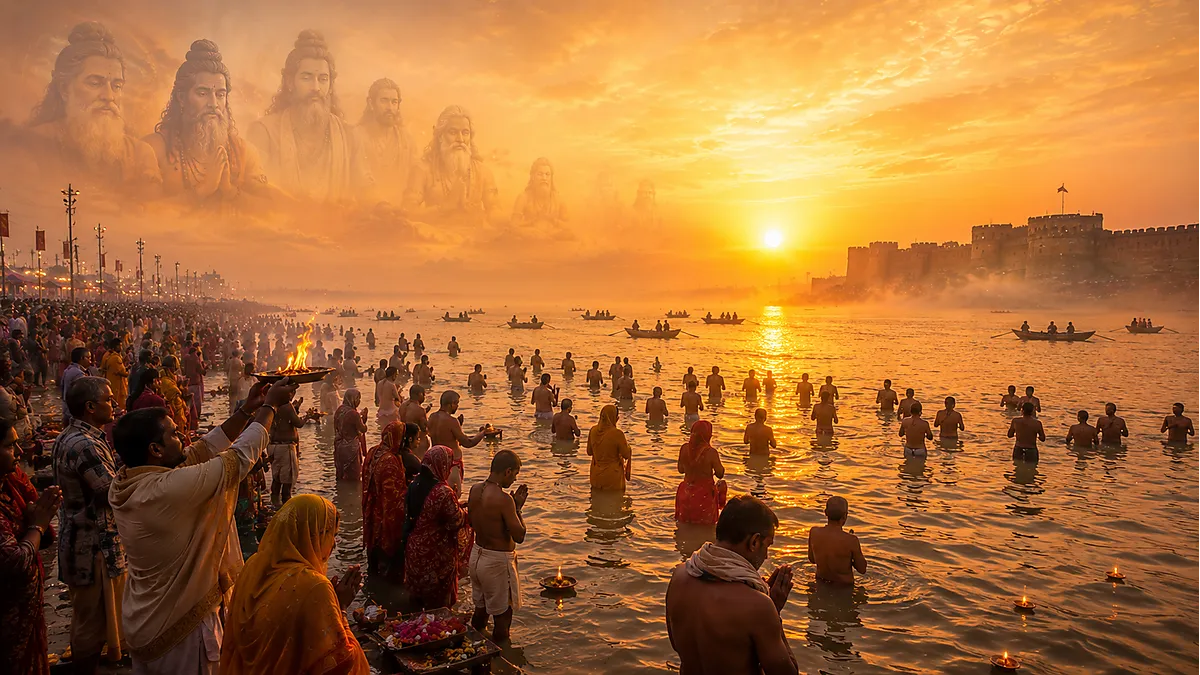
There is a moment, just before the sun rises over the Triveni Sangam, when you realize why Prayag is called the King of all Pilgrimage Sites.
The air is cool and still. The waters of the Ganga and Yamuna flow silently towards their eternal meeting point. Somewhere beneath the surface, the invisible Saraswati — the river of knowledge and liberation — completes this sacred trinity. In the distance, a conch shell sounds. Then another. Soon, the air is filled with the gentle chanting of Vedic mantras, the ringing of temple bells from the city, and the soft lapping of water against the ghats.
Thousands have gathered here, as they have for millennia — saints with matted locks, young families with their children, elderly pilgrims taking slow, deliberate steps toward the water, and seekers from distant lands who have heard of this place and come to see for themselves.
As the first rays of the sun touch the water, a collective energy rises. People begin to immerse themselves, offering water to the sun, praying for purification, for liberation, for their ancestors. The scene has repeated itself, day after day, for thousands of years. The same prayers have risen from these waters since before recorded history. The same faith has brought generations of pilgrims to this exact spot.
If India has countless sacred rivers, temples, and pilgrimage centers, why was Prayag alone honored with the title Tirtharaj — the King of All Tirthas? Why, among the thousands of holy places that dot this ancient land, does Prayag stand alone at the summit?
This is not a question of mere geography or tourism. It is a question that touches the very heart of Sanatan Dharma — what makes a place sacred? What transforms a stretch of riverbank into a gateway to the divine? And why have the scriptures, saints, and sages of India, for thousands of years, unanimously declared Prayag to be the greatest of them all?
Let us journey together into the spiritual heart of Tirtharaj Prayag.
SUMMARY
| Detail | Information |
| Sacred Name | Prayag |
| Modern Name | Prayagraj |
| Honorific Title | Tirtharaj (King of Pilgrimage Sites) |
| Most Sacred Location | Triveni Sangam (Confluence of Ganga, Yamuna, and Saraswati) |
| Major Scriptures | Prayag Mahatmya, Matsya Purana, Padma Purana, Skanda Purana, Mahabharata |
| Primary Significance | Confluence of three sacred rivers; site of Brahma’s first sacrifice; abode of all tirthas |
| Key Festival | Kumbh Mela (once every 12 years) and Magh Mela (annually) |
| Spiritual Benefit | Purification of sins, liberation from rebirth, ancestral liberation |
WHAT DOES TIRTHARAJ MEAN?
Before we can understand why Prayag is called Tirtharaj, we must first understand what these words mean. Behind every Sanskrit word lies a world of meaning, and Tirtharaj is no exception.
The Meaning of “Tirtha”
The Sanskrit word Tīrtha (तीर्थ) comes from the root √तॄ — meaning “to cross over, to traverse, to pass through.” At its deepest level, a tirtha is a crossing place — not merely a physical crossing of a river, but a crossing from the mundane to the sacred, from the limited to the infinite, from bondage to liberation.
In the Rigveda, one of the oldest texts in human history, the word tirtha appears with the meaning of “road” or “way.” The Shatapatha Brahmana speaks of dawn and dusk as the tirthas of the cosmic ocean — the crossing points between day and night, light and darkness.
Just as some parts of the human body are considered purer than others (the hands, the eyes), so some places on earth are considered more sacred than others. These places, for various reasons, become tirthas — doorways between worlds, where the veil between the material and the spiritual becomes thin.
The Puranas classify tirthas into three categories:
- Natural tirthas — rivers, mountains, forests — places of natural beauty and power
- Spatial tirthas — places associated with deities and divine events
- Spiritual tirthas — the inner pilgrimage of truth, charity, and self-control
But the highest of all tirthas, the one that contains all others within it, is called Tirtharaj.
The Meaning of “Raj”
Rāj (राज्) means king, sovereign, the highest, the supreme. When added to the end of a word, it denotes supremacy — the greatest among its kind.
Thus, Tirtharaj (तीर्थराज) means the King of all Tirthas — the supreme pilgrimage site, the holiest of the holy, the place that stands above all others in spiritual power and sacred significance.
Why Certain Places Become Tirthas
The Mahabharata itself tells us why some places become sacred. A tirtha may be sacred for three reasons:
- For its wonderful natural characteristics (like the confluence of great rivers)
- For the splendor of its waters (rivers that purify and heal)
- Because great sages and wise men have frequented it, infusing the land with their spiritual energy
Prayag possesses all three in abundance — and more.
HISTORICAL AND SCRIPTURAL CONTEXT
Prayag is not a place that became famous recently, nor is its status as Tirtharaj a modern invention. The reverence for Prayag stretches back to the earliest layers of Indian civilization.
Ancient References to Prayag
The Vedas themselves speak of the confluence of two rivers — one white, one dark — where those who bathe rise up to heaven. Scholars believe this refers to the meeting of the Ganga and Yamuna at Prayag — the “white” and “dark” rivers described in ancient texts.
The Manusmriti, one of the most authoritative law codes of ancient India, explicitly names Prayag as Tirtharaja — the King of Pilgrimage centers.
Why Confluences Are Considered Sacred
In Hindu sacred geography, the confluence of two or more rivers is considered especially sacred. The meeting point adds the sacredness of one river to that of the other, creating a place of multiplied spiritual power.
Prayag excels all other confluences because it stands at the meeting point of the two most sacred rivers of India — the Ganga and the Yamuna — with the third river Saraswati present invisibly, completing a trinity unmatched anywhere else on earth.
The Evolution of Pilgrimage Traditions
In Vedic times, the primary means of attaining religious merit was through yajna — elaborate fire sacrifices requiring great wealth and priestly expertise. But the Puranas opened the path of tirtha-yatra — pilgrimage — making spiritual merit accessible to all, regardless of caste, gender, or wealth. A pilgrimage to a sacred place was considered equivalent to performing a Vedic sacrifice and could be undertaken by anyone.
Among all the tirthas listed in the Puranas, three stand out as the most prominent: Prayag, Kasi (Varanasi), and Gaya. And among these three, Prayag is always named first — the Tirtharaj.
SCRIPTURAL SOURCES THAT CALL PRAYAG TIRTHARAJ
The title “Tirtharaj” is not a casual compliment. It is a recognition that appears again and again across dozens of scriptures, each confirming what the others have declared. Let us walk through the sacred sources that establish Prayag’s supreme status.
The Prayag Mahatmya
The Prayag Mahatmya is a section within larger Puranas dedicated entirely to glorifying Prayag. It describes Prayag as “one of the holiest places in India” and explicitly calls it Tirtharaja for its eminence. The text states that the tirtha of Prayag, rich in the sacredness and redeeming power deriving from both rivers, is considered the holiest place on earth.
The Prayag Mahatmya also records a profound teaching: “prayāgāttīrtharājācca” — meaning “Prayag is indeed the Tirtharaj”. This Sanskrit phrase appears repeatedly in traditional literature, echoing through centuries of devotional practice.
The Matsya Purana
The Matsya Purana provides detailed information about Prayag as a supreme tirtha. It declares that Vishnu, Shiva, and Brahma all reside in Prayag. What other pilgrimage site can claim that all three deities of the Hindu trinity have made it their home?
The Matsya Purana also describes the cosmic significance of Prayag. It states that there were five channels at the Prayag, with the Ganga as the central one. The text also proclaims that those who cannot leave their homes can observe “spiritual tirthas” such as truthfulness, charity, and control of the passions — yet the merit of physically visiting Prayag remains supreme.
The Padma Purana
The Padma Purana dedicates entire sections to the glory of Prayag. It states that “a man who with his senses controlled lives in Prayag for a month, is freed from all sins”. It also contains the Prayag Stotra, a hymn of praise to the sacred city, where each stanza closes with the refrain: “tīrtharājo jayati prayāgaḥ” — “Victory to Prayag, the King of Tirthas!”
The Padma Purana also describes how all the tirthas of the three worlds come to reside at Prayag during the month of Magh — a belief that draws millions of pilgrims to the Magh Mela every year. It further states that men whose hearts are smitten with sins do not reach the holy place of Prayag, emphasizing that reaching Prayag requires a certain spiritual readiness.
The Skanda Purana
The Skanda Purana, one of the largest of the eighteen Mahapuranas, glorifies Prayag as the supreme tirtha. According to the Skanda Purana, Prayag is described as the place where other tirthas come to purify themselves — a remarkable statement suggesting that Prayag’s spiritual power surpasses even that of other sacred sites.
The Skanda Purana also discusses the extent of the Prayag region, describing the Prayag Mandala as covering five yojanas (approximately 40 square miles), extending from Pratishthana to Vasukihrada. It lists Prayag among the three most sacred places — the Tristhali — along with Varanasi and Gaya.
The Mahabharata
The Mahabharata, India’s great epic, contains extensive references to Prayag. The Tirtha-yatra Parva (Pilgrimage Section) explicitly mentions Prayag and emphasizes the spiritual merits of bathing at the confluence.
The Anushasana Parva refers to all the tirthas of the world visiting Prayag during the auspicious month of Magh — a passage that beautifully captures the belief that Prayag is the tirtha to which all other tirthas pay homage.
The Mahabharata also lists the three reasons a place becomes sacred — natural characteristics, splendor of waters, and presence of sages — and presents Prayag as the place where all three conditions are perfectly met.
Other Traditional References
The Brahma Purana explains the etymology of Prayag: “prakṛṣṭatvāt prayāgo ‘sau pradhānyād rājaśabdavān” — “Because of its excellence, Prayag is called by the royal title of Tirtharaj”.
The Narada Purana also repeatedly refers to Prayag as Tirtharaj, using the term in multiple chapters.
The Mahabhagavata Purana confirms that Prayag is the confluence of Bhagirathi (Ganga), Yamuna, and Sarasvati, where taking a dip is accessible even for the gods.
The Kurma Purana likewise affirms that at the very sight of Prayag, even by taking its name or by applying its clay to one’s body, sins are destroyed.
THE SACRED GEOGRAPHY OF PRAYAG
Prayag’s status as Tirtharaj is not merely a scriptural declaration — it is rooted in the very geography of the place. The land itself is sacred.
The Triveni Sangam — Confluence of Three Rivers
At the heart of Prayag lies the Triveni Sangam — the confluence of three rivers. The word “Triveni” means “three braids” — the coming together of three sacred streams into one.
Here, you can see two rivers with your eyes:
- Ganga (Ganges) — the celestial river that descended from heaven to earth, whose waters are said to purify all who touch them. The Ganga appears blue-green and clear.
- Yamuna — the dark river, beloved of Lord Krishna, whose waters have a distinct greenish hue.
The third river, Saraswati, is invisible — a hidden river that flows underground, joining the confluence from beneath the earth. Together, these three rivers form a sacred trinity unmatched anywhere in the world.
Ganga — The Celestial River
The Ganga is not merely a river — she is a goddess, a mother, a liberator. The Brahma Purana tells how the Ganga was born in heaven from Vishnu’s feet, then held in Shiva’s locks before descending to earth to purify the ashes of the ancestors.
The Matsya Purana similarly affirms that the Ganga originated from Vishnu’s left big toe — making every drop of her water divine. When the Ganga meets the Yamuna at Prayag, her purifying power is magnified.
Yamuna — The Dark Beloved
The Yamuna, associated with Lord Krishna and his divine pastimes, flows dark and deep. Her waters are said to be cooler and darker than the Ganga, and at the Sangam, you can clearly see where the two rivers meet — the line of demarcation visible for some distance before the waters finally merge.
Saraswati — The Invisible Liberator
The Saraswati is the most mysterious of the three. Once a mighty river in ancient India, she is now believed to flow underground, joining the confluence at Prayag invisibly. The presence of the Saraswati transforms the Sangam from a mere confluence of two rivers into Triveni — the meeting of three.
In Hindu cosmology, the three rivers represent different paths to liberation:
- Ganga — Bhakti (devotion)
- Yamuna — Karma (right action)
- Saraswati — Jnana (knowledge)
Thus, bathing at the Sangam is not merely a physical act — it is a symbolic immersion into all three paths to the divine.
Akshayavat — The Indestructible Banyan Tree
Within the precincts of the Allahabad Fort lies the Akshayavat — the “indestructible banyan tree.” This tree is mentioned in the Prayag Mahatmya as a sacred site of immense power.
The legend of the Akshayavat is profound. During the cosmic dissolution (pralaya) when the entire world was submerged, this one tree remained standing above the waters — untouched by destruction. The Padma Purana states that those who venerate the Akshayavat with devotion are freed from sins.
The tree is also associated with Lord Rama, who is said to have rested under it with Sita and Lakshmana during their exile. According to tradition, Akshayavat originated when Lord Brahma performed the Ashwamedha Yagya at Prayag for the creation of the universe, with himself as the priest, Lord Vishnu as the host, and Lord Shiva as the presiding deity.
Bharadwaj Ashram — The Sage’s Hermitage
On the outskirts of Prayagraj lies the Bharadwaj Ashram, the ancient hermitage of the great sage Bharadwaj. This ashram is symbolic of the continuum of Hindu culture and civilization since ages immemorial.
During the time of Lord Rama, the Ganga is believed to have flowed next to this ashram. Lord Rama, Sita, and Lakshmana visited this ashram during their exile and received the blessings of Sage Bharadwaj.
The ashram also represents India’s ancient scientific heritage — according to tradition, Sage Bharadwaj is said to have authored texts on aeronautics and is credited with knowledge of 500 different methods of flight.
The Ancient Pilgrimage Landscape
The sacred geography of Prayag extends beyond the Sangam. The Prayag Mandala (the sacred region of Prayag) is described in scriptures as extending five yojanas (approximately 40 square miles), from Pratishthana to Vasukihrada, encompassing numerous sub-tirthas within its boundaries.
According to tradition, three crore and ten thousand tirthas (pilgrimage sites) from the three worlds — earth, heaven, and the ethereal realm — converge at the Triveni Sangam in Prayag during the month of Magh. To bathe at the Sangam during this period is therefore to bathe in all the sacred waters of the universe simultaneously.
WHY PRAYAG IS CALLED THE KING OF ALL TIRTHAS
Now we come to the heart of our inquiry. What specific qualities elevate Prayag above all other pilgrimage sites? The scriptures give us clear answers.
The Confluence of Three Sacred Rivers — A Unique Sangam
Other tirthas may have one sacred river. Some may have two. But only Prayag has the confluence of three — Ganga, Yamuna, and the invisible Saraswati. No other place on earth possesses this unique sacred geography. The Rigveda itself praises those who bathe where two rivers flow together. How much greater, then, is the merit of bathing where three unite?
The Matsya Purana states that there were five channels at Prayag, with the Ganga as the central one — a unique hydrological arrangement mentioned in no other place.
The Presence of All Deities
The Matsya Purana declares that Vishnu, Shiva, and Brahma all reside in Prayag. What other tirtha can claim to be the home of all three deities of the Hindu trinity? According to the Matsya Purana: “Lord Brahma lives in the north of Pratishthana. Lord Vishnu lives in the form of Veni Madhava”.
The Convergence of All Tirthas
The scriptures teach that during the month of Magh, all the tirthas of the three worlds — numbering three crore and ten thousand — come and reside at Prayag. To bathe at Prayag during this sacred month is therefore to bathe in all the holy waters of the universe at once.
The Merit of a Single Bath
The scriptures declare that a single bath at Prayag equals the merit of bathing in all other tirthas combined. The Matsya Purana states: “At the very sight of Prayag, even by taking its name or by applying its clay to one’s body, sins are destroyed”.
Liberation from the Cycle of Rebirth
The Triveni Sangam is specifically described as a place where bathing can “flush away all of one’s sins and free one from the cycle of rebirth”. The culmination of all pilgrimage — liberation from samsara — is available here.
The Site of Brahma’s First Sacrifice
According to tradition, after creating the universe, Lord Brahma performed his first yajna at Prayag, consecrating the land as eternally sacred. The very name “Prayag” is said to derive from this sacrifice — “Prakrishta Yagya” — the supreme offering.
Survival Through Cosmic Dissolution
The Matsya Purana records that even at the time of the destruction of the universe, Prayag is saved. The Akshayavat tree that stands here survived the great flood that submerged the world. This cosmic durability marks Prayag as a place that transcends time itself.
The Presence of Countless Sub-Tirthas
Within the Prayag Mandala are found numerous sub-tirthas, each with its own significance — the Rinamochana Tirtha (which removes debts and sins), the Visnupada Tirtha, and many others. The pilgrim to Prayag can visit multiple sacred sites within a single day.
The Tradition of Ancestral Liberation
Shraddha rituals performed at Prayag for departed ancestors are considered especially efficacious. The scriptures state that offerings made to ancestors at the Sangam reach them directly and bring them liberation.
The Highest Kumbh Mela
Among the four locations where the Kumbh Mela is celebrated, the Sangam at Prayag is known as Tirtharaj — the King of Tirthas — and the Kumbh held here once every twelve years is considered the greatest and holiest of all.
THE MYTHOLOGICAL STORIES OF TIRTHARAJ PRAYAG
Behind every sacred place lies a story — a legend that reveals why the divine chose this spot as a doorway between worlds. Prayag has many such stories.
The Story of Brahma’s First Sacrifice
After creating the universe, Lord Brahma looked upon his creation and wished to consecrate it with a great sacrifice. He searched for the most sacred spot on earth — the place where the energy of creation was strongest. He found it at the confluence of the Ganga and Yamuna, where an invisible third river, the Saraswati, completed the trinity.
Here, Brahma performed the Ashwamedha Yajna, making the land eternally sacred. The very name Prayag is said to mean “the place of sacrifice” — from “Prakrishta Yaga” — the supreme offering.
This story also gives Prayag its geographical reference in the cosmos of yajnas. The legend runs that Prajapati (Brahma) performed a sacrifice here, and Prayag is considered the middle vedi (altar) of Brahma, with Kurukshetra in the north (uttaravedi) and Gaya in the east forming the other two altars.
The Story of the Churning of the Ocean
The Kumbh Mela itself is rooted in the story of the Samudra Manthan — the churning of the cosmic ocean. When the devas (gods) and asuras (demons) churned the ocean for the nectar of immortality, drops of the divine nectar fell at four places on earth — one of them being Prayag.
Thus, the very soil of Prayag has been touched by the nectar of immortality. When pilgrims bathe at the Sangam during Kumbh Mela, they are bathing in waters that remember that divine event.
The Story of the Akshayavat
There is a profound story behind the Akshayavat — the undying banyan tree.
Once, the sage Markandeya asked Lord Narayana to show him a glimpse of his divine power. Narayana caused a cosmic dissolution — a pralaya — in which the entire world was flooded and everything was destroyed. In that moment, as the waters rose above all creation, Markandeya saw one thing still standing — the Akshayavat tree at Prayag.
From that day, the tree has been known as Akshayavat — the imperishable one. It has witnessed the birth and death of universes. To stand before this tree is to stand before a witness of eternity.
The Story of Rama and the Akshayavat
According to another tradition, Lord Rama, during his fourteen-year exile, passed through Prayag and rested under the banyan tree at the hermitage of Sage Bharadwaj. The tree blessed him, and in return, Mother Sita blessed the tree, declaring that even when the entire earth is submerged in the cosmic deluge, the Akshayavat would remain green.
The Story of All Tirthas at Prayag
The scriptures tell that during the month of Magh, all the tirthas of the three worlds travel to Prayag. They come as divine beings, each one wanting to experience the spiritual power of the Sangam. Thus, a pilgrimage to Prayag during Magh is a pilgrimage to all tirthas at once.
THE SPIRITUAL IMPORTANCE OF TIRTHARAJ PRAYAG
What does Prayag offer to the pilgrim beyond geography and mythology? The scriptures list specific spiritual benefits that come from visiting the King of Tirthas.
Purification — The Washing Away of Sins
The Triveni Sangam is described as a place where a bath “flushes away all of one’s sins and frees one from the cycle of rebirth”. The Padma Purana states that even living in Prayag for a month, with controlled senses, frees one from all sins.
The power of Prayag is so great that even thinking of Prayag, or uttering its name, is said to destroy sins. The Matsya Purana declares that at the very sight of Prayag, sins are destroyed.
Moksha — Liberation from Rebirth
The highest goal in Hindu spirituality is moksha — liberation from the cycle of birth and death. Prayag is specifically described as a place where liberation can be attained. The scriptures even mention that while suicide is prohibited elsewhere, at Prayag the act of self-sacrifice (kayotsarga) is considered a path to liberation.
Ancestral Liberation
The rituals of shraddha and tarpana — offerings to departed ancestors — performed at Prayag carry special power. The scriptures state that offerings made to ancestors at the Sangam reach them directly and help them attain liberation.
The Path of Pilgrimage
The Puranas opened the path of pilgrimage to all — regardless of caste, gender, or wealth. A pilgrimage to Prayag was considered equivalent to performing a Vedic yajna and could be undertaken by everyone.
The Inner Pilgrimage
The Puranas also speak of spiritual tirthas — the pilgrimage within. They list:
- Satyatirtha — the tirtha of truth
- Dayatirtha — the tirtha of compassion
- Indriyanitirtha — the tirtha of controlling the senses
- Dhanatirtha — the tirtha of charity
Thus, a pilgrim to Prayag is encouraged not only to bathe in the external waters but also to purify the inner landscape. This integration of external and internal pilgrimage is the deepest teaching of Tirtharaj.
WHY SAINTS, SAGES AND PILGRIMS CAME TO PRAYAG
The greatest testament to Prayag’s status as Tirtharaj is the countless saints, sages, and spiritual masters who have made their way here over millennia.
Bharadwaj Rishi
Sage Bharadwaj is one of the most revered rishis of ancient India. His ashram in Prayag was a great center of learning and spiritual practice. He is credited with extensive knowledge of aircraft technology — the Vimana Shastra — and is said to have known 500 different methods of flight. Lord Rama himself visited this ashram during his exile.
Markandeya Rishi
The sage Markandeya, known for his immortality and his vision of cosmic dissolution, had a deep connection with Prayag. The Prayag Mahatmya is presented as a conversation between Markandeya and King Yudhishthira, where Markandeya explains the supreme glory of Prayag.
Adi Shankaracharya
The great philosopher and reformer Adi Shankaracharya visited Prayag during his travels across India, re-establishing the spiritual traditions of Sanatan Dharma. He established a matha (monastery) here and composed hymns in praise of the Sangam.
The Bhakti Saints
During the Bhakti movement, saints like Tulsidas (who composed the Ramcharitmanas in nearby Varanasi), Surdas, and others made pilgrimage to Prayag, adding their devotional poetry to the city’s spiritual legacy.
Modern Spiritual Leaders
In modern times, saints like Swami Vivekananda, Paramahansa Yogananda, and countless others have visited Prayag and spoken of its unique spiritual energy. The Kumbh Mela at Prayag draws sadhus and saints from every tradition — Shaivas, Vaishnavas, Shaktas, and others — making the Sangam a meeting ground for the entire spectrum of Hindu spirituality.
Why the Saints Came
The saints came to Prayag for the same reasons the scriptures recommend it:
- The spiritual energy of the Sangam is uniquely powerful
- The month of Magh offers special opportunities for sadhana
- The Kumbh Mela brings together the entire spiritual community
- The Akshayavat and other sacred sites provide powerful points of meditation
KUMBH MELA AND THE GLORY OF TIRTHARAJ
Among the four locations where the Kumbh Mela is celebrated — Prayagraj, Haridwar, Nashik, and Ujjain — Prayagraj is considered Tirtharaj, the king of tirthas. The Kumbh Mela here once every twelve years is the greatest and holiest of all.
Why Kumbh Is Held Here
The Kumbh Mela commemorates the event when drops of the divine nectar of immortality fell at Prayag during the Samudra Manthan (churning of the cosmic ocean). The Sangam at Prayag is one of the four spots where these drops landed, and because Prayag is the place where three sacred rivers meet, the Kumbh here is considered exceptionally powerful.
The Sangam Significance
During the Kumbh Mela, the spiritual energy at the Sangam is believed to intensify beyond ordinary measure. Millions of pilgrims gather to take the holy dip on the most auspicious bathing dates — especially Mauni Amavasya, Makar Sankranti, Basant Panchami, and others.
Global Pilgrimage Importance
The Kumbh Mela at Prayagraj is the largest peaceful gathering of humanity on Earth. The 2019 Kumbh Mela attracted over 240 million pilgrims. It draws not only Hindus but also spiritual seekers, researchers, and tourists from around the world.
Spiritual Equality at Kumbh
One of the most beautiful aspects of the Kumbh Mela is the way it dissolves social distinctions. At the Sangam, the king and the peasant bathe side by side. The scholar and the illiterate share the same water. The Kumbh Mela is a living demonstration of the spiritual equality that is the deepest teaching of Sanatan Dharma.
TIRTHARAJ PRAYAG IN THE MODERN WORLD
The title Tirtharaj is not merely an ancient honor — it continues to resonate in the modern world.
Pilgrimage Today
Millions of pilgrims continue to visit Prayagraj every year, especially during Magh Mela (January–February) and Kumbh Mela. The traditions of taking a holy dip at the Sangam, offering water to the ancestors, and circumambulating the sacred sites continue without interruption.
Cultural Tourism
Beyond pilgrimage, Prayagraj attracts tourists interested in its history, culture, and architecture. The Allahabad Fort, Anand Bhavan (Nehru family museum), Khusro Bagh, and other sites draw visitors from around India and the world.
Heritage Conservation
Efforts are underway to preserve Prayagraj’s sacred heritage. The Akshayavat corridor project aims to make this sacred tree more accessible to pilgrims. The ghats along the Sangam are being developed and beautified.
Environmental Responsibility
With millions of pilgrims visiting the Sangam, environmental protection has become crucial. Efforts are being made to keep the rivers clean, manage waste, and promote sustainable pilgrimage practices.
Spiritual Relevance in the Modern Age
In an age of stress, distraction, and disconnection, the call of Tirtharaj Prayag remains as powerful as ever. The need for purification, for connection with something greater than oneself, for a place where the noise of the world falls away — these needs are perhaps even more acute today than in ancient times.
Prayag continues to offer what it has always offered: a crossing place. A place to leave behind the old and step into the new. A place to remember who we truly are.
THE HIDDEN WISDOM OF TIRTHARAJ
Beyond the external pilgrimage, the scriptures reveal a deeper wisdom encoded in the title Tirtharaj.
Unity — The Wisdom of Convergence
At the Sangam, three rivers become one. Different traditions, different paths, different colors — all meet and merge. Prayag teaches us that beneath the apparent diversity of the world, there is a fundamental unity. The name Tirtharaj honors not just a physical place but a spiritual truth — that all paths, when followed sincerely, lead to the same divine destination.
Humility — The Wisdom of the Waters
Water seeks the lowest level. It flows downward, not upward. The Sangam teaches humility — the willingness to let go of ego, to descend into the waters of devotion, to become small so that the divine can become large.
Purification — The Wisdom of Letting Go
The holy dip at the Sangam symbolizes the letting go of past mistakes, past identities, past burdens. The waters accept everything and purify everything. To bathe at Tirtharaj is to practice the art of surrender — releasing what no longer serves so that we may become free.
Service — The Wisdom of Charity
The scriptures emphasize dana — charity — as a key part of pilgrimage. Prayag has traditionally been a place where pilgrims feed the poor, give to the needy, and practice generosity. The title Tirtharaj is not only about receiving blessings but about giving service.
The Inner Pilgrimage — Tirtha Within
The Puranas remind us that the ultimate tirtha is within — the tirtha of truth, of compassion, of self-control. The external pilgrimage to Prayag is meant to awaken the internal pilgrimage of the soul. The true Tirtharaj is the heart purified by devotion and wisdom.
TIMELESS VERSES ON PRAYAG
The glory of Prayag has been sung by saints, poets, and scriptures for millennia. Here are some of the most beloved verses that establish Prayag as Tirtharaj.
Verse 1: From the Prayag Stotra (Padma Purana)
Devanagari:
तीर्थराजो जयति प्रयागः
IAST:
Tīrtharājo jayati prayāgaḥ
Source:
Padma Purana, Prayag Stotra (VI.23.28-35)
Word-by-Word Meaning:
- Tīrtharājaḥ — The King of Tirthas
- Jayati — Is victorious / reigns supreme
- Prayāgaḥ — Prayag
Translation:
“Victory to Prayag, the King of Tirthas!”
Traditional Interpretation:
This is the refrain that closes each stanza of the Prayag Stotra, a hymn of praise to the sacred city. It is both a declaration and a prayer — an acknowledgment of Prayag’s supreme status and an invocation of its blessings.
Practical Takeaway:
When you visit Prayag, carry this mantra in your heart. Let “Tīrtharājo jayati prayāgaḥ” be your meditation as you approach the Sangam.
Verse 2: On Living in Prayag (Padma Purana)
Devanagari:
यो वसेत् प्रयागे संवत्सरं संयतेन्द्रियः |
स मुच्यते सर्वपापेभ्यः पुनाति च पितॄनपि ||
IAST:
Yo vaset prayāge saṁvatsaraṁ saṁyatendriyaḥ |
Sa mucyate sarvapāpebhyaḥ punāti ca pitṝnapi ||
Source:
Padma Purana, likely from the Prayag Mahatmya section
Word-by-Word Meaning:
- Yaḥ — One who
- Vaset — Lives / dwells
- Prayāge — In Prayag
- Saṁvatsaram — For a (one) year
- Saṁyata-indriyaḥ — With senses controlled / restrained
- Saḥ — That person
- Mucyate — Is freed
- Sarva-pāpebhyaḥ — From all sins
- Punāti — Purifies / liberates
- Ca — And
- Pitṝn — The ancestors
- Api — Also
Translation:
“One who lives in Prayag for a year with his senses controlled is freed from all sins and also liberates his ancestors.”
Traditional Interpretation:
This verse emphasizes both the power of Prayag and the importance of the pilgrim’s inner state. Living in Prayag is powerful, but living there with controlled senses — with discipline, devotion, and awareness — multiplies that power. The benefits extend not only to the pilgrim but to generations of ancestors.
Practical Takeaway:
Even if you cannot live in Prayag for a year, the verse teaches that pilgrimage must be accompanied by inner discipline. Approach the Sangam with focused intention, not merely as a tourist.
Verse 3: Merely Seeing Prayag (Matsya Purana)
Devanagari:
प्रयागस्य तु संदर्शनात् पापं नश्यति सर्वदा |
IAST:
Prayāgasya tu sandarśanāt pāpaṁ naśyati sarvadā |
Source:
Matsya Purana (as referenced in Purana Bulletin)
Word-by-Word Meaning:
- Prayāgasya — Of Prayag
- Tu — Indeed
- Sandarśanāt — From (the mere) seeing / sight
- Pāpam — Sins
- Naśyati — Are destroyed
- Sarvadā — Completely / forever
Translation:
“From the very sight of Prayag, all sins are completely destroyed.”
Traditional Interpretation:
So powerful is Prayag that even before you bathe — even before you step into the water — the mere sight of this sacred place begins to purify you.
Practical Takeaway:
When you first see the Sangam from a distance, pause. Offer a prayer of gratitude. Recognize that your pilgrimage has already begun to bear fruit.
Verse 4: Prayag as the King of Tirthas (Brahma Purana)
Devanagari:
प्रकृष्टत्वात् प्रयागोऽसौ प्राधान्याद्राजशब्दवान् |
IAST:
Prakṛṣṭatvāt prayāgo ‘sau prādhānyād rājaśabdavān |
Source:
Brahma Purana (quoted in Tristhalisetu)
Word-by-Word Meaning:
- Prakṛṣṭatvāt — Because of its excellence / superiority
- Prayāgaḥ — Prayag
- Asau — This (is called)
- Prādhānyāt — Because of its prominence / pre-eminence
- Rāja-śabdavān — Bearing the royal title (Raj/Tirtharaj)
Translation:
“Because of its excellence, Prayag is called by the royal title (of Tirtharaj).”
Traditional Interpretation:
This verse directly explains the title. Prayag does not claim kingship through conquest or political power. Its royalty comes from excellence — its unique sacred geography, its presence in scripture, its spiritual power.
Practical Takeaway:
The title Tirtharaj is earned, not claimed. Prayag’s excellence has been recognized for thousands of years. When you visit, you are participating in a tradition that stretches back to the dawn of Indian civilization.
Verse 5: All Tirthas in Prayag (Traditional)
Devanagari:
सर्वाणि तीर्थानि प्रयागे वसन्ति
IAST:
Sarvāṇi tīrthāni prayāge vasanti
Source:
Traditional saying, found in multiple Puranas (including Matsya Purana)
Word-by-Word Meaning:
- Sarvāṇi — All
- Tīrthāni — Tirthas / pilgrimage sites
- Prayāge — In Prayag
- Vasanti — Reside / dwell
Translation:
“All tirthas reside in Prayag.”
Traditional Interpretation:
During the month of Magh, all the tirthas of the three worlds come to reside at the Sangam in Prayag. Therefore, to bathe at Prayag during this period is to bathe in all sacred waters simultaneously.
Practical Takeaway:
If you can only make one pilgrimage in your life, let it be to Prayag. One visit to Tirtharaj equals a lifetime of pilgrimage to other sites.
Verse 6: On Bathing at the Sangam (Mahabharata)
Devanagari:
गङ्गाद्वारे च यत् पुण्यं प्रयागे यत् तपोबलम् |
सर्वं तत् संगमे प्राप्य मुच्यते सर्वकिल्बिषैः ||
IAST:
Gaṅgādvāre ca yat puṇyaṁ prayāge yat tapobalam |
Sarvaṁ tat saṅgame prāpya mucyate sarvakilbiṣaiḥ ||
Source:
Mahabharata, Tirtha-yatra Parva (approximate — traditional verse)
Word-by-Word Meaning:
- Gaṅgādvāre — At Gangadwar (Haridwar)
- Ca — And
- Yat — Whatever
- Puṇyam — Sacred merit / virtue
- Prayāge — At Prayag
- Yat — Whatever
- Tapaḥ-balam — Power of austerities
- Sarvam — All
- Tat — That
- Saṅgame — At the confluence (Sangam)
- Prāpya — Having obtained / attained
- Mucyate — Is liberated
- Sarva-kilbiṣaiḥ — From all impurities / sins
Translation:
“Whatever merit there is at Gangadwar (Haridwar) and whatever power of austerities there is at Prayag — having attained all of that at the Sangam (Triveni Sangam), one is liberated from all sins.”
Traditional Interpretation:
The Mahabharata recognizes the sacredness of multiple pilgrimage sites but declares that the Sangam specifically — the confluence of the three rivers — contains the combined power of all other tirthas.
Practical Takeaway:
Make the Sangam itself — not just the city of Prayag — the focal point of your pilgrimage. It is at the water’s edge, where the rivers meet, that the full power of Tirtharaj is realized.
Verse 7: The Glories of Prayag (Padma Purana)
(From a conversation where Lord Shiva explains to Parvati the greatness of the Ganga and sacred places)
Devanagari:
प्रयागं ये न पश्यन्ति मानवाः पापचेतसः |
तेषामन्यैस्तपोभिश्च न मुक्तिरुपजायते ||
IAST:
Prayāgaṁ ye na paśyanti mānavāḥ pāpacetasaḥ |
Teṣāmanyais tapobhiśca na muktirupajāyate ||
Source:
Padma Purana
Word-by-Word Meaning:
- Prayāgam — Prayag
- Ye — Those who
- Na — Not
- Paśyanti — See / visit
- Mānavāḥ — Human beings
- Pāpa-cetasaḥ — Of sinful mind
- Teṣām — For them
- Anyaiḥ — By other
- Tapaḥbhiḥ — Austerities / penances
- Ca — And
- Na — Not
- Muktiḥ — Liberation
- Upajāyate — Arises / comes about
Translation:
“Those sinful-minded human beings who do not see (visit) Prayag — for them, liberation does not arise even through other austerities.”
Traditional Interpretation:
This strong statement emphasizes the supreme importance of Prayag in the spiritual life. While other spiritual practices are valuable, the Padma Purana declares that without visiting Prayag, liberation remains difficult to attain.
Practical Takeaway:
If you have the opportunity to visit Prayag, do not delay or dismiss it. The scriptures consider it not merely a nice place to visit but an essential component of the spiritual journey.
Verse 8: The Victory of Prayag (From the Prayag Stotra)
Devanagari:
नमः प्रयागाय नमः प्रयागाय नमः प्रयागाय तीर्थराजाय |
त्रिवेणी संगम नमो नमस्ते गंगा यमुना सरस्वतीसंगम ||
IAST:
Namaḥ prayāgāya namaḥ prayāgāya namaḥ prayāgāya tīrtharājāya |
Triveṇī saṅgama namo namaste gaṅgā yamunā sarasvatīsaṅgama ||
Source:
Traditional prayer (Prayag Stotra)
Word-by-Word Meaning:
- Namaḥ — Salutations / bowing
- Prayāgāya — To Prayag
- Tīrtharājāya — To the King of Tirthas
- Triveṇī Saṅgama — O Triveni Sangam
- Namo namaste — Salutations, salutations to you
- Gaṅgā Yamunā Sarasvatī-saṅgama — O confluence of Ganga, Yamuna and Saraswati
Translation:
“Salutations to Prayag, salutations to Prayag, salutations to Prayag, the King of Tirthas. O Triveni Sangam, salutations, salutations to you — O confluence of the Ganga, Yamuna, and Saraswati.”
Traditional Interpretation:
This simple yet powerful verse is often recited by pilgrims as they approach the Sangam. The repetition of “Namaḥ prayāgāya” three times emphasizes complete surrender and devotion.
Practical Takeaway:
Recite this verse when you arrive at the Sangam. Let the words be your offering as you step into the sacred waters.
SPECIAL PRAYAGRAJ FOCUS — THE LIVING TIRTHA
Prayag is not a museum or a relic of the past. It is a living tirtha — a place where the sacred traditions continue, uninterrupted, from ancient times to the present day.
The Sangam Symbolizes Unity
At the Sangam, the clear waters of the Ganga meet the darker waters of the Yamuna, and for some distance, you can see the line where they meet. Yet both are water. Both are sacred. Both flow toward the same goal. This visible meeting point teaches us that differences are surface-level; at the deepest level, all is one.
Pilgrimage Encourages Detachment
The experience of pilgrimage — leaving one’s home, traveling to a sacred place, living simply, focusing on spiritual practice — naturally encourages detachment from material concerns. Prayag, with its focus on purification and liberation, amplifies this effect.
Kumbh Mela Reflects Spiritual Equality
When millions gather at the Sangam, social distinctions dissolve. The rich and poor, the high and low, the educated and illiterate — all stand in the same water. The Kumbh Mela is a living demonstration of the truth that all souls are equal before the divine.
Saints Gathered Here for Contemplation
From the ancient rishis who meditated in the forests of Prayag to the modern sadhus who camp at the Sangam during Magh Mela, Prayag has always been a gathering place for those seeking the highest truth. To walk the same ground where countless saints have walked is to connect with a lineage of spiritual aspiration that spans millennia.
Akshayavat — Symbol of Eternity
The Akshayavat tree, which according to tradition survived the cosmic dissolution that destroyed the entire world, reminds us that the spiritual is eternal while the material is temporary. Standing before this tree, the pilgrim is invited to contemplate what truly lasts.
Bharadwaj Ashram — Symbol of Knowledge
The ashram of Sage Bharadwaj represents the union of spirituality and science — the recognition that true knowledge embraces both the inner and outer worlds. The sage who knew the science of flight also knew the science of the soul.
PHASE 15: RELATED SACRED JOURNEYS
To deepen your understanding of Tirtharaj Prayag, we invite you to explore these related guides:
- Triveni Sangam: The Complete Pilgrim Guide — Everything you need to know about taking a holy dip at the confluence
- Prayag Mahatmya: Scriptural Glories of Prayag — Extended exploration of the Puranic texts that glorify Prayag
- Kumbh Mela: The Complete Guide — When and how to attend the world’s largest pilgrimage
- Magh Mela: Annual Pilgrimage to Tirtharaj — Detailed guide to the month-long sacred fair
- Akshayavat: The Indestructible Tree of Prayagraj — History, legend, and significance of this sacred site
- Bharadwaj Ashram: The Sage’s Hermitage — Exploring the ancient seat of learning at Prayag
- Shringverpur Dham: Ramayana Connection — The nearby site where Lord Rama crossed the Ganga
- Chitrakoot: Where Rama Lived in Exile — Extend your pilgrimage to this sacred forest
- Kashi (Varanasi): The City of Light — The other great tirtha of the Tristhali
FREQUENTLY ASKED QUESTIONS
1. Why is Prayagraj called Tirtharaj?
Prayagraj is called Tirtharaj because the scriptures declare it the “King of all Pilgrimage Sites” (Tirtha + Raj = King of Tirthas). It is uniquely sacred as the confluence of three holy rivers — Ganga, Yamuna, and the invisible Saraswati — and is glorified in the Vedas, Puranas, Mahabharata, and Manusmriti as the supreme pilgrimage destination.
2. What does Tirtharaj mean?
Tirtharaj (तीर्थराज) literally means “King of Tirthas” — the supreme pilgrimage site, the holiest among all sacred places. “Tirtha” comes from the root √तॄ meaning “to cross over” — thus a tirtha is a crossing place from the mundane to the sacred.
3. Which scripture first calls Prayag Tirtharaj?
The Manusmriti is one of the earliest texts to name Prayag as Tirtharaja. The Prayag Stotra in the Padma Purana repeatedly declares “Tīrtharājo jayati prayāgaḥ” — “Victory to Prayag, the King of Tirthas”. The Brahma Purana also explains the title.
4. Why is Triveni Sangam sacred?
The Triveni Sangam is sacred because it is the meeting point of the Ganga (the celestial liberator), the Yamuna (the dark beloved of Krishna), and the invisible Saraswati (the river of knowledge). Bathing here is said to flush away sins and free one from the cycle of rebirth.
5. Is Prayag the holiest pilgrimage site in Hinduism?
According to the scriptures, yes. The Matsya Purana, Padma Purana, Skanda Purana, Mahabharata, and other texts repeatedly declare Prayag as the greatest of all tirthas — the Tirtharaj. Among the Tristhali (three most sacred places: Prayag, Kashi, Gaya), Prayag is named first.
6. What is Prayag Mahatmya?
The Prayag Mahatmya is a section within the Puranas (particularly the Matsya Purana) dedicated entirely to describing the glory and greatness of Prayag. It presents the conversation between Sage Markandeya and King Yudhishthira, where Markandeya explains why Prayag is the supreme pilgrimage site.
7. What does the Matsya Purana say about Prayag?
The Matsya Purana declares that Vishnu, Shiva, and Brahma all reside in Prayag. It states that Prayag has five channels with the Ganga as the central one. It proclaims that even seeing Prayag or touching its clay destroys sins.
8. What does the Mahabharata say about Prayag?
The Mahabharata’s Tirtha-yatra Parva describes Prayag as a major pilgrimage site. The Anushasana Parva states that all tirthas of the world visit Prayag during the month of Magh. The epic extols the virtues of bathing at the confluence.
9. What is the Akshayavat?
The Akshayavat is the “indestructible banyan tree” located within the Patalpuri Temple in the Allahabad Fort. According to legend, it survived the cosmic dissolution (pralaya) that submerged the entire world. The Padma Purana states that venerating it frees one from sins.
10. What is the connection between Lord Rama and Prayag?
Lord Rama, Sita, and Lakshmana visited Prayag during their exile and stayed at the hermitage of Sage Bharadwaj. They also rested under the Akshayavat tree. The Bharadwaj Ashram still stands as a testament to this visit.
11. Why is Kumbh Mela held at Prayag?
The Kumbh Mela is held at Prayag because drops of the divine nectar of immortality (amrita) fell here during the Samudra Manthan (churning of the cosmic ocean). Prayag’s Kumbh is considered the greatest because the Sangam is the Tirtharaj.
12. What is the difference between Kumbh Mela and Magh Mela?
Kumbh Mela occurs once every 12 years at Prayag (next in 2031) and is the largest gathering. Magh Mela occurs annually during the month of Magh (January–February) and is considered a smaller version of the Kumbh, drawing millions of pilgrims each year.
13. Can non-Hindus visit Tirtharaj Prayag?
Yes. Prayagraj welcomes all visitors regardless of faith. The Triveni Sangam is open to everyone, though visitors should dress modestly and behave respectfully as it is an active place of worship.
14. What is the best time to experience Prayag as Tirtharaj?
The Magh Mela period (January–February) is the best time to experience Prayag’s identity as Tirtharaj, as this is when all tirthas are believed to reside at the Sangam. For those seeking a quieter experience, October–November and February–March offer pleasant weather with fewer crowds.
15. What spiritual practices should I perform at Prayag?
Traditional practices at Prayag include: taking a holy dip at the Sangam (snana), offering water to the rising sun (arghya), performing shraddha for ancestors (tarpana), offering charity (dana), circumambulating the sacred sites, and spending time in meditation or prayer.
16. Is the Saraswati river actually visible?
No. The Saraswati is considered an invisible river that joins the confluence from underground. While the Ganga and Yamuna are visible and distinct, the Saraswati is present only in spirit — yet her presence makes the Sangam Triveni (three braids) rather than merely Dviveni (two braids).
17. What is the significance of the month of Magh at Prayag?
According to the Mahabharata and Puranas, all the tirthas of the three worlds come to reside at Prayag during the month of Magh. A bath taken at the Sangam during this month carries the merit of bathing in all sacred waters simultaneously.
18. How old is Prayag as a pilgrimage site?
Prayag’s status as a sacred site dates back to the Rigveda (which speaks of bathing where two rivers meet) and is mentioned in the Manusmriti, Mahabharata, and all major Puranas. Archaeological evidence suggests continuous habitation and pilgrimage activity for over 3,000 years.
19. What is the Tristhali?
The Tristhali (literally “three places”) refers to the three most sacred pilgrimage destinations in Hinduism: Prayag, Kashi (Varanasi), and Gaya. Among these three, Prayag is named first and considered supreme.
20. Why should I visit Tirtharaj Prayag?
You should visit Prayag because it is not merely another tourist destination. It is a living crossing place — a site where, according to millennia of tradition, the divine touches the material world most directly. Whether you seek purification, liberation, ancestral peace, or simply a deeper connection with India’s spiritual heritage, Prayag offers what no other place can offer: the confluence of three sacred rivers, blessed by all deities, visited by all saints, declared by all scriptures as the King of Tirthas.
WHY THE TITLE “TIRTHARAJ” STILL MATTERS TODAY
So here we are, having walked together through scriptures and stories, through sacred geography and spiritual teachings. We have seen why the Vedas, the Puranas, the Mahabharata, and generations of saints have all declared Prayag to be the King of Tirthas.
But why does this title matter today, in the modern world?
It matters because Prayag still does what it has always done. The Ganga still flows. The Yamuna still meets her. The Saraswati still joins invisibly from beneath. The Akshayavat still stands, having witnessed the rise and fall of empires, the birth and death of generations.
When you stand at the Sangam at dawn, surrounded by mist and devotion and the ancient sound of temple bells, you are not merely a tourist taking a photograph. You are a pilgrim standing where Rama stood, where Krishna is said to have come, where Brahma offered his first sacrifice, where Markandeya witnessed the cosmic dissolution, where millions upon millions have come before you — to bathe, to pray, to cross over.
The title Tirtharaj was not bestowed by any human king or political power. It emerged organically, through millennia of lived spiritual experience. Generation after generation went to Prayag, bathed in the Sangam, felt something shift within them, and returned home transformed. And they told others. And the stories spread. And eventually, the scriptures recorded what the people already knew:
This place is different. This place is special. This place is the King.
And still today, the pilgrims come. Families with children. Elderly couples supporting each other down the ghat steps. Young seekers with backpacks and curiosity. Sadhus in saffron and householders in simple cotton. They come from every corner of India and from countries around the world. And when they step into the waters of the Triveni Sangam, when the cold water touches their skin, when they raise their cupped hands to the rising sun, they feel it too:
This is a crossing place.
Something shifts here.
The veil is thin.
That is why Prayag is called Tirtharaj. Not because a scripture declared it — though scriptures did. Not because a saint said so — though saints did. But because, for thousands of years, the human heart has recognized this place as a doorway between worlds.
Tīrtharājo jayati prayāgaḥ.
Victory to Prayag, the King of Tirthas.
May your journey to this sacred place be blessed. May the waters of the Sangam purify your body, mind, and soul. May the prayers of millions who have stood where you will stand carry you across the ocean of existence to the shores of liberation.
Om Tat Sat.
This article is part of a series on the sacred places and spiritual traditions of India. For more information on planning your pilgrimage to Tirtharaj Prayag, including transportation, accommodation, and guided tours, please contact us.
Prayag Tourism
📞 Phone/WhatsApp: +91-9555313526
📧 Email: contact@prayagtourism.com
🌐 Website: PrayagTourism.com
May your journey be peaceful, safe, and spiritually enriching.