
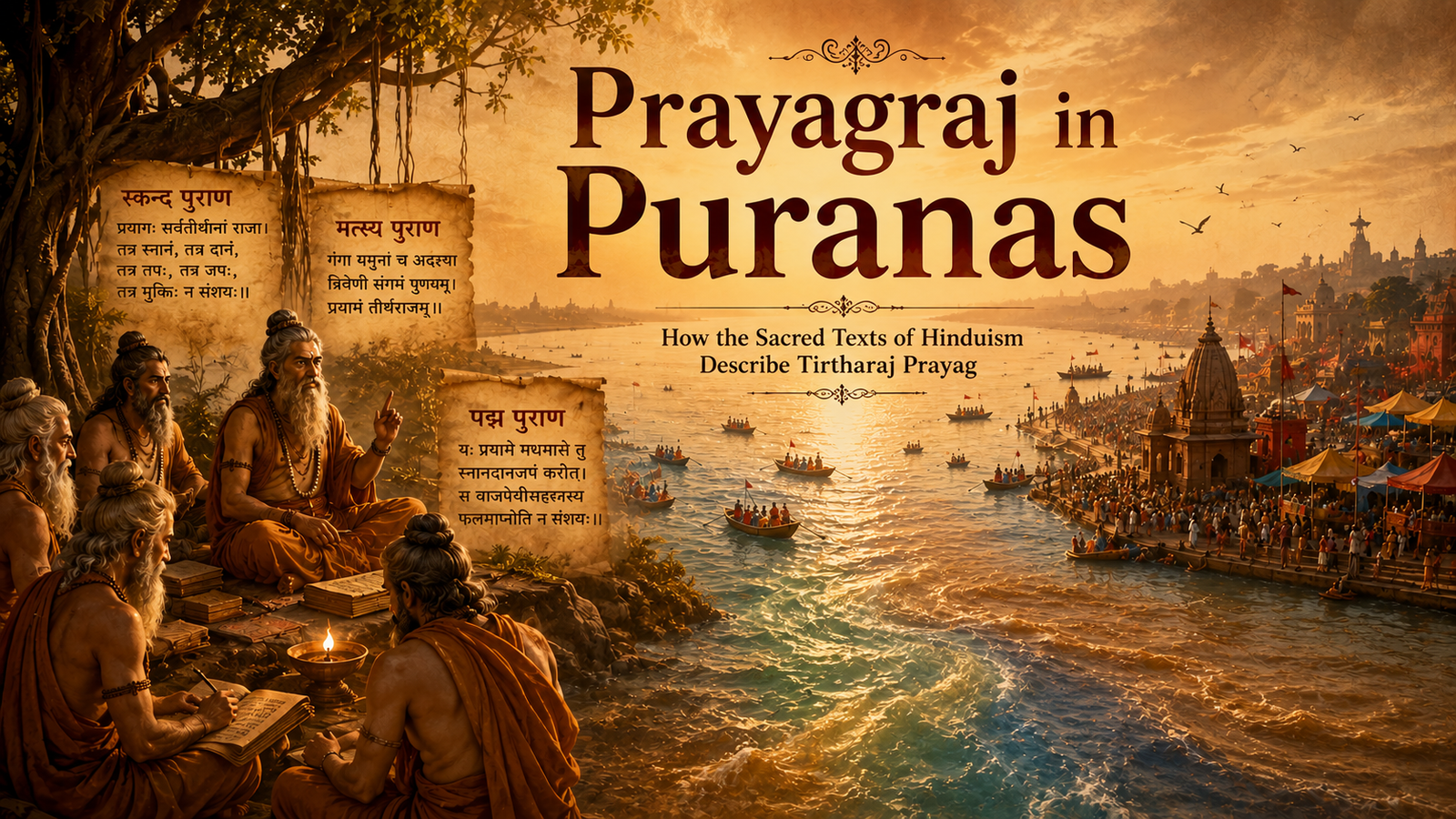
Across centuries, through the sacred syllables of Sanskrit, the Puranas have praised Prayag as no other tirtha on earth.
Imagine yourself seated at the feet of a wise sage, the air thick with the fragrance of sandalwood and the distant murmur of the Ganga. He unrolls a palm-leaf manuscript, his voice carrying the weight of ages. He tells you of a place where the three sacred rivers meet—the radiant Ganga, the dark and beautiful Yamuna, and the mystical, invisible Sarasvati. He speaks of a region so holy that its mere sight can wash away lifetimes of sin. He calls it Prayāga, and he calls it Tīrtharāj Prayag—the King of all Pilgrimage Sites.
For millennia, this has been the promise whispered by the Puranas. The Matsya Purana, the Skanda Purana, the Padma Purana, and countless other sacred texts are not merely stories; they are a spiritual geography, a guidebook to liberation that has drawn seekers for thousands of years. Long before modern maps marked the location, the Puranas had already established Prayag‘s celestial place in the Hindu cosmos.
What did these ancient seers say about Prayag? And why does their message still echo with such power today?
Let us open the ancient texts and journey to the Prayag of the Puranas.
What are the Puranas?
The Puranas are a vast genre of ancient Indian literature, revered as Smriti (“that which is remembered”) texts that preserve the history, cosmology, mythology, and spiritual teachings of Sanatana Dharma. The word Purana itself means “ancient” or “old,” signifying their role as custodians of timeless knowledge.
There are eighteen major Puranas (Mahapuranas), each dedicated to praising a particular deity while containing universal wisdom. Among the most important for understanding the sacred geography of India are:
| Purana | Primary Deity / Focus | Key Features |
| Skanda Purana | Lord Shiva / Tīrtha Māhātmya | Largest Purana; extensive sections on pilgrimage sites, including the Prayag Māhātmya |
| Matsya Purana | Lord Vishnu (Fish Avatar) | One of the oldest; contains a detailed Prayag Māhātmya (chapters 103-113) describing the glory of Tirtharaj |
| Padma Purana | Lord Vishnu | Divided into five sections; repeatedly praises Prayag as Tirtharaj |
| Agni Purana | Lord Agni / Comprehensive topics | Contains a list of sacred tirthas and pilgrimage instructions |
| Brahma Purana | Lord Brahma / Creation | The first in the traditional list of Puranas; describes the glory of Prayag |
| Vamana Purana | Lord Vishnu (Vamana Avatar) | Mentions the glory of Kashi, Prayag, and the Narmada |
| Kurma Purana | Lord Vishnu (Kurma Avatar) | Devotes chapters to the greatness of Kashi and Prayag |
Note for Pilgrims: The Prayag Māhātmya is the generic term for the collection of Puranic chapters that glorify Prayag. The Matsya Purana (Chapters 103-113), the Padma Purana, and the Skanda Purana each contain their own Prayag Māhātmya, together creating a comprehensive scriptural portrait of Tirtharaj.
Why is Prayag Called Tīrtharāja? The Scriptural Origin
The title Tīrtharāja (तीर्थराज)—”King of Pilgrimage Sites”—is not a modern invention. It is a designation rooted in the most authoritative Puranic verses. The very term appears repeatedly across multiple texts, affirming Prayag‘s supreme status.
The Padma Purana‘s Triumphant Refrain
The Padma Purana (VI.23.27-35) contains one of the most powerful declarations of Prayag’s glory. Each verse in that section concludes with the triumphant refrain:
Devanagari: स तीर्थराजो जयति प्रयागः
IAST: Sa tīrtharājo jayati prayāgaḥ
Source: Padma Purana, VI.23.27-35
Translation: “Victory to Prayaga, the King of Tirthas!”
The Matsya Purana‘s Declaration
The Matsya Purana (109.15) explicitly calls Prayag the Tirtharaja, as does the Skanda Purana (Kāśī Khaṇḍa 7.45). But what makes Prayag the king? The Puranas provide a celestial hierarchy: Kurukṣetra in the north, Gayā in the east, and Prayāga as the middle vedi (sacrificial altar) of Lord Brahma himself. Prayag thus occupies the central, most sacred position in the spiritual geography of India. For this reason, later texts like the Agni Purana (111.6-7) declare that pilgrimage to Prayag is so powerful that it is said even the gods (Devas) and sages (Rishis) visit this place to seek purification.
📜 Prayag in the Skanda Purana – The Triumph of Tīrtharāja
The Skanda Purana, the largest of the eighteen Mahapuranas, contains one of the most extensive and poetic glorifications of Prayag. Within its vast expanse lies the Prayag Māhātmya, a section dedicated entirely to singing the praises of this sacred city.
The Divine Assembly at Prayag
The Skanda Purana describes Prayag as a place where the divine trinity—Brahma, Vishnu, and Shiva—reside together. This is echoed in the Matsya Purana as well, which states that “Vishnu, Śiva, and Brahmā, all resided in Prayag.” The confluence is not just a meeting of rivers but a gathering of gods.
The Verse of Guptaprayāga
One of the most evocative verses from the Skanda Purana speaks of the secret, inner power of Prayag:
Devanagari: एवं गुप्तप्रयागस्य माहात्म्यं कथितं तव ।
श्रुत्वाभिनन्द्य पुरुषः प्राप्नुयाच्छंकरालयम् ॥ ३३ ॥
IAST: Evaṃ guptaprayāgasya māhātmyaṃ kathitaṃ tava | Śrutvābhinandya puruṣaḥ prāpnuyācchaṃkarālayam || 33 ||
Source: Skanda Purana, Verse 7.1.298.33
Word-by-Word Meaning:
- Evam – thus
- Guptaprayāgasya – of hidden/secret Prayag (the spiritual essence of the site)
- Māhātmyam – the glory
- Kathitam – has been described
- Tava – to you
- Śrutvā – having heard
- Abhinandya – having praised/having rejoiced
- Puruṣaḥ – a person
- Prāpnuyāt – would attain
- Śaṃkarālayam – the abode of Shankara (Lord Shiva), i.e., liberation
Translation: “Thus, the glory of Secret Prayag has been described to you. Hearing this and rejoicing, a person attains the abode of Shankara (liberation).”
Spiritual Insight: “Guptaprayāga” refers to the hidden, inner dimension of the pilgrimage. It is not enough to simply visit the physical place; one must approach it with faith, reverence, and spiritual awareness. This inner pilgrimage, the text suggests, is what ultimately leads to liberation.
The Verse of the Highest Yajna
The Skanda Purana also describes Prayag as the highest form of sacrifice:
Devanagari: प्रकृष्टं सर्वयागेभ्यः प्रयागमिति गीयते ।
यज्वनां पुनरावृत्तिर्न प्रयागार्द्रवर्ष्मणाम् ॥ ४९ ॥
IAST: Prakṛṣṭaṃ sarvayāgebhyaḥ prayāgamiti gīyate | Yajvanāṃ punarāvṛttirna prayāgārdravarṣmaṇām || 49 ||
Source: Skanda Purana, Verse 4.1.7.49
Word-by-Word Meaning:
- Prakṛṣṭam – superior, excellent
- Sarva-yāgebhyaḥ – than all sacrifices
- Prayāgam – Prayag
- Iti – thus
- Gīyate – is sung, is proclaimed
- Yajvanām – of the performers of sacrifice
- Punar-āvṛttiḥ – return (to rebirth)
- Na – not
- Prayāga-ārdra-varṣmaṇām – of those whose bodies have been moistened by Prayag (i.e., who have bathed there)
Translation: “Prayag is proclaimed as superior to all sacrifices. Those whose bodies have been moistened by Prayag (i.e., who have bathed there) do not return (to rebirth).”
Spiritual Insight: This verse elevates the act of bathing at Prayag to a status higher than performing elaborate Vedic sacrifices. The punarāvṛtti (return to rebirth) is the very definition of saṃsāra—the cycle of birth and death. By bathing at Prayag, one breaks this cycle and attains liberation.
The Verse of the Rivers‘ Celebration
The Skanda Purana also describes how the rivers themselves celebrate Prayag:
Devanagari: रेवाद्याः सरितः सर्वाः प्रचक्रुर्गीतनर्त्तनम् ।
प्रयागादीनि तीर्थानि सागराः पर्वतोत्तमाः ॥ ३८ ॥
IAST: Revādyāḥ saritaḥ sarvāḥ pracakrurgītanarttanam | Prayāgādīni tīrthāni sāgarāḥ parvatauttamāḥ || 38 ||
Source: Skanda Purana, Verse 7.4.30.38
Translation: “All the rivers, beginning with Revā (Narmada), engaged in singing and dancing. All the tirthas beginning with Prayag, as well as the oceans and the best of mountains, (did the same).”
Spiritual Insight: The entire cosmos, including the rivers, mountains, and oceans, rejoices in the glory of Prayag. The verse poetically conveys that Prayag is not just a human pilgrimage site but a sacred center of the entire universe.
📜 Prayag in the Matsya Purana – The Unquestionable King
The Matsya Purana is one of the oldest and most important sources for the Prayag Māhātmya. It is in its chapters (103-113) that we find the most elaborate justification for why Prayag is considered the King of Tirthas. This section is traditionally presented as a dialogue between the sage Mārkaṇḍeya and King Yudhiṣṭhira, the eldest Pandava.
The Doubt of Yudhiṣṭhira and the Sage‘s Answer
The dialogue is remarkable in its honesty. Yudhiṣṭhira, a wise king, questions why Prayag should be extolled over other famous tirthas like Naimiṣāraṇya, Puṣkara, and Kurukṣetra. He admits to finding it difficult to put his faith in the idea that a brief stay at a single place could bring such immense benefits.
Mārkaṇḍeya‘s response is a powerful testament to the Puranic worldview:
Devanagari: श्रद्दधानो भवेद्यस्तु सर्वमेवास्य सिध्यति ।
श्रद्धाहीनोऽल्पबुद्धिस्तु प्रतिकूलमवाप्नुयात् ॥
IAST: Śraddadhāno bhavedyastu sarvamevāsya sidhyati | Śraddhāhīno‘lpabuddhistu pratikūlamavāpnuyāt ||
Source: Matsya Purana (paraphrased from Chapter 109)
Translation: “Whatever a man with faith undertakes, that succeeds. But a man without faith and of small intellect meets with disappointment.”
Spiritual Insight: This verse identifies śraddhā (faith) as the essential ingredient for pilgrimage. The physical act of visiting a sacred place is not magic; it is the pilgrim‘s faith, devotion, and intention that unlock the spiritual benefits. This is a universal spiritual principle, as relevant today as it was millennia ago.
The Verse of Supreme Authority
After a detailed exposition, Mārkaṇḍeya declares the supreme status of Prayag:
Devanagari: तस्मादेतत्प्रयागाख्यं तीर्थराजं प्रचक्षते ।
सर्वतीर्थेषु राजेन्द्र विशिष्टं सततं हि तत् ॥
IAST: Tasmādetatprayāgākhyaṃ tīrtharājaṃ pracakṣate | Sarvatīrtheṣu rājendra viśiṣṭaṃ satataṃ hi tat ||
Source: Matsya Purana, Chapter 109, Verse 15
Translation: “Therefore, this place known as Prayag is called the King of Tirthas. O King, among all pilgrimage sites, it is always the most distinguished.”
The Royal Imagery of Prayag
The Matsya Purana also contains a beautifully poetic verse that imagines Prayag as a monarch, with the rivers as his attendants and the Akshayavat as his royal umbrella:
Devanagari: श्यामो वटोश्यामगुणं वृणोति स्वच्छायया श्यामलया जनानाम् ।
श्यामः श्रमं कृन्तति यत्र दृष्टः स तीर्थराजो जयति प्रयागः ॥
IAST: Śyāmo vaṭośyāmaguṇaṃ vṛṇoti svacchāyayā śyāmalayā janānām | Śyāmaḥ śramaṃ kṛntati yatra dṛṣṭaḥ sa tīrtharājo jayati prayāgaḥ ||
Source: Matsya Purana, Prayag Māhātmya (popular verse)
Translation: “Shines in his glory the King of shrines. Two noble-born maids—Gangā and Yamunā—daughters of the ascetic Jahnu and of the Sun—wave their white and blue chauris (the woolly tail of the yak). The imperishable holy banyan tree serves as the azure-coloured royal umbrella over Prayaga‘s head.”
Spiritual Insight: This verse transforms the physical experience of the Sangam—the white waters of the Ganga, the blue waters of the Yamuna, and the ancient banyan tree—into a vivid spiritual metaphor. It teaches that for the eyes of faith, the entire landscape of Prayag is a living, breathing act of worship.
📜 Prayag in the Padma Purana – The Refrain of Glory
The Padma Purana, a major Vaishnava text, is perhaps the most emphatic in its praise of Prayag. Its verses are known for a powerful and unique refrain: at the end of many stanzas, the text triumphantly declares “sa tīrtharājo jayati prayāgah” —“Victory to Prayag, the King of Tirthas!”. This repetitive praise is a form of liturgical chant, designed to imprint the glory of Prayag upon the heart of the reader or listener.
The Verse of Divine Construction and Living Faith
The Padma Purana makes a crucial distinction between the physical and the spiritual pilgrimage:
Devanagari: ये न पश्यन्ति प्रयागं पापचेतसः ।
तेषां दुर्लभं तत्स्थानं देवैरपि कृतं पुरा ॥
IAST: Ye na paśyanti prayāgaṃ pāpacetasaḥ | Teṣāṃ durlabhaṃ tatsthānaṃ devairapi kṛtaṃ purā ||
Source: Padma Purana (Uttara Khanda)
Translation: “Men who have no faith and whose hearts are smitten with sins, do not obtain (i.e. reach) the (holy) place Prayāga, fashioned by gods.”
Spiritual Insight: This verse is a profound warning. Prayag is not just a geographical location; it is a spiritual reality “fashioned by gods.” To truly “reach” it, one must purify the heart and cultivate faith. Without this inner preparation, one can be physically present yet spiritually absent.
The Verse of the One-Month Fast
The Padma Purana also quantifies the power of living at Prayag:
Devanagari: यो वसेत् प्रयागे संवत्सरं संयतेन्द्रियः ।
स मुच्यते सर्वपापेभ्यः पुनाति च पितॄनपि ॥
IAST: Yo vaset prayāge saṃvatsaraṃ saṃyatendriyaḥ | Sa mucyate sarvapāpebhyaḥ punāti ca pitṝnapi ||
Source: Padma Purana
Translation: “A man who with his senses controlled lives in Prayāga for a month, is freed from all sins.”
Spiritual Insight: This verse provides the scriptural basis for the tradition of Kalpavas during the Magh Mela—the practice of living on the riverbanks for the entire month of Māgha, observing vows, performing daily rituals, and controlling the senses.
The Verse of Magh Snan
The Padma Purana also specifies the power of bathing in the month of Magh:
Devanagari: प्रयागो माघमासे तु पुष्करं कार्तिके तथा ।
अवंती माधवे मासि हन्यात्पापं युगार्जितम् ॥ ४७ ॥
IAST: Prayāgo māghamāse tu puṣkaraṃ kārtike tathā | Avaṃtī mādhave māsi hanyātpāpaṃ yugārjitam || 47 ||
Source: Padma Purana, Verse 6.118.47
Word-by-Word Meaning:
- Prayāgaḥ – Prayag
- Māgha-māse – in the month of Magh (January-February)
- Tu – indeed
- Puṣkaram – Pushkar
- Kārtike – in the month of Kartik
- Tathā – similarly
- Avaṃtī – Avanti (Ujjain)
- Mādhave māsi – in the month of Madhav (Vaishakha)
- Hanyāt – destroys
- Pāpam – sin
- Yuga-arjitam – accumulated over ages
Translation: “Bathing at Prayag in the month of Magh, at Pushkar in Kartik, and at Avanti (Ujjain) in the month of Madhav (Vaishakha) destroys sins accumulated over ages.”
Spiritual Insight: This verse specifies the most auspicious times for pilgrimage to each of these sacred sites, with Prayag being associated with the month of Magh, which is the time of the Magh Mela.
📜 Prayag in the Agni Purana – The Pilgrim‘s Duty
The Agni Purana, named after the god of fire, is a comprehensive text that covers a vast range of topics, including dharma, pilgrimage, and ritual. While not as detailed as the Prayag Māhātmya sections in other Puranas, the Agni Purana contains important pilgrimage instructions and a list of sacred tirthas, including Prayag.
Pilgrimage by Foot
Perhaps the most distinctive teaching from the Agni Purana (and echoed in other texts) is the instruction to complete the pilgrimage on foot:
Devanagari: न यानेन व्रजेत् प्राज्ञः प्रयागं पापशङ्कया ।
पद्भ्यामेव व्रजेत् तत्र यथाशक्ति समाहितः ॥
IAST: Na yānena vrajet prājñaḥ prayāgaṃ pāpaśaṅkayā | Padbhyāmeva vrajet tatra yathāśakti samāhitaḥ ||
Source: Agni Purana (traditional verse)
Translation: “A wise man should not travel to Prayag by a vehicle, fearing sin. He should travel there on foot, according to his capacity, with a concentrated mind.”
Spiritual Insight: The implication is that the journey itself, with its physical hardships and mental discipline, is an essential part of the penance and spiritual benefit. The suffering of the journey purifies the pilgrim‘s mind and body, making them more receptive to the grace of the sacred site. Even today, many pilgrims choose to walk to Prayag, especially during the Kumbh Mela.
📜 Prayag in Other Puranas – Brahma, Vamana, and Kurma
The praise of Prayag extends beyond the major texts. The Brahma Purana, which holds the first place in the traditional list of Puranas, also describes the glory of this sacred site.
The Kurma Purana (named after Vishnu‘s tortoise avatar) is noted for its significant sections on Kāśī and Prayāga, describing them as two well-known pilgrim centres. It proclaims:
Devanagari: प्रजापतेः पवित्रं तत् त्रिवेणीति प्रचक्षते ।
तीर्थराजः स विज्ञेयः केशवस्य प्रियः सदा ॥
IAST: Prajāpateḥ pavitraṃ tat triveṇīti pracakṣate | Tīrtharājaḥ sa vijñeyaḥ keśavasya priyaḥ sadā ||
Source: Kurma Purana (as quoted)
Translation: “It is the sacred spot of Prajāpati; those who bathe here go to heaven and those who die here are not born again. That sacred spot is known as tīrtharāja; It is dear to Keśava. The same is known as Triveṇī.”
Spiritual Insight: The Kurma Purana highlights two key aspects: the practice of ritual bathing as a path to heaven, and the belief that death at Prayag can lead directly to liberation (moksha).
The Vamana Purana (one of the eighteen major Puranas) also mentions the glories of Kashi, Prayag, and the Narmada, praising Prayag as a sacred destination.
🌍 The Divine Geography of Prayag in the Puranas
The Puranas present Prayag as a microcosm of the cosmos, a sacred landscape that contains within its boundaries the most holy sites of the entire earth.
The Three Rivers (Triveṇī)
The Triveṇī—the confluence of the Gaṅgā, Yamunā, and the underground Sarasvatī—is the heart of Prayag‘s sanctity. The Puranas describe the Gaṅgā as the white, celestial river, the Yamunā as the dark, earthly stream, and the Sarasvatī as the invisible, mystical river that flows beneath the surface. The Mahabhagavata Purana (70.5-7) states that Prayaga is the confluence of Bhagirathi, Yamuna, and Sarasvati, where Bhagirathi is holy and inaccessible for Gods.
The Ganga with All Tirthas
The Matsya Purana makes a breathtaking claim about the Ganga‘s presence at Prayag:
Devanagari: त्रिकोट्यः षष्टिः षष्टिश्च तीर्थानां यानि सन्ति वै ।
माघमासे समायान्ति गङ्गायमुनसंगमे ॥
IAST: Trikoṭyaḥ ṣaṣṭiḥ ṣaṣṭiśca tīrthānāṃ yāni santi vai | Māghamāse samāyānti gaṅgāyamunasaṅgame ||
Source: Matsya Purana, Prayag Mahatmya
Translation: “There are sixty thousand sixty hundred holy places. They go to the confluence of Gaṅgā and Yamunā in the month of Māgha.”
Spiritual Insight: This verse describes the Ganga at Prayag as a “tirtha of tirthas”—a sacred waterbody that brings together all the holy places of the world. Bathing here is equivalent to bathing at millions of other tirthas simultaneously.
The Akshayavat (Indestructible Banyan Tree)
The Akshayavat is repeatedly mentioned in the Puranas as a sacred site within Prayag. The Matsya Purana poetically describes it as the “azure-coloured royal umbrella over Prayaga’s head.” Its antiquity is confirmed by the Chinese traveler Hiuen Tsang, who visited Prayag in the 7th century CE and described pilgrims leaping from its branches to attain moksha.
The Sacred Boundaries
The Puranas describe Prayag as a Kṣetra (sacred field) with specific boundaries. The central vedi (altar) of Lord Brahma is said to be at Prayag, with Kurukshetra as the northern uttaravedi and Gaya as the eastern vedi. This cosmic geography established Prayag not just as a local pilgrimage site, but as a central axis of the entire Hindu sacred universe.
🙏 The Puranic Benefits of Visiting Prayag
The Puranas are unequivocal about the spiritual rewards of visiting Prayag. These benefits are a matter of scriptural belief—a testament to the power of faith and the sanctity of the place.
- Pāpa Nāśa (Destruction of Sins): Even the mere sight of Prayag, or applying its clay to one‘s body, is said to free a person from sin.
- Nāma-Sankīrtana (Chanting the Name): Simply chanting the name of Prayag is considered spiritually potent.
- Sākṣāt Darśana (Direct Vision): Seeing Prayag with one‘s own eyes brings immense merit.
- Snāna (Ritual Bathing): Bathing at the Triveṇī is the central act of purification.
- Māgha Snāna (Winter Bathing): The Padma Purana states that bathing for three days at Prayag during the month of Māgha (Magh Mela) is equivalent to giving away a thousand cows.
- Māsa-Vāsa (Residence for a Month): Living at Prayag for a month, with controlled senses, frees one from all sins.
- Kalpavāsa (Month-long Penance): The Magh Mela tradition of Kalpavas is a living embodiment of this Puranic principle.
- Pitṛ Tarpana (Ancestor Offerings): Performing tarpana (water offerings) and pinda dana (rice-ball offerings) at Prayag is believed to liberate one‘s ancestors from suffering and grant them peace.
- Mokṣa (Liberation): The ultimate goal—death at Prayag is believed to break the cycle of reincarnation.
🌊 The Puranas and the Kumbh Mela Tradition
While the Puranas do not describe the modern Kumbh Mela in its current form, they provide the mythological foundation upon which this magnificent festival is built. The Kumbh Mela commemorates the Samudra Manthan (Churning of the Ocean), described in the Bhagavata Purana, Vishnu Purana, and Mahabharata, in which the Devas (gods) and Asuras (demons) churned the cosmic ocean to obtain the nectar of immortality (amrita).
According to tradition, a few drops of this nectar fell at four locations on earth—Prayag, Haridwar, Ujjain, and Nashik. This is why the Kumbh Mela rotates among these four sacred sites. The Puranic emphasis on the transformative power of sacred water and the belief in certain astrological alignments also inform the ritual calendar of the Kumbh. The festival is held when specific planetary positions are believed to be most conducive for a sacred bath. In this sense, the Kumbh Mela is the grand, public performance of the Puranic vision of Prayag as Tīrtharāja.
💡 What Modern Readers Can Learn from the Puranas
- The Power of Faith (Śraddhā): The Puranas repeatedly emphasize that faith is the essential ingredient. Without faith, pilgrimage is just travel. With faith, it becomes a transformative spiritual practice.
- The Unity of Sacred Geography: The Puranas teach that the divine is not confined to temples but is present in the natural world—in rivers, trees, and mountains. This ecological spirituality is deeply relevant to our modern environmental concerns.
- The Importance of Pilgrimage (Yātrā): The act of leaving one‘s home and journeying to a sacred place is a powerful metaphor for the spiritual journey itself—a journey from the known to the unknown, from the material to the divine.
- The Continuity of Tradition: The Magh Mela and Kumbh Mela are not new inventions; they are the living continuation of the traditions described in the Puranas, connecting millions of modern Hindus to their ancient heritage.
- The Value of Discipline: The month-long Kalpavāsa is a lesson in self-discipline, renunciation, and focus, showing that spiritual growth often requires sustained effort and sacrifice.
📜 Timeline of Prayag in Hindu Scriptures
| Period / Text | Reference | Significance |
| Rigveda (1500-1200 BCE) | Earliest mention of rivers (Ganga, Yamuna, Sarasvati) | Lays the foundation for the concept of sacred rivers |
| Ramayana (500-100 BCE) | References to Prayag and Bharadwaj Ashram | Connects Prayag to the epic of Rama |
| Mahabharata (400 BCE-400 CE) | Vana Parva (85.69-97, 87.18-20), Anushasana Parva (25.36-38) | Dwells on the greatness of Prayag; Pandavas visit |
| Matsya Purana (200-500 CE) | Chapters 103-113 (Prayag Māhātmya), 260 verses | Declares Prayag as Tīrtharāja; describes Brahma‘s sacrifice |
| Padma Purana (400-600 CE) | Chapters 40-49 (Uttara Khanda) | Repeats the refrain “sa tīrtharājo jayati prayāgah” |
| Skanda Purana (600-800 CE) | Kāśī Khaṇḍa, Chapter 7.45-65 | Extensive glorification; introduces concept of Guptaprayāga |
| Kurma Purana (600-900 CE) | Chapters 36-39 (verses 121) | Proclaims death at Prayag leads to no rebirth |
❓ Frequently Asked Questions (FAQs)
1. Which Purana mentions Prayag?
The Skanda Purana, Matsya Purana, Padma Purana, Agni Purana, Brahma Purana, Vamana Purana, and Kurma Purana all mention Prayag‘s glory.
2. Why is Prayag called Tirtharaj?
Prayag is called Tirtharaj, the “King of Pilgrimage Sites,” because multiple Puranas—including the Matsya (109.15), Skanda (Kāśī 7.45), and Padma (VI.23.27-35)—explicitly give it this title.
3. What does the Skanda Purana say about Prayag?
The Skanda Purana contains a detailed Prayag Māhātmya, describes Prayag as the confluence of three sacred rivers, and proclaims that hearing its glory leads to liberation (moksha).
4. What is the Prayag Māhātmya?
The Prayag Māhātmya (“Greatness of Prayag”) is a collection of Puranic chapters that glorify Prayag. It is found primarily in the Matsya Purana (Chapters 103-113), the Padma Purana, and the Skanda Purana.
5. Is Prayag mentioned in the Padma Purana?
Yes. The Padma Purana (Uttara Khanda, Chapters 40-49) contains a significant section on Prayag, repeatedly praising it as “Tirtharaj”.
6. What does the Matsya Purana say about Prayag?
The Matsya Purana contains one of the most detailed Prayag Māhātmya sections (Chapters 103-113), discusses the three rivers, and declares Prayag to be the most sacred tirtha, superior to Naimiṣāraṇya, Puṣkara, and Kurukṣetra.
7. Which Purana describes the benefits of dying at Prayag?
The Kurma Purana explicitly states: “those who die here are not born again.” This belief is also mentioned in the Skanda Purana and Matsya Purana.
8. Is there any reference to the Kumbh Mela in the Puranas?
The Puranas do not directly describe the Kumbh Mela as it is observed today. However, they provide the mythological foundation—the Samudra Manthan (Churning of the Ocean) described in the Bhagavata Purana and Vishnu Purana—and the concept of sacred bathing, which forms the basis of the festival.
9. What is the significance of the Triveṇī in the Puranas?
The Triveṇī—the confluence of the Gaṅgā, Yamunā, and the underground Sarasvatī—is repeatedly mentioned in the Puranas as the most sacred bathing spot. The Kurma Purana describes it as “the sacred spot of Prajāpati.”
10. What are the main spiritual benefits of visiting Prayag according to the Puranas?
The Puranas list several benefits, including destruction of sins (pāpa nāśa), purification of the soul, blessings for ancestors (pitṛ tarpana), and ultimately, liberation from the cycle of birth and death (moksha).
11. Are the Puranas considered historical documents?
The Puranas are primarily religious and mythological texts, not historical documents in the modern sense. They preserve spiritual teachings, cultural traditions, and ancient beliefs that have shaped Hindu civilization for millennia.
12. What is the Akshayavat mentioned in the Puranas?
The Akshayavat is the “Indestructible Banyan Tree” at Prayag. The Matsya Purana describes it as a “royal umbrella” over Prayag, and its existence was confirmed by the Chinese pilgrim Hiuen Tsang in the 7th century CE.
13. Why did the Puranas describe Prayag so extensively?
The Puranas were composed to preserve and promote dharma, pilgrimage traditions, and sacred geography. Describing holy sites like Prayag and extolling their spiritual benefits was a way to encourage pilgrimage, which was seen as a powerful means of spiritual purification accessible to all.
14. Are the Puranas still relevant for Hindu pilgrims today?
Absolutely. The Puranas continue to inspire millions of pilgrims who visit Prayag for the Magh Mela and Kumbh Mela. The traditions of ritual bathing, Kalpavasa, and ancestor worship described in the Puranas are still practiced today, forming a living link between ancient scripture and modern devotion.
💎 Conclusion: The Timeless King
Long before modern maps identified Prayagraj, the Puranas had already established its place in the spiritual imagination of India. Their verses continue to guide pilgrims toward Tīrtharāja Prayag—the timeless king of sacred pilgrimage destinations.
The voice of the Puranas is not a whisper from a distant, irrelevant past. It is a living call, echoing through the centuries, inviting you to leave behind the noise of the world and step into the sacred silence of the Triveni. They offer not just a journey to a place, but a journey of the heart—a path of faith, a discipline of the senses, and a vision of liberation.
To stand at the Sangam is to stand where the gods themselves have stood, to bathe where the nectar of immortality fell, and to hear the same sacred verses that have guided seekers for over two thousand years. The Puranas spoke of Prayag as the King of Tirthas. To visit it is to understand why.
🚶 Walk in the footsteps of the ancient sages with our “Prayag Mahatmya Pilgrimage Tour” – a guided journey through the sacred sites described in the Puranas, including the Triveni Sangam, Akshayavat, and the Dwadash Madhav temples.
📞 Phone/WhatsApp: +91-9555313526
📧 Email: contact@prayagtourism.com
🌐 Website: PrayagTourism.com
This article is part of a series exploring the heritage and sacred traditions of Prayagraj.
Prayag Tourism
May your journey be peaceful, safe, and spiritually enriching – and may the ancient verses of the Puranas guide your steps toward liberation.