
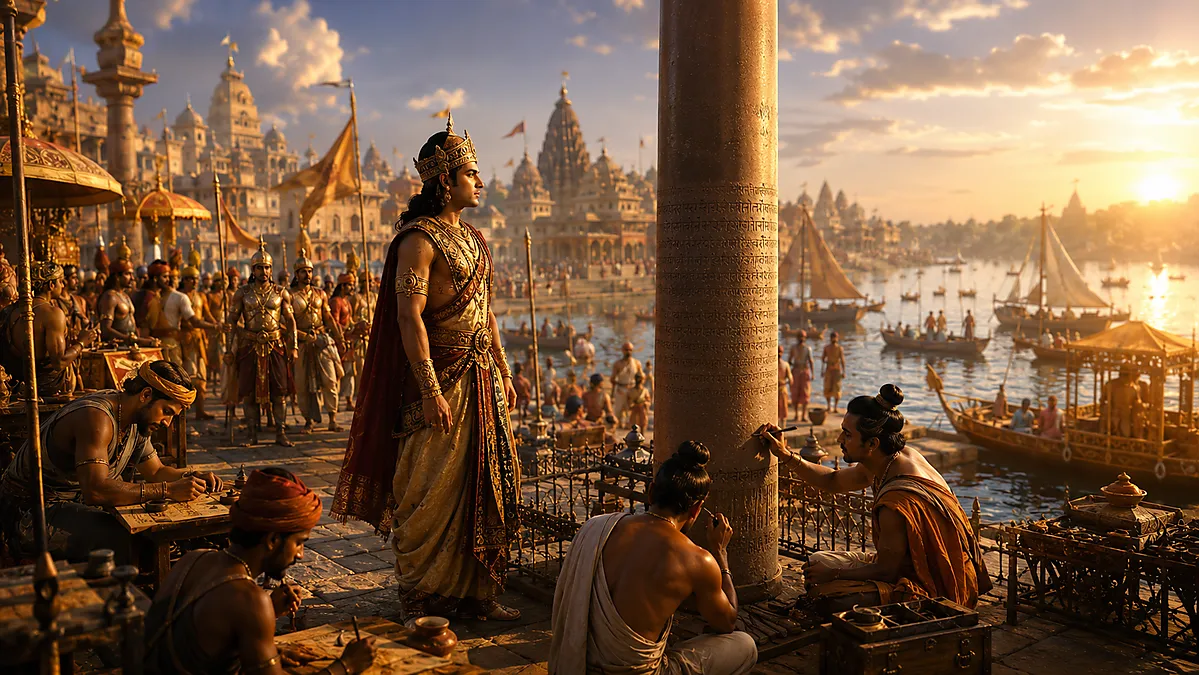
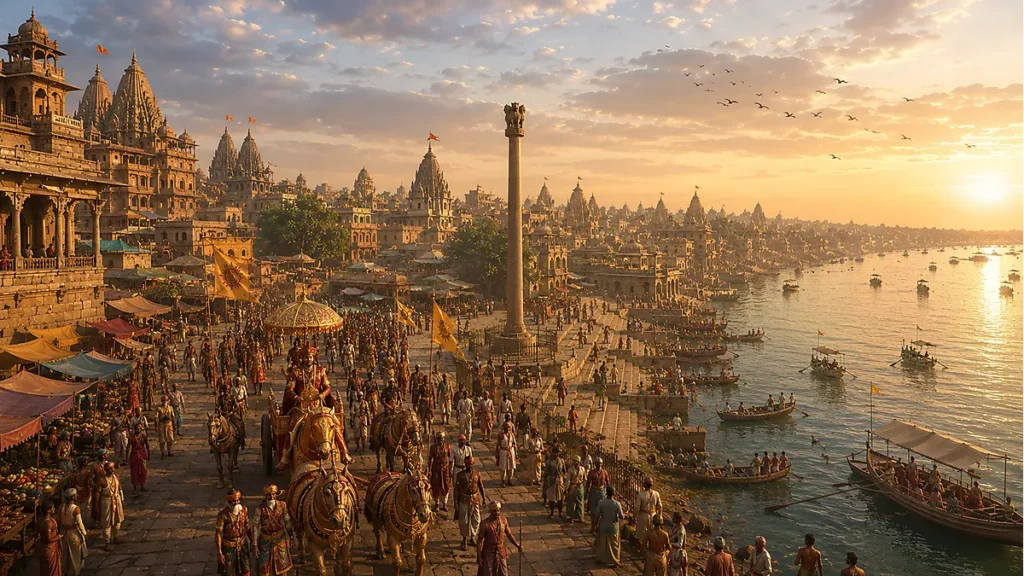
The story of one of ancient India’s most powerful empires is carved in stone. More than 1,600 years ago, the ambitious Gupta emperor Samudragupta looked out from the sacred city of Prayag and set his sights on conquering the entire subcontinent. His triumphs, his character, and his vision were not recorded on perishable palm leaves but etched into the enduring surface of an Ashokan pillar. This inscription, the Prayag Prashasti, turned a Mauryan relic into a Gupta imperial proclamation and transformed Prayag into a cornerstone of India’s Golden Age.
Today, millions of pilgrims visit Prayagraj for the sacred Triveni Sangam. But few realize that the same city where they seek spiritual liberation also preserves one of the most important historical documents of ancient India—a document that reveals how a single emperor turned a holy city into an imperial capital.
1. The Stone That Preserved an Empire
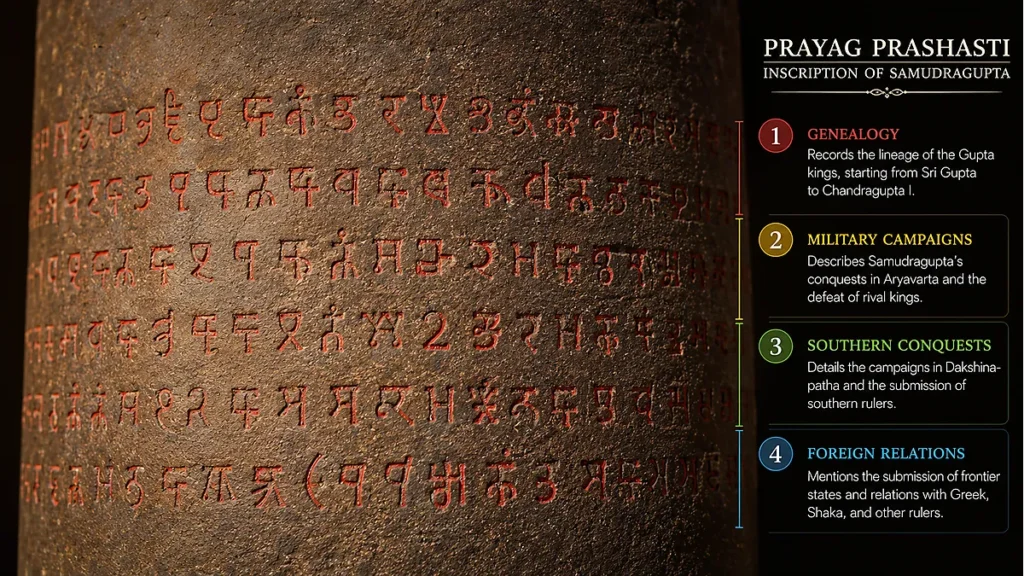
Inside the walls of the formidable Allahabad Fort, a single pillar of polished sandstone stands as a silent witness to millennia of Indian history. On its surface, a traveler can trace the hand of three great dynasties: the Mauryan edicts of the 3rd century BCE, the Gupta-era Sanskrit inscription of the 4th century CE, and the Mughal Persian inscription of the 17th century CE. Between them, the lyrical masterpiece of the 4th century—the Prayag Prashasti—stands out as one of the most important historical documents of ancient India.
Commissioned by Samudragupta, the second emperor of the Gupta dynasty, this inscription is not mere royal praise. It is a geopolitical survey, a military chronicle, a literary masterpiece, and an ideological manifesto, all carved into stone.
2. Prayag Before the Guptas: A Sacred Crossroads
Long before Samudragupta engraved his name on history, Prayag was a place of profound importance. Known as Prayaga in ancient texts, it was already a celebrated holy city, mentioned in the Rigveda and the Mahabharata, renowned for the sacred confluence of the Ganga and Yamuna.
By the time of the Mauryan emperor Ashoka in the 3rd century BCE, Prayag’s significance was well established. The very pillar Samudragupta would later use was first erected by Ashoka, likely at the nearby city of Kaushambi, to disseminate his dhamma edicts. The pillar was a symbol of imperial authority, and its polished sandstone was a hallmark of Mauryan craftsmanship.
Under the Guptas, the city would become not just a spiritual hub but a strategic, political, and cultural powerhouse—the nerve center of an empire that would one day control most of northern India.
3. The Rise of the Gupta Dynasty
The Gupta Origins (c. 3rd Century CE)
The Gupta dynasty rose from modest beginnings in the Magadha region (modern-day Bihar). Unlike the Mauryas, who rose to power through conquest, the Guptas emerged as local chieftains who gradually expanded their control over the fertile Gangetic plain.
The earliest known Gupta ruler was Sri Gupta (c. 240–280 CE), mentioned only in later records. His son Ghatotkacha (c. 280–319 CE) followed, but neither held imperial titles. They were Maharajas—great kings—but not emperors.
Chandragupta I: The Dynasty’s True Founder (c. 319–335 CE)
The empire’s first great monarch was Chandragupta I, who strengthened his position through a strategic marriage to the Lichchhavi princess Kumaradevi. The Lichchhavis were a powerful republican clan based in Vaishali (modern Bihar), and this alliance brought immense prestige and military strength.
Chandragupta I assumed the title Maharajadhiraja—”King of Great Kings”—marking the beginning of the imperial Gupta dynasty. He expanded his territory to include much of the Gangetic plain, with Prayag emerging as a key center.
4. Who Was Samudragupta? The Warrior-Poet of Ancient India
Early Life and Accession (c. 335–350 CE)
Samudragupta was his father’s chosen successor. According to the Prayag Prashasti, he was selected for his “devotion, righteous conduct, and valour.” The same inscription notes that he “eclipsed the other sons of the king”—suggesting a contested succession that he overcame.
The “Napoleon of India”
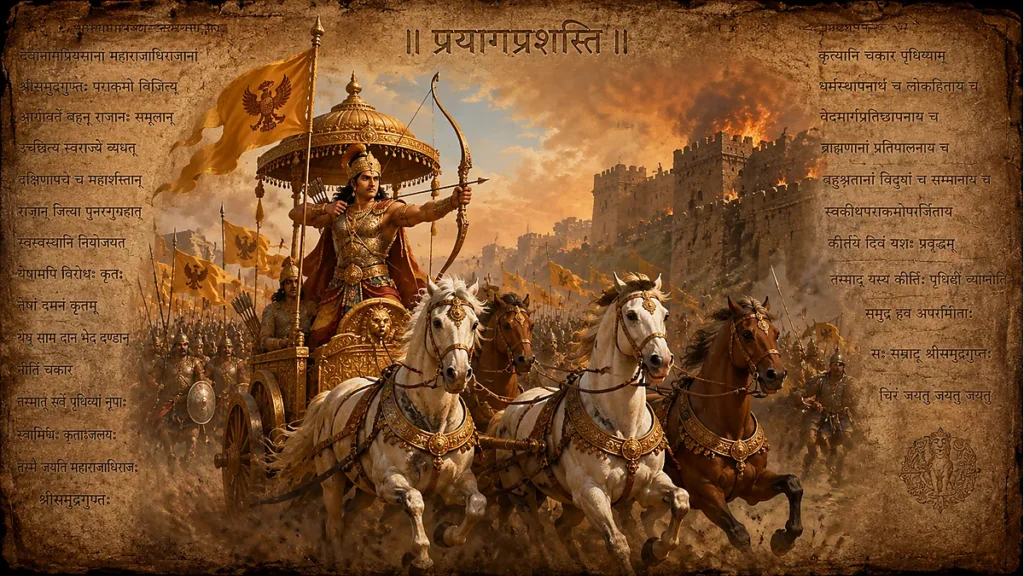
Samudragupta is often called the “Napoleon of India” for his brilliant military campaigns. However, the comparison falls short. Unlike Napoleon, Samudragupta was a multi‑faceted genius—a poet, a musician, a patron of the arts, and an astute administrator. Moreover, his conquests were not driven by mere ambition; they were framed within a dharmic ideology of righteous rule.
A Poet on the Throne
The Prayag Prashasti explicitly praises Samudragupta as a man of culture. It states that he was “proficient in poetry and music” and was even called Kaviraja—”King of Poets”—by his contemporaries. His gold coins depict him playing the veena (a stringed instrument), an image unique in Indian numismatics. No other ruler before or after has been so intimately associated with the arts.
The Military Campaigns: A Two‑Phase Strategy
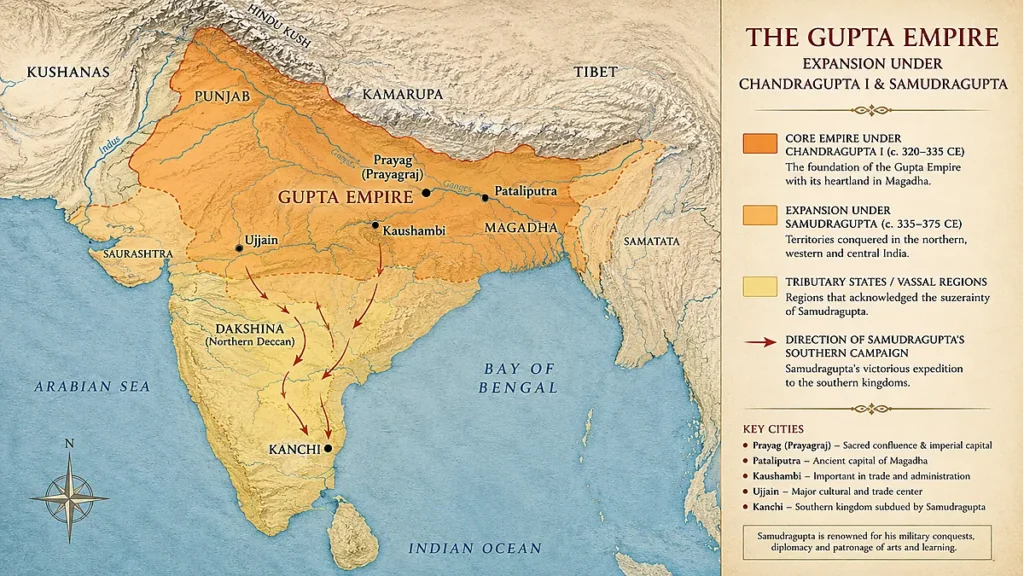
Samudragupta’s conquests were systematic and brilliant. He first turned his army north, “uprooting” nine kings of the Gangetic plain and absorbing their kingdoms into the Gupta Empire. This aggressive expansion in northern India (Aryavarta) was conquest of a final, annexing nature.
After subduing the north, he marched south along the eastern coast. In the Dakshinapatha, his strategy changed. The Prayag Prashasti records the defeat of twelve southern kings, but these rulers were not annexed. Instead, Samudragupta was a “dharma‑vijayi”—a righteous conqueror—defeating them, accepting their submission, and then reinstalling them on their thrones as tributary vassals.
He controlled the forest kingdoms, received tribute from the tribal republics of Rajasthan (the Malavas, Yaudheyas, Arjunayanas, etc.), and his reputation was so great that kings of the northwest (the Kushanas) and even the king of Ceylon (Sri Lanka) sent embassies bearing gifts.
5. The Prayag Prashasti: A Stone Eulogy
Location and Discovery
The Prayag Prashasti, also known as the Allahabad Pillar Inscription, is located on the Ashokan pillar inside the Allahabad Fort. The pillar is a single shaft of polished sandstone, 10.6 meters (35 feet) tall, and has stood for over 2,300 years.
The inscription was first studied and translated by British archaeologists in the 19th century, most notably by Alexander Cunningham, the founder of the Archaeological Survey of India. Its significance was immediately recognized, and it has since become one of the most studied inscriptions in Indian history.
Harisena: The Poet-Minister
The inscription was composed by Harisena, one of Samudragupta’s chief courtiers, who held the title Sandhi‑Vigrahika—the minister for war and peace. This dual role—poet and diplomat—is reflected in the inscription’s content, which combines lyrical praise with precise geopolitical detail.
Language and Style
The inscription is written in highly polished classical Sanskrit and employs the Champu Kavya style, which alternates between prose (gadya) and poetry (padya). This sophisticated literary form was reserved for the most important royal eulogies.
Structure of the Inscription
The Prayag Prashasti follows a clear structure:
- Genealogy of the Guptas: It traces Samudragupta’s lineage from his grandfather Ghatotkacha and father Chandragupta I, proudly mentioning his mother Kumaradevi’s Lichchhavi background.
- Praise of Personal Qualities: It describes the emperor as compassionate, a patron of the arts, and himself a talented poet and veena player.
- Military Conquests (Aryavarta): It lists the nine kings he “uprooted” in northern India.
- Military Conquests (Dakshinapatha): It names the twelve southern kings he defeated and reinstated.
- Frontier and Forest Kingdoms: It records the submission of border states and tribal republics.
- Foreign Relations: It notes the goodwill of distant rulers, including the king of Ceylon.
A Sanskrit Verse from the Prayag Prashasti
Devanagari:
श्रीश्चन्द्रगुप्तो भुवि भारतीयो जयत्यजेयो रणदुर्गवीर्यः।
तत्पुत्रः समुद्रगुप्तोऽवनीन्द्रो विस्तीर्णयशा विजयी च राजा॥
IAST:
Śrīścandragupto bhuvi bhāratīyo jayatyajeyo raṇadurgavīryaḥ |
Tatputraḥ samudragupto ‘vanīndro vistīrṇayaśā vijayī ca rājā ||
Source: Prayag Prashasti (Allahabad Pillar Inscription), lines 3-4 (paraphrased extract)
Word-by-Word Meaning:
- Śrīścandraguptaḥ – the glorious Chandragupta
- Bhuvi – on earth
- Bhāratīyaḥ – of Bharat (India)
- Jayati – is victorious
- Ajeyaḥ – unconquerable
- Raṇa-durga-vīryaḥ – whose strength is the fortress of battle
- Tat-putraḥ – his son
- Samudraguptaḥ – Samudragupta
- Avanīndraḥ – lord of the earth
- Vistīrṇa-yaśā – of widespread fame
- Vijayī – victorious
- Ca – and
- Rājā – king
Translation:
“The glorious Chandragupta, unconquerable on earth, is victorious. His son, Samudragupta, the lord of the earth, of widespread fame, is a victorious king.”
Historical Significance: This opening section establishes the dynastic legitimacy of the Guptas and presents Samudragupta as the natural heir to a powerful and righteous father.
6. Decoding the Prayag Prashasti: A Blueprint of Empire
The core of the inscription is a geographical and political catalog of Samudragupta’s world, revealing a sophisticated imperial policy.
Aryavarta (Northern India) – Total Conquest
The inscription lists nine kings whom Samudragupta “uprooted” (utpāṭita). This was total conquest. Their kingdoms were annexed directly into the Gupta Empire. Among these rulers were prominent Naga chieftains such as Achyuta, Nagasena, and Ganapatinaga.
Dakshinapatha (Southern India) – Tributary Alliance
The inscription names a dozen rulers he defeated, humbled, and then reinstated. This established a tributary alliance without direct administrative control. By defeating them and then showing mercy, Samudragupta displayed both power and magnanimity. Among the southern kings were Vishnugopa of Kanchi (of the Pallava dynasty) and the kings of Mahishmati and Kalinga.
Frontier and Forest Kingdoms
The border states and tribal republics (including the Malavas, Yaudheyas, Arjunayanas, and Kunindas) paid him homage. The forest kingdoms (āṭavika rājya) were “subjugated” through military campaigns.
Foreign Kings and Distant Relations
The prashasti records the goodwill of distant rulers, including the “Daivaputra-Shahi-Shahanushahi” (the Kushana kings of the northwest) and the “Saka-Murundas.” Most remarkably, it notes that the king of Ceylon (Sri Lanka), Meghavarna, sent a royal embassy with rich gifts, asking for permission to build a monastery at Bodh Gaya. Samudragupta granted this request, demonstrating his role as a powerful, benevolent ruler who was tolerant of other faiths.
7. Harisena: The Poet-Minister of the Gupta Court
Harisena’s role went far beyond that of a court poet. His title, Sandhi-Vigrahika, meant he was the minister for foreign affairs—the chief diplomat and military strategist. This dual role is reflected in the inscription’s content, which combines poetic language with precise geopolitical detail.
He was also a significant literary figure in his own right. Besides the Prayag Prashasti, he is credited with composing other works, though they have not survived. His mastery of the Kavya style placed him among the greatest Sanskrit poets of the classical age.
The very fact that a minister, not a professional poet, composed the inscription speaks to the high level of literary culture at the Gupta court. It also suggests that Harisena was an eyewitness to the events he describes—he was not merely recording second‑hand accounts.
8. Samudragupta’s Administration: The Machinery of Empire
The Prayag Prashasti gives us glimpses of the Guptas’ sophisticated administrative machinery.
Central Administration
The emperor was the supreme authority, aided by a council of ministers (mantri-parishad) and high officials. Harisena himself was one such official. The presence of officers with titles like Kumaramatya (prince-minister) and Sandhi-Vigrahika indicates a well-organized bureaucracy.
Provincial Administration
The empire was divided into provinces (bhuktis), governed by Uparikas (provincial governors). These were further divided into districts (vishayas), headed by Ayuktakas (district magistrates). The system allowed the central government to maintain control over vast territories while delegating local administration.
Revenue System
The Guptas inherited and refined the Mauryan revenue system. Land revenue was the primary source of income, typically one-sixth of the produce. Taxes were collected in cash and kind, and the state maintained detailed land records.
Military Organization
The Gupta army was a standing imperial force, supplemented by feudal levies. The Prayag Prashasti mentions the emperor’s prowess as a military commander, but it also implies a well-organized chain of command. The army consisted of infantry, cavalry, chariots, and war elephants.
9. Prayag as an Imperial Center: Why the Guptas Chose the Sangam
Prayag’s location made it the perfect power base for a dynasty aspiring to control all of India. Situated at the heart of the Gangetic plain and at the junction of key riverine trade routes, Prayag was both a commercial hub and a spiritual centre.
Strategic Geography
From Prayag, the Guptas could project power in all directions. The Ganga and Yamuna rivers served as highways for trade and military movement. The city was also located near the historic Mauryan capital of Pataliputra, giving the Guptas symbolic continuity with India’s first empire.
Political Importance
Under Samudragupta, Prayag became an imperial capital. It is said that he assembled his army here before the great southern campaign. The Sangam served as the spiritual epicentre of his vast dominion, and the city remained central to the Guptas, serving as an imperial capital until the reign of Kumaragupta I, when power later shifted to Ayodhya.
Religious Importance
The Guptas were devout Hindus, but they also patronized Buddhism and Jainism. Prayag, with its ancient status as a tirtha, provided a religious legitimacy that no other city could offer. By associating himself with Prayag, Samudragupta positioned himself as a protector of dharma—a righteous king ruling from a sacred land.
10. Samudragupta’s Coins: Power and Piety in Gold
Samudragupta’s ambitions were not only recorded in stone but also stamped onto gold coins, known as dinars. His coins are masterpieces of art and political communication, minted in at least seven distinct types.
The Veena Type – The Poet-King
The most iconic is the Veena type, which depicts the emperor seated on a high‑backed couch, playing a stringed instrument, his head surrounded by a halo. This image perfectly matches the description in the Prayag Prashasti of the emperor as a cultured man. The legend reads “Maharajadhiraja Sri Samudragupta”.
The Ashvamedha Type – The Imperial Sacrifice
To advertise his supreme authority, he revived the ancient Ashvamedha (horse sacrifice). The Ashvamedha was a ritual declaration of imperial sovereignty—only a king who had conquered his neighbors could perform it. The coin shows the sacrificial horse on one side and the queen on the reverse, with the legend “Ashvamedha Parakramah” (having the valor of the horse sacrifice).
The Archer Type – The Warrior King
Another common type shows the emperor as a standing archer, drawing a bow. This image emphasizes his martial prowess and is accompanied by the legend “Maharajadhiraja Samudragupta”.
11. The Ashokan Pillar Through the Ages: From Maurya to Mughal
The pillar’s journey is a fascinating story in itself, reflecting the changing political landscape of India over two millennia.
Mauryan Period (3rd Century BCE)
The pillar was first erected near the ancient city of Kaushambi by Emperor Ashoka. It was one of a series of pillars he erected across his empire, inscribed with his edicts promoting dhamma (righteous conduct).
Gupta Period (4th Century CE)
Samudragupta, recognizing the symbolic power of the pillar, chose it as the medium for his own inscription. By engraving the Prayag Prashasti on an existing Mauryan monument, he was consciously linking his dynasty to the great Mauryan Empire, claiming legitimacy and continuity.
Mughal Period (17th Century CE)
Centuries after the Guptas, the Mughal emperor Akbar moved the pillar from Kaushambi to his new fort at Prayagraj. Later, his son Jahangir added his own Persian inscription to the pillar, commemorating his accession to the throne. The inscription begins: “In the reign of the exalted Emperor Jahangir…”
British Period and Today
The pillar has remained in place inside the Allahabad Fort ever since. It is now a protected monument under the Archaeological Survey of India, and its inscriptions continue to be studied by scholars from around the world.
12. Archaeology of Gupta-Era Prayagraj
Kaushambi (56 km from Prayagraj)
Extensive excavations at Kaushambi—the pillar’s original home—have confirmed the site’s ancient past as a thriving metropolis at the time of Samudragupta. Excavations uncovered:
- Massive fortifications dating to the early historic period
- The Ghositarama monastery, a large brick complex where the Buddha is said to have stayed
- A palace with brick foundations and drainage systems
- Pottery typical of the Gupta period, including the distinctive red ware
The Gupta period is well represented in the excavation layers, yielding high-quality pottery, sculptures, and artifacts that speak of a prosperous and sophisticated culture.
Jhusi (Pratishthanpur)
The ancient mounds of Pratishthanpur (Jhusi) , located across the Ganga from Prayagraj, also show evidence of Gupta-era occupation. Excavations here revealed a continuous sequence from the Neolithic period (c. 7100 BCE) to the Gupta era, highlighting the region’s dense and continuous history.
Shringverpur
The site of Shringverpur, associated with the Ramayana as the kingdom of Nishadraj Guha, has also yielded Gupta-period artifacts. This indicates that the region was not only politically and religiously significant but also continuously occupied.
[📸 INLINE IMAGE]
Visual Description: A photograph of the excavated ruins of Ghositarama Monastery at Kaushambi, showing brick foundations and a layout of cells. The site is surrounded by green grass, with a clear sky overhead. A signboard indicates the area as a protected monument.
Alt Text: Excavated ruins of Ghositarama Monastery at Kaushambi, a key Gupta-era site.
Purpose: Connect the historical narrative to a tangible archaeological site that visitors can explore.
13. Visiting the Legacy of Samudragupta in Prayagraj
Allahabad Fort
The Ashokan pillar, with the Prayag Prashasti, is located within the Allahabad Fort. The fort is under the jurisdiction of the Indian Army, but the pillar is accessible to visitors through a designated corridor. Contact local authorities for access and timings.
Allahabad Museum
The museum houses a replica of the pillar, a small gallery dedicated to the Gupta period, and a collection of ancient coins, including some of Samudragupta’s gold dinars. The museum is open from 10:30 AM to 4:30 PM, closed on Mondays.
Kaushambi Excavation Site
Located about 56 km from Prayagraj, the excavated ruins of the ancient city are a must‑visit for history enthusiasts. Key attractions include:
- The original site of the Ashokan pillar (a replica marks the spot)
- The foundations of the Ghositarama monastery
- The massive earthen ramparts
Jhusi (Pratishthanpur)
The extensive archaeological mounds of this ancient site contain layers from the Gupta period. The Samudra Koop (Ocean Well) is attributed to Samudragupta himself and is still considered sacred.
[📸 INLINE IMAGE]
Visual Description: A modern photograph of the Allahabad Museum interior, showing a gallery with Gupta-era stone sculptures, a display case of ancient coins, and a large wall panel explaining the Gupta Empire. Visitors are seen observing the exhibits.
Alt Text: Allahabad Museum gallery displaying Gupta-era artifacts and coins.
Purpose: Guide visitors to where they can see Gupta artifacts today and encourage heritage tourism.
14. Why the Prayag Prashasti Still Matters Today
The Prayag Prashasti is more than a stone monument; it is a foundational source for understanding India’s classical age.
For Historians
It offers a detailed, contemporary account of the political geography of 4th-century India. The inscription names kings, dynasties, and regions that would otherwise be unknown. It is a primary source of the highest order.
For Students of Literature
It is a literary masterpiece, showcasing the sophistication of Sanskrit court poetry. The Kavya style of Harisena set a standard that would be emulated for centuries.
For Heritage Travelers
For visitors to Prayagraj, the pillar provides a tangible connection to a pivotal moment in the past. Standing before it, one can feel the weight of history—the same stone that was polished by Mauryan craftsmen, inscribed by Gupta poets, and admired by Mughal emperors.
For National Identity
The Gupta period is often called India’s “Golden Age.” The Prayag Prashasti is a reminder that India has a long and continuous tradition of centralized governance, military strategy, and artistic excellence.
15. Frequently Asked Questions (FAQs)
1. Who was Samudragupta?
Samudragupta was the second emperor of India’s Gupta dynasty (c. 350-375 CE). He was a great military conqueror, a patron of the arts, and a poet-musician.
2. What is the Prayag Prashasti?
The Prayag Prashasti (or Allahabad Pillar Inscription) is a eulogy composed by Samudragupta’s minister Harisena. It is inscribed on an Ashokan pillar and describes the emperor’s achievements.
3. Where is the Allahabad Pillar Inscription located?
It is located on an Ashokan pillar inside the Allahabad Fort in Prayagraj.
4. Why is Samudragupta called the Napoleon of India?
He is called the “Napoleon of India” for his extensive and brilliant military campaigns, which unified much of northern India under Gupta rule.
5. What was Prayagraj’s role during the Gupta Empire?
Prayagraj (then Prayaga) served as an imperial center, a strategic military headquarters, and a sacred site that legitimized Gupta rule.
6. Who composed the Prayag Prashasti?
The inscription was composed by Harisena, Samudragupta’s minister for war and peace (Sandhi-Vigrahika).
7. What are the main types of Samudragupta’s coins?
The main types include the Veena type (emperor playing music), the Ashvamedha type (horse sacrifice), and the Archer type (emperor as a warrior).
8. How did the Guptas use existing Mauryan monuments?
Samudragupta used an existing Ashokan pillar for his inscription, a deliberate act of claiming legitimacy by linking his dynasty to the Mauryan past.
9. Is the Prayag Prashasti written in Sanskrit?
Yes, it is written in highly polished classical Sanskrit, using the Champu Kavya style (prose and poetry alternating).
10. What is the historical significance of the Prayag Prashasti?
It is the most important source for Samudragupta’s reign, providing a detailed account of his conquests, administration, and personality.
11. Can visitors see the Ashokan pillar today?
Yes, the pillar is inside the Allahabad Fort. Visitors can see it through a designated corridor, though access may be restricted at times.
12. What other Gupta-era sites can be visited near Prayagraj?
Key sites include Kaushambi (excavated ruins), Jhusi (Pratishthanpur), and the Allahabad Museum (which houses Gupta artifacts and coins).
13. How does the Prayag Prashasti describe Samudragupta’s personality?
It describes him as a compassionate ruler, a patron of the arts, and a talented poet and musician who was also a fierce warrior.
14. What does the inscription say about Samudragupta’s southern campaign?
It records the defeat of twelve southern kings, but unlike in the north, these rulers were reinstated as tributary vassals rather than being deposed.
15. Why is the Gupta period called India’s Golden Age?
The Gupta period saw remarkable achievements in literature, art, science, and philosophy, along with political stability and economic prosperity.
16. Conclusion: The Eternal Echoes of an Emperor
The Prayag Prashasti is more than an inscription—it is a stone chronicle of ambition, conquest, governance, and cultural brilliance. Through its carefully carved lines, Samudragupta continues to speak across sixteen centuries, reminding us why the Gupta Age remains one of the brightest chapters in India’s history.
For the visitor to Prayagraj, the pillar offers a unique opportunity: to stand where emperors have stood, to read words that have been read for over a thousand years, and to connect with a past that is both distant and immediately present.
“The Prayag Prashasti is more than an inscription—it is a stone chronicle of ambition, conquest, governance, and cultural brilliance. Through its carefully carved lines, Samudragupta continues to speak across sixteen centuries, reminding us why the Gupta Age remains one of the brightest chapters in India’s history.”
17. Related Articles
To deepen your understanding of Prayagraj’s historical and spiritual heritage, we invite you to explore these related articles:
- Prayag Prashasti: The Allahabad Pillar Inscription – A Complete Guide – An in‑depth look at the inscription itself, its translation, and its historical context.
- Exploring Prayagraj’s Historical Layers: From Ancient Empires to Colonial Legacy – A broader journey through the city’s 5,000-year history.
- Kaushambi: The Ancient Capital of the Vatsas and a Lost City of Indian Civilization – Discover the archaeological site where the Ashokan pillar originally stood.
- Pratishthanpur (Old Jhusi): The Ancient Capital of the Lunar Dynasty – Explore the Neolithic and Gupta-era mounds across the Ganga.
- Allahabad Fort: History, Architecture & Visitor Guide – Learn about the Mughal fort that now houses the Ashokan pillar.
- Allahabad Museum: Complete Visitor Guide to Prayagraj’s Treasure House of History – Plan your visit to see Gupta sculptures and Samudragupta’s coins.
- Top Places to Visit in Prayagraj: The Complete Travel Guide – A comprehensive overview of the city’s attractions, including historical and spiritual sites.
- Why Every Hindu Should Visit Prayagraj Once in a Lifetime – Understand the spiritual significance of the city beyond its history.
This article is part of a series on the historical heritage of Prayagraj. For more information on planning your heritage tour, please contact us.
Prayag Tourism
📞 Phone/WhatsApp: +91-9555313526
📧 Email: contact@prayagtourism.com
🌐 Website: PrayagTourism.com
May your journey be peaceful, safe, and historically enriching.