
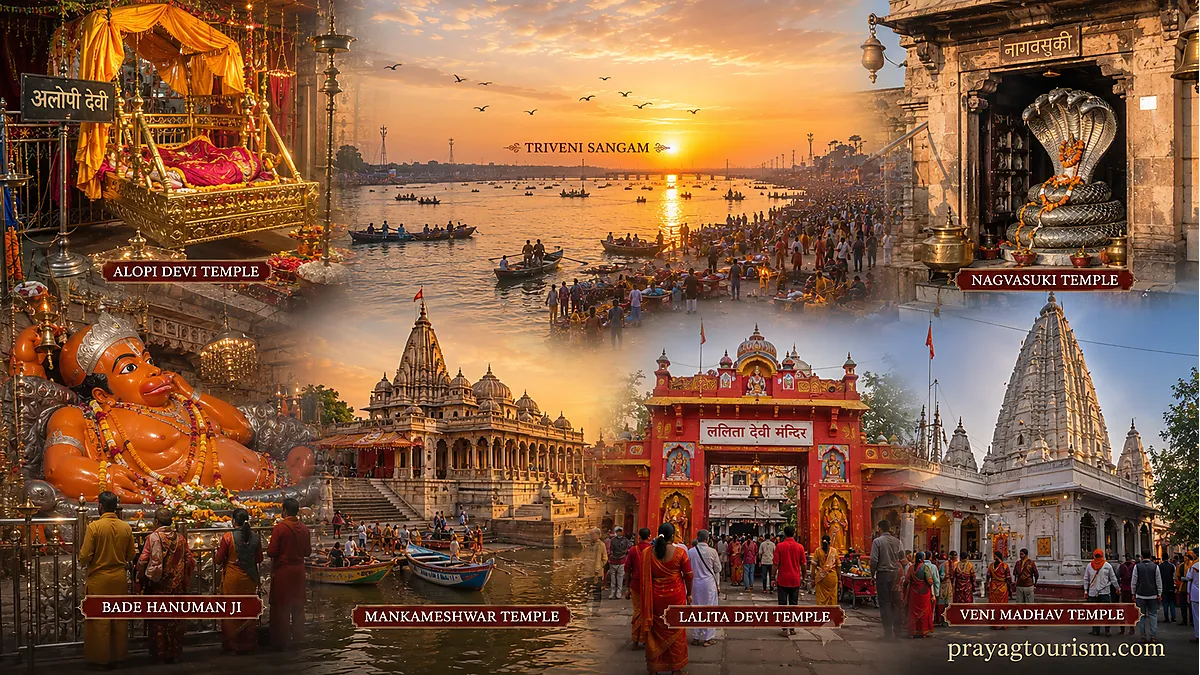
A sacred journey through the spiritual heart of India’s Tirtharaja
Table of Contents
Dawn Among the Sacred Shrines
The first light of dawn touches the spires of Prayagraj. From the ghats of the Triveni Sangam to the alleys of Alopibagh, temple bells begin to ring – a chorus of devotion that wakes the city.
You walk toward the river. A priest lights incense before the massive reclining idol of Hanuman. Devotees gather at Mankameshwar Temple on the Yamuna’s bank, pouring milk over a shivling said to have been installed by Lord Rama himself. At Nagvasuki Mandir, the morning aarti echoes across the Ganga, while pilgrims offer prayers to the serpent king Vasuki, seeking freedom from astrological afflictions.
Beyond the Sangam’s sacred waters, the temples of Prayagraj offer a treasure trove of experiences that cater to every kind of traveller. Each site reflects the city’s cultural, historical and spiritual heritage. From unique Shakti Peethas without idols to underground shrines beneath a Mughal fort, from banyan trees that survived cosmic dissolution to ashrams where Rama rested – the temples of Prayagraj are as diverse as the deity traditions they represent.
Beyond the famous Sangam, what are the temples that define the spiritual soul of Prayagraj?
The answer lies in a sacred network of fifteen shrines – each with its own mythology, each with its own legend, each with its own form of the divine. Together, they form the spiritual geography of one of India’s holiest cities.
Quick Facts – Prayagraj’s Sacred Temples at a Glance
| Attribute | Details |
| Destination | Prayagraj (formerly Allahabad) |
| Primary Spiritual Identity | Tirtharaja – King of Pilgrimage Sites |
| Number of Featured Temples | 15 |
| Major Traditions | Shakta (Mother Goddess), Shaiva (Lord Shiva), Vaishnava (Lord Vishnu), Hanuman Worship |
| Ideal Pilgrimage Duration | 2–3 Days for complete circuit |
| Best Time to Visit | October–March (winter) for pleasant weather; major festivals draw additional crowds |
| Famous Temple | Bade Hanuman Ji Mandir (unique reclining idol) |
| Unique Shakti Temple | Alopi Devi Mandir (no idol – cradle worshipped) |
| Ancient Shaiva Site | Mankameshwar Mandir (shivling installed by Lord Rama) |
| Astrological Remedy Temple | Nag Vasuki Mandir (believed to mitigate Kaal Sarp Dosh) |
| Most Sacred Tree Shrine | Akshayavat (the immortal banyan) |
| Accessibility | Most temples within city; local transport (auto, e-rickshaw, taxi) easily available |
Why Prayagraj Is a Sacred Temple City – A Spiritual Geography
Prayagraj is not merely a city of one sacred site. It is a complete sacred geography where multiple streams of Hindu devotion converge.
The Triveni Sangam – the confluence of the Ganga, Yamuna and the mythical Saraswati – is the spiritual heart of the city. But around this heart, a network of temples has grown over millennia, each dedicated to a different form of the divine.
The Prayag Mahatmya – the scriptural glorification of Prayag – describes this sacred landscape in detail. The uploaded text declares that “Sath karor dash hazaar tirtha Prayagraj ke samip hain” – 60 crores and 10 thousand tirthas are located near Prayagraj. While this theological number suggests infinity, it points to the idea that Prayagraj contains the essence of all holy places.
The temples of Prayagraj represent all three major streams of Hindu worship:
- Shakta (Mother Goddess): Represented by Alopi Devi, Lalita Devi and Kalyani Devi temples – three Shakti Peethas within the same city.
- Shaiva (Lord Shiva): Represented by Mankameshwar, Shivkuti, Padila Mahadev and the shivling within Patalpuri Temple.
- Vaishnava (Lord Vishnu): Represented by the Dwadash Madhav (twelve Madhav temples), including Veni Madhav.
- Hanuman Worship: Represented by Bade Hanuman Mandir, Hanumat Niketan and Sankat Mochan Temple.
The coexistence of these diverse traditions within a single sacred geography makes Prayagraj unique. Here, a devotee of Shiva, a worshipper of the Goddess, a follower of Vishnu and a devotee of Hanuman can all find their chosen form of the divine – often within walking distance of each other.
The 15 Most Important Temples of Prayagraj
Temple 1: Triveni Sangam – The Confluence as Temple
| Attribute | Details |
| 📍 Location | Near Allahabad Fort, Prayagraj |
| ⏳ Best Time | Sunrise (5:30–7:00 AM) |
| ⏱️ Time Required | 2–3 hours (including boat ride) |
| 🔓 Entry Fee | Free (boat charges separate) |
Before exploring individual temple structures, one must acknowledge the Triveni Sangam itself as the holiest site – the temple without walls, the shrine without a roof. It is the confluence of the Ganga, Yamuna and the mythical Saraswati, described in the scriptures as Tirtharaja – the King of Pilgrimage Sites.
The sacred Sangam Temple (also referred to as the temple at the confluence) is a recent addition to the banks of the Sangam. However, the act of pilgrimage here precedes any structure. Pilgrims take a holy dip (snan) at sunrise, then proceed to the various temples surrounding the confluence. According to temple tradition, there is no meaning to the Sangam snan until one also visits the Patalpuri Temple and prays to all the deities residing there.
Visitor Experience: Boats are required to reach the exact confluence point. Shared boats cost ₹50–150 per person; private boats cost ₹800–2,500 per boat. The sunrise view from the confluence is legendary – the golden light on the meeting of the two visibly distinct rivers is an unforgettable sight.
Temple 2: Alopi Devi Mandir – The Unique Shakti Peetha Without an Idol
| Attribute | Details |
| 📍 Location | Alopibagh, near Triveni Sangam, Prayagraj |
| 🕉️ Presiding Deity | Goddess Sati (no idol; wooden cradle worshipped) |
| ⏰ Darshan Timings | 5:00 AM – 11:00 PM (daily) |
| ⏱️ Time Required | 30–45 minutes |
| 🔓 Entry Fee | Free |
What Makes It Unique: Alopi Devi Temple is one of the most mysterious temples in India. There is no idol of the goddess inside the sanctum. Instead, a wooden carriage or cradle (doli) is worshipped.
The origin of the name Alopi (disappeared) lies in a Hindu legend. After the death of his wife Sati, the grieving Lord Shiva wandered through the skies carrying her dead body. Lord Vishnu, to relieve Shiva from his agony, threw his Sudarshana Chakra at the corpse, causing various parts of the body to fall at different places across India. The last part fell at this location, where it disappeared. Hence, the place was named Alopi (where disappearance was concluded). The temple is one of the 51 Maha-Shakti Peethas (or 18 Maha-Shaktipeeths according to the Devi Bhagwatam) and is considered the holiest of all.
Historical evidence suggests the Maratha warrior Shreenath Mahadji Shinde developed the Sangam area during his stay at Prayagraj in 1771–72. Later, in the 1800s, Maharani Baizabai Scindia undertook renovation of Sangam ghats and temples at Prayagraj.
Visitor Experience: Devotees bow before the wooden cradle, offering flowers and prayers. The temple is particularly crowded during Navratri, when special ceremonies are held. Located near the holy Sangam where the Ganga, Yamuna and legendary Sarasvati meet, Alopi Devi Mandir is accessible via local transport from any part of the city.
Temple 3: Bade Hanuman Ji Mandir – The Reclining Guardian of the Sangam
| Attribute | Details |
| 📍 Location | Opposite the Sangam, near Prayagraj Fort, approximately 1 km from Triveni Sangam |
| 🕉️ Presiding Deity | Lord Hanuman (reclining form) |
| ⏰ Darshan Timings | 5:00 AM – 2:00 PM; 5:00 PM – 8:30 PM (Tuesdays & Saturdays extended to 10:30 PM) |
| ⏱️ Time Required | 30–45 minutes |
| 🔓 Entry Fee | Free |
Unique Feature: Bade Hanuman Mandir, also known as Lete Hanuman Ji Mandir, houses the world’s only 20-foot-long reclining idol of Lord Hanuman. The idol is believed to be several centuries old, with the temple itself dating back approximately 700 years.
According to legend, Hanuman rested here after burning Lanka – exhausted, he lay down on the banks of the Sangam. The reclining posture symbolises his eternal vigilance: even while resting, he protects the sacred confluence.
Unique Phenomenon: During the monsoon season (July–September), the waters of the Ganga rise and partially submerge the idol. Devotees believe this symbolises Mother Ganga bathing Lord Hanuman. By October, the waters recede, revealing the complete idol once again. This seasonal submersion has been witnessed for centuries and draws thousands of devotees.
Visitor Experience: Located just 500 metres from the Triveni Sangam, the temple is easily accessible on foot or by auto-rickshaw from the Sangam area. Tuesdays and Saturdays see the largest crowds, with the temple remaining open until 10:30 PM on these days. The idol is truly massive – as you stand before it, you feel the power and presence of Hanuman. Devotees offer sindoor (vermillion) and flowers, believing the deity grants protection and fulfils wishes.
Temple 4: Mankameshwar Mandir – The Wish-Fulfilling Lord on Yamuna’s Bank
| Attribute | Details |
| 📍 Location | Fort Road, Kydganj, on the banks of the Yamuna River, opposite Minto Park |
| 🕉️ Presiding Deity | Lord Shiva (Mankameshwar – the wish-fulfilling Lord) |
| ⏰ Darshan Timings | 4:00 AM – 10:00 PM (daily) |
| 🕛 Aarti Timings | Mangala Aarti: 4:00 AM; Sandhya Aarti: 9:30 PM |
| ⏱️ Time Required | 30 minutes – 1 hour |
| 🔓 Entry Fee | Free |
Legend: The name “Mankameshwar” signifies the deity who grants wishes. According to legend, the shivlingam of the temple is swayambhu (self-existent) and emerged in Tretayuga. As per another legend, it was established by Lord Ram while Ram, Laxman and Sita stayed under the Akshayavat during their journey to Chitrakoot. After Sita’s ritual bathing at the Sangam, she desired to pray to Lord Shiva. As there was no Shiva temple nearby, Lord Ram established the shivlingam at this site to fulfil her wish. Thereafter, both of them worshipped Lord Shiva and performed Abhishek Pooja.
The three-and-a-half-foot shivalingam is believed to extend much deeper underground. The temple’s antiquity and religious significance find mention in the Shiva Purana, Padma Purana, Skanda Purana and Prayag Mahatmya under the name ‘Kameshwar Tirtha’. It is also known as ‘Pishach Mochan Tirtha’.
Visitor Experience: The temple offers a serene and panoramic view of the Yamuna River. It is looked after by the trust of Swami Swaroopanand Saraswati, the Shankaracharya of Dwarka Sharda Peetham and Jyotirmath. The temple also serves as the Shankaracharya’s camp during his Prayagraj visits. During the month of Shravan (July–August), thousands of devotees perform Rudrabhishek. Mondays are considered especially auspicious. The temple management also gives saplings as prasad to devotees who perform Rudrabhishek – a unique eco-friendly initiative.
Temple 5: Nag Vasuki Mandir – The Serpent King’s Abode
| Attribute | Details |
| 📍 Location | Daraganj, on the banks of the Ganga River, approximately 3.4 km from Triveni Sangam |
| 🕉️ Presiding Deity | Lord Vasuki (King of Serpents) |
| ⏰ Darshan Timings | Morning to evening (exact timings may vary) |
| ⏱️ Time Required | 30–45 minutes |
| 🔓 Entry Fee | Free |
Historical & Mythological Significance: The origins of Nagvasuki Mandir trace back to the 10th century CE. The temple’s present structure was established in the 18th century by Maratha king Shridhar Bhonsle. Ancient Hindu texts like the Skanda Purana, Padma Purana, Bhagavata Purana and Mahabharata describe Naga Vasuki, the Serpent King, who played a crucial role in the Samudra Manthan (churning of the ocean) as the rope.
After the churning, Nagraj Vasuki, covered in blood, sought rest at this sacred site in Prayagraj, as advised by Lord Vishnu. According to local belief, the temple is one of only two in the world (Nasik is the second) where one can be liberated from the bad effects of ‘Kaal Sarpa Dosha’ – a difficult astrological influence where all seven planets in a person’s birth chart are positioned between the lunar nodes Rahu and Ketu.
Visitor Experience: Devotees believe that taking a bath in the Sangam followed by the darshan (vision) of Lord Nagvasuki grants blessings, spiritual fulfilment and freedom from life’s obstacles. No journey to Prayagraj is considered complete without paying homage here. The temple also has statues of other deities, including Ganesh, Parvati and a reclining statue of Bhishma Pitamah. There is also a Shiva temple on the premises. A large fair is held on Nag Panchami day.
In preparation for Maha Kumbh 2025, the historic Nagvasuki Temple was adorned with vibrant red stones from Rajasthan, known for their beauty and durability.
Temple 6: Lalita Devi Temple – The Finger of the Goddess
| Attribute | Details |
| 📍 Location | Meerapur colony, on the banks of the Yamuna River, near Barahkhambha Kydganj |
| 🕉️ Presiding Deity | Goddess Lalita (form of Goddess Durga) |
| ⏰ Darshan Timings | 9:00 AM – 9:00 PM (open 24 hours on some days) |
| ⏱️ Time Required | 30–45 minutes |
| 🔓 Entry Fee | Free |
Shakti Peetha Significance: Lalita Devi Temple is one of the 51 revered Shakti Peethas in Bharat (India). This is the sacred site in Meerapur, the historic old city of Prayagraj, where the fingers (hastangulika) of the right hand of Goddess Sati fell. Along with Alopi Devi and Kalyani Devi, Lalita Devi Temple completes the trinity of Shakti Peethas in Prayagraj – making the city one of the few places in India with three separate Shakti Peethas.
Visitor Experience: Described as a peaceful and clean temple, the sound of mantras fills the air along with the scent of havan (sacred fire offerings). A banyan tree on the temple grounds exudes divine energy, making it a perfect spot for meditation. The temple is particularly vibrant during Navratri, when devotees from various locations gather to seek the Goddess’s blessings.
Note: Google Maps displays an incorrect location for this temple. Visitors should rely on directions from locals or use the Meerapur colony address to find the temple.
Temple 7: Kalyani Devi Temple – Ancient Shakti of the 7th Century
| Attribute | Details |
| 📍 Location | Khushal Parvat, Attarsuiya, approximately 3 km from Prayagraj Railway Station |
| 🕉️ Presiding Deity | Goddess Kalyani Devi (form of Goddess Durga/Parvati) |
| ⏰ Darshan Timings | 4:00 AM – 10:00 PM (daily) |
| ⏱️ Time Required | 30–45 minutes |
| 🔓 Entry Fee | Free |
Ancient Shakti Peetha: Kalyani Devi Temple is one of the 51 Shakti Peethas dedicated to Goddess Sati. According to Hindu mythology and religious scriptures, when Lord Shiva carried the corpse of Devi Sati, three fingers of the Goddess fell at the place where the temple now stands.
According to archaeologists, the idol of Kalyani Devi in the temple is believed to be from the 7th century – over 1500 years old. The temple was built in 1883 by Chaudhari Mahadev Prasad, who renovated the temple complex. The divine idols placed within its sanctum have a history spanning more than 15 centuries. The temple is dedicated to Goddess Kalyani Devi, a form of Goddess Parvati, celebrating the divine feminine, strength and motherhood.
Visitor Experience: The Kalyani Devi Temple is a renowned Hindu temple known for its sacredness and spirituality. Standing in a densely populated area, it remains an emblem of unwavering faith and trust. During the festival season (especially Navratri), the temple experiences heavy footfall. Besides the main deity, the temple also contains idols of Lord Ganesha, Lord Hanuman, Lord Dattatreya and the Ram Parivar. A beautification project costing approximately one crore rupees was initiated in 2025.
Temple 8: Patalpuri Temple – The Subterranean Shrine of Immortal Idols
| Attribute | Details |
| 📍 Location | Inside Allahabad Fort, near Triveni Sangam |
| 🕉️ Presiding Deities | Over 40 deities including Brahma, Vishnu (Narsingh), Shiva (Mahadev), Ganga, Saraswati, Hanuman, Jamwant, Ved Vyas, Durvasa, Markandeya |
| ⏰ Darshan Timings | 8:00 AM – 5:00 PM (via Allahabad Fort entry) |
| ⏱️ Time Required | 1–2 hours |
| 🔓 Entry Fee | ₹25 for Indian citizens; ₹300 for foreign nationals (includes fort entry) |
The Subterranean Experience: Patalpuri Temple is an underground shrine located within the Allahabad Fort complex. The word “Patal” means underground – and indeed, this temple is neither above the land nor below the flowing river, but carved into a subterranean space. The present structure was erected by Emperor Akbar in the 16th century as part of fort construction, but the sacred cave or subterranean shrine predates the Mughal era by centuries.
Architectural Features:
- 84 pillars – 7 rows of 12 columns each
- Length: 84 feet; Width: 50 feet
- Ceiling height: 6.5 feet
- Over 40 exquisitely embellished ancient statues of deities and sages arranged systematically along the periphery
Temple Tradition: According to folklore, there is no meaning to Sangam snan until one visits this temple and prays to all the deities residing here. Lord Rama came here from Ayodhya to perform Pind Daan (ancestral offerings) for his father Raja Dashrath after completing 14 years of his exile.
Recent renovations have improved accessibility for pilgrims, though the other side of the holy Akshayavat tree remains under Army jurisdiction. Visitors can now explore the tunnel, which is illuminated and refurbished with red stones and wall carvings portraying Hindu mythological narratives.
Temple 9: Akshayavat – The Immortal Banyan Tree Shrine
| Attribute | Details |
| 📍 Location | Within Patalpuri Temple, Allahabad Fort |
| 🕉️ Significance | Indestructible banyan tree; mentioned in Vedas, Puranas, Mahabharata and Ramayana |
| ⏰ Darshan Timings | Via Patalpuri Temple (8:00 AM – 5:00 PM) |
| ⏱️ Time Required | 30 minutes (part of temple visit) |
| 🔓 Entry Fee | Included with fort entry |
What is Akshayavat? Akshayavat (Sanskrit: अक्षयवट, ‘undecaying banyan’) is a sacred fig tree considered one of the most ancient and sacred in Hindu tradition. The Padma Purana states that those who venerate the Akshayavat with devotion are freed from sins. The Akshayavat is mentioned as a holy site in the Mahabharata.
Legends:
- According to legend, sage Markandeya asked Narayana to show him his divine power. Narayana caused a pralaya (cosmic dissolution), flooding the entire world for a moment, during which only the Akshayavat could be seen above the water level.
- Lord Rama, Lakshmana and Sita are said to have rested beneath this tree during their exile from Ayodhya. Mother Sita blessed the banyan tree, and it was the only tree to survive when the earth submerged during the deluge.
- The Chinese Buddhist pilgrim Xuanzang mentions a tree at this site (a stump with miraculous properties) in his 7th-century writings.
- According to legend, the tree originated when Lord Brahma performed Ashwamedha Yagya at Prayag for the creation of the universe, with himself as the priest, Lord Vishnu as the host and Shiva as the presiding deity.
Visitor Experience: Currently, the other side of the holy Akshayavat tree remains a restricted area under Army jurisdiction. Pilgrims can watch the holy tree from a distance while walking through the newly developed corridor. The corridor culminates with a visit to the Saraswati Koop temple. It is believed that just seeing Akshayavat grants one ‘Akshaya Punya’ (eternal virtue).
Temple 10: Bharadwaj Ashram – Ancient Sage’s Hermitage
| Attribute | Details |
| 📍 Location | Colonelganj locality, near Anand Bhavan |
| 🕉️ Significance | Ashram of Sage Bharadwaj; visited by Lord Rama during exile |
| ⏰ Darshan Timings | Morning to evening (typically 5:00 AM – 10:00 PM) |
| ⏱️ Time Required | 1 hour |
| 🔓 Entry Fee | Free |
Historical Significance: Sage Bharadwaj was a repository of knowledge about Vedas, Puranas, Ayurveda, Dhanurveda and Vimana Shastra. His Gurukul was a great centre of learning and education. During his exile, Lord Rama, Sita and Lakshmana made their first halt at this ashram after crossing the Ganga. The ashram stands as a testament to the spiritual journey of Lord Rama and the intellectual heritage of ancient India.
Key Attractions: The ashram houses a shivling of Bharadwajeshwar Mahadev established by Sage Bharadwaj, and numerous statues including Ram, Lakshman, Mahishasur Mardini, Surya, Sheshnag and Nar Varah.
Temple 11: Veni Madhav Temple – The Presiding Deity of Prayagraj
| Attribute | Details |
| 📍 Location | Daraganj, on the banks of the Ganga, approximately 2.1 km from Triveni Sangam |
| 🕉️ Presiding Deity | Lord Vishnu (Veni Madhav – one of the twelve forms) |
| 🛕 Significance | Considered the presiding deity of Prayagraj |
| ⏰ Darshan Timings | Morning to evening (exact timings may vary) |
| ⏱️ Time Required | 30–45 minutes |
| 🔓 Entry Fee | Free |
Dwadash Madhav Tradition: Veni Madhav Temple is one of the twelve Madhav temples of Prayagraj, each representing a different form of Lord Vishnu. It is considered the presiding deity of the city – the city’s spiritual guardian. According to Puranic legend, Lord Vishnu vanquished the demon Gajkarna to safeguard the Triveni Sangam, and thereafter established his presence here to protect the city’s sanctity.
Visitor Experience: The temple enshrines black stone idols of Radha and Lord Krishna. It is considered an integral part of the Prayagraj pilgrimage – no journey to the Sangam is complete without a visit to Veni Madhav. The temple was renovated and beautified ahead of Mahakumbh 2025 with theme-based entrance gates, murals, signages and improved amenities.
Temple 12: Hanumat Niketan – Modern Hanuman Sanctuary in Civil Lines
| Attribute | Details |
| 📍 Location | M.G. Marg, Civil Lines, Prayagraj |
| 🕉️ Presiding Deity | Lord Hanuman |
| ⏰ Darshan Timings | 5:30 AM – 12:00 PM, 4:00 PM – 9:30 PM (daily) |
| ⏱️ Time Required | 1 hour |
| 🔓 Entry Fee | Free |
Unique Modern Temple: Hanumat Niketan is a modern temple built in the Nagar style of temple architecture. It was founded by Saint Ramlochan Brahmachari, who laid its foundation in 1958 and installed the idol of Lord Hanuman in 1973. He single-handedly raised the entire structure by collecting donations from Prayagraj residents – a rupee at a time. The idol of Lord Hanuman here is unique in that it consists of all elements of the body, symbolising Hanuman as ‘Jitendriya’ (one who has control over all senses).
Temple Complex: Spread over three and a half acres, Hanumat Niketan is an integrated complex featuring a temple, gymnasium, yogalaya, library, reading rooms, Ved Bhawan, guest house and a museum of weaponry. The temple also houses smaller shrines and idols of many other deities, including Lord Shiva, Lord Ram, Goddess Saraswati, Goddess Lakshmi and Goddess Durga. The construction of the whole complex reached its completion by 1974.
Visitor Experience: The temple promotes Hanuman worship, with the intention of helping youth inculcate the virtues of Lord Hanuman – knowledge, trustworthiness, physical strength, devotion to duty and service above self. The temple is open to all; there is no caste bar for entry, and people of all faith are welcome.
Temple 13: Shivkuti Temple – Shiva’s Abode Where Rama Worshipped
| Attribute | Details |
| 📍 Location | On the banks of the Ganga River, near the northern bend |
| 🕉️ Presiding Deity | Lord Shiva (Koteshwar Mahadev) |
| ⏰ Darshan Timings | 5:30 AM – 12:00 PM, 4:00 PM – 9:00 PM (daily) |
| ⏱️ Time Required | 30–45 minutes |
| 🔓 Entry Fee | Free |
Mythological Significance: According to the Shiva Purana, this is the same sacred place where Lord Rama worshipped Lord Shiva after crossing the River Ganges on his way to exile from Ayodhya city. Ages ago, Rama Bhagwan is said to have done penance here. He consecrated a shivalinga of Koteshwar Mahadev. The temple is also known as Someshwara because the main presiding deity is the Rudra Roop of Lord Shankara.
Historical Background: The sanctuary, otherwise called Shiv Kachehri, was built by a Nepali king, Rana Jung Bahadur, in 1825. He had 306 rulers, and every one of them installed a shivlinga here. However, now only 280 shivlings exist.
Visitor Experience: The temple is also known for the legend that a wish made here with a pure heart is fulfilled. During the month of Shravan, devotees perform Jalabhishek (water offerings) on the shivling. The Shivalayas are filled with the echo of “Har-Har Mahadev.” The temple is situated near the bank of the Ganga river, offering a peaceful environment for spiritual reflection.
Temple 14: Padila Mahadev – The Mahabharata Era Shiva Temple
| Attribute | Details |
| 📍 Location | Approximately 16 km from Prayagraj city centre (likely Phaphamau area) |
| 🕉️ Presiding Deity | Lord Shiva (Padila Mahadev / Pandeshwarnath) |
| 🕉️ Other Deities | Hanuman, Ganesha, Durga |
| ⏰ Darshan Timings | 5:00 AM – 9:00 PM (daily) |
| ⏱️ Time Required | 1 hour |
| 🔓 Entry Fee | Free |
Mahabharata Connection: Padila Mahadev Temple is popularly known as a Mahabharata-era temple. Locals claim that the temple was built in the Dwapar Yuga by the Pandavas. During their exile, when the place was covered by a thick forest, they came across a shivling that appeared miraculously. The brothers worshipped the deity, and in the course of time, a temple was built around it. The presiding deity is called Baba Pandeshwarnath.
Visitor Experience: Devotees make a beeline to seek the deity’s blessings throughout the year. On special occasions like Mahashivratri or Sawan (the month of July–August), the temple witnesses huge footfall. Some devotees also live in dharmashalas around the temple to offer 40-day-long penance and offer jalabhishek to the deity. The temple is also a part of the Prayag Panchkosi Parikrama – an ancient circumambulation tradition that covers approximately 20 temples in and around Prayagraj.
Temple 15: Sankat Mochan Hanuman Temple – Banisher of Troubles
| Attribute | Details |
| 📍 Location | Sarojini Naidu Marg, Cantonment, Civil Lines, Prayagraj |
| 🕉️ Presiding Deity | Lord Hanuman |
| ⏰ Darshan Timings | 6:30 AM – 8:30 PM (daily) |
| ⏱️ Time Required | 30 minutes |
| 🔓 Entry Fee | Free |
Spiritual Significance: The name “Sankat Mochan” means “the banisher of troubles and agonies.” Dedicated to Lord Hanuman, this temple is believed to remove obstacles and grant relief from difficulties to sincere devotees. The devotees offer Prasad and sindoor (vermillion) to the statue of Lord Hanuman, which is sealed within the temple campus.
Visitor Experience: The temple is located in the Civil Lines area of the city, making it easily accessible. A shrine of Lord Shiva is also present in the temple campus. The temple attracts devotees seeking to overcome challenges and obstacles in their lives through the powerful intercession of Hanuman.
The Spiritual Significance of Prayagraj’s Temples – A Syncretic Tradition
The temples of Prayagraj represent the full spectrum of Hindu devotional traditions:
Shakta Worship (Mother Goddess): Prayagraj is home to three Shakti Peethas – Alopi Devi, Lalita Devi and Kalyani Devi – each marking the spot where a part of Goddess Sati’s body fell. This concentration of Shakti Peethas in a single city is rare, making Prayagraj a major centre for Goddess worship.
Shaiva Worship (Lord Shiva): Temples like Mankameshwar, Shivkuti and Padila Mahadev represent the Shaiva tradition. The legend of Lord Rama installing a shivling at Mankameshwar connects the epic Ramayana directly to the Shaiva tradition of Prayagraj.
Vaishnava Worship (Lord Vishnu): The Dwadash Madhav tradition – twelve temples representing twelve forms of Lord Vishnu – is unique to Prayagraj. Veni Madhav, considered the presiding deity of the city, anchors this tradition.
Hanuman Worship: Bade Hanuman Mandir, with its unique reclining idol, is perhaps the most famous Hanuman temple in the region. Hanumat Niketan and Sankat Mochan Temple offer additional centres for Hanuman devotion.
Unity in Diversity: What is remarkable about Prayagraj’s temple landscape is the peaceful coexistence of these diverse traditions. A pilgrim can start the day with a dip at the Triveni Sangam (honouring all three traditions), visit a Shakti Peetha, a Shaiva temple and a Vaishnava temple – all within a few kilometres. This diversity reflects the inclusive spirit of Sanatana Dharma.
Suggested Temple Circuits – One-Day and Two-Day Pilgrimages
One-Day Temple Circuit (Fast-Paced – Sangam Focus)
| Time | Temple | Duration | Notes |
| 5:30–7:30 AM | Triveni Sangam (boat ride & snan) | 2 hours | Sunrise boat to confluence; most spiritual time |
| 8:00–9:00 AM | Bade Hanuman Ji Mandir | 1 hour | Reclining idol; special darshan |
| 9:30–10:30 AM | Patalpuri Temple & Akshayavat (inside Fort) | 1 hour | Requires fort entry permission |
| 10:45–11:15 AM | Mankameshwar Mandir | 30 min | Yamuna bank; shivling installed by Lord Ram |
| 11:30 AM–12:00 PM | Nag Vasuki Mandir | 30 min | Serpent king; Kaal Sarp Dosh remedy |
| 12:30–1:30 PM | Lunch | — | Daraganj or Civil Lines |
| 2:00–2:45 PM | Alopi Devi Mandir | 45 min | Unique Shakti Peetha with cradle |
| 3:00–4:00 PM | Veni Madhav Temple | 1 hour | Presiding deity of Prayagraj |
Two-Day Complete Temple Circuit (Relaxed – All 15 Temples)
Day 1: Sangam Zone Temples
| Time | Activity |
| 5:30–7:30 AM | Triveni Sangam (boat ride & snan) |
| 8:00–9:00 AM | Bade Hanuman Ji Mandir |
| 9:30–11:00 AM | Allahabad Fort: Patalpuri Temple & Akshayavat |
| 11:15 AM–12:15 PM | Mankameshwar Mandir |
| 12:30–1:30 PM | Lunch |
| 2:00–3:00 PM | Nag Vasuki Mandir |
| 3:30–4:30 PM | Veni Madhav Temple |
| 5:00–6:00 PM | Alopi Devi Mandir (evening aarti) |
Day 2: City Temples & Extended Sites
| Time | Activity |
| 8:00–9:00 AM | Lalita Devi Temple (Meerapur) |
| 9:30–10:30 AM | Kalyani Devi Temple (Attarsuiya) |
| 11:00 AM–12:00 PM | Bharadwaj Ashram |
| 12:00–1:00 PM | Lunch |
| 1:30–2:30 PM | Hanumat Niketan (Civil Lines) |
| 3:00–3:30 PM | Sankat Mochan Temple (Civil Lines) |
| 4:00–5:00 PM | Shivkuti Temple (Ganga bank) |
Major Festivals at Prayagraj Temples
| Festival | Temples Celebrating | Significance |
| Maha Kumbh Mela (every 12 years) | All Sangam-area temples | The world’s largest spiritual gathering |
| Magh Mela (annual Jan–Feb) | All temples | Month-long pilgrimage period |
| Navratri (March/April, Sept/Oct) | Alopi Devi, Lalita Devi, Kalyani Devi | Nine nights of Goddess worship |
| Mahashivaratri (Feb/March) | Mankameshwar, Shivkuti, Padila Mahadev | Night-long Shiva worship |
| Hanuman Jayanti (March/April) | Bade Hanuman Mandir, Hanumat Niketan, Sankat Mochan Temple | Hanuman’s birth celebration |
| Nag Panchami (July/August) | Nag Vasuki Mandir | Special worship of serpents |
| Shravan Month (July–August) | Mankameshwar Mandir, Shivkuti Temple | Month-long Monday fasts and offerings to Shiva |
| Ram Navami (March/April) | Bharadwaj Ashram, Veni Madhav Temple | Lord Rama’s birth celebration |
A Word on the Dwadash Madhav – The Twelve Vishnu Temples
The Dwadash Madhav Parikrama (circumambulation of the twelve Madhav temples) is a unique pilgrimage tradition of Prayagraj. According to religious belief, after the creation of the universe, Lord Brahma established the Dwadash Madhav in Prayagraj. In Tretayuga, under the leadership of Maharishi Bharadwaj, the circumambulation of the 12 Madhav was performed.
The twelve Madhav temples are:
- Shri Veni Madhav (Daraganj) – considered the presiding deity of Prayagraj
- Shri Aadi Madhav (in the form of water in the confluence)
- Shri Manohar Madhav (Johnstonganj)
- Shri Bindu Madhav (Draupadi Ghat)
- Shri Gada Madhav (Cheoki railway station area)
- Shri Chakra Madhav (Arail)
- Shri Shankh Madhav (Chatnag, Munshi’s garden)
- Shri Akshayavat Madhav (middle of the river Ganga and Yamuna)
- Shri Sankasthar Madhav (Sandhyavat, Jhunsi)
- Shri Anant Madhav (Daraganj)
- Shri Asi Madhav Nagvasuki (Daraganj)
- Shri Padma Madhav (Deoria village)
The Dwadash Madhav temples were renovated ahead of Mahakumbh 2025 with a budget of ₹12.34 crore, including theme-based entrance gates, murals, benches, proper flooring, drinking water arrangements, toilets and greenery.
It is believed that to receive the full blessings of Kalpavas and the holy dip in Sangam, the circumambulation of these 12 Madhav temples is a must.
Practical Visitor Guide – Temple Etiquette, Best Time & Travel Tips
Dress Code for Temples
- Modest clothing recommended for all temples – cover shoulders and knees.
- Sarees or salwar kameez for women; dhoti, pyjama or trousers for men.
- Footwear: Remove shoes before entering any temple sanctum.
- Avoid shorts, mini-skirts, sleeveless tops in all temples.
Temple Etiquette
- Maintain silence inside temple premises.
- Do not touch idols, priests or ritual objects without permission.
- Ask for permission before photographing saints or sadhus.
- Respect queues during festival seasons and major bathing days.
- Offerings: Flowers, coconut, sweets and sindoor are common offerings. Some temples (Alopi Devi, Bade Hanuman, Mankameshwar, Lalita Devi) have enforced restrictions on offerings; dry fruits and coconut are preferred over sweets.
Best Time to Visit
| Season | Months | Weather | Recommendation |
| Winter (Best) | October–March | Pleasant (10–25°C) | Highly Recommended |
| Summer | April–June | Very hot (35–45°C) | Not recommended |
| Monsoon | July–September | Humid; river levels rise | Not recommended for temple-heavy pilgrimage |
Best Time of Day
- Morning (6:00–10:00 AM): Best for temple visits – peaceful, less crowded, good for photography.
- Evening (5:00–8:00 PM): Aarti timings; many temples (especially those on riverbanks) are beautifully lit.
- Avoid noon–3:00 PM: Hottest part of the day; temples may have limited activity.
Photography Tips
- Golden hours (sunrise and sunset) offer the most beautiful natural light.
- Use a polarizing filter to reduce glare when photographing temple exteriors.
- Respect photography restrictions – many temples prohibit photography inside the sanctum.
- Alopi Devi Temple: Photography of the cradle may be restricted – ask first.
- Bade Hanuman Temple: The massive reclining idol is a favourite subject – the morning light on the idol is particularly good.
Getting Around
| Mode | Best For | Approximate Cost |
| Auto-rickshaw | Short to medium distances | ₹50–150 |
| E-rickshaw | Sangam area and short trips | ₹20–50 |
| Private taxi (Ola/Uber) | Full-day temple circuit | ₹600–1,200 for day hire |
| Walking | Temples within Civil Lines and Daraganj | Free |
Frequently Asked Questions (FAQs)
1. Which is the most famous temple in Prayagraj?
The Bade Hanuman Ji Mandir (Lete Hanuman Temple) is the most famous, known for its unique 20-foot reclining idol of Lord Hanuman – the only one of its kind in the world.
2. How many Shakti Peethas are there in Prayagraj?
Prayagraj is home to three Shakti Peethas – Alopi Devi Mandir, Lalita Devi Temple and Kalyani Devi Temple – marking different parts of Goddess Sati’s body.
3. Which temple in Prayagraj has no idol?
Alopi Devi Mandir has no idol in the sanctum. Instead, a wooden cradle (doli) is worshipped.
4. What is special about Mankameshwar Temple?
The shivling at Mankameshwar Temple is believed to have been installed by Lord Rama himself during his exile to fulfil Goddess Sita’s wish to worship Lord Shiva. The temple is also known as a wish-fulfilling shrine.
5. Why is Nag Vasuki Temple important?
Nag Vasuki Temple is one of only two temples in the world (the other being in Nasik) where devotees believe they can be liberated from Kaal Sarp Dosh – a difficult astrological affliction.
6. Is one day enough for a temple pilgrimage in Prayagraj?
A two-day itinerary is recommended for a complete temple pilgrimage covering all major shrines. However, a fast-paced one-day circuit covering Sangam zone temples is possible.
7. What is the best time to visit Prayagraj for temple pilgrimage?
The winter season (October–March) offers the most pleasant weather for extensive temple sightseeing.
8. Is Akshayavat open to the public?
Yes, pilgrims can now view Akshayavat from a designated viewing corridor within Allahabad Fort. Physical touching of the tree is not permitted as the other side remains under Army jurisdiction.
9. Which temple in Prayagraj is associated with Lord Rama?
Bharadwaj Ashram is where Lord Rama, Sita and Lakshmana rested during their exile. Mankameshwar Temple is where Rama installed a shivling. Akshayavat is where the trio rested. Patalpuri Temple is where Rama performed Pind Daan for his father.
10. Are there dress code restrictions for temple entry?
Yes – modest clothing is required. Avoid shorts, sleeveless tops and revealing attire. Remove footwear before entering any temple sanctum.
11. What is the entry fee for Patalpuri Temple?
Entry to Patalpuri Temple is included with the Allahabad Fort entry fee: ₹25 for Indian citizens and ₹300 for foreign nationals.
12. What is the significance of Veni Madhav Temple?
Veni Madhav Temple is considered the presiding deity of Prayagraj. It is one of the twelve Madhav temples (Dwadash Madhav), each representing a different form of Lord Vishnu.
13. How can I reach Nag Vasuki Temple?
Nag Vasuki Temple is located in the Daraganj area of Prayagraj, approximately 3–4 km from Triveni Sangam. Auto-rickshaws and taxis are readily available.
14. Is photography allowed inside temples?
Photography is generally permitted in temple courtyards but may be restricted inside the sanctum. Alopi Devi Temple, Bade Hanuman Mandir and Mankameshwar Temple have photography restrictions. Always ask permission first.
15. Which temple should I visit first during my pilgrimage?
Most pilgrims begin with the Triveni Sangam (holy dip at sunrise), then proceed to Bade Hanuman Mandir, followed by Patalpuri Temple and Akshayavat.
16. What is the Dwadash Madhav Parikrama?
The Dwadash Madhav Parikrama is the circumambulation of the twelve Madhav temples in Prayagraj. It is believed to be a must for receiving the full blessings of the Sangam dip and Kalpavas.
17. Is there a timing restriction for visiting temples during Magh Mela?
During Magh Mela (January–February), most temples have extended hours to accommodate the large number of pilgrims arriving for the festival.
18. Can children visit these temples?
Yes, all temples welcome children. Bade Hanuman Mandir (the massive reclining idol) and Nag Vasuki Temple (serpent imagery) are particularly fascinating for younger visitors.
11. Why Every Pilgrim Should Explore the Temples of Prayagraj
The temples of Prayagraj are not merely places of worship. Together they form a living spiritual network that has guided pilgrims, saints and seekers for thousands of years, making Prayagraj one of India’s greatest sacred cities.
Why pilgrims return: The experience of standing before the immortal Akshayavat, of bowing before the cradle at Alopi Devi Mandir, of touching the shivling installed by Lord Rama at Mankameshwar – these are experiences that stay with you long after the pilgrimage ends. Each temple has its own energy, its own story, its own form of blessing.
Why the temple circuit matters: The sacred geography of Prayagraj is designed as a complete spiritual journey. The Triveni Sangam purifies; the Shakti Peethas offer the Goddess’s grace; the Shaiva temples grant wishes; the Vaishnava temples bestow protection; the Hanuman temples provide courage and strength. To explore the temples of Prayagraj is to experience the fullness of Sanatana Dharma.
A Pilgrimage Meditation: Imagine temple bells ringing at sunrise as you walk toward the Yamuna. Imagine devotees offering flowers at Alopi Devi, the cradle swaying gently as prayers are chanted. Imagine standing beneath Akshayavat, touching centuries of history, feeling the presence of Lord Rama, Sita and Lakshmana who once rested here. Imagine the massive reclining form of Hanuman, partially submerged in the Ganga during monsoon, a reminder of his eternal vigil.
The temples of Prayagraj are more than stone and mortar. They are thresholds between the earthly and the divine, between the seeker and the sought.
The temples of Prayagraj are not merely places of worship. Together they form a living spiritual network that has guided pilgrims, saints and seekers for thousands of years, making Prayagraj one of India’s greatest sacred cities.
Related Sacred Journeys
- Triveni Sangam – The sacred confluence at the heart of Prayagraj
- Prayag Mahatmya – The complete glorification of Prayagraj as Tirtharaja
- Allahabad Fort – History, Akshayavat, Patalpuri Temple and visitor guide
- Magh Mela Prayagraj – Complete guide to Kalpavas, bathing dates and accommodation
- Prayagraj Sangam Ghat – Visitor guide, rituals, photography and boat access
- Shringverpur Dham – Where Lord Rama met Nishadraj Guha
- Bharadwaj Ashram – Ancient hermitage visited by Lord Rama
- Kumbh Mela Guide – The world’s largest spiritual gathering at the Sangam
May your journey through the sacred temples of Prayagraj be blessed. May the sound of temple bells guide your steps, the fragrance of incense lift your prayers, and the light of a million diyas illuminate your path. Jai Shri Ram! Har Har Mahadev! Jai Maa Shakti! 🙏
All timings, entry fees and travel information are subject to change; readers are advised to confirm current details at the time of planning.
Researched and compiled by Prayag Tourism using scriptural references, Prayag Mahatmya traditions, temple authorities, ASI records, and local pilgrimage sources.