
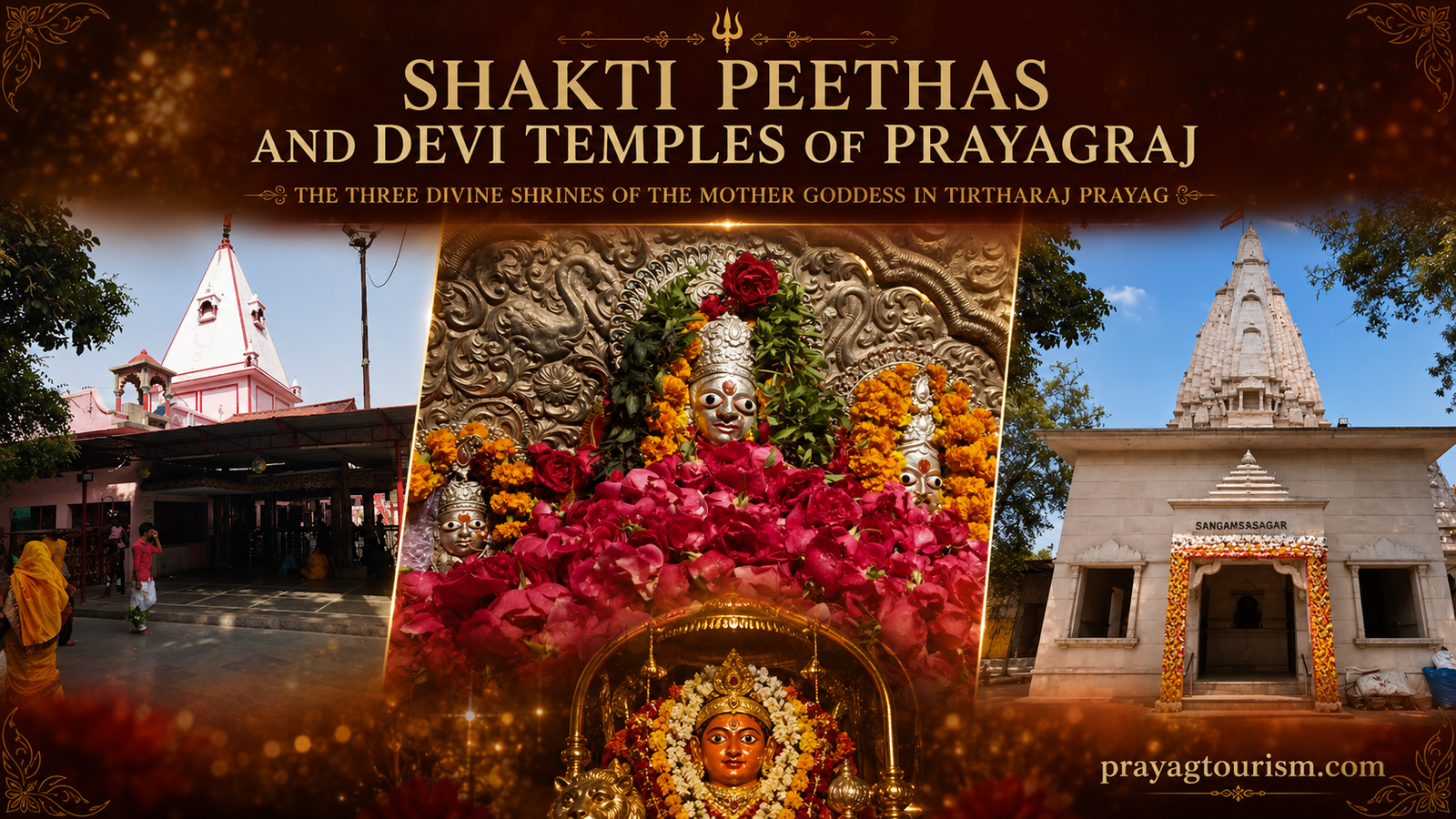
The sacred city of Prayagraj, where the divine rivers Ganga, Yamuna and the invisible Saraswati converge, the pilgrimage is considered incomplete without seeking the blessings of the Mother Goddess. While the Triveni Sangam purifies the soul, the three Shakti Peethas—Alopi Devi, Lalita Devi, and Kalyani Devi—complete the spiritual journey of Tirtharaj Prayag.
As a pilgrim takes the holy dip at the Sangam and offers prayers to Lord Vishnu at the Beni Madhav Temple, a local Pandit gently reminds them: the circle of worship is not yet closed. The Divine Mother, who manifested in fifty-one sacred sites across the Indian subcontinent, chose Prayagraj to bless her devotees in three unique forms. Each temple represents a different aspect of the Goddess—the formless, the creative, and the protective—forming a powerful trinity of Shakti worship that has attracted devotees for centuries.
What makes these three Shakti Peethas unique among the 51 scattered across the subcontinent? Why does Alopi Devi Temple have no idol to worship? And what spiritual treasures await those who complete the circuit of the three Devi temples of Prayagraj?
Let us embark on a sacred journey to discover the Shakti Peethas and Devi Temples of Tirtharaj Prayag.
What are Shakti Peethas? The Sacred Seats of the Divine Mother
The term “Shakti Peetha” holds profound meaning in Sanatana Dharma. Shakti (शक्ति) means divine power or energy, while Peetha (पीठ) means seat or throne. Together, they represent the sacred seats of the Divine Mother, Adi Shakti, who manifests as the primordial cosmic energy that creates, sustains, and transforms the universe.
Shakti Peethas are distinct from other pilgrimage sites. At each Peetha, the Goddess is worshipped as the embodiment of divine feminine energy, and her consort, Lord Shiva, is worshipped as Bhairava. These shrines are considered among the most powerful places of worship in Hinduism, where the grace of the Divine Mother is believed to be most accessible to her devotees.
The 51 Shakti Peethas across the Indian subcontinent share a common mythological origin—the story of the Daksha Yajna, Sati’s self-immolation, and Lord Shiva’s cosmic dance of destruction, which will be explored in detail later in this guide.
The Three Shakti Peethas of Prayagraj – An Overview
Prayagraj is unique in that it holds three distinct Shakti Peethas within its sacred geography. According to tradition, multiple fingers of Goddess Sati fell across the Prayag region, giving rise to three powerful shrines that form a spiritual circuit for devotees.
| Feature | Alopi Devi Temple | Lalita Devi Temple | Kalyani Devi Temple |
| Body Part | Right hand (that disappeared) | Fingers of the right hand | Three fingers |
| Unique Feature | No idol; worshipped as a cradle | 108-ft tall crown; three Pindi idols | Idols over 1500 years old |
| Architecture | Nagara style | Based on Sri Yantra | North Indian style |
| Location | Alopibagh, near Sangam | Meerapur, near Yamuna | Kalyani Devi Mohalla |
| Best Time to Visit | Navratri, Fridays | Navratri, Kumbh Mela | Navratri, Tuesdays/Fridays |
| Timings | 5:00 AM – 9:30 PM | 5:00 AM – 9:00 PM | 5:30 AM – 10:30 PM |
Alopi Devi Temple – The Shakti Peetha Where the Goddess Disappeared
The Alopi Devi Temple, also known as Alop Shankari Mandir or Alopibagh Temple, is one of the most unique Shakti Peethas in India. The name “Alopi” (अलोपी) means “disappeared” or “vanished”—a reference to the sacred belief that the last part of Goddess Sati’s body fell here and disappeared.
The Temple Without an Idol
Perhaps the most remarkable feature of Alopi Devi Temple is that it has no idol of any deity. This makes it perhaps the only temple in India where devotees bow their heads before a symbolic representation rather than a traditional murti. Inside the sanctum, a wooden cradle (Palna) is suspended above a sacred well (Kund). Beneath the water lies a symbolic palm, covered with a layer of silver, representing the goddess whose physical form vanished at this very spot.
According to Mahant Yamuna Puri of Sri Panchayati Akhada MahaNirvani, who manages the temple, the shrine belongs to the Satyuga and was refurbished approximately 80 years ago. The temple finds mention in the Puranas as “the place which is one Kos from the holy Sangam and towards the West and North-West direction from the Akshayavat tree.”
Mythological Significance
The Alopi Devi Temple is believed to be the site where the right hand of Goddess Sati fell and disappeared. As the last body part to fall, it carried the unique distinction of being the place where the goddess physically vanished from the material world, hence the name “Alopi” (where disappearance was concluded).
Lord Shiva is worshipped here as Bhavya Bharat Laliteshwar Mahadev.
Kul Devi of Prayagraj
Alopi Devi holds a special place in the hearts of the city’s original residents. She is considered the Kul Devi (family goddess) of all the natives of the Sangam city—a tradition that continues to this day, with families who have moved away making special efforts to return for important rituals and seek her blessings.
Temple Timings and Darshan
The temple is open daily from 5:00 AM to 9:30 PM. Special significance is attached to prayers offered on Tuesdays and Fridays, when the temple sees larger crowds of devotees. Devotees traditionally offer coconuts, red chunari, bangles, sweets, and sindoor to the symbolic representation of the goddess.
Historical Context
Some historical evidence suggests that the Maratha warrior Mahadji Shinde developed the Sangam area during his stay at Prayagraj in 1771–1772. Later, in the 1800s, Maharani Baizabai Scindia undertook renovation work for the Sangam ghats and temples, including Alopi Devi Temple.
Lalita Devi Temple – The Shakti Peetha of the Three Forms
The Lalita Devi Temple, located in the Meerapur (Mirpur) colony on the banks of the River Yamuna, is revered as the ‘queen of Prayag’ and occupies a special place among the many gods and goddesses blessing the holy land of Prayagraj.
Mythological Significance
According to Hindu mythology, the Lalita Devi Temple is the sacred spot where a finger of Sati’s right hand fell. The temple is mentioned in the Devi Purana, and it is said that Maharishi Bharadwaj worshipped the Goddess here. A visit to the Lalita Devi Temple after bathing in the holy Triveni Sangam is believed to ensure the fulfilment of all wishes.
The Sacred Trinity (Tridevi)
The divine manifests in three forms within the temple: Goddess Lalita, Goddess Saraswati, and Goddess Mahakali. Three sacred Pindis represent Mahakali, Mahalakshmi, and Saraswati, each adorned with a silver facial covering.
The 108-Foot Tall Crown and Sri Yantra Architecture
The temple stands as an architectural marvel with a magnificent 108-foot tall crown (Shikhara) that serves as a landmark visible from across the city. The entire temple is constructed based on the model of the sacred Sri Yantra, which is also used for the worship of the deity, symbolizing divine energy. It was last renovated in 1987.
Other Deities in the Complex
The temple complex houses a unique mercury Shiva Linga within a smaller shrine dedicated to Lord Shiva, known as Laliteshwar Mahadev. It also contains statues of Sankatmochan Hanuman, Lord Rama, Lakshmana, Goddess Sita, and the idols of Navagraha (nine planetary deities).
Spiritual Significance
Devotees who bathe at Triveni Sangam and then have the darshan of Goddess Lalita Devi are blessed abundantly, with all their wishes fulfilled. She is worshipped as Skandamata, symbolizing motherhood and divine protection. According to belief, the three divine rivers Ganga, Yamuna, and Saraswati wash her feet, making her the supreme deity of the city.
Temple Timings
The temple is open from 5:00 AM to 9:00 PM all days of the week.
Kalyani Devi Temple – The Ancient Maha Shakti Peetha
The Kalyani Devi Temple, located in the Kalyani Devi Mohalla (neighborhood) of Prayagraj, is one of the most ancient Shakti Peethas in India. The entire area is named after the temple, highlighting its profound importance in the city’s spiritual landscape.
Mythological Significance
According to ancient Hindu beliefs and references found in religious texts such as the Padma Purana and Brahmavaivarta Purana, three fingers of Goddess Sati fell at this spot when Lord Shiva wandered with her body after the Daksha Yagna incident. From those three fingers, the divinity of Maa Kalyani manifested.
Ancient Idols
The present temple structure was built in 1883, but the divine idols within the sanctum are believed to be over 1500 years old. The inscription displayed inside the temple premises mentions that the sacred place became spiritually powerful after a divine part of Goddess Sati fell here.
According to local traditions, Maharishi Yajnavalkya worshipped Maa Kalyani at this holy site during the Treta Yuga and established the idol of the goddess. The current main idol is believed to be approximately 32 Angul (traditional unit) in height.
Deities Within the Sanctum
Inside the main sanctum, three forms are worshipped together:
- Maa Kalyani in the centre (worshipped as a manifestation of Adi Shakti)
- Chhinnamasta Devi on the left (the sixth Mahavidya, depicted with her own severed head)
- Shankar–Parvati on the right
This arrangement gives the temple a strong Shakti–Shiva balance, making it a unique destination for devotees of both traditions.
Other Deities in the Complex
The temple complex also houses shrines dedicated to:
- Lord Ganesha
- Lord Hanuman
- Lord Dattatreya
- Ram Parivar
Spiritual Significance
Devotees come to Kalyani Devi Temple to seek strength, protection, and relief from problems. The temple is particularly popular for ceremonies such as Mundan (head-shaving) and Karn-Chhedan (ear-piercing) for children. It is considered a Mahashakti Siddhipeeth, where the goddess’s blessings are believed to be especially powerful.
Temple Timings
- Morning: 5:30 AM to 1:00 PM
- Evening: 4:00 PM to 10:30 PM
- Morning Aarti: 5:30 AM to 6:30 AM
- Evening Aarti: around sunset
- Special rituals on Mondays and Fridays
Chhinnamasta Devi – The Unique Mahavidya Connection
The presence of Goddess Chhinnamasta within the Kalyani Devi Temple sanctum is particularly significant. Chhinnamasta is the sixth of the Das Mahavidya (the ten Wisdom Goddesses), depicted with her own severed head. She represents self-sacrifice and the transcendence of ego, and her worship is considered extremely powerful and rare. Other Mahavidyas include Kali, Tara, Tripura Sundari, Bhuvaneshwari, Bhairavi, Dhumavati, Bagalamukhi, Matangi, and Kamala (Lakshmi).
Other Devi Temples and Shakti Shrines in Prayagraj
Beyond the three primary Shakti Peethas, Prayagraj is home to several other Devi temples of great significance:
1. Kali Temple (Kalibari, Mutthiganj)
Established in 1860 by Swami Krishnananda (from Kalna, Bengal), this temple houses Goddess Kali seated on the Panchanarmundi Asana. It was rebuilt in 1953 and remains an important shrine for devotees of the Mother Goddess.
2. Siddheshwari Temple (Civil Lines)
The ninth form of Goddess Durga is worshipped here. This temple is also considered a Siddha Peeth, where spiritual aspirations are believed to be fulfilled.
3. Shrines Mentioned in Prayag Mahatmya
The sacred geography of Prayag includes several other Devi shrines mentioned in the Prayag Mahatmya, including:
- Bagla sub-peetha – east of Ganga
- Chamunda sub-peetha – north of Ganga
- Bhuvaneshwari sub-peetha – south of Yamuna (Imilian Devi/Masurian Devi)
- Rajarajeshwari main Peetha – at Sangam
The Daksha Yajna – The Mythological Origin of the Shakti Peethas
The story of the Shakti Peethas begins with a tale of divine love, sacrifice, and cosmic balance.
The Antagonism Between Daksha and Shiva
Daksha Prajapati, the father of Sati, harbored deep resentment towards Lord Shiva. Despite his daughter’s deep devotion to Shiva, Daksha disapproved of the match. Sati married Shiva against her father’s wishes, and the rift between father and son-in-law grew wider over time.
The Grand Yajna at Kankhal
Daksha organized a magnificent yajna (sacrifice) at Kankhal near Haridwar and invited all the gods and sages. Consumed by his animosity, he deliberately excluded Lord Shiva and Sati from the invitation.
Sati’s Decision to Attend
Sati, seeing everyone proceeding to the yajna, felt a deep longing to attend her father’s ceremony. Despite Lord Shiva’s warnings that she would not be welcomed, Sati insisted on going, driven by the hope that her presence might help heal the family rift.
The Insult and Self-Immolation
At the yajna, Daksha ignored Sati and openly insulted Lord Shiva in her presence. Unable to bear her husband’s humiliation, Sati sat in yogic meditation and generated an internal fire (yogagni), immolating herself in a final act of protest.
Shiva’s Grief and the Tandava
When Lord Shiva learned of Sati’s death, he was consumed with uncontrollable grief and rage. He lifted Sati’s lifeless body and began the Rudra Tandava—the cosmic dance of destruction—threatening to annihilate the entire universe.
Vishnu’s Intervention
To save creation and calm Shiva’s grief, Lord Vishnu used his Sudarshana Chakra and cut Sati’s body into 51 pieces. These pieces fell across the Indian subcontinent (present-day India, Pakistan, Nepal, Bangladesh, and Sri Lanka).
The Birth of the 51 Shakti Peethas
Each location where a body part or ornament fell became a Shakti Peetha. At each Peetha, the goddess is worshipped as Shakti, and her consort is worshipped as Bhairava (a form of Shiva).
The 51 Shakti Peethas and the Ashta Dasha Maha Peethas
Different Scriptural Accounts
Different scriptures mention varying numbers of Shakti Peethas. The Srimad Devi Bhagavatam mentions 108 Shakti Peethas, while the Shiva Charitra mentions 51 Shakti Peethas. The Tantra Chudamani proposes 52 Shakti Peethas.
The 18 Ashta Dasha Maha (Major) Shakti Peethas
Adi Shankaracharya, the great philosopher-saint of the 8th century, recognized 18 major Shakti Peethas known as the Ashta Dasha Maha Shakti Peethas in his famous stotra.
अलोपी माधवेश्वरी ज्वालायां वैष्णवी तथा।
अष्टादश महापीठानि योगिनामपि दुर्लभम्॥
Transliteration: Alopī Mādhaveshvarī jvālāyām Vaiṣṇavī tathā। Aṣṭādaśa mahāpīṭhāni yogināmapi durlabham॥
Source: Ashta Dasha Shakti Peetha Stotra by Adi Shankaracharya
Word-by-Word Meaning:
- अलोपी (Alopī) – Alopi Devi (the goddess who disappeared)
- माधवेश्वरी (Mādhaveśvarī) – the consort of Lord Madhava
- ज्वालायां (jvālāyām) – in the region of the flame (Jwala)
- वैष्णवी (Vaiṣṇavī) – the Vaishnavi form of the goddess
- तथा (tathā) – and also
- अष्टादश (aṣṭādaśa) – eighteen
- महापीठानि (mahāpīṭhāni) – great Peethas
- योगिनामपि (yogināmapi) – even for the yogis
- दुर्लभम् (durlabham) – rare or difficult to attain
Translation: “Alopi Devi, Madhaveshwari, Jwalamukhi, Vaishnavi, and the other great Peethas—these eighteen Maha Shakti Peethas are rare even for the yogis to attain.”
Practical Spiritual Insight: This verse underscores the supreme sanctity of the 18 Maha Peethas, with Alopi Devi of Prayagraj finding a prominent place in the list. The 14th Peetha in this list is Alopi Devi Temple in Prayagraj.
The Trinity of Shakti in Prayagraj – Spiritual Significance
| Temple | Aspect of Shakti | Blessings |
| Alopi Devi | Formless, transcendental energy | Family harmony, protection |
| Lalita Devi | Creative, nurturing energy | Knowledge, prosperity, motherhood |
| Kalyani Devi | Protective, transformative energy | Strength, liberation, problem-solving |
Why Three Peethas in One City
The unique concentration of Shakti energy in Tirtharaj Prayag is no accident. The three temples represent the three primary aspects of the Divine Mother—the formless, the creative, and the protective—offering devotees a complete spiritual experience.
The Invisible Saraswati Connection
It is believed that the sacred Saraswati River flows invisibly beneath Prayagraj, and that Ganga, Yamuna, and Saraswati touch the feet of Lalita Devi. This connection elevates the three Peethas to supreme spiritual significance.
The Pitru Tarpan (Ancestral Rites) Tradition
Many Shakti Peethas, including the Prayag temples, are considered powerful for performing Pitru Tarpan. Ancestors are believed to attain liberation when offerings are made at these sacred sites.
The Role in Kumbh Mela Pilgrimage
The three Shakti Peethas are integral to the Kumbh Mala (complete pilgrimage circuit). Many sadhus and Kalpvasis perform the full circuit of the three Devi temples, and combined with the Triveni Sangam dip, this yields the greatest spiritual merit.
Festivals and Celebrations at the Devi Temples
Navaratri (Chaitra and Ashwin)
The most important festival at all three Shakti Peethas. The temples witness huge queues of devotees, special decorations, aartis, and bhajans. Panchmeva (five types of dry fruits), kheer, and channa are offered as prasad. The Shat Chandi Yajna is performed to invoke the goddess’s blessings, and the Lalita Sahasranamam and Durga Saptashati are chanted by temple priests.
Lalita Devi is particularly worshipped on the fifth day of Navaratri as Lalita Panchami Vrata. During Navratri, the Goddess is decorated in special ways on all 9 days.
Kumbh Mela (Every 12 Years)
Millions of devotees visit the three Shakti Peethas during the Kumbh Mela. The temples witness a high spiritual vibe with bhajans and kirtans, with special arrangements for darshan and offerings.
Magh Mela (Annual, January–February)
The annual fair that begins on Makar Sankranti and continues for 45 days brings devotees from across India to the three Devi temples for special prayers for peace, prosperity, and family well-being.
Weekly Special Days
- Alopi Devi: Fridays and Tuesdays draw large crowds
- Kalyani Devi: Special rituals on Mondays and Fridays
- Lalita Devi: All days but especially crowded on weekends and festival days
A Complete Pilgrimage Guide to the Three Shakti Peethas
Suggested One-Day Itinerary for Visiting All Three Peethas
- Morning (6:00 AM – 8:00 AM): Start at Triveni Sangam for a holy dip and sunrise prayers. This purifies the body and mind before approaching the goddess.
- Morning (8:00 AM – 9:30 AM): Visit Kalyani Devi Temple (3 km from Sangam). Early morning darshan avoids crowds. Offer flowers, coconut, and red chunari.
- Late Morning (9:30 AM – 11:00 AM): Visit Lalita Devi Temple (approximately 5 km from Kalyani Devi). Receive darshan of the three Pindis.
- Afternoon (12:30 PM – 1:30 PM): Break for lunch. Local restaurants near Alopibagh or in Civil Lines offer quality vegetarian meals.
- Afternoon (2:00 PM – 3:30 PM): Visit Alopi Devi Temple (Alopibagh area). Experience the unique formless worship at the cradle.
- Late Afternoon (4:00 PM onwards): Return to the Sangam area for evening aarti or visit nearby attractions like Bade Hanuman Temple.
Suggested Two-Day Pilgrimage Itinerary
- Day 1: Triveni Sangam (sunrise) → Kalyani Devi Temple → Lalita Devi Temple → evening at Sangam ghats
- Day 2: Alopi Devi Temple → Bade Hanuman Temple → Veni Madhav Temple (Daraganj) → Nagvasuki Temple
Travel and Transportation
- By Air: Prayagraj Airport (IXD) is 12–15 km from the city centre
- By Train: Prayagraj Junction is 3–5 km from most temples
- Local Transport: Auto-rickshaws, e-rickshaws, and taxis easily available
- Best Season: October to March (pleasant weather for temple visits)
Dress Code and Temple Etiquette
- Dress modestly. Traditional Indian attire is preferred (saree, salwar suit for women; kurta-pyjama or formal wear for men)
- Remove footwear before entering temple premises
- Maintain silence inside the sanctum
- Phones on silent; avoid photography inside the inner sanctum without permission
- Offerings: Flowers, coconuts, red chunari, bangles, sweets, sindoor
Practical Tips for Pilgrims
- Best time: Winter months (October to March) avoid extreme heat
- Peak days: Tuesdays, Fridays, Navaratri, Kumbh Mela – expect longer queues
- Carry water and light snacks; stay hydrated
- Be mindful of pickpockets in crowded areas during festivals
- Respect local customs and traditions
Nearby Attractions to Combine with Devi Temples
- Triveni Sangam – must-visit for holy dip before temple visits
- Bade Hanuman Ji Temple – reclining Hanuman idol
- Akshayavat and Patalpuri Temple – within Allahabad Fort area
- Veni Madhav Temple – presiding deity of Prayagraj
- Nagvasuki Temple – serpent king Vasuki temple in Daraganj
- Bharadwaj Ashram – Ramayana connection
Frequently Asked Questions (FAQs)
1. What are the three Shakti Peethas in Prayagraj?
The three Shakti Peethas are Alopi Devi Temple, Lalita Devi Temple, and Kalyani Devi Temple.
2. Why is Alopi Devi Temple unique among all Shakti Peethas?
It is perhaps the only Shakti Peetha in India without a traditional idol. Devotees worship a wooden cradle (Palna) and a symbolic palm submerged in water.
3. Where is Lalita Devi Temple located in Prayagraj?
It is located in the Meerapur (Mirpur) colony on the banks of the River Yamuna.
4. Which body part fell at Kalyani Devi Temple?
Three fingers of Goddess Sati are believed to have fallen at Kalyani Devi Temple.
5. Is Alopi Devi Temple a Maha Shakti Peetha?
Yes, Alopi Devi Temple is recognized as one of the 18 Ashta Dasha Maha Shakti Peethas in Adi Shankaracharya’s stotra.
6. What is the significance of the three Pindis at Lalita Devi Temple?
The three Pindis represent Mahakali, Mahalakshmi, and Saraswati.
7. Can tourists visit all three Devi temples in one day?
Yes, with careful planning and a private vehicle, you can visit all three temples in one day.
8. What is the best time to visit the Shakti Peethas of Prayagraj?
The winter months from October to March are ideal, as well as the Magh Mela (January-February) and Kumbh Mela periods.
9. Why is Alopi Devi called the Kul Devi of Prayagraj?
She is considered the family goddess of all natives of the Sangam city.
10. How old is Kalyani Devi Temple?
The temple structure was built in 1883, but the idols within are believed to be over 1500 years old.
11. What are the darshan timings at Alopi Devi Temple?
The temple is open daily from 5:00 AM to 9:30 PM.
12. Is photography allowed inside the Devi temples?
Photography is generally allowed in the temple courtyards, but it is respectful to ask for permission before taking photos inside the inner sanctum.
13. What offerings should devotees bring to Alopi Devi Temple?
Devotees traditionally offer coconuts, red chunari, bangles, sweets, and sindoor.
14. Which Mahavidya is worshipped at Kalyani Devi Temple?
Goddess Chhinnamasta, the sixth Mahavidya, is worshipped within the sanctum.
15. Are the three Shakti Peethas mentioned in the Puranas?
Yes. Lalita Devi Temple is mentioned in the Devi Purana, and Kalyani Devi Temple is mentioned in the Padma Purana and Brahmavaivarta Purana.
16. What is the connection between Triveni Sangam and the Devi temples?
It is believed that Ganga, Yamuna, and Saraswati wash the feet of Lalita Devi, and a visit to the Devi temples after bathing at Sangam is considered highly meritorious.
17. Do the Devi temples remain open during Kumbh Mela?
Yes, all three temples welcome devotees during Kumbh Mela with special arrangements.
18. What is the significance of the wooden cradle at Alopi Devi Temple?
The cradle represents the goddess who vanished, and it is said that she lives in the cradle as the entire world is her child.
19. Can unmarried women visit the Shakti Peethas?
Yes, all devotees regardless of marital status are welcome to seek the blessings of the Divine Mother.
20. What are the nearest railway stations to these temples?
Prayagraj Junction is the nearest railway station for all three temples.
21. Is there a dress code for visiting the Devi temples?
Modest, traditional attire is respectful. Remove footwear before entering the sanctum.
22. What festivals are celebrated at Kalyani Devi Temple?
Navaratri is the most important festival, along with special celebrations on Tuesdays, Fridays, and during Kumbh Mela.
23. How far is Lalita Devi Temple from the Sangam?
Lalita Devi Temple is approximately 5 km from the Sangam area.
24. Are there guided tours available for the three Peethas?
Local guides can be hired near the temples, and Prayag Tourism offers assistance in planning the Shakti Peetha circuit.
25. Why are there three Shakti Peethas in one city?
Multiple fingers of Goddess Sati fell across the Prayag region, giving rise to three distinct shrines that form a complete spiritual circuit.
Conclusion – The Divine Mother’s Eternal Blessing
Tirtharaj Prayag is not only the land of sacred rivers and Lord Vishnu’s protection. It is also a powerful seat of the Divine Mother, where three distinct forms of Shakti bless humanity in unique ways.
Alopi Devi teaches us that the divine is beyond form, yet ever present. Her temple, without any idol, reminds us that the Mother Goddess dwells not only in stone and metal but in the faith and devotion of her children.
Lalita Devi blesses us with knowledge, prosperity, and the nurturing embrace of motherhood. Her three forms—Lalita, Saraswati, and Mahakali—represent the creative energy that sustains the universe.
Kalyani Devi grants us strength, protection, and the courage to overcome all obstacles. Her ancient idols, worshipped for over 1500 years, have blessed countless generations of devotees.
To visit the three Shakti Peethas of Prayagraj is to receive the complete blessings of the Divine Mother. It is to walk the sacred earth that was sanctified by her sacrifice. It is to connect with a tradition that has worshipped the feminine divine for millennia.
In the sacred city where three rivers meet and Lord Vishnu stands as the eternal guardian, the Divine Mother manifests in three unique forms—Alopi, the formless; Lalita, the threefold goddess; and Kalyani, the ancient protector. Together, they bless the pilgrim with harmony, prosperity, and spiritual liberation. May their grace guide your journey through Tirtharaj Prayag and beyond.
This article is part of a series exploring the heritage and sacred traditions of Prayagraj.
Prayag Tourism
📞 Phone/WhatsApp: +91-9555313526
📧 Email: contact@prayagtourism.com
🌐 Website: PrayagTourism.com
May your journey be peaceful, safe, and spiritually enriching – and may the blessings of the Divine Mother guide you always.