
The sacred city of Prayagraj is renowned across the world as Tirtharaj—the King of Pilgrimage Sites. Millions of devotees journey here to take a holy dip at the Triveni Sangam, where the Ganga, Yamuna, and the mythical Saraswati rivers converge. But few realize that beneath the surface of this ancient city lies another world of hidden water shrines, forgotten tirthas, and sacred wells that preserve thousands of years of spiritual memory.
A traveler who has already visited the Sangam, offered prayers at the Bade Hanuman Temple, and explored the majestic Allahabad Fort hears a whisper from a local Pandit: “You have seen the rivers. But have you seen the sacred wells of Prayag?” Curiosity piqued, they venture off the beaten path—across the Shastri Bridge to the ancient town of Jhusi, through the narrow lanes of the Civil Lines, into the depths of Akbar’s great fortress.
And there they discover Samudra Koop, a well whose waters are said to have healing properties and a legendary connection to the ocean. They descend into the Patalpuri Temple to witness the Saraswati Koop, a mystical well where the invisible river Saraswati is believed to materialize. They encounter ancient wells mentioned in the Puranas, forgotten by most pilgrims, yet patiently preserving the spiritual heritage of Tirtharaj.
Could some of Prayag’s oldest sacred sites actually lie beneath the surface, hidden inside ancient wells that most pilgrims never visit?
Let us descend into the hidden history of the Sacred Wells of Prayag.
Table of Contents
Why Wells Are Sacred in Sanatana Dharma
Before we explore the sacred wells of Prayag, it is important to understand why wells hold such profound significance in Sanatana Dharma.
Water as Divine Energy: In Vedic tradition, water (apas) is one of the five great elements (pancha mahabhuta) and is considered a purifying, life-giving force. The Rigveda glorifies water as the source of all life and a medium for healing and spiritual renewal.
Wells as Living Tirthas: A well (koop or kupa) is not merely a utilitarian structure. It is considered a living tirtha—a sacred crossing point between the earthly and the divine. Ancient sages believed that wells formed a network of underground water channels that connected sacred sites across the Indian subcontinent.
Symbolism of the Well: The well symbolizes the descent of the seeker into the depths of their own consciousness. Just as one draws water from the well, the devotee draws forth wisdom, purification, and spiritual grace. This is why ancient pilgrimage traditions placed great emphasis on visiting sacred wells as part of the complete spiritual journey.
Sacred Geography of Prayag
Prayag holds a unique position in the sacred geography of India. The Prayag Mahatmya, a section of the Matsya Purana, extols this region as the holiest of all tirthas. The sacred complex of Prayag is said to contain the Ganga along with 3 crores and 10,000 tirthas within its boundaries.
For ancient pilgrims, the sacredness of Prayag was not limited to its rivers. The entire region—its forests, its temples, its wells, and its water bodies—was considered a Kshetra, a sacred field charged with divine energy. Sacred wells were integral to this geography, serving as:
- Points of meditation and penance for sages and rishis
- Healing sites where pilgrims sought relief from ailments
- Spiritual thresholds where the boundaries between worlds were believed to thin
Today, most visitors never venture beyond the Sangam and the main temples. The sacred wells—hidden in archaeological mounds, enclosed within fort walls, or tucked away in forgotten corners—remain the hidden treasures of Tirtharaj Prayag.
Samudra Koop – The Most Famous Sacred Well of Prayag
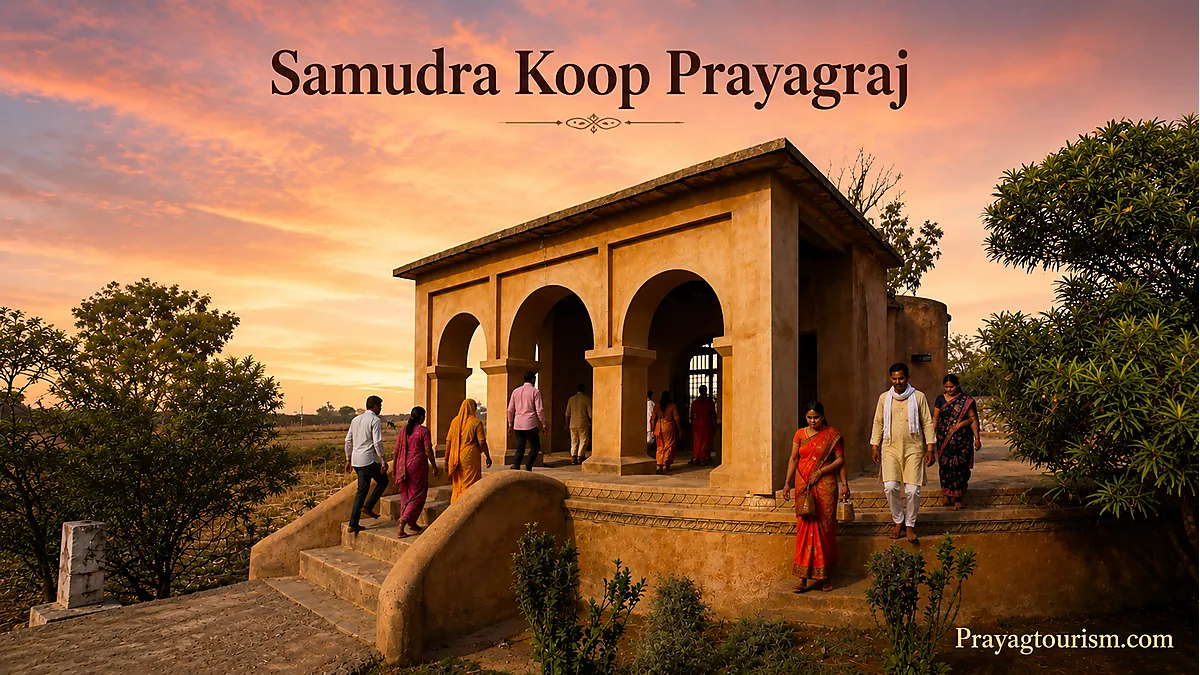
Samudra Koop (literally “Ocean Well”) is undoubtedly the most famous sacred well in Prayagraj. Located in the archaeologically rich town of Jhusi (ancient Pratishthanpur), this ancient well is a protected monument of the Archaeological Survey of India (ASI) that has been drawing devotees and historians for millennia.
Location and Accessibility
- Location: Pratisthan Pur, Haveliya, Jhusi, Prayagraj, Uttar Pradesh 211019 (near Ulta Qila)
- Area: Jhusi, across the Shastri Bridge from the main city
- Nearest Landmark: Ulta Qila, a mysterious “inverted fort” on the banks of the Ganga
Historical Background
The history of Samudra Koop is intertwined with the ancient city of Pratishthanpur. Jhusi (known in ancient times as Pratishthan) was the capital of the Chandravamsha dynasty (Lunar dynasty) roughly around 7100 BCE.
Two major traditions exist regarding the builder of Samudra Koop:
- Chandravamsha Dynasty Tradition: Local tradition holds that the well was established during the reign of the Chandravamsha (Lunar) dynasty around 7100 BCE, making it one of the oldest man-made structures in the entire Gangetic plain.
- Samudragupta Tradition: The well is also attributed to Maharajadhiraja Shri Samudragupta of the Gupta Dynasty (4th century CE), one of ancient India’s most powerful emperors. According to this tradition, Samudragupta built this well on the ruins of the ancient city, on a high mound on the bank of the river Ganga. Renowned historian and former head of the Department of Medieval and Modern History of Allahabad University, Prof Yogeshwar Tewari, confirms this attribution. Samudragupta is believed to have constructed similar wells with waters of the seven seas in Mathura, Varanasi, Ujjain, and Pataliputra (Patna).
Architectural Features
The well is situated on a large, high mound along the banks of the Ganga. The temple features a well that is approximately 15 feet in diameter and constructed with large stones, surrounded by a stone wall. The entire premises are enclosed within a protective stone wall.
Samudra Koop is an Archeological Survey of India (ASI) protected monument.
Legends and Mythology
- Connection to the Ocean: The name “Samudra Koop” literally means “Ocean Well.” Legend has it that the water level below the well is equal to the sea level, hence its name. Some believe that the well is mystically connected to the ocean itself.
- Samudra Manthan Connection: According to local lore, this well is connected to the legendary event of Samudra Manthan (the churning of the ocean), where the ocean’s essence was concentrated in a single source.
- Healing Properties: The water of Samudra Koop is said to carry medicinal and healing properties. The well is mentioned in both the Matsya Purana and the Padma Purana.
- Never-Drying Waters: Local residents believe that the depth of the well is unknown, and its water level never increases or decreases. Neither has it ever dried up. Some elders say that Ganga water comes into it, while others believe the water flows from the ocean itself.
Scientific Testing and Modern Recognition
A significant development occurred in 2023. A team of experts and officials from the Prayagraj Mela Authority visited the fort and tested the water of Samudra Koop. The water was tested on 18 parameters in the lab of the Jalkal department. All the elements were found in the right quantity.
The Mayor declared that the water is potable even today. Although some bacteria were found, they were determined not to be harmful, and the water can be purified by adding bleaching powder. A proposal for beautification of the entire area is being prepared, and water samples have been sent to Lucknow for further testing of medicinal properties.
Religious Importance
Samudra Koop is considered one of the most sacrosanct tirthas (pilgrimage sites) of Prayagraj. Devotees flock to this well during significant events, including the Magh Mela and Kumbh Mela, when large gatherings occur at Prayagraj. Many locals and pilgrims consider the waters sacred, attributing purifying and healing qualities to them.
Present Condition
- Timings: 8:00 AM – 7:00 PM (daily)
- Entry Fee: Free (donations accepted)
- Archaeological Status: ASI Protected Monument
Visitor Note: The directions shown on Google Maps can be misleading. It is advisable to seek local assistance or ask for directions to Ulta Qila in Jhusi.
Hanuman Cave at Samudra Koop
Within the Ulta Qila complex near Samudra Koop, there exists a Hanuman Cave. Devotees descend 27 steps—symbolizing the 27 constellations—to reach the cave containing the idol of Lord Hanuman. The steps are so narrow that only one person can go down at a time. Inside the cave, there is enough space for two or three people to stand. Several other caves within the fort are said to have been used by sages for intense penance and spiritual practices. The 27 steps represent the 27 Nakshatras, and the nine caves symbolize the nine planets.
Saraswati Koop – The Mystical Well of the Invisible River
Located within the Allahabad Fort, near the sacred Patalpuri Temple and the Akshayavat (the indestructible banyan tree), lies the Saraswati Koop—a mystical well believed to be the materialization of the invisible Saraswati River.
Location and Historical Context
- Location: Allahabad Fort, near the Triveni Sangam
- Area: Inside the fort, currently under the jurisdiction of the Army Ordnance Depot
- Proximity: A few hundred metres from the Sangam
Mythological Significance
According to the priest of the Saraswati Koop temple, the well maintains a direct subterranean connection to the Sangam.
- Origins in Badrinath: It is believed that the water in Saraswati Koop originates from Mana village of Badrinath area in Chamoli district of Uttarakhand, approximately 650 km away. Mana was traditionally considered the last village of India at the Indo-Tibetan border.
- The Legend of the Silent River: According to folklore, when Ved Vyas needed assistance to write the 18 Puranas, he sought help from Lord Ganesha. While Ved Vyas was dictating the Puranas, the water flow of Maa Saraswati created a continuous loud noise, disturbing Lord Ganesha’s concentration. Mata Saraswati was then instructed to flow down into Patal Lok (the netherworld) to proceed toward the Sangam. However, at Prayagraj, the door of Veni Madhav (the incarnation of Lord Vishnu) persuaded Maa Saraswati to return to the surface to break the state of oblivion. Therefore, the water in Saraswati Koop is considered the Saraswati River itself, which merges into the Sangam Triveni.
Scientific Evidence
A study was conducted in 2016 by a group of geomorphologists, limnologists, and other scientists. They poured coloured dye into the well and discovered it emerging at the Sangam Triveni confluence, confirming the traditional belief in an underground connection.
Kamyakoop Kuan – The Well of Desires
Located near the Akshayavat within the Allahabad Fort complex, there is a deep water well known as Kamyakoop Kuan.
- Mythology: According to tradition, religious devotees used to jump into this well to attain salvation. The name “Kamyakoop” suggests a well associated with desires (kamya—wished for, desired)—perhaps a well where prayers for desires are answered.
- Historical Mention: Historical sources mention that in one of his previous births, Akbar was a hermit at this site, and at the time of attaining nirvana, he wished to become the emperor of India in his next birth.
Sacred Wells in Prayag Mahatmya
The Matsya Purana, specifically chapters 103 to 113 (the Prayag Mahatmyam), contains extensive discussions about the sacred geography of Prayag, including its sacred water bodies. The Samudra Kupa (Samudra Koop) at Pratishthana (ancient Jhusi) is duly mentioned in the Matsya Purana as part of the Prayag pilgrimage.
The Prayag Mahatmya extols the importance of tirthas (pilgrimage sites) within the sacred region. As the text states: One who reads or hears this Mahatmya, in the morning, is freed from all his sins and goes to heaven.
The concept of Sapta Puri (Seven Holy Cities) and the Kumbh Mela’s rotation among four sacred sites—Prayagraj, Haridwar, Ujjain, and Nashik—underlines the importance of sacred water bodies. The cosmic alignment during the Kumbh is believed to charge the waters with divine energy, making them especially potent for purification and moksha.
Sanskrit Verse from Matsya Purana
While the exact verse about Samudra Koop in the Matsya Purana is lengthy, the Purana clearly establishes the sacred geography of Prayag:
मत्स्यपुराणे प्रयागमाहात्म्यम्
प्रयागं तीर्थराजं च सर्वतीर्थोत्तमोत्तमम्।
यः स्मरेत्सततं मर्त्यः स याति परमां गतिम्॥
- Source: Matsya Purana, Prayag Mahatmya
- Translation: “The one who always remembers Prayag, the King of Tirthas, the best of all pilgrimage sites, that mortal attains the supreme destination.”
Practical Spiritual Insight: This verse reminds us that the sacredness of Prayag is not limited to its physical geography. Even remembering this holy city—its rivers, its temples, and yes, its hidden wells—brings spiritual merit to the devotee.
Legends Associated with the Wells
The Samudra Manthan Connection
According to local lore at Samudra Koop, the well represents a miniature form of the Samudra Manthan (churning of the ocean) in Hindu mythology. This legendary event, described in the Bhagavata Purana and other texts, involved the devas (gods) and asuras (demons) churning the cosmic ocean to obtain the nectar of immortality (amrita). The essence of that great cosmic event is said to be concentrated in this single well.
The Mysterious Depth of Samudra Koop
Local residents tell fascinating stories about the well’s unknown depth. According to them, no one knows how deep Samudra Koop really is. Some say Ganga water comes into it; others believe the water flows from the ocean itself. What is certain is that the water level has never decreased or increased for hundreds of years—it remains constant, a phenomenon that continues to intrigue scientists and devotees alike.
The Pancha Samudra Kuupa Tradition
The Matsya Purana mentions the existence of Pancha Samudra Kupa (Five Ocean Wells). According to the Puranic text Kurma Purana, the Prayag Kshetra is home to these five sacred wells, though their exact locations have become obscured over time. Samudra Koop is one of these five, preserving the tradition of the Pancha Samudra Kupa in the Prayag region.
Saraswati’s Subterranean Journey
The legend of Saraswati’s journey from Badrinath to Prayagraj is a captivating tale. When Lord Ganesha struggled to hear Ved Vyas dictating the Puranas due to the noise of the flowing Saraswati, the river was instructed to flow underground. She travelled through Patal Lok, emerging only at Prayagraj, where Veni Madhav (Lord Vishnu) persuaded her to rise to the surface. Thus, the Saraswati Koop is considered the point where the invisible river makes a brief, miraculous appearance before merging into the Sangam.
Archaeological and Historical Evidence
The Ancient Mounds of Jhusi
The area around Samudra Koop is part of the larger archaeological site of Jhusi (ancient Pratishthanpur). Excavations at Jhusi have revealed Neolithic levels dating back to 7100 BC, providing evidence of farming and settled life in the Middle Gangetic Plain dating to the early Holocene period. Major portions of the ancient site have been occupied by modern settlements, but the Samudrakup mound and the adjoining area remain intact, preserving invaluable cultural layers.
Historical References
- Matsya Purana: The Samudra Kupa at Pratishthana is duly mentioned in the Matsya Purana as part of the Prayag pilgrimage.
- Padma Purana: The sacred well is also referenced in this important Purana.
- Gupta Period Inscriptions: Samudragupta’s well-building activities across ancient India (Mathura, Varanasi, Ujjain, Pataliputra) are historically documented, supporting the attribution of Samudra Koop to this great emperor.
- Medieval Travelogues: The Saraswati Koop is described in medieval texts as a site of pilgrimage, though access was restricted for many centuries.
Sacred Wells and the Kumbh Tradition
During the Kumbh Mela (held every 12 years) and the Magh Mela (held annually), the sacred wells of Prayag take on special significance.
- Pilgrim Circuits: Many pilgrims include Samudra Koop in their spiritual itinerary, combining a visit to the well with a dip at the Sangam.
- Healing Prayers: Devotees offer prayers at Samudra Koop for healing and relief from ailments, believing in the well’s traditionally attributed medicinal properties.
- Kalpavasis: During the Magh Mela, Kalpavasis (devotees who live on the riverbanks for a month) often make the journey to Jhusi to visit Samudra Koop as part of their spiritual observances.
- Community Gatherings: Both Samudra Koop and Saraswati Koop are included in the sacred geography that pilgrims traverse during the Kumbh, when the city becomes a temporary spiritual capital for millions.
Hidden Heritage of Prayag – Why Tourists Rarely Visit
Despite their profound spiritual and historical significance, the sacred wells of Prayag remain largely unknown to mainstream tourists. Why?
- Lack of Publicity: While the Sangam receives international media attention, the wells are rarely mentioned in travel guides or promotional materials.
- Remote Locations: Samudra Koop is located in Jhusi, across the Shastri Bridge, requiring dedicated transportation to reach.
- Restricted Access: The Saraswati Koop is within the Army Ordnance Depot area of Allahabad Fort, limiting access to special occasions.
- Poor Signage: As noted by visitors, Google Maps directions can be misleading, and there are few signboards directing pilgrims to these sites.
- Maintenance Issues: Visitor reviews indicate that maintenance at Samudra Koop has been suboptimal, a factor that discourages repeat visits.
Visitor’s Guide to the Sacred Wells
Samudra Koop
- Location: Pratisthan Pur, Haveliya, Jhusi, Prayagraj, Uttar Pradesh 211019
- Timings: 8:00 AM – 7:00 PM (daily)
- Entry Fee: Free
- Best Time to Visit: October to March (winter months), during Magh Mela (January–February) or Kumbh Mela for the most vibrant spiritual atmosphere
- Darshan Tips: Visit early morning for a peaceful experience. Combine with a visit to Ulta Qila in Jhusi. Seek local assistance for directions.
- Photography Rules: Permitted in the outer areas. Ask before taking photos inside the temple sanctum.
Saraswati Koop
- Location: Allahabad Fort, near Triveni Sangam
- Timings: Access is primarily during Kumbh Mela, Magh Mela, and special occasions when the Army Ordnance Depot permits pilgrim entry. Confirm before planning.
- Entry Fee: Free (but requires entry to Allahabad Fort)
- Special Note: The Saraswati Koop Corridor was inaugurated in December 2024, significantly improving accessibility for the Maha Kumbh 2025.
Travel and Transportation
- By Air: Prayagraj Airport (IXD) is 12–15 km from the city centre
- By Train: Prayagraj Junction is the nearest station for all sacred wells; Jhusi Station is convenient for Samudra Koop
- Local Transport: Auto-rickshaws and e-rickshaws are the most convenient for Jhusi and the Allahabad Fort area
- Parking: Limited parking available near both sites
Temple Etiquette and Safety
- Dress Code: Modest, traditional attire is respectful
- Footwear: Remove shoes before entering the temple sanctum
- Water Contact: Avoid drinking water from the wells without proper purification (though Samudra Koop water has been tested potable, caution is advised)
- Photography: Not permitted inside the inner sanctum
- Respectful Conduct: Maintain silence near the well, as these are active places of worship
Sacred Well Heritage Walk of Prayag
Half-Day Circuit
Morning:
- 8:00 AM – 9:30 AM: Visit Samudra Koop in Jhusi. Explore the ancient well, the Hanuman Cave, and the Ulta Qila area.
- 10:00 AM – 11:00 AM: Return to the Allahabad Fort area.
Late Morning:
- 11:00 AM – 12:30 PM: If accessible, visit Saraswati Koop and the Patalpuri Temple.
Afternoon:
- 12:30 PM – 2:00 PM: Break for lunch in Civil Lines or near the Sangam area.
Afternoon:
- 2:00 PM – 3:00 PM: Visit Kamyakoop Kuan (near Akshayavat) if accessible.
Full-Day Circuit
Combine the half-day circuit with:
- Visit to Ulta Qila (Jhusi) – exploring the mysterious “inverted fort”
- Bharadwaj Ashram – ancient ashram connected to the Ramayana
- Triveni Sangam – holy dip and boat ride
- Bade Hanuman Temple – reclining Hanuman idol
Frequently Asked Questions (FAQs)
1. What is Samudra Koop Prayagraj?
Samudra Koop, also known as Samudra Koop Temple, is an ancient sacred well located in Jhusi, Prayagraj. The name literally means “Ocean Well,” and it is one of the most sacrosanct tirthas of Prayagraj.
2. Where is Samudra Koop located?
It is located in Pratisthan Pur, Haveliya, Jhusi, Prayagraj, near the Ulta Qila (Ulta Fort) on the banks of the Ganga.
3. How old is Samudra Koop?
According to tradition, the well was established during the reign of the Chandravamsha dynasty (Lunar dynasty) roughly around 7100 BCE. It is also associated with Gupta Emperor Samudragupta (4th century CE).
4. Is Samudra Koop mentioned in the Puranas?
Yes. The Samudra Koop is mentioned in both the Matsya Purana and the Padma Purana.
5. Is the water of Samudra Koop safe to drink?
Scientific testing in 2023 confirmed that the water is potable. All 18 tested parameters were within safe limits. However, visitors are advised to exercise caution.
6. What is Saraswati Koop?
Saraswati Koop is a sacred well within the Allahabad Fort believed to be a manifestation of the invisible Saraswati River. A 2016 scientific study confirmed its underground connection to the Sangam.
7. When was Saraswati Koop opened for pilgrims?
Sealed for nearly 450 years, it was first opened for devotees during the 2019 Kumbh Mela. The Saraswati Koop Corridor was inaugurated in December 2024 for Maha Kumbh 2025.
8. Can tourists visit both wells in one day?
Yes. Samudra Koop in Jhusi and Saraswati Koop in Allahabad Fort can be visited in a single day with careful planning and a private vehicle.
9. What is the best time to visit the sacred wells of Prayag?
The winter months (October to March) are ideal. The Magh Mela (January–February) and Kumbh Mela periods are especially spiritually potent but also more crowded.
10. What are the darshan timings at Samudra Koop?
The temple is open daily from 8:00 AM to 7:00 PM.
11. Is photography allowed at Samudra Koop?
Photography is permitted in the outer areas, but it is respectful to ask permission before photographing the inner sanctum.
12. What other attractions are near Samudra Koop?
The Ulta Qila, the Hanuman Cave within the fort, and the archaeological mounds of ancient Jhusi are nearby.
13. What is the significance of the 27 steps at Hanuman Cave?
The 27 steps represent the 27 Nakshatras (constellations) in Hindu astrology, and the nine caves symbolize the nine planets.
14. Are there any entry fees?
Entry to both Samudra Koop and Saraswati Koop is free (donations accepted).
15. Is there a dress code for visiting the sacred wells?
Modest, traditional attire is recommended as a mark of respect for these active places of worship.
Conclusion: The Depths of Tirtharaj
The sacred wells of Prayag remind us that not all holy waters flow on the surface. Some of the deepest spiritual treasures of Tirtharaj Prayag remain hidden beneath the earth, quietly preserving the wisdom, faith, and legends of countless generations.
Samudra Koop, with its mysterious depths and never-drying waters, connects us to the cosmic ocean of creation. Saraswati Koop, where the invisible river makes its miraculous appearance, testifies to the hidden dimensions of sacred geography. And the forgotten kunds and wells scattered across the Prayag region continue to bless the silent pilgrim who ventures off the beaten path.
As millions gather at the Sangam for their holy dip, may a few intrepid souls also seek out these ancient water shrines. For in descending into the depths of a sacred well, one ascends into the heights of spiritual understanding.
The sacred wells of Prayag remind us that not all holy waters flow on the surface. Some of the deepest spiritual treasures of Tirtharaj Prayag remain hidden beneath the earth, quietly preserving the wisdom, faith, and legends of countless generations.
This article is part of a series exploring the heritage and sacred traditions of Prayagraj.
Prayag Tourism
📞 Phone/WhatsApp: +91-9555313526
📧 Email: contact@prayagtourism.com
🌐 Website: PrayagTourism.com
May your journey be peaceful, safe, and spiritually enriching – and may you discover the hidden depths of this ancient city.