
Table of Contents
THE HUMAN EXPERIENCE: A MORNING IN AYODHYA
It is still dark when the first temple bells begin to chime.
The holy city of Ayodhya, cradled on the banks of the Sarayu River, begins to stir. From the ancient stone steps of the ghats, the sweet fragrance of jasmine, camphor and freshly lit clay lamps drifts through the morning air. From a small, humble shrine, the hauntingly beautiful chant rises:
“Shri Ram Jai Ram Jai Jai Ram…”
A grandmother pulls her shawl tighter against the cool dawn breeze. A young father lifts his toddler onto his shoulders so the child can see the flickering lights floating down the river. A group of pilgrims, having walked for days, finally dip their tired feet into the holy water, their faces glowing with a peace that seems to come from another world.
You stand among them. You are not a scholar. You are not a priest. You are simply a human being, standing at the edge of a sacred river, listening to the name of a King who lived perhaps seven thousand years ago, and feeling your heart grow soft.
Who was this King? Why does his name still echo through the ages? And why does his story—of duty, loss, love, and war—still feel so deeply, intimately, like my own?
This is the magic of the Ramayana. It is not a book of ancient mythology preserved in a museum. It is a living river of devotion, a manual for living, and a mirror held up to the human soul. In its 24,000 verses, you will not just find the story of a prince. You will find the story of dharma—righteousness—in every conceivable situation.
Welcome to the eternal journey of Lord Rama. Let us walk this sacred path together.
WHAT IS THE RAMAYANA?
The First Poem of Humanity
The word Ramayana (रामायण) literally means “Rama’s Journey” or “The Path of Rama.” It is one of the two great epics of ancient India (Itihasa), the other being the Mahabharata. But where the Mahabharata is a sprawling encyclopedia of human complexity and moral ambiguity, the Ramayana shines like a beacon of dharma—a clear light showing the way a righteous human should walk.
Traditionally, the Ramayana was composed by the great sage Valmiki, revered as the Adi Kavi (आदिकवि)—the First Poet of Sanskrit literature. Legend tells that Valmiki, once a highway robber, underwent a profound spiritual transformation. While watching a hunter kill a pair of mating birds (krauncha), Valmiki was overcome with grief and spontaneously uttered a curse in a perfectly metered verse—the first śloka. Lord Brahma then appeared and commanded him to compose the life story of Rama in this new poetic form.
The Structure: Seven Kandas (Books)
The Valmiki Ramayana consists of approximately 24,000 verses divided into seven major sections, known as kandas:
- Bala Kanda (The Book of Childhood) — Birth of Rama, his education, and the marriage to Sita.
- Ayodhya Kanda (The Book of Ayodhya) — The drama of the royal court, exile, and the death of King Dasharatha.
- Aranya Kanda (The Book of the Forest) — Life in the wilderness, the encounter with Shurpanakha, and the abduction of Sita.
- Kishkindha Kanda (The Book of the Monkey Kingdom) — Friendship with Hanuman and Sugriva, and the slaying of Vali.
- Sundara Kanda (The Book of Beauty) — Hanuman’s heroic journey to Lanka, his discovery of Sita, and the burning of Lanka.
- Yuddha Kanda (The Book of War) — The construction of the bridge to Lanka, the great battle, and the defeat of Ravana.
- Uttara Kanda (The Later Book) — The return to Ayodhya, the establishment of Rama Rajya, and the eventual departure of Rama.
Two Great Streams: Valmiki and Tulsidas
While the original Sanskrit Valmiki Ramayana is the source text, its story has been told in hundreds of languages across Asia. The most beloved version in North India is the Ramcharitmanas (“The Lake of the Deeds of Rama”), composed in the 16th century by the saint-poet Goswami Tulsidas in the Awadhi dialect. Tulsidas wrote in the common language of the people, making the profound spiritual truths of the epic accessible to farmers, weavers, and householders who did not know Sanskrit.
Both traditions are sacred. The Valmiki Ramayana is the root; the Ramcharitmanas is the flower. Both lead the devotee to the same destination: the feet of Lord Rama.
THE COMPLETE STORY OF LORD RAMA (SEVEN KANDAS)
Bala Kanda: The Divine Birth
In the ancient city of Ayodhya, on the banks of the Sarayu River, ruled the noble King Dasharatha of the Solar Dynasty (Suryavamsa). He had three queens: Kausalya, Kaikeyi, and Sumitra. But for many years, the king’s greatest sorrow was that he had no children.
Desperate for an heir, Dasharatha performed the Putrakameshti Yajna (a Vedic sacrifice to beget sons). From the sacrificial fire emerged a divine being who handed the king a bowl of sweet rice (payasam). Dasharatha gave the blessed rice to his queens, and soon, sons were born:
- Kausalya gave birth to Rama, the eldest and the noblest—an incarnation of Lord Vishnu.
- Kaikeyi gave birth to Bharata.
- Sumitra gave birth to twins: Lakshmana and Shatrughna.
Rama grew into a young man of extraordinary qualities: brave, compassionate, learned in the Vedas, and devoted to truth.
One day, the great sage Vishwamitra, tormented by demons who were disturbing his Vedic sacrifices, arrived at Dasharatha’s court and requested that Rama be sent to protect his hermitage. Reluctantly, the king agreed.
On their journey, Rama slew the demoness Tataka and defeated the mighty Subahu. The sage blessed Rama with powerful divine weapons (divyastras).
The Swayamvara of Sita
The trio then journeyed to the kingdom of Mithila, where the wise King Janaka was holding a swayamvara (a ceremony where a princess chooses her husband from among worthy suitors). The challenge: to lift, string, and break the mighty bow of Lord Shiva (the Pinaka), a weapon so heavy that no mortal could even budge it.
One by one, kings and princes failed. Ravana, the king of Lanka, also attempted but could not lift the bow.
Then Rama stepped forward. With effortless grace, he lifted the bow, strung it, and pulled the string—snapping the ancient bow in two with a sound that shook the heavens.
Princess Sita, the daughter of Mother Earth (Bhumi), placed her bridal garland around Rama’s neck. Lakshmana, bound by his love for Rama, married Sita’s sister, Urmila. Bharata and Shatrughna married Mandavi and Shrutakirti, the daughters of King Janaka’s brother.
Thus began the union that would become the gold standard of devotion, loyalty, and love in all of human literature.
Ayodhya Kanda: The Heart of Sacrifice
King Dasharatha, now old and weary, decided to install his beloved son Rama as the crown prince and heir to the throne. The entire city erupted in joy. The streets were decorated with flowers. Music played in every courtyard.
But the evil hunchback Manthara, a servant of Queen Kaikeyi, poisoned the queen’s mind with jealousy. She reminded Kaikeyi of two boons that Dasharatha had promised her long ago, after she had saved his life in a battle.
“Demand your two boons now,” whispered Manthara. “First: that your son, Bharata, be crowned king. Second: that Rama be exiled to the Dandaka forest for fourteen years.”
Kaikeyi, blinded by ambition, approached the king in her anger chamber (kopa-bhavana). She coldly reminded him of his word. Dasharatha was shattered. The king, bound by his devotion to truth (satya), reluctantly agreed.
Rama, when he heard the news, did not waver. With absolute equanimity, he accepted the decree.
“One must uphold the promise of one’s father,” Rama said. “To the forest I shall go.”
Sita, though the king begged her to stay in the safety and luxury of the palace, refused to be separated from her husband.
“The forest is my home if Rama is there,” she said. “A husband’s suffering is the wife’s suffering. I will walk barefoot beside you.”
Lakshmana, burning with anger at the injustice, pleaded with Rama to seize the throne by force. When Rama refused, Lakshmana, too, laid down his royal robes and followed his brother into the wilderness.
As Rama, Sita, and Lakshmana left the city gates, the people of Ayodhya wailed in grief. But Rama walked forward—the embodiment of dharma, duty above desire.
King Dasharatha, unable to bear the separation from his son, died of a broken heart that very night.
When Bharata and Shatrughna returned from their uncle’s kingdom and discovered the plot, Bharata was filled with horror and rage. He publicly disowned his mother, Kaikeyi, and refused to sit on the throne. He journeyed into the forest to bring Rama back.
But Rama gently refused.
“A promise given by our father must be honored,” Rama said.
Bharata returned to Ayodhya carrying Rama’s wooden sandals (padukas). He placed them on the throne and ruled only as Rama’s regent, waiting patiently for fourteen years.
Aranya Kanda: The Abduction
In the forests of Dandakaranya, the trio lived a simple life of austerity and devotion. They visited the hermitages of many sages, protecting them from the demons (rakshasas) who tormented them.
One day, the demoness Shurpanakha, the sister of Ravana, saw Rama and was overcome with lust. Disguising herself as a beautiful woman, she propositioned him. When Rama gently refused, she tried to attack Sita. Lakshmana, enraged, cut off Shurpanakha’s nose and ears.
Humiliated and shrieking, Shurpanakha fled to Lanka and demanded revenge. She told her brother, the ten-headed king Ravana, of Sita’s incomparable beauty.
Ravana, a master of illusion and a formidable scholar of the Vedas, devised a plan. He enlisted the help of the demon Maricha, who could transform himself into a magnificent golden deer.
The deer appeared near their hermitage. Sita, enchanted by its beauty, begged Rama to capture it for her. Rama, seeing through the illusion, warned Sita it was a trap but went after the deer to fulfill her wish.
During the chase, Maricha cried out in Rama’s voice: “Alas, Sita! Alas, Lakshmana!”
Hearing what she thought was her husband’s dying cry, Sita panicked and begged Lakshmana to go help Rama. Lakshmana, knowing it was an illusion, hesitated. He drew a protective boundary line (Lakshmana Rekha) around the hermitage and warned Sita:
“Do not cross this line for any reason.”
As soon as Lakshmana left, Ravana appeared disguised as a humble old sage begging for alms. Sita, following the sacred duty of hospitality, stepped outside the protective line to offer him food. Instantly, Ravana shed his disguise, grabbed Sita, and ascended into the sky in his flying chariot, the Pushpaka Vimana.
On the way to Lanka, the great eagle Jatayu, the king of birds and a friend of Dasharatha, saw Sita’s abduction and bravely attacked Ravana. Despite his courage, the old eagle was mortally wounded.
Rama and Lakshmana, returning to an empty hermitage, found Sita gone. Their frantic search led them to the dying Jatayu, who told them where Sita was taken before breathing his last.
Kishkindha Kanda: The Alliance with the Monkeys
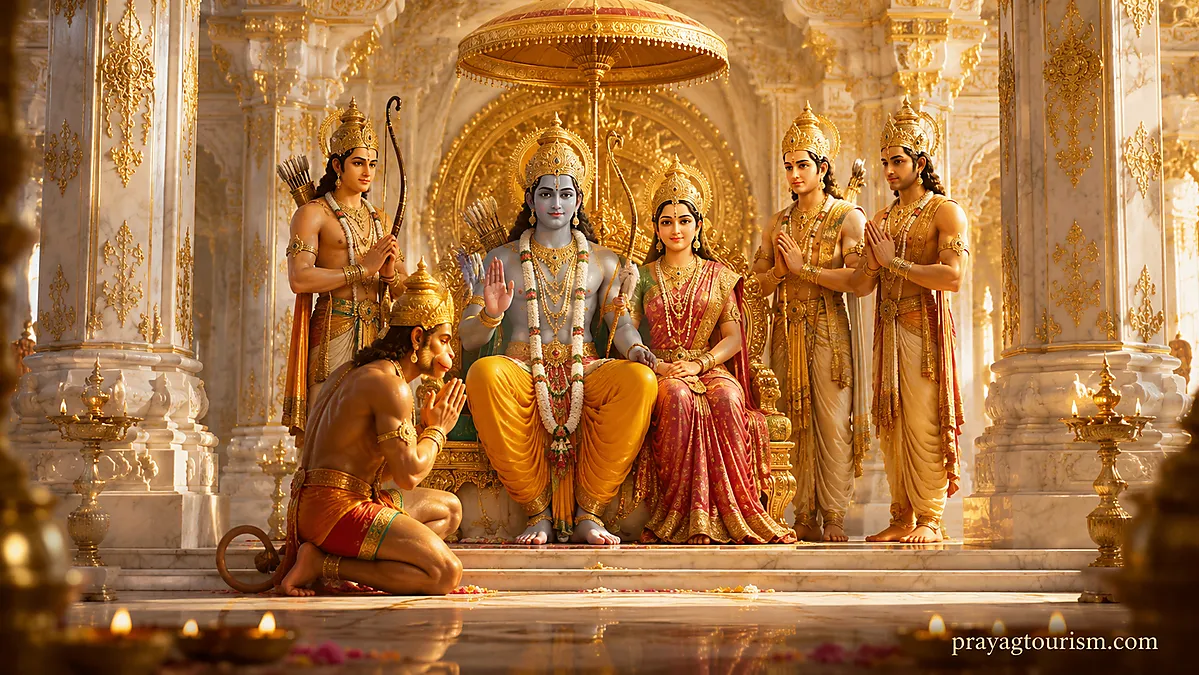
Deep in the forest, Rama and Lakshmana met Hanuman, the monkey minister of the exiled monkey king Sugriva. Hanuman, recognizing the divine nature of Rama, immediately fell at his feet.
Sugriva had been ousted from his kingdom Kishkindha by his powerful brother, Vali, who had also taken Sugriva’s wife, Ruma. Sugriva promised Rama: “Help me regain my throne, and I will mobilize all the monkeys of the world to find Sita.”
Rama agreed. In a fierce duel, Rama shot an arrow that felled Vali, who was considered invincible. Even as he died, Vali recognized Rama’s divinity and praised him.
Sugriva was crowned king of Kishkindha.
But soon, Sugriva, drunk on power and pleasure, forgot his promise. He shut himself inside his palace, ignoring Rama’s urgent need. It was the wise and loyal Hanuman who reminded Sugriva of his duty.
The search parties were sent in every direction.
Hanuman was chosen to lead the southern expedition. After many trials, they learned from the vulture Sampati (Jatayu’s brother) that Sita was held captive in the island kingdom of Lanka, a hundred yojanas (thousands of miles) across the southern ocean.
Sundara Kanda: The Heart of the Epic
The Sundara Kanda—the “Beautiful Chapter”—is considered the very heart of the Ramayana. It focuses entirely on the heroism, intelligence, and devotion of Hanuman.
Standing on the shore of the ocean, the monkeys despaired. How could they cross the vast sea?
Hanuman remembered his divine powers. As the son of the Wind God (Vayu), he could fly. He expanded his body to a gigantic size, took a running leap, and soared across the ocean.
In Lanka, he shrank himself down to the size of a cat and searched the golden city. He finally found Sita in the Ashoka Vatika (a grove of Ashoka trees), surrounded by fearsome demonesses.
Sita was gaunt, weeping, and refusing to look at Ravana. She had vowed that if Rama did not come to rescue her within the year, she would burn herself to death.
Hanuman revealed himself, gave her Rama’s signet ring as proof of his identity, and offered to carry her back to Rama on his back. But Sita refused. She insisted that Rama must come himself to vanquish Ravana and uphold his honor.
“Do not touch me,” Sita said. “Only my husband can rescue me. Tell him to come quickly.”
Before leaving, Hanuman allowed himself to be captured by Ravana’s guards. When brought before Ravana, Hanuman warned the demon king of his impending doom. Enraged, Ravana ordered Hanuman’s tail to be set on fire.
But Hanuman, using his divine powers, made his tail infinitely long. As he was paraded through the streets of Lanka, he leaped from rooftop to rooftop, setting the entire golden city ablaze—a magnificent warning of the destruction to come.
He then flew back across the ocean and delivered the good news to Rama: “I have seen Sita. She is alive and waiting for you.”
Yuddha Kanda: The Great War
Rama, Lakshmana, and the vast army of monkeys marched to the southern tip of India. There, the ocean stretched endlessly before them—impassable.
Rama meditated for three days, praying to the Ocean God for passage. When the Ocean God did not appear, Rama strung his bow and prepared to dry up the sea with his divine arrows.
Terrified, the Ocean God emerged and suggested that the monkeys build a bridge (Rama Setu) across the ocean using stones that floated because they bore Rama’s name.
Under the supervision of the divine architect Nala, the monkeys threw massive boulders and trees into the water. Miraculously, the stones did not sink. In five days, a floating bridge was completed.
The Battle
The war with Ravana was devastating. Rama’s army faced an endless onslaught of demons, magical weapons, and illusions. Lakshmana was gravely wounded by a spear from Ravana’s son, Indrajit.
The only cure: the Sanjivani herb found in the Himalayas. Hanuman flew to the mountain in a single leap. Unable to find the specific herb, he simply lifted the entire mountain peak and carried it back to the battlefield.
The Final Duel
Ravana and Rama finally faced each other. Ravana, a master of all divine weapons, rained destruction upon Rama. But Rama, holding the Brahmastra, a weapon given by the sage Agastya, aimed it at Ravana’s chest.
The arrow pierced Ravana’s heart. The ten-headed demon king fell, finally defeated. The gods in heaven rejoiced.
Ravana’s noble brother, Vibhishana, who had abandoned Ravana and joined Rama’s side because he followed dharma, was crowned the new king of Lanka.
The Reunion
Rama asked that Sita be brought to him, adorned in beautiful clothes and jewels. But standing before the army of monkeys and the public, Rama spoke with a heavy heart:
“I have fought this war to restore the honor of my family and dynasty. I have fulfilled my duty. O Sita, you have suffered in captivity. You are free to go wherever you wish.”
The implication was clear: how could he, the King of Dharma, take back a wife who had lived in another man’s palace?
Sita, her heart shattered by the implication, turned to Lakshmana and asked him to build a funeral pyre.
“If I am pure,” she prayed to Agni, the Fire God, “let the fire not burn me.”
She stepped into the flames.
But the fire was cool as sandalwood. Agni himself appeared, carrying Sita in his arms, and declared her absolute purity.
“O Rama,” the Fire God said, “Sita is as pure as the flame of a lamp. Take her back.”
The reunited couple returned to Ayodhya on the Pushpaka Vimana. The entire kingdom, which had been plunged into darkness for fourteen years, erupted in a celebration of lights—the origin of the festival of Diwali.
Uttara Kanda: The Last Chapter
The Uttara Kanda (The Later Book) follows the life of Rama after his coronation.
Under Rama’s rule, Ayodhya became a utopia—Rama Rajya, the ideal kingdom. There was no crime, no disease, and no untimely death. Everyone followed their dharma.
But despite this perfection, rumors persisted among the citizens of Ayodhya: “How do we know Sita was pure while in Ravana’s captivity?”
Rama, always the people’s king, bowed to public opinion. With unbearable sorrow, he asked Lakshmana to take a pregnant Sita to the banks of the Ganga, near the hermitage of Sage Valmiki, and leave her there.
Sita, abandoned and devastated, found refuge in Valmiki’s ashram. There, in the holy forest, she gave birth to twin sons: Lava and Kusha.
Years later, Rama performed the grand Ashvamedha Yajna (horse sacrifice) to establish his authority. A royal horse was allowed to roam freely, accompanied by the army. If any king stopped the horse, they had to fight.
Lava and Kusha, now young warriors trained by Sage Valmiki, captured the horse. When Rama’s army came to retrieve it, the twins defeated them all. Finally, Rama himself arrived.
In the presence of the assembly, the twins began to recite a beautiful poem—the story of Rama, composed by Sage Valmiki. As they sang of Sita’s abandonment, Rama was overcome with grief and remorse.
Valmiki brought Sita before the assembly. He declared her purity in front of all.
Sita, humiliated and exhausted, turned to Mother Earth, her mother. “If I am pure, O Earth, take me back.”
The ground split open, and a golden throne rose up. Sita sat upon it and was swallowed by the earth.
Rama, realizing that he had lost his beloved forever, ruled for many more years. When the time came, he walked into the Sarayu River and returned to his divine abode, Vaikuntha.
THE GREAT CHARACTERS OF THE RAMAYANA
Lord Rama (The Ideal Man/Maryada Purushottam)
Rama is not just a hero; he is the embodiment of Maryada Purushottam — the Supreme Being who upholds the boundaries of righteousness. He is an avatar of Lord Vishnu, descended to earth to destroy Ravana and re-establish dharma. Yet, despite his divinity, he is deeply human. His qualities—compassion, courage, truthfulness, humility—are not abstract concepts but are demonstrated through his actions: accepting exile to honor his father’s word, weeping over the loss of Sita, and forgiving the monkey king Vali even as he lay dying.
Sita (The Ideal Woman)
Sita is the sacred daughter of the Earth (Bhumi). She is the embodiment of strength, self-respect, and resilience. Often misunderstood as passive, a closer reading of the Ramayana reveals Sita as fiercely independent. She refuses to be rescued by Hanuman, demanding that Rama prove his valor in battle. She stands up to Ravana, threatening to burn herself rather than submit. Her final act—returning to Mother Earth—is not weakness but a powerful assertion of her own honor when the world has failed her.
Lakshmana (The Ideal Brother)
Lakshmana is the incarnation of Shesha Naga, the serpent on whom Vishnu rests. His entire life is one of service. He cannot sleep peacefully when Rama is in danger (his wife, Urmila, famously slept for fourteen years so Lakshmana could remain awake). His anger is righteous, his loyalty absolute.
Hanuman (The Ideal Devotee)
Hanuman is the son of the Wind God (Vayu). He is the model of bhakti—total, selfless, and joyful devotion. “I do not know who Rama is,” Hanuman famously said. “I just know he is the refuge of my heart. When I don’t know who I am, I serve him. When I know who I am, I am him.”
Ravana (The Tragic Scholar)
Ravana is not a simple monster. He was a great scholar of the Vedas, a powerful king, and a devotee of Shiva. His downfall was his unchecked ego (ahamkara) , his desire, and his disregard for dharma. He knew he was wrong to take Sita; he knew Rama was an avatar; but his pride would not let him admit defeat.
THE HIDDEN WISDOM OF THE RAMAYANA: DHARMA FOR MODERN LIFE
The Ramayana is far more than a thrilling adventure. It is a sophisticated treatise on ethics that explores the complex, often painful interplay between action (karma), duty (dharma), and the greater cosmic good.
The Threefold Dharma
The epic educates us on the threefold Dharma relevant to the individual, the family, and society:
- Individual Dharma: Ram’s unwavering commitment to truth (even when it cost him the throne) teaches us that personal integrity is the foundation of all else.
- Family Dharma: The relationship between the four brothers—Rama, Lakshmana, Bharata, and Shatrughna—demonstrates that love and duty within a family must be stronger than ambition or jealousy.
- Leadership Dharma: As a king, Rama prioritized the welfare of his people above his own personal happiness (installing the padukas and exiling Sita). Modern leadership often ignores this principle, prioritizing corporate profits or political power over the common good.
The Ramayana in the Boardroom: Leadership Lessons
The Ramayana is increasingly studied in management schools as one of the oldest leadership playbooks. Key takeaways include:
- Putting People First (Rama): A good leader leads by example and makes sacrifices for the well-being of the community.
- Building a Team (Hanuman): A successful project depends on trusted lieutenants (like Hanuman, Sugriva, and the Vanara army) who bring diverse skills to the table.
- Ethical Governance (Ravana’s Failure): Ravana’s Lanka was technologically advanced, but because it lacked dharma, it collapsed rapidly.
Navigating Life’s Moral Dilemmas
The Ramayana does not present a black-and-white world. It presents the “gray” in stark, painful contrast:
- Was Rama right to abandon Sita? The epic forces us to wrestle with the conflict between “King Dharma” (public duty to citizens) and “Husband Dharma” (private loyalty to a spouse).
- Is it ethical to kill an enemy by trickery? Rama’s killing of Vali from behind a tree—a controversial act debated within the epic itself—forces readers to consider whether the ends ever justify the means.
THE SACRED GEOGRAPHY OF THE RAMAYANA
The Ramayana is not just a story; it is a living map of India’s sacred geography. Every location associated with Rama is a pilgrimage destination (tirtha), believed to retain a spiritual charge of his presence.
Ayodhya (Uttar Pradesh)
The birthplace of Lord Rama on the banks of the Sarayu River, Ayodhya is one of the seven most sacred cities in Hinduism (Sapta Puri). The Shri Ram Janmabhoomi Temple complex marks the exact birth spot and is a major hub of devotion. Pilgrims bathe in the Sarayu and perform shraddha (ancestor rites) on its ghats.
Shringverpur (Prayagraj Region)
Just 20-33 kilometers from modern-day Prayagraj (Allahabad), Shringverpur (also known as Singrora) was the kingdom of the Nishad king, Guha, a close friend of Rama. It was here that Rama, Sita, and Lakshmana crossed the Ganges on their way to exile, and Guha personally ferried the Lord across the river. Ruins of Guha’s ancient fort still stand.
Bharadwaj Ashram (Prayagraj)
After crossing the Ganges at Shringverpur, Rama, Sita, and Lakshmana visited the ashram of the great sage Bharadwaja at the confluence (Triveni Sangam) of the Ganga, Yamuna, and Saraswati—modern-day Prayagraj. The sage advised them on their route to the forest.
Chitrakoot (Uttar Pradesh/Madhya Pradesh Border)
Nestled in the Vindhya Range on the banks of the Mandakini River, Chitrakoot was where Rama, Sita, and Lakshmana spent a significant portion of their 14-year exile. The Ram Ghat is the sacred spot where Lord Rama is said to have taken his daily baths. Pilgrims flock here to take a holy dip and perform evening aarti. The forested hill Kamadgiri (“Wish-Fulfilling Mountain”) is believed to be the very Chitrakoot mentioned in the Valmiki Ramayana.
Panchavati (Nashik, Maharashtra)
In the region of Dandakaranya, Panchavati on the banks of the Godavari River is where the golden deer illusion took place and Ravana abducted Sita.
Rameswaram (Tamil Nadu)
The southernmost point of India is where Rama built the bridge (Rama Setu) to Lanka. The famous Ramanathaswamy Temple houses a lingam worshipped by Rama himself to atone for the sin of killing Ravana (a Brahmin).
The Triveni Sangam (Prayagraj) – A Special Confluence
For the modern pilgrim in Prayagraj, the Triveni Sangam is the most powerful spiritual anchor. The city is unique in its association with Rama:
- Shringverpur marks the place of crossing.
- Bharadwaj Ashram marks the place of spiritual consultation.
- The mythic river Saraswati, which meets the Ganga and Yamuna at the Sangam, represents the flow of Vedic knowledge that Rama embodied.
According to the Prayagraj Mahatmya, bathing at the Sangam washes away the sins of countless lifetimes, just as the Ganges washed the dust from Rama’s feet on his journey.
RAMAYANA IN INDIAN CULTURE: FESTIVALS AND TRADITIONS
The Ramayana is not confined to books. It lives in the cultural bloodstream of India through vibrant festivals and performance arts.
Diwali: The Festival of Lights
Diwali (Deepavali) commemorates the return of Rama, Sita, and Lakshmana to Ayodhya after their fourteen-year exile. The people of Ayodhya lit thousands of oil lamps (diyas) to welcome their king home. Today, Hindus worldwide celebrate Diwali as the triumph of light over darkness, good over evil, and knowledge over ignorance.
Dussehra: The Victory of Good
Dussehra (also known as Vijayadashami) marks the day Lord Rama defeated the ten-headed Ravana. Across India, towering effigies of Ravana, his brother Kumbhakarna, and his son Meghanada are stuffed with firecrackers and set ablaze in open fields, symbolizing the destruction of evil.
Ram Lila: The Performance
The Ram Lila (literally “Rama’s Play”) is a dramatic folk re-enactment of the epic. In North Indian cities like Ayodhya, Varanasi, and Ramnagar, the entire epic is performed over a 31-day period, culminating in the burning of Ravana on Dussehra.
The Hanuman Chalisa
The Hanuman Chalisa, a devotional hymn composed by Tulsidas, is recited by millions daily. Its 40 verses extoll the virtues of Hanuman, offering protection, strength, and courage to the devotee.
TIMELESS VERSES OF THE RAMAYANA
Here are verified verses from the Valmiki Ramayana that capture the essence of the epic.
Verse 1: The Blamelessness of Sita (Yuddha Kanda)
Devanagari:
सा हि लक्ष्मण वैदेही धर्मात्मानं प्रियंवदा।
राममानृशंस्येन गुणैश्चैवोपपद्यते।।
IAST Transliteration:
Sā hi lakṣmaṇa vaidehī dharmātmānaṁ priyaṁvadā |
Rāmam ānṛśaṁsyena guṇaiś caivopapadyate ||
Source Citation: Valmiki Ramayana, Yuddha Kanda (Version), Chapter of Agni Pariksha.
Translation: “O Lakshmana, this Sita of Videha, who speaks sweetly, is indeed a virtuous woman. By her compassion and virtues, she is truly fitting for Rama.”
Practical Life Lesson: A person’s character is revealed not by accusations but by their consistent virtue over time.
Verse 2: The Devotion of Hanuman (Sundara Kanda)
Devanagari:
यत्र यत्र रघुनाथकीर्तनं तत्र तत्र कृतमस्तकाञ्जलिम्।
वाष्पवारि परिपूर्णलोचनं मारुतिं नमत राक्षसान्तकम्।।
IAST Transliteration:
Yatra yatra raghunātha-kīrtanaṁ tatra tatra kṛta-mastakāñjalim |
Bāṣpa-vāri paripūrṇa-locanaṁ mārutiṁ namata rākṣasāntakam ||
Source Citation: Sundara Kanda (verse popular in Ramacharitmanas and Bhakti tradition).
Translation: “Wherever the glorious deeds of Raghunatha (Rama) are sung, there Hanuman stands with bowed head and hands folded, tears of devotion flowing from his eyes.”
Practical Life Lesson: Be an audience of devotion. When you listen to good teachings with a humble heart, you align yourself with the spirit of Hanuman.
Verse 3: Rama’s Declaration of Dharma (Ayodhya Kanda)
Devanagari:
पितुवचनानृता कर्तुं नार्हामि सत्यपालकः।
इक्ष्वाकुकुलजातोऽहं राज्यं त्यक्त्वा वने वसे।।
Source Citation: Valmiki Ramayana, Ayodhya Kanda 18.34
Translation: “Truth is the primary duty. I cannot make my father’s word false. Even for the sake of kingship, I will keep my promise.”
Practical Life Lesson: True honor is not in holding power but in keeping your word. The character of a person is tested in moments of sacrifice.
Verse 4: Shiva’s Praise of Rama (Yuddha Kanda)
Devanagari:
यस्य विक्रममानेन स्थावराणि चराणि च।
संग्रहेणैव सर्वाणि तं रामं शरणं गतः।।
Source Citation: Valmiki Ramayana, Yuddha Kanda (Shiva’s Praise of Rama)
Translation: “By whose valor and discipline all moving and non-moving beings are governed, I have taken that supreme Rama as my shelter.”
Practical Life Lesson: Recognize the supreme order in the universe. When you surrender your ego to the cosmic dharma, peace follows.
RAMA RAJYA: THE IDEAL KINGDOM
The concept of Rama Rajya (The Kingdom of Rama) is perhaps the epic’s greatest political gift to the world.
Rama Rajya is not just a mythological utopia; it is a practical vision for an ideal state. Under Rama’s rule:
- Justice was swift and impartial. The king punished no one based on prejudice but based on truth.
- There was no poverty, crime, or disease.
- Every person followed their individual dharma (svadharma) with joy and dedication.
- The environment flourished. The forests were protected; animals were not hunted for sport.
- The relationship between ruler and citizen was one of service. When rumors circulated about Sita, Rama did not use his absolute power to silence his critics. He bowed to public opinion, even though it broke his heart.
Modern Relevance
In an age of failing governance, polarized politics, and corruption, the standard of Rama Rajya serves as a powerful critique. Leaders in India are often publicly held to the standard of Rama: “Rama rajya” is still used as a political slogan in India, representing honest, efficient, and compassionate governance.
For the individual, Rama Rajya is an internal vision. When you rule over your own mind with truth, compassion, and discipline, your internal kingdom flourishes.
WHY THE RAMAYANA STILL MATTERS TODAY
A judge in a modern courtroom might say, “The Ramayana teaches the importance of following the path of Dharma in everyday life”. A CEO might use it as a leadership playbook. A devotee might find solace in chanting the Hanuman Chalisa during a personal crisis.
Why does this epic survive? Because the human condition has not changed.
We still face moral dilemmas where every choice seems wrong (like Rama’s exile of Sita). We still confront jealousy, greed, and pride (like Ravana). We still search for friendship and loyalty (like Rama with Sugriva). We still seek a higher purpose beyond the daily grind (like the army of monkeys building the bridge).
The Ramayana offers the foundational answer: What is Right (Dharma) . The epic does not present a simplistic, rigid dogma. It presents a framework. Just as the ocean accepts all rivers, the Ramayana accepts the complexity of your life. It whispers, “Yes, this is difficult. But let us see how the archetypal Man, Woman, Devotee, and Brother handled it.”
As you sit in the glow of your phone, facing the noise of modern politics and the loneliness of urban living, the name of Rama is a balm. Shri Ram Jai Ram Jai Jai Ram.
The Pilgrimage’s End (and Beginning)
Your journey through the Ramayana does not end with the closing of a book. It continues when you walk the streets of Ayodhya, touch the feet of a Hanuman statue, or simply close your eyes and whisper a prayer for courage. The epic is not a story about the past. It is a technology for the present. It is a mantra for the future.
May the journey of Lord Rama illuminate the path of your own life.
Jai Shri Ram.
FREQUENTLY ASKED QUESTIONS
Q1: Who wrote the Ramayana?
A: The original Sanskrit Ramayana was composed by the sage Valmiki, who is revered as the Adi Kavi (First Poet) of Sanskrit literature. The epic was composed over 2,000 years ago, though its stories are much older in oral tradition.
Q2: Is the Ramayana a religious book or a historical epic?
A: It is both. Hindus believe the events of the Ramayana actually occurred (itihasa). It is considered a sacred text (Smriti) that outlines the path of dharma. It also functions as history, mythology, and literature depending on one’s perspective.
Q3: What is the difference between Ramayana and Ramcharitmanas?
A: The Ramayana is the original Sanskrit text by Valmiki. The Ramcharitmanas is a 16th-century retelling in the Awadhi dialect by the poet-saint Tulsidas, written for the common people of North India. The latter focuses more on devotion (Bhakti).
Q4: Is Ram Setu (Adam’s Bridge) real?
A: According to geological surveys, there is a chain of limestone shoals between India and Sri Lanka that matches the epic description of a bridge. For believers, it is a sacred archaeological trace of the events of the Yuddha Kanda.
Q5: What is the Sundara Kanda?
A: The Sundara Kanda (Book of Beauty) is the 5th book of the Ramayana. It focuses solely on Hanuman’s journey to Lanka, his discovery of Sita in the Ashoka Vatika, and his burning of the golden city. It is widely believed that reading the Sundara Kanda removes obstacles and brings blessings.
Q6: Where is Chitrakoot?
A: Chitrakoot is a pilgrimage town located on the border of Uttar Pradesh and Madhya Pradesh. It is famous for the Ram Ghat on the Mandakini River, where Lord Rama is said to have bathed daily during his exile. It is a key stop on the Rama Vanavasa pilgrimage circuit.
Q7: What is the significance of Shringverpur?
A: Shringverpur (near Prayagraj) was the kingdom of King Guha, a tribal lord who helped Rama cross the Ganges. It is a sacred site because it represents the friendship between a noble king and a Vanara chief, as well as a significant stop on the route to exile.
Q8: What is the Lakshmana Rekha?
A: It is a protective boundary line drawn by Lakshmana around the hermitage to protect Sita. He told her never to cross it. It symbolizes the boundary of safety and discipline; once it is broken (by stepping out to help the demon Ravana in disguise), danger ensues.
Q9: Why is Rama considered an avatar of Vishnu?
A: The Ramayana states that Rama is an incarnation of Lord Vishnu, who descended to Earth to kill the demon king Ravana, who had received a boon of invincibility against gods and demons but not against humans or monkeys.
Q10: Which version of the Ramayana should a beginner read?
A: For a quick story: Ramayana by C. Rajagopalachari. For literary beauty and devotion: The Ramayana by R. K. Narayan (prose) or the Ramcharitmanas in English by various translators. For scholarship: The complete English translation of Valmiki’s Ramayana by Bibek Debroy.
Oṃ Tat Sat.
May the wisdom of the Ramayana illuminate your path, from the shores of Ayodhya to the depths of your heart.