
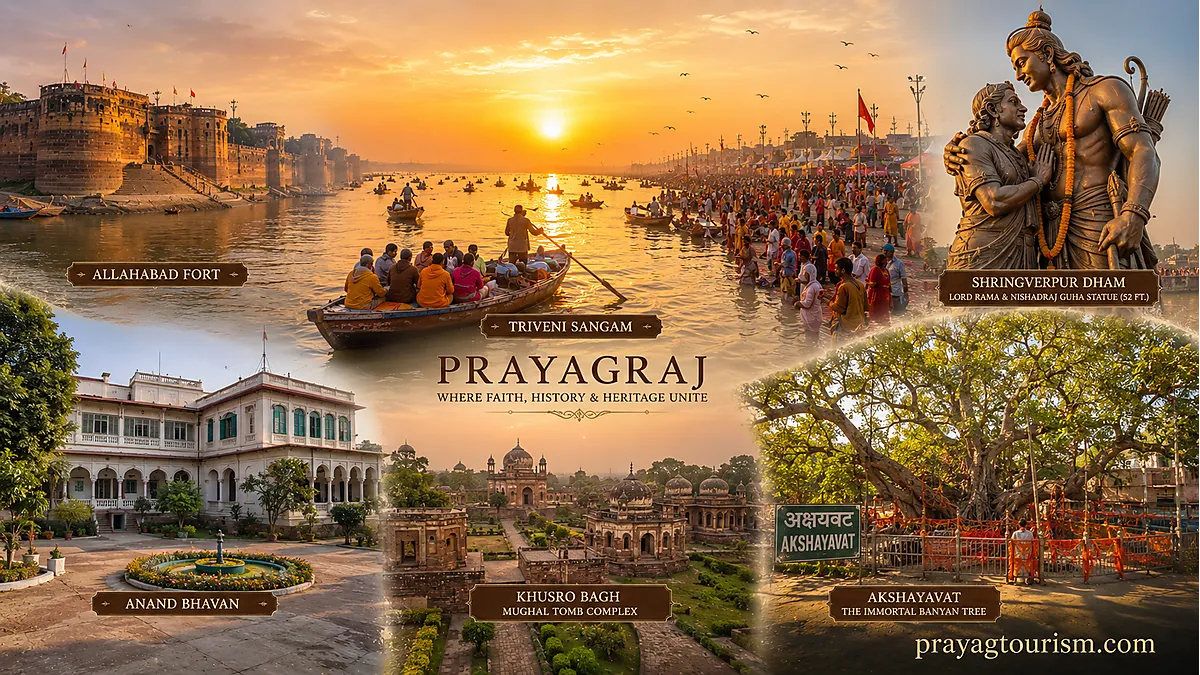
Your Complete Travel Companion to the Spiritual Heart of India
A Journey Through Prayagraj
The day begins before dawn. The streets of Prayagraj, still wrapped in darkness, hum with quiet anticipation. E-rickshaws glide silently through the cool morning air, carrying pilgrims and tourists alike toward the river.
You step out at the ghat. The world is still, but the river is awake. The Ganga flows gently, its dark waters reflecting the first hints of pink on the eastern horizon. Small wooden boats bob at the shore, their boatmen calling out softly, inviting you to begin your journey.
The boat pushes away from the bank. As it glides across the water, the sounds of the city fade away. All that remains is the gentle splash of oars, the distant call of temple bells, and the soft chanting of pilgrims preparing for their sacred bath.
The sun breaks over the horizon, turning the confluence into a river of liquid gold. The pale blue waters of the Ganga meet the deeper green of the Yamuna. The invisible Saraswati, believed to flow beneath, completes the Triveni. Pilgrims around you step into the water, their faces lit with devotion, their voices raised in prayer: “Har Har Gange! Jai Shri Ram!”
What makes Prayagraj one of India’s most fascinating destinations for pilgrims, history lovers, and travelers alike?
The answer lies in its unique blend of the spiritual and the historical, the sacred and the secular. Prayagraj is where the Ganga meets the Yamuna, where ancient sages meditated, where Mughal emperors built their fort, where the freedom movement found its voice, and where the Ramayana comes alive on the banks of the sacred river.
Why Visit Prayagraj? – Spirituality, History & Culture
Prayagraj is not merely a destination; it is an experience that unfolds at the intersection of faith, history, and culture.
Spiritual Significance: At the heart of Prayagraj lies the Triveni Sangam – the confluence of the Ganga, Yamuna, and the mythical Saraswati. This is one of the holiest sites in Hinduism, described in the scriptures as Tirtharaja – the King of Pilgrimage Sites. The entire city radiates a spiritual energy that draws millions of pilgrims annually, especially during the Kumbh Mela (every 12 years) and the Magh Mela (annual).
Historical Importance: Prayagraj’s history spans millennia. The Allahabad Fort was built by Emperor Akbar in the 16th century. The city witnessed the birth of the Indian freedom movement – Anand Bhavan was the epicenter of the Nehru family’s political life, and Chandrashekhar Azad sacrificed his life here at Alfred Park. The Ashokan Pillar inside the fort stands as a silent witness to over 2,000 years of Indian history.
Cultural Heritage: Prayagraj is a living museum of Ganga-Jamuni tehzeeb – the syncretic culture that blends Hindu and Muslim traditions. From the Mughal architecture of Khusro Bagh to the ancient temples like Alopi Devi and Nag Vasuki, the city celebrates its diverse heritage.
Pilgrimage Traditions: The city is a key stop on the Ram Van Gaman Path – the sacred route of Lord Rama’s exile. Shringverpur Dham, located approximately 35–45 km from the city, is where Rama, Sita, and Lakshmana met their first ally, Nishadraj Guha.
Whether you come seeking spiritual liberation, historical exploration, cultural immersion, or simply a peaceful riverside retreat, Prayagraj offers an unforgettable journey.
Quick Facts – Prayagraj at a Glance
| Attribute | Details |
| Destination | Prayagraj |
| State | Uttar Pradesh |
| Famous For | Triveni Sangam, Tirtharaja (King of Pilgrimage Sites) |
| Major Events | Kumbh Mela (every 12 years), Magh Mela (annual) |
| Best Duration | 2–3 Days |
| Ideal For | Pilgrims, History Lovers, Families, Tourists |
| Best Time to Visit | Winter (October–March) |
| Nearest Airport | Prayagraj Airport (IXD) – 12 km from city centre |
| Nearest Railway Station | Prayagraj Junction (PRYJ) – major North Indian hub |
| Estimated Reading Time | 12–15 Minutes |
Top Places to Visit in Prayagraj
1. Triveni Sangam – The Heart of Prayagraj
📍 Location: Near Allahabad Fort, Prayagraj
What Is Triveni Sangam?
Triveni Sangam is the sacred confluence of three rivers: the Ganga, the Yamuna, and the mythical Saraswati. It is considered one of the holiest places in Hinduism and is described in the scriptures as Tirtharaja – the King of Pilgrimage Sites.
Spiritual Significance: A holy dip (snan) at the Sangam is believed to wash away all sins and grant liberation (moksha). The site is particularly auspicious during the Kumbh Mela and Magh Mela, when millions gather to bathe. The 2026 Magh Mela will be held from January 3 to February 15, 2026.
Boat Rides: The exact confluence point is not accessible from the shore. A boat ride (approximately 15–20 minutes each way) is required to reach it. Shared boats cost ₹100–150 per person, while private boats range from ₹500 to ₹1000 per boat. Boats operate from Arail Ghat, Qila Ghat, and other ghats, with services available from early morning until sunset. Life jackets are mandatory.
Sunrise Experience: The sunrise at Sangam is legendary. As the first rays hit the confluence, the waters turn gold, and the morning aarti begins at the ghats – a spectacle that no visitor should miss.
How to Reach: Take a boat from Arail Ghat, Qila Ghat, or Saraswati Ghat. An e-rickshaw or taxi can bring you to these boarding points from any part of the city.
🕒 Timings: Boat services available from approximately 5:00 AM to 6:00 PM (extended during festivals). The ghats are accessible 24/7.
💲 Entry Fee: Free (boat charges apply separately).
📸 Best Photography Spots: The confluence point (from the boat), sunrise views, and the iconic flags marking the sacred area.
2. Allahabad Fort – Akbar’s Architectural Marvel
📍 Location: On the banks of the Yamuna, near Triveni Sangam
Historical Significance: The Allahabad Fort was built by Emperor Akbar in 1583 on the banks of the Yamuna, near the Triveni Sangam. The fort is a magnificent example of Mughal architecture and encloses several sacred sites, including the Patalpuri Temple and the Akshayavat (immortal banyan tree).
Key Attractions Inside the Fort:
- Patalpuri Temple: An underground shrine that descends into the earth, housing over 40 carved ancient statues. According to legend, Lord Rama visited this temple.
- Akshayavat (The Immortal Banyan Tree): Considered one of the oldest and most sacred banyan trees in India. Devotees believe that offerings made here reach departed ancestors.
- Ashokan Pillar: A 35-foot polished sandstone pillar dating back to the Mauryan Emperor Ashoka (273–232 BCE), later inscribed by the Gupta emperor Samudragupta and the Mughal emperor Jahangir.
🕒 Timings: 7:00 AM to 6:00 PM (daily).
💲 Entry Fee: ₹25 for Indian citizens, ₹300 for foreign nationals. Entry to Patalpuri Temple is free with permission (part of the fort).
📍 Note: Visitors may require permission from the Commandant of the Prayagraj Fort Ordnance Depot to access certain areas. Photographs are permitted only in designated zones.
📸 Photography Tips: The fort’s massive walls, the Patalpuri Temple, and the Ashokan Pillar are excellent subjects for heritage photography.
3. Anand Bhavan – The Nehru Family Legacy
📍 Location: Colonelganj, near Swaraj Bhawan
Historical Significance: Anand Bhavan is a historic mansion and house museum in Prayagraj, originally purchased by Motilal Nehru in the 1930s to serve as the residence of the Nehru family. It later became the epicentre of India’s freedom movement and was donated to the nation by Indira Gandhi in 1970.
What to See:
- Personal belongings, letters, and photographs of the Nehru family
- The room where Indira Gandhi was married
- Original furniture and artifacts from the freedom movement
- A planetarium on the grounds
🕒 Timings: 9:30 AM to 5:00 PM (Tuesday to Sunday); closed on Mondays and public holidays.
💲 Entry Fee: Ground floor only: ₹20 for adults (Indian). Full museum (ground + first floor): ₹70 for adults (Indian), ₹200 for foreign nationals. Children and students often receive discounted rates.
📸 Photography Tips: The colonial architecture and vintage exhibits offer excellent opportunities for history photography. Photography may require a nominal fee.
4. Khusro Bagh – Mughal Garden of Tranquility
📍 Location: Near Prayagraj Junction railway station
Historical Significance: Khusro Bagh is an extensive walled garden and burial complex housing the tomb of Prince Khusro, the rebellious eldest son of Emperor Jahangir and grandson of Akbar. The complex also contains the tombs of Khusro’s mother, Shah Begum, and his sister, Sultan Nithar Begum.
Architectural Features: The tombs are exquisite examples of Mughal architecture, with intricate carvings, red sandstone domes, and beautiful gardens. The main tomb is a three-storey structure with a massive central dome.
🕒 Timings: 6:00 AM to 8:00 PM (daily).
💲 Entry Fee: Free for all visitors.
Best Time to Visit: Early morning or late afternoon (especially in winter) when the light is golden and the gardens are peaceful.
📸 Photography Tips: The tombs, the entrance gate, and the lush gardens are excellent for heritage and architectural photography.
5. Shringverpur Dham – Where Rama Met Nishadraj
📍 Location: Approximately 35–45 km from Prayagraj on Lucknow Road
Ramayana Connection: Shringverpur Dham is mentioned in the Valmiki Ramayana as the capital of Nishadraj Guha, the king of the Nishadas. This is where Lord Rama, Sita, and Lakshmana spent their first night of exile, crossing the Ganga with the help of their devoted friend, Guha.
Key Attractions:
- A 52-foot statue of Lord Rama embracing Nishadraj Guha at the Nishadraj Tourist Park
- Ram Ghat – the sacred riverbank where the trio rested
- Excavated site of Shringi Rishi Temple (protected by the Archaeological Survey of India)
- Ruins of Guha’s ancient fort
Tourism Development: In December 2024, the site was officially declared a pilgrimage destination. A 6-hectare Nishadraj Tourist Park was developed at a cost of over ₹37 crore, featuring a gallery, meditation centre, cafeteria, and open-air stage.
How to Reach: By road (35–45 km from Prayagraj). Local buses, taxis, and auto-rickshaws are available from Prayagraj city.
🕒 Timings: The park and ghats are accessible from morning to evening. The temple remains open during darshan hours.
💲 Entry Fee: Free entry (no official fee reported).
📸 Photography Tips: The massive statue of Rama and Guha, the Ganga river views, and the ancient ruins are must-capture images.
6. Bade Hanuman Temple – The Reclining Protector
📍 Location: Opposite the Sangam, across the river
Unique Feature: This temple houses a 20-foot-long reclining idol of Lord Hanuman – a rare depiction in Hanuman iconography. The idol is partially submerged during the monsoon season when the Ganga rises, a spectacular sight that draws thousands.
Spiritual Significance: Bade Hanuman is regarded as the spiritual guardian (kotwal) of Prayagraj. It is believed that no pilgrimage to Prayagraj is complete without a visit to this temple. The temple opens at 5:00 AM with Mangal Aarti and remains open until 9:00 PM.
🕒 Timings: 5:00 AM to 9:00 PM (daily). On Tuesdays and Saturdays, the temple remains open until 10:30 PM.
💲 Entry Fee: Free for all devotees.
📸 Photography Tips: The massive reclining idol, the temple courtyard, and the river views are excellent subjects.
7. Alopi Devi Temple – The Unique Shakti Peetha
📍 Location: Alopibagh area, near Daraganj
What Makes It Unique: Alopi Devi Temple is one of India’s most mysterious temples. There is no idol in the sanctum. Instead, a wooden doli (palanquin) and a symbolic representation of the goddess’s palm are worshipped.
According to legend, after the death of his wife Sati, the grief-stricken Lord Shiva wandered with her body. Lord Vishnu used his Sudarshana Chakra to dismember the body into 51 pieces, which fell across the Indian subcontinent – creating the Shakti Peethas. At this spot, Sati’s right hand fell and disappeared (alop), giving the temple its name.
🕒 Timings: 5:00 AM to 12:00 PM, and 4:00 PM to 11:00 PM (daily). Aarti is held at 7:00 AM and 8:00 PM. Special days include Tuesdays, Fridays, and all nine days of Navratri.
💲 Entry Fee: Free.
📸 Photography Tips: The unique doli, the temple architecture, and the peaceful courtyard are worth capturing. Photography inside the main sanctum may be restricted – ask permission first.
8. Bharadwaj Ashram – Ancient Sage’s Hermitage
📍 Location: Colonelganj, near Anand Bhavan
Historical Significance: Sage Bharadwaja, one of the Saptarishis (seven great sages) and a composer of the Rigveda, is said to have lived and meditated here. During his exile, Lord Rama, Sita, and Lakshmana visited the ashram, making it a significant stop on the Ram Van Gaman Path.
Key Attractions:
- A shivling known as Bharadwajeshwar Mahadev
- Statues of Ram, Lakshman, Mahishasur Mardini, Surya, Sheshnag, and Nar Varah
🕒 Timings: 5:00 AM to 10:00 PM (daily). Some sources indicate opening at 9:00 AM.
💲 Entry Fee: Free.
📸 Photography Tips: The ancient architecture, the shivling, and the peaceful atmosphere of the ashram are ideal for spiritual photography.
9. Nag Vasuki Temple – Abode of the Serpent King
📍 Location: Daraganj, on the banks of the Ganga
Historical Significance: This temple is dedicated to Vasuki, the king of serpents who served as the churning rope during the Samudra Manthan (churning of the ocean). According to legend, after the ocean was churned, Lord Vasuki rested at this sacred spot.
Visiting the temple is believed to mitigate Kaal Sarp Dosh – an astrological condition affecting many. The temple also offers beautiful views of the Ganga and the city.
🕒 Timings: 5:00 AM to 9:00 PM (daily). Sources vary; some indicate closing at 6:00 PM.
💲 Entry Fee: Free.
Best Time to Visit: Early morning and evening provide a calm atmosphere. The month of Shravan and Nag Panchami draw large crowds and vibrant fairs.
📸 Photography Tips: The temple’s riverside location, the Ganga views, and the serpent deity imagery are excellent for photography.
10. Other Important Attractions
| Attraction | Location | Highlight |
| Chandrashekhar Azad Park | Near Civil Lines | Historic park where freedom fighter Chandrashekhar Azad sacrificed his life in 1931 |
| Allahabad Museum | Near Chandrashekhar Azad Park | Extensive collection of artifacts, sculptures, and freedom movement memorabilia |
| Saraswati Ghat | Near Sangam | Popular ghat for boat boarding and evening aarti |
| Mankameshwar Temple | Near the Fort | Ancient Shiva temple attracting thousands of devotees |
| New Yamuna Bridge | Yamuna River | Modern bridge offering panoramic sunset views |
Best Time to Visit Prayagraj
| Season | Months | Experience | Recommendation |
| Winter (Best Season) | October – March | Pleasant weather (10–25°C); clear skies; migratory birds present; ideal for outdoor activities and bathing | Highly Recommended |
| Magh Mela Period | January – February | Spiritual atmosphere; special arrangements; crowds; cold morning temperatures for bathing | Ideal for Pilgrims |
| Summer | April – June | Hot (35–45°C); fewer crowds; lower rates | Not recommended |
| Monsoon | July – September | Humid; high water levels; occasional river flooding | Not recommended for bathing |
Festival Periods:
- Magh Mela 2026: January 3 – February 15, 2026
- Kumbh Mela: Next at Prayagraj in 2037 (every 12 years)
Suggested Itineraries
One-Day Prayagraj Itinerary (Fast-Paced)
| Time | Activity | Notes |
| 5:30 AM – 7:30 AM | Triveni Sangam Boat Ride & Snan | Sunrise boat to confluence; holy dip |
| 8:00 AM – 9:00 AM | Bade Hanuman Temple | Reclining Hanuman idol |
| 9:30 AM – 10:30 AM | Allahabad Fort (Patalpuri Temple & Akshayavat) | Mughal fort + sacred sites |
| 11:00 AM – 12:30 PM | Anand Bhavan Museum | Nehru family heritage |
| 1:00 PM – 2:00 PM | Lunch | Local cuisine (Chowk area) |
| 2:30 PM – 3:30 PM | Alopi Devi Temple | Unique Shakti Peetha |
| 4:00 PM – 5:00 PM | Nag Vasuki Temple | Serpent king temple |
| 5:30 PM – 6:30 PM | Khusro Bagh | Sunset garden walk |
Two-Day Prayagraj Itinerary (Relaxed)
Day 1: Spiritual and Heritage South Bank
| Time | Activity |
| 5:30 AM – 8:00 AM | Triveni Sangam boat ride and snan |
| 8:30 AM – 9:30 AM | Bade Hanuman Temple |
| 10:00 AM – 12:00 PM | Allahabad Fort (Patalpuri Temple & Akshayavat) |
| 12:30 PM – 1:30 PM | Lunch |
| 2:00 PM – 4:00 PM | Anand Bhavan Museum |
| 4:30 PM – 5:30 PM | Chandrashekhar Azad Park |
| 6:00 PM – 7:00 PM | Evening aarti at Saraswati Ghat |
Day 2: Sacred Sites and Temples
| Time | Activity |
| 8:00 AM – 9:30 AM | Alopi Devi Temple |
| 10:00 AM – 11:30 AM | Nag Vasuki Temple |
| 12:00 PM – 1:00 PM | Bharadwaj Ashram |
| 1:00 PM – 2:00 PM | Lunch |
| 2:30 PM – 5:00 PM | Shringverpur Dham excursion (optional) |
| 5:00 PM – 6:00 PM | Return to Prayagraj; shopping at local markets |
Three-Day Prayagraj Itinerary (Comprehensive)
Day 1: Same as Two-Day Day 1
Day 2: Same as Two-Day Day 2
Day 3: Full-Day Excursion to Shringverpur and Chitrakoot
| Time | Activity |
| 7:00 AM – 8:30 AM | Drive to Shringverpur Dham (45 km) |
| 8:30 AM – 10:30 AM | Explore Shringverpur (52-ft statue, Ram Ghat, ancient ruins) |
| 10:30 AM – 12:30 PM | Drive to Chitrakoot (approx. 120 km) |
| 12:30 PM – 4:00 PM | Chitrakoot Ramayana sites (Kamadgiri, Ramghat, Bharat Milap Temple) |
| 4:00 PM – 6:00 PM | Return to Prayagraj |
How to Reach Prayagraj
By Air
Prayagraj Airport (IXD) is located at Bamrauli, approximately 12 km from the city centre. The airport operates domestic flights connecting to major cities including Delhi, Mumbai, Kolkata, and Bengaluru.
| Airport | Code | Distance to Prayagraj |
| Prayagraj Airport | IXD | 12 km |
| Varanasi Airport | VNS | ~130 km |
| Lucknow Airport | LKO | ~200 km |
From the airport, taxis and pre-paid cabs are available. Cab fare to the city centre is approximately ₹400.
By Train
Prayagraj Junction (PRYJ) – formerly Allahabad Junction – is one of the busiest railway stations in North India, situated on the Howrah–Delhi main line. The station is in the heart of the city.
Other railway stations in Prayagraj:
- Prayagraj City Station (Rambagh) – primarily for local and passenger trains
- Phaphamau Station – approximately 2.5 km from the city
Many major trains from across India stop at Prayagraj Junction, making it easily accessible from anywhere in the country.
By Road
Prayagraj is well-connected by national highways:
- NH 30 (Varanasi – Lucknow route)
- NH 19 (Delhi – Kolkata route)
Major road distances:
- Varanasi: ~120 km
- Lucknow: ~200 km
- Kanpur: ~100 km
- Delhi: ~700 km
- Ayodhya: ~160 km
Buses and taxis are readily available from nearby cities. Uttar Pradesh State Road Transport Corporation (UPSRTC) and private operators run regular services.
Local Transportation
- Auto-rickshaws: Widely available; fares negotiable; ₹30–50 for short distances
- E-rickshaws: Abundant, especially around Sangam and railway station; economical
- Taxis/Ola/Uber: Available in the city; convenient for longer distances
- Cycle rickshaws: Best for short trips in congested old city areas
Prayagraj Sangam Darshan Tour Packages start from around ₹1,200 per person for groups of 4, covering a Sangam boat ride, Triveni holy dip, Bade Hanuman Temple, and Allahabad Fort.
Where to Stay in Prayagraj
Prayagraj offers accommodation options for every budget.
During the Kumbh Mela and Magh Mela, the government and religious organizations set up:
- Tent cities with basic to luxury options (from ₹1,500 to ₹35,000/day during Kumbh)
- Ashram accommodations (basic facilities)
- Dharamshalas (very basic, extremely economical)
Local Food and Shopping
Must-Try Local Delicacies
Prayagraj’s street food is a delightful fusion of Awadhi, Mughlai, and Bihari influences.
| Dish | Description | Where to Try |
| Samosa with Chole | Spicy potato samosas served with chickpea curry | Local street vendors |
| Kachori Sabzi | Crispy kachoris with spicy potato curry | Netaram Mulchand & Sons, Chowk |
| Churmura | Puffed rice with potatoes, peanuts, and tamarind water | Street stalls |
| Lassi | Thick, creamy yogurt drink | Raja Ram Lassi (famous) |
| Chaat varieties | Aloo chaat, papdi chaat, pani puri, bhel puri | Chowk, Loknath Gali, Katra |
Popular Food Joints
| Name | Specialty | Location |
| Shiva Chat Bhandar | Pani puri, papdi chaat, aloo tikki | Chowk area |
| Netaram Mulchand & Sons | Kachori sabzi | Chowk |
| Loknath Gali vendors | Wide variety of street food | Chowk area |
| Katra Market | Evening food stalls | Old city |
Shopping
| Item | Where to Buy | Notes |
| Religious items | Near Sangam ghats | Idols, malas, sacred threads, Ganga water bottles |
| Handicrafts | Local markets | Traditional UP handicrafts |
| Clothing | Civil Lines, MG Marg | Modern shopping centres |
| Souvenirs | Tourist shops near attractions | Keychains, postcards, miniature temples |
10. Practical Travel Tips
What to Wear
- Temples and ghats: Modest, comfortable cotton clothing. Avoid shorts and sleeveless tops. Saffron, white, or simple colours are preferred for pilgrimage sites.
- Winter (Magh Mela): Layered clothing is essential. Morning boat rides are extremely cold – carry a thick shawl, jacket, gloves, and socks.
- Footwear: Sandals or slip-on shoes (easy to remove before entering temples).
Safety Tips
- Boat safety: Life jackets are mandatory. Do not board a boat without one. Do not stand or move excessively in small boats.
- Crowd safety: During festivals, follow designated routes and avoid overcrowded ghats. Stick to your group.
- Valuables: Avoid carrying large sums of cash or expensive jewellery. Use digital payments where possible.
- Pickpocketing: Be alert in crowded areas, especially during Kumbh and Magh Mela.
- Swimming: Only bathe at designated safe ghats: Sangam, Ram Ghat, Kali Ghat, Dashaswamedh Ghat, Arail, and Chatnag.
Photography Guidelines
- Best time: Golden hour (sunrise and sunset) offers the most beautiful natural light.
- Equipment: Use a waterproof bag for your camera/phone during boat rides.
- Respect: Ask for permission before photographing saints, ascetics, or pilgrims bathing.
- Drones: Drone photography may be restricted – check local regulations.
Local Customs
- Remove shoes before entering any temple or sacred platform.
- Dress modestly – temples are active worship sites, not tourist attractions.
- Respect silence during aarti and prayers.
- Do not touch idols, priests, or ritual objects without permission.
Budget Planning
| Expense | Budget (per person, per day) | Mid-Range (per person, per day) | Luxury (per person, per day) |
| Accommodation | ₹800 – ₹2,000 | ₹2,000 – ₹6,000 | ₹6,000+ |
| Food | ₹200 – ₹500 | ₹500 – ₹1,000 | ₹1,500+ |
| Transport (local) | ₹100 – ₹300 | ₹300 – ₹600 | ₹600+ |
| Attractions (entry) | ₹25–100 | ₹100–200 | ₹200+ |
| Sangam boat (shared) | ₹50–150 | ₹150–250 | ₹500+ (private) |
| Total (approx.) | ₹1,200 – ₹3,000 | ₹3,500 – ₹8,000 | ₹9,000+ |
11. Why Prayagraj Is More Than a Pilgrimage City
Prayagraj is not merely a city of temples and ghats. It is a place where multiple dimensions of Indian life converge.
Spiritual Dimension: For millennia, saints, sages, and seekers have come to the Triveni Sangam to seek liberation. The city is a living repository of devotion, where every sunrise brings thousands to the sacred waters.
Historical Dimension: From the Ashokan Pillar (3rd century BCE) to the Mughal Fort (16th century) to the freedom movement sites (20th century), Prayagraj’s history spans over two millennia of Indian civilization.
Architectural Dimension: The city’s built heritage includes ancient temples, Mughal tombs, colonial-era buildings, and modern infrastructure – a visible timeline of Indian architecture.
Freedom Movement Dimension: Prayagraj was the heart of India’s struggle for independence. The Nehru family made their home here. Mahatma Gandhi visited frequently. Chandrashekhar Azad sacrificed his life here. Anand Bhavan and the surrounding area resonate with the echoes of India’s freedom fighters.
Literary and Educational Dimension: Prayagraj has produced some of India’s greatest writers and thinkers, and the city’s educational institutions continue to shape the nation’s intellectual future.
For the traveler, Prayagraj offers an immersive experience that engages the soul, the mind, and the senses – all at once.
12. Frequently Asked Questions (FAQs)
1. What are the best places to visit in Prayagraj?
The must-visit places include Triveni Sangam, Allahabad Fort, Anand Bhavan, Khusro Bagh, Bade Hanuman Temple, Alopi Devi Temple, Bharadwaj Ashram, Nag Vasuki Temple, and Shringverpur Dham.
2. Is one day enough for Prayagraj?
A one-day trip is possible but rushed. Two days are recommended for a relaxed exploration of the major attractions. A three-day trip allows time for the Shringverpur excursion.
3. What is Prayagraj famous for?
Prayagraj is primarily famous for the Triveni Sangam – the sacred confluence of the Ganga, Yamuna, and mythical Saraswati rivers – and for the Kumbh Mela, the world’s largest peaceful gathering.
4. What is the best time to visit Prayagraj?
The best time is during winter (October–March) . The Magh Mela (January–February) offers a deeply spiritual experience.
5. How many days should I spend in Prayagraj?
2–3 days is ideal. With 2 days, you can cover the main city attractions. With 3 days, you can also include an excursion to Shringverpur Dham or Chitrakoot.
6. Is Triveni Sangam worth visiting?
Absolutely. It is the spiritual heart of Prayagraj and one of the holiest sites in Hinduism. A boat ride to the confluence at sunrise is an unforgettable experience.
7. How far is Shringverpur from Prayagraj?
Shringverpur Dham is approximately 35–45 km from Prayagraj city.
8. How to reach Triveni Sangam?
Take a boat from Arail Ghat, Qila Ghat, or Saraswati Ghat. An e-rickshaw or taxi will bring you to these boarding points. The boat ride takes about 15–20 minutes each way.
9. Is there any entry fee for Prayagraj attractions?
Most temples (Bade Hanuman, Alopi Devi, Nag Vasuki) and Khusro Bagh are free. The Allahabad Fort charges ₹25 for Indian citizens and ₹300 for foreign nationals. Anand Bhavan charges ₹20–70 for Indian adults (depending on sections).
10. What are the timings for the boat rides?
Boat services generally operate from 5:00 AM to 6:00 PM, with extended hours during festivals.
11. Can I take a holy dip at Triveni Sangam?
Yes. The holy dip (snan) is the central purpose of visiting Sangam. Boats stop at the exact confluence point, and pilgrims can step into the water. Assistance is available for elderly pilgrims.
12. Is Prayagraj safe for tourists?
Yes, Prayagraj is generally safe for tourists. During festivals, the administration deploys extensive security measures, including CCTV surveillance, police patrols, and emergency response teams. However, as with any crowded destination, remain alert for pickpocketing and keep valuables secure.
13. What should I wear for temple visits?
Wear modest, comfortable clothing. Avoid shorts, sleeveless tops, and tight clothing. Saffron, white, or simple cotton clothes are preferred.
14. What is the difference between Magh Mela and Kumbh Mela?
The Magh Mela is held annually in January–February. The Kumbh Mela is a larger festival held every 12 years at Prayagraj based on specific astrological conjunctions.
15. Can senior citizens visit these attractions?
Yes. Most attractions have wheelchair-accessible areas. Boat operators offer assisted boarding for elderly pilgrims. Senior citizen discounts (10–20%) are available from many operators.
16. Is photography allowed inside temples?
Photography is generally permitted in courtyards and temple grounds but may be restricted inside the main sanctum. Always ask for permission.
17. What local foods should I try?
Must-try local delicacies include samosa with chole, kachori sabzi, churmura, lassi, and chaat varieties (aloo chaat, papdi chaat, pani puri).
18. How can I book a Sangam boat ride online?
You can book through PrayagTourism.com or through authorized tour operators like TripCosmos. Online booking ensures transparent pricing and guarantees availability during festivals.
13. Why Prayagraj Should Be on Every Traveler’s Bucket List
Imagine standing on a wooden boat as the first rays of the sun touch the sacred waters of the Triveni Sangam. The golden light dances on the confluence where the Ganga meets the Yamuna, and the invisible Saraswati flows beneath. Pilgrims around you chant ancient mantras, their voices rising with the morning aarti.
Imagine walking through the halls of Anand Bhavan, touching the very rooms where India’s freedom was shaped. Imagine standing before the Ashokan Pillar, a witness to over two millennia of Indian history. Imagine sitting in the peaceful gardens of Khusro Bagh as the sun sets behind the Mughal tombs.
Imagine traveling 40 kilometers to Shringverpur Dham, closing your eyes, and feeling the presence of Lord Rama, Sita, and Lakshmana on the banks of the Ganga – standing where they stood, where Nishadraj Guha welcomed them with open arms.
Prayagraj is where spirituality, history, culture, and heritage meet. Whether you come for faith, history, architecture, or exploration, the city offers an unforgettable journey through the heart of India.
From the sacred waters of the Sangam to the hallowed halls of the freedom movement; from the ancient ashram of Bharadwaja to the modern statue of Rama and Guha – Prayagraj invites you to experience the soul of India.
14. Related Sacred Journeys
- Triveni Sangam – The sacred confluence at the heart of Prayagraj
- Prayag Mahatmya – The complete glorification of Prayagraj as Tirtharaja
- Kumbh Mela – The world’s largest spiritual gathering at the Sangam
- Magh Mela – The annual winter pilgrimage to the confluence
- Kalpavas – Month-long spiritual discipline on the Sangam banks
- Akshayavat – The immortal banyan tree inside Allahabad Fort
- Bharadwaj Ashram – Ancient hermitage visited by Lord Rama
- Shringverpur Dham – Where Lord Rama met Nishadraj Guha
- Chitrakoot – Where Lord Rama spent a significant part of his exile
- Ayodhya – The birthplace of Lord Rama
May your journey to Prayagraj be blessed with clear skies, calm waters, and a heart full of devotion. May the sacred confluence of the Ganga, Yamuna, and Saraswati purify your body, mind, and soul. And may the city’s rich history and culture leave you with memories that last a lifetime. 🙏
This comprehensive guide is based on verified sources including the Valmiki Ramayana, the Archaeological Survey of India, Uttar Pradesh Tourism, official Prayagraj Mela Authority announcements, and multiple authoritative travel sources. All timings, fees, and travel information are subject to change; readers are advised to confirm current details at the time of planning.