
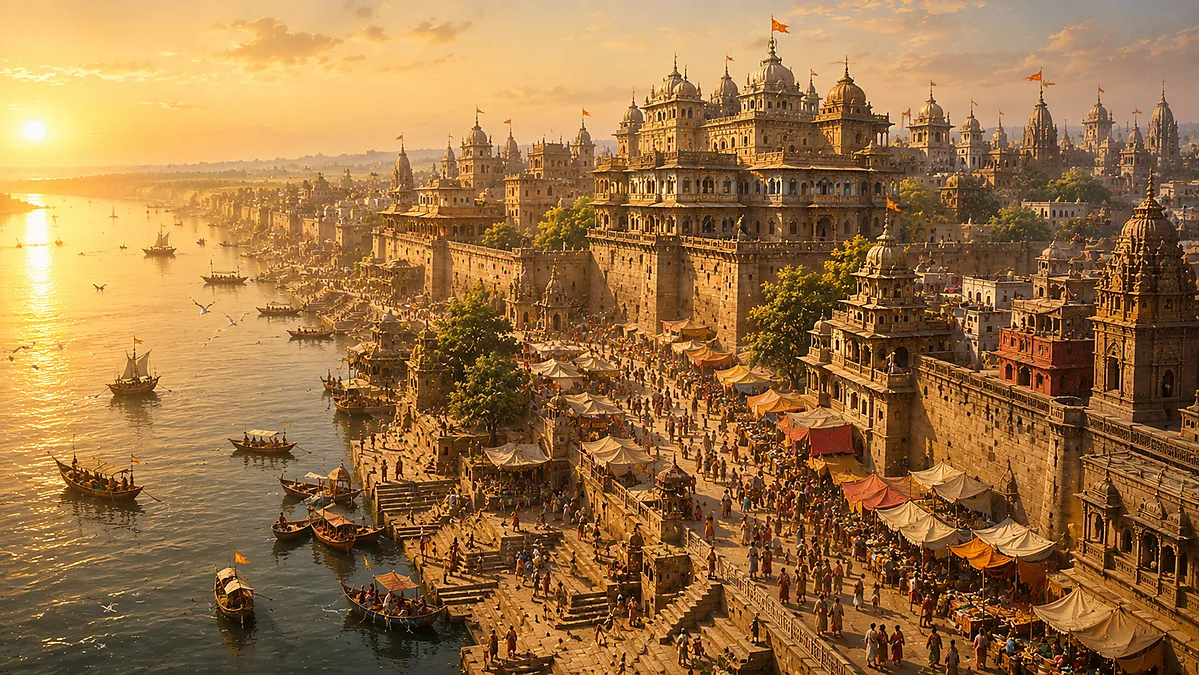
The early morning mist rises from the Ganga, veiling the distant spires of Prayagraj. On the opposite bank, the high, silent mounds of Jhusi watch over the river like sleeping giants. Hardly any pilgrim looking at the Triveni Sangam from the city side knows that the ground beneath the opposite shore holds the remains of a forgotten capital—older than the Mahabharata, older than the Puranas, perhaps even older than the Vedas themselves.
Take a boat from the city ghats, cross the river, and step onto the ancient shoreline. Beneath the bustle of a modern town lies the archaeological floor of Pratishthanpur—the legendary capital of the Lunar Dynasty. Here, in a stretch of land exposed to the erosive power of the Ganga, one can still feel the weight of an immense past. The river breeze carries not just the sound of temple bells but also the whisper of a civilization that began to take root here more than nine thousand years ago.
How did this ancient capital come to be forgotten? What secrets do its buried mounds still hold? And why does this forgotten heritage of Prayagraj deserve to be rediscovered today?
Quick Facts at a Glance
| Detail | Information |
| Ancient Name | Pratishthanpur (Pratishthana) |
| Modern Name | Jhusi / Jhunsi |
| Location | Prayagraj, Uttar Pradesh (eastern bank of the Ganga, about 7 km from the city centre) |
| Associated Tradition | Lunar Dynasty (Chandravansha / Somavansha) |
| Historical Importance | Ancient urban settlement; Neolithic site with one of the earliest pieces of evidence of farming in South Asia |
| Major Interest | Archaeology, ancient history, sacred geography, heritage tourism |
| Estimated Antiquity | Neolithic levels dated to c. 7100 BCE |
Table of Contents
A Forgotten Capital
Across the Ganga from the famous Triveni Sangam, where millions gather for the Kumbh Mela, lies a place that quietly holds the key to a much deeper past. This is Jhusi—or Jhunsi, as it was once called—a town that still preserves, beneath its modern surface, the memory of Pratishthanpur, the ancient capital of the Lunar Dynasty.
For centuries, the high mounds of Jhunsi have been known to local residents as places of legend. Villagers spoke of a forgotten city that had been burned and abandoned, of a well that contained the waters of the seven seas, and of kings who ruled here before the great epics were composed. Today, archaeology has begun to confirm what tradition always maintained: Pratishthanpur was not a myth but a real urban centre, one of the earliest and most significant settlements in the entire Gangetic plain.
Yet, unlike the well‑preserved monuments of the Gupta period or the towering walls of the Allahabad Fort, the remains of Pratishthanpur lie largely unexcavated, exposed to the erosive force of the river and the pressures of modern development. This is the forgotten heritage of Prayagraj—a heritage that deserves to be remembered, protected, and celebrated.
Where Is Prashthanpuri? – Jhusi in the Sacred Landscape of Prayagraj
Jhusi is located on the eastern bank of the Ganga, just across the river from the main city of Prayagraj. The ancient settlement lies approximately 7 km east of Allahabad city, very close to the Ganga‑Yamuna confluence, at a marked meander of the river that creates a natural promontory overlooking the waters. In terms of the sacred geography of Prayagraj, Jhusi occupies a position of immense significance: it lies on the opposite shore from the Triveni Sangam, yet within sight of the confluence.
Geographic coordinates: 25°26′10″N, 81°54′30″E.
Elevation: Approximately 76 m (249 ft).
Jhusi is now a growing town with a population of about 34,000 (2011 census). It is connected to Prayagraj by the Lal Bahadur Shastri Bridge (Shastri Bridge), which spans the Ganga and makes the crossing quick and convenient. The town also has its own railway station (Jhusi railway station, code JI), situated near the Grand Trunk Road, with numerous trains passing through daily.
From a heritage perspective, Jhusi’s location is crucial: it lies on the opposite bank from the main Kumbh Mela area, yet it has been an integral part of Prayagraj’s pilgrimage landscape for millennia. During the Magh Mela and Kumbh Mela, pilgrims traditionally cross the river to visit the sacred sites of Jhusi, including the Samudra Koop (Ocean Well) and the Ulta Qila (Upside‑Down Fort).
What Is Prashthanpuri? – Meaning and Identity of the Ancient City
The name Pratishthanpur (also written Pratishthanapur, Pratisthanapura, or Pratisthan Puram) is composed of two Sanskrit elements:
- Pratishthāna (प्रतिष्ठान) — meaning “established,” “foundation,” or “capital”. In ancient Indian political geography, a pratishthāna was a royal seat, a city that served as the centre of power for a dynasty.
- Pura (पुर) — meaning “city” or “settlement”.
Thus, Pratishthanpur means “the established city” or “the capital city”—a name that itself testifies to its ancient status as a centre of royal authority.
In traditional Hindu literature, the city is also referred to simply as Pratishthana. The Prayag Mahatmya (the glorification of Prayag) identifies Pratishthana as “the most important locality of Prayag”, indicating that in the Puranic understanding, the sacred geography of Prayagraj was not limited to the Triveni Sangam alone but included the eastern bank of the Ganga as an integral part of the holy landscape.
The modern name Jhusi (or Jhunsi) is believed to derive from the Hindi word jhulasna, meaning “to scorch” or “to burn”. According to tradition, the city was destroyed by a great fire—either from a natural calamity or from an invasion—and the name preserves the memory of that conflagration. In some accounts, the town was known as Andhernagri (the Dark City) before it was renamed Jhunsi. The burning of the city is traditionally associated with a king named Harbonga, who caused an “upheaval on the earth,” leading to the city’s destruction by fire. Other accounts attribute the destruction to Muslim invaders in the 13th–14th centuries, after which the city came to be known as Jhulsi, with the “l” gradually disappearing to give the current name.
The Lunar Dynasty Capital – King Ila and the Chandravansha
According to the Puranas and the Mahabharata, Pratishthanpur was the capital of the Lunar Dynasty (Chandravansha or Somavansha)—one of the two great legendary lineages of Kshatriya kings in ancient India, the other being the Solar Dynasty (Suryavansha).
The founder of the city is said to be King Ila, a fascinating figure in Hindu mythology. Ila was the child of Manu Vaivasvata (the progenitor of humanity in the present cosmic age) and, according to some traditions, was originally a daughter named Ila who was transformed into a man by the grace of the gods. Ila is described in the Shatapatha Brahmana and the Puranas as the progenitor of the Lunar Dynasty, ruling from Prayag. The Mahabharata also records that Ila ruled from Prayag and that his descendant Shashabindu ruled in the country of Bahli.
Ila’s son (or, in some accounts, his successor) was Pururavas, the most celebrated king of the early Lunar Dynasty. The Valmiki Ramayana (Uttara Khanda, Sarga 90) explicitly states that Pururavas ruled from Pratishthana. Thus, for over two millennia, Jhusi was remembered in the literary tradition as the seat of the earliest Chandravansha kings—a lineage that would later include the heroes of the Mahabharata, including the Pandavas and Kauravas, as well as Lord Krishna himself, who was born in the Yaduvansha branch of the Lunar Dynasty.
The Puranas also list Pratishthana as a sacred tirtha (pilgrimage site). The Mahabharata (III.83.72) mentions both Prayaga and Pratisthana together, indicating that the two sites were intimately connected in the pilgrimage geography of ancient India.
A note on terminology: The term “Lunar Dynasty” (Chandravansha) is used here in its traditional sense, as recorded in the Puranic and Itihasic literature. It is not a historical dynasty in the same sense as the Mauryas or Guptas (whose reigns can be dated with certainty), but rather a legendary lineage that carried immense cultural and political significance in ancient India. The association of Pratishthanpur with the Lunar Dynasty is therefore a literary and traditional claim, not one that has been confirmed by archaeology. However, the consistency of the tradition across multiple texts—the Ramayana, the Mahabharata, and several Puranas—suggests that the site’s importance was universally recognised in the ancient world.
The Legend of Pururavas and Urvashi – A Love Story Etched in Time
No discussion of Pratishthanpur would be complete without recounting the famous love story associated with its most celebrated king: Pururavas and the celestial nymph Urvashi.
The story, first told in the Rigveda (X.95) and later expanded by the great poet Kalidasa in his Sanskrit drama Vikramōrvaśīyam, is one of the most beloved tales in Indian literature.
According to the legend, the beautiful apsara Urvashi was sent down from heaven to the earth. Pururavas, the king of Pratishthana, saw her and was instantly captivated by her beauty. Urvashi agreed to live with him on one condition: that he would never appear naked before her and that he would never neglect her beloved pet goats.
For many years, they lived happily together. But one night, the celestial guardians (the Gandharvas) stole the goats, and Pururavas, forgetting his promise, rushed naked to retrieve them. In that instant, a flash of lightning revealed his naked form to Urvashi, who—according to the terms of their agreement—immediately vanished back to the celestial realm.
Pururavas, heartbroken, wandered the earth searching for his lost love. His desperate quest eventually led him to a lake where Urvashi had temporarily descended. There, moved by his devotion, the gods allowed her to return to him, and they were reunited.
The story of Pururavas and Urvashi was not merely entertainment; it carried deep symbolic meaning. The earthly king and the celestial nymph represented the eternal tension between the human and the divine, between attachment and renunciation, between the world of the senses and the realm of the spirit. The fact that Kalidasa—the greatest poet of the Gupta Golden Age—chose to set his drama in Pratishthana testifies to the continued cultural importance of the city long after its political heyday.
What Archaeology Reveals About Ancient Pratishthanpur
For many years, the identification of Jhusi with the ancient Pratishthana of the Puranas rested on literary evidence alone. However, systematic archaeological work—particularly excavations conducted by the Department of Ancient History, Culture and Archaeology of the University of Allahabad—has now provided a firm material foundation for the site’s antiquity.
The site of Jhusi is located on the left (eastern) bank of the river Ganga, about 7 km east of Prayagraj, very close to the Ganga‑Yamuna confluence. Its strategic location—at a marked meander of the river, with a natural promontory overlooking the waters—would have made it an ideal location for settlement from the earliest times.
Excavations at Jhusi have revealed multicultural occupations distributed in five‑fold cultural periods, ranging from the Neolithic to the Early Medieval period. In other words, the site was continuously or near‑continuously occupied for over nine thousand years—one of the longest occupational sequences in the entire Gangetic plain.
The most sensational discovery came from the Neolithic levels of the site. Carbon‑14 dating of material from these levels yielded a date of 7100 BC (and, in some calculations, as early as 7106 BCE). This means that a settled agricultural community was living on this spot at the same time as the earliest farming villages in Mesopotamia and the Indus Valley—and perhaps even earlier.
Archaeological significance: The Neolithic levels at Jhusi have helped to rewrite the prehistory of the Gangetic plain. Earlier, it was thought that there was a cultural break between the Mesolithic and the Chalcolithic periods in this region. The Jhusi excavations have now provided proof of cultural continuity from the Mesolithic, through the Neolithic to the Chalcolithic ages, which continued into the historical period.
The High Mounds of Jhunsi – Five Cultural Phases in One Site
The remains of ancient Pratishthana are still visible today in the form of high mounds that rise above the floodplain on the eastern bank of the Ganga. These mounds, which cover an area of about four square miles, are the archaeological signature of a city that was occupied for millennia.
The excavations have identified five cultural phases at the site:
- Neolithic phase (c. 7100–??? BCE) – Characterised by handmade pottery, bone tools, bone arrowheads, fish and animal bones, stone tools, and a large structure that may have been a hearth‑cum‑pottery‑kiln. This phase also provides evidence of grain‑based agriculture, including cereals, pulses, and oil‑yielding crops. Significantly, the site has yielded evidence of rice cultivation, suggesting that the Gangetic plain may have been a nuclear region for the domestication of rice.
- Chalcolithic phase – Occupations with distinct ceramic traditions and the first indications of metal use.
- Pre‑NBPW (Northern Black Polished Ware) phase (c. 700–200 BCE) – A continuous settlement at the site from the pre‑NBPW period to the Gupta period.
- Kushana period – Layers dating to the Kushana period (c. 1st–3rd centuries CE) have yielded typical Kushana pottery, terracotta objects, iron and copper objects, beads of semi‑precious stones and terracotta, bone objects, and evidence of burnt brick walls. A high mound representing this period is still visible, though it has suffered from continuous erosion by the Ganges.
- Gupta period and later – The site continued to be occupied into the Gupta period and beyond, though there appears to be a cultural gap between the end of the Gupta period and the beginning of the Early Medieval period. However, some archaeologists believe that further excavations may fill this gap, as the strategic location of the site would never have been entirely abandoned.
The presence of burnt brick structures at Jhusi dating back to c. 700 BCE is particularly significant. Along with the nearby site of Kaushambi, Jhusi provides some of the earliest evidence of burnt brick architecture in the Gangetic plain.
The ruins of ancient Pratishthana have suffered greatly from erosion by the Ganges over the centuries. The Indian National Trust for Art and Cultural Heritage (INTACH) has documented that the site is slowly losing its identity on account of continuous erosion. The high mound belonging to the Kushana period now has few bricks exposed, and urgent conservation work is needed to preserve what remains.
Samudra Koop – The Ocean Well of Samudragupta
One of the most extraordinary surviving features of ancient Jhusi is the Samudra Koop—the “Ocean Well.” Located near the Ulta Qila (Upside‑Down Fort) on a high mound along the Ganga, this ancient well is attributed to Maharajadhiraja Shri Samudragupta of the Gupta dynasty (c. 4th century CE).
The name Samudra Koop has a double meaning. “Samudra” means “ocean” (and also refers to the emperor Samudragupta), while “Koop” means “well”. According to tradition, the well was built on the ruins of the ancient city, on a high mound overlooking the Ganga, and was believed to contain the waters of the seven seas.
The well is mentioned in the Matsya Purana and the Padma Purana, where it is described as a divine entity and a sacred tirtha. According to the Puranas, five such wells were established by Samudragupta in five sacred cities: Ujjain, Mathura, Prayag, Varanasi, and Pataliputra. The well at Prayag (Jhusi) is the Samudra Koop.
In 2023, the Prayagraj Mela Authority tested the water of Samudra Koop in a laboratory. The results showed that the water is still potable even today, more than 1,600 years after it was built. Plans are now underway to test the water for medicinal properties, as local tradition has long attributed healing qualities to it.
In 2024–2025, as part of the preparations for the Maha Kumbh Mela, the area around Samudra Koop and the Ulta Qila is being beautified and restored.
The Samudra Koop is also of religious significance. According to local lore, the well represents a miniature form of the Samudra Manthan (Churning of the Ocean), and the waters are considered to have purifying and healing qualities. Devotees flock to the well during the Magh Mela and Kumbh Mela, when large gatherings occur at Prayagraj, to offer prayers and seek blessings.
Ulta Qila – The “Upside‑Down” Fort
Adjacent to the Samudra Koop is the Ulta Qila (literally “Upside‑Down Fort”), a structure that has puzzled historians and visitors alike for centuries. The name “Ulta” (upside‑down) refers to the fact that the fort’s foundations are exposed and its walls are inverted—perhaps as a result of earthquake damage, erosion, or deliberate destruction.
Little is known about the precise origins of the Ulta Qila. The ruins visible today are believed to date from the medieval period, though the site had been occupied continuously from much earlier times. The structure is built on top of a high mound that contains archaeological deposits from the Kushana and Gupta periods, indicating that the location was already ancient when the fort was constructed.
The Ulta Qila and the Samudra Koop are often visited together by heritage tourists and pilgrims exploring the Jhusi side of Prayagraj. In 2023, it was announced that the Ulta Qila would be restored as part of a larger beautification project ahead of the Maha Kumbh Mela, bringing renewed attention to this neglected historical monument.
Sacred Geography – Jhusi in Pilgrimage Tradition
Although modern attention focuses on the Triveni Sangam on the western bank of the Ganga, the eastern bank at Jhusi also holds a significant place in the pilgrimage geography of Prayagraj.
During the Magh Mela (January–February) and the Kumbh Mela, pilgrims traditionally cross the river to visit the Samudra Koop and offer prayers at its sacred water. The well is considered a tirtha in its own right, with waters that purify and heal. The Puranic references to the well have ensured that it remains a site of veneration for the devout, even if it is less crowded than the main Sangam.
The high mounds of Jhusi also have a connection to the Kumbh Mela tradition. According to some historians, the pre‑NBPW deposit at Jhusi, which contains iron objects and pottery similar to chalcolithic sites elsewhere in the Gangetic plain, marks the earliest culture represented at the site—and this culture has been linked to the origin of the Kumbh Mela itself. The site may thus hold the key to understanding the very beginnings of the pilgrimage tradition for which Prayagraj is world‑famous.
Prashthanpuri Through Different Historical Periods
The occupational history of Jhusi can be summarised as follows:
- Neolithic Period (c. 7100 BCE and earlier) – Early farming communities, rice cultivation, handmade pottery, bone tools, and the earliest evidence of settled village life in the Gangetic plain.
- Chalcolithic Period – Copper and other metal artefacts appear, along with continuing ceramic traditions.
- Pre‑Mauryan / Pre‑NBPW Period (c. 700–200 BCE) – Burnt brick architecture, iron objects, and the first emergence of an urban‑scale settlement.
- Mauryan Period (c. 321–185 BCE) – The site came under the Mauryan Empire; the famous Ashokan pillar now in Allahabad Fort originally stood at or near Kaushambi, but the region was an integral part of the Mauryan heartland.
- Shunga and Kushana Periods (c. 185 BCE – 3rd century CE) – Jhusi continued as an important settlement, with distinctive Kushana pottery and terracotta objects being found in the excavations. The high mounds still visible today represent, in part, deposits from this period.
- Gupta Period (c. 4th–6th centuries CE) – The Golden Age of Indian civilization. Samudragupta built the Samudra Koop, and the city of Pratishthana continued to be occupied. The Prayag Prashasti (Allahabad Pillar Inscription) was composed nearby during this period.
- Early Medieval Period – There appears to be a cultural gap after the Gupta period, though the site was not completely abandoned. The city, once known as Pratishthanpur, gradually fell into decline.
- Medieval Period – The city was destroyed by a great fire—whether by a natural calamity or by invasion. It came to be known as Jhunsi (“the burnt city”). The Ulta Qila may date from this period. According to tradition, the city was destroyed in an earthquake in 1359 CE, as a result of the invocations of the saint Ali Murtaza, though other accounts attribute the destruction to Muslim invaders in the 13th century.
- Modern Period – Jhusi remains a growing town with a railway station, an important role in the Magh Mela, and a heritage that is only beginning to be fully appreciated.
Heritage Importance – Why Jhusi Deserves Greater Attention
Jhusi is, without exaggeration, one of the most important archaeological sites in the entire Gangetic plain. Yet, compared to the well‑preserved monuments of the Gupta period or the bustling Kumbh Mela grounds, it remains remarkably overlooked—both by the government and by tourists.
Here is why this neglect must be addressed:
It Is a Neolithic Site of Global Significance
The carbon‑14 date of c. 7100 BCE places Jhusi among the earliest agricultural settlements in South Asia. Along with Mehrgarh in Balochistan (c. 7000 BCE), Jhusi provides evidence for the independent origin of agriculture in the Indian subcontinent. The site has the potential to yield information about the domestication of rice, the earliest farming communities in the Gangetic plain, and the transition from hunting‑gathering to settled life.
It Provides Evidence of Uninterrupted Settlement
The five cultural phases at Jhusi—spanning the Neolithic to the Early Medieval period—demonstrate that this was a site of continuous or near‑continuous occupation for over nine millennia. Few sites in India, or even in the world, can claim such a long and uninterrupted history of human habitation.
It Is the Forgotten Capital of a Legendary Dynasty
The identification of Jhusi with the Pratishthana of the Puranas, the Mahabharata, and the Ramayana connects the site to the deepest layers of Indian literary tradition. For the millions who revere the Itihasa‑Puranas as a record of their cultural memory, Jhusi is not just an archaeological site—it is the capital of the Lunar Dynasty, the city of King Ila and Pururavas, the setting of one of Kalidasa’s greatest dramas.
It Is at Risk of Erosion and Destruction
The Ganges has been eroding the high mounds of Jhusi for centuries. Much of the ancient city has already been lost to the river. Without urgent conservation work—including riverbank protection, stabilisation of the exposed mounds, and careful archaeological excavation—the remaining deposits will continue to be destroyed, and with them, the history of this extraordinary site will be lost forever.
It Is Part of the Sacred Geography of Prayagraj
Prayagraj is known as Tirtharaj—the King of Pilgrimage Sites. That title does not refer only to the Triveni Sangam; it refers to the entire sacred landscape, including the opposite bank of the Ganga at Jhusi. The Samudra Koop, the Ulta Qila, and the high mounds are integral parts of that landscape. A complete pilgrimage to Prayagraj should include a visit to this forgotten heritage.
Visitor Guide – Walking Through the Mounds of Jhusi Today
Location
Jhusi is located on the eastern bank of the Ganga, across the river from the main city of Prayagraj.
How to Reach
- By road: Jhusi is connected to Prayagraj by the Lal Bahadur Shastri Bridge (Shastri Bridge). From the city centre, taxis and auto‑rickshaws can cross the bridge and reach Jhusi in approximately 20–30 minutes.
- By train: Jhusi has its own railway station (Jhusi Station, code JI) situated near the Grand Trunk Road. Numerous trains pass through the station daily.
- By boat: During the Magh Mela and Kumbh Mela, special boat services operate between the city ghats and the Jhusi side, offering a traditional and scenic way to reach the ancient site.
What to See
- The High Mounds of Jhunsi – The exposed archaeological deposits, visible on the riverbank, are the most tangible remains of ancient Pratishthana. The mounds cover an area of about four square miles and contain material from the Neolithic to the medieval period. However, access to the mounds may be restricted, and visitors should exercise caution as the banks are subject to erosion.
- Samudra Koop (Ocean Well) – Located near the Ulta Qila on a high mound along the Ganga, this ancient well is attributed to Samudragupta and is mentioned in the Puranas. The water is still potable, and the well is considered a sacred tirtha.
- Ulta Qila (Upside‑Down Fort) – Adjacent to the Samudra Koop, this ruined fort is a site of historical interest. The “upside‑down” name refers to its inverted and ruined appearance. Restoration work is underway.
- Panoramic View of the Sangam – From the high ground of Jhusi, one can look across the Ganga and see the Triveni Sangam—the confluence of the Ganga, Yamuna, and mythical Saraswati—from a unique vantage point.
Best Time to Visit
- Winter (October–March): The weather is pleasant, and the visibility across the river is good. This is the best time for heritage walks.
- Kumbh Mela and Magh Mela: Jhusi is more crowded during these periods, but the spiritual atmosphere is at its peak, and the boat rides across the Ganga are particularly memorable.
Photography Opportunities
The high mounds offer excellent opportunities for landscape photography, with the Ganga in the foreground and Prayagraj visible across the river. Early morning and late afternoon provide the best light. The Samudra Koop and Ulta Qila are also photogenic, particularly when visitors are present to give scale to the ancient structures.
Practical Tips
- Footwear: The mounds are uneven and may be muddy. Wear sturdy walking shoes.
- Sun protection: Carry a hat, sunglasses, and sunscreen, especially during the warmer months.
- Water: Bring your own water, as facilities are limited.
- Guide: Consider hiring a local guide familiar with the history of the site to enhance your experience.
- Respect: Jhusi is a lived‑in town as well as an ancient site. Respect local residents and their properties when exploring.
Why Prashthanpuri Still Matters
What is the value of remembering a city that has been in ruins for centuries? Why should a pilgrim or a tourist take the time to cross the bridge to Jhusi when the Sangam itself offers so much to see and experience?
The answer lies in the depth of time—in the recognition that the sacred landscape of Prayagraj is not something that was created at a single moment but something that grew, layer by layer, over thousands of years. The earliest farmers who settled on the banks of the Ganga at Jhusi, planting their first crops of rice, were already beginning the process that would eventually make this place the King of Pilgrimage Sites. The kings of the Lunar Dynasty who ruled from Pratishthana—whether historical or legendary—contributed to the accumulation of sacred memory that made Prayagraj the most important tirtha in India. The Gupta emperors who built the Samudra Koop were drawing on a past that was already ancient to them.
When you stand on the high mounds of Jhusi and look across the river, you are not just looking at a view. You are looking at nine thousand years of human history—nine thousand years of prayer, of settlement, of agriculture, of kingship, of poetry, of faith. The layers beneath your feet contain the remains of every generation that ever called this place home.
Jhusi is not a rival to the Sangam; it is the other half of the story. The Sangam represents the sacred, the ritual, the transcendent; Jhusi represents the historical, the archaeological, the human. Together, they make up the complete picture of Prayagraj—a city that is at once a portal to the divine and a record of human striving, a place where myth and history, legend and archaeology, merge into a single continuous tradition.
Pratishthanpur is not merely an archaeological site. It is the forgotten heritage of Prayagraj—a heritage that, if properly preserved and presented, could transform our understanding of the city’s past and enrich the experience of every pilgrim who comes to this sacred place.
Frequently Asked Questions (FAQs)
1. What was Pratishthanpur?
Pratishthanpur (also called Pratishthana) was the ancient capital of the Lunar Dynasty (Chandravansha), located on the eastern bank of the Ganga at the site of modern Jhusi in Prayagraj. It is mentioned in the Ramayana, the Mahabharata, and the Puranas.
2. Is Pratishthanpur the same as Jhusi?
Yes. Modern Jhusi (also spelled Jhunsi) occupies the location of ancient Pratishthanpur. The name Jhusi is believed to derive from the Hindi word jhulasna (“to scorch”), referring to the destruction of the ancient city by fire.
3. How old is Pratishthanpur?
The Neolithic levels at Jhusi have been carbon‑dated to c. 7100 BCE (some sources give 7106 BCE), making it one of the earliest agricultural settlements in South Asia.
4. Who founded Pratishthanpur?
According to tradition, Pratishthanpur was founded by King Ila, a progenitor of the Lunar Dynasty. The city was the capital of Pururavas and other early Chandravansha kings.
5. Who was Pururavas?
Pururavas was a celebrated king of the early Lunar Dynasty who ruled from Pratishthana. His love story with the celestial nymph Urvashi is told in the Rigveda and in Kalidasa’s drama Vikramōrvaśīyam.
6. What is the Lunar Dynasty (Chandravansha)?
The Lunar Dynasty (also called Somavansha) is one of the two legendary Kshatriya lineages in ancient Indian literature, the other being the Solar Dynasty. According to tradition, the city of Pratishthanpur was the capital of the early Lunar Dynasty kings.
7. What is the Samudra Koop?
The Samudra Koop (Ocean Well) is an ancient step‑well at Jhusi attributed to Emperor Samudragupta of the Gupta dynasty (4th century CE). It is mentioned in the Matsya Purana and the Padma Purana and is considered a sacred tirtha.
8. What is the Ulta Qila?
The Ulta Qila (Upside‑Down Fort) is a ruined fort adjacent to the Samudra Koop at Jhusi. Its name refers to its inverted appearance, possibly caused by earthquake damage, erosion, or deliberate destruction. Restoration work is underway.
9. What archaeological discoveries have been made at Jhusi?
Excavations have revealed five cultural phases—Neolithic, Chalcolithic, pre‑NBPW, Kushana, and Gupta—including handmade pottery, bone tools, iron and copper objects, burnt brick structures, and evidence of rice cultivation from the Neolithic period.
10. Is Jhusi mentioned in the Mahabharata?
Yes. The Mahabharata (III.83.72) mentions Pratishthana as a sacred tirtha alongside Prayaga, confirming the site’s importance in ancient pilgrimage geography.
11. Is Jhusi mentioned in the Ramayana?
Yes. The Valmiki Ramayana (Uttara Khanda, Sarga 90) explicitly states that Pururavas ruled from Pratishthana, identifying the city as the seat of the early Lunar Dynasty.
12. Which dynasties ruled at Jhusi?
The site has been associated with the Maurya, Shunga, Kushana, and Gupta dynasties, based on archaeological evidence and historical tradition.
13. Why is Jhusi important for understanding the history of agriculture in India?
The Neolithic deposits at Jhusi contain evidence of grain‑based agriculture, including cereals, pulses, and oil‑yielding crops. The site has also yielded evidence of rice cultivation, suggesting that the Gangetic plain may have been a nuclear region for the domestication of rice.
14. What is the current condition of the archaeological site?
The high mounds of Jhusi are eroding into the Ganga due to the continuous action of the river. The Indian National Trust for Art and Cultural Heritage (INTACH) has documented that the site is “slowly losing its identity” on account of erosion.
15. Can tourists visit Jhusi?
Yes. Jhusi is accessible by road from Prayagraj via the Shastri Bridge and has its own railway station. The Samudra Koop and the Ulta Qila are open to visitors, and the high mounds can be viewed from the riverbank.
16. Is Jhusi connected to the Kumbh Mela?
Yes. During the Magh Mela and Kumbh Mela, pilgrims visit the Samudra Koop at Jhusi to offer prayers. Some historians also believe that the earliest cultural deposits at Jhusi are linked to the origin of the Kumbh Mela tradition itself.
Related Heritage Journeys
To deepen your exploration of the ancient and sacred sites of Prayagraj, we invite you to explore these related articles:
- Prayag Prashasti: The Allahabad Pillar Inscription That Revealed the Empire of Samudragupta – The story of the inscription that transformed our understanding of the Gupta Age.
- Allahabad Fort: History, Architecture, and Visitor Guide – The Mughal fort that now houses the Ashokan pillar and the Akshayavat.
- Akshayavat: The Indestructible Banyan Tree of Prayagraj – The sacred tree that has witnessed the rise and fall of civilisations for millennia.
- Triveni Sangam: The Complete Pilgrim Guide – Everything you need to know about the confluence of the Ganga, Yamuna, and Saraswati.
- Tirtharaj Prayag: Why Prayagraj Is Called the King of Pilgrimage Sites – The scriptural and spiritual basis for Prayagraj’s supreme status.
- Kumbh Mela: History, Mythology, Akharas & Spiritual Significance – The world’s largest gathering of faith, held at Prayagraj.
This article is part of a series on the historical and sacred sites of Prayagraj.
Prayag Tourism
📞 Phone/WhatsApp: +91-9555313526
📧 Email: contact@prayagtourism.com
🌐 Website: PrayagTourism.com
May your journey into the past be as enriching as your pilgrimage is peaceful.