
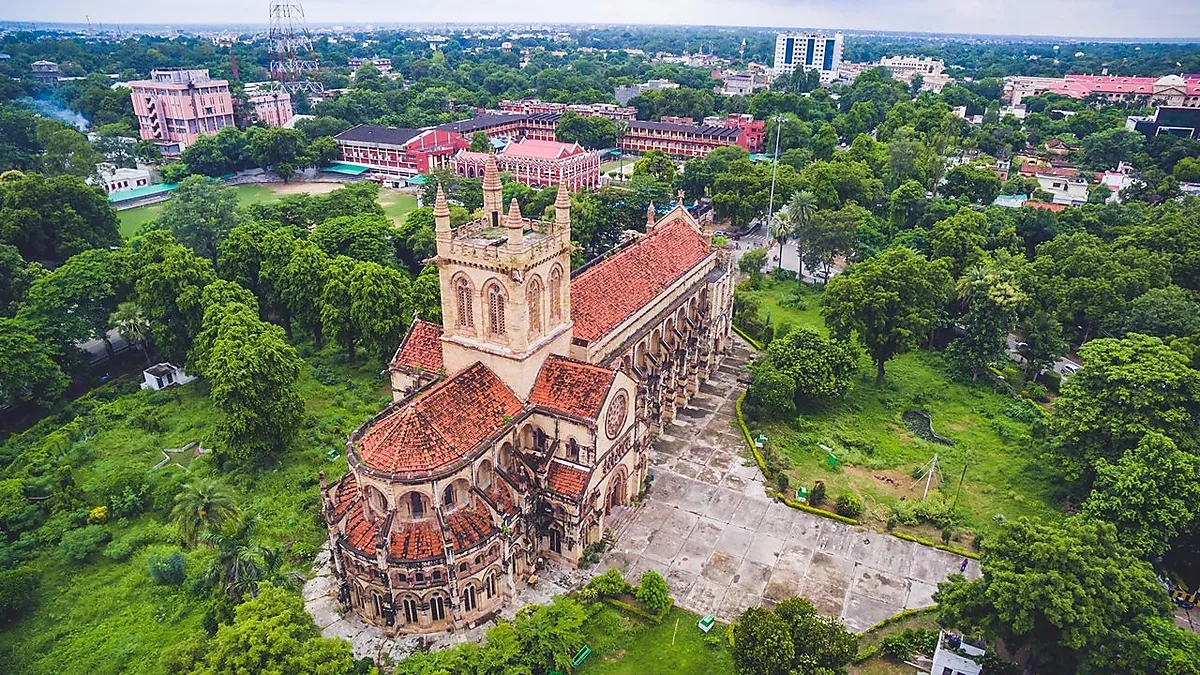
The first thing that strikes you is the sheer unexpectedness of it. You are driving down Sarojini Naidu Marg, past the orderly bungalows and green avenues of Prayagraj’s Civil Lines, when it suddenly rises above the treeline. Not a temple spire, but a towering stone cathedral, complete with flying buttresses, a massive tower, and snarling gargoyles. It looks as though a medieval parish from the English countryside has been magically transported to the banks of the Ganga. This is Patthar Girjaghar Prayagraj—the “Stone Church”—and it is one of North India’s most magnificent architectural treasures.
Stepping inside, the clamour of the Indian street vanishes. A profound silence, broken only by the echo of your own footsteps on the marble floor, takes its place. Sunlight streams through magnificent stained-glass windows, casting kaleidoscopic patterns of ruby, sapphire, and emerald onto the stone pillars. High above, the ribbed vaulted ceiling soars, creating an atmosphere of reverence and awe. You are in the presence of a masterpiece of the Gothic Revival, a building of such ambition and artistry that it is often called the finest Anglican cathedral in all of Asia.
For a city famous for its ancient ghats and holy sangams, how did this Gothic gem, a perfect emblem of the British Raj, come to define the skyline of Prayagraj? The answer is a fascinating story of imperial ambition, architectural genius, and the enduring legacy of a world-changing faith.
🗿 Quick Facts: Patthar Girjaghar at a Glance
| Feature | Information |
| Official Name | All Saints Cathedral |
| Local Name | Patthar Girjaghar Prayagraj |
| Location | Sarojini Naidu Marg, Civil Lines, Prayagraj, Uttar Pradesh, 211001 |
| Architect | Sir William Emerson (1843–1924) |
| Architectural Style | Gothic Revival (modelled after 13th-century cathedrals) |
| Construction Period | Designed in 1871; consecrated in 1887; completed in 1891 |
| Dimensions | Length: 240 ft (73 m); Width: 56 ft (17 m); Height: 103 ft (31 m) |
| Capacity | 500–600 worshippers |
| Materials | Creamish-white stone, red sandstone, marble, tile, stained glass |
| Denomination | Church of North India (United Protestant) |
| Timings | 8:30 AM – 5:30 PM (daily) |
| Entry Fee | Free |
| Recommended Duration | 1–2 hours |
| Best Time to Visit | October – March (winter) |
📖 What is Patthar Girjaghar? The ‘Stone Church’ of Prayagraj
Known locally as Patthar Girjaghar or Patthar Girja—literally the “Stone Church”—the official name of this magnificent building is the All Saints Cathedral. It is a cathedral of the Church of North India (CNI), a testament to the city’s significant Christian community and its deep connection to the colonial era. For over a century, its towering presence at the junction of Mahatma Gandhi Marg and Sarojini Naidu Marg has served as a spiritual anchor and an unmistakable landmark of the city‘s Civil Lines area.
🏛️ A History Set in Stone: The Cathedral’s Colonial Past
The story of the All Saints Cathedral is woven into the fabric of British India. The foundation stone of this imposing colonial structure was laid in 1871 by Lady Muir, the wife of Sir William Muir, the Lieutenant-Governor of the North-Western Provinces. The eminent British architect Sir William Emerson was commissioned for the ambitious project, a figure whose name would become synonymous with some of the most iconic buildings of the era. Emerson’s design was a masterful interpretation of the 13th-century Gothic style—a deliberate choice to evoke the grandeur and permanence of medieval European cathedrals. Construction was painstaking; the cathedral was consecrated in 1887 and finally completed in 1891.
🎨 The Master Architect: Sir William Emerson
To appreciate the cathedral, one must appreciate its creator. Sir William Emerson (1843–1924) was one of the most celebrated British architects to work in India. His portfolio is a roll call of imperial landmarks, including the Victoria Memorial in Kolkata, the Crawford Market in Mumbai, and the Muir College in Allahabad itself. Emerson’s genius lay not just in replicating European styles but in adapting them to the Indian climate and context. For the All Saints Cathedral, he created what many consider the finest Anglican cathedral in Asia. The building’s landmark status was recently reaffirmed in 2026 when the Prayagraj Municipal Corporation announced a ₹9 crore beautification project, including new railings and pedestrian-friendly pathways.
⛪ Architectural Marvel: A Gothic Revival Masterpiece
The exterior of the All Saints Cathedral is a breathtaking vision of 13th-century Gothic Revival architecture. Built from beige sandstone, its most dramatic features are the flying buttresses, the gargoyles, and the grand pointed arches. The exterior design, especially the towering spires, is a spectacle, but the interior is where the cathedral‘s true genius reveals itself.
The Prayer Hall: Volume, Light, and Art
Stepping inside is a sensory and spiritual experience. The sheer scale is designed to inspire awe: the total length of the cathedral is 240 feet, with an internal width of 56 feet. The nave is a lofty 130 feet long and 40 feet wide and can accommodate 400 to 600 worshippers.
Classical Columns and Arched Ceilings: The weight of the soaring stone roof is borne by rows of classical columns with beautifully carved acanthus leaf capitals. Above, ribbed, vaulted ceilings draw the eye upward, a classic Gothic device to symbolize the heavens.
The Magnificent Stained Glass: The most breathtaking feature is the stained glass. Huge arched windows line the walls, while a stunning rose window adorns one end. These windows depict biblical scenes in vivid blues, reds, and golds, and when sunlight streams through them, they bathe the interior in a truly divine light.
Awe-Inspiring Altar and Pulpit: The focal point of the chancel is an impressive marble altar adorned with intricate inlay work and mosaics. Equally remarkable is the pulpit, carved from alabaster, a testament to the high level of craftsmanship that went into every element of the cathedral’s design.
🕊️ A Living Heritage: More Than Just a Monument
While the All Saints Cathedral is undeniably a major tourist attraction, it remains a living, breathing house of worship. It belongs to the Church of North India (United Protestant) and continues to serve a vibrant local congregation. Regular services are held, with Sundays being particularly special. For the community, the cathedral is not a relic of the past but the centre of their present faith. It plays a significant role in the city’s multicultural character, standing as a proud symbol of religious harmony alongside Prayagraj’s countless Hindu temples and other sacred sites.
🚶 A Heritage Walk Through Civil Lines: A Self-Guided Itinerary
The All Saints Cathedral is the architectural anchor of Prayagraj‘s Civil Lines. This area is a treasure trove of colonial heritage, and one can easily spend a rewarding half-day exploring it. The suggested route begins at the cathedral and loops through key sights, all within a 30-minute walk.
| Stop | Approximate Time | Key Highlights |
| 1. All Saints Cathedral (Patthar Girjaghar) | 1 hour | The Gothic Revival architecture, stained glass windows, and serene interior. |
| 2. Chandrashekhar Azad Park | 1 hour (optional for the museum) | The historic park and the Allahabad Museum, which houses the pistol of freedom fighter Chandrashekhar Azad. |
| 3. Allahabad Public Library (Thornhill Mayne Memorial) | 20 minutes | A magnificent building in the Scottish Baronial style. |
| 4. Indian Coffee House | 45 minutes (for a meal) | A legendary café that has been an intellectual hub for decades. |
🗓️ Visitor Information: Your Complete Guide
🕒 Timings
The All Saints Cathedral is open daily from 8:30 AM to 5:30 PM.
💰 Entry Fee
There is no entry fee to visit the cathedral. Free entry ensures that this architectural and historical treasure is accessible to all.
☀️ Best Time to Visit
- Season: The winter months from October to March are ideal for exploring the Civil Lines area, as the weather is cool and pleasant for a long walk.
- Day of Week: For a peaceful experience, plan your visit on a weekday. If you wish to experience the cathedral as a living place of worship, Sundays are best, though it will be busier.
- Time of Day: The morning hours (9 AM – 11 AM) offer the most beautiful sunlight streaming through the stained-glass windows, creating a magical atmosphere inside. The late afternoon is best for exterior photographs.
📝 What to Wear and Know
- Dress Modestly: The cathedral is an active place of worship. Visitors are kindly requested to dress modestly as a sign of respect.
- Photography: Photography is generally allowed, making it a popular destination. However, please be respectful and avoid using flash during services or when others are praying. A tripod may be used.
- Maintain Silence: The prayer hall is a place for silent reflection. Please avoid loud conversations or disturbances.
📍 How to Reach
- By Air: Prayagraj Airport (Bamrauli) is about 12 km away. You can take a pre-paid taxi or an app-based cab to the Civil Lines area.
- By Train: Prayagraj Junction is the city‘s main railway station, approximately 4 km from the cathedral. From the station, you can take a taxi, auto-rickshaw, or cycle-rickshaw to Sarojini Naidu Marg. The journey will take about 10-15 minutes.
- By Road: The cathedral is a prominent landmark at the junction of Mahatma Gandhi Marg (MG Marg) and Sarojini Naidu Marg (SN Marg) in Civil Lines. You can easily hire an auto-rickshaw from any part of the city.
❓ Frequently Asked Questions (FAQs)
1. Why is All Saints Cathedral called Patthar Girjaghar?
Patthar Girjaghar means ‘Stone Church’ in Hindi, a reference to its construction from durable beige sandstone and red stone, which distinguishes it from many other buildings in Prayagraj.
2. Where is Patthar Girjaghar (All Saints Cathedral) located?
It is located in the Civil Lines area of Prayagraj at the crossing of Mahatma Gandhi Marg (MG Marg) and Sarojini Naidu Marg (SN Marg).
3. Who built All Saints Cathedral in Prayagraj?
The cathedral was designed by the famous British architect Sir William Emerson, who also designed Kolkata’s Victoria Memorial.
4. What is the architectural style of Patthar Girjaghar?
It is a masterpiece of 13th-century Gothic Revival architecture.
5. When was Patthar Girjaghar built?
The foundation stone was laid in 1871, the cathedral was consecrated in 1887, and the building was completed in 1891.
6. What is the entry fee for visiting All Saints Cathedral?
Entry is completely free for all visitors.
7. What are the All Saints Cathedral timings?
The cathedral is open daily from 8:30 AM to 5:30 PM.
8. What is special about Patthar Girjaghar?
It is considered one of the finest examples of Gothic Revival architecture in Asia and is renowned for its stunning stained glass windows, grand tower, and beautiful marble altar.
9. Is there a dress code for visiting All Saints Cathedral?
Yes, modest attire is requested out of respect, as it is an active place of worship.
10. Is photography allowed inside Patthar Girjaghar?
Yes, photography is generally allowed. Visitors are asked to be respectful and avoid using flash during services or when it may disturb other worshippers.
11. Can tourists visit All Saints Cathedral?
Absolutely. It is one of the top heritage destinations in Prayagraj and welcomes tourists and pilgrims of all faiths.
12. What is the best time to visit Patthar Girjaghar?
The best time is during the winter months (October–March), with mornings being ideal for the best natural light inside the cathedral.
13. What is the size of the building?
The cathedral is 240 feet long, 56 feet wide, and its tower rises to a height of 103 feet.
14. What is inside the cathedral?
Inside, you can see the magnificent stained-glass windows, classical columns, the ribbed vaulted ceiling, the impressive marble altar, and the carved alabaster pulpit.
15. Does the cathedral hold regular services?
Yes, it is a living cathedral of the Church of North India and holds regular services, especially on Sundays.
16. Who is the guardian or caretaker of the cathedral?
The small congregation is looked after by a friendly guardian.
17. What are the nearest landmarks to Patthar Girjaghar?
It is located in Civil Lines, within walking distance of Chandrashekhar Azad Park, the Allahabad Museum, and the Allahabad Public Library.
18. What is the architecture style of the exterior of Patthar Girjaghar?
Its exterior is adorned with flying buttresses, snarling gargoyles, Gothic arches, and a prominent tower, all crafted from sandstone.
19. Is the cathedral a protected heritage site?
Yes, it is listed as one of the top heritage and tourist attractions in Prayagraj, with the government undertaking significant restoration efforts for its preservation.
20. Why is it considered one of the finest Anglican cathedrals in Asia?
Its exceptional architecture, the global renown of its architect, the sheer scale of the building, and its beautifully preserved interiors make it a truly world-class monument.
💎 Conclusion: A Timeless Stone Witness
As you leave the quiet, hallowed space of All Saints Cathedral and re-enter the vibrant, chaotic energy of Prayagraj’s streets, you carry a different sense of the city. You have seen its ancient temples and sacred ghats, its Mughal-era fort and its revolutionary parks. Now, you have also experienced its colonial soul, preserved not in a museum but in a living, breathing cathedral of stone.
Patthar Girjaghar is far more than a church. It is an architectural masterpiece, a silent witness to over a century of Indian history, and a proud symbol of the country’s diverse and inclusive heritage. Amid the sacred temples, bustling markets, and ancient traditions of Prayagraj, Patthar Girjaghar stands quietly in stone and silence—a timeless reminder that the city‘s heritage is as diverse as it is magnificent.
This article is part of a series on the heritage sites of Prayagraj. For more information on planning your visit, please contact us.
Prayag Tourism
📞 Phone/WhatsApp: +91-9555313526
📧 Email: contact@prayagtourism.com
🌐 Website: PrayagTourism.com
May your journey be peaceful, safe, and historically enriching—and may the magnificent stones of Patthar Girjaghar tell you their story.