
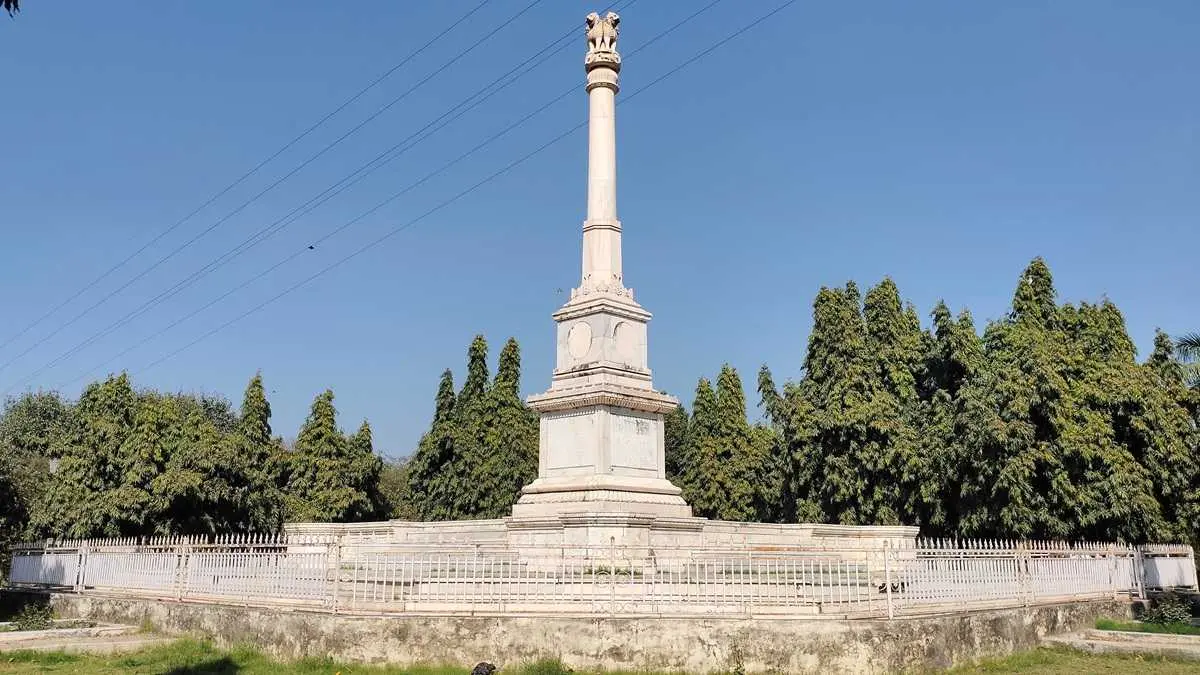
The gentle lapping of the Yamuna against its ghats is the only sound that breaks the morning calm. As you stand on the manicured lawns of this park, the city’s low hum fades away. Before you, a solitary white marble pillar rises against the vast blue sky, its elegant form softened by the golden dawn light. At its peak, a magnificent Ashokan Lion Capital catches the first rays of the sun, gazing out across the river with timeless authority.
But this pillar has a secret. Once, in a remarkable act of post-independence reinvention, the marble busts of British royalty were carefully removed from its top, and the iconic national symbol was placed there in their stead.
This is Minto Park, officially known as Madan Mohan Malaviya Park – a place where the story of a nation’s long march to freedom was both announced and later rewritten, all on the same serene, unassuming ground.
Quick Facts
| Detail | Information |
| Current Name | Madan Mohan Malaviya Park |
| Former Name | Minto Park |
| Location | Yamuna Bank Road, Southern Prayagraj, Near Triveni Sangam |
| Area | Approximately 20 acres |
| Known For | Queen Victoria Proclamation Site (1858) |
| Major Monument | Minto Tower / Proclamation Pillar |
| Key Features | Ashokan Lion Capital, Riverfront Gardens, Walking Trails |
| Entry Fee | Free |
| Timings | Open 24 hours |
| Best Time to Visit | October – March (winter) |
| Recommended Duration | 45 – 90 minutes |
| Distance from Sangam | Approximately 2.5 km |
| Distance from Station | Approximately 5 km from Prayagraj Junction |
| Renovation Status | Revamped at ₹2 crore ahead of Maha Kumbh 2025 with statue of Madan Mohan Malaviya, new entrance gate, and other amenities |
| Nearby Attractions | Triveni Sangam, Allahabad Fort, Saraswati Ghat, Alopi Devi Mandir |
Table of Contents
What is Minto Park (Madan Mohan Malaviya Park)?
Madan Mohan Malaviya Park, better known by its former name Minto Park, is a beautiful riverfront public park located on the banks of the Yamuna River in southern Prayagraj. Spanning about 20 acres, it’s a haven of peace, known for its lush green lawns, shaded walking paths, and serene riverfront views.
But beneath this gentle exterior lies a story of immense historical weight. This is not merely a place for a leisurely stroll; it is the very site where the British Crown formally assumed control of India. After 1947, the park underwent a symbolic transformation, its colonial monuments being reimagined to reflect a newly independent India‘s pride and heritage.
Why It’s a Must-Visit in Prayagraj
- A Living History Lesson: Stand on the ground where the British Raj was formally announced, and see how the monument was later changed to represent Indian sovereignty.
- Architectural Heritage: The Proclamation Pillar is a fine example of early 20th-century colonial monument architecture.
- Riverfront Beauty: With the Yamuna flowing beside it, the park offers a stunning natural setting that is especially beautiful at sunrise and sunset.
- Peaceful Ambience: It‘s a perfect spot for quiet reflection, a family picnic, or a morning walk, away from the city’s crowds.
The Proclamation of 1858 – A Turning Point in Indian History
The historical significance of Minto Park is enormous. In the aftermath of the devastating Indian Rebellion of 1857, the British Parliament decided to abolish the rule of the East India Company and bring India directly under the sovereignty of the Crown.
The Queen‘s Proclamation
On 1 November 1858, Lord Canning, the Governor-General of India (soon to be the first Viceroy), stood at this very site and publicly read out Queen Victoria‘s Proclamation. This was a pivotal moment. The proclamation:
- Formally transferred the governance of India from the East India Company to the British Crown.
- Promised a new era of governance under the Queen, including religious tolerance, respect for the rights of Indian princes, and a commitment to non-interference in social and religious customs.
- Marked the official beginning of the British Raj, which would last for the next 89 years.
For the British, this was a moment of consolidation. For Indians, it was the beginning of a new, more systematic phase of colonial rule that would eventually spark the fire of a nationwide freedom struggle. The park where this history was announced remains a vital link to the turning point of modern Indian history.
Why Was the Proclamation Announced in Prayagraj?
Prayagraj was not chosen at random. By the 19th century, the city had become a key administrative and military hub for the British.
Strategic & Administrative Importance
- North-Western Provinces Capital: Prayagraj was the capital of the North-Western Provinces, a crucial colonial administrative region.
- Military Presence: The city hosted a large British military cantonment, a necessity in the aftermath of the 1857 revolt.
- Geographic Centre: Its location at the confluence of India‘s holiest rivers and at the heart of the Gangetic plain gave it symbolic weight as a center of power.
Thus, Prayagraj was the natural stage for the British government to announce its new imperial authority over India, making Minto Park a landmark of both colonial history and Indian nationalism.
The Minto Tower and Proclamation Pillar
Fifty years after the proclamation, to commemorate its golden jubilee, the then Viceroy, Lord Minto (Gilbert Elliot-Murray-Kynynmound) , decided to erect a permanent memorial at the historic spot.
- Erection: The monument, a tall, elegant marble pillar, was installed in 1908. In 1910, the park was officially named Minto Park in his honour.
- Original Design: The pillar was topped with marble busts of Queen Victoria and King Edward VII – a clear statement of British imperial authority.
For over 30 years, this pillar stood as a symbol of the Empire, its royal busts gazing out over the rivers of Prayagraj. But the city itself was also becoming a cradle of India‘s freedom movement, and change was on the horizon.
The Ashokan Lion Capital – A Symbol of India’s Sovereignty
The most powerful chapter in the story of Minto Park was written after India won its independence in 1947.
A Post-Colonial Reinvention
In a deliberate and symbolic act, the marble busts of Queen Victoria and King Edward VII were removed from the top of the pillar. They were replaced with the Ashokan Lion Capital – the same iconic sculpture that the Government of India adopted as the national emblem. The capital depicts four Asiatic lions standing back-to-back, mounted on a circular abacus.
Reclaiming India’s Ancient Heritage
This single act transformed the monument. It visually marked India‘s departure from its colonial past and its proud reclamation of its ancient Mauryan heritage. The pillar no longer commemorated the Queen of a distant empire, but instead celebrated the political, spiritual, and cultural power of a free India.
Today, visitors can see this unique fusion of colonial architecture and national symbolism, a testament to India’s enduring journey from subjection to sovereignty.
From Minto Park to Madan Mohan Malaviya Park
As part of this post-colonial transformation, the park itself was renamed to honour one of India‘s greatest sons: Madan Mohan Malaviya, a freedom fighter, educationist, and social reformer who hailed from Prayagraj.
The park’s current official name is Madan Mohan Malaviya Park, ensuring that the new generation of Indians associates the site with one of the nation’s builders and not just a colonial viceroy.
Madan Mohan Malaviya – The Man Behind the Name
Born in Prayagraj
Pandit Madan Mohan Malaviya was born in Prayagraj on 25 December 1861. The city remained the centre of his multifaceted life as a scholar, journalist, activist, and statesman.
An Educationist and a Leader
A brilliant student who graduated from Muir Central College (now Allahabad University), Malaviya became a true visionary in the field of education. His greatest legacy is the founding of the Banaras Hindu University (BHU) in 1916, one of India‘s most prestigious institutions of higher learning.
A Pioneer of the Freedom Movement
Malaviya played a crucial role in the Indian independence struggle. He was a close associate of Bal Gangadhar Tilak, Mahatma Gandhi, and other national leaders, and was elected President of the Indian National Congress four times. He was also a leading voice for Hindu social and religious causes and a tireless advocate for the end of the indenture system.
A Champion of the Kumbh Mela
One of his most enduring and beloved contributions was his successful effort to preserve and protect the traditional character of the Kumbh Mela. He compelled the colonial authorities to organise the event under better conditions, ensuring that this millennial festival of faith retained its sanctity. It is incredibly fitting that in 2025, a statue of Madan Mohan Malaviya was installed inside the park as a tribute to his immense contributions to Prayagraj and the nation.
The Natural Beauty of the Park
Beyond its historical significance, Minto Park is a popular recreational space and a pocket of natural beauty in the city.
- Lush Lawns: The well-maintained, emerald-green lawns are perfect for a picnic, a game of catch with children, or simply lying down and watching the clouds drift by.
- Shaded Walkways: Mature trees line the paths, offering cool shade even during warmer days, making it a favourite spot for morning and evening walkers.
- Riverfront Setting: The park‘s location on the banks of the Yamuna provides stunning views. The sight of the river at sunset, with the gentle breeze, is incredibly soothing. You can also sit on the ghat and watch the world go by.
- Avian Life: The riverfront attracts a variety of birds, making it an excellent spot for birdwatching, especially in the early mornings.
Minto Park and the Triveni Sangam
Minto Park enjoys a unique geographical and spiritual connection with the Triveni Sangam, the city’s most sacred site.
- Close Proximity: The park is conveniently located just 2.5 km from the Triveni Sangam, a short 5-minute drive or a pleasant 20-minute walk via the riverbank roads.
- Part of the Pilgrimage Circuit: Because of its location and historical importance, many tour operators and pilgrims combine a visit to the holy Sangam with a stop at Minto Park. It offers an interesting contrast: the ancient, spiritual heart of the city (the Sangam) and the colonial, historical landmark (the Park).
- Historical Walk: For those with time and an interest in heritage, a walking route from the Sangam, past Saraswati Ghat, to Minto Park offers a beautiful way to experience Prayagraj‘s varied facets.
Minto Park During Kumbh Mela
The Kumbh Mela, the world‘s largest religious gathering, sees millions of pilgrims flood into Prayagraj. Minto Park plays a small but notable role during this event.
- Pilgrim Facilities: The park provides a large, open space that can be used to manage the massive crowds. The park‘s lawns are often used as a resting area, information centre, or waiting zone for the millions of pilgrims visiting the nearby Sangam.
- Religious Attraction: In 2024, the Kumbh Mela authorities announced plans to set up a “Dwadash Jyotirlinga Park” within Minto Park for the 2025 event. This attraction featured models of the 12 sacred Jyotirlingas of Lord Shiva, allowing pilgrims to have a symbolic darshan of all these shrines at one location, right on the banks of the Yamuna.
- Revamped Amenities: As part of the Maha Kumbh 2025 preparations, the park underwent a major beautification project to provide a better experience for visitors, including a new entrance gate, wildlife-themed sculptures, and separate restrooms.
Things to Do in Minto Park
Here are the best ways to experience this historic site:
- Explore the Proclamation Pillar: Walk around the central pillar. Look closely at its structure and imagine the moment the proclamation was read out. Ponder its layered history, from imperial monument to a pillar of Indian independence.
- Pay Respects to Madan Mohan Malaviya: Locate the statue of Pandit Malaviya inside the park. Read the plaque, learn about his life, and honour one of India’s greatest nation-builders, who was also a guardian of the Kumbh tradition.
- Enjoy the Riverside Ambience: Find a quiet bench facing the Yamuna River. Watch the sun rise or set, listen to the gentle lapping of the water, and enjoy the peace.
- Morning Walk/Jog: The clean, traffic-free paths make it a favourite spot for local fitness enthusiasts. You can join them for an early morning jog or a brisk walk.
- Birdwatching: Bring a pair of binoculars. The riverfront area is teeming with birdlife, especially during the winter months when migratory birds arrive.
- Photography: The park is a photographer‘s delight. Capture the interplay of light and shadow on the white pillar, or the beautiful landscape scenes of the riverfront gardens (see the dedicated photography section below).
- Picnic: Pack a light snack or picnic basket. The clean, open lawns are ideal for a quiet family lunch or a relaxed afternoon.
- Reflect on History: This is a place for contemplation. Think about the dramatic events that unfolded here – the end of Company rule, the beginning of the Raj, and finally, the post-colonial reclamation of Indian identity.
Photography Guide – Capturing the Spirit of Minto Park
Minto Park offers a variety of stunning photographic opportunities.
- Best Time for Photography: The golden hours – just after sunrise and just before sunset – are the best times to photograph the park. The light is soft, and the colours are vibrant.
- The Proclamation Pillar: The central pillar is the main subject. It looks magnificent from a distance with the sky in the background. Frame it with the park‘s lawns in the foreground. Get up close to capture the texture of the white marble and the details of the Ashokan Lion Capital at its peak.
- Riverfront: Head to the edge of the park facing the Yamuna. Capture the reflection of the pillar and trees on the river’s surface, especially during calm weather.
- Madan Mohan Malaviya Statue: Take a respectful photo of the statue, framing it with the greenery of the park or the pillar in the background.
- Gardens and Lawns: Wide, sweeping shots of the park‘s landscape are beautiful. You can also take macro shots of the seasonal flowers that are planted in the beds.
- People: Capture candid shots of local morning walkers, children playing, or visitors sitting on the lawns. Always be respectful and ask permission if you are taking a close portrait.
A Walk Through History
As you walk through the gates of Madan Mohan Malaviya Park, you are not just entering a public garden; you are stepping onto a stage where history was made. The peaceful garden before you was once the setting for a dramatic transfer of power. Here, under the gaze of the British, Queen Victoria‘s proclamation was read, and the modern Indian state was forged. The gardens that surround you have been a gathering place for those seeking freedom, and a spot for peaceful prayer and reflection for pilgrims for centuries. Every path you walk, every blade of grass under your feet, is steeped in the story of India‘s past, present, and future.
Visitor Guide – Best Time, Timings & Entry Information
- Best Time to Visit: The ideal time to visit is during the winter months (October to March) when the weather is pleasant. Early mornings and late afternoons are the most comfortable and offer the best lighting.
- Park Timings: The park is open 24 hours a day.
- Best Day to Visit: Any day of the week. Weekends see more local families enjoying the park, adding to the lively atmosphere.
- Entry Fee: There is some entry fee to visit the park.
- What to Wear: Comfortable clothing and walking shoes.
- What to Carry: A camera, a water bottle, a hat and sunscreen for sun protection.
- Amenities: The park has basic facilities, including seating and well-maintained walkways. Restrooms are available at the entrance.
- Note on Rules: Littering is strictly prohibited. Help keep this heritage site clean.
How to Reach Minto Park
The park is centrally located and easily accessible from any part of Prayagraj.
- By Air: Prayagraj Airport (Bamrauli) is approximately 12-14 km away. From the airport, you can take a taxi or use a ride-sharing service.
- By Train: Prayagraj Junction is the city‘s main railway station, about 5 km from the park. From the station, you can take an auto-rickshaw or a city bus to the Yamuna Bank Road.
- By Road: The park is well-connected by road. Auto-rickshaws are the most convenient and economical way to reach the park from anywhere in the city.
- Local Landmark: Tell your driver: “Minto Park” or “Madan Mohan Malaviya Park”.
Nearby Attractions – Combining Heritage in Prayagraj
Minto Park’s central location makes it a perfect starting point for exploring other major sights of Prayagraj.
- Triveni Sangam: The holiest site in the city (approx. 2.5 km).
- Allahabad Fort & Akshayavat: The Mughal fortress and the sacred banyan tree (approx. 3 km).
- Saraswati Ghat: A peaceful ghat along the Yamuna, located just a short walk away.
- Bade Hanuman Temple: The famous reclining Hanuman temple, very close to the Sangam and the Fort.
- Alopi Devi Mandir: A unique Shakti Peetha (approx. 3 km).
- Khusro Bagh: A beautiful Mughal-era garden with tombs (approx. 4 km).
- Anand Bhavan: The Nehru family home, now a museum (approx. 5 km).
- Allahabad Museum and Chandrashekhar Azad Park: (approx. 5 km).
Suggested Half-Day Itinerary:
- Morning (6:00 AM): Start at Minto Park for a peaceful riverside walk, photos of the pillar, and to see the sunrise.
- Late Morning (8:00 AM): Head to the Triveni Sangam (a 5-10 minute drive). Take a holy dip or a boat ride.
- Morning (9:30 AM): Visit the nearby Bade Hanuman Temple.
- Late Morning (10:30 AM): Explore the Allahabad Fort and see the Akshayavat tree.
- Lunch: Enjoy a meal at a restaurant in the Civil Lines area (approximately 15 minutes away).
- Afternoon (1:30 PM): Visit Khusro Bagh or the Alopi Devi Mandir.
Frequently Asked Questions (FAQs)
1. Why is Minto Park famous?
Minto Park is famous as the site where, on 1 November 1858, Lord Canning read out Queen Victoria‘s Proclamation, formally transferring control of India from the East India Company to the British Crown.
2. What is the historical significance of Minto Park?
The park is a landmark of colonial history, marking the official beginning of the British Raj. After independence, it gained further significance when the monument was renamed and its pillar‘s busts were replaced with the Ashokan Lion Capital, symbolising India’s sovereignty.
3. Is Minto Park and Madan Mohan Malaviya Park the same?
Yes, Minto Park is the former name. The park is officially known as Madan Mohan Malaviya Park, renamed after independence in honour of the great freedom fighter and educationist.
4. What is the Minto Tower?
The Minto Tower is the white marble pillar situated in the centre of the park. It is the Proclamation Pillar, erected by Lord Minto in 1908 to commemorate the 50th anniversary of the 1858 proclamation.
5. What is the Ashokan Lion Capital at Minto Park?
The Ashokan Lion Capital is the sculpture of four lions standing back-to-back that replaced the marble busts of Queen Victoria and King Edward VII on top of the pillar after independence. It is a powerful symbol of India‘s national identity and sovereignty.
6. Who was Madan Mohan Malaviya?
Pandit Madan Mohan Malaviya was a great Indian educationist, freedom fighter, and social reformer born in Prayagraj. He founded the Banaras Hindu University (BHU) and was a four-time president of the Indian National Congress.
7. What is the entry fee for Minto Park?
No, There is Entry fee to Minto Park for all visitors.
8. What are the Minto Park timings?
The park is open 12 hours a day.
9. What is the best time to visit Minto Park?
The best time is during the winter months (October to March) in the early morning or late afternoon for pleasant weather and great light for photography.
10. Is Minto Park near Triveni Sangam?
Yes, it is located very close to the Triveni Sangam. The distance is approximately 2.5 km, which is a short 5-minute drive away.
11. How far is Minto Park from Prayagraj Junction?
The park is about 5 km from Prayagraj Junction, the city‘s main railway station.
12. Are there any eateries inside Minto Park?
No, there are no restaurants inside the park. It‘s best to carry your own water and light snacks. There are many good restaurants a short auto-rickshaw ride away in the Civil Lines area.
13. Is there a statue of Madan Mohan Malaviya in the park?
Yes, as part of the Maha Kumbh 2025 preparations, a statue of Pandit Madan Mohan Malaviya was installed inside the park.
14. How much time should I spend at Minto Park?
A visit typically takes between 45 minutes and 1.5 hours. This allows enough time to explore the pillar, walk through the gardens, relax by the riverfront, and take photos.
15. Is Minto Park wheelchair accessible?
The park has paved pathways and large open lawns, so it is generally accessible for wheelchair users. The main entrance gate also has ramped access.
16. Can I take photos inside Minto Park?
Yes, photography is allowed. It is a very popular spot for both amateur and professional photographers, especially during sunrise and sunset.
17. Is Minto Park a good place for a picnic?
Absolutely. The clean, open lawns and riverfront setting make it an ideal spot for a relaxed family picnic or outing.
18. Are there washrooms available at Minto Park?
Yes, there are washrooms available for visitors at the main entrance area of the park.
19. Are there any special events held at Minto Park?
The park is a popular public space and sometimes hosts local events. During the Kumbh Mela, it is used for temporary attractions and managing the large crowds of pilgrims.
20. Why is Minto Park a must-visit in Prayagraj?
It is a unique destination that combines a beautiful natural setting with profound historical importance. It tells the story of India‘s modern history – from the proclamation of the British Raj to the post-independence reclaiming of national symbols – all on one peaceful riverside site.
Where History Meets the River
As you leave the quiet grounds of Minto Park, you take with you more than just photographs. You carry the weight of a pivotal moment in India‘s history, and a sense of awe at how a nation can take a monument of its subjugation and transform it into a symbol of its freedom. This park is a testament to the idea that history is not just something that happens to us; it is something we can reclaim, reinterpret, and make our own.
From the solemn reading of the Proclamation in 1858 to the installation of the Ashokan Lion Capital nearly a century later, Minto Park has been a living witness to the grand drama of the Indian nation. It is a serene spot by the river, where the past and the present exist side by side, inviting you to reflect on the long, hard journey from colony to sovereign republic.
Madan Mohan Malaviya Park is not just a landmark; it is a chronicle of India’s resilience, a memorial to its heroes, and a beautiful, peaceful space where history meets the sacred river.
This article is part of a series on the historical landmarks and heritage destinations of Prayagraj.
Prayag Tourism
📞 Phone/WhatsApp: +91-9555313526
📧 Email: contact@prayagtourism.com
🌐 Website: PrayagTourism.com
May your journey be peaceful, safe, and historically enriching – and may you carry the stories of this land with you wherever you go.