
Table of Contents
THE HUMAN EXPERIENCE: STANDING ON THE THRESHOLD OF DESTINY
It is still dark when you arrive at Brahma Sarovar in Kurukshetra. The air is cool, carrying the faint scent of earth and incense from a distant temple. A priest begins the aarti, waving a brass lamp in slow, deliberate circles. The flames dance, and the water of the sacred tank reflects the flickering light like molten gold.
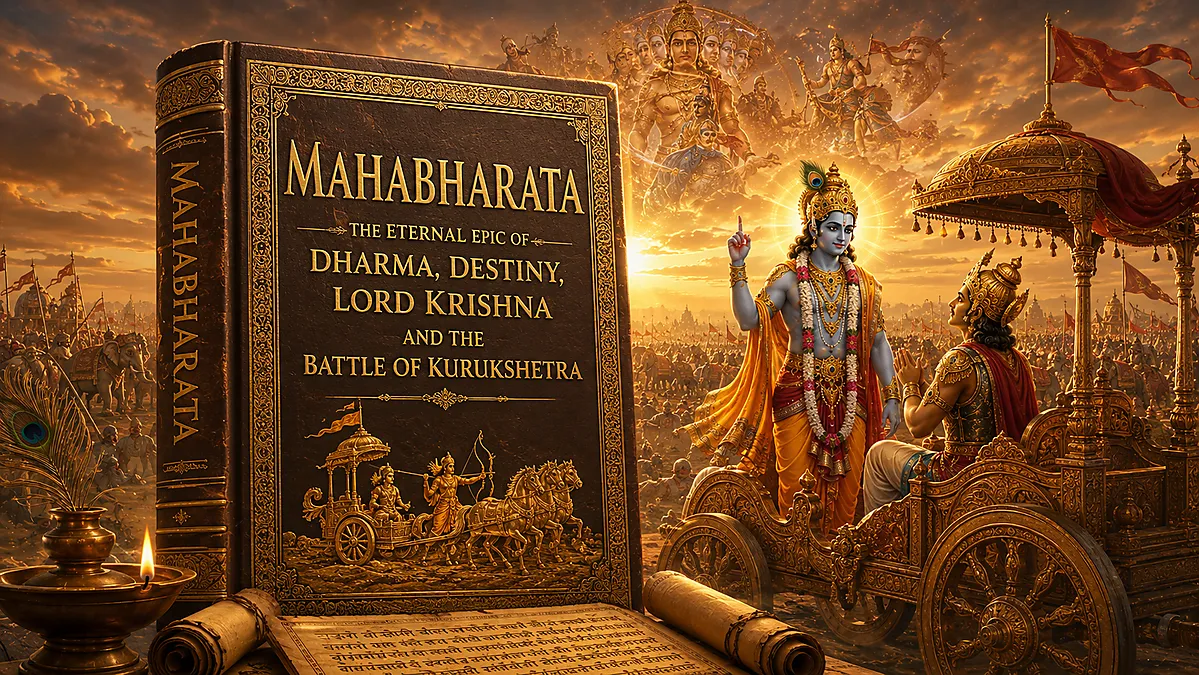
Somewhere across these plains—now quiet farmlands dotted with shrines—two vast armies once faced each other. The conch shells blew. The chariots thundered. A prince named Arjuna looked at the faces of his grandfathers, teachers, and cousins standing on the opposite side, and his heart shattered. He turned to his charioteer, a man named Krishna, and asked a question that has haunted humanity ever since:
“How can I fight my own family? How can I choose between duty and love?”
Krishna’s answer—the Bhagavad Gita—became the spiritual anchor of Hinduism. But the Mahabharata is far more than the Gita’s setting. It is the greatest story ever told—an epic of ambition and sacrifice, loyalty and betrayal, divine grace and human folly.
The Mahabharata is not merely a poem composed by a sage in a distant age. It is a mirror held up to the human soul. Every time you face a difficult choice between what is easy and what is right, you are standing on the battlefield of Kurukshetra. Every time you feel the pull of jealousy, the ache of rejection, the weight of duty, you are walking in the footsteps of its characters.
Let us step onto that sacred ground together.
WHAT IS THE MAHABHARATA?
The Longest Poem Ever Written
The word Mahabharata literally means “The Great Tale of the Bharata Dynasty.” Traditionally attributed to the sage Vyasa, it is one of the two major Itihasas (sacred epics) of Sanatana Dharma, the other being the Ramayana.
Its longest version consists of over 100,000 shlokas (verses) or over 200,000 individual lines, making it roughly ten times the length of the Iliad and the Odyssey combined, or about four times the length of the Ramayana. At about 1.8 million words, it is the longest known epic poem in world literature. Even the critical edition has nearly 75,000 verses.
Itihasa: Sacred History
The Mahabharata belongs to the Smriti (“that which is remembered”) tradition. It is classified as Itihasa (“thus indeed it happened”), meaning it is considered sacred history—an account of real events, real people, and real places, preserved through the ages.
But more than history, the Mahabharata is described as a treatise on life itself—an encyclopedia of dharma (righteousness), artha (prosperity), kama (desire), and moksha (liberation), known collectively as the purusharthas, the four aims of human existence.
The Traditional Author: Sage Vyasa
The authorship of the Mahabharata is traditionally attributed to the sage Krishna Dvaipayana Vyasa, who is regarded by Hindus as a partial incarnation of Lord Vishnu. Vyasa is also credited with compiling the Vedas into four texts and writing the eighteen Puranas and the Brahma Sutras. The festival of Guru Purnima (Vyasa Purnima) is dedicated to him.
Inside the Epic: The Bhagavad Gita
Embedded within the Mahabharata, specifically in the Bhishma Parva (Book of Bhishma), is the Bhagavad Gita—the 700-verse dialogue between Krishna and Arjuna that is the spiritual heart of the epic and one of the most beloved scriptures in all of Hinduism.
THE ORIGIN OF THE KURU DYNASTY: SEEDS OF CONFLICT
The Mahabharata begins centuries before the war of Kurukshetra, with a king named Shantanu. While walking along the banks of the Ganga, he fell in love with a beautiful woman—the goddess Ganga herself. She agreed to marry him on one strange condition: he could never question her actions, no matter how terrible they appeared. When Ganga drowned their first seven sons one by one, Shantanu remained silent. But when she raised her hand to drown the eighth, he cried out in anguish.
Ganga revealed her purpose: the eight children were the Vasus, cursed to be born as mortals. By drowning them, she was releasing them from their curse. She kept the eighth son, Devavrata, with her.
Years later, Shantanu fell in love with Satyavati, a fisherwoman. Her father agreed to the marriage only on the condition that Satyavati’s children, not Devavrata, would inherit the throne.
To make his father happy, Devavrata took a terrible oath: he would renounce his claim to the throne and remain celibate for life, so that his children would never challenge Satyavati’s descendants. The gods, witnessing this sacrifice, rained flowers upon him and called him Bhishma—”one who has taken a terrible oath.”
Bhishma’s vow was noble, but it set in motion a chain of events that would eventually lead to the destruction of his family. Satyavati had two sons: Chitrangada and Vichitravirya. Both died young without heirs. To preserve the dynasty, Bhishma arranged for the sage Vyasa (born from Satyavati before her marriage) to father sons on Vichitravirya’s widows through niyoga (a practice of levirate marriage).
Thus were born three children:
- Dhritarashtra, the eldest, born blind.
- Pandu, pale and sickly.
- Vidura, born from a maid, the wisest of them all.
Dhritarashtra, though the eldest, could not be king because of his blindness. Pandu became king instead. He was cursed by a sage: if he ever approached a woman with desire, he would die. His wives, Kunti and Madri, bore children through divine fathers invoked by powerful mantras. Kunti gave birth to Yudhishthira (by Dharma, the god of righteousness), Bhima (by Vayu, the wind god), and Arjuna (by Indra, the king of gods). Madri gave birth to twins, Nakula and Sahadeva (by the Ashwini twins).
These were the Pandavas.
Dhritarashtra, despite his blindness, ruled as regent. He had a hundred sons by his wife Gandhari, who, in a fit of jealousy at Pandu’s fertility, struck her womb and produced a lump of flesh, which Vyasa divided into a hundred potted embryos. The eldest was Duryodhana. They were known as the Kauravas (descendants of Kuru).
The stage was set for the greatest conflict in human history.
THE COMPLETE STORY THROUGH THE 18 PARVAS
The Mahabharata is divided into 18 Parvas (books), which are further subdivided into chapters and verses. The 18 Parvas are traditionally grouped into three sections of six, corresponding to the three gunas. Let us walk through this vast epic story.
Adi Parva – The Book of the Beginning
The first Parva introduces the epic’s frame story: Sage Vyasa composes the Mahabharata and teaches it to his disciple Vaishampayana, who narrates it to King Janamejaya at a snake sacrifice. Janamejaya is the great-grandson of the Pandavas, and the recitation is meant to console his grief.
This Parva covers the origin of the Kuru dynasty, the birth of the Pandavas and Kauravas, their childhood, and the seeds of rivalry. Young Duryodhana burns with jealousy, especially toward the mighty Bhima, whom he tries to poison. Duryodhana’s scheming uncle, Shakuni (the prince of Gandhara), fans the flames of his nephew’s envy.
The Parva culminates with Arjuna winning the hand of Draupadi—the beautiful, fiery princess born from a sacrificial fire—at her swayamvara (self-choice ceremony). When he returns home and announces, “Look what I have found,” his mother Kunti, without seeing it, replies, “Whatever it is, share it equally among your brothers.” Bound by this royal command, all five Pandavas become the husbands of Draupadi.
Sabha Parva – The Book of the Assembly Hall
The Pandavas build a magnificent palace at Indraprastha, Maya Danava serving as architect. Yudhishthira performs the Rajasuya Yajna (royal consecration sacrifice), establishing his supremacy over all kings. Duryodhana is invited to see the palace, but it is a hall of illusions—floors that look like water, water that looks like solid ground. He mistakes a solid door for glass and falls into a pool. Draupadi laughs, and Duryodhana burns with humiliation.
Shakuni, the master of dice, challenges Yudhishthira to a gambling match. Yudhishthira, bound by dharma to accept any challenge from a fellow Kshatriya, cannot refuse. He loses everything—his kingdom, his brothers, himself, and finally, Draupadi.
Duryodhana’s brother, Dushasana, drags Draupadi into the court by her hair and attempts to disrobe her. In that moment of ultimate degradation, Draupadi prays to Krishna, who miraculously extends her sari so that the Kauravas cannot strip her naked.
Enraged and dishonored, Draupadi vows not to tie her hair until she has washed it with Dushasana’s blood. Bhima vows to drink Dushasana’s blood and break Duryodhana’s thigh. The Pandavas are sent into exile for twelve years, followed by a thirteenth year in hiding, to be lived incognito.
Vana Parva – The Book of the Forest
The Pandavas wander in the wilderness, enduring hardship and receiving spiritual teachings from sages. Arjuna performs intense penance and wins celestial weapons from Lord Shiva. The Parva contains many philosophical discourses and the famous story of Nala and Damayanti—another couple who lost everything through gambling.
Virata Parva – The Book of Virata
The Pandavas spend their final year of exile incognito in King Virata’s court: Yudhishthira as a courtier, Bhima as a cook, Arjuna as a eunuch dance teacher, Nakula as a horse trainer, Sahadeva as a cowherd, and Draupadi as the queen’s hairdresser. When the king’s cattle are stolen by the Kauravas, the Pandavas reveal themselves and save the kingdom.
Udyoga Parva – The Book of the Effort
Krishna attempts to broker peace. He travels to the Kaurava court and offers a compromise: let the Pandavas rule five villages. Duryodhana refuses: “I will not give them enough land to fit the head of a pin!” Krishna reveals his cosmic form to the assembled court, but only the wise Vidura and the devoted Karna recognize it. War becomes inevitable.
Bhishma Parva – The Book of Bhishma
The great war begins. On the first day, Arjuna asks Krishna to drive his chariot between the two armies. He sees his grandfather Bhishma, his teacher Drona, and his cousins—all standing on the opposite side. His heart fails. He throws down his bow. This is the setting of the Bhagavad Gita (Chapters 25–42 of the Bhishma Parva), where Krishna teaches him about the immortality of the soul, the nature of dharma, and the path of selfless action.
Ten days of slaughter follow, with Bhishma commanding the Kaurava forces. Arjuna finally defeats Bhishma, hiding behind the warrior woman Shikhandi (whom Bhishma, bound by honor, will not fight). Bhishma falls on a bed of arrows and chooses the auspicious moment of Uttarayana (the winter solstice) to depart his body.
Drona Parva – The Book of Drona
Drona becomes the Kaurava commander. He unleashes devastating weapons, and the battlefield runs with blood. On the thirteenth day, the Kauravas deploy the Chakravyuha (a lotus-shaped battle formation that only a few warriors know how to enter). Abhimanyu, Arjuna’s young son, knows how to enter but not how to exit. He enters alone and is surrounded and brutally killed by seven warriors. Bhima rages, vowing revenge.
The Pandavas finally kill Drona by spreading a rumor that his son Ashwatthama is dead. Drona lays down his weapons, and Dhrishtadyumna (the general of the Pandava army) beheads him.
Karna Parva – The Book of Karna
Karna—the son of Kunti, born before her marriage, abandoned as a baby, and raised by a charioteer—commands the Kaurava forces. He is Arjuna’s equal in archery, but cursed and plagued by misfortune. His chariot wheel sinks into the mud; while he struggles to free it, Arjuna shoots him down, with Krishna urging him, “Kill him now!”
Shalya Parva – The Book of Shalya
Shalya, the king of Madra and Nakula and Sahadeva’s maternal uncle, becomes the final Kaurava commander. The last day of the war ends with a mace fight between Bhima and Duryodhana. Bhima breaks Duryodhana’s thighs—honoring Draupadi’s vow—by striking below the waist, a move forbidden in mace combat. But the war is over.
Sauptika Parva – The Book of the Sleeping Warriors
That night, the enraged Ashwatthama sneaks into the Pandava camp and kills all the remaining warriors, including the five sons of Draupadi, while they sleep. Only the five Pandavas and Krishna survive.
Stri Parva – The Book of the Women
The women of the Kuru dynasty lament the dead. Gandhari, the mother of the Kauravas, confronts Krishna and curses him: “Thirty-six years from today, your own Yadava dynasty will destroy itself, and you will die alone in the forest.”
Shanti Parva & Anushasana Parva – The Books of Peace and Instruction
Yudhishthira is crowned king. Bhishma, still lying on his bed of arrows, gives a long philosophical discourse on dharma, governance, and the duties of a king. These two books are the longest in the Mahabharata.
Ashvamedhika Parva – The Book of the Horse Sacrifice
Yudhishthira performs the Ashvamedha Yajna (horse sacrifice) to establish his sovereignty. Arjuna follows the sacrificial horse on a world conquest.
Ashramavasika Parva – The Book of the Hermitage
Dhritarashtra, Gandhari, and Kunti renounce the world and retire to the forest. They die in a forest fire—a tragic end.
Mausala Parva – The Book of the Mace
Thirty-six years pass. Gandhari’s curse manifests. The Yadava clan kills each other in a drunken brawl. Krishna’s brother Balarama dies, and Krishna himself is shot in the foot by a hunter’s arrow, mistaken for a deer. He returns to his divine abode.
Mahaprasthanika Parva – The Book of the Great Journey
The five Pandavas and Draupadi renounce their kingdom and begin a pilgrimage toward the Himalayas, hoping to ascend to heaven in their physical bodies. One by one, they fall and die. Only Yudhishthira reaches the summit.
Svargarohana Parva – The Book of the Ascent to Heaven
Yudhishthira arrives in heaven—but finds Duryodhana and the Kauravas gloriously seated, while his brothers are nowhere to be found. He refuses to stay without them. He descends to hell to retrieve them. Finally, he learns that all souls must undergo purification before reaching their eternal destination. The cycle concludes.
LORD KRISHNA – THE DIVINE GUIDE OF THE MAHABHARATA
The Incarnation of Vishnu
The Mahabharata presents Krishna as the mortal incarnation (avatara) of Lord Vishnu, who descends to the earthly plane to uphold dharma. He is not merely a character; he is the spiritual axis around which the entire epic revolves. As Swami Krishnananda writes, “He undertook this role not out of personal need, but to support those who sought His grace.”
Krishna as Friend, Strategist, and Diplomat
Krishna plays a unique role in the war: though he sides with the Pandavas, he refuses to bear arms. Instead, he offers a choice: either his entire army, the Narayani Sena, on one side; or himself alone, unarmed, on the other. Duryodhana, foolishly valuing quantity over quality, chooses the army. Arjuna chooses Krishna.
Thus, Krishna becomes Arjuna’s charioteer—a servant, not a general. He guides Arjuna’s chariot into the most dangerous parts of the battlefield, yet he holds no weapon. This is the profound symbolism of the Gita: the Divine is not our agent to do our work but our guide, helping us see clearly so we can act rightly.
Krishna also protects the dignity of Draupadi when Dushasana tries to strip her in the court.
Krishna as Teacher: The Bhagavad Gita
When Arjuna despairs on the battlefield, it is Krishna who delivers the Bhagavad Gita—a complete syllabus of spiritual life. He reveals his Vishvarupa (Cosmic Form), showing Arjuna that all events, including this terrible war, are part of the cosmic dance of time.
THE GREAT CHARACTERS OF THE MAHABHARATA
Yudhishthira – The King of Dharma
The eldest Pandava is the son of Dharma, the god of righteousness. He is the personification of truth and virtue. Yet, his addiction to gambling—and his fatalistic acceptance of Shakuni’s challenge—becomes the catalyst for all the tragedy that follows. Yudhishthira teaches us that even the most virtuous person can have a blind spot that causes immense suffering.
Bhima – The Mighty Protector
The second Pandava, son of Vayu (the wind god), is a warrior of immense physical strength, famous for his mace-fighting skills. He is the fierce protector of the family. His vows—to drink Dushasana’s blood and break Duryodhana’s thighs—are savage, but they arise from a protective anger that refuses to allow injustice to go unpunished.
Arjuna – The Peerless Archer
The third Pandava, son of Indra (the king of the gods), is the world’s greatest archer. He is the seeker-student in the Bhagavad Gita, representing every person who faces a difficult moral choice. He embodies courage, skill, humility, and the capacity to receive wisdom.
Draupadi – The Incandescent Heroine
The common wife of the five Pandavas is one of the most powerful female figures in world literature. She is fire incarnate—proud, articulate, and fearless. She is also an authority on the responsibilities of a woman. Her appeal to dharma in the court of Hastinapur is a searing indictment of the failures of those who claim to follow righteousness. She teaches that dignity, once violated, can demand justice without apology.
Karna – The Tragic Warrior
The son of Kunti born before her marriage, Karna is abandoned by his mother, raised by a charioteer, and rejected by the world. Yet he rises to become a warrior equal to Arjuna. His loyalty to Duryodhana, who sees his true worth, is absolute. He is a symbol of the person who has everything—talent, generosity, courage—except the social validation that might allow him to be happy. He teaches that circumstance can trap a noble soul in a tragic fate.
Bhishma – The Grandsire Bound by Vows
The son of Ganga, Bhishma took a terrible oath of celibacy to give up his claim to the throne. His entire life is a study in the complexity of dharma: by upholding his vow of loyalty to the throne of Hastinapur, he is forced to fight against the righteous Pandavas, whom he loves. He can give them advice, but he cannot act against the Kaurava side. He teaches that vows, once taken, can imprison the soul in contradictions.
Duryodhana – The Emperor of Envy
The eldest of the hundred Kauravas is not a simple villain. He is a brilliant warrior, a loyal friend, and a generous patron. But he is consumed by jealousy of the Pandavas. His envy turns to hatred, his hatred to cruelty (the attempt to disrobe Draupadi), and his cruelty to a determination to go to war, even when his own advisers plead for peace. He teaches that envy is a poison that destroys not only its victim but everyone around it.
Vidura – The Wise Counselor
The half-brother of Dhritarashtra, Vidura is the wisest person in the court. His counsel is consistently ignored. He teaches that wisdom without power can only witness tragedy, not prevent it.
THE GREAT WAR OF KURUKSHETRA: DHARMA IN FLAMES
The battlefield was called Kurukshetra, meaning “the field of the Kuru” or “the field of action.” It is also called Dharmakshetra, “the field of righteousness.”
The war lasted eighteen days. Each day was a chess match of strategies, formations (vyuhas), and devastating divine weapons.
Key Events:
- Day 1–10 (Bhishma Parva): Commanded by Bhishma, the Kaurava forces strike fear into the Pandava army. Bhishma knows that the Pandavas cannot kill him while he fights, so he gives them permission to hide behind Shikhandi (a princess transformed into a man who had been a female warrior in a past life). On the tenth day, Arjuna uses Shikhandi as a shield and rains arrows upon Bhishma, who falls on a bed of arrows.
- Day 11–15 (Drona Parva): Drona takes command. He uses a deadly tactic, the Chakravyuha, to kill Arjuna’s son Abhimanyu on the thirteenth day—a turning point that fuels Bhima’s rage.
- Day 16–17 (Karna Parva): Drona is dead. Karna takes command. On the final day of his life, Karna’s chariot wheel sinks into the mud. He cannot free it. Arjuna, at Krishna’s urging, kills him.
- Day 18 (Shalya Parva): The last commander, Shalya, is killed. The mace duel between Bhima and Duryodhana ends the war with Duryodhana’s thigh broken.
After the war, Yudhishthira walked across the blood-soaked earth and saw the bodies of his family, friends, and teachers. He did not rejoice. He wept. Victory felt like defeat.
The Mahabharata asks a question that every military leader should consider: Was the victory worth the cost?
THE HIDDEN WISDOM OF THE MAHABHARATA: DHARMA FOR MODERN LIFE
The Mahabharata is not a simple tale of good versus evil. It is a deeply ambiguous exploration of moral choice.
The epic’s famous line, Yato dharmastato jayah, means, “Where there is dharma, there is victory.” But what is dharma? The Mahabharata never gives a simple answer. It shows dharma as contextual, conflicted, and often heartbreaking.
Family Conflict Resolution
Duryodhana’s jealousy and Yudhishthira’s inability to say no to a gambling challenge are recognizable behaviors in any family. The epic teaches that unaddressed envy and addiction to risk are not neutral—they are destructive.
Leadership: Duryodhana vs. Yudhishthira
The epic contrasts two models of leadership: Duryodhana’s model, driven by unethical means, greed, and envy; and Yudhishthira’s model, driven by humility, transparency, spiritual grounding, and accountability.
The Limits of Non-Violence
The Mahabharata wrestles with a question that haunts our world: When is violence a duty? Arjuna, the great pacifist at the start of the war, ends up committing terrible violence. Krishna’s teaching is not that violence is good but that refusing to fight when one’s dharma requires it is itself a form of adharma. The epic does not resolve this tension; it presents it honestly.
Emotional Intelligence
Arjuna’s dilemma on the battlefield is recognized as one of the most profound explorations of emotional intelligence—the ability to manage one’s own emotions and make a decision aligned with dharma.
The Yaksha Prashna
In the forest, a Yaksha (a nature spirit) asks Yudhishthira a series of profound questions. The answers distill the epic’s ethical wisdom. One question: “What is the most wonderful thing?” Answer: “Every day, we see creatures dying, yet we live as if we are immortal. No wonder is greater than this.”
SACRED GEOGRAPHY OF THE MAHABHARATA: WALKING THROUGH HISTORY
The Mahabharata is not just a story; it is a map of India’s sacred landscape. The locations associated with the epic are pilgrimage sites today, where the events are honored as part of living tradition.
Kurukshetra (Haryana)
The most important site—the very ground where the war was fought. At the heart of Kurukshetra lies Brahma Sarovar, a vast water tank believed to have been created by Lord Brahma, where pilgrims take a holy dip. Nearby, Jyotisar is revered as the place where Lord Krishna delivered the sacred Bhagavad Gita to Arjuna. A large banyan tree is said to be a silent witness to the divine discourse.
Other significant sites include Sannihit Sarovar, believed to be the meeting point of seven Saraswati rivers, and the Bhadrakali Temple, one of the 51 Shakti Peeths.
Hastinapur (Uttar Pradesh)
The capital of the Kuru kingdom, identified with present-day Hastinapur in Meerut district of Uttar Pradesh. Here, visitors can see the Pandeshwar Temple, Draupadi Ghat, Karna Temple, and Vidur Tila. The Vidur Kuti is another important pilgrimage site.
Indraprastha (Present-Day Delhi)
The magnificent city built by Maya Danava for the Pandavas. It is now associated with the Purana Qila (Old Fort) in Delhi.
Dwarka (Gujarat)
The magnificent city built by Vishwakarma for Lord Krishna after he moved from Mathura. It was supposed to have had 900,000 royal palaces constructed with crystal and silver. The current Dwarka is one of the four sacred Char Dham pilgrimage sites. The city is believed to have been submerged after Krishna’s departure.
Virat Nagar (Modern-day Jaipur region)
King Virata’s kingdom, where the Pandavas spent their thirteenth year incognito.
Badrinath (Uttarakhand)
The sage Vyasa is said to have composed the Mahabharata in a cave near this Himalayan temple. It is one of the four Char Dham sites.
Swargarohini (Uttarakhand)
The peak in the Garhwal Himalayas where the Pandavas are said to have begun their final ascent to heaven, falling one by one.
Other Significant Sites
| Site | Mahabharata Association |
| Barnawa (Varnavat) | The “House of Lac” (Lakshagriha) where Duryodhana tried to burn the Pandavas alive |
| Kampilya | The capital of the Panchala kingdom, Draupadi’s homeland |
| Ekachakra | Bhima killed the demon Bakasura here |
| Prabhasa | The place where the Yadava clan destroyed itself, fulfilling Gandhari’s curse |
| Naimisharanya | Where the Mahabharata was first recited by Suta |
For pilgrims, walking these sites is to step into the living geography of the Mahabharata, where stones and rivers still bear the names and stories of the epic’s heroes and heroines.
THE BHAGAVAD GITA WITHIN THE MAHABHARATA: THE SONG OF SELF-KNOWLEDGE
Embedded within the Bhishma Parva (Chapters 25–42) is the Bhagavad Gita—700 verses that have become one of the most influential spiritual texts in human history.
Arjuna’s Dilemma
As the two armies prepare to clash, Arjuna asks Krishna to drive his chariot between them. He sees his grandfather Bhishma, his teacher Drona, his cousins, his relatives—all standing on the opposite side, ready to kill and be killed. His resolve crumbles. He throws down his bow and refuses to fight:
“Krishna, what pleasure can come from killing my own family? Even if they kill me, I would rather lay down my arms than strike them down.”
Krishna’s Response
Krishna does not offer a simple answer. He offers a complete spiritual education:
- The Immortal Soul (Atman): The body dies, but the soul within is eternal, unborn, unchanging. “Never was there a time when I did not exist, nor you, nor these kings. Nor shall any of us cease to be hereafter.”
- The Law of Action (Karma Yoga): “You have a right to action alone, never to its fruits. Let not the fruit of action be your motive, nor let your attachment be to inaction.”
- The Path of Devotion (Bhakti Yoga): “Fix your mind on Me, be devoted to Me, sacrifice to Me, bow down to Me. Having thus united your whole self with Me, you shall come to Me.”
- The Cosmic Form (Vishvarupa): Krishna reveals his identity as the Lord of the Universe—time itself, the destroyer of worlds.
The Final Teaching
The Gita ends with the most radical instruction: “Abandon all varieties of dharma and come to Me alone for refuge. I will liberate you from all sins. Do not grieve.”
The Gita teaches that action, knowledge, and devotion are not separate—they are limbs of a single path. Work without attachment, know the Self, and love the Divine. This synthesis is the unique gift of the Gita.
TIMELESS VERSES OF THE MAHABHARATA
Here are seven verified verses from the Mahabharata (including the Bhagavad Gita) that capture the epic’s essential wisdom.
Verse 1: The Immortal Soul (Bhagavad Gita 2.20)
Devanagari:
न जायते म्रियते वा कदाचिन् नायं भूत्वा भविता वा न भूयः।
अजो नित्यः शाश्वतोऽयं पुराणो न हन्यते हन्यमाने शरीरे॥
IAST Transliteration:
Na jāyate mriyate vā kadācin nāyaṁ bhūtvā bhavitā vā na bhūyaḥ |
Ajo nityaḥ śāśvato ‘yaṁ purāṇo na hanyate hanyamāne śarīre ||
Source Citation: Bhagavad Gita 2.20
Word-by-Word:
- Na – not; Jāyate – is born; Mriyate – dies; Kadācit – ever
- Na – not; Ayam – this (Self); Bhūtvā – having come into being; Bhavitā – will come into being; Na – not; Bhūyaḥ – again
- Ajaḥ – unborn; Nityaḥ – eternal; Śāśvataḥ – everlasting; Ayam – this; Purāṇaḥ – ancient
- Na hanyate – is not slain; Hanyamāne – when it is slain; Śarīre – the body
Translation: “The Self is never born nor does it ever die. It is not that having come into being, it will cease to be again. The Self is unborn, eternal, everlasting, ancient. It is not slain when the body is slain.”
Practical Life Lesson: Do not fear death. The real you—awareness, consciousness—cannot be destroyed. This knowledge is the foundation of courage in the face of life’s greatest uncertainty.
Verse 2: Right to Action Alone (Bhagavad Gita 2.47)
Devanagari:
कर्मण्येवाधिकारस्ते मा फलेषु कदाचन।
मा कर्मफलहेतुर्भूर्मा ते सङ्गोऽस्त्वकर्मणि॥
IAST Transliteration:
Karmaṇy evādhikāras te mā phaleṣu kadācana |
Mā karma-phala-hetur bhūr mā te saṅgo ‘stv akarmaṇi ||
Source Citation: Bhagavad Gita 2.47
Word-by-Word:
- Karmaṇi – in action; Eva – only; Adhikāraḥ – right; Te – your
- Mā – not; Phaleṣu – in the fruits; Kadācana – ever
- Mā – not; Karma-phala-hetuḥ – cause of the fruit of action; Bhūḥ – become
- Mā – not; Te – your; Saṅgaḥ – attachment; Astu – let there be; Akarmaṇi – to inaction
Translation: “You have a right to action alone, never to its fruits. Let not the fruit of action be your motive, nor let your attachment be to inaction.”
Practical Life Lesson: This is the practical antidote to anxiety. Do your best, but let go of the outcome. Work without attachment to results.
Verse 3: The Steady Wisdom (Bhagavad Gita 2.62–63)
Devanagari:
ध्यायतो विषयान्पुंसः सङ्गस्तेषूपजायते।
सङ्गात्सञ्जायते कामः कामात्क्रोधोऽभिजायते॥
क्रोधाद्भवति सम्मोहः सम्मोहात्स्मृतिविभ्रमः।
स्मृतिभ्रंशाद् बुद्धिनाशो बुद्धिनाशात्प्रणश्यति॥
Source Citation: Bhagavad Gita 2.62–63
Translation: “When a person dwells on the objects of the senses, attachment to them arises. From attachment, desire is born. From desire, anger arises. From anger comes delusion. From delusion, loss of memory. From loss of memory, destruction of discrimination. From destruction of discrimination, he perishes.”
Practical Life Lesson: Watch the subtle chain reaction in your own mind—contact with stimulus leads to wanting, wanting to frustration, frustration to suffering. Cut the chain at the first link: mindful contact.
Verse 4: Seeing Equally (Bhagavad Gita 5.18)
Devanagari:
विद्याविनयसम्पन्ने ब्राह्मणे गवि हस्तिनि।
शुनि चैव श्वपाके च पण्डिताः समदर्शिनः॥
Source Citation: Bhagavad Gita 5.18
Translation: “The wise see with equal vision a brahmin endowed with learning and humility, a cow, an elephant, a dog, and a dog-eater.”
Practical Life Lesson: True wisdom dissolves prejudice. The same consciousness shines in all beings. Practice seeing the unity beneath differences—it is the foundation of compassion.
Verse 5: The Supreme Yoga (Bhagavad Gita 6.32)
Devanagari:
आत्मौपम्येन सर्वत्र समं पश्यति योऽर्जुन।
सुखं वा यदि वा दुःखं स योगी परमो मतः॥
Source Citation: Bhagavad Gita 6.32
Translation: “He who sees the happiness and suffering of all beings as his own, through the analogy of his own self—that yogi, O Arjuna, is considered the highest.”
Practical Life Lesson: The highest spiritual realization is not a trance; it is empathy. When you feel another’s pain as your own, you are living the truth of non-duality.
Verse 6: Conquering Anger (Mahabharata, Udyoga Parva)
Sanskrit Text:
अक्रोधेन जयेत्क्रोधमसाधुं साधुना जयेत्।
जयेत्कदर्यं दानेन जयेत्सत्येन चानृतम्॥
Source Citation: Mahabharata, Udyoga Parva 39.60–61 (prose sections)
Translation: “Conquer anger by non-anger. Conquer evil by goodness. Conquer the miser by giving. Conquer falsehood by truth.”
Practical Life Lesson: You cannot defeat hatred with more hatred, or lies with more lies. Meet darkness with light. This is the practical application of the highest ethics.
Verse 7: Where Dharma Is, There Is Victory
Sanskrit Text:
यतो धर्मस्ततो जयः
IAST Transliteration:
Yato dharmastato jayaḥ
Source Citation: Mahabharata, general principle
Translation: “Where there is dharma, there is victory.”
Practical Life Lesson: This is the epic’s most famous moral—and its most contested. The Mahabharata shows us that victory is not always immediate, clean, or even easy to recognize. But over time, righteousness, truth, and integrity are the only stable foundations for any civilization.
WHY THE MAHABHARATA STILL MATTERS TODAY
The Mahabharata is not a text to be placed on a shelf and admired. It is a mirror held up to our own lives.
For Families
Every family has its rivalries, jealousies, and conflicts over inheritance. The Mahabharata shows the cost of allowing these resentments to fester: the destruction not only of the family but of an entire generation.
For Leaders and Professionals
The epic contrasts two models of leadership: Duryodhana’s (driven by greed and envy) and Yudhishthira’s (grounded in humility and accountability). It asks every leader: Are you surrounding yourself with yes-men, or with truth-tellers like Vidura? Are you focused on short-term victory, or on long-term stability?
For Seekers of Truth
The Bhagavad Gita within the Mahabharata offers a complete spiritual path—action without attachment, knowledge of the Self, and devotion to the Divine. You do not need to renounce the world. You need to see the world differently.
For Anyone Facing a Moral Dilemma
Arjuna’s question on the battlefield is your question: “What should I do when every choice seems wrong?” The Mahabharata does not give a simple answer. It gives permission to struggle, to ask, to weep—and then to act, with clarity, once you have done the hard work of moral reasoning.
For Pilgrims
Walking the ground of Kurukshetra, bathing at Brahma Sarovar, and sitting under the banyan tree at Jyotisar is to enter the story—not as a spectator but as a participant. The Mahabharata is not “over there” in the past. It is happening in your heart, right now.
The Mahabharata teaches that life is a battlefield. You cannot avoid the fight. But you can choose your weapon: clarity over confusion, dharma over adharma, love over fear.
As the epic ends, Yudhishthira arrives in heaven and finds his brothers in hell. He refuses to enter paradise without them. The gods smile. This, finally, is the highest dharma: to refuse one’s own liberation as long as any being suffers.
Jai Shri Krishna.
FREQUENTLY ASKED QUESTIONS
Q1: What is the Mahabharata about?
A: The Mahabharata is a vast epic that tells the story of a dynastic struggle between two branches of the Kuru family—the five Pandavas and the hundred Kauravas—over the throne of Hastinapur. This conflict culminates in the eighteen-day war of Kurukshetra. It also contains the Bhagavad Gita, a profound spiritual dialogue between Krishna and Arjuna.
Q2: Who wrote the Mahabharata?
A: The Mahabharata is traditionally attributed to the sage Vyasa (also known as Krishna Dvaipayana). He is a central character in the epic as well as its author.
Q3: How many verses does the Mahabharata have?
A: The Mahabharata consists of over 100,000 shlokas (verses), or over 200,000 individual lines. At about 1.8 million words, it is roughly ten times the length of the Iliad and Odyssey combined.
Q4: Why did the Kurukshetra war happen?
A: The war was the result of Duryodhana’s jealousy of the Pandavas and his refusal to return their rightful share of the kingdom. It followed a rigged dice game, the Pandavas’ exile, and the failure of Krishna’s peace mission.
Q5: What is the Bhagavad Gita?
A: The Bhagavad Gita is a 700-verse spiritual dialogue embedded within the Mahabharata. It is a conversation between Arjuna and Krishna on the battlefield of Kurukshetra, dealing with dharma, yoga, the nature of the Self, and devotion to the Divine.
Q6: Who was Lord Krishna’s role in the Mahabharata?
A: Krishna was Arjuna’s charioteer and guide. He did not take up arms but served as a strategic advisor and teacher. He delivered the Bhagavad Gita and sided with the Pandavas to uphold dharma.
Q7: Is the Mahabharata a historical text or a mythological one?
A: In Hindu tradition, the Mahabharata is considered Itihasa (“thus indeed it happened”)—sacred history, not mythology. Archaeological and geological evidence supports the existence of sites mentioned in the epic, such as Hastinapur, Dwarka, and Kurukshetra. Many Hindus regard the events as historically real, while also recognizing their allegorical and spiritual significance.
Q8: Where is Kurukshetra located?
A: Kurukshetra is a city in the modern-day state of Haryana, India, about 160 kilometers north of Delhi. It is an important Hindu pilgrimage site.
Q9: What is the significance of the 18 Parvas?
A: The 18 Parvas correspond to the 18 days of the war and represent a complete guide to life—from birth (Adi Parva) to death and beyond (Svargarohana Parva). Many commentators note that the 18 Parvas also relate to the 18 chapters of the Bhagavad Gita, symbolizing the completeness of the teaching.
Q10: Is the Mahabharata relevant for modern readers?
A: Yes. Its themes—family conflict, ambition, jealousy, ethical decision-making, leadership, duty, sacrifice, loss—are universal. Modern readers find in the Mahabharata a profound exploration of the moral complexities of everyday life.
Q11: Why is the Bhagavad Gita placed within the Mahabharata?
A: The Gita serves as the spiritual center of the epic. By placing it at the moment of greatest crisis—with two armies facing each other—the text shows that spiritual wisdom is not for the ashram alone. It is for the battlefield. It is for the hardest moments of life.
Q12: How long did the war of Kurukshetra last?
A: According to the epic, the war lasted 18 days. Each day is described in detail in the Bhishma, Drona, Karna, and Shalya Parvas.
Q13: Are there any authentic English translations of the Mahabharata?
A: Yes. The most complete English translation is Kisari Mohan Ganguli’s 1896 translation (available online). More recent and accessible is Bibek Debroy’s 10-volume translation (Penguin). For the Gita section, Eknath Easwaran is excellent for beginners.
Q14: What is the main lesson of the Mahabharata?
A: The epic’s central teaching is dharma—righteousness—and its complexity. It teaches that dharma is not a set of rules to be memorized but a living, context-dependent reality. It also teaches that action without attachment (karma yoga) is the path to inner peace, and that love (bhakti) is the highest path to the Divine.
Q15: Can I visit Mahabharata-related pilgrimage sites?
A: Absolutely. The main sites are Kurukshetra, Hastinapur, Dwarka, Indraprastha (Purana Qila in Delhi), Bharadwaj Ashram (Prayagraj), Chitrakoot, and Badrinath. Many of these are accessible by road and rail from major Indian cities.
BEGIN YOUR JOURNEY THROUGH THE MAHABHARATA
You have journeyed through the world’s longest epic poem—from the oaths of Bhishma to the dice game that shattered a kingdom, from the eighteen days of slaughter to the final ascent of the Pandavas into heaven.
But this guide is only the map. The territory awaits you.
Where to Start Reading
If you are new to the Mahabharata, begin with an abridged version:
- “The Mahabharata: A Modern Rendering” by Ramesh Menon (2 volumes) – Accessible prose for beginners.
- “Jaya: An Illustrated Retelling of the Mahabharata” by Devdutt Pattanaik – Engaging and visually rich.
- “The Mahabharata” by C. Rajagopalachari – A classic, one-volume abridgment (ideal for a first read).
For the complete translation:
- Bibek Debroy’s 10-volume translation (Penguin) – The most accessible complete translation for modern readers.
- Kisari Mohan Ganguli’s 1896 translation – Available for free online at sacred-texts.com and archive.org.
For the Bhagavad Gita specifically:
- Eknath Easwaran’s “The Bhagavad Gita” – Highly readable, poetic, and accurate.
A Final Blessing
The Mahabharata is not a book you finish. It is a book that finishes you—and then rebuilds you. Every time you face a difficult choice, you will recall Arjuna’s despair. Every time you witness jealousy tearing apart a relationship, you will see Duryodhana. Every time you offer wise counsel to a friend in need, you become Vidura.
The epic is a living presence in the world—chanted in temples, recited in homes, performed in village squares, and wrestled with in boardrooms and university classrooms.
May the wisdom of the Mahabharata guide you through your own battles—with clarity, courage, and the steady hand of dharma.
Om Shanti Shanti Shanti.
Jai Shri Krishna.
This article published at PrayagTourism.com – Your guide to the sacred scriptures, pilgrimage sites, and eternal wisdom of Sanātana Dharma.