
Table of Contents
A Winter Pilgrimage to the Sangam
The alarm rings at 3:30 AM. Outside, the world is still wrapped in darkness, and the January cold bites through every layer of clothing. But in Prayagraj, the streets are already stirring. E-rickshaws hum softly as they carry pilgrims toward the river, their headlights cutting through the thick winter fog.
You arrive at the ghat while the stars are still visible. The river before you is a sheet of dark glass, barely disturbed by the gentle current. Thousands of pilgrims have already gathered, wrapped in shawls and blankets, their breath forming clouds in the cold air. The first sounds reach your ears – the distant clang of a temple bell, the soft chanting of a priest beginning his morning prayers, the gentle lapping of water against the stone steps.
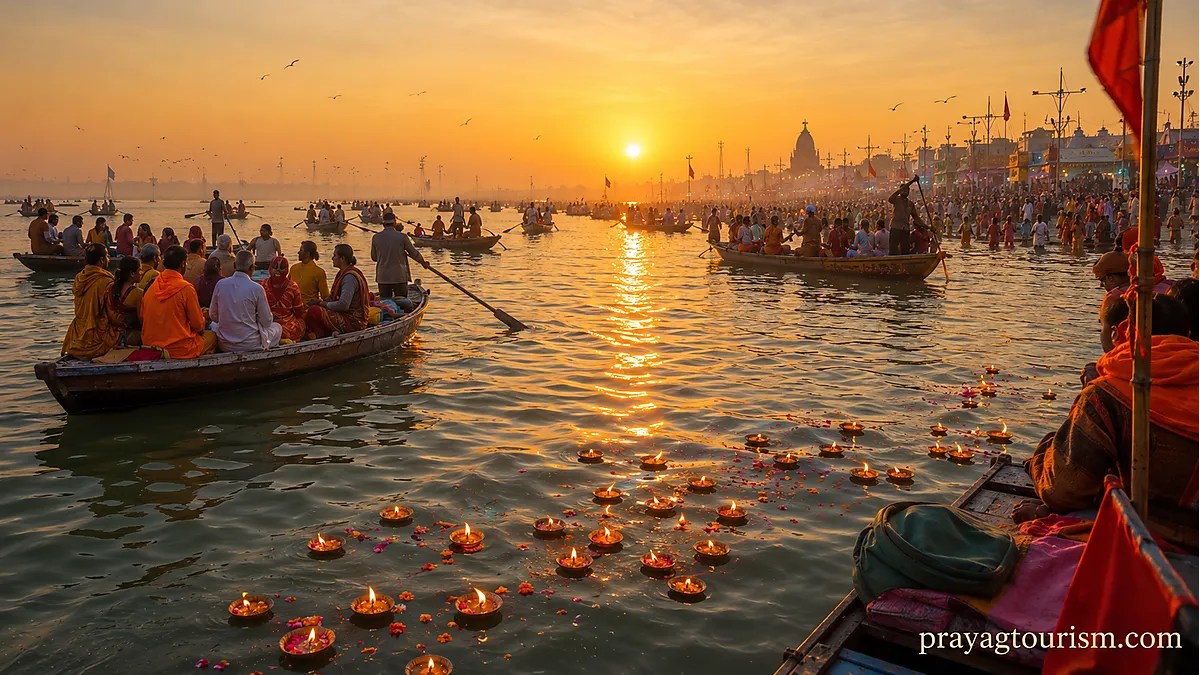
As you descend toward the water’s edge, the world begins to transform. The eastern horizon shifts from deep purple to pink, then to orange. The dark waters catch the first light, turning gold. Temple bells from across the river join the chorus. A saint wrapped in saffron robes walks past, his eyes fixed on the horizon, his lips moving in silent prayer.
You step into the water. It is cold – bracingly so. The initial shock takes your breath away. But as you submerge yourself, a profound stillness descends. The chatter fades, the boats become silent, and for a fleeting moment, there is only you and the sacred confluence of the Ganga, Yamuna and the invisible Saraswati.
Around you, thousands of pilgrims perform the same ritual. Some chant “Har Har Gange.” Others sit in silent prayer. A family offers floating diyas (lamps) to the river. A Kalpavasi, having already been living on the banks for weeks, smiles peacefully as he completes his morning bath.
What inspires millions of pilgrims to gather every year at Prayagraj during the coldest weeks of winter?
The answer lies not merely in tradition or religious obligation. It lies in a deep, abiding faith – the belief that the waters of the Triveni Sangam carry the power to wash away lifetimes of sin, that the discipline of Kalpavas can lead to liberation, and that the Magh Mela offers a rare opportunity to connect with the divine, with community, and with oneself.
Quick Facts – Magh Mela Prayagraj 2027 at a Glance
| Attribute | Details |
| Event | Magh Mela Prayagraj 2027 |
| Location | Triveni Sangam, Prayagraj, Uttar Pradesh |
| Duration | Approximately 45–60 days (based on traditional calendar) |
| Primary Activities | Magh Snan (holy bath), Kalpavas (month-long spiritual discipline), prayers, discourses |
| Special Tradition | Kalpavas – living on riverbanks for one month |
| Ideal For | Pilgrims, spiritual seekers, tourists, photographers |
| Best Time for Pilgrims | Major snan days (see table below) |
| Best Time for Tourists | Between major bathing dates to avoid extreme crowds |
Important Note: Official Magh Mela 2027 dates have not yet been formally announced by the Prayagraj Mela Authority as of this writing. Based on the traditional Hindu calendar, the festival is expected to take place from approximately mid-January to late February/early March 2027. Major bathing dates are derived from astronomical calculations. Readers are advised to confirm dates with official sources closer to the event.
What is Magh Mela? – The Annual Gathering of Faith
Magh Mela is an annual religious gathering held on the banks of the Triveni Sangam in Prayagraj – the sacred confluence of the Ganga, Yamuna and the mythical Saraswati rivers. The festival derives its name from the Hindu month of Magh (January–February), during which it is observed.
1. Spiritual Significance
Magh Mela is deeply rooted in Hindu tradition. According to scriptures, bathing at the Sangam during the month of Magh brings spiritual purification and is believed to cleanse sins accumulated over lifetimes. The Padma Purana and Skanda Purana state that bathing in holy rivers during this sacred period brings greater spiritual merit than performing intense penance for many years.
The festival’s location at Triveni Sangam amplifies its sacred power exponentially. Hindu cosmology recognizes river confluences as natural temples where divine energies concentrate most intensely. The Triveni Sangam represents the ultimate such convergence, creating a geographical point where three distinct divine energies merge into a unified spiritual force.
2. The Astronomical Significance
The timing of Magh Mela aligns with cosmic cycles that traditional Hindu understanding considers optimal for spiritual advancement. The sun’s northward journey (Uttarayana) beginning from Makar Sankranti creates favourable cosmic conditions that enhance meditation, prayer and spiritual transformation throughout the festival period.
3. Magh Mela as “Mini Kumbh”
Magh Mela is often described as a “Mini Kumbh Mela” – a smaller version of the grand Kumbh Mela that occurs every 12 years. While Kumbh Mela draws astronomical crowds, Magh Mela offers a more intimate yet still deeply spiritual experience. It is held annually, making it more accessible to pilgrims who cannot wait for the larger 12-year cycle.
History of Magh Mela – Ancient Roots, Enduring Traditions
The origins of Magh Mela are deeply embedded in Hindu mythology and ancient scriptures. The festival finds mention in the Mahabharata, major Puranas, and other ancient Hindu texts, indicating that the tradition of gathering at the Triveni Sangam during the Magh month is thousands of years old.
1. Puranic References
According to the Padma Purana and Mahabharata, performing Kalpavas during the Magh month on the banks of the Ganga bestows virtues equivalent to 100 years of penance. The Padma Purana outlines 21 strict rules that a Kalpavasi must follow, covering mind, speech and action, designed to facilitate a transformative journey toward spiritual elevation.
2. The Legend of Creation
Some traditions trace the origin of Magh Mela to the beginning of the Universe itself. Hindu mythology considers the Triveni Sangam as one of the most sacred places in Sanatan Dharma, a site where the divine and the earthly meet.
3. Ancient Pilgrim Accounts
The Chinese pilgrim Hsuan Tsang (Xuanzang) , who visited the site in the 7th century CE, documented large religious gatherings at Prayag where hundreds of thousands would bathe in the sacred confluence. While his accounts primarily describe events related to the Kumbh Mela, they confirm the ancient and continuous tradition of mass pilgrimage at this sacred site.
4. Modern Development
Today, Magh Mela is organized by the Prayagraj Mela Authority, established by the Uttar Pradesh government to manage the logistics of this massive annual gathering. The mela area transforms into a temporary city, complete with roads, electricity, water supply, police stations, medical camps and pontoon bridges.
Kalpavas – The Heart of Magh Mela
1. What Is Kalpavas?
Kalpavas (also spelled Kalpvas) is the month-long period of spiritual discipline observed by devotees during Magh Mela. The word “Kalpavas” means “living by the banks of the Ganga for a month,” typically from Paush Purnima to Maghi Purnima.
The term “Kalp” in ancient Hindu Vedas refers to a period equal to the total number of years in the four yugas – Satyug, Treta, Dwapar and Kalyug – which adds up to several millions of years. By observing Kalpavas, a devotee symbolically prepares for this immense cosmic cycle through concentrated spiritual practice.
2. Who Are Kalpavasis?
Those who religiously observe Kalpavas are known as Kalpavasis. They come from all walks of life – farmers, businessmen, teachers, retired professionals and entire families. Some Kalpavasis stay for the full month, while others observe shorter durations of 3, 5 or 11 days, depending on their conscience.
3. The 21 Rules of Kalpavas
According to the Padma Purana, a Kalpavasi must abide by 21 strict rules covering mind, speech and action, designed to facilitate a transformative journey towards spiritual elevation. These include:
- Daily bathing in the Ganga – typically three times a day (dawn, afternoon and evening)
- Simple meals – most Kalpavasis eat only once a day
- Abstaining from vices – no alcohol, no non-vegetarian food, no intoxicants
- Celibacy during the observance period
- Truthfulness and non-violence in thought, word and deed
- Devotion through chanting of mantras and listening to religious discourses
- Meditation and prayer throughout the day
4. Sankalp – The Sacred Vow
The Kalpavas begins with a Sankalp – a formal vow taken at the Triveni Sangam, mentioning the devotee’s name, gotra (lineage), the purpose of the observance, and the duration of the stay. This ritual marks the official commencement of the spiritual discipline.
5. Completing 12 Kalpavas
According to scriptures, completing 12 Kalpavas (observing the month-long discipline for 12 consecutive years) is considered highly rewarding and liberating. After 12 Kalpavas, a Kalpavasi must perform Shayya Daan – donating their bed and all belongings, symbolizing complete renunciation.
6. Kalpavas as a Spiritual Gateway
According to Sanatan tradition, Kalpavas serves as a spiritual gateway, transitioning an individual from the ‘Vanaprastha’ (forest-dweller) to the ‘Sanyas’ (renunciate) stage of life. It is a profound practice for inner and outer rejuvenation, allowing the devotee to step away from worldly attachments and focus entirely on spiritual growth.
Daily Life of a Kalpavasi – A Month of Discipline
The life of a Kalpavasi follows a disciplined routine that begins well before dawn and continues until nightfall.
1. Early Morning (3:00 AM – 5:00 AM)
Kalpavasis wake up before the first light of dawn. After morning ablutions, they walk to the river for the first bath of the day. This morning dip at sunrise is considered the most important of the three daily baths. They stand in the cold water facing the rising sun, offering prayers and chanting mantras.
2. Morning Prayers and Discourses (5:00 AM – 10:00 AM)
After the bath, Kalpavasis return to their tents for prayers and meditation. Many visit the akharas (camps of saints and sadhus) to listen to spiritual discourses and participate in bhajans and kirtans.
3. Midday – One Meal and Afternoon Rest (10:00 AM – 2:00 PM)
Most Kalpavasis eat only one meal a day, typically taken before noon. The food is simple, sattvic (pure vegetarian), and prepared without onion or garlic. After the meal, some rest while others continue their spiritual practices.
4. Afternoon – Second Bath and Study (2:00 PM – 4:00 PM)
A second bath is taken in the afternoon. Kalpavasis spend the remaining daylight hours studying scriptures, chanting mantras, or participating in group spiritual activities.
5. Evening – Third Bath and Aarti (4:00 PM – 6:00 PM)
The third bath is taken before sunset. As darkness falls, the evening aarti begins at the ghats – thousands of diyas (lamps) are lit and floated on the river, while conch shells, bells and devotional songs fill the air.
6. Night – Meditation and Rest (6:00 PM – 10:00 PM)
After the evening aarti, Kalpavasis return to their tents for night prayers and meditation. They sleep on simple bedding on the ground, without the comforts of their home beds. The next day begins again before dawn.
This routine, repeated for 30 days, is designed to strip away physical comforts and worldly distractions, allowing the devotee to focus entirely on spiritual growth. Many Kalpavasis report feeling a profound sense of inner peace and transformation by the end of their observance.
Magh Mela 2027 Bathing Dates – Auspicious Snan Days
The sacred snan (bathing) dates align with the most important holy bathing days in Hindu tradition during the January–February period. These days are considered the most auspicious times for ritual bathing and spiritual purification.
1. Important Notice
Official Magh Mela 2027 dates have not yet been formally announced as of this writing. The dates provided below are based on the traditional Hindu calendar and astronomical calculations. The Prayagraj Mela Authority typically announces official dates 3–6 months before the event.
The following dates are derived from panchang (Hindu calendar) calculations and are intended as a planning guide. Readers are strongly advised to confirm all dates with official sources closer to the event.
2. Major Snan Dates for Magh Mela 2027 (subject to change)
| Date (2027) | Day | Snan Day | Significance |
| January 15 | Friday | Makar Sankranti | Marks the beginning of the sun’s northward journey (Uttarayana). Considered the first major bathing day of Magh Mela. |
| January 22 | Friday | Paush Purnima | Full moon day. Marks the traditional start of Kalpavas. |
| February 6 | Saturday | Mauni Amavasya | The most powerful bathing day. Devotees observe silence (maun vrat). Believed to offer deep spiritual cleansing. |
| February 11 | Thursday | Basant Panchami | Marks the arrival of spring. Represents the union of wisdom and purity. |
| February 20 | Saturday | Maghi Purnima | Full moon day. Marks the conclusion of the month-long Kalpavas for many devotees. |
| March 6 | Saturday | Mahashivratri | The final major bathing day. Dedicated to Lord Shiva. Concludes the Magh Mela season. |
3 Significance of Each Snan Day
Makar Sankranti (January 15, 2027 – Friday): This day marks the transition of the sun into the zodiac sign of Capricorn (Makara), signifying the beginning of Uttarayana – the sun’s northward journey. It is considered one of the most auspicious days in the Hindu calendar for holy baths.
Paush Purnima (January 22, 2027 – Friday): This full moon day marks the traditional beginning of Kalpavas. Devotees who intend to observe the full month-long discipline take their Sankalp (vow) on this day.
Mauni Amavasya (February 6, 2027 – Saturday): This is the most important bathing day of Magh Mela. Devotees observe silence (maun vrat) throughout the day, turning their focus inward. It is believed that the water of the holy Ganges turns into nectar on this day, and taking a bath in the Ganges is considered especially holy. This day attracts the largest crowds – often millions of pilgrims bathing at the Sangam.
Basant Panchami (February 11, 2027 – Thursday): This day marks the arrival of spring and is associated with Goddess Saraswati, the deity of wisdom, knowledge and arts. Bathing at the Sangam on this day is believed to bring wisdom and purity.
Maghi Purnima (February 20, 2027 – Saturday): The full moon day that concludes the Magh month. For many Kalpavasis, this marks the completion of their month-long observance.
Mahashivratri (March 6, 2027 – Saturday): The final major bathing day, dedicated to Lord Shiva. This day concludes the Magh Mela season for most pilgrims.
Why Bathing at Sangam Is Considered Sacred
The Triveni Sangam is not merely a geographical location; it is one of the holiest sites in Sanatan Dharma. A bath at the Sangam is believed to:
- Cleanse all sins (papa nasha) accumulated over many lifetimes
- Liberate the soul from the cycle of birth and death (moksha)
- Benefit one’s ancestors for generations
- Grant spiritual merit (punya) equivalent to performing ancient royal sacrifices
- Scriptural References
According to the Padma Purana and Skanda Purana, bathing in holy rivers during the Magh month brings greater spiritual merit than performing intense penance for many years. The Mahabharata also extols the virtues of bathing at Prayag, mentioning the specific merits of Kalpavas.
As one scriptural verse proclaims:
“Those who bathe at the place where the two rivers, white and dark, flow together, rise up to heaven.”
2. The Power of the Confluence
Hindu cosmology recognizes river confluences as natural temples where divine energies concentrate most intensely. The Triveni Sangam represents the ultimate such convergence – a point where three distinct divine energies (Ganga, Yamuna and Saraswati) merge into a unified spiritual force.
3. The Month of Magh
The month of Magh is considered particularly auspicious for spiritual practices. Ancient texts describe specific benefits associated with Magh Mela participation, including karmic purification, spiritual merit accumulation and divine grace acquisition that can accelerate spiritual progress equivalent to lifetimes of ordinary spiritual practice.
Accommodation During Magh Mela – Where to Stay
1. Tent Cities (Most Popular)
The most immersive way to experience Magh Mela is to stay in the tent cities established along the riverbanks. During Magh Mela, the mela area transforms into a temporary city covering hundreds of hectares, with roads, electricity, water supply, police stations and medical camps.
Types of Tent Accommodation:
| Tent Type | Features | Estimated Price Range |
| Basic Pilgrim Tents | Simple tents, shared facilities, very basic amenities | ₹500 – ₹1,500 per night |
| Deluxe Tents | Cottages with bedroom, attached washroom, furniture, electricity | ₹7,500 – ₹8,500 per night |
| Luxury Tents | Premium cottages, enhanced amenities, better furnishings | ₹11,500 – ₹12,500 per night |
| Premium Tents | Highest category, best furnishings, extra space | ₹15,000 – ₹18,000 per night |
Source for premium/luxury/deluxe categories:
During the 2026 Magh Mela, the UPSTDC (Uttar Pradesh State Tourism Development Corporation) set up a tent colony at Arail Ghat with 50 modern cottages in three categories – premium, luxury and deluxe – with online booking available through the UPSTDC website. Similar arrangements are expected for 2027.
UPSTDC Tent City Features (based on 2026 experience):
- Bedroom with proper bed and Sheesham wood furniture
- Dressing-cum-store room
- Attached washroom with modern facilities
- Front lobby
- Yagyashalas (sacrificial halls) with continuous bhajan-kirtan
- Sattvic (pure vegetarian) food service
- Kala Gram (art village) showcasing local crafts and folk art
2. Hotels in Prayagraj
| Hotel Category | Price Range | Features |
| Budget Hotels | ₹800 – ₹2,000 per night | Basic amenities, located in city centre |
| Mid-Range Hotels | ₹2,000 – ₹6,500 per night | Comfortable rooms, good locations |
| Luxury Hotels | ₹6,500 – ₹15,000+ per night | Premium amenities, best locations |
3. Ashrams and Dharamshalas
- Ramakrishna Math & Mission Sevashrama – offers simple accommodation for pilgrims
- Various temple trusts run dharamshalas (pilgrim rest houses) with very basic facilities
- Typically very economical (₹200 – ₹500 per night)
4. Government Camps
The Uttar Pradesh government and Mela Authority set up organized camps with basic infrastructure – including clean toilets, drinking water and medical facilities – often at nominal cost.
5. Booking Tips
- Book well in advance – especially for premium/luxury tents and during peak bathing days (Mauni Amavasya sees the highest crowds)
- Online booking is available through UPSTDC’s official website for tent city accommodations
- TripCosmos and Dharmik Bharat Yatra offer pre-arranged tent booking packages with guided assistance
- For budget pilgrims, dharamshalas and basic tents are available on a first-come, first-served basis
Travel Planning – How to Reach Prayagraj
1. By Air
Prayagraj Airport (IXD) is located at Bamrauli, approximately 12 km from the city centre. The airport operates domestic flights connecting to major cities including Delhi, Mumbai, Kolkata and Bengaluru.
From the airport:
- Pre-paid taxis to Sangam area: approximately ₹400 – ₹600
- Ola/Uber services available
- During Magh Mela, special shuttle services operate from the airport
2. By Train
Prayagraj is well-connected by rail, with several railway stations serving the city:
| Station | Code | Distance to Sangam | Primary Use |
| Prayagraj Junction (PRYJ) | PRYJ | 5–6 km | Main station; best connectivity |
| Prayagraj Rambag (PRRB) | PRRB | 6–7 km | Secondary station |
| Prayagraj Sangam (PYGS) | PYGS | Near Sangam | Close to mela area |
Special Magh Mela Trains: Indian Railways operates special trains during Magh Mela to accommodate the surge in pilgrims. Based on past patterns, special trains may include routes such as:
- Lucknow – Prayagraj
- Kanpur – Prayagraj
- Varanasi – Prayagraj
- Gorakhpur – Prayagraj
- Gwalior – Prayagraj
Note: Specific 2027 Magh Mela special train schedules will be announced by Indian Railways closer to the event.
3. By Road
Prayagraj is well-connected by national highways:
- NH 19 (Delhi – Kolkata) passes through Prayagraj
- NH 30 (Varanasi – Lucknow) passes through the city
Road Distances:
- Varanasi: ~120 km (3 hours)
- Lucknow: ~200 km (4–4.5 hours)
- Kanpur: ~100 km (2.5 hours)
- Ayodhya: ~160 km (3.5–4 hours)
- Delhi: ~700 km (11–12 hours)
Bus Services:
- UPSRTC (Uttar Pradesh State Road Transport Corporation) operates regular and special services
- Private bus operators also connect Prayagraj to major cities
4. Local Transportation During Magh Mela
| Mode | Best For | Estimated Cost |
| E-rickshaw | Short distances, Sangam access | ₹20 – ₹50 per ride |
| Auto-rickshaw | Short to medium distances | ₹50 – ₹150 |
| Shuttle buses | Between parking zones and mela area | ₹10 – ₹30 |
| Private taxi (Ola/Uber) | Comfort, longer distances | ₹200 – ₹600 |
| Pontoon bridges | Walking across the river within mela area | Free |
Important: The mela area becomes a no-vehicle zone on major bathing days. Designated parking zones are established on the outskirts, connected by shuttle buses to the mela grounds.
Safety Guide for Pilgrims – Practical Advice
1. Crowd Safety
Magh Mela draws massive crowds, particularly on major bathing days. Mauni Amavasya typically sees the highest footfall – often millions of pilgrims in a single day.
Practical Tips:
- Stay with your group – designate a meeting point in case someone gets lost
- Avoid peak bathing hours (6:00–10:00 AM) on major snan days if you wish to avoid the heaviest crowds
- Use designated routes – follow the signage and directions from mela authorities
- Be aware of your surroundings – keep valuables secure and remain alert
2. River Safety
- Do not swim away from the designated bathing areas – the current can be deceptive
- Take assistance from boatmen or volunteers when entering the water for the holy dip
- Avoid bathing if you are unwell or have serious medical conditions
- The water is very cold in January–February – limit your time in the water to 5–10 minutes
3. Winter Weather Safety
- Layer your clothing – mornings in January–February can be 5–10°C
- Wear woolen socks, gloves and a cap during early morning bathing
- Carry a waterproof bag for dry clothes
- Change into dry clothes immediately after bathing to avoid hypothermia
- Stay hydrated – despite the cold, dehydration can occur
4. Elderly Pilgrims
- Private motorboats are recommended for elderly pilgrims (₹800–1,200 per boat)
- Assisted boarding is available at designated ghats
- Senior citizen discounts (10–20%) are offered by many operators (generally for those above 60 years)
- Avoid the most crowded bathing times – consider bathing on less crowded days
5. Children
- Always keep children supervised – crowds can separate families quickly
- Life jackets are mandatory for children on boats
- Dress children in bright colors so they are easily identifiable
- Carry identification with contact information
6. Health Precautions
- Carry personal medicines – medical camps are available but may not have all medications
- Wear comfortable footwear – you will walk considerable distances on uneven ground
- Drink only bottled or filtered water – avoid tap water
- Wash hands frequently – sanitation facilities are available throughout the mela area
- Seek medical attention immediately if you feel unwell
7. Personal Belongings
- Carry minimal valuables – leave expensive jewellery, large amounts of cash at home
- Use digital payments where possible – UPI and digital wallets are widely accepted
- Keep important documents in a waterproof pouch
- Use a cross-body bag worn in front to deter pickpockets
8. Emergency Services
- Magh Mela Control Room – established by the Mela Authority
- Police stations – multiple police posts established within the mela area
- Medical camps – multiple locations with doctors and first-aid facilities
- CCTV surveillance – the mela area is monitored by hundreds of CCTV cameras
- NDRF teams – specialized disaster response teams are deployed for river safety
9. Prohibited Items
- Alcohol and non-vegetarian food are prohibited within the mela area
- Smoking is restricted to designated zones
- Large bags and luggage are not permitted near bathing ghats on major snan days
What to Expect During Magh Mela – The Tent City Experience
- The Scale of the Gathering
During Magh Mela, the Prayagraj riverfront transforms into a temporary city of tents, camps, ashrams, akharas (monastic orders) and markets. For the 2026 Magh Mela, over 12–15 crore pilgrims were expected over the 44-day period. Similar or larger numbers are anticipated for 2027.
2. The Tent City Atmosphere
Walking through the mela grounds is an experience like no other. Rows upon rows of tents – from simple cloth shelters to deluxe cottages with modern amenities – line the sandy banks. The air is filled with:
- The sound of devotional songs (bhajans) and temple bells
- The fragrance of incense and camphor
- The shouts of vendors selling religious items, snacks and clothing
- The chanting of mantras from various akharas
3. Saints and Akharas
One of the most fascinating aspects of Magh Mela is the presence of saints, sadhus and ascetics from various akharas (monastic orders). These include:
- Naga Sadhus – ascetics who remain naked, covered in ash, representing the most extreme renunciation
- Urdhvavahurs – ascetics who believe in rigorous physical disciplines
- Parivajakas – wandering monks who have taken vows of silence
- Shirshasins – ascetics who remain standing or sleep on beds of nails
Visiting the akharas allows pilgrims to observe ancient spiritual traditions, participate in discourses, and receive blessings.
4. Spiritual Discourses and Cultural Programs
Throughout the Mela, spiritual leaders and scholars conduct discourses (katha, pravachan) on scriptures like the Ramayana, Bhagavad Gita and Puranas. Evening cultural programs include classical music, dance and devotional performances.
5. The Sangam Experience
The Triveni Sangam remains the focal point of the entire Mela. Pilgrims bathe here at sunrise, offer prayers, perform rituals for ancestors (pind daan), and take boat rides to the exact confluence point.
6. The Boat Ride Experience
Boats are available from multiple ghats to take pilgrims to the confluence. During Magh Mela, boat numbers increase significantly to accommodate the rush.
Estimated Charges (based on past Mela patterns):
| Boarding Ghat | Approx Round-Trip Fare |
| Arail Ghat and Mela Ghat | ₹75 per person |
| Qila Ghat | ₹90 per person |
| Balua Ghat | ₹150 per person |
Source: Based on 2026 Magh Mela official rates; 2027 rates to be announced.
Food, Facilities and Essential Services
1. Food Options
The Mela area offers a variety of food options:
- Prasad stalls – offering free or nominal cost meals
- Food courts – with paid sattvic (pure vegetarian) meals
- Restaurants – near the Mela area and in the city
- Hotel and tent packages – meals included in many packages
Most food available is strictly vegetarian (no eggs, onion or garlic in sattvic meals).
2. Drinking Water
- RO water stations – established throughout the mela area
- Bottled water – available from vendors
- Carry your own bottle – reusable water bottles recommended
3. Toilets and Sanitation
- Public toilets – numerous facilities established across the mela grounds
- Maintained regularly – sanitation staff work around the clock during the Mela
- Wash stations – available near major ghats and food areas
4. Medical Facilities
- Mela hospitals – multiple locations with doctors and emergency services
- First-aid posts – scattered throughout the grounds
- Ambulance services – available for emergency transport
- Specialized care – arrangements for elderly and differently-abled pilgrims
5. Banking and ATMs
- Temporary bank branches – established within the mela area
- ATMs – multiple locations with regular replenishment
- Digital payment – widely accepted (UPI, cards)
6. Mobile Connectivity
- Network coverage – all major providers have good coverage
- Additional towers – temporary towers erected for the Mela
- Public Wi-Fi – sometimes available in designated zones
7. Lost and Found
- Lost and Found centres – established at major Mela administration points
- Control rooms – can be contacted for assistance locating lost persons
Best Photography Opportunities
Magh Mela offers extraordinary photographic opportunities for both professional and amateur photographers.
| Subject | Best Location | Best Time | Tips |
| Sunrise at Sangam | Arail Ghat or from a boat | 5:30–6:30 AM | Capture golden light on the confluence; use a polarizing filter |
| Pilgrims bathing | Designated ghats | 6:00–8:00 AM | Ask permission; capture devotional moments |
| Kalpavasi camps | Tent cities | Morning light | Document daily life; warm winter light on tents |
| Saints and sadhus | Akhara areas | Throughout the day | Always ask permission; respect privacy |
| Evening aarti | Saraswati Ghat | Sunset (5:30–7:00 PM) | Capture floating diyas and illuminated ghats |
| Mela markets | Shopping zones | Daytime | Colorful scenes, local crafts, crowds |
| Bird photography | Sangam area | Early morning (Nov–Feb) | Migratory birds (seagulls) arrive in winter |
Ethical Photography Tips:
- Always ask for permission before photographing saints, sadhus or individuals bathing
- Avoid intrusive angles – maintain respectful distance
- Do not use flash inside temples or during rituals
- Be mindful of privacy – avoid photographing individuals in vulnerable moments
Magh Mela vs Kumbh Mela – Understanding the Difference
| Aspect | Magh Mela | Kumbh Mela |
| Frequency | Annual – held every year | Every 12 years (full Kumbh); Ardh Kumbh every 6 years |
| Scale | Smaller, more intimate | Massive – world’s largest gathering |
| Crowds | 1–5 crore over 45 days (estimated) | 10–25 crore over 45 days |
| Spiritual Focus | Magh Snan and Kalpavas | Shahi Snan (royal baths) with akhara processions |
| Naga Sadhus | Present | More prominent with elaborate processions |
| Infrastructure | Well-developed but smaller scale | Extremely extensive – temporary city with 800+ hectares |
| Best For | Regular pilgrims seeking annual observance | Those who want the ultimate experience |
Key distinction: Kumbh happens once every 12 years, but Magh is the same ritual bathing that happens every year with fewer crowds. The yearly festival itself provides a better option for religious bathing with fewer crowds, and devotees can further enjoy peaceful worship.
Frequently Asked Questions (FAQs)
1. What is Magh Mela Prayagraj?
Magh Mela is an annual religious gathering held on the banks of the Triveni Sangam in Prayagraj during the Hindu month of Magh (January–February). It is known for holy bathing (Magh Snan) and the month-long spiritual discipline of Kalpavas.
2. When is Magh Mela 2027?
Official dates have not yet been formally announced. Based on the traditional calendar, the festival is expected to take place from approximately mid-January to early March 2027. Major bathing dates include Makar Sankranti (January 15), Paush Purnima (January 22), Mauni Amavasya (February 6), Basant Panchami (February 11), Maghi Purnima (February 20) and Mahashivratri (March 6).
3. What is Kalpavas?
Kalpavas is a month-long period of spiritual discipline observed during Magh Mela, where devotees (“Kalpavasis”) live on the banks of the Ganga for approximately 30 days, following strict rules including daily bathing, simple meals, celibacy, prayer and meditation.
4. How long does Magh Mela last?
Magh Mela typically lasts approximately 45–60 days, from the start of the Magh month to Mahashivratri.
5. Is accommodation available during Magh Mela?
Yes. Options include tent cities (from basic to luxury), hotels in the city, ashrams, dharamshalas and government camps. Booking online through UPSTDC is available for tent city accommodations.
6. How crowded is Magh Mela?
Crowds vary by day. Major bathing days – especially Mauni Amavasya – see the highest crowds (millions of pilgrims). Weekdays and non-bathing days are significantly less crowded.
7. What is the most important bathing day during Magh Mela?
Mauni Amavasya is considered the most powerful bathing day. Devotees observe silence and take a holy dip, believing the waters turn into nectar on this day.
8. Is Magh Mela suitable for tourists (non-pilgrims)?
Yes. Magh Mela offers a unique cultural and spiritual experience. The infrastructure, food options and accommodation cater to both pilgrims and tourists.
9. Can I visit Magh Mela as a Kalpavasi without staying the full month?
Yes. Some devotees observe shorter durations of 3, 5 or 11 days instead of the full month.
10. Is there an entry fee for Magh Mela?
No. The Mela grounds are free to enter. Boat rides, accommodation and food are paid services.
11. How do I book a tent for Magh Mela 2027?
Tent bookings can be made online through:
- UPSTDC official website (for government-run tent cities)
- TripCosmos – offers Magh Mela tent packages
- Dharmik Bharat Yatra – offers accommodation booking
12. Are boat rides available during Magh Mela?
Yes. Boats operate from multiple ghats. During peak days, boat numbers increase significantly. Life jackets are mandatory.
13. Is Magh Mela safe for women and families?
Yes. The Mela Authority deploys extensive security, including CCTV surveillance, police patrols and dedicated women’s help desks. Female travelers should still follow standard safety precautions.
14. What should I wear during Magh Mela?
- For bathing: Modest, warm clothing (winter mornings are cold)
- For general Mela visits: Comfortable, modest clothing – simple cotton or traditional attire
- Footwear: Sandals or slip-ons (easy to remove)
15. What is the difference between Magh Mela and Kumbh Mela?
Magh Mela is held annually, while Kumbh Mela is held every 12 years. Kumbh is much larger in scale, with more elaborate rituals and greater prominence of Naga Sadhus.
16. Can I perform Pind Daan at Magh Mela?
Yes. Pind Daan (ancestral offerings) is one of the main rituals performed at the Triveni Sangam during Magh Mela. Local pandits are available to assist with the ceremony.
17. Are there senior citizen facilities?
Yes. Senior citizen discounts (10–20%) are offered by many boat operators. Assisted boarding is available at designated ghats. Private motorboats are recommended for elderly pilgrims.
18. What is the nearest airport?
Prayagraj Airport (IXD) is approximately 12 km from the Sangam area.
19. What is the nearest railway station?
Prayagraj Junction (PRYJ) is the main station, approximately 5–6 km from the Sangam area. Prayagraj Sangam Station (PYGS) is even closer to the Mela grounds.
20. Is drinking water available inside the Mela grounds?
Yes. RO water stations and bottled water are available throughout the Mela area.
Why Magh Mela Remains Relevant Today
In a world of increasing distraction and disconnection, Magh Mela offers something rare and precious: an opportunity to step outside the ordinary – to live simply, to focus on what truly matters, and to connect with a community of fellow seekers.
Spiritual Discipline in a Chaotic World: The discipline of Kalpavas – waking before dawn, bathing in cold water, eating one meal a day, dedicating every hour to prayer and meditation – stands in stark contrast to modern life’s comforts and distractions. Yet it is precisely this contrast that makes Magh Mela transformative. For a month, the Kalpavasi strips away the unnecessary and rediscovers what is essential.
Community and Connection: In a world of increasing isolation, Magh Mela brings millions together in a shared purpose. The sense of community – of being part of something larger than oneself – is profound. Pilgrims from different regions, speaking different languages, belonging to different castes and backgrounds, come together on the banks of the same sacred river.
A Living Tradition: Magh Mela is not a re-enactment or a tourist spectacle. It is a living tradition that has continued uninterrupted for thousands of years. When you bathe at the Sangam during Magh Mela, you are not merely participating in a ritual; you are joining a river of devotion that has flowed for millennia.
Inner Transformation: Pilgrims who have observed Kalpavas often speak of feeling transformed – not by any single dramatic event, but by the cumulative effect of a month of discipline, prayer and simplicity. The habits cultivated during Kalpavas – waking early, eating simply, focusing the mind – can persist long after the Mela ends.
Why Every Spiritual Seeker Should Experience Magh Mela
Standing at the Sangam before dawn, with thousands of pilgrims around you, chanting and praying as the first rays of the sun touch the sacred waters – this is an experience that transcends words.
Imagine waking at 3:30 AM in a simple tent, the cold air sharp on your face, the distant sound of temple bells calling you to the river. Imagine walking through the tent city as it comes alive – saints in saffron robes emerging from their ashrams, families gathering for morning prayers, the air thick with the fragrance of incense.
Imagine stepping into the water – the initial shock of cold, then the surprising warmth that follows, the feeling of purification, of surrender, of connection to something ancient and eternal.
Imagine listening to a saint’s discourse under a tent, surrounded by hundreds of pilgrims, all united in their search for meaning. Imagine sharing a simple meal with strangers who become friends, their stories and struggles mirroring your own.
Magh Mela is more than a festival. It is more than a pilgrimage. It is an immersion in the sacred – a month-long opportunity to step away from the noise of daily life and listen to the silence within.
Magh Mela is a living spiritual tradition where faith, discipline, simplicity and devotion come together at the sacred confluence of India’s holiest rivers. Whether you come for a day, a week or a month, the experience will stay with you forever.
Related Sacred Journeys
- Triveni Sangam – The sacred confluence at the heart of Prayagraj
- Prayag Mahatmya – The complete glorification of Prayagraj as Tirtharaja
- Magh Snan – The sacred bath during the month of Magh
- Kumbh Mela – The world’s largest spiritual gathering (every 12 years)
- Kalpavas – Month-long spiritual discipline on the Sangam banks
- Triveni Sangam Boat Booking – Complete guide to boat types, charges and sunrise rides
- Prayagraj Sangam Ghat – Complete visitor guide to rituals, photography and boat access
- Shringverpur Dham – Where Lord Rama met Nishadraj Guha
- Bharadwaj Ashram – Ancient hermitage visited by Lord Rama
- Akshayavat – The immortal banyan tree inside Allahabad Fort
May your journey to Magh Mela Prayagraj be blessed. May the sacred waters of the Triveni Sangam purify your body, mind and soul. May the discipline of Kalpavas bring you closer to your true self. And may the experience of this ancient gathering remain in your heart as a reminder of the eternal light within you. 🙏
Disclaimer: This guide is based on traditional Hindu calendar calculations, past Magh Mela patterns and available government sources. Official Magh Mela 2027 dates have not yet been formally announced by the Prayagraj Mela Authority as of this writing. Readers are strongly advised to confirm all dates, accommodation availability and travel arrangements with official sources closer to the event. The author and publisher assume no responsibility for any errors, omissions or changes in dates, fees or arrangements.