
Journey to the Abode of the Goddess
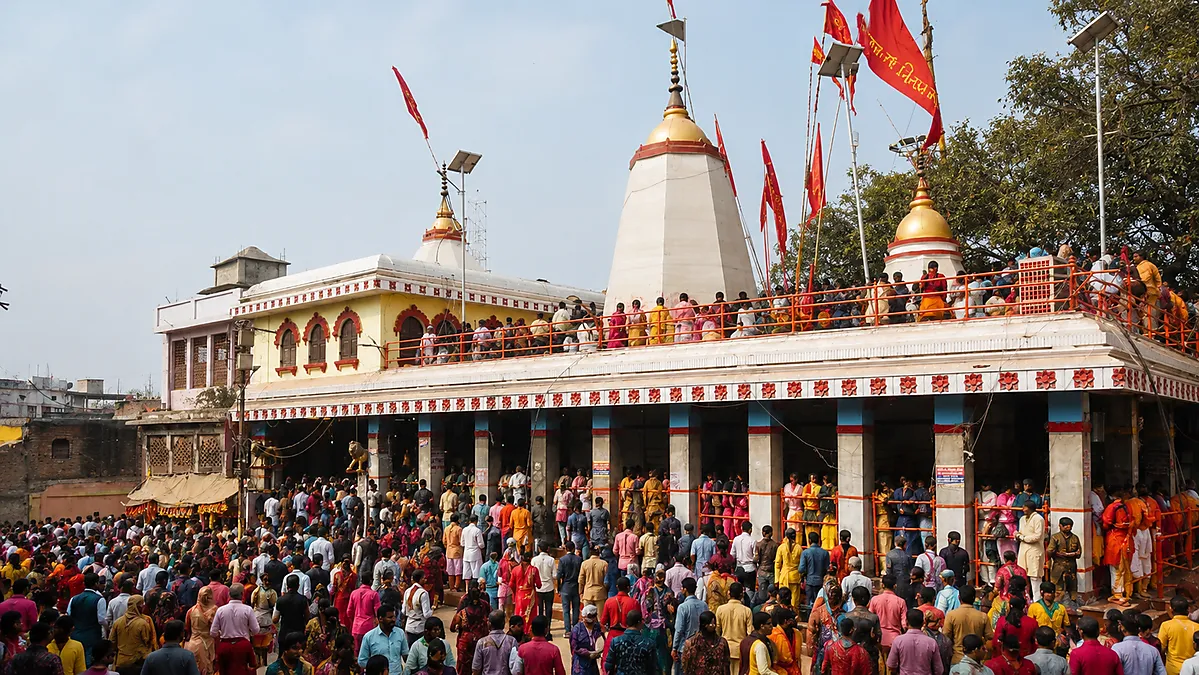
The sun has not yet risen over the Vindhya ranges. The air is cool and carries the fragrance of incense and fresh flowers. In the narrow lanes of Vindhyachal town, thousands of devotees are already awake, their voices rising in a continuous chant: “Jai Maa Vindhyavasini, Jai Maa Vindhyavasini”.
Red flags flutter from every rooftop. The sound of bells echoes from the temple above. Women carry coconut offerings wrapped in red cloth. Men balance baskets of flowers on their heads. Children hold miniature tridents and red chunari cloth for the Goddess.
As you climb the stone steps toward the temple, you feel something shift within you. The tiredness of the journey fades. The worries of daily life seem distant. In front of you, the golden spire of the temple glows as the first rays of the sun touch it.
Inside the sanctum, the Goddess waits. Her eyes — large, compassionate, yet fierce — gaze upon every devotee who enters. She is Maa Vindhyavasini — the Goddess who resides in the Vindhya mountains, the sister of Lord Krishna, the slayer of demons, the protector of the faithful.
For centuries, millions have made their way to this sacred town on the banks of the Ganga. Kings and commoners, saints and sinners, the wealthy and the poor — all have stood where you stand now, offering their prayers, their tears, their gratitude, and their hopes.
What power has drawn millions of devotees to Vindhyachal for centuries? What makes this humble temple in a small town one of the most revered Shakti shrines in all of India?
Let us journey together into the sacred world of Maa Vindhyavasini.
Quick Facts at a Glance
| Detail | Information |
| Temple Name | Maa Vindhyavasini Temple |
| Location | Vindhyachal, Mirzapur District, Uttar Pradesh |
| Distance from Prayagraj | Approximately 85 kilometres (about 1.5 – 2 hours by road) |
| Presiding Deity | Maa Vindhyavasini (an incarnation of Goddess Durga / Adi Shakti) |
| Tradition | Shakta |
| Temple Timings | 5:00 AM – 12:00 PM (morning); 1:00 PM – 10:00 PM (evening) |
| Aarti Timings | Morning: 4:00 AM (Mangala Aarti), Evening: 7:30 PM (Sandhya Aarti) |
| Major Festivals | Navratri (Chaitra and Sharadiya) |
| Pilgrimage Circuit | Vindhyachal Trikon Yatra (Vindhyavasini – Ashtabhuja – Kali Khoh) |
| Sacred River | Ganga |
| Ideal Visit Duration | 1–2 days (including Trikon Yatra) |
| Best Time to Visit | October–March (winter); Navratri (especially auspicious) |
Table of Contents
Who Is Maa Vindhyavasini? – The Goddess Who Resides in the Vindhyas
To understand Maa Vindhyavasini, we must first understand her name — for in the Sanskrit language, names carry the essence of the divine.
Vindhyavasini (विन्ध्यवासिनी) is composed of two words:
- Vindhya — the Vindhya mountain range, one of the most ancient geographical features of India
- Vasini — “she who resides” or “she who dwells”
Thus, Maa Vindhyavasini means “the Goddess who resides in the Vindhya mountains.”
She is an incarnation of Adi Shakti — the primordial cosmic energy that creates, sustains, and dissolves the universe. In the Shakta tradition, she is considered the supreme Goddess, the mother of all creation, the embodiment of divine power.
In the Devi Bhagavata Purana and the Markandeya Purana, Maa Vindhyavasini is identified as the sister of Lord Krishna and the daughter of Yashoda and Nanda in the Dwapara Yuga. She is the divine Yogamaya who was born to deceive the demon king Kansa and protect the infant Krishna.
She is also closely associated with the Devi Mahatmya (Durga Saptashati), where the Goddess appears as Chandika and Durga to slay the buffalo demon Mahishasura and restore cosmic order.
In her iconography, Maa Vindhyavasini is typically depicted with eight arms (Ashtabhuja), each holding divine weapons — a trident (trishul), a sword, a discus (chakra), a conch (shankha), a bow, an arrow, a mace, and a lotus. Her mount (vahana) is the lion, symbolising courage, strength, and the fearless nature of the divine mother.
The Meaning of Vindhyavasini
The name Vindhyavasini carries profound spiritual meaning beyond its literal translation.
The Vindhya Range: The Vindhya mountains are among the oldest mountain ranges in India, stretching across central India from Gujarat to Bihar. In Hindu cosmology, the Vindhyas represent the boundary between North and South India — a geographical and symbolic division. The Goddess residing here indicates that she is accessible to all, regardless of region or tradition.
The Goddess of the Threshold: The Vindhyas are often described in Sanskrit literature as the “threshold” between different cultural zones of India. Maa Vindhyavasini, as the deity of this threshold, is seen as the protector of boundaries — between good and evil, between the human and the divine, between ignorance and wisdom.
The Shakti of the Mountains: In Shakta philosophy, mountains are considered natural repositories of spiritual energy (tapobala). The Goddess choosing to reside in the Vindhyas symbolises that divine power is available not only in grand temples but also in the natural landscape — in the hills, the rivers, the forests.
The Sister of Krishna: The Vindhyavasini tradition uniquely identifies her as the sister of Lord Krishna — a connection that blends Vaishnava and Shakta traditions, making her accessible to devotees of both paths. This syncretic quality has contributed to her widespread popularity across northern India.
The Fulfiller of Vows: In popular devotion, Maa Vindhyavasini is known as Mano Vanchit Fal Data — the bestower of desired fruits. Devotees believe that sincere prayers offered at her temple are answered, whether the request is for health, prosperity, children, marriage, or spiritual progress.
The Mythology of Maa Vindhyavasini – The Story of Yogamaya
The most celebrated legend associated with Maa Vindhyavasini comes from the Bhagavata Purana and is intimately connected with the birth of Lord Krishna.
The Tyranny of Kansa
In the city of Mathura, the demon king Kansa ruled with cruelty and fear. He had imprisoned his own father, Ugrasena, and terrorised the people. A divine prophecy had warned Kansa that the eighth child of his sister Devaki would be the cause of his death.
Terrified, Kansa imprisoned Devaki and her husband Vasudeva. Each time Devaki gave birth, Kansa killed the child. Six children were murdered in this manner. The seventh, Balarama, was miraculously transferred from Devaki‘s womb to that of Rohini. The eighth was destined to be Lord Krishna.
The Birth of Yogamaya
When Devaki gave birth to her eighth child, the divine Lord Krishna, a divine announcement was made to Kansa: “Your destroyer has been born elsewhere.”
At the exact same moment, in the village of Gokul, Yashoda gave birth to a daughter. This daughter was not an ordinary child — she was Yogamaya, the divine illusory energy of Lord Vishnu.
Kansa, hearing that a child had been born to Yashoda, rushed to Gokul and seized the infant girl, intending to kill her as he had killed Devaki‘s children. He lifted her high and dashed her against a stone.
But instead of dying, the child rose into the air and revealed her divine form. She transformed into the eight-armed Goddess Durga and spoke to Kansa:
“O foolish one! Your destroyer has already been born elsewhere. He is the son of Devaki, growing up in Gokul. What will you gain by killing me?”
Thus declaring her identity, the Goddess disappeared and is said to have taken residence in the Vindhya mountains, where she came to be worshipped as Maa Vindhyavasini.
This legend establishes Maa Vindhyavasini as the sister of Lord Krishna — making her an essential part of the Krishna narrative and explaining why she is often worshipped alongside Krishna in many parts of northern India.
Maa Vindhyavasini and Mahishasura – The Triumph of Shakti
While the Bhagavata Purana establishes her connection with Krishna, the Devi Mahatmya (Durga Saptashati) within the Markandeya Purana connects her to the central narrative of Shakta tradition — the slaying of the buffalo demon Mahishasura.
The Rise of Mahishasura
Mahishasura, the buffalo demon, had obtained a boon from Lord Brahma that no man or god could kill him. Empowered by this boon, he attacked the heavens, defeated the gods, and usurped their kingdom. The devas, led by Indra, were driven out of their celestial abode.
Unable to defeat Mahishasura, the gods went to Lord Vishnu and Lord Shiva for help. From the combined energies (tejas) of the gods — from Shiva‘s anger, Vishnu‘s power, Brahma‘s wisdom, and the forces of all other deities — a divine light emerged.
From this light, Goddess Durga was born — fierce, powerful, radiant, and invincible.
The Battle
The Goddess rode forth on a lion to confront Mahishasura. For nine days and nine nights, the battle raged — a cosmic war between good and evil, between the forces of light and the forces of darkness.
Mahishasura changed forms constantly — from buffalo to lion, from elephant to man — but the Goddess matched each transformation with a fiercer manifestation of her power. Finally, on the tenth day (Vijayadashami), she pierced Mahishasura‘s chest with her trident and beheaded him.
Connection to Vindhyavasini
In the Shakta tradition, Maa Vindhyavasini is understood as one of the many manifestations of this same Goddess — the same Adi Shakti who slayed Mahishasura, the same Durga who protects the cosmos from evil forces.
Thus, when devotees worship Maa Vindhyavasini, they are worshipping the same supreme power that the Devi Mahatmya celebrates — the power that protects the good, destroys evil, and restores cosmic balance.
The connection is also geographical. Vindhyachal is located in the region where, according to some traditions, the Goddess fought and defeated Mahishasura‘s generals before the final confrontation. The very soil of Vindhyachal is considered sacred because it absorbed the energy of that celestial battle.
The Vindhyachal Mahatmya confirms this connection, establishing that the Goddess‘s triumphant return to her abode in the Vindhyas occurred after her victory over Mahishasura.
Vindhyachal – The Sacred Geography and Why the Goddess Chose This Place
Vindhyachal is not a random location. Its sacred geography is deeply rooted in Hindu tradition.
The Confluence of Sacred Rivers
Vindhyachal is situated on the banks of the Ganga River, just a few kilometres from its confluence with the Yamuna and the mythical Saraswati at Prayagraj. The Ganga here is considered especially sacred, and many pilgrims take a holy dip before ascending to the temple.
The Vindhya Mountains
The Vindhya range is considered one of the seven sacred mountain ranges (Sapta Kulagiri) of India in Hindu tradition. Mountains are considered natural temples — repositories of spiritual energy (tapobala) accumulated over millennia by sages, saints, and the natural forces themselves.
The Legend of the Goddess‘s Choice
According to the Vindhyachal Mahatmya, after the Goddess revealed herself to Kansa and declared that she would reside in the Vindhyas, she was drawn to this specific spot because of its natural beauty, its elevation, and its proximity to the sacred Ganga River.
The Vindhyavasini Mahatmya describes that the Goddess instructed her devotees that she could be worshipped at this location in three forms — Vindhyavasini, Ashtabhuja, and Kali — establishing the Trikon Yatra pilgrimage circuit.
The Unique Energy of Vindhyachal
In Shakta philosophy, certain places are considered pitha sthala — seats of the Goddess‘s power. Vindhyachal is one such place, where the divine feminine energy (Shakti) is considered to be particularly accessible to devotees. Pilgrims believe that prayers offered here are heard more quickly, that the blessings of the Goddess flow more freely, and that the spiritual benefits of worship are magnified.
Is Vindhyachal a Shakti Peetha?
This is a question that arises frequently among pilgrims. The answer requires a nuanced understanding of the Shakti Peetha tradition.
What Is a Shakti Peetha?
According to the Kalika Purana and other Shakta texts, when Lord Shiva carried the burning body of his consort Sati across the cosmos in grief, Lord Vishnu used his divine discus (Sudarshana Chakra) to dismember her body into 51 pieces. Each piece fell to earth at a different location, creating a Shakti Peetha — a seat of the Goddess‘s power.
The Kalika Purana lists 51 Shakti Peethas, each associated with a specific body part of the Goddess and a corresponding Bhairava (form of Shiva).
Vindhyachal in Shakta Tradition
There is some scholarly debate on this classification. However, according to the Bengali Shakta tradition documented in the Kalidarpana of the 18th century, the Kalika Purana explicitly names Vindhyachal as a Shakti Peetha, with the specific body part being the curls of hair (Guchha Kuntala).
In this classification:
- Body Part: Curls of hair (Kesh or Kuntala)
- Deity: Vindhyavasini
- Bhairava: Bhuteshwar
Other traditional sources, such as the Pithanirnaya and the Maha Pitha Nirupana, confirm that Vindhyachal is indeed the Shakti Peetha of Goddess Parvati‘s curls of hair.
Vindhyachal‘s Unique Status
Whether classified formally as a Shakti Peetha or not, Vindhyachal is universally recognised as one of the most important Shakti shrines in northern India, alongside Vaishno Devi (Jammu), Jwala Ji (Kangra), Naina Devi (Himachal), and Mansa Devi (Haridwar).
Its unique mythology — the residence of Yogamaya, the sister of Lord Krishna, and the deity who slayed Mahishasura‘s forces — gives it a distinct identity among Shakta temples. The Vindhyavasini Mahatmya extols the virtues of visiting Vindhyachal and states that a pilgrimage here grants the same spiritual merit as visiting all the 51 Shakti Peethas combined.
The Vindhyachal Trikon Yatra – The Three-Temple Pilgrimage Circuit
One of the most distinctive features of Vindhyachal is the Trikon Yatra — the “Triangular Pilgrimage” — which involves visiting three temples in a specific sequence.
The Three Temples of the Trikon Yatra
| Temple | Deity | Significance |
| Maa Vindhyavasini Temple | Maa Vindhyavasini | The main temple; the Goddess in her primary form |
| Maa Ashtabhuja Temple | Maa Ashtabhuja (eight-armed Goddess) | Located atop a hill; the Goddess in her fierce form |
| Maa Kali Khoh Temple | Maa Kali | A cave temple; the Goddess in her dark form |
The Spiritual Meaning of the Trikon Yatra
The three temples are believed to represent the three forms of the Goddess:
- Vindhyavasini — The protector, the nurturer, the sister of Krishna, accessible and compassionate
- Ashtabhuja — The warrior, the slayer of demons, fierce and powerful, wielding eight weapons
- Kali Khoh — The destroyer of evil, the dark mother, residing in a cave, representing the deepest mysteries of Shakti
The journey between the three temples forms a triangle (trikon), which in Tantric geometry represents the yoni — the creative, feminine principle of the universe.
The Pilgrimage Route
Step 1: Maa Vindhyavasini Temple — The pilgrim begins at the main temple, offering prayers and making vows. This is the central and most important stop of the journey.
Step 2: Maa Ashtabhuja Temple — From the main temple, the pilgrim climbs to the Ashtabhuja temple on the hilltop. The climb symbolises the ascent from worldly concerns to divine consciousness. The view of the Ganga and the surrounding landscape is breathtaking.
Step 3: Maa Kali Khoh Temple — Finally, the pilgrim descends to the Kali Khoh temple, a cave shrine. The cave represents the womb of the Goddess — the darkness from which all creation emerges. After this darshan, the pilgrim emerges renewed, having made the full circuit.
Completion of Pilgrimage: Traditional belief holds that a pilgrimage to Vindhyachal is incomplete without performing the full Trikon Yatra. Visiting only the main temple grants merit, but visiting all three in sequence multiplies that merit and brings the complete blessings of the Goddess.
In many ways, the Trikon Yatra is a complete spiritual journey — from the manifest Goddess (Vindhyavasini) to the fierce protector (Ashtabhuja) to the primordial source (Kali Khoh), and back to the world transformed.
Temple History and Evolution
The history of the Vindhyavasini Temple is both ancient and layered, blending mythology with documented historical developments.
Traditional History
According to the Skanda Purana, the goddess Vindhyavasini has been worshipped at this site for thousands of years, with sages like Markandeya, Durvasa, and Bharadwaj having meditated here.
The temple is mentioned in the Vindhyavasini Mahatmya, a section of the Puranas, which extolls the virtues of visiting Vindhyachal, performing the Trikon Yatra, and offering prayers to the Goddess.
Medieval Developments
The temple gained prominence during the medieval period as a centre of Shakti worship. Regional kings and chieftains patronised the temple, donating lands, building facilities for pilgrims, and sponsoring festivals. The current temple structure reflects contributions from multiple periods, though much of the present form is relatively recent.
The Scindia and Holkar dynasties of the Maratha confederacy were notable patrons of the temple, contributing to its maintenance and to the organisation of the Navratri festivities.
Modern Temple Complex
Today, the temple complex has been expanded and renovated multiple times to accommodate the growing number of pilgrims. Facilities such as waiting halls, locker rooms, and restrooms have been added. The temple is managed by a trust under the supervision of the Government of Uttar Pradesh.
Archaeological Significance
The region around Vindhyachal contains archaeological evidence of continuous habitation and worship going back centuries. Ancient sculptures, inscriptions, and structural remains have been discovered in the area, confirming the site‘s long history as a centre of religious activity.
The Kali Khoh temple, in particular, is considered one of the oldest structures in the region, with its cave shrine representing a form of worship that predates the construction of formal temples.
Spiritual Significance of Maa Vindhyavasini
The worship of Maa Vindhyavasini is not merely about petitioning a deity for favours. It carries profound spiritual meaning for those who approach with understanding.
The Divine Motherhood
In the Shakta tradition, the Goddess is not a distant, judgmental deity but a mother — compassionate, forgiving, and always accessible. Maa Vindhyavasini, as an incarnation of Adi Shakti, embodies this divine motherhood. Devotees approach her not with fear but with the trust of a child approaching its mother.
Protection from Evil
The Goddess‘s mythology centres on the destruction of evil forces — Kansa, Mahishasura, and other demons. For devotees, she remains the protector who shields them from negative influences, removes obstacles, and guards against harm. The red flag (chunari) offered at her temple symbolises this protective covering.
Fulfillment of Desires
Maa Vindhyavasini is widely known as a wish-fulfilling deity. Devotees come to her with specific requests — for children, for marriage, for health, for prosperity, for success in exams or business — and many return bearing witness to prayers answered. This belief is so strong that the temple is often crowded with devotees seeking manokamna (heart’s desire).
Courage and Strength
The image of the Goddess seated on a lion, wielding weapons in her eight arms, is a powerful symbol of courage and inner strength. Worshipping her is believed to instil these qualities in the devotee — to face life‘s challenges without fear, to stand up against injustice, and to fight one‘s own inner demons of anger, greed, and attachment.
Liberation (Moksha)
Beyond worldly desires, the Goddess also offers the highest goal of spiritual life — liberation from the cycle of birth and death. The Vindhyavasini Mahatmya declares that sincere worship of the Goddess, especially during Navratri, leads to the purification of the soul and eventual union with the divine.
Unity of Traditions
Maa Vindhyavasini‘s unique identity as both the sister of Krishna (connecting her to Vaishnava traditions) and the slayer of Mahishasura (connecting her to Shakta traditions) makes her a unifying figure in the diverse landscape of Hindu worship. She is worshipped by devotees of all sects — Vaishnavas, Shaivas, Shaktas — and even by followers of other religions who seek her blessings.
Navratri at Vindhyachal – When the Goddess Comes Alive
The most important festival at the Vindhyavasini Temple is Navratri — the nine nights dedicated to the worship of the Goddess.
Chaitra Navratri (March–April)
The first Navratri of the Hindu calendar occurs in the month of Chaitra (March–April). This Navratri culminates in Ram Navami, the birth of Lord Rama, who is himself considered an incarnation of Lord Vishnu.
Sharadiya Navratri (September–October)
The more famous Navratri occurs in the month of Ashwin (September–October), culminating in Vijayadashami or Dussehra — the celebration of the Goddess‘s victory over Mahishasura.
What Happens During Navratri at Vindhyachal?
During Navratri, the small town of Vindhyachal transforms into a sea of devotion:
- Special Aartis: Additional aartis are performed throughout the day and night. The Mangala Aarti at 4:00 AM is especially crowded.
- Continuous Chanting: The temple premises resound with the chanting of Durga Saptashati and Devi Mahatmya.
- Akhand Jyoti: A continuously burning lamp is maintained throughout the nine nights.
- Kanya Pujan: On the eighth or ninth day (Ashtami or Navami), young girls are worshipped as manifestations of the Goddess.
- Animal Sacrifice (Tradition): Traditionally, animal sacrifice (usually goats) was offered to the Goddess, symbolising the sacrifice of ego and negative tendencies. In modern times, many devotees offer symbolic sacrifices such as coconuts, pumpkins, or gourds. The practice continues in some forms, though it is gradually being replaced by symbolic offerings.
The Atmosphere During Navratri
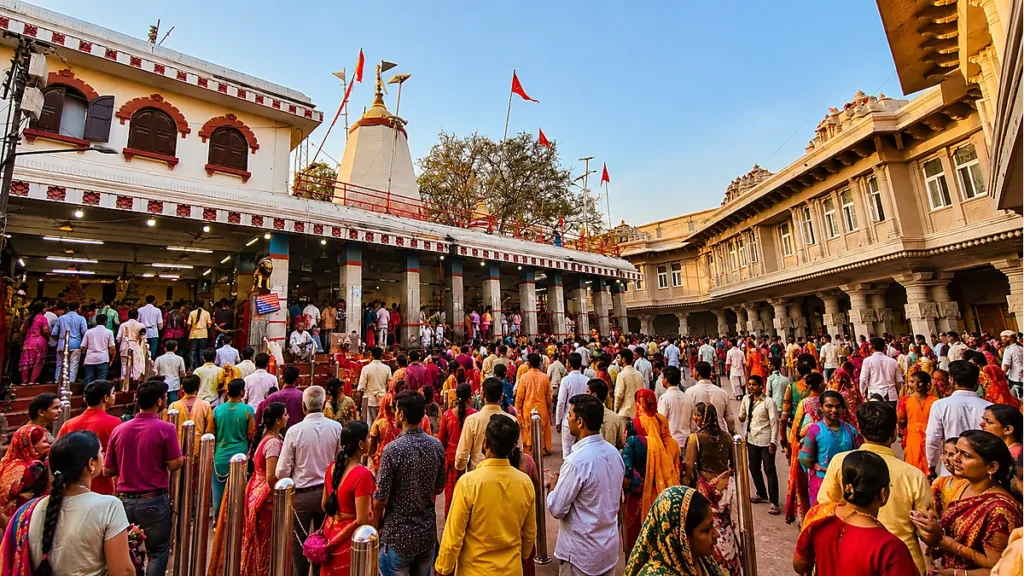
For the pilgrim, Navratri at Vindhyachal is an experience unlike any other. The queues stretch for over a kilometre. The sound of bells, drums, and chanting is continuous. The air is thick with the smell of incense and flowers. At night, the temple is illuminated with thousands of lights.
Why Navratri Is So Important
Navratri is not merely a festival — it is a spiritual retreat. The nine nights are considered the most powerful time of the year for worshipping the Goddess, when her energy is most accessible to devotees. Those who cannot visit during Navratri are encouraged to perform the rituals at home — fasting, chanting, praying — as a way of participating in the collective devotion.
Visiting During Navratri – What to Expect
- Massive crowds — be prepared for long waits
- Special arrangements — the temple administration sets up queues, barricades, and waiting areas
- Accommodation shortage — book weeks or months in advance
- Heightened spiritual energy — the collective devotion of thousands creates a powerful atmosphere
- Limited movement — roads may be blocked, and parking is extremely limited
Despite the crowds, millions choose to visit during Navratri because they believe that the blessings received during these nine days are greater than at any other time of the year.
Temple Architecture and Darshan Experience
The Vindhyavasini Temple, while not as architecturally grand as some of India‘s larger temples, has a unique character shaped by centuries of devotion.
The Temple Complex
The temple is situated on the bank of the Ganga on an elevated site. The complex includes:
- The Main Sanctum (Garbha Griha): This is the heart of the temple, housing the image of Maa Vindhyavasini. The deity is adorned with jewellery, flowers, and a red chunari (veil). The face of the Goddess is the focus of the devotee‘s attention — her eyes are said to be particularly captivating, expressing both compassion and power.
- The Courtyard (Pradakshina Path): A marble-floored courtyard surrounds the sanctum, allowing devotees to circumambulate (parikrama) around the deity.
- The Mandapam: A pillared hall where devotees can sit, wait for darshan, and participate in group prayers and bhajans.
- The Prasad Counter: Where devotees can purchase offerings (coconuts, flowers, chunari, sweets) for the Goddess.
- The Locker Room: For storing shoes and belongings before entering the temple.
Darshan Experience
The Queue: Depending on the day and season, waiting times can vary from 30 minutes to 6 hours. During Navratri, the wait can be even longer.
The Approach: Devotees pass through security checks before entering the queue. The final approach to the sanctum is narrow, designed to keep the queue moving while allowing each devotee a moment of darshan.
The Darshan: As you reach the sanctum entrance, you will see the deity up close — illuminated, decorated, and radiating divine presence. Devotees are allowed only a few seconds for darshan before being gently moved along by the priests and volunteers. It is customary to:
- Fold your hands in prayer
- Offer your chunari, coconut, or flowers to the priest, who will place them at the Goddess‘s feet
- Make a mental prayer or vow
- If you have brought a child, you may request the priest to touch the child‘s forehead with the Goddess‘s blessings
Exit and Prasad: After darshan, devotees exit through a separate route, where they can receive prasad (consecrated offerings) such as sweets or coconut pieces.
Aarti Schedule
The temple conducts four aartis daily:
| Aarti | Time | Significance |
| Mangala Aarti | 4:00 AM | The first aarti of the day, awakening the Goddess |
| Madhyana Aarti | 12:00 PM (noon) | Midday worship |
| Sandhya Aarti | 7:30 PM | Evening aarti; the most spectacular and crowded |
| Shayana Aarti | 10:00 PM | The final aarti, putting the Goddess to rest |
Visitor Guide – Temple Timings, Best Time to Visit, How to Reach
Temple Timings
| Period | Timings |
| Morning | 5:00 AM – 12:00 PM |
| Afternoon closure | 12:00 PM – 1:00 PM |
| Evening | 1:00 PM – 10:00 PM |
| Mangala Aarti | 4:00 AM (before opening, may require special access) |
| Madhyana Aarti | 12:00 PM |
| Sandhya Aarti | 7:30 PM |
| Shayana Aarti | 10:00 PM |
Note: Timings may vary during festivals, especially Navratri. It is advisable to confirm before travelling.
Best Time to Visit
| Season | Months | Experience |
| Winter (Best) | October – March | Pleasant weather; ideal for darshan and Trikon Yatra |
| Summer | April – June | Hot (35–45°C); early morning or evening visits recommended |
| Monsoon | July – September | Humid, occasional rain; fewer crowds but slippery paths |
| Navratri (Most Auspicious) | March–April & September–October | Peak crowds; maximum spiritual energy; requires advance planning |
Best Time of Day: Early morning (6:00 AM – 9:00 AM) offers cooler temperatures and shorter queues. Evening aarti (7:30 PM) offers a spectacular experience but is more crowded.
How to Reach Vindhyachal
From Prayagraj (85 km, 1.5–2 hours): Most pilgrims approach Vindhyachal from Prayagraj.
- By Road: Regular buses and taxis are available from Prayagraj. The route passes through the Grand Trunk Road and the city of Mirzapur. Buses drop passengers at the Vindhyachal bus stand, a short distance from the temple.
- By Train: Vindhyachal has its own railway station (Vindhyachal Station, code BDL). Trains from Prayagraj Junction to Vindhyachal are available. From the station, auto-rickshaws and cycle-rickshaws can take you to the temple (approx. 15–20 minutes).
- By Car: The most convenient option. Parking is available but may be limited on crowded days.
From Varanasi (approx. 110 km, 2–2.5 hours): Vindhyachal is often combined with a visit to Kashi. Taxis and buses are available.
From Mirzapur (approx. 12 km, 20–30 minutes): Vindhyachal is a suburb of Mirzapur. Local buses and auto-rickshaws connect the two towns frequently.
Local Transport
Once in Vindhyachal, the main temple is accessible by foot from most parts of the town. For the Trikon Yatra:
- Vindhyavasini Temple to Ashtabhuja Temple: Approx. 1.5 km; can be walked (climb) or taken by auto
- Ashtabhuja Temple to Kali Khoh Temple: Approx. 2 km; auto-rickshaw recommended
Accommodation
Vindhyachal has several dharamshalas (pilgrim rest houses) and budget hotels. For a wider range of options, many pilgrims stay in Mirzapur (12 km away) or Prayagraj (85 km away).
What to Carry
- Comfortable footwear (lots of walking, especially for Trikon Yatra)
- Water bottle (stay hydrated)
- Sun protection (hat, sunglasses, sunscreen)
- Modest clothing (as the site is a place of worship)
- Offering items (coconuts, red chunari, flowers) — available near the temple
- Small bills for offerings and donations
- Rain gear (if visiting during monsoon)
Tips for a Smooth Darshan
- Start early — the queues are shortest in the early morning (6:00–8:00 AM)
- Avoid weekends if possible — weekends are more crowded
- During Navratri, book accommodation weeks in advance
- Keep mobile phones silenced inside the temple
- Be prepared to wait — patience is part of the pilgrimage
- Lockers are available for storing shoes and belongings before entering the temple
- Prasad is available both before and after darshan
The Ritual of ‘Kisli’ – A Unique Tradition
One of the most distinctive traditions at the Vindhyavasini Temple is the offering of a kisli.
What Is a Kisli?
A kisli is a silver (or now, often silver-plated) cradle-like object or a small ornament, traditionally offered to the Goddess by couples who wish to have children. The ritual is particularly popular among childless couples, who believe that offering a kisli to Maa Vindhyavasini will result in the birth of a child.
The Ritual
The couple, after taking a holy dip in the Ganga, approaches the temple with the kisli. The kisli is offered to the priest at the sanctum, who presents it to the Goddess. The couple prays for a child, and after darshan, they receive the Goddess‘s blessings.
The Child‘s First Visit
After the child is born, the family returns to the temple with the infant to offer thanks to the Goddess. The child‘s head may be shaved (mundan) at the temple as a symbolic offering of gratitude.
Symbolism
The kisli ritual reflects the deep-seated belief in Maa Vindhyavasini‘s role as a bestower of children — an extension of her identity as the divine mother. The cradle symbolises her care and protection over the child‘s life from the very beginning.
Continuing the Tradition
While modern couples may question the literal efficacy of such offerings, the kisli ritual continues to be one of the most popular reasons for pilgrimage to Vindhyachal. The faith of millions who have returned with children and offered thanks has created a powerful cycle of belief — one that sustains the tradition across generations.
Note: In recent years, the government has discouraged the offering of precious metals to reduce temple expenses and security concerns. Devotees are encouraged to offer symbolic kisli or donate cash equivalents.
The Vindhyavasini Mahatmya – Scriptural Glories
The Vindhyavasini Mahatmya is a section of the Skanda Purana dedicated entirely to glorifying the Goddess and the sacred site of Vindhyachal.
Contents of the Mahatmya
The Vindhyavasini Mahatmya contains:
- The story of Yogamaya — her birth, her revelation to Kansa, and her settlement in the Vindhyas
- The establishment of the Trikon Yatra — how the three temples came to be
- The glorification of various rituals — including offerings (puja), vows (vrat), and pilgrimages (yatra)
- The merit of visiting Vindhyachal — including benefits for health, prosperity, family, and spiritual progress
Key Declarations from the Mahatmya
The Vindhyavasini Mahatmya declares:
- That Visiting Vindhyachal during the sacred month of Magh (January–February) grants the same merit as bathing in all the sacred rivers of India.
- That Performing the Trikon Yatra during Navratri is equivalent to performing a hundred Vedic sacrifices.
- That Offering a red chunari (veil) to the Goddess protects the devotee from negative influences and evil spirits.
- That Women who pray to Maa Vindhyavasini will be blessed with happy marriages, healthy children, and long life for their husbands.
- That Childless couples who offer a kisli will be blessed with children.
- That Even seeing the temple spire from a distance grants merit to the viewer.
The Authority of the Mahatmya
As a section of the Skanda Purana — one of the eighteen major Mahapuranas — the Vindhyavasini Mahatmya carries significant scriptural authority within the Shakta tradition. Its verses are recited by priests and devotees, particularly during the Navratri festival.
Relevance for the Modern Pilgrim
While the specific promises of the Mahatmya should be understood within their traditional context, the underlying message remains relevant: Vindhyachal is a place of profound spiritual power, where the Goddess is especially accessible to her devotees. The Mahatmya‘s glorification of the site continues to draw millions of pilgrims, who trust in the tradition that has sustained this shrine for centuries.
A Note on Interpretation: The Mahatmya belongs to the Puranic genre, which uses exaggeration and poetic hyperbole to express spiritual truths. When it says a pilgrimage to Vindhyachal equals a hundred Vedic sacrifices, the intended meaning is: “The spiritual benefit is immense — beyond ordinary measure.” The value of the pilgrimage is not in the external act but in the internal transformation it inspires—the faith, devotion, and surrender to the Divine Mother that such a journey demands and cultivates. This understanding is consistent with the teachings of traditional commentators and modern spiritual teachers alike.
Timeless Verses of the Divine Mother
The worship of the Divine Mother has inspired poetry and scripture for millennia. Here are some of the most cherished verses that connect to the Shakti tradition of Maa Vindhyavasini.
Verse 1: The Supreme Goddess – The Source of All (Devi Mahatmya)
Devanagari:
या देवी सर्वभूतेषु विष्णुमायेति शब्दिता ।
या देवी सर्वभूतेषु चेतनेत्यभिधीयते ।
या देवी सर्वभूतेषु बुद्धिरूपेण संस्थिता ।
नमस्तस्यै नमस्तस्यै नमस्तस्यै नमो नमः ॥
IAST:
Yā devī sarvabhūteṣu viṣṇumāyeti śabditā |
Yā devī sarvabhūteṣu cetanetyabhidhīyate |
Yā devī sarvabhūteṣu buddhirūpeṇa saṁsthitā |
Namastasyai namastasyai namastasyai namo namaḥ ||
Source:
Devi Mahatmya (Markandeya Purana), Chapter 1, Verse 56–57 (Dhyana Mantra of the Great Goddess)
Word‑by‑Word Meaning:
- Yā — She who
- Devī — The Goddess
- Sarva‑bhūteṣu — In all beings
- Viṣṇu‑māyā — As the divine illusory power of Vishnu
- Iti — Thus
- Śabditā — Is called / known
- Cetanā — Consciousness / awareness
- Iti — Thus
- Abhidhīyate — Is spoken of / described
- Buddhi‑rūpeṇa — In the form of intellect / wisdom
- Saṁsthitā — Resides / is established
- Namaḥ — Salutations / bowing
- Tasyai — To Her
Translation:
“She who is known as Vishnumaya in all beings, She who is spoken of as consciousness in all beings, She who is established in the form of intellect in all beings — salutations to Her, salutations to Her, salutations to Her, again and again salutations!”
Traditional Interpretation:
This famous hymn from the Devi Mahatmya celebrates the Goddess not as a distant deity but as the immanent presence within all creation. She is the consciousness that animates every living being, the intelligence that guides the mind, the divine power that creates, sustains, and dissolves the universe. The triple repetition of “namastasyai” expresses the overwhelming reverence and total surrender of the devotee.
Practical Takeaway:
When you worship Maa Vindhyavasini, you are not worshipping a stone image or a distant deity. You are worshipping the very consciousness that resides within you and within all beings. Let this understanding transform your darshan from mere ritual to deep recognition.
Verse 2: The Ever-Present Mother – Guarding the Devotee
Devanagari:
सरस्वति महाभागे विद्ये कमललोचने ।
विद्यारूपे विशालाक्षि विद्यां देहि नमोस्तु ते ॥
IAST:
Sarasvati mahābhāge vidye kamalalocane |
Vidyārūpe viśālākṣi vidyāṁ dehi namostu te ||
Source:
Devi Mahatmya (traditional devotional verse often recited before study)
Word‑by‑Word Meaning:
- Sarasvati — O Goddess Sarasvati
- Mahā‑bhāge — O greatly fortunate one
- Vidye — O embodiment of knowledge
- Kamala‑locane — O lotus-eyed one
- Vidyā‑rūpe — O one whose form is knowledge
- Viśāla‑akṣi — O wide-eyed one
- Vidyām — Knowledge / wisdom
- Dehi — Please give / bestow
- Namaḥ — Salutations
- Te — To you
Translation:
“O Sarasvati, most fortunate one, embodiment of knowledge, lotus-eyed one, whose very form is wisdom, wide-eyed Goddess — bestow knowledge upon me. Salutations to you.”
Traditional Interpretation:
While this verse is addressed to Sarasvati, the same principle applies to all forms of the Goddess — including Vindhyavasini. The Goddess is the source of all knowledge — not only intellectual but also spiritual wisdom, intuitive understanding, and the discernment that leads to liberation.
Practical Takeaway:
Before beginning any spiritual practice — especially the chanting of the Devi Mahatmya or the offering of prayers — invoke the Goddess as the giver of knowledge. Approach her not only with requests for material blessings but also with a sincere desire for wisdom.
Verse 3: Protection from Evil (Devi Mahatmya, Durga Saptashati)
Devanagari:
सर्वमङ्गलमाङ्गल्ये शिवे सर्वार्थसाधिके ।
शरण्ये त्र्यम्बके गौरि नारायणि नमोस्तु ते ॥
IAST:
Sarvamaṅgalamāṅgalye śive sarvārthasādhike |
Śaraṇye tryambake gauri nārāyaṇi namostu te ||
Source:
Devi Mahatmya (Markandeya Purana), Chapter 11, Verse 10 (from the popular Devi Stuti)
Word‑by‑Word Meaning:
- Sarvamaṅgala‑māṅgalye — O the most auspicious among all auspicious things
- Śive — O benevolent one
- Sarva‑artha‑sādhike — O fulfiller of all goals / purposes
- Śaraṇye — O giver of refuge / she who is approached for protection
- Tryambake — O three-eyed one (Shiva‘s consort)
- Gauri — O fair one
- Nārāyaṇi — O consort of Narayana
- Namaḥ — Salutations
- Te — To you
Translation:
“O most auspicious among all auspicious things, O benevolent one, O fulfiller of all purposes, O giver of refuge, O three-eyed Goddess, O fair one, O consort of Narayana — salutations to you.”
Traditional Interpretation:
This powerful verse, recited daily by millions of devotees, extolls the Goddess as the source of all auspiciousness, the fulfiller of all sincere desires, and the protector of those who seek her refuge. The multiple names — Śivā, Gaurī, Nārāyaṇī — affirm that the same supreme Goddess is worshipped by Shaivas, Shaktas, and Vaishnavas alike.
Practical Takeaway:
Recite this verse when you feel fearful, uncertain, or in need of protection. It is a reminder that the Divine Mother is always present, always ready to offer refuge to those who turn to her with faith.
Verse 4: She Who Resides in the Vindhyas – A Traditional Invocation
Devanagari:
विन्ध्याचले निवसति या जगतां च माता ।
तां विन्ध्यवासिनीम् अहं प्रणमामि नित्यम् ॥
IAST:
Vindhyācale nivasati yā jagatāṁ ca mātā |
Tāṁ vindhyavāsinīm ahaṁ praṇamāmi nityam ||
Source:
Traditional invocation (oral tradition; not found in a specific Purana but widely recited in Vindhyachal)
Word‑by‑Word Meaning:
- Vindhyācale — In Vindhyachal (the Vindhya mountain region)
- Nivasati — Resides / dwells
- Yā — She who
- Jagatām — Of the worlds / universe
- Ca — And
- Mātā — The mother
- Tām — To her
- Vindhyavāsinīm — Maa Vindhyavasini
- Aham — I
- Praṇamāmi — Bow down / prostrate
- Nityam — Daily / always
Translation:
“She who resides in Vindhyachal, the Mother of all the worlds — to that Maa Vindhyavasini, I bow down daily.”
Traditional Interpretation:
This simple yet powerful invocation is recited by pilgrims as they approach the temple or after completing their darshan. It affirms the identity of the local deity — Maa Vindhyavasini — with the universal Mother of all creation.
Practical Takeaway:
Recite this verse as you climb the steps toward the temple. Let it prepare your heart for the darshan that awaits.
Vindhyachal in the Sacred Geography of North India
Vindhyachal is not an isolated shrine — it is part of a network of sacred sites that make the region between Prayagraj and Varanasi one of the most densely pilgrimage-oriented landscapes in the world.
The Prayagraj–Vindhyachal–Varanasi Circuit
Many pilgrims combine visits to three major sacred cities:
| Destination | Distance from Vindhyachal | Significance |
| Prayagraj (Triveni Sangam) | 85 km north | Tirtharaj — the King of Pilgrimage Sites |
| Vindhyachal (Maa Vindhyavasini) | — | Shakti Shrine; the sister of Krishna; slayer of Mahishasura |
| Varanasi (Kashi Vishwanath) | 110 km east | The City of Light; Lord Shiva‘s eternal abode |
The Ganga Corridor
The Ganga River connects these sacred sites. Pilgrims often travel by road, taking holy dips at each location — at the Triveni Sangam in Prayagraj, at the ghats of Vindhyachal, and at the ghats of Varanasi. Each dip is considered to amplify the purifying power of the previous one.
The Shakti Pilgrimage Network
For devotees of the Goddess, Vindhyachal is one stop on a larger circuit of Shakti shrines:
- Vaishno Devi (Jammu) — the Mother in the Trikuta mountains
- Jwala Ji (Kangra, Himachal) — the eternal flame
- Naina Devi (Himachal) — the eyes of the Goddess
- Mansa Devi (Haridwar) — the wish-fulfilling Goddess
- Vindhyavasini (Vindhyachal) — the sister of Krishna, residing in the Vindhyas
Why the Region Is So Sacred
The region between Prayagraj and Varanasi — often called the Braj–Kashi–Prayag corridor — is considered the most sacred stretch of the Ganga. Here, the river has been worshipped for millennia, and every bend in the river is associated with some legend, temple, or tirtha.
Vindhyachal occupies a unique position in this landscape — a Shakta shrine in a region dominated by Vaishnava (Prayagraj) and Shaiva (Varanasi) traditions. Its very existence is a testament to the syncretic unity of the Hindu tradition, where the Divine Mother is honoured alongside Lord Vishnu (as Madhava at Prayagraj) and Lord Shiva (as Vishwanath at Varanasi).
Frequently Asked Questions (FAQs)
1. Why is Maa Vindhyavasini famous?
Maa Vindhyavasini is famous as the sister of Lord Krishna (born as Yogamaya to deceive Kansa) and as a powerful manifestation of Goddess Durga who protects devotees from evil, fulfills wishes, and bestows children upon childless couples.
2. Is Vindhyachal a Shakti Peetha?
According to the Bengali Shakta tradition (Kalidarpana) and the Kalika Purana, Vindhyachal is indeed a Shakti Peetha where the curls of hair (Guchha Kuntala) of the Goddess Sati fell. The deity is Vindhyavasini and the Bhairava is Bhuteshwar.
3. What is the Trikon Yatra?
The Trikon Yatra is a pilgrimage circuit at Vindhyachal involving three temples: Maa Vindhyavasini (main temple), Maa Ashtabhuja (on the hilltop), and Maa Kali Khoh (cave temple). Traditional belief holds that a pilgrimage is incomplete without visiting all three.
4. What is the best time to visit Maa Vindhyavasini Temple?
The best time is winter (October–March) when the weather is pleasant. The Navratri months (March–April and September–October) are the most auspicious but also the most crowded. Early mornings are ideal for shorter queues and cooler temperatures.
5. How far is Vindhyachal from Prayagraj?
Vindhyachal is approximately 85 kilometres from Prayagraj — about 1.5 to 2 hours by road.
6. What are the temple timings of Maa Vindhyavasini?
The temple is open from 5:00 AM to 12:00 PM and then 1:00 PM to 10:00 PM daily. Aartis are at 4:00 AM (Mangala Aarti), 12:00 PM (Madhyana Aarti), and 7:30 PM (Sandhya Aarti).
7. What is the significance of the red chunari offering?
Offering a red chunari (veil) to the Goddess is believed to protect the devotee from negative influences, evil spirits, and misfortunes. It also symbolises the devotee‘s surrender to the Divine Mother‘s protection.
8. What is the kisli offering?
A kisli is a small silver (or silver-plated) cradle-like object offered by childless couples who pray to Maa Vindhyavasini for a child. After the child is born, the family returns to offer thanks and perform the child‘s mundan (first head shave) at the temple.
9. Which festivals are celebrated at Vindhyachal?
The most important festival is Navratri (both Chaitra in March–April and Sharadiya in September–October). Other festivals include Vijayadashami (the victory of the Goddess), Diwali, and Magh Mela (January–February).
10. Is there any dress code for the temple?
Modest clothing is recommended. As it is a place of active worship, devotees are expected to dress respectfully. There is no strict dress code, but revealing clothing is discouraged.
11. Can non-Hindus visit the Vindhyavasini Temple?
Yes. The temple is open to all visitors regardless of religious background. Visitors are expected to behave respectfully, remove their shoes before entering, and follow the temple‘s rules.
12. How long does it take to complete the Trikon Yatra?
A complete Trikon Yatra — visiting all three temples — takes approximately 3–4 hours, depending on the crowds and your pace.
13. Are there any accommodation options near the temple?
Vindhyachal has several dharamshalas (pilgrim rest houses) and budget hotels. For more comfortable accommodation, many pilgrims stay in nearby Mirzapur (12 km away) or Prayagraj (85 km away).
14. What is the significance of the lion in Maa Vindhyavasini‘s iconography?
The lion is the Goddess‘s mount (vahana), symbolising courage, strength, and the fearless nature of the divine mother. The lion‘s roar is said to terrify demons and negative forces, while its protective presence reassures devotees of the Goddess‘s guardianship.
15. Can I take photographs inside the temple?
Photography inside the sanctum sanctorum is generally prohibited to maintain the sanctity of the space. Photography in the outer courtyard may be permitted, but it is advisable to ask a priest or temple official before taking pictures.
16. What should I offer to Maa Vindhyavasini?
Traditional offerings include coconuts, red chunari (cloth), flowers (especially red flowers), sweets, incense, and ghee lamps. For couples seeking children, a kisli (silver cradle) is offered.
17. Is animal sacrifice still practiced at the temple?
Traditionally, animal sacrifice (usually goats) was offered to the Goddess. In modern times, many devotees offer symbolic sacrifices such as coconuts, pumpkins, or gourds instead. The practice continues in some traditional forms, but it is gradually being replaced by symbolic offerings.
18. What is the Vindhyavasini Mahatmya?
The Vindhyavasini Mahatmya is a section of the Skanda Purana dedicated to glorifying Maa Vindhyavasini and the sacred site of Vindhyachal. It contains the mythology of the Goddess, the establishment of the Trikon Yatra, and the promised benefits of pilgrimage.
19. Why is Vindhyachal called by this name?
The name Vindhyachal means “the abode of the Vindhyas” — referring to the Vindhya mountain range where the Goddess resides. The suffix achal means “immovable” or “mountain”.
20. Why should I visit Maa Vindhyavasini Temple?
You should visit because Vindhyachal is not merely a temple — it is a living centre of Shakti where the Divine Mother continues to bless devotees with courage, protection, and spiritual strength. Whether you seek a child, success, protection, or simply the peace that comes from being in the presence of the Goddess, Maa Vindhyavasini welcomes all who come to her with faith.
Why Maa Vindhyavasini Still Inspires Millions
Let us return to where we began — standing in the queue outside the temple, the chanting of thousands in our ears, the scent of incense in the air, the red flags fluttering above us.
What is it that draws millions to this small town year after year? What keeps the queues long, the faith strong, the temple bustling with devotees across generations?
It is not merely the hope of a wish fulfilled — though that hope is real and powerful. It is not merely the beauty of the temple or the force of tradition — though both are significant.
It is the presence of the Mother.
In the heart of every devotee — whether of Maa Vindhyavasini, of Durga, of Kali, or of the Mother in any of her countless forms — there is a longing for protection, for comfort, for unconditional love. The world can be harsh. Life can be difficult. In moments of despair, the devotee turns to the one who never judges, never abandons, never withholds her grace.
Maa Vindhyavasini is that Mother.
She is the Goddess who revealed herself to Kansa not with anger but with a declaration of her power — and then calmly took her place in the Vindhyas. She is the sister who protected the infant Krishna, ensuring that the divine plan could unfold. She is the fierce Durga who slayed Mahishasura — and also the compassionate mother who hears the whispered prayers of the childless couple, the anxious student, the struggling householder.
When you stand before her sanctum, when you see her eyes looking back at you, when you place your offering at her feet — you are not performing an empty ritual. You are entering into a relationship. You are acknowledging that there is a power greater than your own, a love more constant than any human love, a presence that will not leave you even when all else falls away.
And when you emerge from the temple, having completed your darshan — and if you have also completed the Trikon Yatra, climbing the hill to Ashtabhuja and descending into the cave of Kali Khoh — you are not the same person who entered. The journey has changed you. The Goddess has blessed you.
May Maa Vindhyavasini bless your journey — with courage to face your battles, with faith to trust in her protection, with the knowledge that you are never alone, and with the grace to recognise the Divine Mother in every being you meet.
This article is part of a series on the sacred Shakti shrines and pilgrimage sites of North India. For more information on planning your pilgrimage to Maa Vindhyavasini Temple, the Trikon Yatra, or the Prayagraj–Vindhyachal–Varanasi circuit, please contact us.
Prayag Tourism
📞 Phone/WhatsApp: +91-9555313526
📧 Email: contact@prayagtourism.com
🌐 Website: PrayagTourism.com
May your journey be peaceful, safe, and spiritually enriching — and may the blessings of the Divine Mother be with you always.