
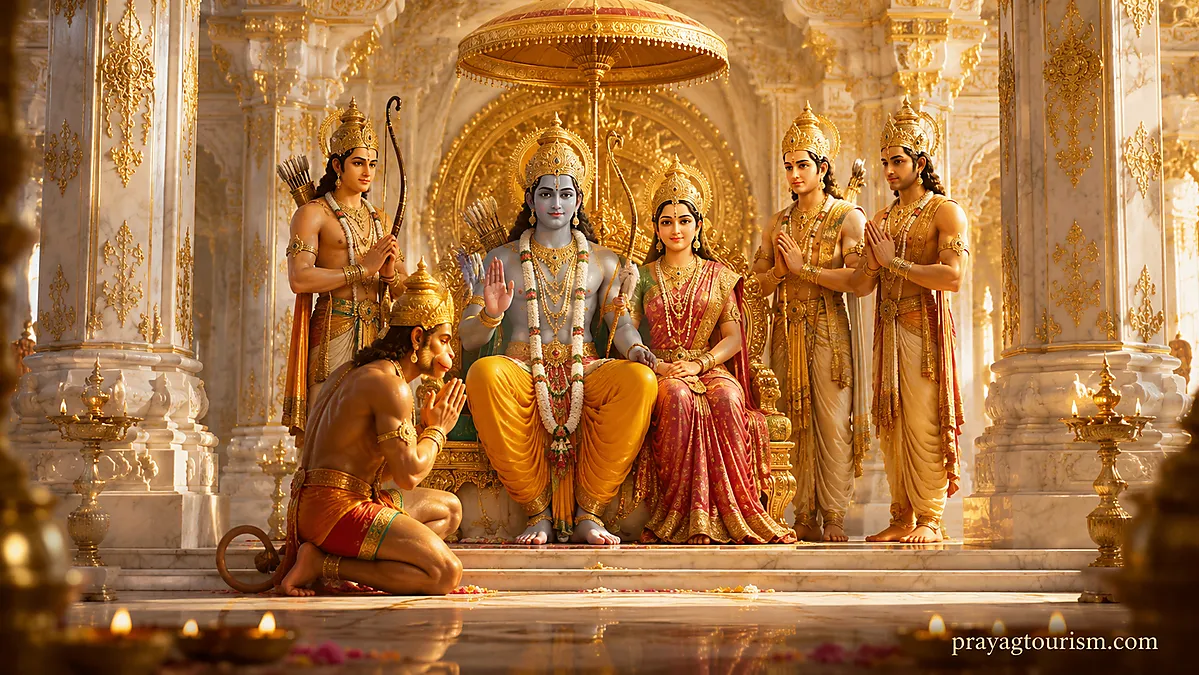
A master-guide to the seventh Avatāra, the zenith of human character, and the architecture of Rāma Rājya.
Table of Contents
Name, Joy, and Maryādā
To feel the gravitational pull of Śrī Rāmacandra, we must begin with the resonance of His name.
The name Lord Rāma (राम) springs from the Sanskrit root ram – “to delight, to rejoice, to sport.” The Padma Purāṇa records the celebrated line:
ramante yogino yasmin nityānande cid-ātmani – “That Supreme Absolute Reality, the embodiment of eternal bliss and pure consciousness in whom the yogis rejoice, is known as Rāma.”
In this sense, Rāma is not merely a historical prince; He is the very locus of spiritual joy – the indwelling Self in whom mystics rest.
Yet, the earthly Rāma we encounter in the Rāmāyaṇa is defined not by effortless bliss but by willing sacrifice. He carries the title Maryādā Puruṣottama:
- Maryādā – boundary, code, honourable limit, the disciplined framework of right conduct.
- Puruṣottama – the supreme (uttama) person (puruṣa).
Rāma is the one who:
- keeps every commitment,
- honours every obligation,
- subordinates personal desire to the demands of truth and role,
- and maintains dharmic conduct even when it costs Him comfort, power, and intimate happiness.
In the evolutionary arc of the Avatāras, the “Rāma age” marks the moment when the measure of a person is no longer merely strength or conquest, but character – the ability to keep faith under maximum pressure. Paraśurāma’s axe clears the field of gross injustice; Rāma’s life builds a positive architecture of order, showing what a truly just, beautiful, and compassionate civilisation can look like.
From Vedic Glimpses to Vālmīki’s Epic
The story of Rāma is not just a tale; it is almost synonymous with the moral imagination of India.
Vedic Hints and Early Echoes
The Ṛgveda (10.93.14) alludes to a noble figure named Rāma, but without the full narrative contour we know today. These early hints suggest that the memory of an exemplary king predates the classical epic, echoing as a cultural archetype that would later be fully developed.
Vālmīki – The Ādi Kavi and the Birth of the Rāmāyaṇa
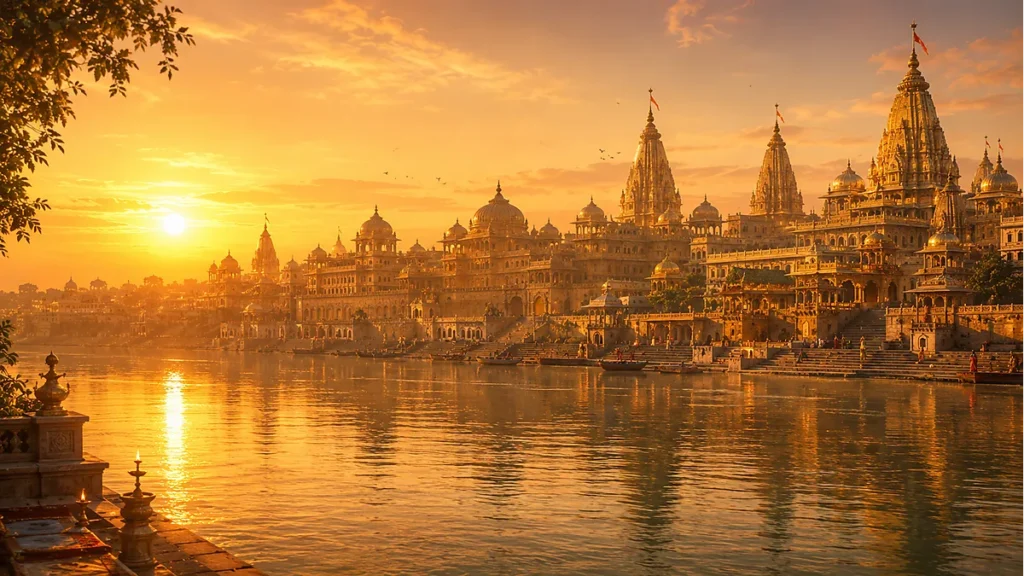
The comprehensive theology and narrative of Rāma crystallise in Śrīmad Vālmīki Rāmāyaṇa, composed by the Ādi Kavi, Maharṣi Vālmīki. The epic opens not with war, but with a question. Vālmīki asks Sage Nārada:
“Is there any man on earth who embodies all virtues at once?
One who is heroic, righteous, grateful, truthful, firm in vows, compassionate, wise, capable, and whose anger is perfectly controlled?”
Nārada does not hesitate. He names Rāma, son of Daśaratha, scion of the Ikṣvāku dynasty.
From that moment, the Rāmāyaṇa becomes much more than a story. It becomes:
- a mirror in which rulers examine their conduct,
- a manual of family, social, and political dharma,
- and a lamp for ordinary householders trying to live with integrity amid suffering.
Over centuries, Rāma’s story spreads across South and Southeast Asia:
- Stone bas-reliefs at Angkor Wat depict Rāmāyaṇa scenes in exquisite detail.
- Indonesian, Thai, and Cambodian royal courts patronise their own Rāma traditions.
- Wayang kulit (shadow puppetry) in Bali and Java retell the epic in local idioms.
Within India, countless retellings appear in regional languages – Tulsīdās’s Rāmacaritamānasa in Avadhi, Kambar’s Rāmāyaṇa in Tamil, Kṛttivāsī Rāmāyaṇa in Bengali, and many more – each adding devotional and philosophical layers while preserving the core ideal: Rāma as the model human and king.
The Grand Narrative: Exile, Abduction, and Return
The narrative of Rāma is a carefully orchestrated sequence of tests, each tightening the knot around His dharma.
Ayodhyā: The Crown Deferred
Rāma is born in Ayodhyā, capital of the kingdom of Kośala, to King Daśaratha and Queen Kauśalyā. Groomed as heir apparent, He marries Sītā, princess of Mithilā, and lives in exemplary harmony with His brothers—Lakṣmaṇa, Bharata, and Śatrughna.
On the eve of His coronation, disaster strikes. Because of an old pledge to Queen Kaikeyī, Daśaratha is bound to:
- banish Rāma to the forest for fourteen years,
- and crown Kaikeyī’s son Bharata instead.
Daśaratha collapses under this conflict between love and promise, but Rāma does not. He accepts the decree with unshaken calm, saying in effect:
“A father’s word, once given, must stand. If your honour requires my exile, I embrace it.”
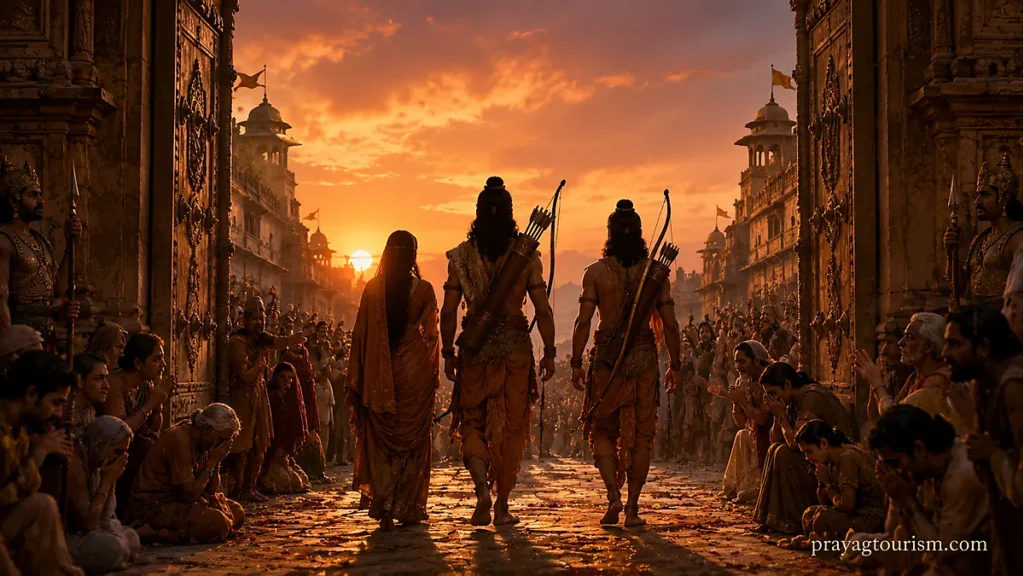
Sītā insists on joining Him, choosing hardship over the comfort of a palace without her Lord. Lakṣmaṇa, unable to conceive of existence apart from Rāma, also accompanies them. The three leave Ayodhyā barefoot, with no resentment toward anyone—not even Kaikeyī.
Forest Years and the Abduction of Sītā
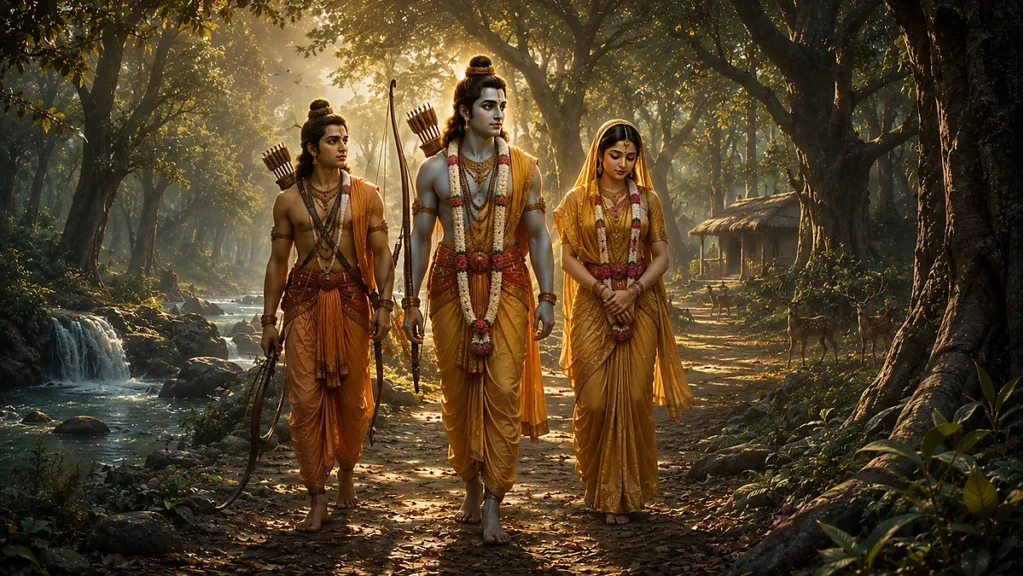
In the forests of Daṇḍakāraṇya, Citrakūṭa, and beyond, Rāma, Sītā, and Lakṣmaṇa live as ascetics. They:
- protect sages from rākṣasa harassment,
- encounter characters like Śūrpaṇakhā, whose humiliation at Lakṣmaṇa’s hand indirectly triggers future calamity,
- and gradually move deeper into wild, dangerous territory.
The pivotal wound of the epic occurs in Pañcavaṭī, when Rāvaṇa—the ten-headed king of Laṅkā—abducts Sītā through deception, taking advantage of Rāma’s absence and Lakṣmaṇa’s brief departure. When Rāma returns to find Sītā gone, He undergoes visibly human grief. He cries, questions the trees, and wanders in anguish.
It is in this broken state that He meets Hanumān, minister of Sugrīva of Kiṣkindhā, upon the banks of the Pampa. This meeting is one of the most sacred in all Hindu tradition: the meeting of the Ideal King and the Ideal Devotee.
The Alliance with Kiṣkindhā and the Bridge to Laṅkā
Rāma helps Sugrīva reclaim his throne from Vālī, forging an alliance with the Vānaras. Hanumān, sent as emissary, leaps across the ocean, locates Sītā in Aśoka-vatikā, consoles her, and returns with proof of her location.
Rāma then leads an enormous Vānara army to the southern shore. There, at Rāmeśvaram, He worships Lord Śiva, establishing the Śivaliṅga of Rāmanāthasvāmi before marching to war. Pilgrims today bathe in the twenty-two tīrtha wells in this temple complex as part of their own reconciliation of Śaiva and Vaiṣṇava devotion.
With the help of engineer-figure Nala and the Vānaras, Rāma’s forces construct the legendary Setu—a bridge of stones across the sea—to Laṅkā. The imagery is profound: dharma builds a bridge where there appears to be only separation and impossibility.
The War and the Fall of Rāvaṇa
On Laṅkā’s soil, a devastating war ensues. Rāvaṇa, for all his faults, is no cartoon villain; he is a great scholar and devotee of Śiva whose ego has corroded his sense of dharma. Rāma’s battle with him is both outer and inner: a clash between uncontrolled desire armed with power and disciplined righteousness armed with principle.
Eventually, Rāma kills Rāvaṇa, not with glee but with solemnity, urging Vibhīṣaṇa, Rāvaṇa’s dharmic brother, to perform the cremation rites. Even in victory, he honours the fallen enemy’s intrinsic dignity.
He rescues Sītā, but the shadow of her captivity in another man’s palace remains. Different textual traditions handle this delicate issue in subtly different ways, but the core tension is clear: public perception vs. inner purity, and the ruler’s responsibility to both.
Return and Rāma Rājya
After fourteen years, Rāma returns to Ayodhyā. Bharata, who has ruled in exile’s name, placing Rāma’s sandals on the throne and living like an ascetic in Nandigrāma, joyfully restores the kingdom to Him.
Rāma’s reign becomes the template for the ideal polity: Rāma Rājya. Later literature and political thought repeatedly invoke this term as shorthand for a society where:
- there is no unnecessary suffering,
- rulers and ruled are held to the same moral standard,
- the weak are protected,
- and dharma prevails over expediency.
Doctrinal and Esoteric Dimensions of Rāma
Why is this Avatāra so central to Sanātana Dharma that His name remains one of the simplest and most beloved mantras in the tradition?
God as Human Within Human Limits
Unlike Narasiṃha and Kṛṣṇa, Rāma rarely uses overtly supernatural interventions. He binds Himself to the laws of human embodiment:
- He experiences grief for Sītā,
- feels fatigue and hunger,
- is wounded in battle,
- and struggles with painful decisions.
This self-limitation is doctrinally crucial. It shows that:
- The Supreme can fully enter human condition without negating it.
- Perfect dharma is possible within, not despite, the constraints of finite life.
Rāma does not “solve” problems with easy miracle; He walks through them, showing how to be dharmic, not just that dharma wins.
Sthitaprajña in Action
One of Rāma’s deepest teachings is the subjugation of ahaṃkāra (ego). When told He will be crowned king, He accepts with graceful composure. When told the crown is cancelled and exile begins tomorrow, His response remains equally calm. This is Sthitaprajñatā—steadiness of wisdom—as described later in the Bhagavad Gītā.
This steadiness is not emotional numbness. Rāma feels sorrow acutely—especially in separation from Sītā and in the agonies of statecraft—but refuses to let feeling derail duty. Emotion flows; commitment remains unmoved.
Rāma Rājya: Dharma as Social Architecture
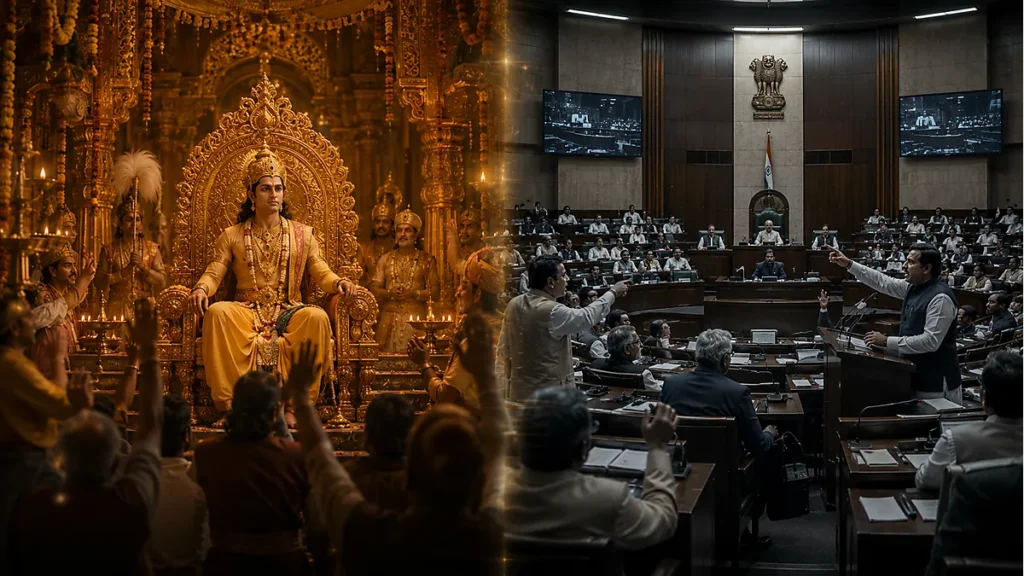
Rāma Rājya is not a utopia of magic; it is a vision of lawful compassion. In such a society:
- the ruler lives by stricter standards than anyone else;
- law is not a tool for the powerful but a boundary for them;
- economic and social justice are anchored in the ruler’s personal renunciation of selfishness.
Later texts describe Rāma Rājya as a time when:
- no one died before their time,
- nature was temperate,
- and people were honest, fearless, and prosperous.
In a metaphysical sense, Rāma Rājya represents the reconciliation of power and goodness. Rāma proves that absolute authority need not corrupt; it can refine, if wielded by one whose centre is entirely given over to dharma.
Sacred Geography: Walking in Rāma’s Footsteps
For the pilgrim, Rāma is not just a figure on a page; His journey maps itself onto the subcontinent as a living tīrtha-yātrā.
Ayodhyā – Birthplace and Spiritual Capital
On the banks of the Sarayū in present-day Uttar Pradesh lies Ayodhyā, long revered as Rāma’s birthplace. Recent decades have seen intense historical, legal, and spiritual focus on the Rāma Janmabhūmi site. A grand new Rām Mandir now stands there, constructed in pink sandstone in a Nāgara-style idiom, with intricate carvings and a three-storey structure.
The temple’s consecration (prāṇa-pratiṣṭhā) of the Rāma Lallā idol took place on 22 January 2024, with the sanctum opened to the public for darśan from January 23, marking a historic moment for millions of devotees. Pilgrims bathe in the Sarayū and then proceed to the temple, experiencing Ayodhyā both as an ancient epic city and as a living, resurgent centre of devotion.
Citrakūṭa – Forest of Harmony and Healing
South-east of Ayodhyā lies Citrakūṭa, spanning areas of modern Uttar Pradesh and Madhya Pradesh along the Mandākinī (Payasvinī) river. Tradition holds that Rāma, Sītā, and Lakṣmaṇa spent approximately eleven to eleven-and-a-half years of their exile here, experiencing their most peaceful forest days.
Key sites include:
- Kamadgiri – a forested hill believed to be the original Citrakūṭa; devotees circumambulate it as a living embodiment of Rāma’s presence.
- Rāma Ghat – ghats along the Mandākinī where Rāma and Sītā are believed to have bathed. The air often vibrates with the chant “Rām Rām Sītā Rām.”
- Sphatik Śilā, Jānkī Kuṇḍ, Hanumān Dhārā – sacred spots memorialising incidents from the exile years.
Citrakūṭa is less about grand architecture and more about landscape as memory—hills, streams, and forests quietly bearing the impression of divine footprints.
Kiṣkindhā – The Vānara Kingdom (Hampi Region)
The episode with Sugrīva and Hanumān situates Rāma in Kiṣkindhā, traditionally identified with the region around Hampi and Anegundi in Karnataka, along the Tuṅgabhadrā river.
- Many scholars and devotees recognise Anjanādri Hill near Anegundi—overlooking the Tuṅgabhadrā—as a strong claimant to being Hanumān’s birthplace, based on Purāṇic references to Anjanā’s hill and the clustering of Rāmāyaṇa-linked toponyms in the area.
- A temple atop Anjanādri, reached via hundreds of steps, enshrines Hanumān as child and warrior; pilgrims climb while chanting “Śrī Rām Jai Rām Jai Jai Rām.”
The surreal boulder fields of Hampi, ancient capital of Vijayanagara, give the area a mythic feel—one can almost imagine Vānara warriors leaping from rock to rock, training for the oceanic crossing.
Rāmeśvaram – The Sacred Bridge and Unity of Deities
At the southern tip of Tamil Nadu lies Rāmeśvaram, with its famed Śrī Rāmanāthasvāmi Temple on Pamban Island. Here, according to tradition:
- Rāma installed a Śivaliṅga and worshipped Śiva to seek blessings before crossing the ocean to Laṅkā.
- The Setu, or bridge, began: a chain of shoals and islands between India and Sri Lanka, popularly known as Rāma Setu.
Within the temple, pilgrims bathe in 22 sacred wells (tīrthas), each said to carry distinct spiritual qualities. Rāmeśvaram thus becomes a living symbol of:
- the confluence of Śaiva and Vaiṣṇava traditions,
- and the moment where contemplative worship and martial action meet.
Modern Spiritual Practice: Building Inner Rāma Rājya
Rāma’s relevance does not lie in nostalgia alone. He offers a template for modern life at multiple levels.
Personal Rāma Rājya: Ethics Before Convenience
At the individual level, the spirit of Rāma Rājya begins when:
- we treat our own power and privilege (education, income, social position) as responsibilities bound by ethical law;
- we prioritise duties—as parents, children, professionals, citizens—over mere convenience;
- we refuse to exploit those with less bargaining power, even when “everyone does it.”
Ask in each role:
“What would a Maryādā Puruṣottama version of this role look like?”
Then take one small step each week toward that standard: a promise kept, a truth told, a sacrifice made for someone weaker.
Emotional Dharma: Holding Pain Without Breaking Faith
Rāma teaches how to suffer without abandoning dharma.
- He does not deny grief over Sītā’s abduction.
- He does not hide the anguish of tough decisions as king.
- Yet He never allows pain to justify adharma.
In an era that often oscillates between emotional suppression and emotional indulgence, Rāma models a third way: emotion fully felt, duty still upheld.
A simple practice:
When you receive painful news, pause and silently repeat: “What is the dharmic response here, even if I am hurting?” Let that question be your inner “Rāma bow,” steering your reaction.
Nāma Japa: The Simplicity of Rāma’s Name
Among the simplest and most potent practices is Rāma Nāma Japa. One popular mantra:
Devanagari
श्री राम जय राम जय जय राम।
IAST
śrī rāma jaya rāma jaya jaya rāma |
For many, this becomes a lifeline in the chaos of urban life:
- recited silently while commuting,
- whispered before sleep,
- or sung collectively in kīrtan.
Traditional teachers say that the name “Rāma” spans both Vaikuṇṭha (Viṣṇu’s realm) and Kailāsa (Śiva’s): it is beloved in Vaiṣṇava and Śaiva currents alike. The mantra works not by magic syllables but by gently aligning the heart with an image of uncompromising integrity and tenderness.
Key Stotras, Nāma Japa, and Meditative Contemplations
To anchor this exposition, we close with verses that distill Rāma’s multifaceted glory, along with ways to work with them in practice.
Rāma Rakṣā Stotram – Relational Divinity
- Devanagari Script
रामाय रामभद्राय रामचन्द्राय वेधसे।
रघुनाथाय नाथाय सीतायाः पतये नमः॥ - IAST Transliteration
rāmāya rāmabhadrāya rāmacandrāya vedhase |
raghunāthāya nāthāya sītāyāḥ pataye namaḥ || - Source: Śrī Rāma Rakṣā Stotram, Verse 37.
- Sense and Bhāṣya
“My salutations to Rāma, to auspicious Rāmabhadra, to Rāmacandra who is pleasing like the moon, to the Supreme Lord and creator, Lord of the Raghu dynasty, protector of all, and beloved husband of Sītā.”
This verse beautifully holds Rāma’s two poles:
- Vedhase – the creator, the transcendent Absolute.
- Sītāyāḥ pataye – Sītā’s husband, situated in the tenderness of intimate relationship.
Reciting this verse daily reminds us that Ultimate Reality, in this tradition, is not a cold abstraction but a relational presence – sovereign and yet deeply involved in love, family, and social duty.
Practice:
Chant this verse once in the morning, once at night. Each time, briefly visualise one of its aspects: Rāmacandra’s moon-like calm, Rāghunātha as leader of lineage, Sītā-pati as ideal partner. Let these images gently shape your own roles.
Maṅgalāśāsanam – Ocean of Virtues
- Devanagari Script
मङ्गलं कोसलेन्द्राय महनीयगुणाब्धये।
चक्रवर्तितनूजाय सार्वभौमाय मङ्गलम्॥ - IAST Transliteration
maṅgalaṃ kosalendrāya mahanīya-guṇābdhaye |
cakravarti-tanūjāya sārvabhaumāya maṅgalam || - Source: Śrī Rāma Maṅgalāśāsanam, Verse 1.
- Sense and Bhāṣya
“Auspiciousness to the Lord of Kośala, who is an ocean of glorious virtues. Auspiciousness to the son of the emperor (Daśaratha), the universal sovereign.”
Rāma is praised not as an emperor of territory but as an ocean of virtues (mahanīya-guṇābdhaye). His global sovereignty (sārvabhaumāya) flows from inner excellence, not imperial expansion.
Practice:
Use this verse as a blessing. When you think of a leader—political, corporate, or community—recite it inwardly, not as flattery but as an invocation: “May this person become more like Rāma: an ocean of virtue whose power serves all.”
Simple Rāma Nāma for All
For those who prefer utmost simplicity, the pared-down name itself can be used:
Devanagari
ॐ रामाय नमः।
IAST
oṁ rāmāya namaḥ |
Chant this while walking, cooking, waiting, or worrying. Allow the name to become a background current, like a steady river on which your daily thoughts float.
FREQUENTLY ASKED QUESTIONS
Who is Lord Rama?
Lord Rama is the seventh avatar of Vishnu and the central figure of the Ramayana, revered as the ideal king and embodiment of dharma.
Why is Rama called Maryada Purushottam?
Rama is called Maryada Purushottam because He perfectly upheld duty, ethics, and righteous conduct in every role of life.
What is Rama Rajya?
Rama Rajya refers to the ideal kingdom ruled according to justice, compassion, prosperity, and dharma.
Where was Lord Rama born?
Hindu tradition identifies Ayodhya in Uttar Pradesh as the birthplace of Lord Rama.
What is the significance of Ram Setu?
Ram Setu is traditionally believed to be the bridge built by Rama’s army to cross the sea and reach Lanka.
What mantra is associated with Lord Rama?
One of the most popular mantras is “Shri Ram Jai Ram Jai Jai Ram.”
Śrī Rāma Avatāra marks the point in the Daśāvatāra journey where the Divine does not merely intervene to rescue, cleanse, or measure the universe, but lives through an entire human lifecycle as a model—from son and brother to husband, exile, warrior, ruler, and finally elder.
In Him we see that true greatness does not lie in never suffering, but in never betraying dharma while suffering. To walk with Rāma today is to quietly rebuild our own lives—families, institutions, nations—on the granite of character, one kept promise at a time.
Hari Om Tat Sat.
⁂
- https://bundelkhand.in/bundelkhand-circuit/chitrakoot
- https://chitrakoot.nic.in/chitrakoot_tourism-2/
- https://www.oneindia.com/india/live-ayodhya-ram-temple-inauguration-date-time-shubh-muhurat-everything-about-ram-mandir-janmabh-3714891.html
- https://www.indiatoday.in/india/story/ayodhya-ram-mandir-pran-pratishtha-news-live-updates-grand-opening-of-ayodhya-ram-temple-2491483-2024-01-21
- https://www.thrillophilia.com/attractions/kamadgiri-temple
- https://chitrakoot.nic.in/places-of-interest/
- https://magikindia.com/en/chitrakoot-madhya-pradesh/
- https://www.deccanherald.com/india/karnataka/a-hill-and-a-deity-the-search-for-hanuman-s-birthplace-981342.html
- https://en.wikipedia.org/wiki/Anjeyanadri_Hill