
A guide to the Pūrṇāvatāra, the Bhagavad Gītā, and living skillfully in an ambiguous world.
Table of Contents
Name, Attraction, and Divine Strategy
As the cosmic narrative shifts from Tretā Yuga to Dvāpara Yuga, the moral landscape thickens. The sharply etched lines of right and wrong in Śrī Rāma’s world begin to blur into the nuanced greys that we recognise from our own lives. Into this ambiguity descends Śrī Kṛṣṇa, the Pūrṇāvatāra—the “Complete Incarnation” who is at once cowherd, king, diplomat, teacher, and the very Absolute.
The name Kṛṣṇa (कृष्ण) is traditionally analysed in many ways, but a celebrated etymology appears in the Mahābhārata’s Udyoga Parva:
- Devanagari Script
कृषिर्भूवाचकः शब्दो णश्च निर्वृतिवाचकः।
तयोरे क्यं परं ब्रह्म कृष्ण इत्यभिधीयते॥ - IAST Transliteration
kṛṣir bhū-vācakaḥ śabdo ṇaś ca nirvṛti-vācakaḥ |
tayor aikyaṃ paraṃ brahma kṛṣṇa ity abhidhīyate || - Sense
“The syllable kṛṣ denotes the supreme, attractive ground of existence; the syllable ṇa denotes spiritual bliss. The union of these two is the Supreme Brahman, who is called Kṛṣṇa.”
Here, Lord Krishna is not merely a historical genius or charming cowherd. He is defined as Parabrahman itself—the attractive ground of being plus the summit of bliss. His very nature is to draw fragmented, anxious souls back into the wholeness of divine joy.
Philosophically, the move from Rāma to Kṛṣṇa marks a critical evolution:
- Rāma is the Avatāra of doing the right thing—He binds Himself to human law and shows perfect conduct.
- Kṛṣṇa is the Avatāra of knowing what the right thing truly is when rules collide—He moves above conventional codes to protect Universal Dharma, even if it means breaking superficial norms.
Rāma stands for Maryādā—ideal boundaries. Kṛṣṇa stands for Līlā and Yukti—divine play and strategic wisdom. He is the Divine Strategist, untethered to human expectations, whose only allegiance is to the deeper fabric of cosmic justice.
From Upaniṣadic Student to Epic Architect
Kṛṣṇa’s literary footprint spans the entire Sanskritic universe—from early Upaniṣads to Purāṇas.
Upaniṣadic Glimpse: Kṛṣṇa as Seeker
A famous early reference appears in the Chāndogya Upaniṣad (3.17.6), where Kṛṣṇa, son of Devakī, is mentioned as a disciple of the sage Ghora Āṅgirasa. From this teacher, he learns that life itself is a sacrifice, prefiguring the later Gītā doctrine that every action can become yajña when offered in the right spirit. This glimpse shows Kṛṣṇa first not as teacher, but as student of profound truth.
The Three Pillars: Mahābhārata, Harivaṃśa, Bhāgavata
Kṛṣṇa’s full theological architecture is constructed primarily across:
- Mahābhārata – presenting Kṛṣṇa in His Aiśvarya (majestic) aspect: diplomat, king of Dvārakā, and architect of Kurukṣetra.
- Harivaṃśa – an appendix to the Mahābhārata elaborating His genealogy and exploits.
- Śrīmad Bhāgavatam (Bhāgavata Purāṇa) – celebrating His Mādhurya (sweetness): the Vrindavan childhood, Rāsa Līlā, and intimate bhakti.
The Bhagavad Gītā—eighteen chapters spoken as a battlefield dialogue between Kṛṣṇa and Arjuna—is the doctrinal heart of the Kṛṣṇa age, synthesising karma, bhakti, jñāna, and yoga into a single, coherent path.
In contrast to previous Avatāras who intervene briefly, Kṛṣṇa’s presence saturates an entire civilisational crisis. He does not only slay demons; He re-codes the moral operating system by which seekers navigate a complex world.
The Grand Narrative: From Vrindavan Flute to Kurukṣetra Conch
Lord Krishna’s life is a journey from pastoral innocence to strategic gravitas, without ever losing joy at the center.
Birth in Captivity and Escape to Gokul
Kṛṣṇa descends into a time dominated by tyrant kings, especially Kaṃsa of Mathurā. He is born at midnight in the prison cell where his parents Devakī and Vasudeva are unjustly confined. Tradition locates this cell at the present Śrī Kṛṣṇa Janmabhūmi complex in Mathurā, now a major pilgrimage site where visitors still see the prison-like chamber and associated temples.
Smuggled across a storm-swollen Yamunā in Vasudeva’s arms, the infant is exchanged with the newborn daughter of Nanda and Yaśodā in Gokul. This single episode encodes a lifetime of paradox: born a prince, raised as a cowherd; destined to rule, yet delighting in play.
Vrindavan: Līlā, Govardhana, and Rāsa
In Gokul and Vrindavan, Kṛṣṇa’s childhood and adolescence overflow with Līlā:
- He slays demons sent by Kaṃsa (Pūtanā, Śakaṭāsura, Aghāsura) with playful ease.
- He lifts the Govardhana Hill on His little finger, sheltering the villagers from Indra’s vengeful storm and inaugurating a new mode of devotion centred on direct love rather than fear-based ritual.
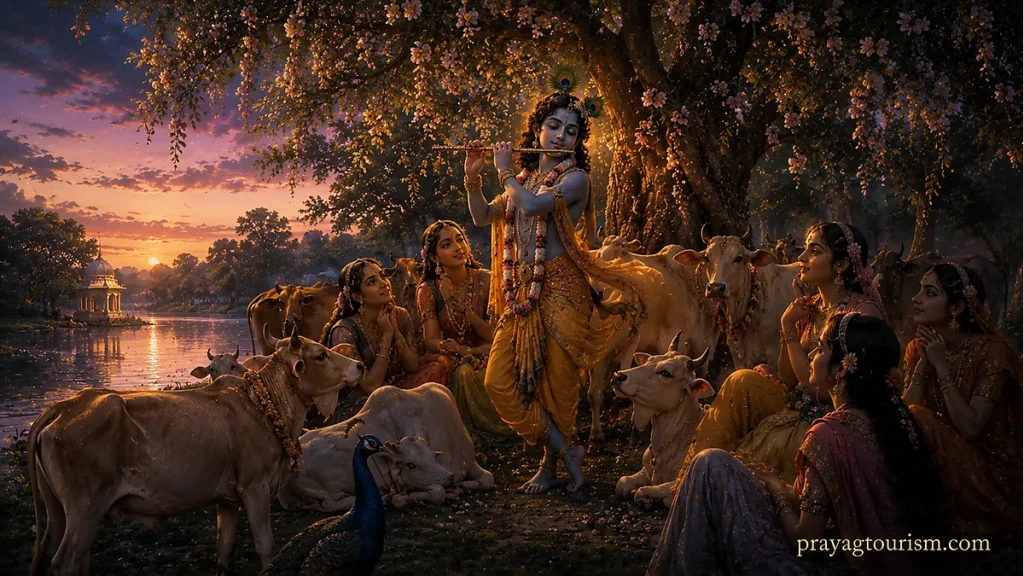
- He dances the Rāsa Līlā with the Gopīs, a circular dance in which each soul feels uniquely accompanied by God—an esoteric symbol of the soul’s intimate union with the Divine.
The boy with the flute is not an escape from reality; He is the revelation of the ultimate reality in the simplest rural setting.
Mathurā and Dvārakā: From Cowherd to King
As an adult, Lord Krishna returns to Mathurā, kills Kaṃsa, and frees his parents. But rather than ruling from this vulnerable city, He relocates His people to Dvārakā, a fortified coastal kingdom described as an advanced, planned city reclaimed from the sea. Today, Dvārakā in Gujarat—with its towering Dvārakādhīś Temple on the Gomti creek by the Arabian Sea—is revered as “Krishna’s land of action” and counted among the Sapta Purī and Char Dham pilgrimage sites.
Marine archaeology off the present-day Dvārakā coast has revealed submerged structures and artefacts suggesting an ancient, well-planned coastal city that experienced sudden submersion, resonating intriguingly with Purāṇic accounts of Kṛṣṇa’s city sinking beneath the sea after His departure.
Kurukṣetra: The Charioteer at the End of an Age
As the political climate of Āryāvarta corrodes, Lord Krishna becomes the quiet axis of the Mahābhārata:
- He tries diplomatic solutions to prevent war.
- When war becomes inevitable, He offers a choice: His army without Him, or Himself unarmed.
- Duryodhana chooses the army; Arjuna chooses Kṛṣṇa.
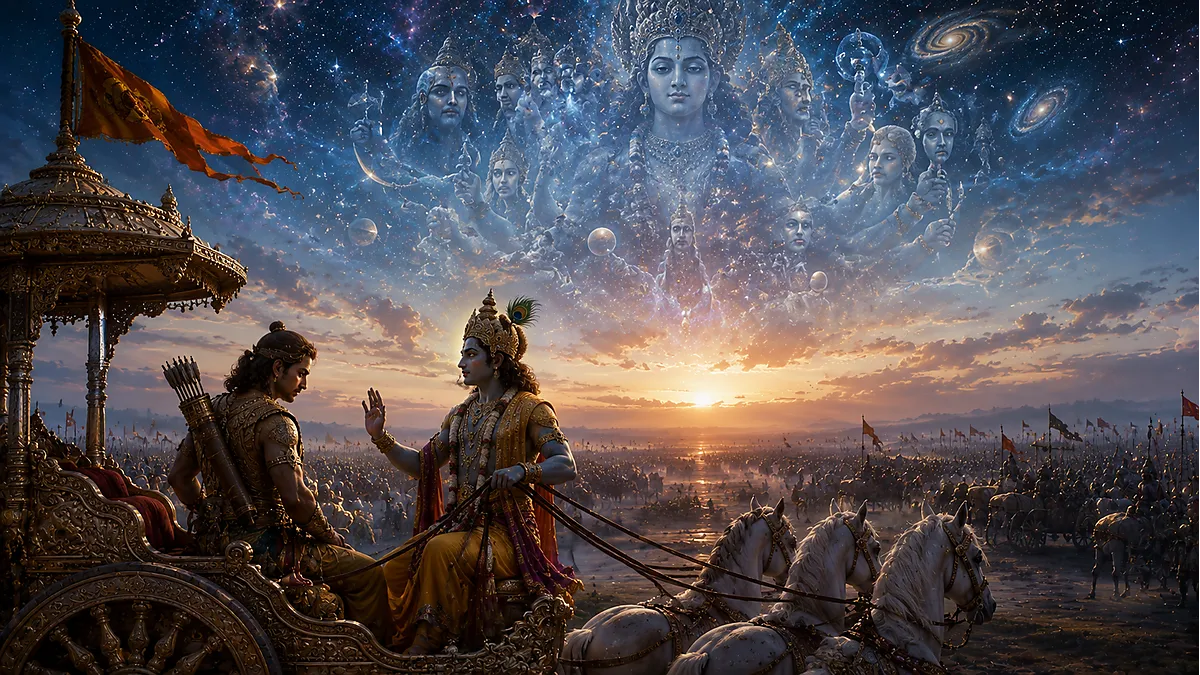
Thus Kṛṣṇa stands on the Kurukṣetra field not as warrior-king, but as sārathi, Arjuna’s charioteer and confidant. When Arjuna collapses in moral anguish, refusing to fight his own kin, Kṛṣṇa delivers the Bhagavad Gītā—unfolding the metaphysics of the soul, the structure of reality, and the path of action in alignment with wisdom.
At the climactic moment of Arjuna’s surrender, Kṛṣṇa reveals His Viśvarūpa, the Universal Form—countless mouths, arms, worlds, and timelines contained in a single blazing vision. Friend becomes God; charioteer becomes the axis of space and time.
Doctrinal and Esoteric Teachings of Kṛṣṇa
To grasp Kṛṣṇa’s doctrine, we must see the world He addresses: not a simple village, but a “civilisation in crisis” where every choice has victims, and dharma is not a single rule but an evolving, context-sensitive wisdom.
Dharma-Saṅkaṭa and the Indestructible Ātman
On Kurukṣetra, Arjuna experiences dharma-saṅkaṭa—paralysis in the tension between:
- Kula-dharma – duty to family, teachers, and elders.
- Kṣatriya-dharma – duty to fight injustice and protect the vulnerable.
He drops his bow, overwhelmed. Kṛṣṇa’s first step is not to shame him, but to redefine who and what the “person” truly is:
- Devanagari Script
नैनं छिन्दन्ति शस्त्राणि नैनं दहति पावकः।
न चैनं क्लेदयन्त्यापो न शोषयति मारुतः॥ - IAST Transliteration
nainaṃ chindanti śastrāṇi nainaṃ dahati pāvakaḥ |
na cainaṃ kledayanty āpo na śoṣayati mārutaḥ || - Source: Bhagavad Gītā 2.23.
- Sense and Bhāṣya
“Weapons cannot cut this soul, fire cannot burn it, water cannot wet it, and wind cannot dry it.”
Here, Kṛṣṇa establishes that the Ātman is indestructible. Arjuna’s grief is rooted in mistaking bodies for selves. Once he understands that no one truly “dies” in the absolute sense, he can engage in necessary action without being crushed by guilt or fear.
Yoga-Sthaḥ: Acting Without Attachment
Having redefined the person, Kṛṣṇa redefines right action:
- Devanagari Script
योगस्थः कुरु कर्माणि सङ्गं त्यक्त्वा धनञ्जय।
सिद्ध्यसिद्ध्योः समो भूत्वा समत्वं योग उच्यते॥ - IAST Transliteration
yoga-sthaḥ kuru karmāṇi saṅgaṃ tyaktvā dhanañjaya |
siddhy-asiddhyoḥ samo bhūtvā samatvaṃ yoga ucyate || - Source: Bhagavad Gītā 2.48.
- Sense and Bhāṣya
“Established in yoga, perform your duties, O Arjuna, abandoning attachment. Be the same in success and failure—this equanimity is called Yoga.”
Lord Krishna does not ask Arjuna to escape to the forest. He asks him to fight, but to fight from a different inner posture:
- Fully engaged,
- Completely competent,
- Yet inwardly free from egoistic attachment to outcomes.
This is Niṣkāma Karma Yoga—desireless, lucid action—which becomes the hallmark of Kṛṣṇa’s teaching.
Līlā and Contingent Ethics
Kṛṣṇa’s life also shows that sometimes, upholding a higher dharma requires bending or breaking lower-level rules:
- He advises Arjuna to strike Karṇa when Karṇa is disarmed, because Karṇa has repeatedly violated warrior ethics and continues to support adharma.
- He orchestrates strategic deceptions (like the announcement of Aśvatthāmā’s “death”) in a war where the Kauravas have already shredded the rulebook.
This is not situational opportunism; it is contextual dharma: when an opponent weaponises rules themselves to perpetuate injustice, acting strictly “by the book” may support adharma. Kṛṣṇa navigates these paradoxes so that dharma, in its deepest sense, survives.
Theologically, He holds in Himself all prior Avatāras:
- Matsya’s preservation,
- Kūrma’s stabilising support,
- Varāha’s rescuing strength,
- Narasiṃha’s category-shattering ferocity,
- Vāmana’s cosmic measure,
- Paraśurāma’s justice,
- Rāma’s unwavering integrity—
and adds to them joy and strategic subtlety: the flute on the battlefield, the smile at the end of an age.
Sacred Geography: The Kṛṣṇa Tīrtha Circuit
Kṛṣṇa’s life sketches a vast pilgrimage map—from prison cell to pastureland, from coastal fortress to battlefield. Modern pilgrims can physically traverse this Kṛṣṇa-circuit.
Mathurā – Birthplace Behind Bars
Mathurā on the Yamunā is revered as Kṛṣṇa’s birthplace. The Śrī Kṛṣṇa Janmabhūmi complex in the Katra Keśav Dev area is believed to stand over the very prison where Devakī gave birth and where Kṛṣṇa first manifested to set his parents free.
Within the complex:
- Devotees see a prison-like chamber representing the original cell.[1][3]
- Multiple shrines honour Kṛṣṇa and associated deities, forming a high-security zone due to the site’s sensitivity.[4][1]
On Janmāṣṭamī, the atmosphere is electric—continuous kīrtan, midnight āratī, and tens of thousands of pilgrims surging through narrow lanes.[3]
Vrindavan and Govardhan – The Pastoral Heart of Bhakti
A short distance from Mathurā lies Vrindavan, the epicentre of Kṛṣṇa bhakti, and Govardhan, the sacred hill He raised on His little finger. Here, devotees:
- Visit temples like Bāṅke Bihārī, Rādhā Raman, and countless others devoted to Kṛṣṇa’s sweet, intimate forms.
- Undertake the Govardhan Parikramā, a circumambulation of approximately 21 km around the hill, often barefoot, recalling Kṛṣṇa’s protection of the villagers during Indra’s deluge.[11][10][9]
The parikramā is typically divided into:
- Bāṛī Parikramā (~12 km) and Chhoṭī Parikramā (~9 km), together forming about 21 km, dotted with holy spots like Dān Ghāṭī, Rādhā Kuṇḍ, Śyāma Kuṇḍ, and Kusum Sarovar.[10][9][11]
Pilgrims describe this walk as a moving classroom in humility, endurance, and ecstatic remembrance.
Dvārakā – The Western Capital and Sunken City
On India’s western edge, where the Gomti river meets the Arabian Sea, stands Dvārakā, one of Hinduism’s Sapta Purī (seven sacred cities) and a key Char Dham site. The imposing Dvārakādhīś (Jagat Mandir) temple, believed in tradition to have been originally established by Kṛṣṇa’s great-grandson Vajranābha and rebuilt in later centuries, rises like a stone mast above the shoreline.
Archaeological and marine surveys off this coast have uncovered submerged structures and artefacts suggestive of an ancient, planned city that underwent rapid submersion, dovetailing in intriguing ways with Purāṇic stories of Kṛṣṇa’s Dvārakā sinking beneath the sea at the end of His earthly pastimes.
Kurukṣetra and Jyotiṣar – Battlefield of the Gītā
In present-day Haryana lies Kurukṣetra, the field of the Mahābhārata war. A particularly sacred spot here is Jyotiṣar, traditionally associated with the revelation of the Bhagavad Gītā.
- An ancient banyan tree at Jyotiṣar has long been venerated as standing at or near the very place where Kṛṣṇa instructed Arjuna; conservation efforts in recent years have sought to preserve this “Gītā tree,” believed by locals to be several millennia old.
- A chariot statue depicting Kṛṣṇa and Arjuna stands nearby, anchoring the philosophical weight of the Gītā in a specific, walkable landscape.
Pilgrims come here not primarily for emotional rapture, but for reflection—to sit under the tree’s shade and grapple with their own dharma-saṅkaṭas.
Modern Spiritual Practice: Nishkāma Karma in the Age of Ambiguity
Today’s seeker faces a world remarkably similar to Kṛṣṇa’s Dvāpara Yuga: rapid change, moral complexity, systemic injustice, and constant conflict between competing duties.
Kṛṣṇa’s life and teachings offer a survival manual for this age.
Living Nishkāma Karma in Daily Life
In corporate boardrooms, hospitals, courtrooms, and family kitchens, we repeatedly face choices where no option is perfectly clean. Kṛṣṇa’s counsel:
- Perform your svadharma (your own best-understood duty).
- Prepare diligently and act skilfully.
- Let go of ego-driven attachment to success or failure.
In practical terms:
- Do your work to the highest standard, but do not hinge your self-worth on promotion, likes, or public applause.
- Speak necessary truths even when they may cost you, but do so without hatred.
- Use strategy; avoid manipulation.
This is Kṛṣṇa’s way of walking through the world: fully in it, never owned by it.
Līlā-Bhāva – Flute in the Battlefield
Kṛṣṇa also insists that the Divine is not confined to caves and monasteries. Vrindavan and Kurukṣetra are both holy:
- Vrindavan shows God as play and intimacy.
- Kurukṣetra shows God as clarity amid crisis.
To cultivate Līlā-bhāva is to recognise that even in the densest office or busiest household, life is a stage for divine play. The point is not to trivialise suffering, but to remember:
- The Ātman is indestructible.
- Every situation is an invitation to learn and serve.
- The Divine Strategist sits quietly in your “chariot,” if you are willing to ask questions and listen.
A simple practice: At particularly stressful moments in your day, close your eyes for ten seconds and imagine Kṛṣṇa in your “charioteer’s seat,” holding the reins of your mind. Whisper inwardly: “Guide me to act rightly, not just nicely.”
Verses, Mantras, and Meditations for the Kṛṣṇa Age
To internalise this Avatāra’s energy, we end with a compact toolkit of verses and practices.
Name-Etymology Verse – Kṛṣṇa as Attractive Bliss
Revisit the Mahābhārata verse:
IAST
kṛṣir bhū-vācakaḥ śabdo ṇaś ca nirvṛti-vācakaḥ |tayor aikyaṃ paraṃ brahma kṛṣṇa ity abhidhīyate ||
Use it as a contemplative mantra:
- On the in-breath, mentally say kṛṣ – remembering the attractive ground of reality.
- On the out-breath, mentally say ṇa – remembering the bliss that is your own deepest nature.
- Let “Kṛṣṇa” be felt as the union of these two: reality plus joy.
Two Gītā Verses as Daily Compass
- Indestructible Self (Gītā 2.23)
nainaṃ chindanti śastrāṇi nainaṃ dahati pāvakaḥ |na cainaṃ kledayanty āpo na śoṣayati mārutaḥ ||
Recite when gripped by loss or fear. Let it remind you:
“The core of who I am cannot be harmed by any of this.”
- Equanimity in Action (Gītā 2.48)
yoga-sthaḥ kuru karmāṇi saṅgaṃ tyaktvā dhanañjaya |siddhy-asiddhyoḥ samo bhūtvā samatvaṃ yoga ucyate ||
Recite before entering a challenging task. Let it set your intention:
“I will do my best and accept the result with grace.”
A Simple Kṛṣṇa Mantra
For regular japa:
Devanagari
ॐ नमो भगवते वासुदेवाय।
IAST
oṁ namo bhagavate vāsudevāya |
Sense: “Obeisance to the Lord, Vāsudeva.”
Chant this:
- quietly during commutes,
- while waiting in queues,
- or as you fall asleep.
It is a timeless address to Kṛṣṇa as the indwelling Lord of all beings.
Visual Meditation: From Flute to Conch
Once a week, sit for ten minutes with this simple visualization:
- See Kṛṣṇa as Vṛndāvana Kṛṣṇa—flute in hand, smiling, surrounded by trees and cows. Let your heart soften.
- Slowly, the scene morphs into Kurukṣetra. The flute becomes a Pāñcajanya conch, the grove becomes a battlefield, but the same smile of inner freedom remains.
- Ask inwardly:
“How can I keep my inner flute even while holding my outer bow?” - Sit in silence, allowing answers to surface in their own time.
Śrī Kṛṣṇa Avatāra is the Divine meeting humanity at its most complicated—where every decision has mixed motives and mixed outcomes. He does not offer escape from this complexity; He offers clarity within it.
To walk with Kṛṣṇa is to learn how to strategise without cynicism, to feel deeply without paralysis, and to act vigorously without ego. It is to discover that the same Being who plays the flute in a forest can hold the reins of your chariot in a war—and that both moments are equally sacred.
Hari Om Tat Sat.
Frequently Asked Questions
Who is Lord Krishna?
Lord Krishna is the eighth avatar of Vishnu and one of Hinduism’s most revered deities, known for the Bhagavad Gita and Mahabharata.
Why is Krishna called Purnavatara?
Krishna is called Purnavatara because he embodies the complete manifestation of divine qualities and powers.
What is the central teaching of Krishna?
Krishna teaches Nishkama Karma—performing one’s duty without attachment to results.
Where was Lord Krishna born?
According to Hindu tradition, Lord Krishna was born in Mathura in present-day Uttar Pradesh.
What is the Bhagavad Gita?
The Bhagavad Gita is a dialogue between Krishna and Arjuna that explains duty, devotion, wisdom, and self-realization.
Why is Dwarka important?
Dwarka was the kingdom established by Krishna and remains one of Hinduism’s most sacred pilgrimage destinations.
⁂