
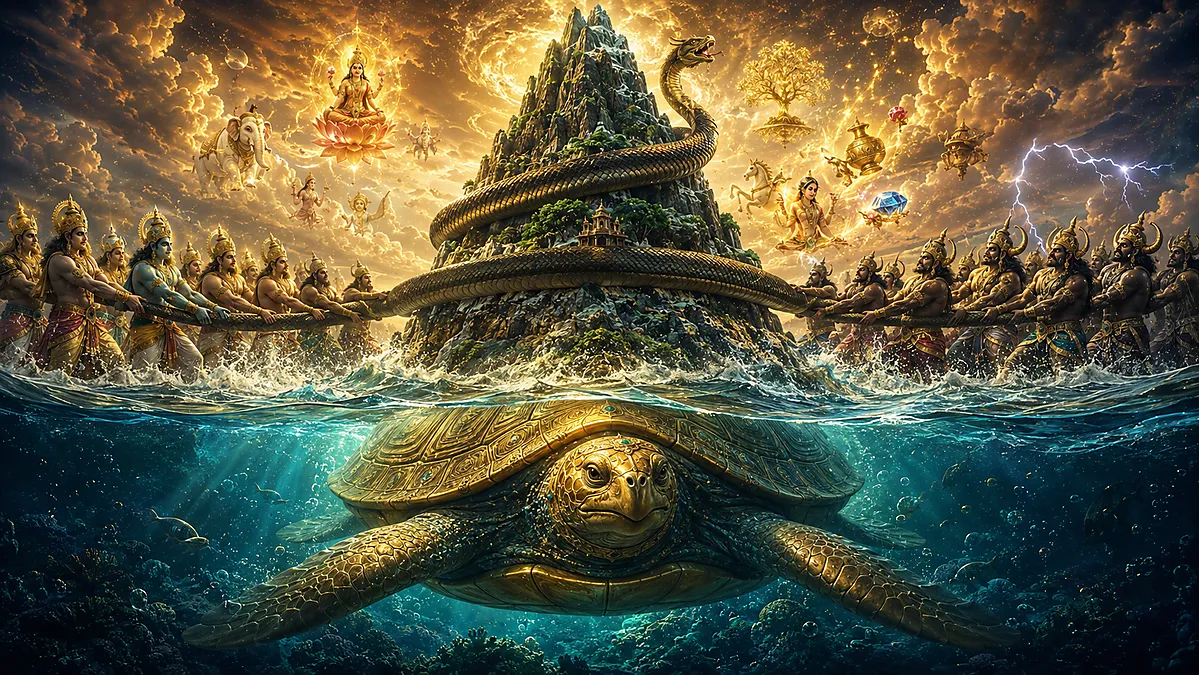
When the Lord Became the Support Beneath the Mountain
Daśāvatāra Series — Part Two | prayagtourism.com
Table of Contents
The Ocean Before the Nectar
Kurma Avatar, the second incarnation of Lord Vishnu, reveals one of the most profound lessons in Hindu spirituality: before transformation can occur, a strong foundation must exist.
There are moments in the spiritual imagination of Sanātana Dharma that feel less like stories and more like cosmic memory. The Kūrma Avatāra belongs to that rare class of sacred history. It does not begin with palace intrigue, heroic conquest, or forest exile. It begins with a structural emergency so immense that even the gods cannot solve it alone: the world has lost its balance, celestial vitality has weakened, and the nectar of renewal lies hidden in the unfathomable depths of the Ocean of Milk.
This is the moment for one of the grandest scenes in all Purāṇic literature: Samudra Manthana, the Churning of the Ocean of Milk. Mount Mandara is chosen as the churning rod and the serpent Vāsuki becomes the rope. The Devas gather on one side, the Asuras on the other. Both parties seek the same reward — amṛta, the nectar of immortality — yet neither side is fully pure, and neither side can win without the other.
But the mountain begins to sink. The ocean floor gives way. The cosmic project threatens collapse before the first treasure can even appear. And then the Lord descends as Kūrma — not to replace the churning, but to make it possible.
That is the first truth of this Avatāra. Before the nectar can rise, something must hold the weight.
Before the treasure appears, the foundation must be found.
Before the world can move forward, something must bear its burden.
What Kūrma Really Means
The Sanskrit word Kūrma (कूर्म) means tortoise or turtle. On the surface, it looks like a modest form for a cosmic deity. But that modesty is precisely the point. The tortoise is a creature of support, patience, and self-contained protection. It lives close to both water and land, carries a shell that functions as a portable refuge, and survives by steadiness rather than speed.
That makes Kūrma the perfect image of the principle of foundation. The Lord is not merely moving through the world. He is supporting the world. He is the hidden base beneath movement, the structural grace that allows all change to occur without collapse.
The evolutionary resonance is striking. The great transition from aquatic life toward terrestrial life required more than ambition. It required structure — a weight-bearing skeleton, stronger limbs, the ability to fight gravity rather than float inside water. Kūrma symbolizes exactly that: the deep, structural capacity to carry weight and remain steady.
In the human heart, too, Kūrma is the principle of inner shelter. When life becomes noisy, the tortoise shows the soul how to withdraw inward without becoming closed, protected without becoming rigid, patient without becoming passive.
The Scriptural Origins of Kūrma
The Kūrma Avatāra is not a late invention. It emerges from a long and layered sacred tradition. The broad churning narrative is preserved across Purāṇic sources such as the Viṣṇu Purāṇa, Bhāgavata Purāṇa, and the Kurma Purāṇa itself. Over time, the story becomes one of the most beloved and symbolic episodes in Hindu mythology.
The Kurma Purāṇa, named after the Avatāra, is especially important because it does not treat the tortoise merely as a supporting figure in another tale. It elevates Kūrma into a theological center of gravity, preserving teachings associated with divine support, cosmic order, and sacred knowledge.
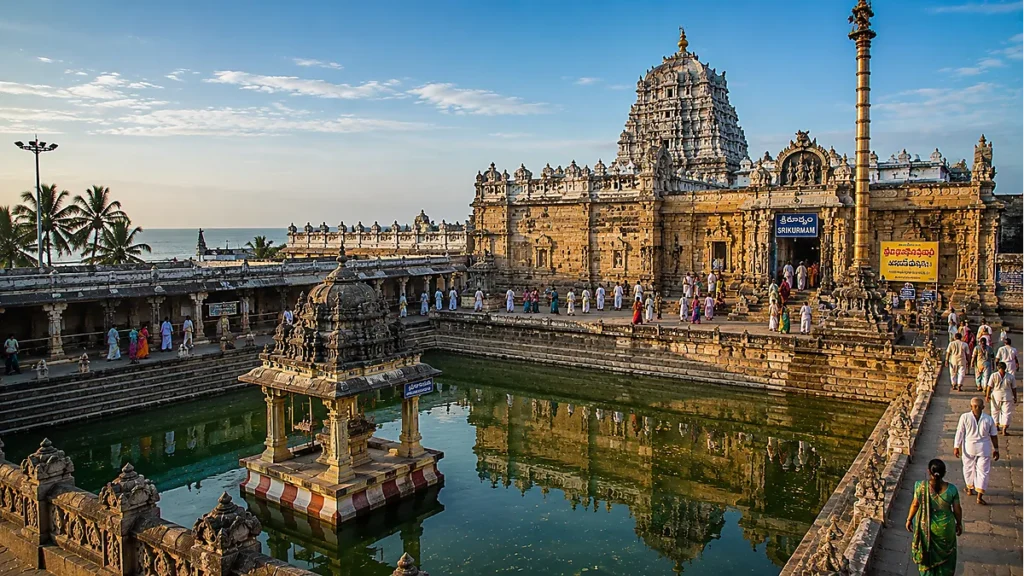
Temple tradition gives the story an even more intimate life. At Srikurmam in Andhra Pradesh, the worship of Lord Viṣṇu as Kūrma continues as a living pilgrimage tradition. The temple is recognized as the singular major shrine in India devoted to the Kurma form, and it remains one of the most important Kūrma-tīrthas in the country.
This continuity matters. Kūrma is not only a text. Kūrma is a place. Kūrma is an image. Kūrma is a living sacred memory.
The Great Churning of the Ocean
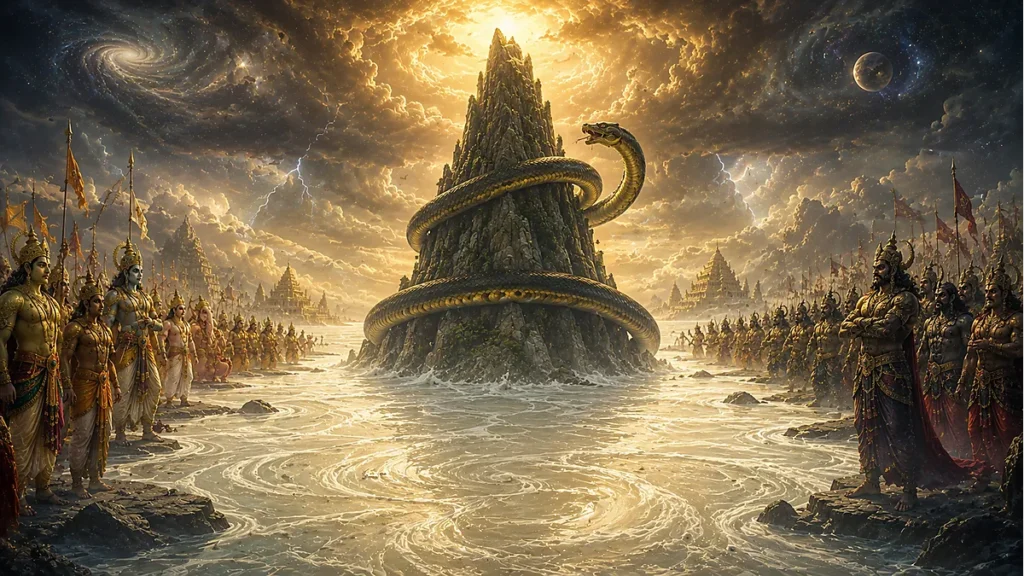
Now enter the story as the devotees of old would have heard it — not as summary, but as living revelation.
The Devas have weakened. Due to a curse and the loss of divine vigor, they are no longer able to sustain their former radiance. The Asuras, meanwhile, have gained strength and are threatening the balance of the worlds. Lord Viṣṇu advises an extraordinary solution: both sides should cooperate to churn the Ocean of Milk and recover amṛta, the nectar of immortality.
Mount Mandara is uprooted and carried to the sea. Vāsuki coils around the mountain. The gods take one side of the serpent. The demons take the other. The ocean roars. The mountain turns. The cosmos begins to churn.
Then disaster arrives. The mountain has no support and begins to sink. The entire cosmic enterprise is on the verge of failure. And that is when Viṣṇu descends as Kūrma, entering the depths and supporting the mountain on His broad shell.
The churning resumes. The pressure is immense. The ocean foams. The deep contents of existence rise to the surface. First comes hālahala, the terrifying poison capable of destroying the worlds. Śiva, in supreme compassion, drinks it and holds it in His throat, becoming Nīlakaṇṭha. Then the treasures emerge: Kāmadhenu, Uccaiḥśravas, Airāvata, the Kaustubha jewel, the Pārijāta tree, the Apsarās, Śrī Mahālakṣmī, and finally Dhanvantari bearing the pot of amṛta.
This is why Samudra Manthana is one of the greatest spiritual symbols in all of Hindu thought. It teaches that the churned world reveals everything hidden within it — both poison and nectar.
The most beautiful thing about the Kūrma Avatāra is that it turns support into revelation. In ordinary life, support is something we notice only when it fails. We notice the chair when it breaks, the roof when it leaks, the family when it fragments, the mind when it unravels. Kūrma reverses that habit. The Lord appears as the invisible strength already holding the entire structure together.
This is why the image of the tortoise has endured so deeply in Indian spiritual memory. The tortoise is not dramatic. It is not fast. It does not ask to be seen. But it teaches a secret the modern world urgently needs: what is lasting is often what is quiet.
The churning of the ocean is therefore not only a myth of divine victory. It is a mirror of every transformation that matters. When we meditate, study, fast, pray, serve, or endure, we are also churning. We are pulling hidden contents upward. Some of those contents heal us. Some confront us. Some terrify us. Yet if the foundation is sound, the process is fruitful.
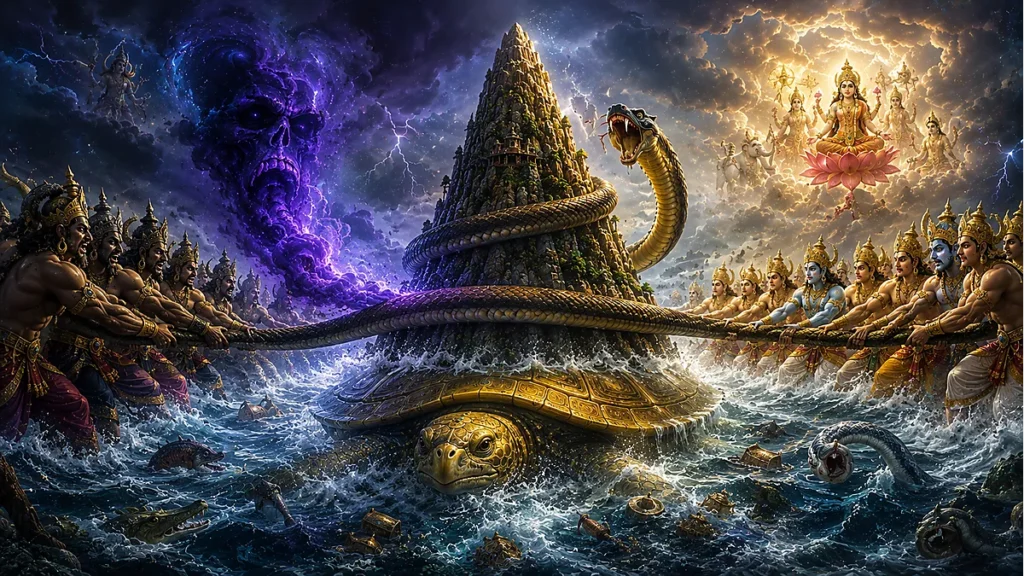
The fourteen treasures
The Purāṇic narrative of Samudra Manthana is famous for the treasures that emerge from the ocean. Different tellings arrange them slightly differently, but the essential sacred imagination remains the same: the churning does not produce only amṛta. It produces the entire spectrum of worldly and divine possibility.
Some of the best-known treasures include Kāmadhenu, Uccaiḥśravas, Airāvata, Kaustubha, the Pārijāta tree, the Apsarās, Lakṣmī, and Dhanvantari. Other traditional lists also include Chandra, Varuṇī, Kalpavṛkṣa, Panchajanya, Śārṅga, and additional divine gems, though the exact count and order vary across Purāṇic and popular retellings.
The point is not merely list-making. The point is that the ocean of consciousness contains all things in seed-form. When life is churned by dharma, the treasures hidden inside us may rise to the surface.
Sanskrit Verses and Pramāṇa
In Sanātana Dharma, poetry is not ornament. Verse is proof, memory, and living transmission. The sacred teaching becomes fully authoritative only when it is grounded in Śruti and Smṛti.
Verse One — The Divine Promise
Devanagari:
यदा यदा हि धर्मस्य ग्लानिर्भवति भारत ।
अभ्युत्थानमधर्मस्य तदात्मानं सृजाम्यहम् ॥
IAST:
yadā yadā hi dharmasya glānir bhavati bhārata |
abhyutthānam adharmasya tadātmānaṃ sṛjāmy aham ||
Source: Bhagavad Gītā, Chapter 4, Verse 7
Word-by-word meaning:
- यदा यदा (yadā yadā) — whenever
- हि (hi) — indeed
- धर्मस्य (dharmasya) — of dharma
- ग्लानिः (glāniḥ) — decline
- भवति (bhavati) — occurs
- भारत (bhārata) — O descendant of Bharata
- अभ्युत्थानम् (abhyutthānam) — rise
- अधर्मस्य (adharmasya) — of adharma
- तदा (tadā) — then
- आत्मानम् (ātmānam) — Myself
- सृजामि (sṛjāmi) — I manifest
- अहम् (aham) — I
Translation: Whenever dharma declines and adharma rises, I manifest Myself.
Bhāṣya: The Kūrma episode is one of the clearest illustrations of this promise. When the world loses support, the Lord appears not in pomp, but in the very form needed to restore equilibrium. This is divine timing, not spectacle.
Verse Two — The Purpose of Descent
Devanagari:
परित्राणाय साधूनां विनाशाय च दुष्कृताम् ।
धर्मसंस्थापनार्थाय सम्भवामि युगे युगे ॥
IAST:
paritrāṇāya sādhūnāṃ vināśāya ca duṣkṛtām |
dharma-saṃsthāpana-arthāya sambhavāmi yuge yuge ||
Source: Bhagavad Gītā, Chapter 4, Verse 8
Word-by-word meaning:
- परित्राणाय (paritrāṇāya) — for protection
- साधूनाम् (sādhūnām) — of the good
- विनाशाय (vināśāya) — for destruction
- च (ca) — and
- दुष्कृताम् (duṣkṛtām) — of the wicked
- धर्मसंस्थापनार्थाय (dharma-saṃsthāpana-arthāya) — for establishment of dharma
- सम्भवामि (sambhavāmi) — I appear
- युगे युगे (yuge yuge) — age after age
Translation: To protect the righteous, destroy evil, and establish dharma, I appear age after age.
Bhāṣya: The Kūrma Avatāra does not merely assist in obtaining nectar. He enables the restoration of order itself. Support is the hidden form of protection.
Verse Three — Jayadeva’s Vision
Devanagari:
क्षितिरिह विपुलतरे तिष्ठति तव पृष्ठे ।
धरणिधरणकिणचक्रगरिष्ठे ॥
केशव धृतकच्छपरूप जय जगदीश हरे ॥
IAST:
kṣitir iha vipulatare tiṣṭhati tava pṛṣṭhe |
dharaṇi-dharaṇa-kiṇa-cakra-gariṣṭhe ||
keśava dhṛta-kacchapa-rūpa jaya jagadīśa hare ||
Source: Gīta Govinda, Daśāvatāra Stotram, Verse 2
Word-by-word meaning:
- क्षितिः (kṣitiḥ) — the earth / the mountain
- इह (iha) — here
- विपुलतरे (vipulatare) — on the immensely expansive
- तिष्ठति (tiṣṭhati) — rests
- तव (tava) — Your
- पृष्ठे (pṛṣṭhe) — back
- धरणि (dharaṇi) — earth / mountain
- धरण (dharaṇa) — holding
- किण (kiṇa) — callus / scar
- चक्र (cakra) — wheel / circular mark
- गरिष्ठे (gariṣṭhe) — glorious / weight-bearing
- केशव (keśava) — O Keśava
- धृत (dhṛta) — who has assumed
- कच्छप (kacchapa) — tortoise
- रूप (rūpa) — form
- जय (jaya) — victory / glory
- जगदीश (jagadīśa) — Lord of the universe
- हरे (hare) — O Hari
Translation: O Keśava, who has assumed the form of a tortoise! Victory to You, O Lord of the universe! The massive Earth rests on Your immensely expansive back, gloriously marked by the circular calluses of cosmic burden.
Bhāṣya: Jayadeva’s use of the word kiṇa is exquisite. It suggests that the Lord willingly bears the “marks” of cosmic effort out of love. The Supreme becomes the bearer of weight so the universe may continue.
Verse Four — The Tortoise of Withdrawal
Devanagari:
यदा संहरते चायं कूर्मोऽङ्गानीव सर्वशः ।
इन्द्रियाणीन्द्रियार्थेभ्यस्तस्य प्रज्ञा प्रतिष्ठिता ॥
IAST:
yadā saṃharate cāyaṃ kūrmo ‘ṅgānīva sarvaśaḥ |
indriyāṇīndriyārthebhyas tasya prajñā pratiṣṭhitā ||
Source: Bhagavad Gītā, Chapter 2, Verse 58
Word-by-word meaning:
- यदा (yadā) — when
- संहरते (saṃharate) — withdraws
- च (ca) — and
- अयम् (ayam) — this person
- कूर्मः (kūrmaḥ) — like a tortoise
- अङ्गानि (aṅgāni) — limbs
- इव (iva) — like
- सर्वशः (sarvaśaḥ) — completely
- इन्द्रियाणि (indriyāṇi) — senses
- इन्द्रियार्थेभ्यः (indriyārthebhyaḥ) — from sense objects
- तस्य (tasya) — his
- प्रज्ञा (prajñā) — wisdom
- प्रतिष्ठिता (pratiṣṭhitā) — firmly established
Translation: One who withdraws the senses from the sense objects, like a tortoise withdrawing its limbs, is firmly established in wisdom.
Bhāṣya: Here Kṛṣṇa explicitly turns the biology of the tortoise into the ideal of meditation. Withdrawal is not fear. It is mastery.
Verse Five — The Lord as Universal Support
Devanagari:
नमः कूर्मरूपाय जगदाधाररूपिणे ।
मन्दरधारिणे नित्यं नमो विश्वप्रतिष्ठिते ॥
IAST:
namaḥ kūrmarūpāya jagadādhārarūpiṇe |
mandaradhāriṇe nityaṃ namo viśvapratishṭhite ||
Source: Traditional devotional invocation to Lord Kūrma; exact verse location varies by lineage and edition
Word-by-word meaning:
- नमः (namaḥ) — salutations
- कूर्मरूपाय (kūrmarūpāya) — to the one in tortoise form
- जगदाधाररूपिणे (jagadādhārarūpiṇe) — to the one who is the support of the world
- मन्दरधारिणे (mandaradhāriṇe) — to the bearer of Mandara
- नित्यम् (nityam) — always, eternally
- नमः (namaḥ) — salutations
- विश्वप्रतिष्ठिते (viśvapratishṭhite) — to the one established in the universe
Translation: Salutations to the Lord in tortoise form, the support of the world, the bearer of Mandara, eternally established in the cosmos.
Bhāṣya: This verse names Kūrma not only as a rescuer but as a cosmic principle. The mountain stands because the Lord has become the foundation beneath it.
The Hidden Wisdom of the Tortoise
To read Kūrma merely as a myth about gods and demons is to miss its deepest purpose. The story is a manual of spiritual psychology.
The Ocean of Milk symbolizes consciousness — vast, rich, and full of hidden potential. Devas and Asuras symbolize our noble and lower tendencies. Mount Mandara is the spine of meditation, the one-pointed focus that must remain upright. Vāsuki symbolizes breath, energy, or the tension of disciplined practice. The poison represents the unresolved darkness that surfaces in deep inner work. The treasures and nectar symbolize the gifts of mature practice.
And Kūrma is the Self beneath it all.
Without a stable identity in the divine, spiritual effort becomes collapse. The mountain sinks. The mind sinks. The practice breaks. But with Kūrma beneath us, the churning becomes fruitful.
The shell is one of nature’s most elegant symbols. It is both protection and restraint, refuge and discipline. In yogic language, it resembles pratyāhāra, the withdrawal of the senses from distraction. In psychological language, it resembles the ability to remain inwardly intact when outer circumstances become hostile.
A person without a shell is vulnerable to every passing wave of praise or blame. A person with Kūrma in the heart can still feel, still love, still serve, but is not easily shattered. That is not apathy. It is a cultivated steadiness.
And this is precisely what the Gītā praises in the image of the tortoise. The seeker who can withdraw the senses as the tortoise withdraws its limbs is not weak; that seeker is spiritually mature.
The shell is not a prison.
The shell is a sanctuary.
Life Lessons for the Modern Seeker
The modern world is a churning ocean. Careers, relationships, news cycles, financial pressure, family obligations, and inner comparison all pull from opposite sides. Many people feel as if their own Mandara mountain is slipping into the sea.
Kūrma offers a profoundly healing response:
- Build foundation before seeking expansion.
- Honor silence as a form of strength.
- Accept that churning brings both poison and nectar.
- Withdraw the senses when the world becomes too loud.
- Recognize that support is often invisible before it is felt.
Core Life Lessons
| Teaching | In the Story | In Daily Life |
| Foundation comes first | The mountain sinks until Kūrma supports it | A life without discipline and values cannot bear pressure. |
| Churning reveals hidden contents | Poison and nectar both emerge. | Crisis exposes both wounds and gifts. |
| Quiet support is powerful | Kūrma holds the mountain from beneath | The most important help may be unseen. |
| Withdrawal is wisdom | The tortoise withdraws into itself | Inner stability protects the mind from chaos. |
| Cooperation can be transformative | Devas and Asuras churn together | Even conflicting forces can serve growth. |
Sacred Geography of Kūrma
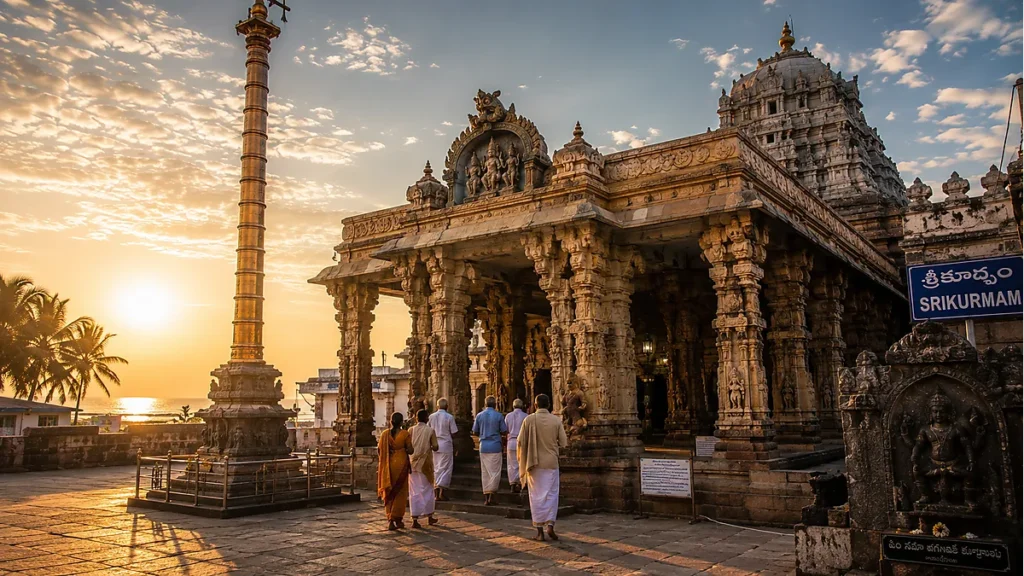
The chief living shrine of Kūrma worship is Śrīkūrmam in Andhra Pradesh. The temple is revered as the singular major shrine dedicated to Lord Viṣṇu in His tortoise form. The temple traditions describe it as a self-manifest sacred place, and the site has long been associated with Vaishnava pilgrimage and ritual life.
Srikurmam’s atmosphere is distinct. It is coastal, calm, and inward-looking. That is exactly right for Kūrma. The deity’s message is not speed. It is support.
Temple traditions remember that the chief deity faces west, and this unusual orientation is linked with the temple’s distinct layout, including the presence of two dhvajastambhas or flagstaffs. Temple sources also state that the temple opens daily from 6:00 am and remains accessible into the evening, with worship rhythms that distinguish morning Viṣṇu worship from evening Śiva worship.
A visit to Srikurmam is not merely heritage tourism. It is a landscape of contemplation. The coast, the breeze, the stone, the tank, and the quiet persistence of ritual all embody the same spiritual truth. The devotee does not rush through this space. The devotee slows down.
Temple traditions remember Srikurmam as a place where the form of the Lord became especially accessible to the devotee’s gaze. The western-facing sanctum, the dual flagstaffs, the sacred tank, and the careful protection of the tortoise symbolism all make the temple feel less like a monument and more like an ongoing conversation between the eternal and the human.
For the pilgrim, the practical experience is simple and profound. Arrive with reverence. Bathe if possible. Walk slowly. Let the architecture teach patience. Let the sea remind you of depth. Let the deity remind you that support can be divine.
A Simple Kūrma Practice at Home
Kūrma can be invoked not only in temple pilgrimage but in daily domestic life.
A short morning practice
- Sit quietly for three minutes.
- Keep the spine straight.
- Breathe slowly and deeply.
- Imagine a mountain resting on a vast, steady shell.
- Say inwardly: O Kūrma, give me steadiness. Let me hold what must be held without breaking.
A complete five-minute practice
- Sit in a quiet place.
- Keep your spine straight.
- Close your eyes and breathe slowly.
- Visualize a shell beneath you, broad and steady.
- Whisper the name: Kūrma, Kūrma, Kūrma.
- Ask for strength to hold your responsibilities without collapse.
- End by offering gratitude for the unseen supports in your life.
A short evening reflection
Ask three questions:
- What in my life has been sinking?
- What foundation do I need to restore?
- What quiet support is already present and unnoticed?
This is a gentle ritual, but it changes the inner climate of a life. The shell is not a barrier to life. It is the condition for life to remain integrated.
FREQUENTLY ASKED QUESTIONS
What is Kurma Avatar?
Kurma Avatar is the second incarnation of Lord Vishnu in the Dashavatara. He appeared as a giant tortoise to support Mount Mandara during the churning of the Ocean of Milk.
Why did Vishnu take the form of a tortoise?
Lord Vishnu assumed the tortoise form to provide a stable foundation beneath Mount Mandara when it began sinking during Samudra Manthana.
What is the meaning of Kurma Avatar?
Kurma Avatar symbolizes stability, patience, support, endurance, and the hidden strength that sustains spiritual growth and cosmic order.
What is Samudra Manthana?
Samudra Manthana, or the Churning of the Ocean of Milk, is a famous Hindu myth in which Devas and Asuras churned the cosmic ocean to obtain Amrita, the nectar of immortality.
Where is the famous Kurma Avatar temple located?
The most important temple dedicated to Kurma Avatar is the Sri Kurmam Temple in Andhra Pradesh, India.
What spiritual lesson does Kurma Avatar teach?
Kurma Avatar teaches that every transformation requires a strong foundation. Just as the mountain needed support during the churning, spiritual progress requires inner stability and discipline.
The Path Ahead
Matsya preserved life in the flood.
Kūrma gave that life a foundation.
Kūrma taught life how to stand under pressure.
The Daśāvatāra is not a random list of myths. It is a sacred sequence describing how the Divine enters history wherever life is threatened, wounded, or destabilized.
The second Avatāra teaches one of the most important truths any pilgrim can learn: endurance is sacred. Support is sacred. Quiet strength is sacred. The Lord does not only arrive in thunder. Sometimes He arrives beneath your weight, holding you up while the world churns.
The next descent of Lord Viṣṇu is even more visceral and even more earth-moving. The Earth herself has fallen, and the Lord will plunge into the abyss as Varāha, the Boar, to lift her on His tusks.
Hari Om Tat Sat.
This article is part of the Daśāvatāra Series on prayagtourism.com. Series: The Divine Descent — Understanding the Mystery of the Avatāra in Sanātana Dharma.