
WALKING INTO THE WORLD’S LARGEST PILGRIMAGE
Before the sun has even thought of rising, the air begins to hum.
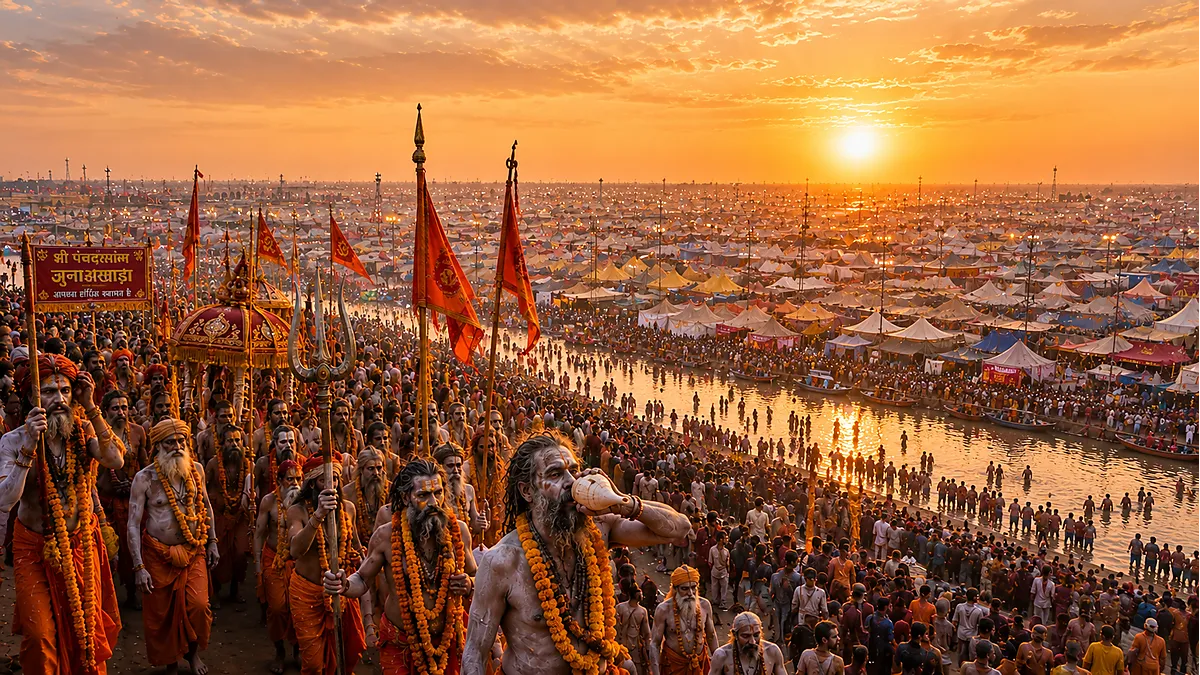
You step out into the darkness, and immediately you are swallowed by a river of humanity — millions of feet moving in the same direction, a silent, purposeful tide toward the Sangam. The air is cool and thick with the smell of incense, wood smoke, and the sweet fragrance of marigolds. Somewhere ahead, a conch shell sounds. Then another. Soon, the entire horizon seems to pulse with the sound of temple bells, Sanskrit chants, and the soft murmur of prayers whispered in a hundred different languages.
A Naga Sadhu walks past you — his body smeared with ash, his matted locks piled high, a trident in his hand. He does not look at you or anyone else. His eyes are fixed on the water. Behind him come hundreds more, their saffron robes bright against the pre‑dawn gloom. Elephants carrying gurus, chariots bearing saints, drummers beating a rhythm that seems to match the beating of your own heart.
You reach the river’s edge. The water is cold. The fog is lifting. And as the first rays of the sun strike the Sangam, you watch millions of hands rise in prayer — and in that moment, you understand.
This is not a festival. This is not a fair. This is something far older, far deeper, far more powerful than any single word can capture.
What power draws millions of people to one place in the largest peaceful gathering on Earth? What faith compels saints and kings, the rich and the poor, the learned and the illiterate to leave their homes and travel vast distances, just to stand in a river at a particular moment in time?
The answer lies in a story as old as creation itself — the story of the Kumbh Mela.
SUMMARY
| Detail | Information |
| Event Name | Kumbh Mela |
| Meaning | Festival of the Sacred Pitcher (Amrita Kumbha) |
| Mythological Origin | Samudra Manthan (Churning of the Ocean of Milk) |
| Major Ritual | Shahi Snan (Royal Bath) |
| Sacred Locations | Prayagraj, Haridwar, Ujjain, Nashik |
| Frequency | Every 12 years (Purna Kumbh), every 6 years (Ardha Kumbh), every 144 years (Maha Kumbh) |
| Largest Gathering Recorded | Approx. 660 million (Prayag 2025) |
| UNESCO Recognition | Inscribed in 2017 on the Representative List of Intangible Cultural Heritage of Humanity |
WHAT IS KUMBH MELA?
Kumbh Mela (Sanskrit: कुम्भ मेला; pronounced kumb‑ha may‑la) means literally “festival of the sacred pitcher.” Each word carries profound meaning.
Kumbha (कुम्भ) refers to the pitcher or pot — specifically the sacred vessel that once held the nectar of immortality (amrita). In Hindu tradition, the kumbha is also a symbol of the womb of creation, the container of life itself. When you see a pitcher filled with water in a Hindu temple or home, you are seeing a reminder of the original Kumbh — the vessel that carried the elixir that could conquer death.
Mela (मेला) comes from the Sanskrit root √मिल् (mil) meaning “to meet, to unite, to come together.” A mela is not merely a fair or a festival — it is a gathering, a confluence, a meeting of souls. At the Kumbh Mela, millions of individuals become one body, one intention, one prayer.
The Kumbh Mela is a Hindu pilgrimage and festival celebrated at four sacred locations — Prayagraj, Haridwar, Ujjain, and Nashik — rotating every 12 years. The festival lasts between one and three months, with the most auspicious days attracting the largest crowds. In 2025, the Prayag Kumbh Mela saw approximately 660 million pilgrims — the largest peaceful gathering of humanity in history.
At its simplest level, the Kumbh Mela is about one act: taking a holy dip in a sacred river at a specific astrological moment. But at its deepest level, it is about something far greater — purification, liberation, and the eternal human quest for immortality.
SAMUDRA MANTHAN — THE MYTHOLOGICAL ORIGIN OF KUMBH MELA
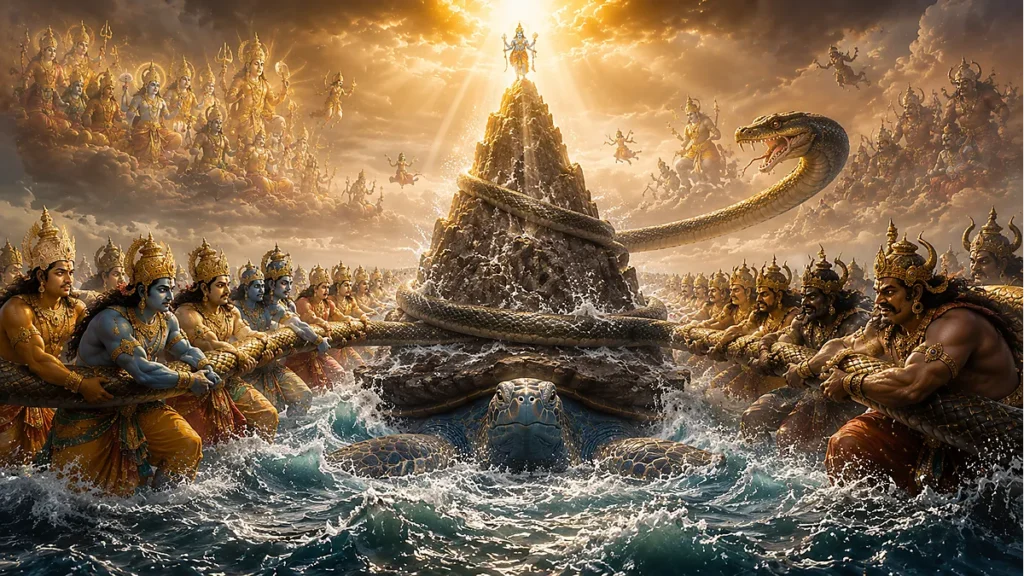
To understand the Kumbh Mela, you must first understand the Samudra Manthan — the Churning of the Ocean of Milk. This is not merely a story; it is the mythological blueprint for the entire Kumbh tradition.
The Conflict Between Devas and Asuras
Long ago, in the celestial realms, the Devas (gods) and Asuras (demons) were locked in an eternal struggle for supremacy. The Devas, weakened by a curse from the sage Durvasa, had lost their strength and their immortality. The Asuras, sensing their weakness, grew bold and oppressive.
But the Devas had one hope. Deep within the cosmic ocean lay Amrita — the nectar of immortality. If they could obtain it, they could regain their power and restore balance to the universe.
There was only one problem. The ocean was vast and infinite, and the nectar lay hidden at its depths. To retrieve it, they would need to churn the entire ocean — a task so immense that neither the Devas nor the Asuras could accomplish it alone.
An Unholy Alliance
And so, an unlikely alliance was formed. The Devas and Asuras agreed to work together — to churn the ocean together, to retrieve the treasures together, and to share the nectar of immortality equally.
It was an alliance born of necessity, not trust. Both sides knew that when the nectar finally appeared, the true battle would begin.
Mount Mandara — The Churning Rod
The churning required two things: a churning rod and a churning rope.
For the rod, they used Mount Mandara — a mountain of immense size and weight, plucked from the earth and placed in the ocean of milk. But the mountain was so massive that even the combined strength of Devas and Asuras could not keep it from sinking. The gods appealed to Lord Vishnu, who took the form of a divine tortoise (Kurma) and supported the mountain on his back — holding it steady for the long churning that lay ahead.
For the rope, they used the great serpent Vasuki (also known as Shesha Naga), the king of all snakes. The Devas held Vasuki’s tail, and the Asuras held his head — each pulling in rhythm, rotating the great mountain and churning the ocean for thousands of years.
The Fourteen Treasures
As the Devas and Asuras pulled and the mountain spun, the ocean began to yield its hidden treasures. One by one, fourteen precious items emerged from the depths:
- Chandra — the moon, which Lord Shiva placed upon his head
- Lakshmi — the goddess of fortune and beauty, who became Vishnu’s consort
- Airavata — the divine white elephant, which became Indra’s mount
- Kaustubha — the wish‑fulfilling jewel, which Vishnu wore on his chest
- Uchhaishravas — the celestial seven‑headed horse
- Parijata — the divine tree of paradise
- Kamadhenu — the wish‑fulfilling cow
- Rambha, Menaka, and other celestial nymphs (apsaras)
- Varuni — the goddess of wine
- Dhanvantari — the divine physician, who emerged holding a golden Kumbha (pitcher) filled with Amrita, the nectar of immortality
The Deadly Poison
But before the nectar appeared, something terrible rose from the ocean. A deadly poison — Halahala — emerged from the depths, so toxic that it threatened to destroy all of creation. The Devas and Asuras recoiled in terror.
Only Lord Shiva was willing to face the poison. He took the entire deadly substance into his hands and drank it. The poison turned his throat blue, earning him the name Neelakantha — the blue‑throated one. By his sacrifice, all of creation was saved.
The Battle for Amrita
When Dhanvantari finally appeared with the golden Kumbha filled with Amrita, the fragile alliance shattered. Both the Devas and Asuras wanted the nectar for themselves — and neither was willing to share.
A terrible battle erupted. The Asuras, stronger in number, soon gained the upper hand. Seeing that the demons would capture the nectar and become immortal, the Devas cried out for help.
Lord Vishnu’s Mohini Avatar
Lord Vishnu saw the dilemma. He could not simply give the Amrita to the Devas, for he had promised to share it equally. Instead, he used divine illusion. He transformed into Mohini — the most beautiful celestial enchantress the universe had ever seen.
The Asuras, mesmerized by Mohini’s beauty, forgot their battle and agreed to let her distribute the Amrita. Mohini served the Devas first, giving each a portion of the nectar. By the time she turned to the Asuras, the Kumbha was nearly empty.
One Asura, Rahu, suspected the trick. He disguised himself as a god and sat among the Devas, drinking the Amrita. But the Sun and the Moon noticed the deception and alerted Mohini. Vishnu, in his Mohini form, threw his divine discus and beheaded Rahu — but Rahu had already drunk the nectar and become immortal. His head, Rahu, and his body, Ketu, became two celestial beings — always chasing the Sun and Moon across the sky, and eclipsing them whenever they come close.
The Flight of the Kumbha
But the story does not end there. The Asuras, furious at being deceived, attacked once more. To protect the remaining Amrita from falling into demon hands, Lord Vishnu entrusted the Kumbha to Jayant, the son of Indra, the king of the gods. Jayant took the sacred pitcher and flew across the sky, carrying it far from the Asuras.
For twelve divine days and nights, Jayant fled. The Asuras pursued. And as he flew, drops of the precious Amrita fell from the Kumbha and landed on four sacred places on Earth. Each drop sanctified the land where it fell, transforming ordinary riverbanks into gateways to immortality.
Those four places were:
- Prayagraj — where the Ganga, Yamuna, and invisible Saraswati meet
- Haridwar — where the Ganga descends to the plains
- Ujjain — on the banks of the Shipra River
- Nashik — on the banks of the Godavari River
Why Kumbh Mela Is Celebrated
Because a single day for the gods is equal to one human year, the twelve divine days of Jayant’s flight correspond to twelve human years. This is why the Kumbh Mela is celebrated every twelve years at each location — to commemorate the moment when the nectar of immortality touched the earth.
And just as the gods and demons fought over the Kumbha at the beginning of time, the Kumbh Mela today is a symbolic re‑enactment of that eternal struggle — between good and evil, between the forces of light and darkness, between mortality and immortality. When you bathe in the sacred river at the Kumbh Mela, you are not merely washing your body. You are stepping into a story that has been unfolding since the beginning of creation.
The Mahabharata also contains the story of Samudra Manthan, with one of the earliest references to Jupiter (Brihaspati) being identified with the planet that governs the Kumbh cycle. The episode is mentioned across multiple Puranas, including the Bhagavata Purana, Vishnu Purana, and the Mahabharata, confirming that the churning of the ocean is one of the most central and widely attested myths in Hindu scripture.
WHY KUMBH MELA IS HELD AT FOUR SACRED LOCATIONS
The four drops of Amrita that fell from Jayant’s Kumbha sanctified four specific locations, each along a sacred river. These four sites became the permanent homes of the Kumbh Mela. According to the Vishnu Purana, “Kumbh occurs at four sacred locations—Haridwar, Nashik, Ujjain, and Prayagraj—where drops of nectar fell from the celestial Kalash during the churning of the ocean.”
Let us journey to each of these blessed places.
Prayagraj — The King of Pilgrimage Sites
Sacred River: Confluence (Sangam) of Ganga, Yamuna, and invisible Saraswati
Significance: Tirtharaj — the King of all Tirthas
Prayagraj is the holiest of the four Kumbh sites. Here, three rivers meet — the celestial Ganga, the dark Yamuna, and the invisible Saraswati — creating a Triveni (three‑braided) Sangam found nowhere else on earth. The Kumbh Mela at Prayagraj is considered the most significant and powerful, drawing the largest crowds. According to the scriptures, Brahma performed the Ashwamedha Yagna at the Sangam, consecrating the land as eternally sacred.
Haridwar — Gateway to the Gods
Sacred River: Ganga
Significance: Where the Ganga descends from the mountains to the plains
At Haridwar, the sacred Ganga flows out of the Himalayas and onto the northern plains of India. The name itself means “Gateway to the Gods” — Hari (Vishnu) + Dwar (gate). The Kumbh Mela here is celebrated when Jupiter enters Aquarius (Kumbh Rashi) and the Sun enters Aries (Mesh Rashi).
Ujjain — City of Mahakal
Sacred River: Shipra
Significance: Seat of Lord Shiva as Mahakaleshwar
Ujjain, home to one of the twelve Jyotirlingas (Mahakaleshwar), is where the Amrita drop fell on the banks of the Shipra River. The Kumbh here is known as Simhastha Kumbh and occurs when Jupiter enters Leo.
Nashik — Abode of the Godavari
Sacred River: Godavari
Significance: The “Dakshin Ganga” of South India
Nashik, on the banks of the Godavari River (often called the Ganga of the South), is the fourth Kumbh site. When Jupiter and the Sun enter Leo, the Kumbh festival occurs here.
Different traditions describe the falling of the nectar differently. Some say the gods kept the pot at these four places during the chase; others say a fight tipped the pot over, spilling drops at these four sites. In many retellings, Mohini, the enchanting form of Vishnu, carried the kumbha away from the demons, and drops spilled at these locations.
THE ASTROLOGY BEHIND KUMBH MELA — WHEN AND WHY
The Kumbh Mela is not a fixed calendar event. It is determined by the precise alignment of celestial bodies — specifically the positions of Jupiter (Brihaspati), the Sun, and the Moon in the Hindu zodiac.
In Hindu astrology, Jupiter — known as Brihaspati — is the teacher of the gods, representing wisdom, expansion, and spiritual knowledge. His orbit around the Sun takes approximately twelve years. Every time Jupiter completes one full revolution, a new Kumbh cycle begins at the location where his alignment with the Sun and Moon matches the mythology of the original Amrita chase.
The specific alignments for each location are:
Prayagraj: Held when Jupiter is in Taurus (Vrishabh Rashi), and the Sun and Moon are in Capricorn (Makar Rashi). The festival takes place on the day of Amavasya (new moon).
Haridwar: Celebrated when Jupiter enters Aquarius (Kumbh Rashi) and the Sun enters Aries (Mesh Rashi).
Nashik: Observed when Jupiter and the Sun enter Leo (Singh Rashi).
Ujjain: Celebrated when Jupiter is in Leo and the Sun enters Aries.
The festival lasts between one and three months, with the most auspicious bathing days — known as Shahi Snan — occurring on specific dates when the celestial alignment is most powerful. The Amavasya (new moon) day traditionally attracts the largest crowds.
HISTORY OF KUMBH MELA — FROM ANCIENT ORIGINS TO UNESCO RECOGNITION
The Kumbh Mela is both ancient and ever‑evolving — a tradition that has grown and adapted across thousands of years.
Ancient Origins in Scripture
While the Samudra Manthan story appears in the Puranas and the Mahabharata, it is important to note that the term “Kumbh Mela” as such does not appear in the earliest Vedic or Puranic texts. The practice of sacred bathing at confluences during astrologically significant times, however, is deeply rooted in ancient pilgrimage traditions. The annual Magh Mela at Prayagraj, mentioned in texts like the Ramcharitmanas, predates the formal Kumbh Mela.
Adi Shankaracharya — The Institutionalizer
The 8th‑century CE Hindu philosopher and saint Adi Shankaracharya is traditionally credited with organizing the Kumbh Mela into a regular gathering. As part of his efforts to revive Hinduism and unite scattered spiritual traditions, Shankaracharya established the monastery system and created the 13 Akharas. He promoted regular gatherings of spiritual leaders and ascetics for philosophical discussions and debates. This institutional framework transformed the Kumbh Mela from a spontaneous pilgrimage into an organized spiritual gathering that could be sustained across centuries.
Xuanzang’s Account (7th Century CE)
The renowned Chinese traveler Xuanzang (Hiuen Tsang) visited India between 629 and 645 CE during the reign of King Harshavardhana. He documented a grand religious assembly on the banks of the Ganga at Prayag — a convention where King Harsha distributed his wealth among the poor and religious people of all classes every five years. Many historians consider this to be an early precursor or early form of the Kumbh Mela, providing the first documented historical evidence of large‑scale sacred gatherings at Prayagraj.
The Adi Shankara Connection
In the 8th century, when Hinduism was facing challenges from Buddhism and Jainism, Shankaracharya popularized the Kumbh as a religious gathering among the common masses, helping to re‑establish Hindu spiritual traditions. He organized the Dashanami monastic order and structured the Akharas that still lead the Kumbh processions today.
Medieval and Colonial Periods
During the Mughal period, the Akharas took on a warrior role as well as a spiritual one — defending Hindu holy sites and the pilgrimage itself from disruption. The Ain‑i‑Akbari, a 16th‑century Mughal administrative document, also records the significance of the Kumbh Mela as a religious and cultural congregation.
The first documented use of the name “Kumbh Mela” appears in the 19th century, with British records from 1868 describing the gathering. The British administration began regulating the Mela in the 19th century, and by 1870, they had formally organized a Kumbh Mela under their supervision.
Modern Recognition — UNESCO Intangible Cultural Heritage
In 2017, the Kumbh Mela was inscribed on UNESCO‘s Representative List of the Intangible Cultural Heritage of Humanity. The UNESCO citation notes that “the event encapsulates the science of astronomy, astrology, spirituality, ritualistic traditions, and social and cultural customs and practices, making it extremely rich in knowledge.” It is recognized as “the largest peaceful congregation of pilgrims on earth, during which participants bathe or take a dip in a sacred river.”
THE AKHARAS OF KUMBH MELA — CUSTODIANS OF SPIRITUAL TRADITION
If the Kumbh Mela is a spiritual ocean, the Akharas are the lighthouses — guiding the faithful, preserving ancient traditions, and providing structure to what might otherwise be chaos.
What Are Akharas?
The word Akhara (आखाड़ा) comes from the Sanskrit root Akhand, meaning “indivisible” — implying a body that cannot be broken, a community bonded by an unbreakable spiritual discipline. Traditionally, an Akhara is a monastic order or a spiritual army — not of soldiers who fight with swords, but of warriors who fight ignorance, ego, and attachment through ascetic practice and devotion.
The Akhara system was established by Adi Shankaracharya in the 6th–8th centuries CE to promote the dual objectives of spiritual learning through scriptures and physical defense through martial arts.
The Three Traditions
The 13 Akharas are divided into three main groups based on their lineage and the deity they worship:
- Shaiva Akharas (Sanyasi) — Followers of Lord Shiva. They are the largest group, known for their Naga Sadhus (warrior ascetics). They worship Lord Shiva and carry traditional weapons like spears and swords.
- Vaishnava Akharas (Bairagi) — Followers of Lord Vishnu, particularly in his incarnation as Lord Hanuman. They focus on devotion and service.
- Udaseen Akharas — A syncretic tradition influenced by the teachings of Guru Nanak and his elder son, Sri Chand. They follow a path of renunciation and detachment.
The 13 Akharas
The seven Shaiva Akharas are:
- Shri Panch Dashan Juna Akhara — The largest and most revered of all Akharas, with a vast number of initiated Naga Sannyasis. The Juna Akhara is known for its rigorous ascetic practices and mastery of martial arts, and it continues to be a major spiritual force at the Kumbh.
- Shri Panch Dashan Mahanirvani Akhara
- Shri Panch Dashan Niranjani Akhara
- Shri Panch Atal Akhara
- Shri Panch Anand Akhara
- Shri Panch Dashan Aavahan Akhara — One of the most historically significant, with over 1,200 years of continuous tradition, known for preserving the Chhari Yatra procession carrying the holy stick symbolizing divine authority.
- Shri Panch Agni Akhara
The three Vaishnava Akharas are:
- Shri Panch Nirvani Ani Akhada
- Shri Panch Nirmohi Ani Akhada
- Shri Panch Digambar Ani Akhada
The three Udaseen Akharas are:
- Bada Udaseen Akhara
- Naya Udaseen Akhara
- Nirmala Akhara
Historical Role of Akharas
From the 9th to the 18th centuries, Akharas were not merely religious orders but also defenders of the faith. They organized the month‑long Kumbh festivities, decided the order of the Shahi Snan, and were instrumental in safeguarding temples and holy sites from foreign invasions. This warrior tradition is why Naga Sadhus carry weapons — not for aggression, but for protection of the sacred.
Organizational Structure
Each Akhara has a hierarchical structure:
- Mahant — The spiritual and administrative head
- Mahamandaleshwar — High‑ranking monks with significant influence
- Mahant, Kotwal, Thanapati — Various ranks overseeing specific functions
The training in Akharas is rigorous, combining spiritual practices (meditation, scriptural study) with physical disciplines (traditional wrestling, martial arts) to foster both physical and mental mastery.
Role in the Kumbh Mela
At the Kumbh Mela, the Akharas are the central actors. They:
- Lead the Shahi Snan processions
- Set up their own camps (tented cities) where devotees can visit and receive blessings
- Preserve ancient spiritual knowledge and transmit it through generations
- Provide a structured environment for spiritual seekers to undergo intense training
SHAHI SNAN — THE SACRED ROYAL BATH
The Shahi Snan (Royal Bath) is the most sacred and spectacular ritual of the Kumbh Mela. It is the moment when the cosmic alignments are at their peak, the spiritual potency of the rivers is at its maximum, and the Akharas — led by their revered Naga Sadhus — enter the water in a grand procession.
What Is Shahi Snan?
“Shahi Snan” literally means “Royal Bath.” The ritual involves the Akharas — in order of their spiritual precedence — taking the first holy dips of the day. The Naga Sadhus go first, entering the water with their weapons, their ash‑covered bodies, and their matted locks flying behind them. Behind them come the other monks, the saints, and then the millions of waiting pilgrims.
Why Are Naga Sadhus First?
The tradition of Naga Sadhus taking the first dip has deep historical roots. During the Mughal period, Naga Sadhus defended the Kumbh Mela from disruptions and violence against Hindus. In recognition of their historical sacrifice and protection of the faith, they were granted the privilege of bathing first. Their intense penance and austerity also bring immense spiritual power to the ceremony, setting the sacred tone for all the devotees who follow.
The Peshwai — The Grand Procession
Before the Shahi Snan, the Akharas stage a Peshwai — a grand procession that brings the saints to the river. The procession features:
- The Acharya Mahamandaleshwar leading the group on a chariot or elephant
- Mahamandaleshwars, Mahants, and other officials walking in order of rank
- Naga Sadhus displaying martial arts and carrying traditional weapons
- Elephants, horses, and drummers accompanying the march
The Peshwai symbolizes respect for spiritual leaders and showcases the power, faith, and devotion of the tradition.
Spiritual Benefits of Shahi Snan
Participating in or even witnessing the Shahi Snan is believed to offer profound spiritual benefits:
- Cleansing of sins — Bathing on these auspicious days washes away not just the sins of the present life but also those from past lives.
- Breaking the cycle of rebirth — Kumbh Snan is believed to lead to salvation and break the cycle of birth and death.
- Ancestral liberation — The Shahi Snan is said to bring peace to the souls of the ancestors of those who partake in the holy dip.
- Divine blessings — The dip bestows the devotee with the blessings of all the deities who participated in the Samudra Manthan.
Key Shahi Snan Dates
The Shahi Snan occurs on specific, astrologically determined dates. For the Maha Kumbh Mela 2025 at Prayagraj, the key dates were:
- Paush Purnima — Marked the start of the Kumbh Mela
- Makar Sankranti — First Shahi Snan
- Mauni Amavasya — Second Shahi Snan (most auspicious day)
- Basant Panchami — Third Shahi Snan
- Maha Shivratri — Final Shahi Snan
Each of these dates corresponds to a particular alignment of Jupiter, the Sun, and the Moon, when the spiritual power of the waters is considered to be at its peak.
NAGA SADHUS — THE MYSTIC WARRIORS OF THE KUMBH
No image of the Kumbh Mela is more striking than that of the Naga Sadhu — the ash‑covered, naked ascetic whose body is a living testament to the conquest of ego, comfort, and social convention.
Who Are the Naga Sadhus?
Naga Sadhus belong to a group of ascetics who have renounced the material world completely. They practice celibacy (brahmacharya), poverty, and extreme austerity. Their bodies are smeared with sacred ash (vibhuti) — a symbol of death to the ego and of Shiva’s all‑consuming fire that burns away illusion.
The name “Naga” means “naked” — for they wear no clothes except perhaps a saffron loincloth. This nakedness is not a statement of exhibitionism but of complete detachment from the body, from shame, from social identity.
Initiation into the Naga Order
Becoming a Naga Sadhu is not a decision taken lightly. Candidates must undergo years of training, study scriptures, practice celibacy, and prove their dedication. Their final initiation is a ritual that symbolically involves “dying to the world” and being reborn as a Naga — leaving behind all family ties, possessions, and social roles.
Lifestyle and Practices
Naga Sadhus live in Akharas, where they follow a strict regimen of:
- Scriptural study (Vedas, Upanishads, Puranas)
- Meditation — hours of focused practice
- Hatha Yoga — physical discipline to master the body
- Martial arts — swords, tridents, and spears, in remembrance of their historical role as defenders of the faith
- Celibacy — complete sexual abstinence
- Penance — including extreme fasts, exposure to heat and cold, and other austerities
A Naga Sadhu purifies his body and soul before the Amrit Snan, aware that “millions of others will bathe in the same water after him, and it is for this reason that he comes out after just one dip or two.”
Their Role in the Kumbh Mela
At the Kumbh Mela, the Naga Sadhus are the stars of the Shahi Snan procession. They march to the river carrying tridents, swords, and spears — not as warriors of war but as spiritual warriors who have conquered their own inner demons. Their presence reminds every pilgrim that the greatest battle is not against external enemies but against the attachments and illusions that bind the soul.
Historical Role
Historically, Naga Sadhus not only saved shrines and the thousands of refugees inside them during invasions, but they also “exemplified the age‑old tradition of valour” — a tradition that continues to be honored by giving them the privilege of the first royal bath.
KUMBH MELA AT PRAYAGRAJ — THE TIRTHARAJ CONNECTION
Among the four Kumbh sites, Prayagraj stands supreme. This is not merely a matter of geography — it is a matter of cosmic significance.
The Triveni Sangam
At Prayagraj, three rivers meet: the Ganga, the Yamuna, and the invisible Saraswati. No other Kumbh site has a confluence of three rivers — only Prayagraj. This Triveni Sangam is described in the scriptures as Tirtharaj — the King of all pilgrimage sites.
Why Prayagraj Kumbh Is Most Significant
The Prayagraj Kumbh Mela is considered the most significant for multiple reasons:
- The confluence of three rivers, not just one or two
- The presence of the Akshayavat (the indestructible banyan tree that survived the cosmic dissolution)
- The performance of Brahma’s first yajna at this spot
- The belief that all tirthas gather here during the sacred period
Astrological Uniqueness
The Prayagraj Kumbh is celebrated when Jupiter is in Taurus and the Sun and Moon are in Capricorn — an alignment that occurs only once every twelve years and that, according to tradition, recreates the conditions under which the nectar first fell.
The Sangam during Kumbh
During the Kumbh Mela, the temporary city that rises on the floodplains of the Sangam is nothing short of a wonder. Pontoon bridges span the rivers, allowing millions to cross. Tent cities stretch as far as the eye can see. And at the center of it all — the sacred water itself, where Ganga, Yamuna, and Saraswati meet, awaiting the pilgrim’s arrival.
THE SPIRITUAL SIGNIFICANCE OF KUMBH MELA
Beyond the mythology, beyond the processions, beyond the millions of bodies in the water — there is the deeper spiritual significance of the Kumbh Mela.
Purification — The Cleansing of Sins
The most direct teaching of the Kumbh Mela is the possibility of purification. The ritual bath is believed to wash away not only the accumulated sins of this life but also those of past lives. It is a moment of reset, of spiritual rebirth, of starting again with a clean slate.
Pilgrimage — The Journey as Transformation
The journey to the Kumbh Mela is itself a spiritual practice. The pilgrim leaves home, family, and routine behind. He travels — often at great expense and discomfort — to a place where nothing is familiar. This dislocation, this breaking of habit, opens the heart to transformation.
Charity — The Merit of Giving
At the Kumbh Mela, the tradition of dana (charity) is observed by millions. Pilgrims feed the poor, give alms to sadhus, and offer donations to Akharas. Charity performed at such a sacred time and place is said to bring infinite merit — for the giver, for the ancestors, and for all beings.
Devotion — The Power of Collective Prayer
When millions of hearts turn toward the same divine reality at the same moment, something happens. The energy of collective devotion, of shared prayer, of unified intention — this is the invisible force that has drawn pilgrims to the Kumbh for thousands of years.
Service — Kumbh Seva
Those who serve pilgrims — building bridges, cooking food, providing medical care, managing crowds — are considered to be performing Kumbh Seva (service). This selfless action, done without expectation of reward, is considered one of the highest forms of spiritual practice.
Spiritual Equality — Where All Are One
In the water of the Sangam, the distinctions of caste, wealth, status, and education disappear. The rich man and the beggar stand side by side. The scholar and the illiterate chant the same prayers. The Kumbh Mela is a living demonstration of the truth that all souls are equal before the divine.
The UNESCO citation captures this beautifully: the event is attended by millions “irrespective of caste, creed, or gender.”
KUMBH MELA IN THE MODERN WORLD
Ancient as it is, the Kumbh Mela is not frozen in time. It has adapted to the modern world in remarkable ways.
Mega‑Infrastructure
Modern Kumbh Melas are feats of civil engineering. Temporary cities rise where previously there was only floodplain — complete with roads, bridges, electricity, drinking water, sanitation, hospitals, police stations, fire services, and communication networks.
Digital Management
In recent years, technology has transformed Kumbh management:
- AI‑powered surveillance helps manage crowd flows
- Lost‑and‑found centers use facial recognition to reunite separated families
- Mobile apps provide maps, schedules, and emergency information
- Social media spreads information about Shahi Snan dates and safety guidelines
Environmental Challenges
With tens of millions of pilgrims comes an environmental impact. Water quality, waste management, and the ecological health of the rivers are ongoing concerns. Authorities now implement extensive cleanup operations and promote eco‑friendly practices — such as banning single‑use plastics and installing temporary sewage treatment plants.
Global Recognition
Since its UNESCO inscription, the Kumbh Mela has gained global recognition as “the largest peaceful congregation of pilgrims on earth.” The event now attracts not only pilgrims but also researchers, anthropologists, photographers, and spiritual seekers from around the world.
Tourism Impact
The Kumbh Mela generates significant economic activity — supporting transportation, hospitality, food services, and countless small businesses. It is both a spiritual event and a major driver of cultural tourism.
Preservation of Tradition
Despite all the modern infrastructure and technology, the heart of the Kumbh Mela remains unchanged. The Naga Sadhus still lead the Shahi Snan. The Akharas still preserve their ancient rituals. The pilgrims still come with the same faith that has moved humanity for millennia. The modern world has not replaced the tradition — it has only added new layers of support.
THE HIDDEN WISDOM OF KUMBH — PRACTICAL LESSONS FOR EVERY SEEKER
Even if you never attend the Kumbh Mela, its deepest teachings are available to you — because they are not about a place or an event but about the human condition.
Impermanence — Everything Passes
The Kumbh Mela city, which takes months to build and houses millions, is dismantled completely within weeks of the final Shahi Snan. The tents disappear. The pontoon bridges are removed. The floodplains return to emptiness. The lesson? Everything passes. The greatest gathering, the most powerful moment, the most intense experience — none of it is permanent. Do not cling.
Unity — Different Paths, Same Goal
At the Kumbh Mela, Shaivas and Vaishnavas, Udaseens and Nirmalas, millions of lay pilgrims and thousands of wandering sadhus — all meet at the same water. They chant different mantras, worship different forms of the divine, follow different practices. But they all seek the same thing: liberation, peace, connection. The Kumbh Mela teaches that the paths may be many, but the destination is one.
Humility — Stand in the Water
You cannot be proud while standing waist‑deep in the Ganga, your wet clothes clinging to your body, the cold water reminding you of your vulnerability. The Kumbh Mela humbles everyone equally. It is a powerful antidote to ego.
Faith — The Power of Belief
Millions do not come because they have proof. Millions come because they have faith — faith in the story of the Amrita, faith in the power of the river, faith that something in the universe cares about their purification. The Kumbh Mela is a living testament to the power of collective belief — and to the truth that faith, not certainty, moves mountains.
Letting Go — The Gift of the Dip
The act of entering the water, immersing yourself completely, and rising again — this is a physical symbol of letting go. Let go of your mistakes. Let go of your attachments. Let go of who you were. The water accepts everything. It does not judge. It simply cleanses. That is the gift of the Kumbh Mela — the permission to start again.
TIMELESS VERSES ON PILGRIMAGE AND SACRED BATHING
The scriptures have sung the glories of sacred bathing and pilgrimage for millennia. Here are some of the most cherished verses that connect to the spirit of the Kumbh Mela.
Verse 1: On the Merit of Sacred Bathing
Devanagari:
प्रयागे माघमासे तु स्नानं यः कुरुते नरः।
सर्वपापविनिर्मुक्तः स्वर्गलोकं स गच्छति॥
IAST:
Prayāge māghamāse tu snānaṁ yaḥ kurute naraḥ |
Sarvapāpavinirmuktaḥ svargalokaṁ sa gacchati ||
Source:
Padma Purana, Prayag Mahatmya (approximate traditional verse)
Word‑by‑Word Meaning:
- Prayāge — At Prayag
- Māgha‑māse — In the month of Magh
- Tu — Indeed
- Snānam — Bathing
- Yaḥ — Whoever
- Kurute — Performs
- Naraḥ — A person
- Sarva‑pāpa‑vinirmuktaḥ — Freed from all sins
- Svarga‑lokam — To the heavenly realm
- Saḥ — That person
- Gacchati — Goes
Translation:
“At Prayag, in the month of Magh, whoever performs a bath — that person, freed from all sins, attains the heavenly realm.”
Traditional Interpretation:
This verse emphasizes the special power of bathing at Prayag specifically during the Magh month (roughly January‑February), which is when the Magh Mela — the annual precursor to the Kumbh — takes place. The water at that time, touched by the presence of all tirthas, carries unique purifying power.
Practical Takeaway:
If you cannot attend the Kumbh, the annual Magh Mela carries its own profound merit. The scriptures assure us that the sacredness is not limited only to the once‑in‑twelve‑years event.
Verse 2: All Sins Destroyed
Devanagari:
गङ्गायमुनयोर्मध्ये पितॄणां तर्पणं यदि।
सर्वतीर्थेषु यत् पुण्यं तत् प्रयागे न संशयः॥
IAST:
Gaṅgāyamunayormadhye pitṝṇāṁ tarpaṇaṁ yadi |
Sarvatīrtheṣu yat puṇyaṁ tat prayāge na saṁśayaḥ ||
Source:
Traditional, found in multiple Puranic sources
Word‑by‑Word Meaning:
- Gaṅgā‑yamunayor madhye — Between the Ganga and Yamuna (at the Sangam)
- Pitṝṇām — Of the ancestors
- Tarpaṇam — Libation / offering
- Yadi — If (performed)
- Sarva‑tīrtheṣu — In all tirthas (pilgrimage sites)
- Yat — Whatever
- Puṇyam — Sacred merit
- Tat — That
- Prayāge — In Prayag
- Na saṁśayaḥ — There is no doubt
Translation:
“If one performs tarpan (libation) for the ancestors at the confluence of the Ganga and Yamuna, the sacred merit that one would obtain from all tirthas (is obtained) in Prayag — of this there is no doubt.”
Traditional Interpretation:
This verse declares that a single ritual performed at the Sangam — particularly the offering of water to ancestors — contains the combined power of performing that same ritual at every sacred site across India. It is a powerful statement of Prayag‘s supreme status as Tirtharaj.
Practical Takeaway:
If you have departed ancestors whose peace you wish to secure, performing shraddha or tarpan at the Sangam — especially during Kumbh or Magh Mela — is among the most powerful acts you can undertake.
Verse 3: The Gathering of Saints
Devanagari:
प्रयागे यत्र सन्तानां संगमः संगमे सति।
स्नानं तत्र विशेषेण सर्वकामफलप्रदम्॥
IAST:
Prayāge yatra santānāṁ saṁgamaḥ saṅgame sati |
Snānaṁ tatra viśeṣeṇa sarvakāmaphalapradam ||
Word‑by‑Word Meaning:
- Prayāge — At Prayag
- Yatra — Where
- Santānām — Of saints / holy people
- Saṁgamaḥ — The gathering / meeting
- Saṅgame — At the confluence (Sangam)
- Sati — Being present
- Snānam — Bathing
- Tatra — There
- Viśeṣeṇa — Especially
- Sarva‑kāma‑phala‑pradam — Bestowing the fruits of all desires
Translation:
“At Prayag, where the gathering of saints occurs at the Sangam — bathing there especially bestows the fruits of all desires.”
Traditional Interpretation:
This verse points specifically to the Kumbh Mela — the great “gathering of saints” at the confluence. The presence of the Akharas, the Naga Sadhus, the Mahamandaleshwars — all of them together — multiplies the spiritual power of the place. To bathe when they are present is to receive blessings far beyond what is possible at ordinary times.
Practical Takeaway:
If you are seeking a particular blessing — health, prosperity, peace, liberation — consider timing your visit to coincide with a Kumbh or Magh Mela, when the saints are gathered and the spiritual potency is at its peak.
FREQUENTLY ASKED QUESTIONS
1. What is Kumbh Mela?
Kumbh Mela is the largest peaceful gathering of pilgrims on earth — a Hindu pilgrimage festival celebrated at four sacred locations (Prayagraj, Haridwar, Ujjain, and Nashik) every 12 years. Participants bathe in sacred rivers to purify sins and attain spiritual merit.
2. What is the meaning of Kumbh Mela?
“Kumbh” means “sacred pitcher” — the vessel that carried the nectar of immortality. “Mela” means “gathering” or “assembly.” Together, Kumbh Mela means “festival of the sacred pitcher,” commemorating the event when drops of Amrita (immortality nectar) fell on earth.
3. What is the mythological origin of Kumbh Mela?
The Kumbh Mela originates from the Samudra Manthan — the Churning of the Ocean of Milk — described in the Puranas and Mahabharata. Gods (Devas) and demons (Asuras) churned the ocean to obtain Amrita (nectar of immortality). As the nectar pot was carried away, drops fell at four locations — creating the four Kumbh Mela sites.
4. Why is Kumbh Mela celebrated every 12 years?
Jayant, the son of Indra, carried the Kumbha (nectar pot) for 12 divine days while being chased by demons. One divine day equals one human year, so the 12 days correspond to 12 human years. Hence, the Kumbh Mela is celebrated every 12 years at each location.
5. Where are the four Kumbh Mela locations?
The four sacred locations are:
- Prayagraj — at the confluence of Ganga, Yamuna, and invisible Saraswati
- Haridwar — on the banks of the Ganga
- Ujjain — on the banks of the Shipra River
- Nashik — on the banks of the Godavari River
6. Which Kumbh Mela is the most important?
Prayagraj is considered the most important Kumbh site because it features the Triveni Sangam — the confluence of three sacred rivers (Ganga, Yamuna, and invisible Saraswati) — rather than just one river.
7. What is the difference between Kumbh, Ardh Kumbh, and Maha Kumbh?
- Kumbh (Purna Kumbh) — Held every 12 years at each of the four locations
- Ardh Kumbh — “Half Kumbh,” held every 6 years (intermediate between Purna Kumbh cycles)
- Maha Kumbh — “Great Kumbh,” held once every 144 years (after 12 Purna Kumbh cycles) at Prayagraj
8. What are Akharas?
Akharas are monastic orders or spiritual armies — groups of ascetics organized under a common tradition. The 13 Akharas are divided into Shaiva (followers of Shiva), Vaishnava (followers of Vishnu), and Udaseen traditions. They preserve spiritual knowledge, conduct rituals, and lead the Shahi Snan processions at Kumbh Mela.
9. How many Akharas are there?
There are 13 Akharas in total — 7 Shaiva Akharas, 3 Vaishnava Akharas, and 3 Udaseen Akharas.
10. What is Shahi Snan?
Shahi Snan (Royal Bath) is the most sacred bathing ritual of the Kumbh Mela. It occurs on specific, astrologically determined days when the Naga Sadhus and Akharas take the first holy dips in the river in a grand procession, followed by the general public.
11. Why do Naga Sadhus bathe first?
Naga Sadhus bathe first due to their historical role — they defended the Kumbh Mela and Hindu faith from disruptions during the Mughal period. Their intense penance also brings spiritual power to the ceremony.
12. Who started the Kumbh Mela tradition?
The 8th‑century philosopher Adi Shankaracharya is traditionally credited with organizing the Kumbh Mela into a regular gathering, establishing the Akhara system, and promoting the festival for philosophical discussions and spiritual renewal among Hindus.
13. When was Kumbh Mela recognized by UNESCO?
The Kumbh Mela was inscribed on the UNESCO Representative List of Intangible Cultural Heritage of Humanity in 2017, during the 12th session of the Intergovernmental Committee held in Jeju, South Korea.
14. Is there historical evidence for Kumbh Mela?
The Chinese traveler Xuanzang (Hiuen Tsang) documented a large‑scale religious assembly at Prayag during King Harshavardhana‘s reign (629–645 CE), which many historians consider an early form of the Kumbh Mela. Written records from the 16th‑century Ain‑i‑Akbari and an 1868 British report also confirm the Kumbh‘s historical significance.
15. How many people attend the Kumbh Mela?
The 2019 Kumbh Mela at Prayagraj attracted over 200 million pilgrims. The 2025 Maha Kumbh at Prayagraj saw approximately 660 million attendees — the largest peaceful gathering of humanity ever recorded.
16. What spiritual benefits does a Kumbh dip provide?
Bathing at Kumbh is believed to:
- Wash away sins from both present and past lives
- Break the cycle of birth and death (attain moksha)
- Bring peace to departed ancestors
- Bestow divine blessings and spiritual merit
17. Can non‑Hindus attend the Kumbh Mela?
Yes. The Kumbh Mela is open to all — irrespective of caste, creed, religion, or nationality. The UNESCO citation emphasizes that the event is attended by millions “irrespective of caste, creed or gender.” Visitors are expected to behave respectfully, dress modestly, and follow local guidelines.
18. When is the next Kumbh Mela at Prayagraj?
The next Purna Kumbh Mela (12‑year cycle) at Prayagraj will be in 2031. The next Ardh Kumbh at Prayagraj will be in 2028.
19. What should I pack for the Kumbh Mela?
Essential items include:
- Warm clothing (winter months)
- Comfortable walking shoes
- Personal identification and a waterproof bag for valuables
- Medications and first‑aid supplies
- Modest, easy‑to‑dry clothing for bathing
- A water bottle, flashlight, and power bank
20. How do I reach the Kumbh Mela at Prayagraj?
By Air: Prayagraj Airport (IXD) is connected to major cities. By Rail: Prayagraj Junction is a major railway hub with special trains during Kumbh. By Road: Extensive bus services and private taxis are available from cities across North India.
RELATED SACRED JOURNEYS
To deepen your understanding of the sacred landscapes associated with the Kumbh Mela, we invite you to explore these related guides:
- Triveni Sangam: The Complete Pilgrim Guide — Everything you need to know about the sacred confluence at Prayagraj
- Tirtharaj Prayag: Why Prayagraj Is Called the King of Pilgrimage Sites — The scriptural and spiritual basis for Prayag‘s supreme status
- Prayag Mahatmya: Scriptural Glories of Prayag — Extended exploration of the Puranic texts that glorify Tirtharaj
- Magh Mela: The Annual Pilgrimage to Tirtharaj — Detailed guide to the sacred fair that occurs every year
- Akshayavat: The Indestructible Tree of Prayagraj — History, legend, and significance of this sacred site
- Bharadwaj Ashram: The Sage‘s Hermitage — Exploring the ancient seat of learning at Prayag
- Haridwar Kumbh Mela Guide — Everything you need to know about the Kumbh on the Ganga
- Ujjain Simhastha: The Kumbh of the Shipra — The sacred gathering at Mahakaleshwar‘s city
- Nashik Kumbh Guide — The Kumbh on the banks of the Godavari
WHY KUMBH MELA STILL MATTERS TODAY
It would be easy to dismiss the Kumbh Mela as a relic of a bygone age — an enormous, crowded, inconvenient festival that has no place in the modern world. But that would be to misunderstand what the Kumbh Mela truly is.
The Kumbh Mela is not a festival. It is not a fair. It is not a tourist attraction, though tourists do come. It is not a logistical challenge, though the logistics are staggering. It is not even — at its deepest level — a Hindu event, though Hindus are its primary participants.
The Kumbh Mela is a human event — one of the most extraordinary gatherings our species has ever produced. It is proof that millions of people can come together, not to fight, not to compete, not to divide — but to unite around a single intention: to be purified, to be renewed, to touch something greater than themselves.
In a world that often feels fractured — by politics, by religion, by nationality, by wealth — the Kumbh Mela reminds us of what is possible. At the Sangam, there is no “us” and “them.” There is only the water. There is only the prayer. There is only the shared moment of immersion, shared by millions, shared across millennia.
Stand at the Sangam before dawn. Watch the Naga Sadhus march toward the water. Hear the conch shells sound. Feel the cold water on your skin. And know that you are doing what millions have done before you — and what millions will do after you — for as long as human beings remember how to hope, how to believe, and how to become clean again.
That is the Kumbh Mela. That is why it still matters. Not because of the crowds, or the spectacle, or the history — but because of you. Because you, too, can step into the water, let go of what you have been, and rise as something new.
The Kumbh Mela awaits. The water is ready. The moment of purification is now.
This article is part of a series on the sacred pilgrimages and spiritual traditions of India. For more information on planning your visit to the Kumbh Mela at Prayagraj — including transportation, accommodation, and guided tours — please contact us.
Prayag Tourism
📞 Phone/WhatsApp: +91-9555313526
📧 Email: contact@prayagtourism.com
🌐 Website: PrayagTourism.com
May your journey be peaceful, safe, and spiritually enriching — and may the sacred waters of the Sangam cleanse your soul as they have cleansed the souls of millions before you.