
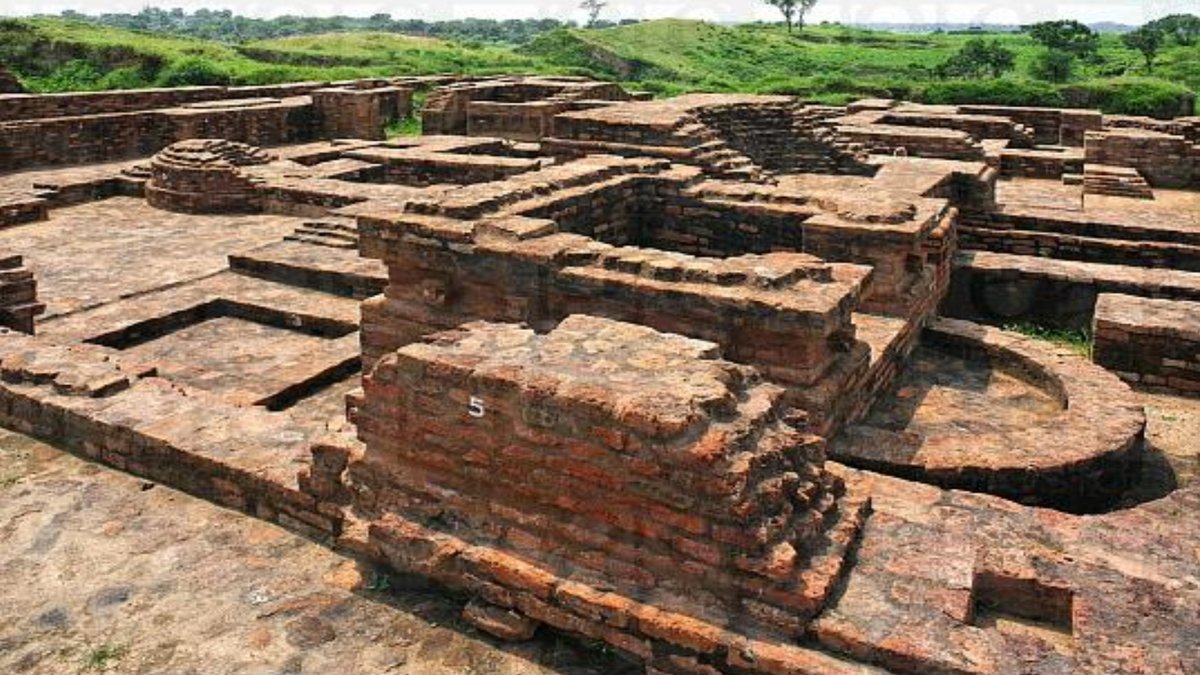
A Walk Through the Ruins of a Lost Metropolis
It is early morning, and the sun has just begun to paint the Yamuna River gold. You are standing on the left bank of this ancient river, in what is now the Kaushambi district of Uttar Pradesh. Before you, stretching across the landscape like the skeleton of a sleeping giant, lie the remains of an immense fortress – massive earthen ramparts that once rose nine metres high, running for over four miles and enclosing one of the wealthiest and most powerful cities of ancient India.
The ground beneath your feet is carpeted with pottery shards – Northern Black Polished Ware with its lustrous jet-black finish, fragments of red ware, pieces of terracotta figurines that have not seen daylight for two thousand years. Ahead, the foundations of a great Buddhist monastery emerge from the earth, its brick walls laid in patterns perfected by master builders of the Gupta age. Not far away, a single pillar of polished sandstone points toward the sky – not as grand as some of its Ashokan counterparts, but a witness to the emperors who once ruled from this very spot.
This is Kaushambi.
Today, it is a quiet archaeological site on the tourist map, visited by a trickle of pilgrims and history enthusiasts. But two and a half thousand years ago, Kaushambi was one of the greatest cities in the world – the capital of the Vatsa Kingdom, one of the sixteen Mahajanapadas that shaped the political destiny of ancient India. It was a city of kings and merchants, of Buddhist monks and Jain saints, of poets and diplomats. Its bustling markets were fed by trade routes that stretched from the Himalayas to the Arabian Sea. Its court was the setting for one of Sanskrit literature’s most beloved dramas. Its monasteries hosted Gautama Buddha himself, who spent several rainy seasons here and delivered sermons that are still preserved in the Tripitakas.
How did such a great city fall into obscurity? What secrets do its silent ruins still hold? And why does Kaushambi deserve a place on every heritage traveler’s itinerary?
Join me as we uncover the story of one of India‘s most important – yet most overlooked – archaeological treasures.
Quick Facts at a Glance
| Detail | Information |
| Ancient Name | Kaushambi / Kosambi |
| Alternative Spelling | Kosam / Kosambi |
| Modern Location | Kaushambi District, Uttar Pradesh, India |
| Distance from Prayagraj | Approximately 45–55 kilometres southwest |
| Administrative Location | Near Manjhanpur town, Kaushambi district (carved out of Allahabad in 1997) |
| Ancient Kingdom | Vatsa Mahajanapada |
| River | Left bank of the Yamuna River |
| Major Historical Period | 8th century BCE to 6th century CE (height) |
| Key Historical Figure | King Udayana (6th century BCE) |
| Religious Significance | Buddhist, Jain, and Hindu |
| Buddhist Association | Buddha spent 6th and 9th rainy seasons at Ghositarama Monastery |
| Jain Association | Birthplace of 6th Tirthankara Padmaprabha |
| UNESCO/Heritage Status | Protected monument, Archaeological Survey of India |
| Ideal Duration for Visit | 3–4 hours |
| Best Time to Visit | October–March (winter) |
Table of Contents
Where Is Kaushambi?
Kaushambi is located in the Kaushambi district of Uttar Pradesh – a district that was carved out of the larger Allahabad (now Prayagraj) district on 4th April 1997.
The ancient city stands on the left (south-western) bank of the Yamuna River, at a distance of approximately 51–56 kilometres southwest of Prayagraj. It lies about 55 kilometres by road from Prayagraj city, with Manjhanpur (the district headquarters) serving as the gateway to the site.
The ruins of the ancient city spread over several villages, with two of them – Kosam-Inam and Kosam-Khiraj – preserving in their very names the memory of Kosam, the ancient Prakrit form of Kaushambi.
Approximate distances for travellers:
- By road from Prayagraj: 50 kilometres, approximately 1 hour 15 minutes by car
- From Chitrakoot: approximately 130 kilometres
- From Varanasi: approximately 180 kilometres
The site has a nearby railway station – Jhusi railway station – but most visitors from Prayagraj prefer road travel, either by private taxi or by bus via the Manjhanpur route.
What Is Kaushambi? – The Origins of the Ancient City
The name Kaushambi (also spelled Kosambi, Kosam, or Kausambi) carries layers of meaning that reach deep into antiquity.
The Meaning of the Name
According to Buddhist tradition recorded by the 5th-century commentator Buddhaghosha, the name Kaushambi derives from the large number of Kusam trees (Schleichera oleosa, the Ceylon oak or Malay lac tree) that once grew abundantly along the banks of the Ganga and Yamuna in this region. The city was established after clearing these forests, giving it the name Kaushambi – the place of the Kusam trees.
Other sources connect the name to the Kshatriya clan of Kosala or to a legendary king named Kusa.
Antiquity and Early References
The antiquity of Kaushambi is remarkable. The city is mentioned in some of the earliest layers of Indian literature – the Brahmanas and the Upanishads – texts that date back to the late Vedic period (circa 800–500 BCE). This suggests that Kaushambi was already an established and important centre long before the rise of Buddhism, Jainism, and the great empires of the historic period.
The City’s Strategic Importance
Kaushambi‘s location was the secret to its prosperity. Situated on the Yamuna River, the city controlled access to one of the great water highways of northern India. More importantly, Kaushambi stood at the junction of several major trade routes.
The most important of these was the Uttarapatha – the great northern road that connected Pataliputra (the Mauryan capital) with Taxila (the gateway to Central Asia). This royal highway passed through Kaushambi on its westward journey from the Ganga-Yamuna Doab to Mathura and beyond. A branch of this road turned south-west through Ujjain to the port of Broach, connecting the Gangetic heartland with the Arabian Sea. Kaushambi thus became a crucial node in the trade networks of ancient India – a place where goods, ideas, and people from across the subcontinent converged.
Kaushambi and Kosala
There is also a traditional connection between Kaushambi and Kosala – the kingdom of Lord Rama. According to the Puranas, the Vatsa kingdom (of which Kaushambi was the capital) was named after a Kashi king. The city of Ayodhya, the capital of Kosala, lay not far to the north-east, and the two regions shared cultural and political ties.
Kaushambi and the Vatsa Mahajanapada
To understand Kaushambi‘s importance, we must place it within the broader political landscape of ancient India.
The Sixteen Mahajanapadas
In the 6th century BCE, northern India was divided into sixteen great kingdoms, known as the Mahajanapadas. These were not mere tribal territories but organised, urbanised states with standing armies, administrative systems, and bustling cities. The Buddhist text Anguttara Nikaya lists these sixteen Mahajanapadas, placing the Vatsa kingdom (also called Vamsa) among the most prominent.
The Vatsa Kingdom
The Vatsa kingdom (Pali and Ardhamagadhi: Vaccha, meaning “calf”) occupied a strategic position in the middle Ganga-Yamuna Doab – the fertile land between the two great rivers. The Puranas state that Vatsa was named after a Kashi king, suggesting dynastic connections between the two neighbouring powers.
The Capital at Kaushambi
The capital of the Vatsa kingdom was Kaushambi. Under the Vatsa kings, Kaushambi became one of the wealthiest and most powerful cities in India, often mentioned in Buddhist texts alongside other great urban centres of the age: Sravasti, Rajgriha, Varanasi, and Champa.
At its height, the city was surrounded by massive fortifications – earthen ramparts of compact clay that ran for over 4 miles (about 6 kilometres) in circuit, rose to 9 metres in height, and were 20 metres wide at the base. These defences were reinforced with baked brick revetments and protected by a moat. The city boasted an astonishing 32 gates, according to traditional accounts, a sign of both its wealth and its openness to trade.
The Political Importance of Vatsa
The Vatsa kingdom was no minor power. It was one of the great central Indian states that emerged after the decline of the Kuru-Panchala hegemony. In the 6th and 5th centuries BCE, Vatsa under King Udayana was a major player in the complex game of alliances and rivalries that involved the other great powers: the powerful Kosala kingdom to the north-east (under King Prasenajit), the rising Magadha kingdom to the east (under King Ajatashatru), and the Avanti kingdom to the south-west (under King Pradyota).
King Udayana – The Golden Age of Kaushambi
No single figure is more associated with Kaushambi‘s glory than King Udayana (reigned approximately 460–444 BCE).
Who Was Udayana?
King Udayana (also known as Udayana Vatsaraja) was the ruler of the Vatsa kingdom during the 6th century BCE. He was a contemporary of Gautama Buddha, King Prasenajit of Kosala, King Ajatashatru of Magadha, and King Pradyota of Avanti. Together, these rulers shaped the political destiny of northern India during the Buddha’s lifetime.
In Buddhist and Jain sources, Udayana is described as a powerful, wealthy, and cultured monarch. He maintained diplomatic relations with all the major kingdoms of his time, sometimes as a friend and ally, sometimes as a rival.
Udayana in Literature and Legend
But Udayana is not merely a historical figure – he is also a legend. His romantic adventures became the stuff of Sanskrit literature, immortalised in several works over the centuries:
- The Kathasaritsagara (Ocean of the Streams of Stories) by Somadeva (11th century CE) contains lengthy narratives of Udayana’s adventures.
- The Brihatkatha (The Great Story), in its lost original and its surviving recensions, made Udayana a romantic hero on par with the heroes of the Mahabharata and Ramayana.
- Most famously, the Svapnavasavadattam (The Dream of Vasavadatta) by the great Sanskrit dramatist Bhasa – a play that is still performed today – is based on the love story of King Udayana and Princess Vasavadatta of Avanti.
Udayana‘s Relationship with Buddha
According to Buddhist sources, King Udayana was a devout supporter of Buddhism. He invited the Buddha to Kaushambi and became his lay disciple. It is said that Udayana’s treasurer, the wealthy merchant Ghosita, was so inspired by the Buddha’s teachings that he built the Ghositarama Monastery – one of the most important Buddhist foundations of ancient India – for the Buddha and his monks.
The Udayana Fort
The remains of what is traditionally called the Udayana Fort (or Udayin Fort) are still visible among the Kaushambi ruins. These consist of large brick structures, fortifications, and foundations that archaeological surveys have identified with the royal palace complex of the Vatsa kings. Standing among these ruins, one can still imagine the court where Udayana entertained diplomats, heard Buddhist discourses, and watched the performances of plays that would later become classics of Sanskrit drama.
Kaushambi in Buddhist History
Kaushambi holds a place of extraordinary importance in the history of Buddhism. It was one of the six great cities of the Buddha‘s time – the others being Sravasti, Rajgriha, Varanasi, Vaishali, and Champa – and the Buddha visited it multiple times during his long ministry.
The Buddha‘s Visits to Kaushambi
According to the Tripitakas (the three baskets of the Buddhist canon), the Buddha visited Kaushambi on several occasions, often at the invitation of King Udayana.
Most significantly, the Buddha spent two of his rainy season retreats (varshavasa) at Kaushambi – the sixth and the ninth retreats of his 45-year ministry. During these extended stays, he delivered many important discourses, some of which are preserved in the Sutta Pitaka.
One of the most famous events in Kaushambi‘s Buddhist history is the quarrel of the Kaushambi monks. This incident, recorded in the Tripitaka, involved a dispute among the monks over a minor point of discipline. The quarrel became so serious that the monks could not resolve it, and the Buddha himself was drawn into the dispute. Unable to bring peace, the Buddha withdrew into solitude in the forest for a period, teaching a profound lesson about harmony and reconciliation. The story is often cited in Buddhist teachings as an example of the importance of community harmony (sangha samagga).
The Ghositarama Monastery
The most important Buddhist site in Kaushambi is the Ghositarama Monastery (also spelled Ghoshitarama or Ghositaram). It was built by Ghosita, a wealthy merchant of Kaushambi who served as the treasurer of King Udayana.
The monastery was one of the great Buddhist foundations of ancient India. It consisted of a large brick complex with residential cells for the monks, assembly halls, and a central courtyard for meditation and teaching. The Buddha frequently stayed here, and the Tripitaka mentions numerous incidents connected with his visits to Ghositarama. It is believed that a great many of the Buddha’s disciples could stay in it during their visits to Kaushambi.
The monastery was later destroyed in the 5th century CE by the Huna king Toramana, though its ruins remain one of the most evocative archaeological sites in India.
Buddhist Pilgrimage Destination
Today, Kaushambi is an important destination on the Buddhist circuit, particularly for pilgrims from Southeast Asia (Sri Lanka, Myanmar, Thailand, Cambodia) and East Asia (Japan, China, Korea). The site is often visited in conjunction with Sarnath, where the Buddha gave his first sermon, and Kushinagar, where he passed into parinirvana.
The Cambodian Monastery at Kaushambi – a modern structure built by the Cambodian government – stands as a testament to Kaushambi‘s enduring importance in the Buddhist world.
Kaushambi in Jain Traditions
Kaushambi is equally sacred to the Jain community.
Birthplace of Padmaprabha
According to Jain tradition, Kaushambi is the birthplace of Lord Padmaprabha, the sixth Tirthankara of the present age (Avsarpini).
Padmaprabha (also known as Padmaprabhu Swami) was born to King Shridhar and Queen Susimadevi of the Ikshvaku dynasty at Kaushambi, on the twelfth day of the Kartik Krishna month of the Indian calendar. The name “Padmaprabha” means “the brilliant one of the lotus” – referring to the red lotus-like colour that suffused his body at birth.
Kaushambi as Jain Tirtha
The Shri Kaushambi Teerth is a major Jain pilgrimage centre. The temple at this site is dedicated to Lord Padmaprabha and attracts Jain pilgrims from across India, particularly during the annual yatra (pilgrimage) held on the tirthankara‘s birth anniversary.
Archaeological Finds
The Jain heritage of Kaushambi is also confirmed by archaeology. In 2017, a 4.5-foot-tall stone statue of the 23rd Jain Tirthankara, Lord Parshavnath, was discovered in the Yamuna River in the Kaushambi area by local fishermen. The statue, believed to be about 1,000 years old, is now preserved for worship and study.
Additionally, the Prabhasgiri Jain Temple (also known as Pabhosha or Prabhosa Pahar) located about 55 kilometres from Prayagraj on the banks of the Yamuna, is an ancient Jain rock-cut cave site associated with the tirthankaras.
Kaushambi in Hindu Traditions and Scriptures
Kaushambi also finds mention in Hindu scriptures.
References in the Puranas and Epics
The Puranas mention Kaushambi as a city of great antiquity and importance. According to the Vishnu Purana and other texts, the Vatsa kingdom – of which Kaushambi was the capital – was named after a Kashi king.
The Mahabharata includes Kaushambi among the sacred tirthas of India, indicating that the city was already a pilgrimage destination in the epic period. The Vatsa kingdom and its capital Kaushambi are mentioned in the context of the great war, with contingents from Vatsa fighting on both sides.
The Ramayana Connection
The Ramayana tells us that the city of Kaushambi was established by a king of the Kosala dynasty named Kusa – the son of Lord Rama. According to this tradition, after Rama‘s departure from the world, his sons Lava and Kusa inherited the Kosala kingdom. While Lava established Shravasti as his capital, Kusa made Kaushambi his seat. The city was thus linked in later tradition to the epic heroes of the Ramayana.
Sacred Geography
In the sacred geography of Hinduism, Kaushambi was part of the Brahmarshi Desha – the land of the sages between the Ganga and Yamuna rivers, considered the most holy region of Aryavarta.
The Vishram Ghat
On the banks of the Yamuna at Kaushambi is the Vishram Ghat. The Hindi word ‘vishram‘ means ‘rest‘, and local tradition holds that Lord Krishna and his brother Balaram rested here after Krishna killed his tyrannical maternal uncle, Kansa, in the city of Mathura. The ghat remains a place of local pilgrimage.
The Archaeology of Kaushambi
The modern rediscovery of Kaushambi‘s history is a story of patient archaeological work spanning more than a century.
Discovery and Identification
The ruins of Kaushambi were first identified as the ancient city of Kosambi by General Alexander Cunningham, the founder of the Archaeological Survey of India, in 1861. Cunningham recognised the massive earthen ramparts and the scattered brick structures as the remains of one of the great cities of the Buddha’s time, known from the Tripitakas and other sources.
Excavation History
Systematic excavations at Kaushambi were taken up by the Archaeological Survey of India (ASI) in 1937–38, followed by large-scale excavations conducted by the University of Allahabad from 1949 to 1965.
The Allahabad University excavations were led by the renowned historian Professor G. R. Sharma (1919–1986), whose work at Kaushambi added significantly to the understanding of early Indian urban history. The excavations of 1957–1959, in particular, focused on the city‘s defences and the famous Syenaciti – a sacrificial altar built in the shape of an eagle, dating to the mid-2nd century BCE, associated with the Purusamedha (human sacrifice) ritual mentioned in Vedic texts.
Archaeological Findings
The excavations at Kaushambi have revealed a remarkable sequence of occupation:
- Pre-Mauryan levels (c. 8th–4th century BCE): These layers have yielded evidence of the earliest urban settlement, including fortifications, housing, and ceramic remains.
- Mauryan levels (c. 4th–2nd century BCE): The city flourished under the Mauryan Empire, with extensive brick structures and the famous Ashokan pillar.
- Shunga and Kushan levels (c. 2nd century BCE–3rd century CE): Continued occupation, with additions to the fortifications and new religious structures.
- Gupta levels (c. 4th–6th century CE): The last major phase of urban occupation, with elaborate brick temples, monasteries, and some of the finest terracotta art of the period.
The City‘s Defences
One of the most impressive archaeological features of Kaushambi is its massive fortification system. The earthen rampart – 4 miles (about 6 km) in circuit, 20 metres wide at the base, and 9 metres high – is one of the largest early historic fortifications in India. The core of the first rampart is made of hard, compact, thoroughly rammed clay, excavated from the natural soil and completely devoid of pottery, suggesting its very early date. The rampart was strengthened in places by revetments of large baked bricks.
Pottery and Artifacts
Excavations have yielded a rich variety of pottery types, including:
- Northern Black Polished Ware (NBPW) – the hallmark of the second urbanisation in India, with its characteristic lustrous jet-black finish. The NBPW levels at Kaushambi are particularly extensive, indicating the city‘s prosperity during the Mauryan and post-Mauryan periods.
- Grey ware and red ware – coarser pottery types that represent the earlier phases of occupation.
- Terracotta figurines – including representations of deities, animals, and everyday life.
Artifacts in Museums
The artifacts recovered from the Kaushambi excavations are now displayed in the Allahabad University Museum and the National Museum in Allahabad for scientific preservation and research.
Major Archaeological Attractions of Kaushambi
For the heritage visitor, Kaushambi offers several distinct attractions, each testifying to a different chapter in the city‘s long history.
1. The Earthen Ramparts (Fortifications)
The most visually striking feature of Kaushambi is its massive earthen ramparts – the outer defences of the ancient city. These ramparts, stretching over 6 kilometres in circuit, survive in various states of preservation. Walking along them, you can sense the scale of the city that once lay within. The ramparts enclose a large area of approximately 5–6 square kilometres, making Kaushambi one of the largest early historic cities in the Ganga valley.
2. Ghositarama Monastery
The Ghositarama Monastery is the most visited archaeological attraction at Kaushambi. Excavations have revealed:
- A large brick complex consisting of individual cells for monks arranged around a central courtyard
- An assembly hall where the Buddha is believed to have delivered discourses
- A bathing tank and other utilitarian structures
- A massive brick platform, possibly the base of a stupa or teaching hall
The seal discovered at the monastery bears the inscription: “Budhāvāse Ghosjtārāme Savabudhānain Pujāye Śilakapitā” – a find that definitively confirmed the identification of this site with the Ghositarama mentioned in Buddhist texts.
3. The Ashokan Pillar
Kaushambi possesses a fragment of an Ashokan pillar, one of the many monolithic columns erected by the Mauryan emperor Ashoka in the 3rd century BCE. The pillar bears an inscription in the Brahmi script, dated to around 232 BCE. A later inscription – dating to approximately 375 CE – is attributed to the second king of the Gupta dynasty, Samudragupta, and is in the more refined Gupta script.
4. The Udayana Fort (Palace Complex)
The remains of what is traditionally called the Udayana Fort can be seen near the centre of the ancient city. These consist of massive brick foundations and structural remains that archaeologists associate with the royal palace of the Vatsa kings. The complex includes:
- A large durbar hall (audience hall)
- Residential quarters
- Storage facilities and other service structures
- A well-preserved brick well of considerable diameter
5. The Syenaciti Sacrificial Altar
In the mid-2nd century BCE, a remarkable Vedic sacrificial altar in the shape of an eagle (syena) was constructed at Kaushambi. This structure, known as the Syenaciti, is associated with the Purusamedha (human sacrifice) ritual – a controversial and complex Vedic rite. The altar was built of specially shaped bricks laid in a precise geometric pattern. It is one of the few such altars to have been archaeologically excavated, providing rare evidence of the continuance of elaborate Vedic ritual in the post-Mauryan period.
6. The Prabhasgiri Jain Caves
Located about 30 kilometres from the main Kaushambi site, Prabhasgiri (also known as Pabhosha or Prabhosa Pahar) is a hill on the banks of the Yamuna containing ancient Jain rock-cut caves. These caves, associated with the Jain tirthankaras, are an important pilgrimage site for Jains and offer a fascinating example of rock-cut architecture in Uttar Pradesh.
7. The Cambodian Monastery
The Cambodian Monastery is a modern Buddhist structure built by the Royal Government of Cambodia as a mark of respect for Kaushambi‘s Buddhist heritage. It reflects traditional Khmer architecture – a connection between the ancient Buddhist history of Kaushambi and the deep-rooted Buddhist traditions of Southeast Asia. The monastery is open to visitors only for a few hours each day (typically 9:30 am–11:30 am and 2:00 pm–5:00 pm) and remains closed on Tuesdays.
Kaushambi Under the Mauryas and Guptas
Kaushambi‘s importance did not end with the decline of the Vatsa kingdom. The city continued to flourish under successive imperial powers.
Under the Mauryan Empire (c. 322–185 BCE)
When Chandragupta Maurya united northern India into a single empire, Kaushambi became one of the major provincial centres of the Mauryan administration. The city‘s strategic location on the trade route from Pataliputra to Taxila made it an essential node in the imperial network.
The presence of an Ashokan pillar at Kaushambi – bearing the emperor‘s edicts in Brahmi script – is clear evidence of the city‘s importance during the Mauryan period. Ashoka would not have erected his pillars in insignificant towns. Kaushambi was a place where his message of dhamma needed to be heard by merchants, travellers, and local administrators.
Kaushambi continued to flourish after the decline of the Mauryas. The Shunga and Kushan periods saw the city’s fortifications maintained and strengthened, and new religious structures – both Buddhist and Hindu – were added.
Under the Gupta Empire (c. 4th–6th century CE)
The Gupta period (4th–6th century CE) is often described as the “Golden Age” of classical Indian civilisation. Kaushambi, now part of the Gupta heartland, experienced a final flowering.
The Gupta emperor Samudragupta – whose achievements are recorded in the Prayag Prashasti (the Allahabad Pillar inscription) – added his own inscription to the Ashokan pillar at Kaushambi. This later inscription, in the more refined Gupta script, dates to approximately 375 CE.
The Gupta period at Kaushambi saw the construction of elaborate brick temples and monasteries, including additions to the Ghositarama complex. Excavations have revealed floors, walls, and terracotta art of exceptional quality dating to this period.
Decline of Kaushambi
Kaushambi‘s decline began in the post-Gupta period. The city was sacked and the Ghositarama monastery destroyed by the Huna king Toramana in the 5th century CE. Though the city continued to be occupied on a reduced scale, its days as a great metropolis were over.
Over the centuries, the Yamuna River shifted its course, leaving much of the ancient city high and dry. The great trade routes that had once passed through Kaushambi were redirected as new political centres – such as Kannauj – rose to prominence. By the early medieval period, Kaushambi had become a ghost city – its palaces and monasteries abandoned, its population dispersed, its greatness preserved only in memory and then eventually forgotten.
What Kaushambi Reveals About Ancient India
The study of Kaushambi – through both literary sources and archaeological evidence – reveals several important aspects of ancient Indian civilisation.
1. The Second Urbanisation
Kaushambi is a key site for understanding the process of urbanisation in the Gangetic plain during the mid-first millennium BCE. The city‘s massive fortifications, planned layout, and evidence of craft specialisation and long-distance trade demonstrate that urban centres of this period were not mere villages writ large – they were complex, stratified societies with advanced engineering skills and sophisticated economic organisation.
2. Trade and Commerce
Kaushambi‘s position on the Yamuna River and at the junction of several major trade routes made it one of the commercial hubs of ancient India. The finds of Northern Black Polished Ware, coins, and exotic goods at the site attest to its integration into regional and trans-regional trade networks. The city‘s wealthy merchants – such as Ghosita, the builder of the famous monastery – were patrons of religion and influential players in the political economy.
3. Religious Diversity
Kaushambi is a microcosm of the religious diversity of ancient India. The city was simultaneously:
- A centre of Buddhism, with its great monastery and the Buddha‘s own presence
- A sacred site in Jainism, as the birthplace of a tirthankara
- An important Hindu centre, with its Vedic sacrificial altars and Puranic connections
This coexistence of multiple religious traditions within a single urban space was characteristic of ancient Indian civilisation and stands as an important historical counterpoint to narratives of exclusive religious identity.
4. Political History
The history of Kaushambi – from the Mahajanapada period through the Mauryan and Gupta empires – is a case study in the political evolution of ancient India. The city witnessed the transition from regional kingdoms to imperial administration, from independent city-states to provincial centres within larger empires. The inscriptions on its pillar – from Ashoka and Samudragupta – are physical witnesses to these changing political orders.
5. Urban Planning and Engineering
The city‘s massive ramparts, brick structures, water management systems, and the Syenaciti altar demonstrate the advanced engineering and architectural skills of ancient Indian builders. The use of burnt brick for structures dating back to c. 700 BCE at Kaushambi (and nearby Jhusi) is particularly significant, providing some of the earliest evidence of brick architecture in the Gangetic plain.
Visiting Kaushambi Today – A Practical Guide
Kaushambi is a rewarding destination for heritage travellers, history enthusiasts, and pilgrims.
How to Reach
From Prayagraj (the most common starting point):
- By road: Kaushambi is located approximately 50–55 kilometres south-west of Prayagraj – a journey of about 1 hour 15 minutes by car. The route goes via Manjhanpur, the district headquarters. Taxis and private vehicles are the most convenient options.
- By bus: Buses are available from Prayagraj to Manjhanpur, from where one can take a local auto-rickshaw to the archaeological site (approximately 5–7 kilometres).
- By train: Kaushambi has a railway station (Kaushambi Junction, code KMNJ). However, train services are infrequent compared to road transport.
From other cities:
- From Varanasi: approximately 180 kilometres (4–5 hours by road).
- From Lucknow: approximately 190 kilometres (4–5 hours by road).
- From Chitrakoot: approximately 130 kilometres (3–4 hours by road).
Best Time to Visit
The winter season (October–March) is the best time to visit Kaushambi. The weather is pleasant, with temperatures ranging from 10°C to 25°C, making it comfortable for walking across the extensive archaeological site. Summer (April–June) brings extreme heat (up to 45°C), while the monsoon (July–September) can make the terrain muddy and difficult to navigate.
Site Timings and Entry
The Ghositarama Monastery site is open from sunrise to sunset and has no entry fee. Other attractions – the Ashokan pillar fragment, the ramparts, the Udayana Fort area – are open to visitors throughout the daylight hours.
Note: The Cambodian Monastery has restricted timings (9:30 am–11:30 am and 2:00 pm–5:00 pm) and is closed on Tuesdays.
What to Carry
- Comfortable walking shoes (the site is large and requires walking on uneven ground).
- Water bottle (facilities are basic; bring your own hydration).
- Hat, sunglasses, and sunscreen for sun protection.
- A camera for photography (though flash photography may be restricted inside museum areas).
- Snacks (restaurants are limited near the site; consider eating in Manjhanpur or Prayagraj).
- Guidebook (or a local guide – though guides are not regularly available at the site).
Suggested Itinerary (Half Day)
- 8:00 am – Depart from Prayagraj by car.
- 9:15 am – Arrive at Kaushambi; begin at the Ghositarama Monastery ruins.
- 10:00 am – Visit the Ashokan pillar fragment.
- 10:30 am – Walk along the ancient ramparts.
- 11:00 am – Explore the Udayana Fort (palace complex).
- 11:30 am – Visit the Cambodian Monastery (if timings permit).
- 12:30 pm – Depart for Prayagraj.
- 1:45 pm – Arrive back in Prayagraj.
Nearby Amenities
- Accommodation: Limited options in Kaushambi town. Most visitors stay in Prayagraj, where a wide range of hotels is available.
- Restaurants: Basic eateries near the site. Better options in Manjhanpur (7 kilometres away) or Prayagraj.
- Restrooms: Basic facilities are available near the Ghositarama site.
Kaushambi and the Prayagraj Heritage Circuit
Kaushambi is not an isolated site. It is part of a dense concentration of archaeological and heritage sites in the Lower Ganga-Yamuna Doab – the region between the two great rivers that has been continuously occupied for over 9,000 years.
A Network of Ancient Cities
The region around Prayagraj contains several ancient cities and important heritage sites, each of which complements and illuminates the others:
- Prayagraj (Allahabad): The modern city – itself the heir to the ancient sacred site of Prayag, “the King of Pilgrimage Sites”.
- Triveni Sangam: The confluence of the Ganga, Yamuna, and mythical Sarasvati – the most sacred bathing spot in Hinduism.
- Pratishthanpur (Old Jhusi): The ancient capital of the Lunar Dynasty, located on the eastern bank of the Ganga, with Neolithic levels dating to c. 7100 BCE.
- Kaushambi: The ancient capital of the Vatsa kingdom, located on the Yamuna, with urban levels dating to the mid-first millennium BCE.
- Shringverpur: A site on the Ganga associated with the Ramayana – it was here that Lord Rama, Sita, and Lakshmana crossed the river during their exile.
- Allahabad Fort: The Mughal fortress containing the Ashokan pillar (now the Prayag Prashasti) and the sacred Akshayavat banyan tree.
Creating a Heritage Itinerary
A motivated heritage traveller can spend 4–5 days exploring the combined heritage of Prayagraj and Kaushambi:
Day 1: Triveni Sangam, Allahabad Fort, Akshayavat, Prayag Prashasti.
Day 2: Pratishthanpur (Old Jhusi), Bharadwaj Ashram, Nagvasuki Temple.
Day 3: Kaushambi – Ghositarama, Ashokan pillar, ramparts, Udayana Fort.
Day 4: Shringverpur and Sita Samahit Sthal.
Day 5: (Optional) Extended exploration of Kaushambi district, including Prabhasgiri Jain caves.
Frequently Asked Questions (FAQs)
1. What is Kaushambi famous for?
Kaushambi is famous as the ancient capital of the Vatsa kingdom, one of the sixteen Mahajanapadas of ancient India. It is also important in Buddhism (the Buddha stayed and taught here), Jainism (birthplace of the 6th Tirthankara Padmaprabha), and Hinduism (mentioned in the Puranas and associated with Lord Krishna‘s visit).
2. How old is Kaushambi?
Kaushambi‘s origins as an urban centre date to approximately the 8th–6th century BCE, making it over 2,500 years old. The site has earlier Neolithic levels nearby (at Jhusi) dating to c. 7100 BCE, though Kaushambi itself rose to prominence in the mid-first millennium BCE.
3. Was Kaushambi a Mahajanapada capital?
Yes. Kaushambi was the capital of the Vatsa kingdom (also called Vamsa), one of the sixteen Mahajanapadas – the great kingdoms of ancient India during the Buddha‘s time.
4. Did Gautama Buddha visit Kaushambi?
Yes. The Buddha visited Kaushambi multiple times during his ministry, often at the invitation of King Udayana. He spent his sixth and ninth rainy season retreats at the Ghositarama Monastery in Kaushambi and delivered many important sermons here.
5. What is the Ghositarama Monastery?
The Ghositarama Monastery is the most important Buddhist site at Kaushambi. It was built by the wealthy merchant Ghosita, treasurer of King Udayana. The Buddha stayed here, and the monastery became a major centre of Buddhist learning.
6. Which Jain Tirthankara was born in Kaushambi?
The 6th Jain Tirthankara, Lord Padmaprabha, was born in Kaushambi to King Shridhar and Queen Susimadevi of the Ikshvaku dynasty.
7. Is there an Ashokan pillar at Kaushambi?
Kaushambi has a fragment of an Ashokan pillar, bearing inscriptions of Emperor Ashoka (c. 232 BCE) and later of the Gupta emperor Samudragupta (c. 375 CE).
8. How far is Kaushambi from Prayagraj?
Kaushambi is approximately 50–55 kilometres south-west of Prayagraj – a journey of about 1 hour 15 minutes by car.
9. Is Kaushambi worth visiting?
Absolutely. Kaushambi is one of the most important archaeological sites in northern India – a place where you can walk through the remains of a city that was once a major political, religious, and economic centre. It is especially meaningful for students of Indian history, Buddhist pilgrims, and heritage travellers.
10. Are there guides available at Kaushambi?
Trained guides are not regularly available at the site. It is advisable to bring your own guidebook, research the site beforehand, or arrange a guide through a travel agency in Prayagraj.
11. What is the best time to visit Kaushambi?
The winter season (October–March) is ideal for visiting Kaushambi, when the weather is cool and pleasant for walking across the site.
12. Is there an entry fee for Kaushambi?
The main archaeological sites at Kaushambi have no entry fee.
13. What is the Cambodian Monastery at Kaushambi?
The Cambodian Monastery is a modern Buddhist temple built by the Royal Government of Cambodia as a mark of respect for Kaushambi‘s Buddhist heritage. It reflects traditional Khmer architecture and is open to visitors on a limited schedule.
14. How long does it take to see Kaushambi?
A thorough visit to the main attractions – Ghositarama, Ashokan pillar, ramparts, Udayana Fort – takes 3–4 hours. A shorter, focused visit can be completed in 2 hours.
15. Where is the Syenaciti sacrificial altar?
The Syenaciti – a Vedic sacrificial altar in the shape of an eagle, discovered by Prof. G. R. Sharma‘s excavations – is in the area of the ancient city. Its exact location may require guidance from a local expert or prior coordination with the archaeological authorities.
16. What is the meaning of the name Kaushambi?
According to the 5th-century Buddhist commentator Buddhaghosha, the name derives from the Kusam trees (Schleichera oleosa) that grew abundantly in the area before the city was established.
17. Who was King Udayana?
King Udayana (reigned c. 460–444 BCE) was the most famous ruler of the Vatsa kingdom. He was a contemporary of Gautama Buddha and a prominent figure in Sanskrit literature, especially in Bhasa‘s play Svapnavasavadattam.
18. Why did Kaushambi decline?
Kaushambi declined after the post-Gupta period due to several factors: the destruction of the Ghositarama monastery by the Huna king Toramana in the 5th century CE; the shifting of the Yamuna River‘s course; and the rise of other political centres like Kannauj.
19. Are there any good hotels near Kaushambi?
Accommodation options near Kaushambi are limited. Most visitors stay in Prayagraj, where a range of hotels is available, and visit Kaushambi as a day trip.
20. Can I combine a visit to Kaushambi with other heritage sites?
Yes. Kaushambi can be combined with visits to Triveni Sangam, Allahabad Fort, Akshayavat, Jhusi (Pratishthanpur), and Shringverpur as part of a comprehensive heritage tour of the Prayagraj region.
Related Heritage Journeys
To deepen your understanding of the heritage of the Prayagraj region, we invite you to explore these related articles:
- Prayag Prashasti: The Allahabad Pillar Inscription That Revealed the Empire of Samudragupta] – The inscription that preserves the Gupta emperor‘s achievements, originally from Kaushambi.
- Allahabad Fort: History, Architecture, and Visitor Guide – The Mughal fortress that now houses the Ashokan pillar (Prayag Prashasti).
- Pratishthanpur (Old Jhusi): The Ancient Capital of the Lunar Dynasty – The Neolithic site on the opposite bank of the Ganga, connected to Kaushambi in archaeological significance.
- Akshayavat: The Indestructible Banyan Tree of Prayagraj – The sacred tree within Allahabad Fort, a symbol of eternity.
- Triveni Sangam: The Complete Pilgrim Guide – The sacred confluence that is the centrepiece of Prayagraj‘s pilgrimage tradition.
- Shringverpur: The Ramayana Connection – The site where Lord Rama crossed the Ganga, located near Prayagraj.
- Magh Mela: The Annual Pilgrimage to Tirtharaj – The sacred fair that draws millions to the Sangam every winter.
Why Kaushambi Still Matters Today
Let us return to where we began – standing on the left bank of the Yamuna, looking across the ruins of a city that was once one of the great metropolises of the ancient world.
Kaushambi is not as well known as it deserves to be. It is not on the beaten track of the Golden Triangle. It does not have the crowds of Varanasi or the monumentality of the Taj Mahal. It is a quiet, contemplative place – a place of ruins and silences, of pottery shards underfoot and the whisper of the Yamuna wind through the grass.
But for those who make the journey – who leave the highways and come to this place – Kaushambi offers something that cannot be found elsewhere. It offers depth.
Here, you can walk along ramparts that have stood for 2,500 years. You can sit in the shade of what was once a monastery where the Buddha himself taught. You can stand before a pillar inscribed by an emperor who united India under a message of peace – and then, a few centuries later, by another emperor whose reign is remembered as a golden age of art and literature.
Kaushambi is not merely an archaeological site. It is a window into the political, cultural, religious, and economic life of Ancient India – one of the few places where the story of an entire civilisation can still be traced through its ruins. It is a reminder that India‘s heritage is not confined to a few famous monuments, but is scattered across the landscape – waiting to be rediscovered by those who care to look.
The Yamuna still flows beside the ruins. The ramparts still rise from the earth. And somewhere beneath the soil, the rest of the story still waits to be told.
May your journey to Kaushambi be as enriching as it is unforgettable.
This article is part of a series on the heritage sites of Prayagraj and the Ganga-Yamuna Doab. For more information on planning your heritage tour to Kaushambi and the wider Prayagraj region, please contact us.
Prayag Tourism
📞 Phone/WhatsApp: +91-9555313526
📧 Email: contact@prayagtourism.com
🌐 Website: PrayagTourism.com
May your journey be peaceful, safe, and historically enriching – and may the ancient stones of Kaushambi speak to you across the millennia.