
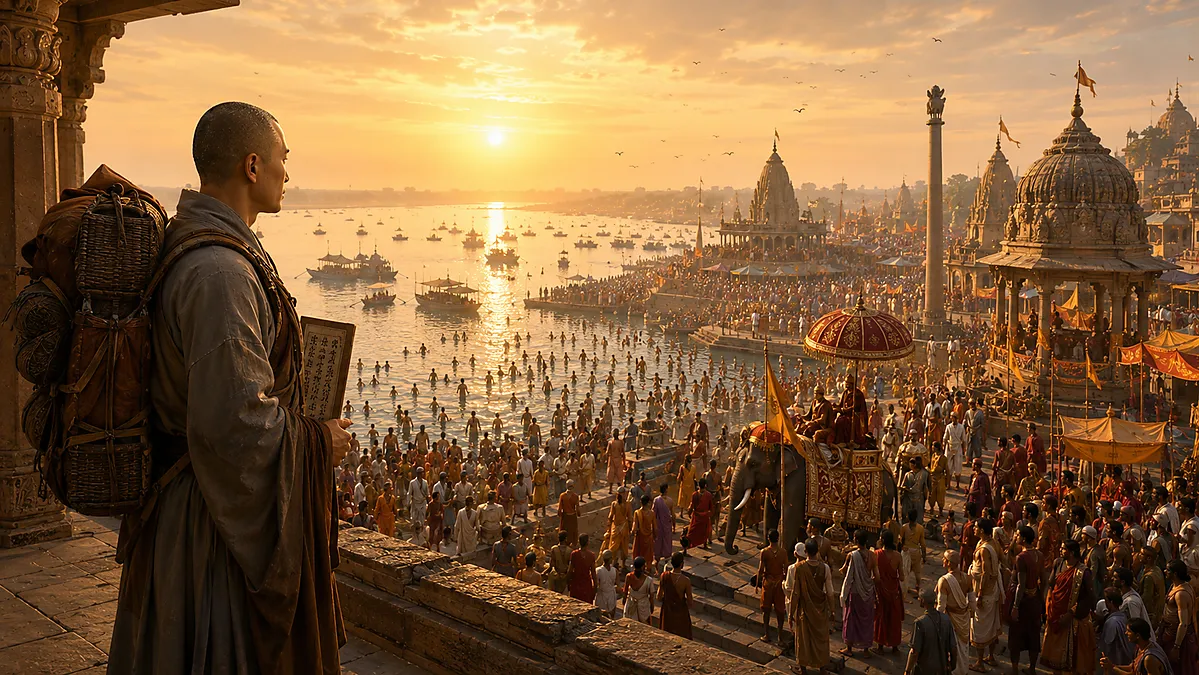
The year is 644 CE. The sun is rising over the confluence of the Ganga and Yamuna, painting the sacred waters in shades of gold and crimson. Thousands of pilgrims have already gathered on the banks, their chants rising like incense smoke toward the heavens. Priests perform Vedic rituals, Buddhist monks debate philosophy under makeshift shelters, and ascetics from countless traditions sit in silent meditation. At the center of this vast assembly stands Emperor Harshavardhana, ruler of a realm stretching over a thousand miles, preparing to distribute his entire treasury to the poor, the pious, and the learned.
And observing it all, recording every detail with the precision of a scholar and the wonder of a pilgrim, is a visitor from a distant land — a Chinese monk named Xuanzang.
His account of this great festival at Prayag is the earliest surviving eyewitness description of what would later become known as the Kumbh Mela. More than fourteen centuries later, his words still offer us a window into a world where kings, monks, and millions of ordinary people gathered at the confluence of sacred rivers to seek liberation.
🧘 1. A Chinese Monk Arrives at the Sangam
Imagine the scene. The year is around 643‑644 CE. The city of Prayag — known to Xuanzang as Po‑lo‑ye‑kia, his Chinese transcription of Prayaga — is buzzing with activity. Pilgrims crowd the Sangam, their voices rising in prayer. Priests chant Vedic hymns. Monks discuss Buddhist philosophy. Ascetics from various traditions meditate along the riverbanks. And at the heart of it all, Emperor Harshavardhana — whom Xuanzang calls Shiladitya — prepares for one of the grandest religious assemblies ever witnessed.
Among the thousands of visitors stands a solitary figure in saffron robes, his face bearing the marks of a journey that had taken him across the deserts of Central Asia, over the Hindu Kush mountains, and through the length and breadth of India. He is not merely a pilgrim; he is a scholar, a translator, a historian in the making.
His name is Xuanzang, and his account of this festival would become the earliest surviving written description of the great religious gathering at Prayag — a tradition that continues to this day as the Kumbh Mela.
What did this remarkable traveler see at Prayag? And why do his accounts still matter after 1,400 years?
🧳 2. Who Was Xuanzang?
Xuanzang (c. 602‑664 CE), also known in older English accounts as Hiuen Tsang, was a Chinese Buddhist monk, scholar, traveler, and translator who became one of the most important figures in the history of Buddhism. His pilgrimage to India and his detailed records of the lands he visited have made him an invaluable source for historians studying ancient India.
Early Life in China
Xuanzang was born Chen Hui (or Chen Yi) around 602 CE in what is now Henan province, China. He was the youngest of four children in a family of scholars. His father, a government official, died when Xuanzang was just ten years old, and the boy was raised by his elder brother, a Buddhist monk. At the age of thirteen, Xuanzang himself became a monk.
He was troubled by the state of Buddhism in China, where different schools of thought often contradicted each other, and many texts were incomplete or poorly translated. He wanted to obtain original Sanskrit texts, particularly the Yogacara‑bhumi‑sastra, to bring clarity and authenticity to Buddhist teachings in his homeland.
Journey Across Asia
At the age of 24, in 629 CE, Xuanzang set out on a perilous journey that would take him across the Gobi Desert, the Tian Shan mountains, and the Hindu Kush. The journey was unauthorized — he left China without official permission, and he traveled in secret, often risking his life.
He crossed deserts where water was scarce, mountains where snow was treacherous, and kingdoms where foreigners were viewed with suspicion. He was imprisoned multiple times, faced bandits, and endured extreme weather. Yet he never turned back.
The Purpose of His Journey
Xuanzang‘s goal was singular: to gain original, unedited knowledge of the Buddha‘s teachings and to bring authentic Buddhist texts back to China. He spent three years learning Sanskrit from Central Asian monks before even reaching India. When he finally arrived in India around 630 CE, he set about fulfilling his mission with unwavering dedication.
🏛️ 3. Xuanzang‘s 16‑Year Journey Through India
Xuanzang spent about 16 years studying various parts of India. During this time, he traveled extensively through the subcontinent, visiting over 100 kingdoms, documenting their customs, religions, and political systems.
Study at Nalanda
He arrived at the famous Nalanda University, then the premier centre of Buddhist learning in the world. There, he studied under the guidance of the renowned scholar Śīlabhadra and became a respected authority on Mahayana Buddhism. He also engaged in debates with Buddhist scholars and thinkers from other traditions.
Travels Across Kingdoms
Xuanzang traveled across the length and breadth of India, from the Punjab to Bengal, from the Himalayas to the Deccan. He documented the geography, climate, agriculture, religions, and political structures of each kingdom he visited. His records are remarkably detailed and have been used by historians to reconstruct the political geography of 7th‑century India.
Return to China
Xuanzang returned to China in 645 CE with a vast collection of Buddhist texts. According to various sources, he brought back approximately 657 Sanskrit manuscripts, including the famous Yogacara‑bhumi‑sastra and many other Mahayana scriptures. He spent the remaining years of his life translating these texts into Chinese, establishing a large translation bureau in Chang‘an (modern Xi‘an) with the support of Emperor Taizong. By the time of his death in 664 CE, he had translated 75 scriptures in 1,335 volumes.
👑 4. India During the Age of Harshavardhana
Xuanzang‘s visit to Prayag took place during the reign of Harshavardhana (c. 606‑647 CE), also known as Shiladitya, who ruled a vast empire covering much of northern India. Harsha‘s coronation had taken place at Prayag in 612 CE, and the city remained an important religious and political centre throughout his reign.
Political Stability
Harsha‘s empire extended about 1,000 miles from the Punjab to Bengal. He maintained cordial relations with China and his reign was marked by peace and prosperity. He was a patron of learning and the arts, and his court attracted scholars from across India.
Religious Tolerance
Harsha was a Mahayana Buddhist, but he also patronized Hindu and Jain traditions. He banned animal slaughter for food and built monasteries and stupas across his empire. The religious festival at Prayag, which Xuanzang witnessed, reflected this diversity — Buddhists, Hindus, and Jains all participated.
Cultural Flourishing
Harsha built well‑maintained hospices for travelers and the poor. According to Xuanzang, he erected hundreds of 100‑feet high stupas on the banks of the Ganges. His reign was a golden age of cultural and religious activity in northern India.
🌊 5. Xuanzang‘s Arrival in Prayag
After attending a grand assembly at Kannauj, Harsha invited Xuanzang to accompany him to Prayag to witness another imposing ceremony. It was 644 CE, and Xuanzang was already on his return journey to China.
First Impressions
Xuanzang was deeply impressed by the kingdom. He praised its abundance of grain, its favourable climate, its good health, and its abundant fruit‑bearing trees. He described the land between the two rivers as a “beautiful and clean sandy field”.
He described the people of Prayagraj and its surroundings as humble, well‑behaved, and devoted to learning. His observations suggest a prosperous, stable, and culturally rich society.
Geography of the Sangam
Xuanzang identified the region as Po‑lo‑ye‑kia, his Chinese transcription of Prayaga. He noted that the territory extended about 1,000 miles. He described the confluence of two rivers — the Ganga and Yamuna — and noted that many hundreds took a bath there to wash away their sins.
🏕️ 6. The Great Religious Assembly of Harsha
The most detailed and historically significant part of Xuanzang‘s account concerns the great religious assembly held at Prayag. This festival, called the Mahamoksha Parishad (Great Assembly of Liberation), was held every five years and attracted enormous crowds.
The Scale of the Gathering
Xuanzang noted that over 500,000 people attended the festival. They included Buddhists, Hindus, Jains, the poor, orphans, and people from various parts of India. 18 other kings had come to attend the assembly alongside Harsha.
The Festival Grounds
The festival grounds covered 7‑8 km in circuit. A great square space was marked off by a bamboo hedge 1,000 paces on each side.
Inside this enclosure, “many scores of thatched buildings” were erected to store all the treasures intended for distribution — gold, silver, fine pearls, red glass, and other valuables. The less costly articles — silk and cotton garments, gold and silver money — were placed in several hundred store‑houses.
Outside the quadrangle were pavilions for refreshments and long buildings where some thousand people might sit down for rest. Harsha‘s royal tent was pitched on the north bank.
The Ceremonies
The ceremonies centered on an image of the Buddha, which was set up in a shrine. On the first day, flowers and precious clothes were offered to the Buddha. On the second and third days, images of Aditya (the sun) and Shiva were worshipped with similar devotion.
Buddhist monks were given more alms than other sects. Each of the selected ten thousand Buddhist monks received: 100 pieces of gold, 1 pearl, 1 cotton garment, various drinks, meats, flowers, and perfumes.
📜 7. What Xuanzang Wrote About Prayag
Xuanzang‘s observations provide a comprehensive picture of Prayag in the 7th century.
The Sangam and Pilgrimage
He noted that many hundreds took a bath at the confluence to wash away their sins. He described the belief that bathing in Prayagraj washes away all sins. He also mentioned that visitors observed a tradition of fasting for seven days.
The Temple
Xuanzang wrote about a temple in the city — now identified as the Patalpuri Temple within the Allahabad Fort — that was renowned for its decoration and miraculous wonders. He observed that people believed offering a single coin here was equivalent to donating a thousand coins in terms of merit.
He also noted that in the temple courtyard stood a large tree (the Akshayavat), whose branches and leaves spread far and wide. It was believed that bathing here washed away all sins.
The People
Xuanzang described the people of Prayagraj as humble, well‑behaved, and devoted to learning. His observations suggest a society that was prosperous, peaceful, and culturally sophisticated.
🙏 8. Prayag as a Tirtha in Xuanzang‘s Account
Xuanzang‘s account confirms that Prayag was already a major pilgrimage centre in the 7th century.
Sacred Geography
He identified the region as Po‑lo‑ye‑kia (Prayaga) and described the confluence of two rivers — the Ganga and Yamuna. He noted that the territory extended about 1,000 miles.
Religious Importance
He recorded the belief that bathing here washes away all sins. He described the miraculous temple and the tradition of offering coins.
Pilgrimage Traditions
He observed the seven‑day fast and noted the massive gatherings of pilgrims. He recorded the belief that one coin equals a thousand in merit.
Comparison with Modern Kumbh
According to scholars, Xuanzang‘s account is the earliest surviving historical account of the Prayaga Kumbh Mela. However, Xuanzang‘s reference describes an event that occurred every 5 years (not 12 years), and it may have been a Buddhist celebration since Harsha was a Buddhist emperor.
💰 9. Harsha‘s Charity Festival at Prayag
The festival at Prayag was primarily a festival of charity, where Harsha distributed his immense wealth to the poor, the pious, and the learned.
Gifts to Monks
10,000 Buddhist monks received: 100 pieces of gold, 1 pearl, 1 cotton garment, various drinks, meats, flowers, and perfumes. Buddhist monks received more alms than other sects.
Gifts to Brahmins and the Poor
Brahmins received their share of the donations. The poor, orphans, and needy were included among the recipients.
Religious Harmony
The festival included worship of Buddha, Aditya, and Shiva on different days. Buddhists, Hindus, and Jains were all represented.
Political Significance
The festival demonstrated Harsha‘s wealth and power. It attracted 18 kings from across India and was a symbol of unity in a politically fragmented region.
☸️ 10. Buddhism in Prayag During Xuanzang‘s Visit
Xuanzang‘s account provides evidence of Buddhism‘s flourishing in Prayag during the 7th century.
Presence of Buddhist Monasteries
Harsha built monasteries at places visited by Gautama Buddha. He erected hundreds of stupas along the Ganges.
Interaction with Hindu Traditions
The festival included Hindu worship alongside Buddhist ceremonies. There was coexistence of different traditions.
State of Buddhism
Buddhism flourished under Harsha‘s patronage. Harsha had converted to Mahayana Buddhism.
Xuanzang‘s Perspective
Xuanzang was a Mahayana Buddhist monk who observed the religious diversity with interest. He recorded the generous patronage of Buddhism by Harsha.
📊 11. Comparing Ancient Prayag with Modern Prayagraj
| Xuanzang‘s Prayag (644 CE) | Modern Prayagraj |
| Pilgrimage center | Pilgrimage center |
| Sangam | Sangam |
| Religious gatherings | Kumbh Mela |
| Harsha‘s assembly (every 5 years) | Kumbh Mela (every 12 years) |
| Over 500,000 attendees | Millions of attendees |
| Buddhist‑Hindu‑Jain coexistence | Multi‑faith pilgrimage |
| Temple (Patalpuri) | Patalpuri Temple |
| Coin offering = 1,000 merit | Pilgrim offerings continue |
| Seven‑day fast tradition | Kalpavas tradition |
| 1,000‑mile empire | Regional city |
This continuity across 1,400 years is remarkable. The pilgrimage traditions described by Xuanzang are still alive today.
🔍 12. Archaeological Evidence Supporting Xuanzang
Archaeological evidence supports Xuanzang‘s observations.
Excavations
Archaeological surveys in the Belan and Sevati regions have uncovered ancient sites. Excavations have revealed Paleolithic, Mesolithic, and Neolithic cultural development.
Historical Sites
The Patalpuri Temple is identified as the temple mentioned by Xuanzang. The Allahabad Fort now stands on the site Xuanzang described.
Gupta Remains
The Prayag Prashasti inscription on the Ashokan pillar was already 250 years old when Xuanzang visited.
Sangam Area
The confluence area remains a pilgrimage site. Xuanzang‘s description of the Sangam is consistent with modern geography.
📖 13. Xuanzang‘s Historical Importance
Why Historians Trust Him
Xuanzang was a careful observer who noted details with precision. His accounts are consistent with other sources and he had no political agenda. He spent 16 years in India.
Accuracy of His Records
He accurately described the political geography of 7th‑century India. His dates are supported by other records.
Contributions to Indian History
He provides the earliest surviving account of the Kumbh Mela. He documents the religious diversity of ancient India. He records the patronage of Buddhism by Harsha.
Importance for Prayagraj Studies
He provides the only detailed description of 7th‑century Prayag. He confirms the continuity of pilgrimage traditions.
🧭 14. Other Chinese Pilgrims Who Visited India
Faxian (Fa‑Hien) (c. 399‑414 CE)
Visited India during the Gupta period and recorded Buddhist sites.
Yijing (I‑tsing) (c. 671‑695 CE)
Visited India after Xuanzang and studied at Nalanda.
Comparison with Xuanzang
Xuanzang traveled the furthest and his account is the most detailed.
🏛️ 15. Xuanzang‘s Legacy in Prayagraj Today
Historical Tourism
Xuanzang‘s account attracts history enthusiasts. The Patalpuri Temple is associated with his description.
Educational Importance
His account is studied in history textbooks and provides insights into 7th‑century Indian society.
Heritage Interpretation
His description is used to reconstruct ancient Prayag and is referenced in museum exhibits and heritage walks.
Academic Research
His work, Da Tang Xiyu Ji, is still studied by historians.
📅 16. Timeline of Xuanzang‘s Journey
| Year | Event |
| c. 602 CE | Birth of Xuanzang (Chen Hui / Chen Yi) in China |
| 629 CE | Departure from China on his journey to India |
| 630 CE | Arrival in India |
| c. 630‑643 CE | Travels across India; studies at Nalanda; visits over 100 kingdoms |
| 639 CE | Meeting with Harsha |
| 643 CE | Harsha‘s expedition to Ganjam; meeting with Xuanzang; Chinese mission |
| 644 CE | Harsha‘s assemblies at Kanauj and Prayaga |
| 644 CE | Xuanzang starts his return journey to China |
| 645 CE | Xuanzang arrives back in China |
| 647‑648 CE | Death of Harsha |
| c. 650 CE | Xuanzang begins translating the texts he brought back |
| 664 CE | Death of Xuanzang |
❓ 17. Frequently Asked Questions (FAQs)
1. Did Xuanzang visit Prayag?
Yes. Xuanzang visited Prayag in 644 CE during the reign of Emperor Harshavardhana.
2. When did Xuanzang visit Prayagraj?
He visited in 644 CE.
3. What did Hiuen Tsang say about Prayag?
He praised its abundance of grain, favourable climate, and healthy environment. He described the people as humble and devoted to learning.
4. Did Xuanzang meet Emperor Harsha?
Yes. Xuanzang met Harsha and attended the grand religious assembly at Prayag.
5. What was Prayag like in the 7th century?
It was a prosperous, peaceful pilgrimage centre with a favourable climate and abundant fruit‑bearing trees.
6. How does Xuanzang describe the Sangam?
He described the confluence of the Ganga and Yamuna, noting that many hundreds bathed there to wash away their sins.
7. What was the Mahamoksha Parishad?
It was the great religious assembly held by Harsha at Prayag every five years.
8. How many people attended Harsha‘s Prayag assembly?
Over 500,000 people attended.
9. Why is Xuanzang‘s account important for historians?
It is the earliest surviving eyewitness account of the Kumbh Mela and provides detailed information about 7th‑century India.
10. What is the Da Tang Xiyu Ji?
Xuanzang‘s travelogue, the Great Tang Records on the Western Regions.
11. Did Xuanzang write about the Kumbh Mela?
His account is considered the earliest surviving historical account of the Kumbh Mela.
12. What did Xuanzang think of Prayag‘s climate?
He described it as favourable to health.
13. How did Xuanzang describe the people of Prayag?
As humble, well‑behaved, and devoted to learning.
14. What temple did Xuanzang mention in Prayag?
He mentioned the temple now identified as Patalpuri Temple within the Allahabad Fort.
15. Did Xuanzang observe the tradition of fasting at Prayag?
Yes, he noted that visitors observed a seven‑day fast.
16. What is the connection between Xuanzang and Patalpuri Temple?
Xuanzang described a temple in Prayag that is now identified as the Patalpuri Temple.
17. How long did Xuanzang stay in India?
He spent about 16 years studying various parts of India.
18. What manuscripts did Xuanzang bring back to China?
He brought back approximately 657 Sanskrit manuscripts.
19. Why is Xuanzang called Hiuen Tsang?
Hiuen Tsang is the older English transliteration of his Chinese name.
20. Was Xuanzang a Buddhist monk?
Yes, he was a Mahayana Buddhist monk.
21. What was Harsha‘s religion?
Harsha had converted to Mahayana Buddhism.
22. Were Buddhists, Hindus, and Jains all present at the assembly?
Yes. Over 500,000 people representing various Hindu sects, Jains, Buddhists, the poor, and orphans attended.
23. What is the historical significance of Xuanzang‘s visit to Prayag?
It is the earliest surviving eyewitness account of the religious gathering at Prayag and confirms the city‘s importance as a pilgrimage centre.
24. Can I visit the sites Xuanzang described in Prayagraj?
Yes. The Patalpuri Temple, the Allahabad Fort, and the Sangam are all accessible to visitors.
25. Where can I read Xuanzang‘s account of Prayag?
His account is preserved in his work, Da Tang Xiyu Ji (Great Tang Records on the Western Regions).
🏁 18. Conclusion: The Eternal Witness
More than fourteen centuries ago, a curious monk from China stood at the banks of the Sangam and recorded what he saw. His observations were not the work of a casual visitor but of a trained scholar, a meticulous observer, and a devoted pilgrim. He noted the abundance of grain, the favourable climate, the humble and learned people, the miraculous temple, and the vast assembly of kings, monks, and pilgrims.
His account transcends time. It allows modern readers to glimpse an ancient Prayag where kings, monks, pilgrims, and seekers gathered at one of the world‘s oldest sacred landscapes. It confirms that the traditions of pilgrimage, charity, and religious diversity that define modern Prayagraj are not recent innovations but continuations of practices that have endured for over a millennium.
Without Xuanzang, much of what we know about 7th‑century Prayag would have been lost. His words are not merely historical records; they are windows into a world that continues to shape the spiritual identity of India.
“More than fourteen centuries ago, a curious monk from China stood at the banks of the Sangam and recorded what he saw. His observations transcended time, allowing modern readers to glimpse an ancient Prayag where kings, monks, pilgrims, and seekers gathered at one of the world‘s oldest sacred landscapes.”
🚶 Walk in the footsteps of Xuanzang with our “Xuanzang‘s Prayag Heritage Tour” – a guided journey covering the Triveni Sangam, Patalpuri Temple, Allahabad Fort, and other sites described by the great Chinese pilgrim.
📞 Phone/WhatsApp: +91-9555313526
📧 Email: contact@prayagtourism.com
🌐 Website: PrayagTourism.com
This article is part of a series exploring the historical heritage of Prayagraj.
Prayag Tourism
May your journey be peaceful, safe, and historically enriching – and may the ancient stones of Prayagraj tell you their stories.