
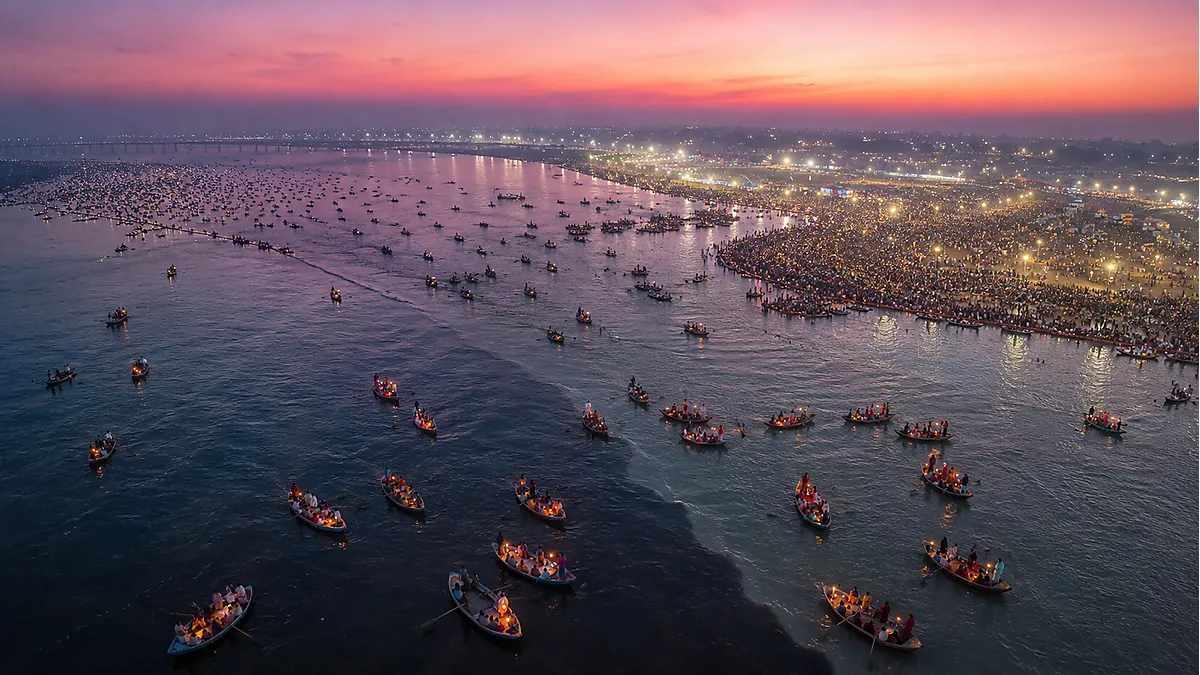
The ghats of Prayagraj are more than just stone steps leading to a river. They are living, breathing entities—ancient witnesses to the endless flow of time, faith, and humanity. A walk along these sacred banks is not merely a stroll; it is a pilgrimage through the very soul of India.
As the first hint of dawn breaks over the horizon, a golden hue spills across the mighty Ganga. The air, crisp and cool, carries the gentle murmur of prayer. You hear the soft splash of devotees taking their first holy dip, the melodic chime of distant temple bells, and the resonant call of a Shankh (conch) from a nearby shrine. The scent of fresh marigolds mingles with the smoke of smouldering camphor, creating an atmosphere both earthly and divine. You walk down the ancient stone steps, and for a moment, the world pauses.
At this hour, the ghats are not just places; they are thresholds between the physical and the spiritual. A boatman unties his wooden vessel. An elderly Kalpvasi in a simple white dhoti meditates on the steps, his face illuminated by the soft glow of a small diya. A family, dressed in traditional colours, offers prayers while floating leaf boats adorned with flowers and candles into the current.
For centuries, these daily rituals have been the heartbeat of Tirtharaj Prayag. For millennia, the faithful have walked these steps, seeking not just a bath, but a cleansing of the soul.
Why have these ancient riverfront steps remained the spiritual heartbeat of Prayagraj for eternity?
The answer lies not only in the confluence of rivers, but in the confluence of life, death, devotion, and eternity—all unfolding daily on the magnificent and sacred Ghats of Prayagraj.
✨ Quick Visitor Information Box
| Feature | Information |
| Best Known Ghats | Sangam Ghats, Dasashwamedh Ghat, Arail Ghat, Jhusi Ghat, Daraganj Ghat, Saraswati Ghat, Kila Ghat |
| Best Time to Visit | October – March (winter months for pleasant weather) |
| Major Festivals | Kumbh Mela, Magh Mela, Makar Sankranti, Chhath Puja |
| Recommended Experience | Sunrise Boat Ride + Ghat Walk (especially from Sangam Nose) |
| Evening Aarti | Typically around 6:00 PM at Saraswati Ghat and Ram Ghat |
| Boat Ride Cost | Shared: ₹100–150; Private: ₹400–600 for 45 minutes |
| Recommended Duration | Half day to full day |
Table of Contents
📖 What Is a Ghat? Gateways to the Divine
To understand Prayagraj, one must first understand its ghats. The word “Ghat” refers to a series of steps leading down to a body of water, most often a sacred river. Yet, to reduce a ghat to mere architecture is to miss its soul.
A ghat is a living, open‑air temple, a civic plaza, and a cosmic crematorium—all in one.
- The Threshold to the Divine (Ganga Dwar): In Hindu tradition, rivers are not just water bodies; they are Goddesses. Descending the steps of a ghat is a symbolic act of humility—leaving behind the impurities of the material world to embrace divine grace. It is the point where humanity meets the divine.
- The Centre of Life and Liberation (Moksha Marg): From the joyful splash of a child’s first bath to the solemn flames of a cremation pyre, the entire cycle of life unfolds here. Pilgrims perform Tarpan (ritual offerings to ancestors) to honour their lineage, while saints meditate in search of Moksha (liberation). It is a place of both worldly celebration and otherworldly renunciation.
- The Cultural Amphitheatre: The ghats are the lungs of the city. The stone steps become seats for crowded festivals, intimate concerts, yoga sessions, and local markets. They are where the social, cultural, and spiritual life of Prayagraj congregates. As a local saying goes, “Time on the ghats is a symbol that connects people across space.”
🗺️ The Sacred Geography of Prayagraj
The unparalleled spiritual power of Prayagraj’s ghats is rooted in its unique geography. The city is known as Tirtharaj, the “King of Pilgrimage Sites,” because of the Triveni Sangam—the confluence of three of the most sacred rivers in Hindu cosmology:
- The Ganga (Ganges): Representing purity, life, and the goddess of salvation. Her waters are believed to wash away sins.
- The Yamuna: Representing love, devotion, and the divine play of Lord Krishna. Her dark, serene waters are distinct from the Ganga.
- The Saraswati: The most mysterious of the three—an invisible, mythical river representing the flow of knowledge, wisdom, and the realm beyond physical perception.
It is at the Triveni Sangam Ghat where the visible waters of the Ganga and Yamuna merge with the invisible Saraswati. Taking a dip at this exact point is believed to grant Moksha—liberation from the cycle of rebirth. Because the ghats are the access points to this celestial meeting, they are treated as sacred portals of immense significance.
🛕 The Role of Ghats in Daily Life – The Rhythm of the River
While the ghats are steeped in mythology, they are equally rooted in the rhythm of everyday life. A day on the ghats follows a timeless schedule:
- Morning – The Awakening (4:00 AM – 8:00 AM): The ghats come alive before the sun. Devotees perform Surya Namaskar (sun salutations) as the sky turns orange. The air fills with Vedic chants as pilgrims take the holy dip. This is the most auspicious time for rituals and meditation.
- Afternoon – The Cycle of Rites (10:00 AM – 4:00 PM): Priests help families perform Pind Daan (rituals for the deceased) and Tarpan. It is also a time for local boatmen to offer rides and for pilgrims to rest in the shade of nearby temples.
- Evening – The Ascent to Divinity (5:00 PM – 8:00 PM): As the sun prepares to set, the ghats prepare for their most spectacular event—the Ganga Aarti. The atmosphere buzzes with anticipation as priests ready their lamps, and the sound of conch shells begins to dominate.
- Night – Silent Contemplation (after 9:00 PM): The crowds thin out, leaving a serene silence broken only by the lapping of water. Lamps float on the river, carrying the prayers of the faithful. The ghats, now lit softly, provide a profound space for introspection.
🌊 Sangam Ghats – The Heart of Prayagraj
If Prayagraj is the King of Pilgrimages, the Sangam Ghats (also known as Triveni Ghat) are its crown jewels. This area is the most prominent and important ghat of Prayagraj, as it is the precise point where the three sacred rivers converge.
- The Spiritual Epicentre: The Sangam area is the main venue for the Kumbh and Magh Melas, attracting the largest gathering of humanity for a religious purpose. The Sangam Nose is the tip of the confluence, considered the most potent spot for a holy dip.
- Boating to the Confluence: A primary activity here is taking a boat ride to the exact point of the confluence. As the boat glides over the waters, it is a tradition to touch the water and feel the distinct textures of the three rivers.
- The Living Festival: Whether it is a normal Tuesday or a festival day, this ghat is a spectacle of faith. Families bring offerings, and the air is thick with the chant “Har Har Gange” – the call of surrender to Mother Ganga.
- Sunrise at Sangam: The most magical time is between 5:30 AM and 7:00 AM. Watching the sun emerge at the confluence, turning the river into a path of molten gold, is an experience that transcends words.
⛰️ Dasashwamedh Ghat – The Ghat of Divine Sacrifice
Dasashwamedh Ghat, not to be confused with its more famous namesake in Varanasi, holds an equally powerful and distinct place in the mythology of Prayagraj. The name Dasashwamedh translates to “the ghat of the ten sacrificed horses,” and its origin story is as grand as it sounds.
- The First Cosmic Sacrifice (Yagya): According to the Padma Purana, this is the site of the very first Yagya of the universe, performed by Lord Brahma (the Creator) himself. He established a sacred Shivlinga on the banks of the Ganga and performed ten Ashvamedha Yagyas (royal horse sacrifices), which is how the ghat got its name.
- A Grand Assembly of Gods: The scriptures narrate that Lord Vishnu served as the host of this great yajna, and the offerings were dedicated to Lord Shiva. To protect this sacred space, the twelve Madhavas (emanations of Lord Vishnu) were born and established around the area. This single act of divine sacrifice gave the region its name, Prayag, and granted the city its title, Tirtharaj.
- The Legend of the Immortal Shivling: History and faith intertwine dramatically here. It is believed that the Mughal emperor Aurangzeb attempted to destroy the temple. However, legend has it that when his sword struck the Brahmeshwar Shivling (installed by Lord Brahma), milk and blood began to flow from it, leaving him so stunned that he abandoned the attack. The original Shivling remained, and another, called the Dashashwavar Shivling, was installed beside it. Both are worshipped together to this day.
- Modern Grandeur: To this day, Dasashwamedh Ghat remains a centre for Vedic rituals and is popular for sunrise and evening aarti ceremonies.
🌿 Arail Ghat – The Ghat of Tranquillity
Located on the southern bank of the Yamuna, across the river from the main city, lies Arail Ghat, a hidden gem for those seeking peace. While other ghats bustle with activity, Arail Ghat is known for its natural beauty, spiritual quietude, and panoramic views.
- The Best View of the Sangam: Because it sits opposite the confluence, Arail Ghat offers the most stunning, uninterrupted view of the entire Triveni Sangam. During sunrise, the golden light hitting the waters at the confluence is breathtaking.
- A Pilgrimage of Solitude: It is less crowded, making it an ideal spot for meditation, quiet prayer, and personal reflection. Devotees perform rituals like Tarpan here, enjoying a deep connection with the divine without the rush.
- A Natural Escape: The serene environment attracts not only devotees but also nature lovers who come to watch migratory birds and enjoy the peaceful flow of the Yamuna. It is a place where you can “sit, think, pray, and just breathe.”
- Getting There: You can reach Arail Ghat by road (about 3 km from the Sangam) or by taking a scenic boat ride directly from the Sangam side.
🏛️ Jhusi Ghat – Where Ancient History Meets the River
On the eastern banks of the Ganges, connected to the main city by the Shastri Bridge, lies the town of Jhusi. Its ghats are not just religious sites; they are archaeological wonders that connect you to India’s prehistoric past.
- The Legend of Pratishthanpur: Jhusi was formerly known as Pratishthanpur or Puri and is considered the ancient capital of the Lunar Dynasty (Chandravansha). It was founded by King Ila and served as the capital for the legendary king Pururavas.
- Evidence of a 9,000‑Year‑Old Civilisation: This is what makes Jhusi truly unique. Carbon dating has revealed Neolithic levels dating back to 7100 BCE, making it one of the earliest sites of farming and settled life in South Asia.
- Spiritual Hub During Magh Mela: During the Magh Mela and Kumbh Mela, Jhusi transforms into a vibrant centre for religious processions, attracting thousands of pilgrims who take holy dips on its ancient banks.
- A Pilgrim’s Experience: Visiting Jhusi Ghat is like taking a walk through time—from the Stone Age to the modern‑day faith of the Kumbh Mela, all on the banks of the sacred Ganga.
🔥 Daraganj Ghat – The Eternal Cycle of Life and Death
To understand the full spiritual spectrum of the ghats, one must visit Daraganj Ghat near the famous Beni Madhav Temple. This ghat is known primarily as a cremation ground, and while it may be confronting, it is a place of profound philosophical truth.
- The Gateway to Moksha: In Hindu philosophy, dying in a sacred city like Prayagraj and having one’s last rites performed on the banks of the Ganga is believed to grant Moksha—liberation from the endless cycle of birth, death, and rebirth.
- An Antidote to Ego: Seeing the flames of a pyre on the ghat is a stark reminder of the impermanence of the physical body. It is called the “last sacrifice,” where the physical form is offered back to the five elements.
- A Sacred Sadness: While it is a place of mourning, there is also a sense of peace here. The chanting of “Ram Nam Satya Hai” (The name of Ram is the only truth) fills the air, carrying the soul on its onward journey.
- Respectful Observation: Visitors should maintain a respectful silence. Observing the cremation rituals at Daraganj can be a profound, life‑changing encounter with the spiritual reality of death.
🌅 Other Important Ghats of Prayagraj
The spiritual tapestry of Prayagraj is woven with many threads. Here are other notable ghats that contribute to its glory:
| Ghat Name | Location / River | Significance & Highlights |
| Kila Ghat | Near Allahabad Fort (Yamuna) | Rich in archaeological and spiritual relevance; magnificent views of the Sangam and the fort from the riverbank. |
| Ram Ghat | Near Sangam Ghat (Ganga) | A major centre of attraction, known for its grand Ganga Aarti performed every evening. |
| Shankar Ghat | Rasulabad (Ganga) | Features the Nageshwar Mahadev temple alongside shrines dedicated to Hanuman, Ganesha, and Maa Durga. |
| Saraswati Ghat | Near Prayagraj Fort (Yamuna) | Noted for its beautiful evening Ganga Aarti. The ghat looks spectacular at night when lit by diyas and candles. |
| Gau Ghat | Banks of Yamuna | A picturesque ghat ideal for relaxing; houses several temples and ashrams. |
| Balua Ghat | Yamuna River | Known for the sand on its banks (Balua means sand); a popular spot for picnics and boat rides. Built about 100 years ago. |
| Rasulabad Ghat | Banks of Ganges | One of the primary ghats where pilgrims from Lucknow, Ayodhya, and Sultanpur routes take a holy dip during Kumbh. |
| Hanuman Ghat | Near Bade Hanuman Temple | Always bustling with devotees, especially on Tuesdays and for Hanuman Jayanti. |
| Draupadi Ghat | Ganga, Cantonment Area | One of the 12 Madhavas ghats, where Bindu Madhav is located. |
🎉 Ghats During Magh Mela – The Forty‑Five Days of Penance
The Magh Mela is an annual, month‑long fair held during the Hindu month of Magha (January–February). It is a smaller version of the Kumbh Mela but holds immense significance. During this time, the ghats become the temporary home to thousands of Kalpvasis.
- What is Kalpavas? Kalpvasis are devotees who renounce worldly comforts to live on the riverbanks for the entire month. They live in simple tents, eat one meal a day, meditate, and perform daily rituals and baths at the ghats.
- A Pilgrim’s Miniature Life: The ghats during Magh Mela are a beautiful sight. Thousands of tents, called “Kalpvas Nagars,” spring up along the riverfront. The mornings begin before dawn with the sound of Vedic hymns echoing across the temporary settlements.
- A Time for Mass Prayer: The main bathing dates during Magh Mela, such as Makar Sankranti, Mauni Amavasya, and Basant Panchami, draw massive crowds. The ghats are filled with devotees, saints from various Akharas, and visitors.
- Cultural Immersion: It is not only about rituals. The ghats become stages for religious discourses, classical music concerts, and cultural performances, making it a profound spiritual and cultural immersion.
🌊 Ghats During Kumbh Mela – The Greatest Show on Earth
The Maha Kumbh Mela, occurring every 12 years, transforms the ghats of Prayagraj into the epicentre of the spiritual universe. When the Kumbh is held, the city becomes a temporary, sacred nation.
- The Shahi Snan (Royal Bath): The most spectacular event is the Shahi Snan. On the most auspicious dates, the 13 Akharas (sects of sadhus) process to the ghats in grand processions of elephants, horses, chariots, and palanquins. The ghats are flooded with naked Naga Sadhus covered in ash, who rush into the waters in a display of raw, untamed faith.
- The 41 Ghats of Kumbh: To manage the millions, the Mela Administration constructs and designates a staggering 41 ghats (8 permanent and 33 temporary), ensuring pilgrims from every direction have access to the holy water. The 15‑km‑long riverfront is meticulously planned to manage crowds.
- An Ocean of Humanity: On a major bathing day like Mauni Amavasya, the ghats look like a sea of humanity. Yet within that vast crowd, an undeniable, palpable energy of shared devotion unites every soul. Many pilgrims prefer to take a boat early in the morning (4:00 AM – 7:00 AM) to avoid the crowds and find a private space for their snan.
- From City to Sanctuary: For 45 days, the normal life of Prayagraj merges with the divine. The ghats are not just steps; they are the centre of a temporary civilisation built entirely on faith.
🚤 Boating from the Ghats – The Pilgrim’s Vessel
No visit to the ghats of Prayagraj is complete without a boat ride. It is not merely a tourist activity but an essential part of the pilgrimage, especially for reaching the precise point of the Sangam confluence.
- Types of Boats: You will find simple rowboats and modern motorboats. For a traditional, peaceful experience, hire a rowboat. For a quicker journey, motorboats are also available.
- Sunrise Sangam Sail: The most magical time is to take a private boat ride early in the morning to the Sangam Nose. As you float on the calm waters, you can witness the sun rising, casting a golden glow on the water, and see the distinct colours of the Ganga and Yamuna merging.
- Costs to Expect: Prices are negotiable. A shared boat can cost around ₹100–₹150 per person. A private small boat for 45 minutes may cost ₹400–₹600, while motorboats range from ₹700–₹1,000 depending on capacity. During peak festivals, prices may rise, but you can bargain.
- From Key Ghats: You can easily hire a boat from Saraswati Ghat, Kila Ghat, or directly from the Sangam Ghats to access the confluence.
🌅 The Ghats at Sunrise and Sunset – The Golden Hours
The ghats change their character dramatically with the rising and setting of the sun. These “golden hours” are the most beautiful and spiritually potent times to experience them.
- Sunrise (The Awakening): The sky transitions from deep blue to soft pink and then to a brilliant orange. The water mirrors these colours, creating a divine canvas. The ghats are relatively quiet, filled with the soft splashes of early bathers and the low hum of morning prayers. This is the time for introspection and personal rituals.
- The Ganga Aarti (The Evening Spectacle): As dusk settles, the ghats prepare for the magnificent Ganga Aarti – a fire‑offering ceremony to honour Maa Ganga, performed by saffron‑clad priests using multi‑tiered brass lamps, incense, and conch shells.
- Where to See: The grandest aartis are often performed at Saraswati Ghat and Ram Ghat.
- Timings: The evening aarti usually takes place around 6:00 PM. It is best to arrive at least 30 minutes early to secure a good spot, as the ghat steps fill up quickly.
- The Experience: As the sun sets, the priests begin the rhythmic chanting of mantras. The synchronised movement of the giant lamps creates a hypnotic effect. Thousands of devotees sway, sing, and release floating lamps onto the river. It is a deeply moving, soul‑stirring spectacle of collective devotion.
🪔 Festivals Celebrated at the Ghats
The ghats are the primary stages for almost every major Hindu festival in Prayagraj, each one transforming the riverfront into a vibrant celebration of life and faith.
- Makar Sankranti (January): Marks the beginning of the sun’s northward journey. The ghats are packed as this is the first major bathing day for the Magh Mela. Devotees take a holy dip and offer sesame seeds and jaggery to the sun god.
- Chhath Puja (October/November): The ghats witness one of the most visually stunning festivals. Thousands of devotees, mostly women, gather to offer Arghya (offerings of water and milk) to the setting and rising sun. The ghats glow with diyas and are filled with folk songs dedicated to Chhathi Maiya.
- Kartik Purnima (November): Another auspicious bathing day. The ghats are filled with devotees, and at night, thousands of diyas are floated on the river, creating a scene of unparalleled beauty.
- Ganga Dussehra (May/June): Celebrates the descent of the Ganga to Earth. The ghats host special pujas and aartis, with thousands taking a dip to cleanse themselves of ten lifetimes of sins.
- Shivratri (February/March): Ghats like Someshwar Ghat and Shankar Ghat, which have Shiva temples, become centres of attraction as devotees perform Jalabhishek (offering water to the Shivling).
🎭 The Cultural Life of the Ghats – The Soul of Prayag
Beyond the grand rituals and festivals, the ghats have a vibrant daily life that defines the culture of Prayagraj.
- The Priests (Pandas): Generations of priests, known as Pandas, sit on the ghats, maintaining ancient family records of pilgrims. They help guide devotees through the complex rituals of Pind Daan and Tarpan.
- The Boatmen (Mallahs): They are the custodians of the river paths. Their livelihood depends on the ebb and flow of the river and the devotion of pilgrims. A conversation with an old boatman will give you stories of the many Kumbhs and Melas he has witnessed.
- The Vendors and Craftsmen: The ghats are lined with small stalls selling everything for worship: marigold garlands, brass lotas (water pots), incense sticks, colourful bindis, and prasad (sweets). You will also find vendors selling fresh coconut water and the local speciality – petha.
- A Stage for Arts: On less crowded days, local artists, folk singers, and storytellers can be found performing on the ghats, keeping ancient oral traditions alive. It is a place where the social relations of the city are “encoded in ritual.”
📝 How to Visit the Ghats – Practical Guide for the Pilgrim
Visiting the ghats is a rewarding experience, but a little planning ensures a smooth and respectful journey.
- Best Time to Visit: The winter months from October to March are ideal due to pleasant weather. Early mornings (5:00 AM – 8:00 AM) for sunrise and evenings (5:00 PM – 7:00 PM) for aarti are the best times of day.
- Duration: Plan at least half a day for a few ghats, or a full day to explore the circuit from Sangam to Arail and Jhusi.
- What to Wear: Modest, comfortable clothing is recommended. Avoid heavy jeans; cotton or linen is best. It is customary to remove footwear before stepping onto the ghat or into the water. Carrying a change of clothes or a light towel is advisable if you plan to take a dip.
- What to Bring:
- A mat or scarf to sit on.
- Sunscreen and a hat for daytime visits.
- A water bottle to stay hydrated.
- A small bag to keep your valuables dry and safe.
- A camera or phone for photos (but be mindful of people’s privacy during rituals).
- Responsible Tourism:
- Keep the Ghats Clean: Avoid using plastic bags and dispose of waste in designated bins.
- Respect the Sacredness: Do not photograph people performing cremation or mourning.
- Bargain with Kindness: When negotiating a price for a boat or a purchase, be fair and respectful.
❓ Frequently Asked Questions (FAQs)
1. Which is the most famous ghat in Prayagraj?
The Sangam Ghat (Triveni Ghat) is the most famous and holiest, as it is the point of confluence of the three rivers.
2. Can tourists visit the Sangam Ghats?
Absolutely. The ghats are open to all visitors, regardless of faith, and are a major attraction for both pilgrims and tourists.
3. What is special about Dasashwamedh Ghat?
It is believed to be the site where Lord Brahma performed the first Yagya of the universe – the ten Ashvamedha sacrifices – giving the ghat its name.
4. Which ghat is best for sunrise views?
For a panoramic view, Arail Ghat is best. For the most spiritually charged experience, the Sangam Ghats at sunrise are unmatched.
5. Are boat rides available from the ghats?
Yes, boat rides are readily available, especially from Sangam, Saraswati, and Kila Ghats, to reach the confluence.
6. What is the Ganga Aarti?
It is a grand evening ritual of offering fire, incense, and prayers to the Goddess Ganga, held at dusk (around 6:00 PM) at Saraswati or Ram Ghat.
7. Which ghat is best for meditation?
Arail Ghat, due to its tranquil environment and fewer crowds, is the most popular choice for meditation.
8. What is the significance of Daraganj Ghat?
It is primarily a cremation ghat, where many Hindus bring their departed for last rites, believing it grants Moksha.
9. How many ghats are there in Prayagraj?
The city has numerous ghats. For the 2025 Maha Kumbh, the administration set up a total of 41 ghats, including 8 permanent ones.
10. What are the timings for the Ganga Aarti?
The evening aarti typically begins around 6:00 PM at Saraswati Ghat and other prominent ghats.
11. What is the cost of a boat ride?
A shared boat ride costs ₹100–150 per person, while a private boat ride ranges from ₹400–₹600 for 45 minutes.
12. Is Jhusi Ghat historically important?
Yes. Jhusi (ancient Pratishthanpur) is an archaeological site with evidence of human habitation dating back to 7100 BCE.
13. Which festivals are celebrated at the ghats?
Major festivals include Magh Mela, Kumbh Mela, Makar Sankranti, Chhath Puja, Kartik Purnima, and Ganga Dussehra.
14. Are the ghats accessible for disabled people?
Some of the newer concrete ghats have ramps and better accessibility, but many ancient ghats have steep steps.
15. What should I wear when visiting a ghat?
Modest, comfortable clothing is recommended. It is customary to remove shoes before stepping onto the ghat.
🔗 Related Sacred Journeys
After experiencing the ghats, your journey through Prayagraj is far from over. We invite you to deepen your pilgrimage by visiting:
- Triveni Sangam – the sacred confluence itself.
- Akshayavat – the indestructible banyan tree.
- Patalpuri Temple – the underground temple.
- Bade Hanuman Ji Temple – the reclining Lord Hanuman.
- Bharadwaj Ashram – the ancient hermitage of Sage Bharadwaj.
- Shri Beni Madhav Temple – the presiding deity of Prayagraj.
📜 Conclusion – The Eternal Steps to the Divine
As you walk back from the river, with the sound of conch shells echoing in your ears and the gentle lapping of the waves still in your heart, you realise that you have experienced something truly timeless.
You have stood where saints meditated, where kings offered sacrifice, and where millions have sought liberation. You have witnessed the joy of a new family and the solemnity of a final farewell. The ghats of Prayagraj are more than riverfront structures. They are the eternal steps to the divine – a living, breathing testament that in this holy city, the boundary between the earthly and the celestial is as thin as a single step.
The river will keep flowing, and the lamps will keep floating, but the peace you carry from this sacred walk will remain with you forever.
This article is part of a series on the sacred geography and pilgrimage sites of Prayagraj. For more information on planning your spiritual journey, please contact us.
Prayag Tourism
📞 Phone/WhatsApp: +91-9555313526
📧 Email: contact@prayagtourism.com
🌐 Website: PrayagTourism.com
May your journey be peaceful, safe, and spiritually enriching – and may the eternal steps of Prayagraj’s ghats lead you closer to the divine.