
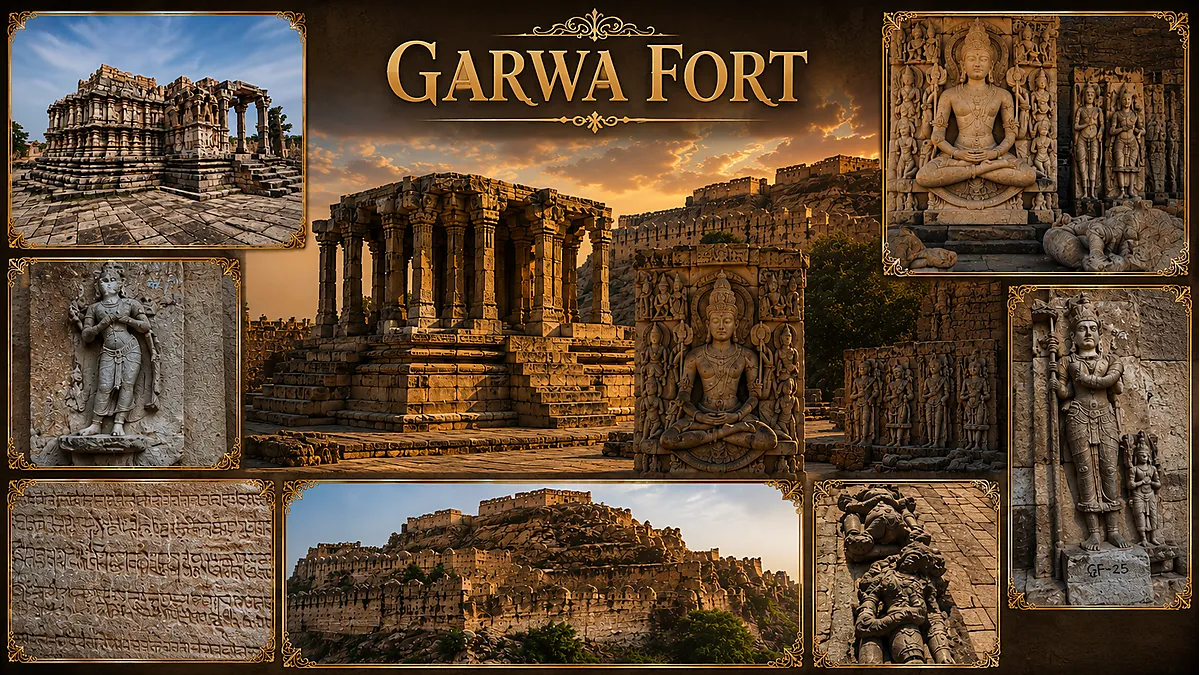
The road from Prayagraj winds southward through the fertile plains of the Doab, past villages where life moves at the pace of ox‑carts and the distant call of peacocks echoes across the fields. After about 50 kilometres, the landscape begins to change. The flat farmland gives way to low, rocky hills. And then, rising unexpectedly from the scrub, you see it—a massive stone enclosure, its walls built from blocks that seem to have been gathered from the ruins of a forgotten civilisation.
This is Garhwa Fort Prayagraj, one of the most important yet underappreciated archaeological sites in the Prayagraj region. Beneath its medieval walls lies a treasure trove of Gupta-era history: a temple complex that once stood as a testament to the artistic and religious brilliance of India‘s golden age, inscriptions that reveal the workings of an empire, and sculptures that have survived over 1,500 years of upheaval.
Yet, unlike the more famous monuments of the Gupta period, Garhwa remains relatively unknown. It is a site where the ancient and the medieval meet, where the stone of a 5th‑century temple was reused by an 18th‑century king to build a fort, and where inscriptions carved under one emperor were later hidden beneath layers of lime, waiting to be rediscovered.
Let us walk through the gates of Garhwa Fort and uncover the story of one of Prayagraj‘s most remarkable historical treasures.
Table of Contents
🏛️ Discovering a Hidden Treasure of the Gupta Age
Stand before the massive stone walls of Garhwa Fort, and you are standing at the intersection of two eras. The fortifications that surround you—the square enclosure, the parapets, the bastions—were built in the 18th century by Raja Vikramaditya of the Baghel dynasty. But the stones that make up those walls, the pillars that support them, and the sculptures that lie scattered across the site belong to a far older age—the age of the Gupta Empire, India‘s golden age.
Inside the enclosure, amid the ruins of a pillared temple and the debris of centuries, you can still see the remnants of a lost world. Carved stones bearing the marks of Gupta artisans lie half‑buried in the earth. A 6‑7 foot high slab depicting all ten avatars of Vishnu stands as a reminder of the site‘s later medieval significance. And inscriptions—some of the most important in the history of early India—tell the story of emperors, donations, and a society that valued learning and charity.
But to understand Garhwa, we must begin not with the fort but with the temple that came before it.
📍 Where Is Garhwa Fort?
Garhwa Fort is located in the Shankargarh tehsil of Prayagraj district, approximately 50 kilometres south‑west of Prayagraj city, on the Jabalpur road. It lies about 5 kilometres from Shankargarh, a small town that serves as the nearest urban centre. The site’s coordinates are 25°13′34″N 81°35′09″E.
The fort sits in the Trans‑Yamuna region, near the border between Uttar Pradesh and Madhya Pradesh. It is often confused with the more famous Kaushambi, but the two sites are distinct. Garhwa is approximately 25 kilometres south of Prayagraj, while Kaushambi lies further to the south-west.
The ancient name of the site was Bhattpraya (or Bhattagrama), and the neighbouring village is still called Bhattgarh (now Bargarh). This name survives today, a faint echo of the site‘s original identity.
The site is managed by the Archaeological Survey of India (ASI) and is a centrally protected monument.
🕉️ The Origins of Garhwa – From Ancient Settlement to Sacred Site
Before the Guptas built their temple, the area around Garhwa was already a place of human activity. Archaeological surveys in the region have revealed rock paintings in the nearby hills that range in date from the Mesolithic to the historical period. These paintings depict hunting scenes, various animals, and folk dances, suggesting that the region has been inhabited for thousands of years.
The site‘s original name, Bhattpraya or Bhattagrama, suggests a settlement associated with Brahmins (Bhatt is a common Brahmin surname). This aligns with the religious character of the later Gupta temple, which was dedicated to Vaishnavite worship.
The temple complex at Garhwa was likely built sometime between the 5th and 6th centuries CE, during the height of the Gupta Empire. The Guptas were patrons of the arts and religion, and they constructed numerous temples across northern India. Garhwa was one of these—a temple dedicated to Lord Vishnu in his various incarnations.
👑 Garhwa During the Gupta Empire – The Golden Age Arrives
The Gupta Empire (c. 3rd‑6th century CE) is often described as India‘s golden age. Under rulers like Chandragupta II and Kumaragupta I, the empire reached its zenith, with flourishing trade, a sophisticated bureaucracy, and a remarkable flowering of art, literature, and religion.
Garhwa became a significant religious centre during this period. The temple complex was dedicated to Vaishnavism, the worship of Lord Vishnu, and the site was patronised by the Gupta emperors themselves. The most important evidence of this patronage comes from the Gadhwa Stone Inscriptions, which record charitable donations made by Chandragupta II and Kumaragupta I to almshouses (sattra) at the site.
The temple likely stood as a prominent landmark in the region, attracting pilgrims, scholars, and devotees. Its architectural style—with its pillared hall, sculptural decoration, and ritual tanks—reflected the artistic and religious sensibilities of the Gupta period.
📜 The Gadhwa Stone Inscriptions – A Window into Gupta India
The Gadhwa Stone Inscriptions (also known as the Garhwa Stone Inscriptions) are among the most important historical records from the Gupta period. They are early 5th‑century CE Sanskrit inscriptions that record a series of charitable donations made by Gupta rulers to almshouses (sattra) at Garhwa.
Discovery of the Inscriptions
The inscribed stones were discovered in 1872 by R.S. Prasad (Raja Śiva Prasād), a local historian. They were found on blocks inside a room of a new house that had been built from demolished and recut stone. The stones had been reused in the construction of the house, and their inscriptions were hidden beneath layers of lime.
Prasad brought the stones to the attention of Alexander Cunningham, the first Director‑General of the Archaeological Survey of India. Cunningham visited Garhwa three times between 1871 and 1877, and he carefully removed the lime from the stones to reveal the inscriptions. The first of these were published in 1873, and the last in 1890.
The Rulers Mentioned
The inscriptions mention two Gupta emperors:
- Chandragupta II (c. 375‑415 CE), one of the most powerful Gupta rulers
- Kumaragupta I (c. 415‑455 CE), his son and successor
The inscriptions date to approximately 408‑418 CE.
The Content of the Inscriptions
The inscriptions record donations to sattra—almshouses or refectories where food and shelter were provided to the poor, the learned, and travellers. They provide valuable information about the administration of the Gupta Empire, the role of religious institutions, and the economic life of the period.
The inscription is also notable for including symbols for numerals 8, 10, 80, and 90 in the 5th century, as well as mentioning the ancient city of Pataliputra (modern Patna).
Where Are They Now?
The Gadhwa Stone Inscriptions are now housed in the Kolkata Museum (Indian Museum), West Bengal.
🔍 Understanding the Inscriptions – What They Reveal
Historians have learned a great deal from the Gadhwa Stone Inscriptions. They provide insights into:
- Religious Endowments: The inscriptions show that the Gupta emperors were patrons of religious institutions, supporting almshouses that served the poor and the learned.
- Social Welfare: The donations to sattra indicate a concern for social welfare and charitable giving.
- Administrative Structure: The inscriptions reveal the administrative apparatus of the Gupta Empire, including the use of grants and endowments.
- Economic Life: The inscriptions provide evidence of the economic activity at Garhwa, including the support of religious institutions through land grants and other donations.
🏗️ The Gupta‑Era Temple Complex – A Lost Masterpiece
The temple complex at Garhwa was once a magnificent structure, but today only ruins remain. The site, now managed by the ASI, occupies a two‑kilometre periphery and takes the rough shape of a pentagon, containing within it bastions, tanks, and a pillared temple.
Temple Layout
The temple complex included:
- A pillared hall (mandapa) with a colonnaded design
- Two eastern tanks for ritual bathing
- A western temple that served as the main shrine
The temple was constructed using a combination of fine‑grained pink sandstone and coarse grey sandstone.
Structural Remains
The only existing temple stood in the south‑west corner of the enclosure. Cunningham noted that the oldest remains at Garhwa belonged to the age of the Guptas. The site also contains a variety of excavated material, including:
- A large figure depicting the full set of Lord Vishnu‘s ten reincarnations (Dashavatara)
- References and images of Parashurama
- Images of the solar divinity Revanta, dating to the 12th‑century Gahadavala period
- Several inscriptions from the time of Kumaragupta and Skandagupta recording donations and grants
🎨 Gupta Architecture at Garhwa – Pillars, Sculptures, and Art
The architectural elements from the Gupta period at Garhwa are among the finest surviving examples of Gupta art.
Pillars
The square pillar bearing the two Gupta inscriptions that were later cut into four beams is a particularly important find. One of the pillars was found to include a Buddhist railing, leading archaeologists to believe that the earlier structure that the pillars belonged to may have been a Buddhist vihara (temple).
Sculptures
The sculptures at Garhwa depict a range of Hindu deities, including Vishnu and his incarnations. The plastic style of the statuary has been compared to that found on the pillar and architrave at the site.
Art and Decoration
The frieze from Garhwa depicting a sattra (almshouse) is a particularly important piece of Gupta art. It shows the “best abode of virtue” and provides visual evidence of the charitable institutions described in the inscriptions.
🖼️ The Dashavatara Sculpture – A Medieval Masterpiece
The most notable item at Garhwa is a carved slab of stone, 6‑7 feet high, representing all ten avatars (Dashavatara) of Lord Vishnu. This sculpture dates to the 11th or 12th century—the Gahadavala period—and is a remarkable example of medieval Indian art.
The Dashavatara includes representations of:
- Matsya (fish)
- Kurma (tortoise)
- Varaha (boar)
- Narasimha (man‑lion)
- Vamana (dwarf)
- Parashurama (Rama with an axe)
- Rama (the prince of Ayodhya)
- Krishna (the divine cowherd)
- Buddha
- Kalki (the future avatar)
The sculpture is a powerful testament to the enduring Vaishnavite tradition at Garhwa.
🏰 The Medieval Transformation – From Temple to Fortress
By the 18th century, the Gupta temple complex at Garhwa had fallen into ruins. The site was no longer a centre of active worship, and its stones were being reused for other purposes.
In 1750 CE, Raja Vikramaditya of the Baghel dynasty (also known as Vishwanath Singh Deo) decided to fortify the site. The fortification consisted of a square enclosure with parapets and bastions at the four corners, giving it the appearance of a fortress. The walls were built using massive carved stones taken from the ruins of the Gupta temple.
The name “Garhwa” itself means “fort” in Hindi. The site‘s transformation from a temple to a fortress is reflected in its name.
👑 Raja Vikramaditya Baghel and the Fortification of Garhwa
The Baghel dynasty ruled the region around Rewa in present‑day Madhya Pradesh. Raja Vikramaditya (also known as Vishwanath Singh Deo) was a Baghel ruler who extended his influence into the Prayagraj region.
In 1750 CE, he built a fort at Garhwa using the ruins of the ancient Gupta temple. The fortification consisted of a square enclosure, bastions on the four corners, and parapets. A flight of steps provided easy access to the bastions.
The fort also contained two stepwells (bawli), which provided water for the garrison and any inhabitants.
The fortification gave the site a defensive appearance, but Cunningham noted that it had little military strength. In his words, the name Garhwa or “the Fort” was a “complete misnomer,” as the place was “only a square enclosure around a group of temples, without any strength as a military position”.
🗿 Sculptures and Artifacts – The Vaishnavite Heritage
Garhwa is a treasure trove of Vaishnavite sculpture. The site contains numerous images of Vishnu and his incarnations, as well as other deities.
The Dashavatara Slab
The 6‑7 foot high Dashavatara slab is the most impressive piece of sculpture at Garhwa. It depicts all ten avatars of Vishnu and dates to the 11th‑12th century.
Other Vaishnavite Images
The site also contains:
- Images of Parashurama (the sixth avatar)
- References to Rama (the seventh avatar)
- Depictions of Krishna (the eighth avatar)
The Revanta Image
One of the more unusual pieces at Garhwa is an image of Revanta, the solar divinity, dating to the Gahadavala period of the 12th century.
Decline and Vandalism
In recent years, Garhwa has suffered from vandalism and neglect. Many of the Dashavatara sculptures have been mutilated, and a colossal Buddha avatar was stolen. The site remains vulnerable to theft and damage, despite being a protected monument.
📚 What Garhwa Reveals About Gupta India
Garhwa offers valuable insights into Gupta India:
| Aspect | What Garhwa Reveals |
| Religion | Vaishnavism was a major religious tradition, with temples dedicated to Vishnu and his avatars. |
| Patronage | The Gupta emperors patronised religious institutions, supporting almshouses and temples. |
| Architecture | Gupta architecture featured pillared halls, sculptural decoration, and ritual tanks. |
| Art | Gupta art reached a high level of sophistication, as seen in the frieze and sculptures. |
| Charity | The donations to sattra indicate a concern for social welfare. |
| Continuity | The site continued to be venerated into the medieval period, as seen in the Dashavatara sculpture. |
🔬 Archaeological Investigations – From Cunningham to the Present
Alexander Cunningham (1871‑1877)
The first systematic archaeological investigation of Garhwa was conducted by Alexander Cunningham, the first Director‑General of the ASI. He visited the site three times between 1871 and 1877. He documented the site‘s architecture, inscriptions, and sculptures, and published his findings in his reports.
20th‑Century Research
In the 20th century, Garhwa received less attention than other Gupta sites. However, scholars continued to study its inscriptions and sculptures. The site was recognised as a centrally protected monument under the ASI.
Recent Conservation
In 2013, the ASI drew up conservation plans for Garhwa, with the intention of restoring the site to its “original composition”. The restoration work used traditional materials like Chitrakoot sandstone and lime mortar to combat weathering and vegetation overgrowth.
However, as of 2025, reports have highlighted ongoing challenges, including vandalism, neglect, and the theft of sculptures.
🏛️ Comparing Garhwa with Other Gupta Monuments
Garhwa shares similarities with other Gupta‑period monuments, but it also has unique features.
| Monument | Location | Key Features | Comparison with Garhwa |
| Garhwa Fort | Prayagraj | Gupta temple, medieval fort, Dashavatara sculpture | Unique combination of Gupta temple and later fortification |
| Deogarh Temple | Jhansi | Gupta temple with sculptural panels | Both are Vaishnavite temples with rich sculptural decoration |
| Bhitargaon Temple | Kanpur | Gupta brick temple | Garhwa is built of stone, not brick |
| Udayagiri | Vidisha | Gupta rock‑cut caves and inscriptions | Both have inscriptions of Chandragupta II |
| Sarnath | Varanasi | Gupta Buddhist sculptures | Garhwa is Hindu, while Sarnath is Buddhist |
| Kaushambi | Prayagraj | Ashokan pillar, Gupta remains | Both are in the Prayagraj region |
🗺️ Garhwa Fort as a Heritage Tourism Destination
Garhwa Fort offers a unique experience for heritage travellers. It is a place where you can see the layers of history—from the Gupta temple to the medieval fort—all in one location.
Visitor Experience
- Architecture: Explore the massive stone walls of the fort, the ruins of the Gupta temple, and the Dashavatara sculpture.
- Photography: The site offers excellent opportunities for photography, with dramatic light on the ancient stones.
- History: Learn about the Gupta Empire, the Gadhwa Stone Inscriptions, and the medieval transformation of the site.
Nearby Attractions
- Shankargarh: A small town with local markets and amenities.
- Kaushambi: The ancient capital of the Vatsa kingdom, about 56 km away.
- Prayagraj: The main city, with its Sangam, Allahabad Fort, and other attractions.
Tourism Development
In 2025, the Uttar Pradesh government announced plans to develop Garha Katra Tourism Village in the trans‑Yamuna area, featuring the historic Garhwa Fort and nearby waterfalls. The project will include 10 homestays to promote rural tourism.
🧭 How to Visit Garhwa Fort – A Practical Guide
Best Time to Visit
The best time to visit Garhwa Fort is during the winter months (October to March), when the weather is pleasant. Avoid the summer months (April to June), when temperatures can exceed 40°C.
How to Reach
| From | Distance | Travel Time | Route |
| Prayagraj | 50 km | 1.5‑2 hours | Jabalpur road via Shankargarh |
| Shankargarh | 5 km | 15‑20 minutes | Local road |
- By Road: The site is accessible by car or taxi from Prayagraj. The journey takes about 1.5‑2 hours.
- By Public Transport: Buses and shared taxis are available from Prayagraj to Shankargarh, from where you can hire a local vehicle.
Visitor Information
| Detail | Information |
| Timings | 6:00 AM – 6:00 PM (daily) |
| Entry Fee | Free (no entry fee) |
| Photography | Allowed, but some restrictions may apply to the Dashavatara sculpture |
| Facilities | Limited; carry water and snacks |
| Guided Tours | Not readily available; recommended to bring a guidebook or research beforehand |
Tips for Visitors
- Wear comfortable shoes: The site involves walking on uneven ground.
- Carry water and snacks: There are no shops near the fort.
- Respect the site: Do not touch or damage the sculptures.
- Be mindful of security: The site is remote; travel during daylight hours.
📅 Timeline of Garhwa Fort
| Period | Date | Event |
| Prehistoric | Mesolithic period | Rock paintings in the hills around Garhwa |
| Gupta Period | 5th‑6th century CE | Temple complex built at Garhwa |
| Gupta Period | c. 408‑418 CE | Gadhwa Stone Inscriptions of Chandragupta II and Kumaragupta I |
| Gupta Period | 5th‑6th century CE | Temple flourishes as a centre of Vaishnavite worship |
| Gupta Period | c. 415‑455 CE | Kumaragupta I and Skandagupta issue donation records |
| Medieval Period | 11th‑12th century CE | Dashavatara sculpture carved |
| 18th Century | 1750 CE | Fortification of the temple ruins by Raja Vikramaditya Baghel |
| 1871‑1877 | 19th century | Alexander Cunningham visits and documents the site |
| 1872 | 19th century | Gadhwa Stone Inscriptions discovered by R.S. Prasad |
| 2013 | 21st century | ASI draws up conservation plans |
| 2025 | 21st century | Government plans tourism village at Garhwa |
❓ Frequently Asked Questions (FAQs)
1. Where is Garhwa Fort located?
Garhwa Fort is located approximately 50 km south‑west of Prayagraj, on the Jabalpur road, near Shankargarh.
2. Why is Garhwa Fort important?
Garhwa Fort is important for its Gupta‑era temple complex, its 5th‑century Sanskrit inscriptions (the Gadhwa Stone Inscriptions), and its Dashavatara sculpture.
3. What are the Gadhwa Stone Inscriptions?
The Gadhwa Stone Inscriptions are early 5th‑century CE Sanskrit inscriptions that record charitable donations by Gupta emperors Chandragupta II and Kumaragupta I.
4. Which Gupta rulers are mentioned at Garhwa?
Chandragupta II and Kumaragupta I are mentioned in the Gadhwa Stone Inscriptions.
5. Was Garhwa originally a temple?
Yes. Garhwa was originally a Gupta‑era temple complex dedicated to Lord Vishnu.
6. Who built the fortification walls at Garhwa?
The fortification walls were built in 1750 CE by Raja Vikramaditya of the Baghel dynasty.
7. What is the Dashavatara sculpture?
The Dashavatara sculpture is a 6‑7 foot high carved slab depicting all ten avatars of Lord Vishnu, dating to the 11th‑12th century.
8. When is the best time to visit Garhwa Fort?
The best time to visit is during the winter months (October to March).
9. Is there an entry fee for Garhwa Fort?
No, entry to Garhwa Fort is free.
10. Are the Gadhwa Stone Inscriptions still at Garhwa?
No. The Gadhwa Stone Inscriptions are now housed in the Kolkata Museum (Indian Museum).
11. How do I get to Garhwa Fort from Prayagraj?
You can reach Garhwa Fort by road via the Jabalpur road, which takes about 1.5‑2 hours.
12. Is there any accommodation near Garhwa Fort?
There are limited accommodation options near Garhwa. Most visitors stay in Prayagraj or Shankargarh.
13. What is the ancient name of Garhwa?
The ancient name of Garhwa was Bhattpraya (or Bhattagrama).
14. Who discovered the Gadhwa Stone Inscriptions?
The inscriptions were discovered in 1872 by R.S. Prasad, a local historian.
15. Why was the site fortified in the 18th century?
The site was fortified in 1750 CE by Raja Vikramaditya to create a defensive outpost.
💎 Conclusion
Within the stone walls of Garhwa lies a remarkable story spanning more than sixteen centuries—a story of emperors, inscriptions, temples, fortifications, and the enduring legacy of one of India‘s greatest civilizations.
The site speaks to the continuity of religious traditions, the adaptability of the human spirit, and the layered nature of Indian history. It reminds us that history is not a single story but a palimpsest—each generation writing over the last, yet leaving traces that the careful observer can still read.
Garhwa Fort is not merely a fort, nor merely a temple ruin. It is a living historical archive preserving the transition from the Gupta Golden Age to medieval India. Its inscriptions offer a direct connection to the Gupta emperors, its sculptures reveal the artistic brilliance of the period, and its fortification walls tell the story of a later age that sought to protect and reuse the stones of the past.
As you stand within the enclosure, surrounded by the ruins of an ancient temple and the walls of a more recent fort, you are standing at the intersection of centuries. The same stones that witnessed the prayers of Gupta devotees were later used to guard a medieval kingdom. And today, they stand as a silent testament to the enduring power of India‘s civilisational heritage.
“Within the stone walls of Garhwa lies a remarkable story spanning more than sixteen centuries—a story of emperors, inscriptions, temples, fortifications, and the enduring legacy of one of India‘s greatest civilizations.”
🚶 Discover the hidden history of Garhwa Fort with our “Prayagraj Heritage Tour” – a guided journey covering Garhwa Fort, Kaushambi, and the ancient sites of the Prayagraj region.
📞 Phone/WhatsApp: +91-9555313526
📧 Email: contact@prayagtourism.com
🌐 Website: PrayagTourism.com
This article is part of a series exploring the historical and archaeological heritage of Prayagraj.
Prayag Tourism
May your journey be peaceful, safe, and historically enriching – and may the ancient stones of Garhwa Fort tell you their stories.