

Table of Contents
The modern search
You wake up, reach for your phone, and before your mind is even fully awake, the world is already asking for your attention. Messages, news, tasks, worries, and comparisons rush in like a crowd at the door, and the heart quietly forgets itself.
That is why daily spiritual practices in Hinduism matter so much. They do not ask you to escape life; they teach you how to live life with steadiness, reverence, and inner light. The householder path has always understood that the sacred is not only in temples and festivals, but also in the first breath of morning, the meal you eat, the words you speak, and the silence before sleep.
The Bhagavad Gītā gives the spirit of this path very clearly:
Devanagari:
कर्मण्येवाधिकारस्ते मा फलेषु कदाचन ।
मा कर्मफलहेतुर्भूर्मा ते सङ्गोऽस्त्वकर्मणि ॥ ४७ ॥
IAST: karmaṇy evādhikāras te mā phaleṣu kadācana |
mā karma-phala-hetur bhūr mā te saṅgo ’stv akarmaṇi || 2.47 ||
Source: Bhagavad Gītā, Chapter 2, Verse 47[4][1]
Word-by-word meaning:
- कर्मणि (karmaṇi) – in action
- एव (eva) – only
- अधिकारः (adhikāraḥ) – right, entitlement
- ते (te) – your
- मा (mā) – not
- फलेषु (phaleṣu) – in the fruits/results
- कदाचन (kadācana) – at any time
- मा (mā) – not
- कर्मफलहेतुः (karma-phala-hetuḥ) – cause of the fruits of action
- भूः (bhūḥ) – become
- मा (mā) – not
- ते (te) – your
- सङ्गः (saṅgaḥ) – attachment
- अस्तु (astu) – let there be
- अकर्मणि (akarmaṇi) – in inaction
Simple translation: You have the right to action alone, never to its fruits. Do not become the cause of the results of action, and do not be attached to inaction.
Practical life takeaway: This verse is a daily cure for anxiety. It teaches you to focus on honest effort, while letting go of the burden of controlling every outcome.[1][4]
In Sanātana Dharma, the ordinary day is not separate from spiritual life; it is the very field where spiritual life is tested, refined, and awakened.
What daily practice means
In Hindu thought, dharma is not only a rulebook. It is a way of living in harmony with truth, duty, balance, and reverence. A Hindu daily routine is therefore not merely a sequence of habits; it is a rhythm that keeps the body clean, the mind clear, and the heart aligned.
Classical Hindu tradition has long linked daily life with discipline through concepts like dinacharyā and sandhyā practice. Even the older sacred literature shows a world where ritual, speech, time, and conduct are woven together rather than separated into “spiritual” and “non-spiritual” compartments. The point is simple: every action can become sādhana when done with awareness.
The great gift of this worldview is psychological as well as spiritual. It teaches that you do not need a perfect life to begin devotion, only a sincere one. A tired parent, a student under pressure, a shopkeeper, a software engineer, or a pilgrim can all begin from where they are.
The sacred morning
Traditional Hindu mornings often begin in brahma muhūrta, the quiet pre-dawn period widely regarded as especially favorable for spiritual practice. This is not superstition; it is a wisdom of timing. When the world is quiet, the senses are less scattered, and the mind is more available for prayer, breathing, and reflection.[5][6]
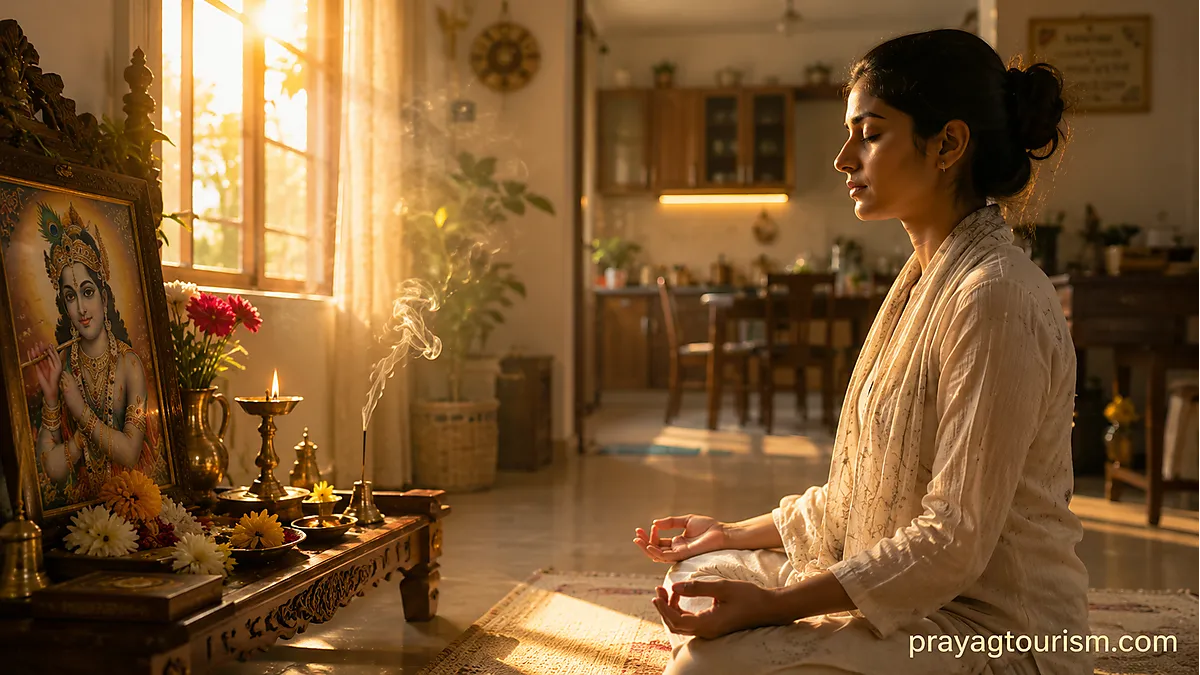
A gentle morning flow may include waking with gratitude, washing the face, bathing, lighting a diya, chanting, pranayāma, meditation, and offering water to the sun. The point is not to perform every item with fear or complexity. The point is to begin the day without handing your mind over to noise.
The Gītā’s teaching in 3.19 supports this mood beautifully:
Devanagari:
तस्मादसक्तः सततं कार्यं कर्म समाचर ।
असक्तो ह्याचरन्कर्म परमाप्नोति पूरुषः ॥ १९ ॥
IAST: tasmād asaktaḥ satataṃ kāryaṃ karma samācara |
asakto hy ācaran karma param āpnoti pūruṣaḥ || 3.19 ||
Source: Bhagavad Gītā, Chapter 3, Verse 19[3][7]
Word-by-word meaning:
- तस्मात् (tasmāt) – therefore
- असक्तः (asaktaḥ) – unattached
- सततम् (satataṃ) – always
- कार्यम् (kāryaṃ) – to be done
- कर्म (karma) – action, duty
- समाचर (samācara) – perform completely
- असक्तः (asaktaḥ) – unattached
- हि (hi) – indeed
- आचरन् (ācaran) – performing
- कर्म (karma) – action
- परम् (param) – supreme
- आप्नोति (āpnoti) – attains
- पूरुषः (pūruṣaḥ) – person
Simple translation: Therefore, always perform the work that should be done, without attachment. By acting without attachment, a person attains the Supreme.
Practical life takeaway: This is one of the most practical verses for daily living. It tells you that the spiritual way is not to stop acting, but to act without being chained to craving and fear.[7][3]
A gentle morning flow may include waking with gratitude, washing the face, bathing, lighting a diya, chanting, pranayāma, meditation, and offering water to the sun. The point is not to perform every item with fear or complexity. The point is to begin the day without handing your mind over to noise.
Morning sequence
A simple Hindu morning routine can be this:
- Wake before sunrise, if possible.
- Sit up and pause for gratitude.
- Wash and bathe with mindfulness.
- Light a diya or lamp.
- Chant a mantra, even one short prayer.
- Offer water to the sun, if that is part of your family tradition.
- Sit silently for a few minutes.
- Begin work with one clear intention.
The famous Gāyatrī mantra is central to this world of morning devotion, and it is traditionally found in the Rig Veda at 3.62.10. Its prayerful spirit is beautifully summarized in the common English rendering of the mantra as a request for inner illumination. For a beginner, even a few quiet recitations can transform the mood of the whole morning.
Gayatri mantra
Devanagari:
ॐ भूर्भुवः स्वः । तत्सवितुर्वरेण्यं भर्गो देवस्य धीमहि । धियो यो नः प्रचोदयात् ॥
IAST: oṃ bhūr bhuvaḥ svaḥ | tat savitur vareṇyaṃ bhargo devasya dhīmahi | dhiyo yo naḥ pracodayāt ||
Source: Rig Veda 3.62.10[8]
Word-by-word meaning:
- ॐ (oṃ) – sacred syllable of invocation
- भूर् (bhūr) – earthly realm
- भुवः (bhuvaḥ) – intermediate realm
- स्वः (svaḥ) – heavenly realm
- तत् (tat) – that
- सवितुः (savituḥ) – of Savitṛ, the Sun
- वरेण्यं (vareṇyaṃ) – worthy of worship
- भर्गः (bhargaḥ) – radiant splendor
- देवस्य (devasya) – of the divine one
- धीमहि (dhīmahi) – we meditate
- धियो (dhiyo) – intellects
- यो (yo) – who
- नः (naḥ) – our
- प्रचोदयात् (pracodayāt) – may inspire
Simple translation: We meditate upon the radiant divine light of Savitṛ, the worthy one, that it may inspire our intellect.
Practical life takeaway: This prayer is not only about worship; it is about direction. It asks that the mind be guided toward clarity, goodness, and right understanding before the day begins.

Practice through the day
Daily spirituality in Hinduism does not end when the prayer ends. It continues in the way you eat, speak, work, and relate to others. This is why the Bhagavad Gītā becomes so practical:
Devanagari:
मयि सर्वाणि कर्माणि संन्यस्याध्यात्मचेतसा ।
निराशीर्निर्ममो भूत्वा युध्यस्व विगतज्वरः ॥ ३० ॥
IAST: mayi sarvāṇi karmāṇi sannyasyādhyātma-cetasā |
nirāśīr nirmamo bhūtvā yudhyasva vigata-jvaraḥ || 3.30 ||
Source: Bhagavad Gītā, Chapter 3, Verse 30[9][10]
Word-by-word meaning:
- मयि (mayi) – in Me
- सर्वाणि (sarvāṇi) – all
- कर्माणि (karmāṇi) – actions
- संन्यस्य (sannyasya) – surrendering, offering up
- अध्यात्मचेतसा (adhyātma-cetasā) – with mind focused on the Self/divine
- निराशीः (nirāśīḥ) – free from hope for reward
- निर्ममः (nirmamaḥ) – free from possessiveness
- भूत्वा (bhūtvā) – becoming
- युध्यस्व (yudhyasva) – act, engage, do your duty
- विगतज्वरः (vigata-jvaraḥ) – free from fever, anxiety
Simple translation: Surrender all actions to Me, with mind fixed on the Self. Free from desire and possessiveness, act without feverish anxiety.
Practical life takeaway: This verse makes work feel lighter. It says that when you offer the day inwardly to the Divine, you can still work hard without becoming emotionally exhausted by every result.[10][9]
That teaching turns the workplace into a field of karma yoga. You answer emails, cook lunch, attend meetings, care for children, or manage a shop—but inwardly you try to remain free from possessiveness and agitation. The work becomes cleaner when the ego becomes quieter.
This is where daily Dharma practices truly begin to shine. Speak truthfully, but gently. Eat with gratitude, not distraction. Do your work with full attention, but without the fever of results. Help someone quietly. Offer the fruit of your effort to the Divine.
The evening return
Evening is the soul’s natural time for gathering itself back together. Where morning is opening, evening is return. The lamp is lit again, and the mind, tired from the world, is invited into softness.
Many Hindu homes keep a quiet evening prayer, a brief ārati, or a simple sitting before the altar. Some read a few verses, others chant a mantra, and many just fold their hands in silence. The sacred atmosphere of lamp, incense, and gentle bells can soothe a nervous system that has been strained all day.
Sandhyā practice traditionally marks these transition moments, especially dawn and dusk, as times for devotion and prayer. That wisdom is deeply practical: transitions are when the mind is most vulnerable and most open. Evening prayer helps the mind close its open loops.[11][12]
A peaceful evening routine may include:
- Turn off extra noise.
- Light a lamp.
- Offer a short prayer.
- Reflect on one good deed from the day.
- Ask forgiveness for any harm done.
- Read a few sacred lines.
- Sleep in gratitude.

For busy lives
Modern life is fragmented, and that is precisely why a Sanātana Dharma lifestyle can be healing. You do not need two hours or a monastery. You need consistency, sincerity, and a few protected minutes.
A realistic beginner routine can be as small as this:
- 5 minutes of silence.
- 5 minutes of mantra or prayer.
- 5 minutes of breath awareness or meditation.
That is enough to begin changing the texture of the day. The Brahma muhūrta window is traditionally considered especially conducive to spiritual practice, and many contemporary explanations describe it as a quiet, favorable time before sunrise. But even if your life does not allow perfection, the deeper principle remains: protect a little sacred time every day.[6][5]
The living horizon
The heart of Hindu daily practice is not performance; it is transformation. Repeated sacred actions shape consciousness the way water shapes stone—not by force, but by patient return.
When a home altar is kept with love, when a meal is taken with gratitude, when work is done without ego, and when evening ends in silence, the ordinary home slowly becomes a place of pilgrimage. The body still lives in the city, but the mind begins to remember the soul.
The Bhagavad Gītā’s final invitation is enormous and tender:
Devanagari:
सर्वधर्मान्परित्यज्य मामेकं शरणं व्रज ।
अहं त्वा सर्वपापेभ्यो मोक्षयिष्यामि मा शुचः ॥ ६६ ॥
IAST: sarva-dharmān parityajya mām ekaṃ śaraṇaṃ vraja |
ahaṃ tvā sarva-pāpebhyo mokṣayiṣyāmi mā śucaḥ || 18.66 ||
Source: Bhagavad Gītā, Chapter 18, Verse 66[2][13]
Word-by-word meaning:
- सर्वधर्मान् (sarva-dharmān) – all dharmas, all duties
- परित्यज्य (parityajya) – having given up
- माम् (mām) – unto Me
- एकम् (ekam) – alone
- शरणम् (śaraṇaṃ) – refuge
- व्रज (vraja) – go, take shelter
- अहम् (aham) – I
- त्वा (tvā) – you
- सर्वपापेभ्यः (sarva-pāpebhyaḥ) – from all sins
- मोक्षयिष्यामि (mokṣayiṣyāmi) – will liberate
- मा (mā) – do not
- शुचः (śucaḥ) – grieve
Simple translation: Abandon all duties and take refuge in Me alone. I shall liberate you from all sins; do not grieve.
Practical life takeaway: This verse is the heart’s shelter. It reminds us that the deepest spiritual practice is not control, but surrender; not fear, but trust.[13][2]
Sanātana Dharma teaches that enlightenment is not hidden only in caves and temples. It is hidden in the sacred repetition of ordinary daily Spiritual Practices in Hinduism. Oṃ Śāntiḥ Śāntiḥ Śāntiḥ.
⁂
References
- https://www.gitasupersite.iitk.ac.in/srimad?etgb=1&setgb=1&choose=1&language=dv&field_chapter_value=2&field_nsutra_value=47
- https://bhagavadgita.com/chapter/18/verse/66
- https://www.wisdomlib.org/hinduism/book/shrimad-bhagavad-gita/d/doc419831.html
- https://vedabase.io/en/library/bg/2/47/
- https://alexandersmap.com/2025/09/27/brahma-muhurta/
- https://timesofindia.indiatimes.com/life-style/soul-search/what-is-the-brahma-muhurta-and-its-importance/photostory/106601356.cms
- https://bhagavadgita.com/chapter/3/verse/19
- https://testbook.com/question-answer/which-veda-contains-the-gayatri-mantra–5cadedddfdb8bb74c49d4872
- https://gitadaily.com/gita-03-19-explained/
- https://jkyog.in/en/wisdom/blog/bhagavad-gita-sankhya-yog-chapter-247-254
- https://www.slideshare.net/slideshow/sandhyavandanam/8634497
- https://www.youtube.com/watch?v=FyZ3KKJrY50
- https://www.bhagavadgitaforall.com/verses/18-66
- https://www.ekanga.in/blogs/ekanga/bhagavad-gita-chapter-2-verse-47-explained
- https://gitajourney.com/category/18-66/