
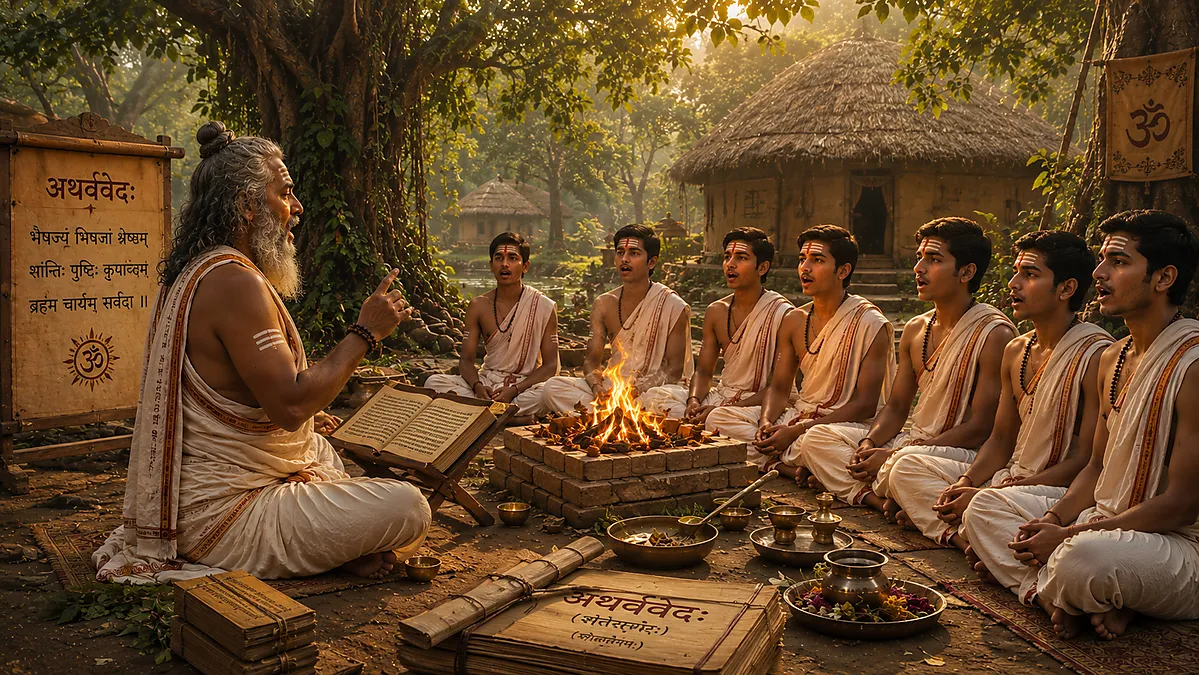
Visitors attending Kumbh Mela at Prayagraj often hear Atharvavedic peace mantras recited during yajñas, householder rituals, and blessings. The emphasis on health, prosperity, and harmony makes Atharvavedic chanting especially relatable to everyday pilgrims.
“The Atharvaveda teaches that spirituality is not separate from daily life. Health, family, society, wisdom, and devotion are all part of a sacred and interconnected existence.”
Imagine a household preparing for a wedding. The bride’s mother applies turmeric paste, praying for her daughter’s well-being. The family priest chants verses to bless the new home. A father teaches his son the value of honesty and courage.
These scenes are not from modern novels—they are reflected in the pages of one of humanity’s oldest and most practical scriptures: the Atharvaveda.
While the Rigveda sings of cosmic glory, the Yajurveda prescribes ritual precision, and the Samaveda weaves divine melodies, the Atharvaveda quietly addresses the concerns of everyday life. It speaks to the householder, the healer, the king, the student, and the seeker. It offers hymns for health, prayers for protection, guidance for governance, and wisdom for the soul.
What if one of humanity’s oldest scriptures was designed not only for rituals and philosophy, but also for the challenges of everyday life?
Let us journey together into this remarkable Veda—the fourth and perhaps most human of the four Vedas.
Table of Contents
Quick Facts
| Attribute | Detail |
| Name | Atharvaveda (अथर्ववेद) |
| Meaning | “Knowledge of the Atharvans” or “Veda of the Fire Priest” |
| Position | Fourth Veda |
| Alternative Name | Brahmaveda (Veda of the Brahma Priest) |
| Total Hymns | Approximately 730 hymns |
| Total Mantras | About 5,977–6,000 mantras |
| Books (Kāṇḍas) | 20 books |
| Primary Recensions | Śaunaka and Paippalāda |
| Key Upanishads | Mundaka, Mandukya, Prashna |
| Estimated Reading Time | 15–20 minutes |
What is the Atharvaveda?
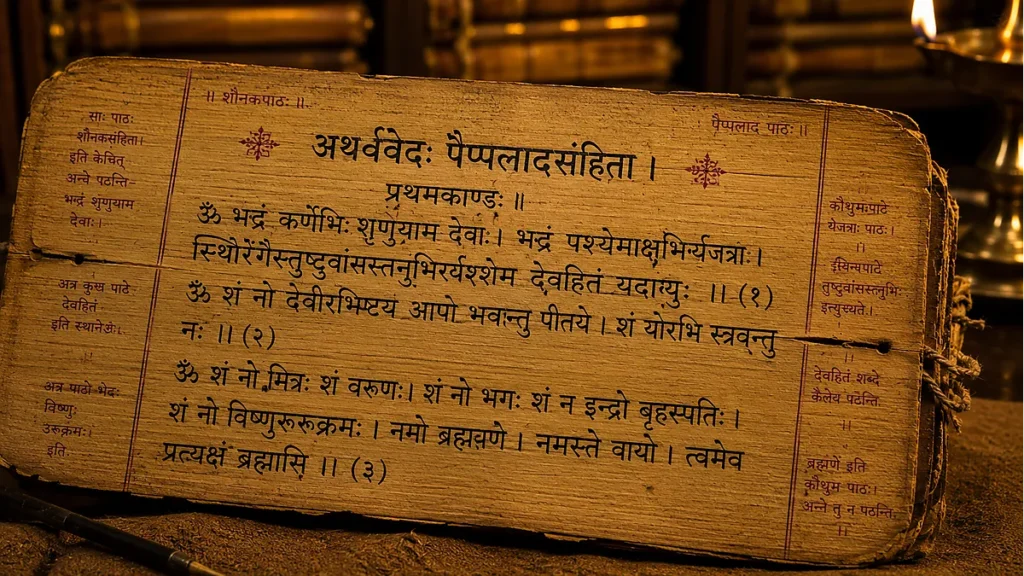
The word Atharvaveda is derived from Atharvan, the name of an ancient sage who was said to be the first to institute fire-sacrifices. It also refers to a class of priests who specialized in domestic rituals, healing, and protection.
The Atharvaveda is the fourth Veda in the traditional order, following the Rigveda, Yajurveda, and Samaveda. However, historical analysis shows that it is as old as the Rigveda. While the first three Vedas focus on śrauta (public, sacrificial) rituals, the Atharvaveda represents the popular side of Vedic culture and religion. It brings the divine into the kitchen, the bedroom, the field, and the court of the king.
Why is it called the Veda of Daily Life?
The Atharvaveda is sometimes called the “knowledge storehouse of procedures for everyday life”. It contains:
- Charms for healing diseases
- Prayers for family harmony
- Blessings for marriage and childbirth
- Rites for house construction
- Spells for protection from enemies
- Hymns for royal consecration
- Philosophical speculations on the nature of reality
Unlike the other Vedas, which are largely concerned with cosmic order and public sacrifice, the Atharvaveda turns its gaze inward and downward—into the home, the body, and the community.
The Brahmaveda
The Atharvaveda is also known as the Brahmaveda, because it is assigned to the Brahma priest, who supervises the entire conduct of the sacrifice. This priest ensures that all rituals are performed correctly, making him the guardian of the entire Vedic tradition.
Historical and Scriptural Context
Two Surviving Recensions
The Atharvaveda originally had nine branches or recensions. Today, only two have survived:
- Śaunaka Recension (AVŚ) – The more widely available version, with 5,977 mantras arranged in 20 books. It was first published by Roth and Whitney in 1856.
- Paippalāda Recension (AVPS) – The older and more archaic version, with about 7,950 mantras. It is preserved in a single birch-bark manuscript from Kashmir and is considered by many scholars to have superior readings.
Relationship with the Other Vedas
The Atharvaveda stands apart from the trayī vidyā (threefold wisdom) of the Rig, Yajur, and Sama Vedas. While the Rigveda hymns appeal to the gods with love, the Atharvaveda often approaches them with a request for protection from harm or misfortune.
About one-sixth of the Atharvaveda adapts verses from the Rigveda. The rest is unique material.
The Atharvan and Angirasa Traditions
The oldest name for the Atharvaveda is Atharvāṅgirasas, combining two priestly families: the Atharvans (associated with auspicious magic and healing) and the Angirasas (associated with fire rituals).
The Unique Character of the Atharvaveda
What makes the Atharvaveda truly special is its breadth. It covers nearly every aspect of human existence.
Everyday Life
“It deals with varieties of customs, birth and burial, love and marriage, hearth and home, field and cattle, government and politics, trade and commerce, magic and medicine, anatomy and astronomy, theosophy and cosmogony and many more things.”
No other Vedic text covers such a wide range of topics. The Atharvaveda is a mirror of Vedic society in all its complexity.
Health and Healing
The Atharvaveda contains the Bhaiṣajya Sūktas—hymns on medicine that deal with human diseases, their causes, and cures. These hymns show a remarkable insight into health sciences, describing medicinal plants and their uses.
Family Welfare
From marriage to childbirth, from housebuilding to ancestor rites, the Atharvaveda offers prayers and rituals for every major life event.
Governance and Kingship
The Atharvaveda includes hymns for the consecration of kings (Rājasūya), protection of the kingdom, and the duties of court priests. It describes the Sabha (assembly) and Samiti (council) as the “two daughters of Prajāpati”.
Spiritual Insight
Despite its practical focus, the Atharvaveda also contains profound philosophical hymns that anticipate the Upanishads. The Prithvi Sukta (Hymn to the Earth) expresses deep reverence for nature.
Healing and Well-Being in the Atharvaveda
Let us now explore one of the Atharvaveda’s most remarkable contributions: its healing hymns.
Bhaiṣajya Sūktas – Hymns on Medicine
“Most of the vedic healing verses/liturgies occur in the Atharvaveda. These liturgies, termed Bhaiṣajya suktās (hymns on medicine), which deal with human diseases, their causes, and cures, show a remarkable insight into the subject of health sciences with several medicinal plants’ descriptions.”
The Atharvaveda identifies various diseases—fever, consumption, jaundice, leprosy, and mental disorders—and offers remedies involving:
- Herbs and plants (such as ajashringi for cough and ala for eye diseases)
- Chants and rituals performed by healers
- Amulets and protective talismans
Herbal Medicine in the Atharvaveda
The Indian Journal of History of Science (2024) published a comprehensive study of plants mentioned in the Atharvaveda. The researchers identified descriptions of medicinal plants that:
- Show detailed botanical knowledge
- Correlate with traditional Ayurvedic practices
- Use terminology still employed in Ayurveda today
Mental Well-Being
The Atharvaveda also addresses psychological suffering. Hymns for protection from nightmares, evil dreams, and demonic possession reveal an understanding that mental states affect physical health.
Aushadhi Sukta – Hymn to Healing Herbs
Atharva Veda 8.7 contains a powerful hymn to all medicinal plants:
“The plants that are brown, and those that are white; the red ones and the speckled ones; the sable and the black plants, all (these) do we invoke.”
⚠️ Important Note: These hymns represent ancient Vedic beliefs about healing. They are not substitutes for modern medical treatment. We present them here as part of India’s rich cultural and intellectual heritage, not as medical advice.
The Atharvaveda and Family Life
The Atharvaveda offers a beautiful vision of family life as a sacred enterprise.
Marriage
Marriage hymns pray for harmony between husband and wife, longevity for the couple, and prosperity for the household. The rituals described form the basis of traditional Hindu weddings.
House-Blessing
Atharva Veda 3.12 contains a prayer recited when building a new house:
“Right here do I erect a firm house: may it stand upon a (good) foundation, dripping with ghee! Thee may we inhabit, O house, with heroes all, with strong heroes, with uninjured heroes!”
Children
Hymns for conception, safe childbirth, and the naming ceremony (nāmakaraṇa) show how the Vedic tradition celebrated every stage of family growth.
Community Life
The Atharvaveda does not see the householder as separate from society. It includes prayers for:
- Prosperity of the village
- Protection of cattle
- Success in trade
- Harmony among neighbors
Governance, Leadership and Society
The Atharvaveda contains fascinating material on kingship and governance.
Rājasūya – The King Consecration
The Rājasūya was a complex royal ceremony that consecrated a king. Atharva Veda Book 4, Hymn 8 accompanies this ceremony:
“The being (bhūtá) sets milk in beings; he has become the overlord of beings; Death attends (car) the royal consecration (rājasū́ya) of him; let him, as king, approve this royalty.”
The hymn recognizes that with great power comes great responsibility—even death watches over the consecration of a king.
The King’s Duties
The Atharvaveda emphasizes that the king must:
- Maintain social order
- Protect the kingdom
- Collect taxes fairly
- Support the priests and sages
Democratic Institutions
The Atharvaveda refers to the Sabha (assembly) and Samiti (council) as the “two daughters of Prajāpati”. These institutions limited the king’s sovereignty and allowed for collective decision-making. Women could participate in the Sabha—a remarkable indication of gender inclusion in Vedic political life.
The Hidden Wisdom of Daily Life
The Atharvaveda teaches that the sacred is not far away in heaven—it is present in the daily routine.
Emotional Resilience
The hymns for protection from fear and anxiety offer a kind of ancient cognitive therapy. By focusing the mind on divine protection, the practitioner calms the nervous system.
Family Values
The Atharvaveda celebrates:
- Gratitude toward parents
- Respect for elders
- Care for children
- Fidelity between spouses
- Generosity toward guests
Community Support
Many hymns are meant to be chanted together—by the family, the village, or the kingdom. This creates social bonding and collective resilience.
The Ethics of the Atharvaveda
Beyond rituals and charms, the Atharvaveda teaches a clear ethical code.
Compassion
The healing hymns are fundamentally compassionate. They seek to alleviate suffering—not just of the chanter, but of the patient.
Honesty
Hymns against theft and deceit show that the Atharvaveda values truthfulness.
Duty
The Rājasūya hymns emphasize the king’s duty (rāja-dharma) to protect his subjects.
Service
The Brahma priest serves the entire sacrifice. This is a model of selfless service.
Respect
The Prithvi Sukta (Hymn to the Earth) expresses reverence for nature—for plants, waters, and animals. This is early ecological awareness.
Spiritual Teachings of the Atharvaveda
The Atharvaveda is not merely practical. It contains some of the highest philosophical teachings of the Vedic tradition.
The Prithvi Sukta – Hymn to Mother Earth
This beautiful hymn (found in Atharva Veda 12.1) describes the earth as a mother, supporting all beings. It teaches:
- Reverence for nature
- Gratitude for life’s sustenance
- Interconnectedness of all life
The Path to Self-Knowledge
The Atharvaveda declares:
“Ayam Ātmā Brahma” – “This Self is Brahman.”
This profound statement, echoed in the Mandukya Upanishad, identifies the individual consciousness with the ultimate reality.
The Mundaka Upanishad’s Teaching
“Satyameva jayate nānṛtam” – “Truth alone triumphs, not falsehood.”
This famous declaration comes from the Mundaka Upanishad of the Atharvaveda. It reminds us that ultimate victory belongs to truth.
The Prashna Upanishad’s Six Questions
The Prashna Upanishad, belonging to the Paippalāda recension of the Atharvaveda, addresses six profound questions about the nature of life, consciousness, and liberation.
Sacred Geography of Atharvavedic Traditions
Certain places in India are intimately connected with the preservation and practice of Vedic traditions, including the Atharvaveda.
Prayagraj (Triveni Sangam)
Prayagraj, the confluence of the Ganga, Yamuna, and the mythical Saraswati, is one of the most sacred cities in Hinduism. It is mentioned in the Vedas and Puranas as a supreme pilgrimage site.
During the Kumbh Mela—the largest religious gathering in the world—millions of pilgrims gather at the Sangam. The atmosphere is filled with:
- Priests chanting Vedic mantras
- Pilgrims performing rituals (pind daan, tarpan)
- The sacred sound of Om and Vedic hymns echoing across the water
Prayagraj as a Center of Learning
Prayagraj has been a center of Vedic learning for millennia. The city’s ashrams and gurukulas have preserved the oral tradition of Vedic chanting, including hymns from the Atharvaveda.
Other Sacred Sites
- Naimisharanya – Where the sages compiled the Puranas
- Kurukshetra – Land of the Mahabharata war
- Kashi – The eternal city of light
- Ujjain – Another Kumbh Mela site
- Haridwar – Gateway to the gods
The Traveler’s Prayer
The Atharvaveda contains protective hymns for safe journeying, reflecting the importance of pilgrimage in Vedic culture. Pilgrims chant these mantras before departing on sacred journeys.
The Atharvaveda and the Upanishads
The Atharvaveda gave rise to three major Upanishads, each a masterpiece of spiritual philosophy.
Mundaka Upanishad
The Mundaka Upanishad derives its name from the munḍa (tonsured) ascetics who shaved their heads. It is one of the most popular Upanishads, known for:
- The distinction between para (higher) and apara (lower) knowledge
- The famous analogy of the spider and its web
- The declaration “Satyameva jayate” (Truth alone triumphs)
Mandukya Upanishad
The Mandukya Upanishad is the shortest Upanishad, but it is considered one of the most profound. It expounds the meaning of the sacred syllable Om and describes the four states of consciousness:
- Waking (jāgrat)
- Dreaming (svapna)
- Deep sleep (suṣupti)
- The fourth state (turiya) – pure consciousness
Prashna Upanishad
The Prashna Upanishad (literally “Question Upanishad”) belongs to the Paippalāda recension. It presents six questions asked by six students of the sage Pippalāda, covering topics such as:
- The origin of beings
- The nature of life-force (prāṇa)
- The relationship between the individual self and the supreme self
“The oldest and most important of these Atharvan Upanishads, as representing the Vedānta doctrine most faithfully, are the Muṇḍaka, the Praçna, and to a less degree the Māṇḍūkya.”
Common Misunderstandings
“Is the Atharvaveda only about magic?”
No. While it contains what early Western scholars called “magical formulas,” these are better understood as protective rites and prayers for well-being. The Atharvaveda also contains profound philosophy, hymns to nature, and guidance for governance.
“Is it merely a collection of charms?”
It is much more. The Atharvaveda is a comprehensive compendium of Vedic life, covering medicine, family, society, politics, and spirituality.
“Does it contain medicine?”
Yes, but the healing hymns of the Atharvaveda represent ancient Vedic beliefs about disease and cure. They are valuable as cultural and historical documents, not as modern medical prescriptions.
“Is it relevant today?”
Absolutely. The Atharvaveda’s teachings on healing, family harmony, ethical governance, and spiritual practice remain deeply relevant. It reminds us that spirituality is not separate from daily life.
“Is it less important than the other Vedas?”
No. The Atharvaveda is considered equally sacred. It is often called the Brahmaveda because it is assigned to the Brahma priest, the supervisor of all Vedic rituals.
Timeless Mantras of the Atharvaveda
Let us now experience the power of the Atharvaveda directly through some of its most sacred mantras.
1. The Shanti Mantra for Universal Peace
1. Devanagari
ॐ द्यौः शान्तिरन्तरिक्षं शान्तिः पृथिवी शान्तिः शान्तिरापः शान्तिरोषधयः शान्तिः |
2. IAST Transliteration
Om dyauḥ śāntirantarikṣaṃ śāntiḥ pṛthivī śāntiḥ śāntirāpaḥ śāntiroṣadhayaḥ śāntiḥ |
3. Source Citation
Atharvaveda 19.9
4. Word-by-Word Meaning
- Dyauḥ – Heaven
- Śāntiḥ – Peace
- Antarikṣaṃ – Atmosphere
- Pṛthivī – Earth
- Āpaḥ – Waters
- Oṣadhayaḥ – Plants and herbs
5. Translation
“Om, may heaven be peaceful, may the atmosphere be peaceful, may the earth be peaceful, may the waters be peaceful, may the plants and herbs be peaceful.”
6. Traditional Interpretation
This mantra invokes peace at every level of existence—from the cosmos down to the smallest plant. It recognizes that true peace must pervade all realms.
7. Practical Takeaway
Before beginning any activity, recite this mantra silently. It centers the mind and aligns you with universal harmony.
2. Prayer for Protection and Prosperity
1. Devanagari
मृडा नो वरुणो मृडा नो मित्रो बृहस्पते । मृडा न इन्द्रो अग्निश्च मृडा नो देवता गणः ॥
2. IAST Transliteration
Mṛḍā no varuṇo mṛḍā no mitro bṛhaspatē | mṛḍā na indro agniśca mṛḍā no devatā gaṇaḥ ||
3. Source Citation
Atharvaveda 19.9 (variation)
4. Word-by-Word Meaning
- Mṛḍā – Show compassion / be merciful
- Naḥ – To us
- Varuṇaḥ – Varuna
- Mitraḥ – Mitra
- Bṛhaspatē – Brihaspati
- Indraḥ – Indra
- Agniśca – Agni also
- Devatā gaṇaḥ – The assembly of gods
5. Translation
“May Varuna be merciful to us, may Mitra be merciful to us, may Brihaspati be merciful to us, may Indra and Agni be merciful to us, may the assembly of gods be merciful to us.”
6. Traditional Interpretation
This prayer asks for divine mercy from all directions—from the celestial judges (Varuna, Mitra), the priest of the gods (Brihaspati), and the warrior king (Indra). It recognizes that protection requires the blessing of the entire divine order.
7. Practical Takeaway
Recite this mantra during times of uncertainty or fear. It reminds you that you are not alone—the cosmos itself supports your well-being.
3. The Prithvi Sukta – Hymn to Mother Earth
1. Devanagari
सत्यं बृहदृतमुग्रं दीक्षा तपो ब्रह्म यज्ञः पृथिवीं धारयन्ति । सा नो भूतस्य भव्यस्य पत्न्युरुं लोकं पृथिवी नः कृणोतु ॥
2. IAST Transliteration
Satyaṃ bṛhadṛtamugraṃ dīkṣā tapo brahma yajñaḥ pṛthivīṃ dhārayanti | sā no bhūtasya bhavyasya patnyuruṃ lokaṃ pṛthivī naḥ kṛṇotu ||
3. Source Citation
Atharvaveda 12.1.1
4. Word-by-Word Meaning
- Satyaṃ – Truth
- Bṛhat – Greatness / Cosmic order
- Ṛtam – Cosmic law
- Ugraṃ – Power
- Dīkṣā – Sacred vow
- Tapaḥ – Austerity
- Brahma – Sacred knowledge
- Yajñaḥ – Sacrifice
- Pṛthivīṃ dhārayanti – Sustain the earth
- Sā – She (the earth)
- Naḥ – For us
- Bhūtasya bhavyasya patnī – The mistress of what has been and what will be
- Uruṃ lokaṃ pṛthivī naḥ kṛṇotu – May the earth create a vast space for us
5. Translation
“Truth, cosmic greatness, cosmic law, power, sacred vow, austerity, sacred knowledge, and sacrifice—these sustain the earth. She, the mistress of the past and the future, may she create a vast (and prosperous) world for us.”
6. Traditional Interpretation
This profound hymn teaches that the earth is not merely physical matter—it is sustained by spiritual principles. Truth, sacrifice, austerity, and knowledge are the pillars that support the planet.
7. Practical Takeaway
When you feel disconnected from nature, chant this verse. It reminds you that your own actions—your truthfulness, your sacrifices, your learning—literally help sustain the earth.
4. Satyameva Jayate
1. Devanagari
सत्यमेव जयते नानृतम्
2. IAST Transliteration
Satyameva jayate nānṛtam
3. Source Citation
Mundaka Upanishad 3.1.6 (associated with Atharvaveda)
4. Word-by-Word Meaning
- Satyam – Truth
- Eva – Alone / indeed
- Jayate – Triumphs / conquers
- Na – Not
- Anṛtam – Falsehood / untruth
5. Translation
“Truth alone triumphs, not falsehood.”
6. Traditional Interpretation
This is the national motto of India. The verse teaches that truth is not merely a moral virtue—it is the very force of victory in the universe. Whatever appears powerful in the short term, falsehood ultimately fails, and truth ultimately prevails.
7. Practical Takeaway
In moments of ethical confusion, remember this mantra. It encourages you to choose truth even when falsehood seems easier.
5. The House-Blessing Mantra
1. Devanagari
इहैवैधि मा व्यथिष्ठाः पूर्णा कुम्भीः सुपर्ण आ वह । इषमूर्जं च सुप्रजां गोभिरश्वैः समावृत ॥
2. IAST Transliteration
Ihaivā idhi mā vyathiṣṭhāḥ pūrṇā kumbhīḥ suparṇa ā vaha | iṣamūrjaṃ ca suprajāṃ gobhir aśvaiḥ samāvṛta ||
3. Source Citation
Atharvaveda 3.12
4. Word-by-Word Meaning
- Iha eva idhi – Be established right here
- Mā vyathiṣṭhāḥ – Do not tremble / be firm
- Pūrṇā kumbhīḥ – Full pots
- Suparṇa ā vaha – Bring happiness like a bird
- Iṣamūrjaṃ – Nourishment and strength
- Suprajāṃ – Good offspring
- Gobhiḥ aśvaiḥ – With cows and horses
- Samāvṛta – Surrounded / endowed with
5. Translation
“Be established right here, do not tremble. May full pots (and) happiness be brought (to this house). Endowed with cows and horses, may (this house) provide nourishment, strength, and good children.”
6. Traditional Interpretation
This mantra is chanted when consecrating a new home. It prays for stability, abundance, and the flourishing of family life. The “full pots” symbolize prosperity, while “cows and horses” represent wealth and vitality.
7. Practical Takeaway
When moving into a new home or space, chant this mantra with family members. It transforms the space from a mere structure into a sacred dwelling.
6. Bhumi Sukta – Hymn to the Earth
1. Devanagari
भूम्यै नमः । भूम्यै नमः । भूम्यै नमः ॥
2. IAST Transliteration
Bhūmyai namaḥ | bhūmyai namaḥ | bhūmyai namaḥ |
3. Source Citation
Atharvaveda 12.1
4. Word-by-Word Meaning
- Bhūmyai – To the earth
- Namaḥ – Salutation / bowing
5. Translation
“Salutation to the Earth. Salutation to the Earth. Salutation to the Earth.”
6. Traditional Interpretation
This simple but profound mantra expresses reverence for the planet that sustains all life. It is an acknowledgment that the earth is a divine mother, deserving of our deepest respect and gratitude.
7. Practical Takeaway
Before taking from the earth—whether by eating, building, or traveling—pause to offer this salutation. It cultivates ecological awareness and gratitude.
7. Mantra for Long Life (Āyuṣya Mantra)
1. Devanagari
दीर्घायुत्वाय चक्षसे । स्वस्ति न इन्द्रो वृद्धश्रवाः ॥
2. IAST Transliteration
Dīrghāyutvāya cakṣase | svasti na indro vṛddhaśravāḥ ||
3. Source Citation
Atharvaveda 19.67
4. Word-by-Word Meaning
- Dīrghāyutvāya – For long life
- Cakṣase – For (good) eyesight
- Svasti – Well-being / auspiciousness
- Naḥ – To us
- Indraḥ – Indra
- Vṛddhaśravāḥ – One whose fame is ancient / greatly renowned
5. Translation
“For long life and good eyesight, may Indra, of ancient fame, grant us well-being.”
6. Traditional Interpretation
This hymn prays for long life and specifically for the preservation of the senses—beginning with eyesight. In Vedic thought, long life without the ability to experience the world fully is not true well-being.
7. Practical Takeaway
Recite this mantra for yourself or for elders who are aging. It honors the desire for a full, vibrant life until the very end.
The Atharvaveda in Modern Life
How can the wisdom of the Atharvaveda be applied today?
For Families
- Morning prayers – Recite a simple Atharvaveda mantra together before breakfast
- House blessing – Chant the house-blessing mantra when moving into a new home
- Healing support – For those undergoing medical treatment, chanting healing hymns can provide emotional and spiritual comfort
For Students
- Satyameva Jayate – Let this mantra guide your academic integrity
- Focus and memory – Vedic chanting is known to improve concentration and memory
For Leaders and Professionals
- Ethical governance – The Rājasūya hymns remind leaders that power comes with responsibility
- Collective decision-making – The emphasis on Sabha and Samiti encourages inclusive leadership
For Spiritual Seekers
- Daily mantra practice – Even 10 minutes of chanting can transform mental states
- Study the Upanishads – The Mundaka, Mandukya, and Prashna Upanishads offer profound guidance for self-realization
For Everyone
- Gratitude for the earth – Recite the Prithvi Sukta to cultivate ecological awareness
- Peace prayers – Chant the Shanti mantra to bring calm to your home and heart
Why the Atharvaveda Still Matters Today
We live in an age of specialization. Medicine, law, politics, family life, and spirituality are treated as separate domains. But the Atharvaveda reminds us of an ancient truth: they are one.
The Atharvaveda teaches that spirituality is not separate from daily life. Health, family, society, wisdom, and devotion are all part of a sacred and interconnected existence.
A Pilgrimage-Style Meditation
Close your eyes for a moment.
Imagine yourself at the Triveni Sangam in Prayagraj. The three rivers meet—Ganga, Yamuna, and the invisible Saraswati. Pilgrims around you chant Vedic mantras. Priests offer prayers for the well-being of all beings.
The waters receive your prayers and carry them to the ocean of divine consciousness.
Now, hear this ancient chant rising from the assembly:
“Satyameva jayate, nānṛtam”
“Dyauḥ śāntiḥ, antarikṣaṃ śāntiḥ, pṛthivī śāntiḥ”
“Bhūmyai namaḥ”
The sound vibrates through you. And in that vibration, you understand: the sacred is not something you find by leaving the world behind. It is something you discover by bringing the divine into every act—healing, loving, governing, learning, serving.
This is the gift of the Atharvaveda.
May the wisdom of the Atharvaveda guide you toward a life of health, harmony, purpose, and spiritual awakening.
Om Shanti Shanti Shanti.
Frequently Asked Questions
1. What is the Atharvaveda in simple terms?
The Atharvaveda is the fourth Veda of Hinduism. It contains hymns, prayers, and rituals for everyday life—healing, marriage, family, governance, and spiritual wisdom.
2. Why is it called the Veda of Daily Life?
Because it deals with practical concerns: health, love, marriage, home building, cattle, trade, politics, and protection from harm.
3. How is the Atharvaveda different from the other Vedas?
The first three Vedas focus on public sacrifices and cosmic order. The Atharvaveda focuses on domestic rituals and individual well-being.
4. Does the Atharvaveda contain medical knowledge?
Yes. It contains the Bhaiṣajya Sūktas—hymns on medicine that describe diseases and medicinal plants. These are valuable as historical and cultural documents.
5. Does it discuss governance?
Yes. The Atharvaveda includes hymns for the consecration of kings (Rājasūya) and describes political institutions like the Sabha (assembly) and Samiti (council).
6. What Upanishads belong to the Atharvaveda?
The three major Upanishads are the Mundaka, Mandukya, and Prashna Upanishads.
7. What does “Satyameva Jayate” mean?
It means “Truth alone triumphs.” It is the national motto of India, taken from the Mundaka Upanishad of the Atharvaveda.
8. What are the two recensions of the Atharvaveda?
The Śaunaka and Paippalāda recensions. The Paippalāda version is older and more archaic.
9. Is the Atharvaveda still practiced today?
Yes. Priests chant hymns from the Atharvaveda during domestic rituals, housewarmings, weddings, and healing ceremonies. The Kumbh Mela in Prayagraj features Vedic chanting that includes Atharvavedic hymns.
10. Can anyone chant mantras from the Atharvaveda?
Many peace mantras can be chanted by anyone with proper pronunciation and reverence. However, certain mantras traditionally require initiation from a qualified guru.
11. Why is Prayagraj important for the Atharvaveda?
Prayagraj has been a center of Vedic learning for millennia. During the Kumbh Mela, millions gather at the Triveni Sangam, and the air is filled with Vedic chants, including those from the Atharvaveda.
12. How can I learn more about the Atharvaveda?
You can:
- Read translations by reliable scholars (Whitney, Griffith)
- Study the Mundaka, Mandukya, and Prashna Upanishads
- Visit centers of Vedic learning like Prayagraj during Kumbh Mela
- Listen to authentic recordings of Atharvaveda chanting
Final Thoughts
The Atharvaveda is not just a scripture—it is a guide to living. It acknowledges that spirituality is not reserved for mountaintops and monasteries. It is found in the care of a sick child, the blessing of a new home, the just rule of a king, and the quiet prayer before sleep.
As you go about your daily life, remember the wisdom of this ancient Veda:
- Heal where you can.
- Love your family.
- Serve your community.
- Speak the truth.
- Honor the earth.
- Seek the self within.
May the peace of the Atharvaveda be with you, today and always.
Om Shanti Shanti Shanti.
This article has been published by PrayagTourism.com to help pilgrims, spiritual seekers, and families understand the timeless wisdom of the Atharvaveda. We invite you to explore the sacred geography of Vedic chanting—especially Prayagraj, where the three rivers meet and the ancient mantras still echo across the waters.