
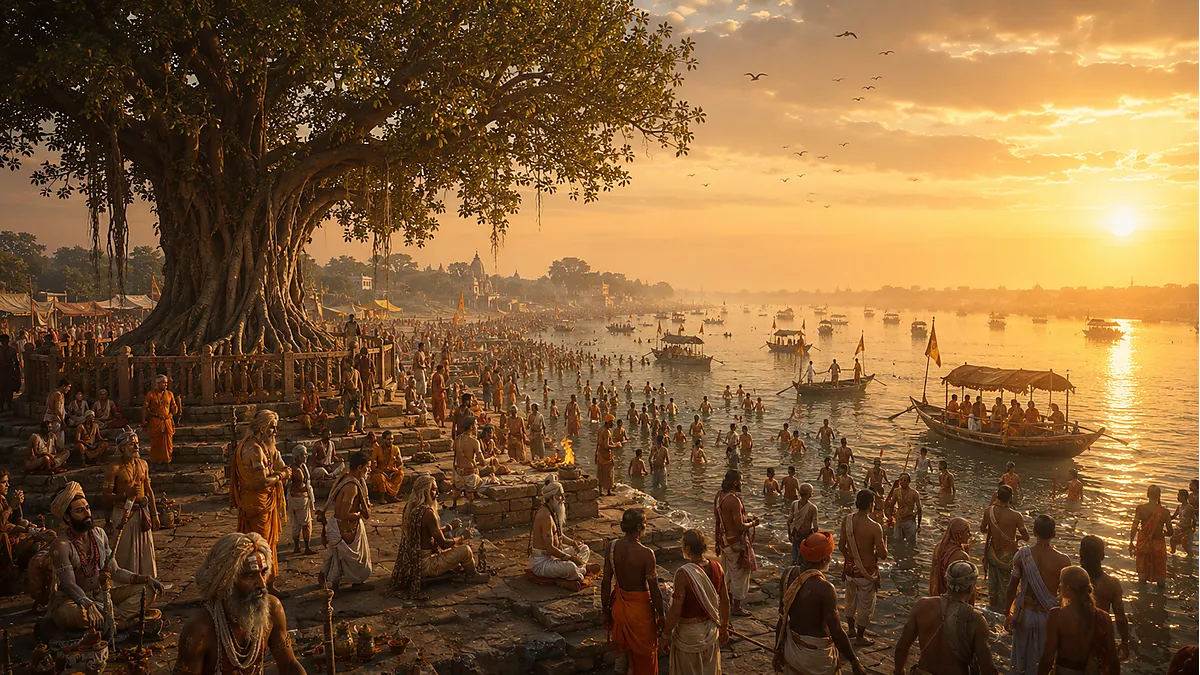
The year 647 CE marked the end of an era. With the death of Emperor Harshavardhana, the last great imperial power to rule over a unified northern India, the Gangetic plain entered a period of political fragmentation that would last for nearly nine centuries. Prayag—the sacred confluence of the Ganga, Yamuna, and the invisible Saraswati—passed through the hands of regional kingdoms, survived early Islamic invasions, adapted to the rule of the Delhi Sultans, and witnessed the slow erosion of its ancient urban glory.
Yet, despite the political turbulence, Prayag never lost its spiritual identity. Pilgrims continued to arrive at the Triveni Sangam. Saints and scholars maintained the traditions of the tirtha. The sacred geography of Prayag—the confluence, the Akshayavat, the ancient ghats—remained a living presence in the religious imagination of India. When the Mughal emperor Akbar arrived in the late 16th century to build his great fort, he was not founding a new city on empty ground. He was building upon a sacred landscape that had already endured for millennia.
This is the story of Prayag in the forgotten centuries between Harsha and Akbar—an age of resilience, continuity, and transformation.
🏛️ 1. The Lost Centuries of Prayag (647–1526 CE)
The history of Prayag is often told in two grand chapters: the ancient period of the Guptas and the Mughal-era transformation under Akbar. What falls between—the nine centuries from Harsha‘s death to Akbar’s fort—is frequently dismissed as a time of decline, a dark age of political fragmentation and cultural stagnation.
This view is incomplete.
The medieval period was not a single story of decay but a complex tapestry of continuity and change. While Prayag lost its status as an imperial capital, it never lost its sacred significance. The Sangam continued to attract pilgrims. The tirtha traditions described in the Puranas were preserved. Regional kingdoms patronized temples and religious institutions. Even as political power shifted to Kannauj, Delhi, and other centres, Prayag remained a spiritual anchor for the Hindu world.
The medieval centuries were also a time of profound transformation. The rise of Islamic power in northern India brought new political structures, new religious communities, and new forms of cultural expression. Prayag adapted to these changes, even as it preserved its ancient identity.
👑 2. Prayag After Harsha (647 CE)
Harshavardhana (c. 606–647 CE) was the last great ruler of the Pushyabhuti dynasty, and his death marked the end of an imperial order that had brought relative stability to northern India. His empire, which had stretched from the Punjab to Bengal and from the Himalayas to the Narmada, rapidly fragmented. The Kannauj三角—the struggle for control over the strategic city of Kannauj—became the defining feature of north Indian politics for the next three centuries.
Prayag, located on the southern fringe of the Kannauj heartland, was drawn into this political turbulence. The city was situated at the confluence of the Ganga and Yamuna, making it a strategic military and commercial point. It was also part of the sacred geography of India, a fact that ensured its continued importance even as political fortunes shifted.
According to the Rajatarangini of Kalhana (12th century CE), in 780 CE, Prayag was an important part of the kingdom of the Karkota king of Kashmir, Jayapida. Jayapida constructed a monument at Prayag, which still existed at Kalhana‘s time. This reference indicates that even in the early medieval period, Prayag was seen as a significant site worthy of royal patronage.
During this period, Prayag was incorporated into the Gurjara-Pratihara Empire, which dominated northern India from the 8th to the 11th centuries. The Pratiharas, based at Kannauj, controlled the Doab region and maintained the pilgrimage traditions of Prayag. In 916 CE, the Pratihara Empire, including Prayaga and Kannauj, was captured and plundered by Indra III of the Rashtrakuta dynasty.
Despite these political upheavals, the pilgrimage to the Sangam continued. The sacred geography of Prayag was not dependent on any single dynasty or empire; it was rooted in the deeper traditions of the Puranas and the epics, which had already established Prayag as the Tirtharaja.
🚶 3. Continuity of Pilgrimage Traditions
The most remarkable feature of Prayag‘s medieval history is the continuity of its pilgrimage traditions. Despite political instability, invasions, and changing rulers, the Sangam never lost its sacred status.
The Sangam as Tirtharaja
The Puranas had already established Prayag as the Tirtharaja—the King of Pilgrimage Sites. This title was not merely a poetic flourish; it had practical implications for the organization of pilgrimage networks. Prayag was recognized as the supreme tirtha, and its spiritual authority was acknowledged across the Hindu world.
The Akshayavat
The Akshayavat—the indestructible banyan tree—remained a powerful pilgrimage site throughout the medieval period. The tree was believed to have survived the cosmic dissolution (pralaya), and its presence at Prayag was a living symbol of eternity. Medieval pilgrims, like their ancient counterparts, sought darshan of the Akshayavat as an essential part of their journey to the Sangam.
The Magh Mela and Kumbh Mela
The annual Magh Mela, which takes place during the month of Magh (January-February), continued to draw pilgrims to the Sangam. The tradition of Kalpavas—the month-long spiritual discipline observed on the riverbanks—was well established by the medieval period. The Kumbh Mela, which occurs every 12 years, also continued to be celebrated at Prayag, though the historical record for this period is sparse.
The Role of Regional Kingdoms
Regional kingdoms, even as they competed for political control, recognized the importance of patronizing pilgrimage sites. The Gahadavala dynasty, which ruled the region from the 11th to the 12th centuries, was particularly active in supporting religious institutions at Prayag. Their inscriptions record land grants to temples and Brahmins, indicating that pilgrimage was a significant element of the regional economy.
🏺 4. Pratishthanpur (Jhusi) in the Early Medieval Period
Pratishthanpur, the ancient city on the eastern bank of the Ganga (modern Jhusi), continued to be occupied during the early medieval period. Excavations at the site have revealed a cultural gap between the end of the Gupta period and the beginning of the early medieval period. However, this gap may be due to limited excavation rather than actual abandonment.
The site appears to have been continuously settled until the 13th or 14th century, when it was burnt down by foreign invaders. According to local tradition, the city was destroyed by a great fire, and the name Jhusi (or Jhunsi) is derived from the Hindi word jhulasna, meaning “to burn.” The town came to be known as Jhulsi (the burnt town), and over time, the ‘l’ was dropped, giving rise to the current name.
The destruction of Pratishthanpur was part of the broader political and military changes sweeping across northern India during the Delhi Sultanate period. The city, which had been inhabited for over 9,000 years, was finally abandoned.
🏯 5. The Rise of the Gahadavala Dynasty
The most significant political development in the region between the 11th and 12th centuries was the rise of the Gahadavala dynasty (also known as the Gaharwar Rajputs). The Gahadavalas ruled parts of present-day Uttar Pradesh and Bihar, with their capital at Kannauj.
Origins and Expansion
The dynasty was founded by Chandradeva (c. 1089–1103 CE), who issued the first Gahadavala inscription in 1090 CE. Chandradeva expanded his territory to include much of the Doab region, including the area around Prayag. His successors—Govindachandra (c. 1114–1154 CE), Vijayachandra (c. 1154–1170 CE), and Jayachandra (c. 1170–1194 CE)—consolidated and extended the dynasty‘s power.
Gahadavala Administration and Patronage
The Gahadavalas were known for their administrative efficiency and their patronage of religious institutions. Their inscriptions record numerous land grants to temples, Brahmins, and religious communities. These grants provided the economic foundation for the maintenance of temples and the continuation of pilgrimage traditions at Prayag.
The Battle of Chandawar (1194 CE)
The Gahadavala dynasty came to an end in 1194 CE, when Jayachandra was defeated and killed by Muhammad Ghori at the Battle of Chandawar. The battle took place on the Yamuna River, close to Agra, and marked the end of Hindu rule in the region. The Gahadavala kingdom was annexed to the Ghurid Empire, and Prayag passed into the hands of the Delhi Sultanate.
🛕 6. Prayag as a Pilgrimage Capital
Even as political power shifted, Prayag remained a pilgrimage capital. The Puranic tradition, which had established Prayag as the Tirtharaja, continued to attract pilgrims from across the Indian subcontinent.
Temple Patronage
Medieval rulers, including the Gahadavalas, patronized temples and religious institutions at Prayag. Inscriptions record grants of land and villages to support the maintenance of temples and the performance of rituals. This patronage ensured that the pilgrimage infrastructure—the ghats, the temples, the rest houses—remained functional.
The Role of Brahmanas
Brahmanas played a central role in the religious life of medieval Prayag. They served as priests, scholars, and administrators of temple properties. Land grants to Brahmins were a common form of religious donation, and these grants helped to maintain the brahmanical traditions that had defined Prayag‘s identity for centuries.
The Pilgrimage Economy
Pilgrimage was not merely a spiritual activity; it was also an economic activity. Pilgrims brought trade, commerce, and revenue to the region. Markets, rest houses, and other facilities catered to the needs of pilgrims, creating a self-sustaining economy. The medieval period saw the expansion of this pilgrimage economy, as the tradition of visiting the Sangam continued to grow.
📜 7. Inscriptions and Epigraphic Evidence
Inscriptions are the most important source of information for the medieval history of Prayag. They provide valuable evidence of political events, religious patronage, and social conditions.
Gahadavala Inscriptions
The Gahadavala dynasty has left a rich corpus of inscriptions, which record land grants, genealogies, and religious endowments. These inscriptions mention the areas ruled by the Gahadavalas, including the region around Prayag. The inscriptions are a vital source for understanding the political and religious history of the period.
The Garhwa Fort Inscriptions
The Garhwa Fort, located about 50 km south-west of Prayagraj, contains a temple complex belonging to the Gupta period. However, the fort itself is a medieval fortified enclosure, and it may have been used during the Gahadavala period. The Garhwa Stone Inscriptions, dating to the early 5th century CE, are the most famous, but the site also contains evidence of later occupation.
The Value of Epigraphy
Epigraphic evidence provides a level of detail that is often lacking in the literary sources. The inscriptions record names, dates, and specific grants, allowing historians to reconstruct the political and social history of medieval Prayag. They also provide evidence of the continuity of pilgrimage traditions.
⚔️ 8. Early Islamic Invasions and Prayag
The 12th and 13th centuries brought a new political reality to northern India: the rise of Islamic power.
Muhammad Ghori and the Ghurid Conquest
The Ghurid invasion of northern India, led by Muhammad Ghori, began in the late 12th century. In 1194 CE, Ghori defeated Jayachandra at the Battle of Chandawar and annexed the Gahadavala kingdom. Prayag, along with the rest of the Doab region, came under Ghurid control.
The Impact of the Conquest
The Ghurid conquest had a profound impact on the religious and political landscape of the region. The Ghurids were Sunni Muslims, and their conquest brought Islam to the Gangetic plain. However, the process of conversion was gradual, and Hindu religious institutions continued to function, albeit under new political circumstances.
The Fate of Pratishthanpur
According to local tradition, the city of Pratishthanpur (Jhusi) was burnt down by foreign invaders in the 13th or 14th century. The destruction of this ancient city was part of the broader political and military upheavals of the period.
🏰 9. Prayag Under the Delhi Sultanate
Following the Ghurid conquest, Prayag became part of the Delhi Sultanate. The sultanate, which ruled northern India from 1206 to 1526, was a series of dynasties that governed from Delhi.
The Khalji and Tughlaq Periods
During the 14th century, Prayag was under the control of the Khalji dynasty (1290–1320) and later the Tughlaq dynasty (1320–1414). The sultanate established a provincial administration, and Prayag was part of the iqtā‘ (fief) of Kara-Manikpur.
Administrative Changes
The Delhi Sultanate introduced new administrative structures to the region. The iqtā‘ system, in which land was assigned to military commanders in exchange for service, replaced the older system of land grants to temples and Brahmins. This shift had significant implications for the religious institutions of Prayag.
The Continuity of Pilgrimage
Despite the political changes, pilgrimage to the Sangam continued. The Puranic traditions were resilient, and the sacred geography of Prayag was not dependent on the patronage of any single ruler. Pilgrims continued to arrive at the confluence, and the annual Magh Mela continued to be celebrated.
🛕 10. The Fate of Temples and Sacred Sites
The medieval period was a time of religious change and transformation. The rise of Islamic power brought new challenges for Hindu temples and religious institutions.
Temple Patronage
During the Gahadavala period, temples were patronized by kings, queens, and wealthy individuals. Land grants provided the economic foundation for temple maintenance. After the Ghurid conquest, this patronage declined, but some temples continued to function.
The Akshayavat and the Sangam
The Akshayavat and the Triveni Sangam remained sacred sites. Pilgrims continued to visit these places, and the traditions of the tirtha were preserved. The sacred geography of Prayag was not dependent on the existence of grand temples; it was rooted in the deeper traditions of the Puranas and the epics.
Archaeological Evidence
Archaeological evidence from the medieval period is limited, but it indicates that some temples were destroyed or abandoned. However, other temples were repaired and continued to be used. The Garhwa Fort, which contains a temple complex from the Gupta period, was later fortified, suggesting that it was still in use during the medieval period.
🏚️ 11. Lesser-Known Medieval Sites of Prayagraj
Beyond the well-known sites, the region around Prayagraj contains numerous lesser-known medieval sites that offer glimpses into its medieval past.
Old Jhusi Ruins
The ruins of Pratishthanpur (Old Jhusi) are a reminder of the ancient city that was destroyed in the medieval period. The high mounds, which contain remnants of temples, stupas, and other structures, are a testament to the city‘s long history.
Ulta Quila
The Ulta Quila (“Inverted Fort”) is a mysterious site in Jhusi, associated with the legend of King Harbonga. According to tradition, when the cup of his inequity was full, there was an upheaval on the earth, and the capital Pratishthana was turned upside down, giving rise to the name ‘Ulta Quila’. The site is also associated with a conflagration that completed the destruction of the city.
Samudra Koop
The Samudra Koop (“Ocean Well”) is an ancient well near the Ulta Quila. It is associated with the Gupta emperor Samudragupta, and its name reflects its legendary connection to the ocean. The well was an important source of water for the ancient city.
Medieval Kara Fort
To the west of Prayag lies the medieval Kara fort, which bears testimony to Rajput Jayachand’s influence. The fort was an important military and administrative centre during the Gahadavala period.
🚤 12. Economy and Trade in Medieval Prayag
Despite the political instability, Prayag continued to be an important commercial centre.
River Commerce
The Ganga and Yamuna rivers were highways of commerce, connecting Prayag to the major cities of northern India. Goods were transported by boat along the rivers, and Prayag was a key stop on the riverine trade routes.
Agricultural Wealth
The Doab region is one of the most fertile regions in India. The agricultural wealth of the region supported the urban population of Prayag and provided goods for trade.
Trade Routes
Prayag was also situated on the overland trade routes that connected the Gangetic plain with the rest of India. The city was a centre of exchange for goods from different regions.
📚 13. Medieval Travelers and References
Literary and historical references provide valuable glimpses into the medieval history of Prayag.
The Rajatarangini of Kalhana
The Rajatarangini, written by Kalhana in the 12th century CE, mentions that Jayapida, a Karkota king of Kashmir, constructed a monument at Prayag in the 8th century CE. This reference indicates that Prayag was still an important site in the early medieval period.
Persian Sources
Persian chronicles, such as the Tabaqat-i-Nasiri and the Tarikh-i-Firuz Shahi, provide information about the political history of the region. They record the Ghurid conquest and the establishment of the Delhi Sultanate.
Pilgrimage Narratives
Pilgrimage narratives and religious texts from the medieval period mention Prayag as a sacred site. These texts confirm the continuity of the pilgrimage tradition.
🎭 14. Culture and Society
Medieval Prayag was a multicultural society, with Hindu, Buddhist, Jain, and Muslim communities.
Language and Literature
Sanskrit continued to be the language of religious and literary expression. The inscriptions of the Gahadavala period are written in Sanskrit, indicating the continued importance of the classical language.
Religious Practices
The Puranic tradition continued to be the dominant religious framework. Pilgrimage to the Sangam, the worship of the Akshayavat, and the observance of the Magh Mela were central religious practices.
Sufi Traditions
The Delhi Sultanate period saw the spread of Sufism in northern India. Sufi saints, who were often associated with the Chishti order, established hospices (khanaqahs) in the region. The presence of Sufis contributed to the religious and cultural diversity of medieval Prayag.
🏯 15. The Road to the Mughal Era
The period of the Delhi Sultanate ended with the rise of the Mughal Empire. In 1526, Babur defeated Ibrahim Lodi at the Battle of Panipat and established Mughal rule in India.
The Lodi Period
The Lodi dynasty (1451–1526) was the last of the Delhi Sultanate dynasties. During this period, the Doab region was contested between the Lodis and the Afghan chiefs. Prayag remained a provincial centre, but its political importance had diminished.
Why Akbar Chose Prayag
In 1583, the Mughal emperor Akbar ordered the construction of a great fort at Prayag. Akbar was impressed by the city‘s strategic position at the confluence of the Ganga and Yamuna. He renamed the city Ilahabas (later Allahabad) and made it a provincial capital. The fort was built on the site of the ancient pilgrimage centre, incorporating the sacred Akshayavat within its walls.
Thus, the medieval period ended, and the Mughal period began. The fort that Akbar built is a reminder of the long history of the site, but it is also a symbol of the new era that was about to unfold.
🏺 16. Medieval Archaeology of Prayagraj
Archaeological excavations in the Prayagraj region have revealed evidence of medieval occupation.
Excavations at Jhusi
The site of Pratishthanpur (Jhusi) has yielded evidence of continuous occupation from the Chalcolithic to the early medieval period. There appears to be a cultural gap between the end of the Gupta period and the beginning of the early medieval period, but this may be due to limited excavation rather than actual abandonment.
Medieval Pottery
Medieval pottery has been found at sites in the Prayagraj region. The pottery provides evidence of the material culture of the period and the continuity of ceramic traditions.
Structural Remains
Remains of structures, including temple foundations and fortifications, have been found at various sites. These structures provide evidence of the built environment of medieval Prayag.
📅 17. Timeline of Prayagraj (647–1526 CE)
| Period | Date | Key Events |
| Harsha‘s Death | 647 CE | End of the Pushyabhuti Empire; political fragmentation |
| Karkota Rule | c. 780 CE | Jayapida of Kashmir constructs a monument at Prayag |
| Pratihara Rule | 8th–10th c. | Prayag part of the Gurjara-Pratihara Empire |
| Pratihara Decline | 916 CE | Indra III captures and plunders Prayaga and Kannauj |
| Gahadavala Rise | c. 1090 CE | Chandradeva founds the Gahadavala dynasty |
| Gahadavala Period | 11th–12th c. | Govindachandra, Vijayachandra, Jayachandra |
| Battle of Chandawar | 1194 CE | Muhammad Ghori defeats Jayachandra; Ghurid conquest |
| Ghurid Period | 1194–1206 CE | Prayag under Ghurid control |
| Delhi Sultanate | 1206–1526 CE | Prayag part of the Delhi Sultanate |
| Khalji Period | c. 1300–1320 CE | Alauddin Khalji; Prayag under Khalji rule |
| Tughlaq Period | 1320–1414 CE | Tughlaq rule; provincial administration |
| Destruction of Jhusi | 13th–14th c. | Pratishthanpur burnt down by foreign invaders |
| Lodi Period | 1451–1526 CE | Lodi rule; decline of Prayag‘s political importance |
| Mughal Conquest | 1526 CE | Babur defeats Ibrahim Lodi; Mughal rule begins |
🔍 18. Why the Medieval Period Matters
The medieval period was a time of profound change for Prayag. It witnessed the end of ancient political orders, the rise of new powers, and the transformation of religious and cultural life.
Continuity of Pilgrimage
The most remarkable aspect of Prayag‘s medieval history is the continuity of its pilgrimage traditions. Despite political instability and religious change, the Sangam remained a sacred site. The Puranic traditions were preserved, and the annual Magh Mela continued to draw pilgrims.
Political Adaptation
Prayag adapted to changing political realities. It was part of the Pratihara Empire, the Gahadavala kingdom, the Ghurid Empire, and the Delhi Sultanate. Through all these changes, the city maintained its identity as a sacred site.
Cultural Resilience
The medieval period was a time of cultural resilience. The traditions of the tirtha, the worship of the Akshayavat, and the observance of the Magh Mela were preserved. Even as new religious and political forces emerged, Prayag remained a living centre of Hindu pilgrimage.
The Foundations of Mughal Prayag
The Mughal era would bring a new chapter in Prayag‘s history. But the Mughals did not build on empty ground. They built on a sacred landscape that had already been shaped by centuries of pilgrimage, devotion, and cultural memory. The medieval period ensured that Prayag remained a living centre of Hindu tradition, even as the political order changed around it.
❓ 19. Frequently Asked Questions (FAQs)
1. Who ruled Prayag after Harsha?
After Harsha‘s death in 647 CE, Prayag became part of the Gurjara-Pratihara Empire, which dominated northern India from the 8th to the 11th centuries. It was later ruled by the Gahadavala dynasty, the Ghurids, and the Delhi Sultanate.
2. What was Prayag‘s importance during the Gahadavala period?
Prayag was an important pilgrimage site during the Gahadavala period. The Gahadavala kings patronized religious institutions and made land grants to temples and Brahmins.
3. Did Muhammad Ghori visit Prayag?
Muhammad Ghori did not visit Prayag directly, but his victory at the Battle of Chandawar (1194 CE) brought the region under Ghurid control. The battle took place on the Yamuna River, close to Agra.
4. Was Prayag important during the Delhi Sultanate?
Prayag was part of the Delhi Sultanate and was administered as part of the iqtā‘ of Kara-Manikpur. It remained an important pilgrimage site, but its political importance declined.
5. What happened before Akbar arrived in Prayag?
Before Akbar arrived in the late 16th century, Prayag was a sacred pilgrimage site with a long history. The city had been ruled by various dynasties and had experienced political changes, but its religious significance endured.
6. What was the fate of ancient Pratishthanpur (Jhusi)?
Pratishthanpur was burnt down by foreign invaders in the 13th or 14th century. The city was destroyed, and the town came to be known as Jhunsi (from jhulasna, meaning “to burn”).
7. Why did Akbar build the Allahabad Fort at Prayag?
Akbar was impressed by Prayag‘s strategic position at the confluence of the Ganga and Yamuna. He ordered the construction of a fort in 1583 to control the region and to establish a Mughal administrative centre.
8. Are there any medieval inscriptions from Prayag?
Yes, the Gahadavala inscriptions record land grants and religious endowments in the region. The Garhwa Fort also contains inscriptions from the Gupta period.
9. What is the Ulta Quila?
The Ulta Quila (“Inverted Fort”) is a site in Jhusi associated with the legend of King Harbonga. It is said that the capital Pratishthana was turned upside down, giving rise to the name.
10. What is the Samudra Koop?
The Samudra Koop (“Ocean Well”) is an ancient well near the Ulta Quila. It is associated with the Gupta emperor Samudragupta and is believed to have medicinal properties.
11. Did the Kumbh Mela continue during the medieval period?
Yes, the Kumbh Mela continued to be celebrated at Prayag during the medieval period, though historical records for this period are sparse. The Magh Mela, which occurs annually, also continued.
12. Were there Sufi saints in medieval Prayag?
Yes, the Delhi Sultanate period saw the spread of Sufism in northern India. Sufi saints established hospices (khanaqahs) in the region, contributing to the religious diversity of medieval Prayag.
13. What language was used in medieval inscriptions?
The Gahadavala inscriptions are written in Sanskrit, indicating the continued importance of the classical language.
14. How did the medieval period end for Prayag?
The medieval period ended with the Mughal conquest of northern India. Akbar built a fort at Prayag in 1583 and renamed the city Ilahabas (later Allahabad), beginning a new chapter in its history.
💎 20. Conclusion
The medieval centuries of Prayag were not an age of decline, but an age of resilience. Kingdoms came and went, rulers changed, and empires rose and fell, yet the sacred confluence continued to draw pilgrims, preserving the city‘s identity until the dawn of the Mughal age.
The story of Prayag in the medieval period is a testament to the enduring power of sacred geography. The Puranic traditions were preserved, the Sangam remained a site of pilgrimage, and the Akshayavat continued to be venerated. Even as political powers shifted, the spiritual identity of Prayag remained constant.
When Akbar arrived in the late 16th century to build his great fort, he was not founding a new city. He was building on a landscape that had been shaped by millennia of human history. The medieval period was a bridge between the ancient and the modern, a time of transition that preserved the sacred traditions of Prayag for future generations.
The medieval centuries of Prayag were not an age of decline, but an age of resilience. Kingdoms came and went, rulers changed, and empires rose and fell, yet the sacred confluence continued to draw pilgrims, preserving the city’s identity until the dawn of the Mughal age.
🚶 Walk through the layers of history with our “Medieval Prayagraj Heritage Tour” – a guided journey covering Pratishthanpur, Kaushambi, Ulta Quila, and other archaeological sites that reveal the city‘s lesser-known medieval past.
📞 Phone/WhatsApp: +91-9555313526
📧 Email: contact@prayagtourism.com
🌐 Website: PrayagTourism.com
This article is part of a series exploring the historical heritage of Prayagraj.
Prayag Tourism
May your journey be peaceful, safe, and historically enriching – and may the ancient stones of Prayagraj tell you their stories.