
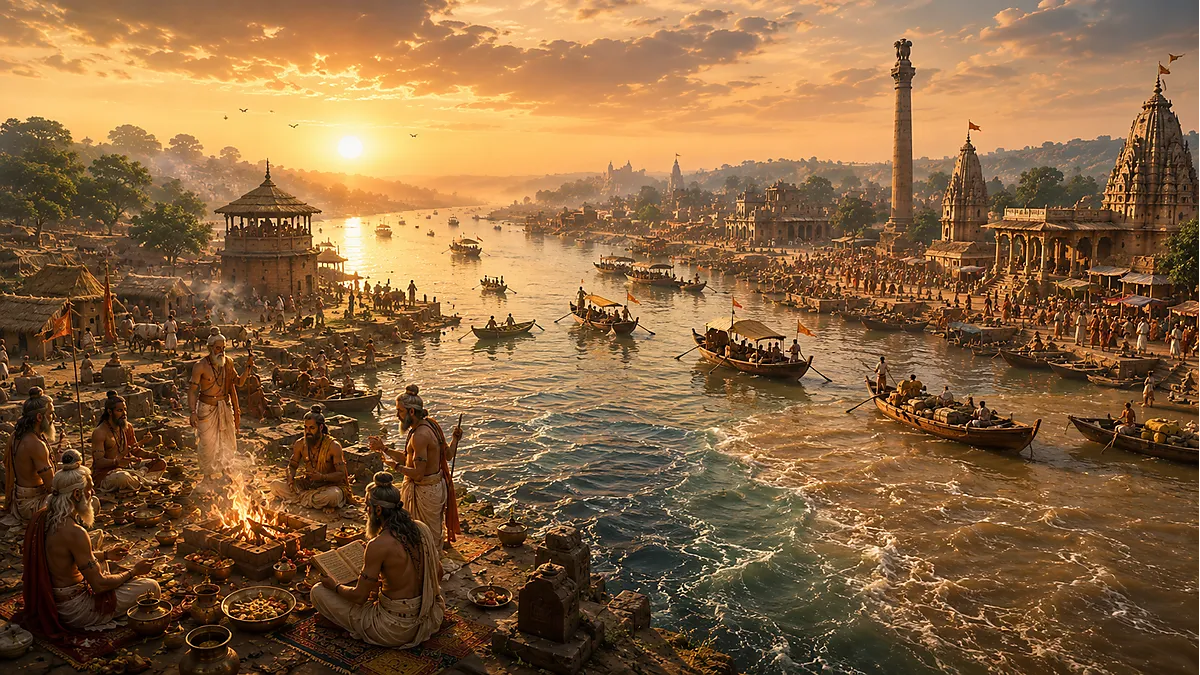
The story of Prayagraj begins not with a city, but with a confluence. Long before the first stone of the Allahabad Fort was laid, before the Guptas established their imperial capital, before the Mauryan emperor Ashoka erected his polished pillar, the meeting point of the Ganga and Yamuna rivers had already captured the imagination of ancient India. This was a place where the celestial and the earthly merged—where the Ganga, descending from the matted locks of Shiva, met the dark waters of the Yamuna and the invisible, subterranean Saraswati.
For thousands of years, this sacred geography drew settlers, sages, merchants, and emperors. The region around modern Prayagraj witnessed some of the earliest human settlements in the Gangetic plain, flourished as a centre of trade and learning during the Mahajanapada period, became a imperial capital under the Guptas, and hosted one of the largest religious gatherings ever recorded. This is the story of Prayagraj not as a pilgrimage site, but as a living, breathing crossroads of Indian civilization—from the Vedic age to the dawn of the medieval period.
🏞️ 1. Before Prayagraj Was a City
Long before the first city emerged on the banks of the Ganga, the region around modern Prayagraj was already a landscape of human activity. Archaeological surveys have uncovered evidence of early human habitation in the Belan Valley, revealing a sequence of cultural development from the Paleolithic, Mesolithic, and Neolithic periods.
The site of Chopani Mando, located in the Belan river valley within modern Prayagraj district, has yielded a three-phase sequence of Paleolithic, Mesolithic, and Neolithic occupation. Excavations revealed circular and oval settlements with hearths, hand-made cord-impressed pottery, and microliths made of chalcedony. These were not cities—they were small, semi-permanent settlements of hunter-gatherers and early agriculturalists.
By the Chalcolithic period (roughly 3,000 to 2,000 BCE), when copper was the dominant metal, the region had become more densely populated. A survey by the Department of Ancient History, Culture and Archaeology at Ishwar Saran PG College identified nearly 50 archaeological sites in the Prayagraj district, yielding remains from the Chalcolithic period through the Mughal period and beyond.
The emergence of a distinct urban culture in the Ganga-Yamuna Doab, however, would have to wait until the late Vedic period. The foundation for this urbanisation was laid by a series of small settlements that gradually grew into towns and, eventually, major cities. Among these, two stand out as the most significant—Pratishthanpur on the eastern bank of the Ganga, and Kaushambi on the Yamuna.
📜 2. The Earliest References to Prayag
The name Prayag (प्रयाग) first appears in the Vedic and Puranic literature, where it is described as the place where the three sacred rivers—Ganga, Yamuna, and Saraswati—meet. The very term “Prayag” is derived from the Sanskrit prakṛṣṭa yāga, meaning “the supreme sacrifice” or “the place of sacrifice.”
The Puranas record that Prayag was related to the sacrifice of Prajapati (Brahma), and they listed Prayag among the most prominent tirthas—alongside Kashi and Gaya. It is said that at the very sight of Prayag, even by taking its name or by applying its clay to one‘s body, a person becomes free from sin.
The Rigveda mentions the rivers Ganga, Yamuna, and Saraswati, though it does not specifically name Prayag. Later Vedic texts and the Brahmanas describe the Doab region—the land between the Ganga and Yamuna—as the sacred heartland of Aryavarta, the land of the noble ones. Prayag, situated at the confluence of these two great rivers, was naturally considered the spiritual centre of this sacred geography.
The Puranas, the Mahabharata, and other texts mention Prayag as a place of pilgrimage, penance, and royal sacrifice. The legendary king Yayati is said to have left Prayaga and conquered the region of Sapta Sindhu. His five sons—Yadu, Druhyu, Puru, Anu, and Turvashas—became the main tribes of the Rigveda.
Thus, even before it became a city of stone and mortar, Prayag was already a city of the imagination—a sacred landscape where the boundaries between the human and the divine were believed to be thin.
🏛️ 3. Pratishthanpur (Old Jhusi): The Ancient Capital
Across the Ganga from modern Prayagraj, on the eastern bank, lies the town of Jhusi—the site of ancient Pratishthanpur (also called Pratishthana or Pratisthan Pur). This archaeological site has yielded a carbon-14 dating of 7100 BCE for its Neolithic levels, making it one of the earliest agricultural settlements in the Gangetic plain.
The Lunar Dynasty Capital
According to tradition, Pratishthanpur was the capital of the Lunar Dynasty (Chandravansha or Somavansha). It was founded by King Ila and later became the capital of Pururavas and other kings of the Lunar Dynasty. This legendary lineage, which produced the heroes of the Mahabharata, is said to have ruled from this very site.
The great poet Kalidasa mentions Pratishthanpur in his drama Vikramorvasiyam, giving an imaginary account of the magnificent palace of Pururavas.
Archaeological Evidence
The high mounds of Jhusi, spread over an area of about four square miles, contain a continuous sequence of occupation from the Chalcolithic to the early medieval period. Excavations have revealed evidence of five cultural phases:
- Pre-NBP Ware period: The earliest culture represented at the site, marked by a deposit containing iron objects. Pottery and antiquities from this layer are similar to those found at different Chalcolithic sites in Uttar Pradesh, Bihar, and the Northern Vindhyas.
- NBP Ware period: The site shows continuous settlement from the pre-NBP Ware period to the Gupta period. The Northern Black Polished Ware (NBPW) is a hallmark of the second urbanisation in India, indicating prosperity and long-distance trade.
- Mauryan period: Pratishthanpur belonged to the rulers of the Maurya, Shunga, Kushana, and Gupta periods.
- Gupta period: The site flourished under the Guptas.
- Early medieval period: There appears to be a cultural gap between the end of the Gupta period and the beginning of the early medieval period, though archaeologists believe this may be due to limited excavation rather than actual abandonment.
The Legacy of Pratishthanpur
Pratishthanpur was described by historians as “the most important locality of Prayag”. Its location on the left bank of the Ganga, about 7 km east of the confluence, made it a strategic and prosperous settlement.
Today, the ancient city has been largely subsumed by the modern town of Jhusi. But the high mounds, the fragments of pottery, and the layers of earth still speak of a city that was already ancient when the Guptas ruled, and which witnessed the transition from the Stone Age to the medieval world.
🏰 4. Kaushambi: The Great City of the Vatsas
If Pratishthanpur was the ancient capital of legend, Kaushambi (also spelled Kosambi or Kauśāmbī) was the great city of history. Located on the banks of the Yamuna, approximately 40 km from the modern district headquarters, Kaushambi was the capital of the Vatsa kingdom, one of the sixteen Mahajanapadas (great kingdoms) of ancient India.
The Vatsa Mahajanapada
The Vatsa kingdom was a major power in the 6th century BCE, alongside Magadha, Kosala, and Avanti. Its capital, Kaushambi, was celebrated in ancient Indian literature, both secular and sectarian, and its fame even travelled across the seas to find a mention in old Javanese literature.
The City‘s Defences and Architecture
Systematic excavations at Kaushambi have revealed unique evidence of the development of city defences. The city was protected by massive fortifications, and archaeological investigations have uncovered wall structures and interconnected chambered buildings. The ruins of Kaushambi cover an area of about four miles.
The Udyan Fort (also called Udayan Fort), dating back nearly 2,500 years, stands as a reminder of the region‘s historical significance. According to historical accounts, King Udyan (Udayana) was a patron of music who played his veena, named Ghoshavati, on the banks of the Yamuna, with melodies said to attract even animals and birds. The fort is believed to be among the earliest man-made forts in India.
Religious and Literary Importance
Kaushambi was closely associated with both Buddhism and Jainism. The Buddha visited the city multiple times, delivering sermons at the Ghositarama monastery. The city also finds mention in Jaina literature as an important centre. Ashoka, the Mauryan emperor, erected a pillar at Kaushambi, which was later moved to Prayagraj by Akbar.
Restoration and Preservation
In 2026, the government approved the restoration of the Udyan Fort, recognising its importance as one of India‘s earliest examples of urban and architectural heritage. The fort currently rests on three bastions, with restoration work adhering to archaeological conservation standards.
🌐 5. Prayag During the Mahajanapada Period
The Mahajanapada period (c. 600-300 BCE) was a time of political consolidation and urbanisation across northern India. Sixteen great kingdoms emerged, each with its own capital, army, and administrative system. Prayag, situated at the confluence of the Ganga and Yamuna, occupied a central position in this political geography.
The region around Prayag was part of the Vatsa kingdom, with Kaushambi as its capital. The Vatsas controlled the fertile Doab region and the riverine trade routes that connected the Gangetic plain with the south and the west. Their strategic location made them wealthy and powerful, but it also brought them into conflict with neighbouring kingdoms like Magadha, Kosala, and Avanti.
Prayag itself was not a capital city in this period. Its importance was primarily religious and strategic. The confluence attracted pilgrims, sages, and merchants, and the site was already recognised as a tirtha. The legend of King Yayati and the Puranic descriptions of Prayag as the supreme sacrifice site suggest that the region held a special place in the religious imagination of ancient India.
🏛️ 6. Prayag Under the Mauryas
The Mauryan Empire (c. 322-185 BCE) was the first great empire to unite most of the Indian subcontinent. Under Emperor Ashoka (c. 268-231 BCE), the empire reached its zenith, and Prayag became part of a vast imperial network.
The Ashokan Pillar
The most enduring legacy of the Mauryan period in Prayag is the Ashokan pillar, now located inside the Allahabad Fort. The pillar is a single shaft of polished sandstone, standing 35 feet (10.7 m) high, with a lower diameter of 35 inches (0.9 m) and an upper diameter of 26 inches (0.7 m).
According to some scholars, the pillar was originally erected at Kaushambi, the ancient capital of the Vatsa kingdom, before being moved to Prayagraj by the Mughal emperor Akbar. However, this theory is disputed by other scholars who point out the absence of confirmatory evidence that the pillar was moved, and pre-Mughal inscriptions that indicate it was already present in its current location.
The Ashokan inscriptions on the pillar date to the 3rd century BCE. They contain one of the pillar edicts of Ashoka, promoting the principles of dhamma—righteous conduct, non-violence, tolerance, and respect for all beings.
Buddhism and the Mauryan Administration
Ashoka‘s pillar edicts indicate that the Mauryan administration was active in the region. A later inscription on the pillar, known as the ‘Queen’s Edict, mentions Karuvaki, Ashoka‘s wife, who donated mango orchards to Buddhists in Kaushambi.
Buddhism flourished under Mauryan patronage, and Kaushambi became a major centre of Buddhist learning. The city is mentioned in Pali literature as one of the six great cities of the Buddha‘s time.
🏺 7. The Shunga, Kushana, and Early Historic Period
After the decline of the Mauryan Empire, the region of Prayag passed through a series of political changes. The Shunga dynasty (c. 185-73 BCE) controlled much of northern India, including the Doab region. Archaeological evidence from Pratishthanpur shows continuous settlement during this period.
The Kushana Empire (c. 1st-3rd century CE) extended its influence over the Gangetic plain, and the region around Prayag remained an important centre of trade and administration. The Kushanas, who originated from Central Asia, were patrons of Buddhism and also worshipped Hindu deities.
Excavations at Pratishthanpur and Kaushambi have yielded pottery, coins, and artefacts from this period, indicating ongoing urban life and economic activity. The region continued to be a crossroads of cultures, religions, and trade routes.
🌟 8. The Gupta Age: Golden Era of Prayag
The Gupta Empire (c. 4th-6th century CE) was a watershed moment in Indian history, often described as the “Golden Age” of classical Indian civilisation. Under the Guptas, Prayag emerged as a political, cultural, and religious centre of the first order.
The Rise of the Guptas
The Gupta dynasty originated in the Magadha region and gradually expanded its control over the Gangetic plain. Prayag, situated at the heart of their territory, became a key administrative and military centre. The city‘s strategic location on the Ganga-Yamuna Doab made it an ideal base for controlling the riverine trade routes and projecting power in all directions.
Samudragupta and the Imperial Capital
The greatest of the Gupta emperors, Samudragupta (c. 335-375 CE), chose Prayag as the site for one of the most important inscriptions in Indian history—the Prayag Prashasti. His choice of Prayag was not accidental. The city‘s ancient sanctity, its strategic location, and its symbolic power as the ‘confluence of the sacred’ made it the perfect stage for imperial proclamation.
The Prayag Prashasti, carved on the Ashokan pillar, describes Samudragupta‘s military conquests, his diplomatic relations, and his personal qualities. It presents him as a warrior, a poet, a musician, and a just ruler—an ideal king of the classical age.
Cultural and Economic Flourishing
Under the Guptas, Prayag prospered. Trade flourished along the Ganga and Yamuna, and the city became a centre of learning, art, and religion. The Gupta period saw a flowering of Sanskrit literature, sculpture, and architecture, and Prayag was part of this cultural renaissance.
The archaeological evidence from Pratishthanpur shows continuous settlement during the Gupta period, with high-quality pottery, sculptures, and artefacts. The nearby site of Garhwa Fort, housing a temple complex belonging to the Gupta period, has yielded early 5th-century CE Sanskrit inscriptions by Chandragupta II and Kumaragupta.
📜 9. The Prayag Prashasti: India‘s Most Important Inscription
The Prayag Prashasti (also known as the Allahabad Pillar Inscription) is one of the most important historical documents of ancient India. Composed by Samudragupta‘s court poet Harisena, it is a glowing account of the emperor‘s personality, personal qualities, greatness, and glorious exploits.
The Inscription‘s Contents
The inscription is written in refined Sanskrit in the Champu style, which alternates between prose and poetry. It contains a detailed description of Samudragupta‘s qualities, a genealogy of the Gupta dynasty, and a list of his military achievements.
The Prayag Prashasti mentions:
- The eight kings of Aryavarta (northern India) who were ‘uprooted’ by Samudragupta.
- The rulers of the forest counties who were reduced to servitude.
- The twelve kings of the Dakshinapatha (southern India) who were defeated and then reinstated as tributary vassals.
- The frontier kingdoms and tribal republics that paid him homage.
- The foreign kings who sent embassies, including the king of Ceylon.
Historical Importance
The Prayag Prashasti provides a contemporary account of the political geography of 4th-century India. It names kings, dynasties, and regions that would otherwise be unknown. It is a primary source of the highest order, offering a detailed framework for understanding the Gupta Empire.
The inscription also presents Samudragupta as an ideal king—a warrior who was also a poet, a musician, and a patron of the arts. This multifaceted image of kingship became a model for later rulers.
The Pillar Through the Ages
The Ashokan pillar, on which the Prayag Prashasti is inscribed, has been a witness to Indian history for over two millennia. It bears inscriptions from Ashoka (3rd century BCE), Samudragupta (4th century CE), and the Mughal emperor Jahangir (17th century CE). This makes it a “historical palimpsest,” a treasured heritage that speaks across the ages.
The pillar is now located inside the Allahabad Fort, where it remains under the protection of the Archaeological Survey of India.
🧳 10. Xuanzang (Hiuen Tsang) in Prayag
One of the most vivid accounts of ancient Prayag comes from the Chinese Buddhist pilgrim Xuanzang (also known as Hiuen Tsang), who visited India in the 7th century CE and spent 16 years studying various parts of the country.
The Visit of 644 CE
In 644 CE, Xuanzang visited Prayag, then under the rule of the powerful king Harshavardhana (c. 606-647 CE). His description of the region is remarkably positive:
- He praised the kingdom for its abundance of grain.
- He described Prayagraj as a region with favourable climate, health, and abundant fruit-bearing trees.
- He described the people as humble, well-behaved, and devoted to learning.
The Great Religious Festival
Xuanzang‘s most remarkable account is of the great religious festival held at Prayag. According to his writings, large religious festivals were held in Prayagraj, with over 500,000 people attending. During these events, many great kings and rulers participated.
The festival was associated with King Harshavardhana, who used the occasion to distribute his immense wealth to the poor and the religious. Xuanzang noted that the wealthiest people from across the country came to bathe at the Sangam and donate their wealth before leaving.
The Temple and Its Traditions
Xuanzang also wrote about a temple in the city (now identified as the Patalpuri Temple within the Allahabad Fort) that was “renowned for its decoration and miraculous wonders”. He mentioned that people believed that offering a single coin here was equivalent to donating a thousand coins in terms of merit.
He also noted that it was believed that bathing in Prayagraj washes away all sins, and that visitors observed a special tradition of fasting for seven days.
The Legacy of Xuanzang‘s Account
Xuanzang‘s account is the earliest detailed description of the great religious gathering at Prayag, which is now recognised as the Kumbh Mela. His writings confirm that Prayag was already a major pilgrimage centre in the 7th century CE, attracting hundreds of thousands of pilgrims and the patronage of powerful kings.
👑 11. Prayag During Harsha‘s Empire
The reign of Harshavardhana (c. 606-647 CE) was a high point in the history of ancient Prayag. Harsha, who ruled a vast empire covering much of northern India, made Prayag one of his key administrative and religious centres.
The Great Assembly at Prayag
According to Xuanzang‘s account, Harsha held a grand religious assembly at Prayag every five years. The king distributed his entire treasury to the poor, the religious, and the learned. The assembly was attended by kings, nobles, monks, and pilgrims from across India.
Xuanzang described the territory of Harsha‘s kingdom as extending up to about 1,000 miles. The region between the Ganges and Yamuna, where Prayag is located, was described as a beautiful and clean sandy field.
The End of an Era
Harsha‘s death in 647 CE marked the end of a golden era. His empire fragmented, and the region around Prayag came under the control of various regional powers. The Pratihara dynasty, which emerged in the 8th century, controlled parts of the Doab region. An inscription of Trilochanapala, a Pratihara king, was discovered from the site of Pratishthanpur in 1830.
The early medieval period saw a gradual decline in the urban prosperity of Prayag. The continuous settlement at Pratishthanpur that had lasted from the pre-NBP Ware period to the Gupta period appears to have been interrupted. However, archaeologists believe that the site may show no gap at all when excavated extensively, given its strategic location.
🏺 12. Lesser-Known Ancient Historical Sites of Prayagraj
Beyond the well-known sites of Kaushambi, Pratishthanpur, and the Allahabad Fort, the Prayagraj region contains numerous lesser-known ancient sites that offer glimpses into its long history.
Samudra Koop (Ocean Well)
The Samudra Koop is an ancient well located near the Ulta Quila in Jhusi. It is associated with the Gupta emperor Samudragupta, and its name reflects its legendary connection to the ocean. Five such wells are traditionally attributed to Samudragupta, located in Ujjain, Mathura, Prayag, Varanasi, and Patalpur. The well was once dumped with garbage but was restored by a sage named Dayaram.
Ulta Quila (Inverted Fort)
The Ulta Quila in Jhusi is a mysterious site associated with the legend of King Harbonga, an imbecile and foolish king. According to tradition, when the cup of his inequity was full, there was an upheaval on the earth, and the capital Pratishthana was turned upside down—hence the name ‘Ulta Quila’. The ruins were also said to be the result of a conflagration, giving the town the name Jhunsi, from the Hindi root ‘jhulasna’ (to burn).
Garhwa Fort
The Garhwa Fort is a medieval fortified enclosure housing a temple complex belonging to the Gupta period. It is most known for the Gadhwa Stone Inscriptions, early 5th-century CE Sanskrit inscriptions by Chandragupta II and Kumaragupta. The ruins of the temple were fortified in the 18th century by Raja Baghel Raja Vikramaditya.
Ancient Mounds and Early Trade Settlements
The high mounds of Jhusi, spread over an area of about four square miles, contain the remains of ancient Pratishthanpur. The site has yielded artefacts from five cultural phases, from the Chalcolithic to the early medieval period. Other archaeological sites in the region include Chopani Mando, which has yielded evidence of Paleolithic, Mesolithic, and Neolithic occupation.
These sites, many of which remain unexplored, hold the key to understanding the long and complex history of the Prayagraj region.
🚤 13. Trade, Economy, and River Networks
The prosperity of ancient Prayag was built on its strategic location at the confluence of two great rivers—the Ganga and the Yamuna. These rivers were not just sacred; they were highways of commerce and communication.
The Ganga-Yamuna Waterway
The Ganga and Yamuna rivers connected Prayag to the major cities and markets of northern India. From Prayag, goods could be transported by boat to Pataliputra, Varanasi, and Bengal in the east, and to Kanauj, Mathura, and the Punjab in the west. The rivers also provided access to the Gangetic plain, one of the most fertile agricultural regions in the world.
The Uttarapatha
Prayag was also situated on the Uttarapatha, the great northern trade route that connected the Gangetic plain with the northwest and Central Asia. Merchants, pilgrims, and armies travelled along this route, bringing goods, ideas, and cultures from distant lands.
Agricultural Economy
The Doab region—the land between the Ganga and Yamuna—is one of the most fertile regions in India. Ancient Prayag benefited from the agricultural surplus of this region, which supported its urban population and provided goods for trade.
Economic Evidence
Archaeological excavations at Kaushambi and Pratishthanpur have yielded coins, pottery, and artefacts that indicate a prosperous urban economy. The Northern Black Polished Ware found at these sites is evidence of long-distance trade and specialised craft production.
🕉️ 14. Religion in Ancient Prayag
Prayag‘s religious significance predates its political importance. From the earliest times, the confluence of the Ganga and Yamuna was considered a sacred tirtha—a crossing place between the human and the divine.
Vedic and Puranic Traditions
The Vedic texts describe the Doab region as the sacred heartland of Aryavarta. The Puranas list Prayag among the most prominent pilgrimage sites, alongside Kashi and Gaya. The concept of the tirtha—a place where one can cross over from the mundane to the sacred—was central to the religious imagination of ancient India.
Buddhism
Prayag and its surrounding region were closely associated with Buddhism from the earliest times. Kaushambi was one of the six great cities of the Buddha‘s time, and the Buddha delivered sermons there. The Ghositarama monastery was a major centre of Buddhist learning.
Ashoka‘s pillar edicts, and the ‘Queen‘s Edict mentioning his wife Karuvaki‘s donation to Buddhists in Kaushambi, testify to the imperial patronage of Buddhism.
Jainism
Kaushambi was also an important centre of Jainism. The city is mentioned in Jaina literature, and archaeological evidence indicates the presence of a Jaina community there.
Hinduism
The Puranas and the epics describe Prayag as a sacred site of Hindu worship. The Triveni Sangam was considered the most powerful tirtha, and the Akshayavat (the indestructible banyan tree) was venerated as a symbol of eternity.
🔍 15. Archaeology of Prayagraj
The archaeology of Prayagraj reveals a continuous sequence of human occupation spanning thousands of years.
Key Archaeological Sites
- Pratishthanpur (Jhusi): Neolithic levels dated to 7100 BCE. Evidence of five cultural phases from the Chalcolithic to the early medieval period.
- Kaushambi: Ancient capital of the Vatsa kingdom, with fortifications and wall structures dating back to the 1st millennium BCE.
- Chopani Mando: Paleolithic, Mesolithic, and Neolithic occupation.
- Garhwa Fort: Gupta-period temple complex with early 5th-century CE inscriptions.
Material Culture
Excavations at these sites have yielded:
- Pottery: Northern Black Polished Ware (NBPW), red ware, grey ware, and other ceramic types.
- Coins: Mauryan, Kushana, Gupta, and later coins.
- Sculptures: Stone and terracotta sculptures of Hindu, Buddhist, and Jaina deities.
- Inscriptions: The Ashokan pillar edicts, the Prayag Prashasti, and the Garhwa stone inscriptions.
The Contribution of Archaeology
Archaeology has confirmed the literary descriptions of Prayag as an ancient and important centre. It has revealed the long history of human settlement in the region, the development of urban centres, and the cultural and economic exchanges that shaped the history of ancient India.
📅 16. Timeline of Ancient Prayagraj
| Period | Date | Key Events |
| Paleolithic-Mesolithic | c. 10,000-8,000 BCE | Occupation at Chopani Mando |
| Neolithic | c. 7100 BCE | Settlement at Pratishthanpur (Jhusi) |
| Chalcolithic | c. 3,000-2,000 BCE | Multiple settlements across the region |
| Vedic Period | c. 1500-600 BCE | References to Prayag in Vedic and Puranic texts |
| Mahajanapada Period | c. 600-300 BCE | Kaushambi as capital of the Vatsa kingdom |
| Mauryan Period | c. 322-185 BCE | Ashokan pillar erected; Buddhism flourishes |
| Shunga-Kushana Period | c. 185 BCE-300 CE | Continuous settlement; trade and cultural exchange |
| Gupta Period | c. 4th-6th century CE | Prayag Prashasti inscribed; Samudragupta‘s reign |
| Harsha Period | c. 606-647 CE | Xuanzang visits; great religious assembly at Prayag |
| Early Medieval Period | c. 8th-12th century CE | Gradual decline; Pratihara control |
🌏 17. Why Prayagraj Was Important in Ancient India
Prayagraj‘s importance in ancient India rested on four pillars: geography, politics, economy, and religion.
Strategic Location
Prayag is situated at the confluence of the Ganga and Yamuna, two of the most important rivers in India. This location gave it control over riverine trade routes and made it a natural meeting point for people, goods, and ideas from across the subcontinent.
Political Importance
From the Mahajanapada period to the Gupta era, Prayag and its surrounding region were a political centre of the first order. It was the capital of the Vatsa kingdom, a key administrative centre under the Mauryas, and an imperial capital under the Guptas.
Economic Importance
The fertile Doab region supported a prosperous agricultural economy, and the rivers provided highways for trade. Prayag was a centre of craft production, commerce, and long-distance trade, connecting the Gangetic plain with the rest of India and Central Asia.
Religious Importance
Prayag was considered the most sacred of all pilgrimage sites—the Tirtharaja. Its religious significance drew pilgrims, sages, and kings from across India, and it was a centre of Hindu, Buddhist, and Jaina traditions.
❓ 18. Frequently Asked Questions (FAQs)
1. What was the ancient name of Prayagraj? The ancient name of Prayagraj was Prayāga, meaning “place of sacrifice.” The city was also known as Pratishthanpur (the ancient city on the eastern bank of the Ganga) and, in the medieval period, as Ilahabas and later Allahabad.
2. What is Pratishthanpur? Pratishthanpur (also called Pratisthan Pur) is an ancient site located at modern Jhusi, on the eastern bank of the Ganga. It was the capital of the Lunar Dynasty and has yielded Neolithic levels dating to 7100 BCE.
3. What is the archaeological significance of Jhusi? Jhusi has yielded evidence of continuous occupation from the Chalcolithic to the early medieval period. The site has produced artefacts from five cultural phases, including pottery, iron objects, and antiquities that help date the early history of the region.
4. Why is Kaushambi important in ancient history? Kaushambi was the capital of the Vatsa kingdom, one of the sixteen Mahajanapadas of ancient India. It was a major urban centre, a centre of Buddhism and Jainism, and was visited by the Buddha. Its fortifications and archaeological remains are among the earliest examples of urban architecture in India.
5. What is the Prayag Prashasti? The Prayag Prashasti (also known as the Allahabad Pillar Inscription) is a panegyric composed by Samudragupta’s court poet Harisena. It describes the emperor’s conquests, his personal qualities, and his genealogy, and is one of the most important historical documents of ancient India.
6. Who composed the Prayag Prashasti? The Prayag Prashasti was composed by Harisena, the court poet and minister of Samudragupta.
7. Why is the Prayag Prashasti important for historians? The Prayag Prashasti provides a detailed contemporary account of the political geography of 4th-century India. It names kings, dynasties, and regions that would otherwise be unknown, and it offers a framework for understanding the Gupta Empire.
8. Did Xuanzang visit Prayag? Yes, the Chinese pilgrim Xuanzang (Hiuen Tsang) visited Prayag in 644 CE. He described the region as having a favourable climate, abundant fruit-bearing trees, and a prosperous kingdom under King Harshavardhana.
9. What did Xuanzang say about Prayag? Xuanzang described Prayag as a region with favourable climate, health, and abundant fruit-bearing trees. He also described the great religious festival held at Prayag, with over 500,000 people attending, and the practice of kings and wealthy people donating their wealth at the Sangam.
10. What is the Ashokan pillar in Prayagraj? The Ashokan pillar is a polished sandstone pillar, 35 feet high, located inside the Allahabad Fort. It was erected by Emperor Ashoka in the 3rd century BCE and contains inscriptions from Ashoka, Samudragupta, and Jahangir. It is one of the few extant pillars that carry Ashokan edicts.
11. Was the Ashokan pillar originally located at Prayagraj? According to some scholars, the pillar was originally erected at Kaushambi and was moved to Prayagraj by Akbar. However, this theory is disputed by other scholars who argue that the pillar was already present at its current location.
12. Which Gupta emperor is associated with Prayag? Samudragupta (c. 335-375 CE) is the Gupta emperor most closely associated with Prayag. He commissioned the Prayag Prashasti, which was inscribed on the Ashokan pillar.
13. What is the ‘Queen’s Edict’ on the Allahabad Pillar? The ‘Queen’s Edict’ is a later inscription on the Allahabad Pillar that mentions Karuvaki, Ashoka’s wife, who donated mango orchards to Buddhists in Kaushambi.
14. What was the Vatsa kingdom? The Vatsa kingdom was one of the sixteen Mahajanapadas of ancient India, with its capital at Kaushambi. It was a major power in the 6th century BCE, controlling the Doab region and the riverine trade routes.
15. What is the connection between Prayag and the Kumbh Mela? The Kumbh Mela, the world’s largest religious gathering, is held at Prayag every 12 years. Xuanzang’s account of the great religious festival at Prayag in the 7th century CE is the earliest description of this tradition.
16. What is Samudra Koop? Samudra Koop is an ancient well near the Ulta Quila in Jhusi, associated with the Gupta emperor Samudragupta. It is one of five such wells traditionally attributed to him.
17. What is Ulta Quila? Ulta Quila is a mysterious site in Jhusi associated with the legend of King Harbonga, whose capital was allegedly turned upside down by an upheaval. The ruins are also linked to the destruction of the city in the medieval period.
18. What are the Garhwa Stone Inscriptions? The Garhwa Stone Inscriptions are early 5th-century CE Sanskrit inscriptions found at Garhwa Fort, issued by Chandragupta II and Kumaragupta.
19. What is the significance of the Belan Valley in Prayagraj’s history? The Belan Valley has yielded evidence of early human habitation from the Paleolithic, Mesolithic, and Neolithic periods. Surveys in the Belan and Sevati regions have uncovered ancient sites such as Hanumanganj, Lon Ghati, and Majhgawan.
20. Why was Prayagraj important in ancient India? Prayagraj was important due to its strategic location at the confluence of the Ganga and Yamuna, its political significance as a capital and imperial centre, its economic role in trade, and its religious importance as the Tirtharaja—the King of Pilgrimage Sites.
💎 19. Conclusion: The Eternal Confluence
The story of ancient Prayagraj is the story of India itself. It is a story of convergence—of rivers, cultures, kingdoms, and ideas. From the Neolithic farmers of Pratishthanpur to the merchants of Kaushambi, from the Mauryan administrators to the Gupta emperors, from the Buddhist monks to the Hindu pilgrims, and from the Chinese traveller Xuanzang to the millions who still gather at the Sangam, Prayag has been a stage for the great drama of Indian civilization.
The archaeological evidence tells us that people have lived on this land for over 9,000 years. The literary and epigraphic records tell us that this place was already sacred when the Vedas were composed. The accounts of travellers tell us that it was a bustling centre of trade, religion, and politics in the 7th century CE.
Prayagraj is not merely a city of temples and ghats. It is a city of layers—each layer representing a chapter in the long and complex story of India. Beneath the modern streets lie the remains of ancient settlements. Beneath the sacred myths lie the realities of trade, politics, and everyday life. And at the heart of it all lies the confluence—the eternal meeting point of the Ganga, Yamuna, and the invisible Saraswati.
Long before modern cities emerged, Prayag stood at the meeting point of rivers, cultures, kingdoms, and ideas. Its history is not merely the story of one city—it is the story of India’s civilizational journey itself.
🚶 Walk through the layers of history with our “Ancient Prayagraj Heritage Tour” – a guided journey covering Pratishthanpur, Kaushambi, the Ashokan Pillar, and other archaeological sites that reveal the city’s ancient past.
📞 Phone/WhatsApp: +91-9555313526
📧 Email: contact@prayagtourism.com
🌐 Website: PrayagTourism.com
This article is part of a series exploring the historical heritage of Prayagraj.
Prayag Tourism
May your journey be peaceful, safe, and historically enriching – and may the ancient stones of Prayagraj tell you their stories.