
The pre‑dawn mist still clings to the water as your boat glides towards the point where the olive‑green Yamuna meets the silty brown Ganga. The air is alive with the soft splash of prayers, the distant echo of temple bells, and the low chant of “Har Har Gange.” You cup your hands and offer water to the rising sun, completing a ritual performed here for thousands of years. This is the Triveni Sangam – the sacred heart of Prayagraj and the beginning of a journey far richer than any traveller might imagine.
But Prayagraj is much more than its famous confluence. Beyond the Sangam lie Mughal forts, Victorian cathedrals, revolutionary memorials, ancient universities and bustling food lanes that together tell the story of a city that has been a stage for faith, empire, rebellion and education for over two millennia.
Whether you are a pilgrim seeking salvation, a history buff chasing the echoes of the Raj, or a curious traveller hunting for the perfect plate of kachori, Prayagraj has a story waiting for you. This guide will help you walk through its layers – from the holy ghats to the forgotten ruins – and plan an unforgettable visit to Tirtharaj, the “King of Pilgrimage Sites.”
Table of Contents
🗿 Quick Facts: Prayagraj at a Glance
| Feature | Information |
| Ancient Name | Prayaga |
| Modern Name | Prayagraj (formerly Allahabad) |
| State | Uttar Pradesh, India |
| Famous as | Tirtharaj (King of Pilgrimage Sites), site of Triveni Sangam & Kumbh Mela |
| Sacred Rivers | Ganga, Yamuna, Saraswati (mythical) |
| Airport | Prayagraj Airport (IXD) – 12‑14 km from city centre |
| Railway Station | Prayagraj Junction (PRYJ) – connected to major Indian cities |
| Best Season | October – March (winter) |
| Ideal Trip Duration | 2–3 days |
| Major Attractions | Triveni Sangam, Allahabad Fort, Khusro Bagh, Anand Bhavan, All Saints Cathedral, Bade Hanuman Temple, Alopi Devi Mandir, Allahabad University |
📖 The Top Places to Visit in Prayagraj
1. Triveni Sangam – The Sacred Confluence
No visit to Prayagraj is complete without a dawn boat ride to the exact point where the Ganga, Yamuna and the mythical Saraswati meet. The water colours are distinct – the Ganga is green‑blue and silt‑laden, the Yamuna is darker and murkier – and the point where they merge is considered the holiest bathing spot in Hinduism. A holy dip here is believed to wash away sins and grant liberation from the cycle of rebirth.
- Best time: 6:00 AM – 9:00 AM (sunrise offers the most spiritual atmosphere).
- Boat types: Rowboats, paddleboats, motorboats.
- Cost: Shared boats ₹100–150 per person; private boats ₹400–600 for 45 minutes.
- High season: Kumbh Mela, Magh Mela, Makar Sankranti, Mauni Amavasya.
2. Allahabad Fort – Akbar’s Mughal Masterpiece
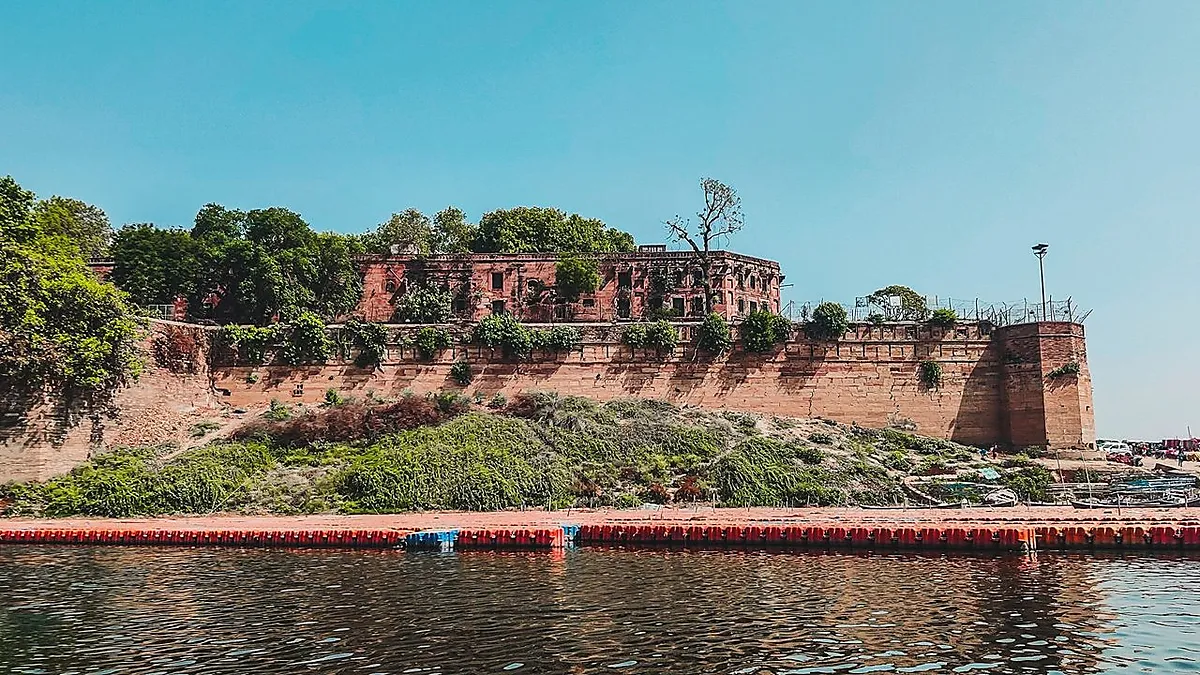
Built in 1583 by Emperor Akbar, this colossal fort on the banks of the Yamuna is a brilliant example of Mughal military architecture. Although much of the fort is still under the Indian Army, visitors can explore three iconic sites inside: the ancient Ashokan Pillar (originally from Kaushambi, inscribed with Mauryan, Gupta and later imperial messages), the underground Patalpuri Temple, and the sacred Akshayavat (the “indestructible banyan tree”).
- Timings: 7:00 AM – 6:00 PM (daily).
- Entry fee: ₹25 for Indian citizens, ₹300 for foreign tourists (cash only).
- What to carry: Valid ID proof; wear comfortable shoes.
3. Akshayavat (The Indestructible Banyan Tree)
Hidden inside the Allahabad Fort complex, the Akshayavat is a massive banyan tree believed to be the one that survived the cosmic deluge (pralaya). Devotees tie sacred threads around its trunk and pray for liberation. The tree is accessible only through the Patalpuri Temple corridor.
4. Patalpuri Temple
A 16‑pillared underground temple located within the fort. It is a rare subterranean shrine where the main objects of worship are a sacred well (kund) and a stone shiva‑linga. The temple is known for its ancient statues of deities and its mysterious, cave‑like atmosphere.
5. Bade Hanuman Ji Temple (Lete Hanuman)
This temple is famous worldwide for its unique 20‑foot reclining idol of Lord Hanuman. Unlike the standing or kneeling Hanuman found everywhere else, the deity here lies on his side, a posture associated with rest after the epic war of Lanka. The temple sits close to the Sangam and is often visited immediately after the holy dip.
- Timings: 5:00 AM – 9:00 PM.
- Entry fee: Free.
- Special days: Tuesdays and Saturdays see large crowds.
6. Alopi Devi Mandir – The Cradle Temple
Alopi Devi Mandir is one of the 51 Shakti Peethas – it marks the spot where the last part of Goddess Sati’s body (her right hand) disappeared. Uniquely, there is no idol in the sanctum. Instead, a wooden cradle (doli/palna) hanging from the ceiling is the focus of worship. The temple is known for the rakshasutra (sacred thread) tied here, which is believed to protect the wearer and fulfil wishes.
7. Mankameshwar Temple
Located near Saraswati Ghat, this Shiva temple is said to have been established by Lord Rama himself to fulfil Sita’s wish to pray to Lord Shiva after her bath at the Sangam. Its name means “the Lord who fulfils the heart’s desires.” The temple has a black stone shiva‑linga that is believed to extend deep underground.
8. Nagvasuki Mandir
Situated on the banks of the Ganga in Daraganj, Nagvasuki Mandir is dedicated to Vasuki, the king of serpents who served as the churning rope in the Samudra Manthan (churning of the ocean). After being wounded in the epic event, Vasuki bathed in the Triveni Sangam to heal, and the temple was built in his honour.
9. Shri Beni Madhav Temple
This Vishnu temple is regarded as the “presiding deity” of Prayagraj. According to the Matsya Purana and Padma Purana, a pilgrimage to Prayag is incomplete without darshan of Shri Beni Madhav. The temple is part of the Dwadash Madhav circuit – the twelve Madhav temples that encircle the holy city.
10. Bharadwaj Ashram
An ancient hermitage associated with the sage Bharadwaj, this ashram is revered as the place where Lord Rama, Sita and Lakshmana stayed during their exile. It is also linked to the legendary aviation knowledge of the sage, who is credited with writing the Vimana Shastra. The ashram is an important stop on the Ramayana Circuit.
11. Anand Bhavan – The Nehru Family Museum
Originally the home of Motilal Nehru, Anand Bhavan was the epicentre of India’s freedom struggle. It was here that Mahatma Gandhi, Jawaharlal Nehru and other national leaders met to plan the Non‑Cooperation and Quit India movements. Today it is a museum preserving the personal belongings, manuscripts and photographs of the Nehru‑Gandhi family.
- Timings: 9:30 AM – 5:00 PM (closed on Mondays).
- Entry fee: ₹20 (Indian), ₹50 (foreigners).
- Nearby: Swaraj Bhavan (the original house, donated to the Indian National Congress).
12. Swaraj Bhavan
Adjacent to Anand Bhavan, Swaraj Bhavan was the original Nehru family home before it was donated to the nation in 1930. It now contains exhibits on the independence movement, including the famous charkha (spinning wheel) used by Mahatma Gandhi.
13. Chandrashekhar Azad Park
Formerly known as Alfred Park, this large green space is the site where revolutionary Chandrashekhar Azad made his last stand against the British on 27 February 1931. Cornered and outnumbered, he shot himself with his last bullet, famously vowing never to be captured alive. The park houses his memorial, the Allahabad Museum (displaying the pistol he used), and the Victorian canopy that once contained a statue of Queen Victoria.
- Park entry: ₹5 (nominal).
- Museum timings: 10:30 AM – 4:30 PM (closed Mondays).
- Museum entry: ₹20 (Indians), ₹500 (foreigners).
14. Allahabad Museum
Located inside Chandrashekhar Azad Park, this museum is a treasure house of Indian art and archaeology. Its highlights include:
- Prehistoric rock paintings (14,000 BC – 2,000 BC)
- Gupta period stone sculptures
- Terracotta artifacts from Kausambi and Bhita
- The Colt pistol of Chandrashekhar Azad
- Rare manuscripts and coins
15. Allahabad Public Library (Thornhill Mayne Memorial)
Housed in a stunning Scottish Baronial Revival building, this library is one of the oldest in Uttar Pradesh. It contains over 125,000 books, rare Persian manuscripts (including the Shahnama and Dara Shikoh’s translation of the Upanishads), and a complete collection of 19th‑century government gazettes.
- Timings: 9:00 AM – 5:00 PM (closed on Mondays).
- Entry fee: Free (small fee for the park).
16. Allahabad University – “The Oxford of the East”
Founded in 1887, the University of Allahabad was the fourth modern university in India. Its iconic red‑sandstone Muir Central College building (designed by Sir William Emerson, who also designed the Victoria Memorial in Kolkata) and the Senate Hall (designed by Sir Swinton Jacob) are masterpieces of Indo‑Saracenic architecture. The campus is open to visitors who wish to admire its heritage buildings.
17. Khusro Bagh
A beautiful Mughal walled garden containing three sandstone tombs: those of Shah Begum (Jahangir’s first wife), Prince Khusrau Mirza (Jahangir’s rebel son), and Nithar Begum (Khusrau’s sister). The tombs are fine examples of early Mughal architecture and are surrounded by lawns, old trees, and peacefulness – a surprising pocket of quiet in the bustling city.
- Timings: 6:00 AM – 7:00 PM.
- Entry fee: Free.
- Note: The garden is a popular spot for morning walks and photography.
18. Patthar Girjaghar (All Saints Cathedral)
Locally known as “Patthar Girjaghar” (the Stone Church), this is one of the finest Gothic Revival cathedrals in Asia. Built in the late 19th century and designed by Sir William Emerson, its flying buttresses, gargoyles, marble altar and stained‑glass windows create a striking contrast to the city’s predominantly Hindu and Mughal skyline.
- Timings: 8:30 AM – 5:30 PM (daily).
- Entry fee: Free.
19. Minto Park (Madan Mohan Malaviya Park)
This riverfront park on the Yamuna was the location where Queen Victoria’s Proclamation was read on 1 November 1858 – the formal transfer of India from the East India Company to the British Crown. After independence, the marble busts of British royalty atop the proclamation pillar were replaced with the Ashokan Lion Capital, India’s national emblem. The park offers a beautiful view of the Yamuna and is a favourite spot for sunset walks.
20. Shringverpur Dham
Located about 40 km from Prayagraj, this site is where Lord Rama, Sita and Lakshmana crossed the Ganga with the help of Nishadraj Guha, the king of the boatmen. A temple dedicated to Nishadraj and a ghat on the Ganga mark the spot, making it an important stop for Ramayana pilgrims.
🌄 Nearby Excursions from Prayagraj
| Destination | Distance | Highlights |
| Jhusi (Pratishthanpur) | 10‑15 km | Ancient capital of the Lunar Dynasty; Neolithic settlement (c. 7100 BCE) |
| Ulta Quila (Jhusi Fort) | 10‑15 km | “Upside‑down” fort; Samudra Koop well; caves of Nath yogis |
| Kaushambi | 56 km | Ruins of the ancient Vatsa kingdom; Ashokan pillar; Buddha’s visit site |
| Vindhyachal | 85 km | Shakti Peetha; Maa Vindhyavasini Temple |
| Chitrakoot | 125 km | Forest where Rama spent exile; Kamadgiri, Ramghat |
📍 Best Experiences in Prayagraj
- Sunrise boat ride to the Sangam – the most sacred moment of any visit.
- Perform the Trikon Yatra – visit the three Shakti temples of Vindhyachal (Vindhyavasini, Ashtabhuja, Kali Khoh).
- Walk the Civil Lines heritage trail – start at All Saints Cathedral, walk through Chandrashekhar Azad Park, admire the Public Library and visit the museum.
- Evening aarti at Saraswati Ghat – watch priests light giant brass lamps and chant to the river goddess.
- Food walk through Loknath Gali – sample tamatar chaat, kulfi‑falooda, samosa from Hari Ram & Sons, and the legendary Netram kachori sabzi.
- Shop at MG Road and Katra Market – for religious souvenirs, brass items, and local sweets.
🗓️ Suggested Itineraries
One‑Day Itinerary
- Morning (6:00–9:00 AM): Boat ride to Triveni Sangam + holy dip.
- Late morning (9:30–11:30 AM): Visit Bade Hanuman Temple + Allahabad Fort (Ashokan Pillar, Patalpuri Temple, Akshayavat).
- Lunch (12:00 PM): Local thali at Netram Moolchand & Sons (Katra Chauraha).
- Afternoon (2:00–4:00 PM): Anand Bhavan Museum + Swaraj Bhavan.
- Evening (5:00–6:30 PM): Walk through Chandrashekhar Azad Park + Allahabad Museum.
- Sunset (6:30–7:30 PM): Ganga Aarti at Saraswati Ghat.
- Dinner (8:00 PM): Street food in Loknath Gali or Civil Lines.
Two‑Day Itinerary
Day 1 (One‑Day itinerary, above)
Day 2:
- Morning: Explore Khusro Bagh + All Saints Cathedral.
- Late morning: Allahabad University campus (Muir Central College, Senate Hall).
- Lunch: Indian Coffee House (Civil Lines).
- Afternoon: Drive to Shringverpur Dham (Nishadraj temple) or Jhusi (ancient mounds).
- Late afternoon: Visit Alopi Devi Mandir + Nagvasuki Mandir.
- Evening: Return to Civil Lines for shopping and dinner.
Three‑Day Itinerary (includes nearby excursions)
Day 1 (One‑Day itinerary)
Day 2:
- Full‑day excursion to Kaushambi (56 km one way). Visit the excavated ruins, Ghositarama Monastery, Ashokan pillar, and Udayin Fort.
- Return by evening; evening free for Civil Lines exploration.
Day 3:
- Morning: Visit Jhusi (Pratishthanpur) + Ulta Quila.
- Afternoon: Explore Garhwa and Bhita (ancient Gupta temples).
- Evening: Return to Prayagraj for departure.
🌤️ Best Time to Visit Prayagraj
| Season | Months | Weather | Recommendation |
| Winter | October – March | Pleasant, 10–25°C, sometimes foggy | Best time for sightseeing, heritage walks, boat rides |
| Summer | April – June | Very hot, up to 45°C | Avoid outdoor activities; early morning visits only |
| Monsoon | July – September | Humid, moderate rainfall | Possible flooding near ghats; fewer crowds |
| Kumbh/Magh Mela | Varies (Jan‑Feb every year; Kumbh every 12 years) | Cool winter | Extraordinary spiritual atmosphere; massive crowds; book well in advance |
🧭 Practical Travel Tips
- Getting Around: Auto‑rickshaws and e‑rickshaws are the most convenient for short distances. For longer trips (Kaushambi, Jhusi), hire a taxi or use local buses.
- Dress Code: Modest clothing for temples and religious sites. Remove shoes before entering temples and the Patalpuri Temple complex.
- Photography: Allowed at most monuments. Avoid using flash inside temples and the Allahabad Museum. Photography is restricted inside the Army‑controlled part of Allahabad Fort.
- Food: Try the kachori sabzi from Netram, tamatar chaat from Loknath Gali, and kulfi‑falooda from Kamdhenu Sweets. Drink bottled water.
- Safety: Prayagraj is generally safe for tourists. Keep valuables secure in crowded areas (especially during Kumbh). Women travellers should avoid isolated areas after dark.
- Currency: Carry small denominations for auto‑rickshaws, street food, and temple offerings. ATMs are widely available in Civil Lines and MG Road.
❓ Frequently Asked Questions (FAQs)
1. What is the best time to visit Prayagraj?
The best time is from October to March when the weather is cool and pleasant for sightseeing.
2. How many days are enough for Prayagraj?
Two to three days are ideal to cover the main attractions and one nearby excursion.
3. Is Prayagraj safe for solo female travellers?
Yes, the city is generally safe. Use common precautions, avoid isolated areas at night, and rely on registered taxis or auto‑rickshaws.
4. Can I take a holy dip at the Sangam without a boat?
The exact confluence point is accessible only by boat. However, you can bathe at the ghats near the fort or Saraswati Ghat.
5. Is photography allowed inside Allahabad Fort?
Photography is allowed in the Ashokan Pillar and Patalpuri Temple areas, but not inside the restricted military zone.
6. What is the Kumbh Mela?
The Kumbh Mela is a mass pilgrimage held every 12 years at Prayagraj, where millions of devotees bathe at the Sangam to cleanse their sins. The Maha Kumbh (once in 144 years) was held in 2025.
7. What is the cost of a boat ride to the Sangam?
Shared boats cost ₹100–150 per person, private boats ₹400–600 for 45 minutes.
8. Are there any entry fees for temples in Prayagraj?
Most temples (Bade Hanuman, Alopi Devi, Mankameshwar) have no entry fee.
9. What should I wear when visiting temples?
Modest attire (covered shoulders and knees) is required. Remove footwear before entering.
10. How do I reach Prayagraj by train?
Prayagraj Junction (PRYJ) is a major railway station on the Howrah‑Delhi main line, connected to all major Indian cities.
11. What is famous street food in Prayagraj?
Kachori sabzi from Netram, tamatar chaat, samosa from Hari Ram & Sons, and kulfi‑falooda.
12. Is there any nightlife in Prayagraj?
Prayagraj is a spiritual and heritage city, not known for nightlife. A few cafes in Civil Lines stay open late.
13. Can I visit Allahabad University campus?
Yes, the main campus is open to visitors. The heritage buildings (Muir College, Senate Hall) are accessible during daylight hours.
14. What is the distance between Triveni Sangam and Allahabad Fort?
The Sangam is about 1.5 km from the fort – a 5‑minute auto ride or a 15‑minute walk.
15. Are there good hotels near the Sangam?
Most hotels are concentrated in Civil Lines and MG Road, a short drive from the Sangam. During Kumbh, temporary tent cities are set up near the river.
16. What souvenirs should I buy in Prayagraj?
Brass puja items, replicas of the Ashokan Pillar, local dalmoth (spiced lentils), and petha from Matadin’s shop.
17. Is Kaushambi worth a day trip?
Absolutely. It is one of the oldest excavated cities in India and was visited by the Buddha himself.
18. What is the significance of Jhusi (Pratishthanpur)?
Jhusi was the ancient capital of the Lunar Dynasty and contains Neolithic remains dating back to 7100 BCE.
19. Can foreign tourists visit the military areas of Allahabad Fort?
The public areas (Ashokan Pillar, Patalpuri Temple, Akshayavat) are open to all. Access to restricted military zones is prohibited.
20. What are the timings of the Ganga Aarti?
The evening aarti is typically held at Saraswati Ghat around 6:00 PM (timings vary with sunset). Arrive by 5:30 PM to secure a good spot.
💎 Conclusion: The City of Layers
Prayagraj is not a city you can rush through in a single morning. It is a palimpsest – a place where the prehistoric Neolithic village still breathes beneath the medieval city, where Mughal elegance stands beside Victorian Gothic, where the chants of the Sangam merge with the bells of the reclining Hanuman and the quiet prayers of a stone cathedral.
Whether you arrive for the Kumbh, seeking a moment of spiritual renewal at the Sangam, or simply to wander through its gardens and museums, Prayagraj will not let you leave unchanged. It will remind you that a city’s true wealth is not in its monuments but in the layers of history, faith and everyday life that flow through its streets – as steadily as the Ganga and Yamuna meet at its heart.
Plan your journey with PrayagTourism.com and let us help you discover every layer of this extraordinary city. May your trip be peaceful, safe and deeply enriching.
🔗 Related Articles (Internal Linking)
- Triveni Sangam – The Complete Pilgrim Guide
- Allahabad Fort – History, Architecture & Visitor Information
- Akshayavat – The Indestructible Banyan Tree
- Bade Hanuman Ji Mandir – The Reclining Hanuman of Prayagraj
- Alopi Devi Mandir – The Mysterious Shakti Peetha
- Patthar Girjaghar (All Saints Cathedral) – The Stone Church of Prayagraj
- Khusro Bagh – The Mughal Garden of Royal Tragedy
- Anand Bhavan – Museum of the Freedom Movement
- Chandrashekhar Azad Park – From Alfred Park to a Revolutionary Memorial
- Allahabad University – The Oxford of the East
- Allahabad Museum – Treasure House of History & Art
- Allahabad Public Library – The Thornhill Mayne Memorial
- Street Food in Prayagraj – A Culinary Pilgrimage
- Prayagraj Independence Movement – The Cradle of Nationalism
- Kumbh Mela Guide – History, Akharas & Spiritual Significance
This article is part of a series on Prayagraj‘s heritage, culture and travel. For more information on planning your visit, please contact us.
Prayag Tourism
📞 Phone/WhatsApp: +91-9555313526
📧 Email: contact@prayagtourism.com
🌐 Website: PrayagTourism.com
May your journey be peaceful, safe and filled with the timeless stories of Tirtharaj Prayag.