
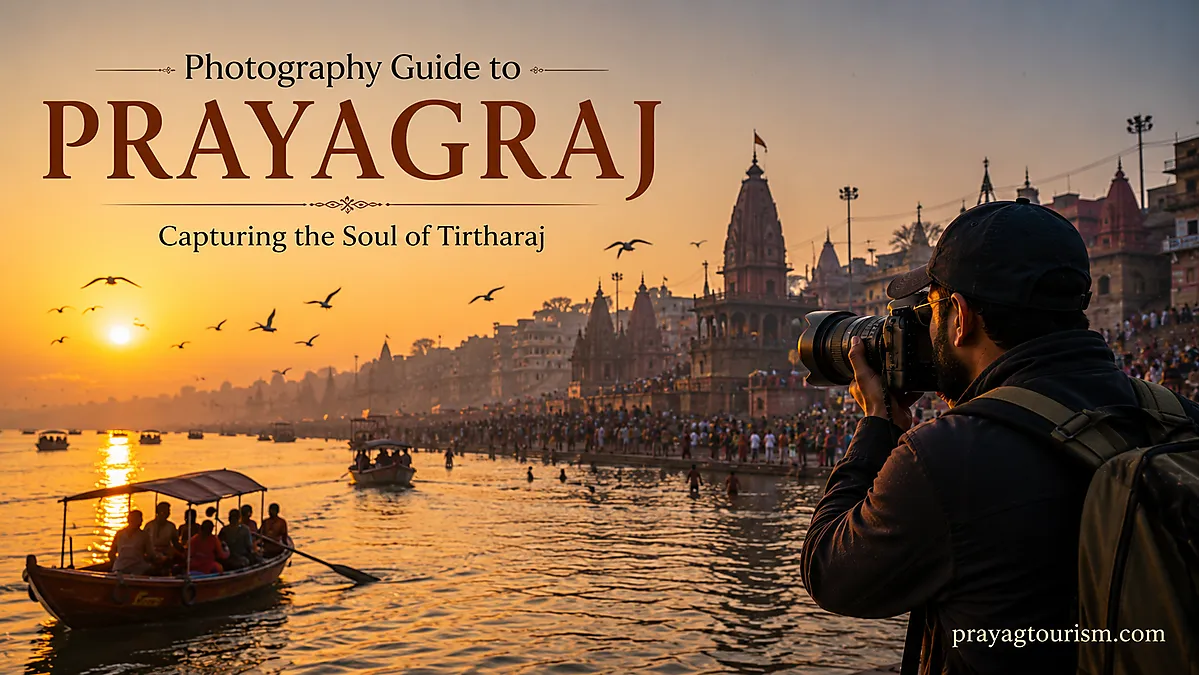
The photographer’s alarm is set for 4:30 AM — not a burden, but an invitation.
As you jolt awake in your hotel room, the city is still dreaming beneath a blanket of silence. By the time you reach the Triveni Sangam, the horizon has begun to blush. The first saffron finger of dawn touches the water, turning it into liquid gold. A lone boatman unties his wooden vessel, his silhouette sharp against the emerging light. Pilgrims, already waist‑deep in the holy confluence, raise their cupped hands to the rising sun. A distant conch shell sounds. You raise your camera — and you understand: this is why you came.
Prayagraj is not a city you simply visit. It is a city you witness. Its visual vocabulary is unmatched: the ethereal mist of the Sangam at sunrise, the red‑sandstone geometry of Mughal tombs, the soaring Gothic arches of a Victorian cathedral, the solemn dignity of a revolutionary‘s memorial, and the joyful chaos of its food lanes. Whether you carry a professional DSLR or just a smartphone, this guide will help you bring home images that do justice to the soul of Tirtharaj — the “King of Pilgrimage Sites”.
Table of Contents
📷 Quick Facts: Photography in Prayagraj at a Glance
| Feature | Information |
| Best Seasons | October – March (winter) for clear skies; January – February for magical mist over the Sangam |
| Prime Golden Hour (Morning) | Approximately 6:30 AM – 7:30 AM (varies seasonally) |
| Prime Golden Hour (Evening) | Approximately 4:50 PM – 5:50 PM (varies seasonally) |
| Most Photographed Location | Triveni Sangam (sunrise and boat rides) |
| Best Location for Architectural Details | Khusro Bagh |
| Best Location for Monumental Scale | Allahabad Fort |
| Best Location for Colonial Architecture | Patthar Girjaghar (All Saints Cathedral) |
| Photography Permits | Free for public areas; permits required for commercial shoots and museum interiors |
| Drone Regulations | Heavily restricted due to proximity to Army Ordnance Depot (Allahabad Fort); check local laws |
| Street Photography Etiquette | Ask permission before photographing sadhus and pilgrims in close‑up; be respectful during cremation rituals at ghats |
🧭 Planning Your Photo Expedition
Best Seasons for Photography
| Season | Photography Experience |
| Winter (October – March) | Ideal. Clear blue skies, crisp light, low humidity. January–February adds morning mist for ethereal Sangam shots. Temperatures range from 10°C to 25°C. |
| Summer (April – June) | Harsh light, high temperatures (often exceeding 45°C), heat haze. Avoid or restrict to early morning / late evening. |
| Monsoon (July – September) | Moody skies, lush greenery, dramatic clouds. Great for atmospheric shots but high humidity and risk of rain. |
Golden Hour Timings (Prayagraj)
In winter months (November–February), the morning golden hour typically runs from 6:30 AM to 7:30 AM, and the evening golden hour from 4:50 PM to 5:50 PM. Arriving at least 30 minutes before sunrise allows you to capture the full transition from pre‑dawn blue to fiery orange — often the most magical moments of all.
Gear Recommendations for Different Skill Levels
For Smartphone Photographers:
- Clean your lens before every shot — it‘s the cheapest upgrade you can make.
- Use your phone’s portrait mode for subjects like flower offerings, temple lamps, or a sadhu on the ghats.
- Avoid digital zoom; move closer instead.
- Use grid lines (rule of thirds) to improve composition.
- Edit with free apps like Snapseed or Lightroom Mobile.
- Carry a small power bank — cold mornings and heavy use drain batteries fast.
- Use voice control or a Bluetooth shutter to minimise camera shake.
For Amateur Photographers (Entry‑level DSLR/Mirrorless):
- Bring a versatile zoom lens (e.g., 18‑135mm or 24‑105mm).
- Carry a polarising filter to cut glare from water and enhance sky colour — especially valuable at the Sangam.
- Use a tripod for low‑light conditions (evening aarti, interiors, long exposures).
- Shoot in RAW format for better post‑processing flexibility.
- A circular polariser is also excellent for reducing reflections on the river.
For Professional Photographers (Commercial/Fine Art):
- Wide‑angle lens (16‑35mm) for architectural interiors and vast landscapes.
- Telephoto lens (70‑200mm or 100‑400mm) for compressed compositions and detail shots of carvings and distant subjects.
- Neutral density filter for long exposures of the river (creating that silky water effect).
- Circular polariser for water reflections and sky contrast.
- Sturdy tripod and remote shutter.
- Consider bringing a drone (but verify restrictions — large parts of Prayagraj, especially around the fort, are no‑fly zones due to military presence).
📱 Smartphone Photography: Getting Pro Results Without Heavy Gear
The best camera is the one you have with you. A modern smartphone can produce stunning results if you follow a few simple principles:
- Natural light is your best friend. Avoid using the phone‘s flash, especially indoors — it flattens faces and destroys atmosphere.
- Golden hour magic: The warm, soft light at sunrise and sunset eliminates the need for heavy editing. Position your subject so the light falls on them, not from behind.
- Composition tools: Enable grid lines in your camera settings. Place key elements on intersecting lines (rule of thirds) for balanced, professional‑looking images.
- Portrait mode: Ideal for pilgrims, priests, artisans, and food vendors. The background blur mimics a wide‑aperture lens and makes your subject pop.
- Avoid digital zoom — it‘s just cropping inside the camera and destroys detail. Move closer to your subject instead.
- Edit on the go: Snapseed (free, excellent for basic adjustments), Lightroom Mobile (free version available, great for colour grading), VSCO (for film‑like presets).
- Keep a power bank handy — shooting all day, especially in cold weather, drains batteries fast.
- Use voice control or a Bluetooth shutter to minimise camera shake when shooting without a tripod.
🌊 Sacred Waters: The Ghats and Triveni Sangam
Primary Tip: Sunrise is magic. The golden hour just after dawn is the only time you‘ll get soft, warm light and manageable crowds. The Sangam area is at its most photogenic between 5:30 AM and 7:30 AM.
Triveni Sangam Sunrise – The Essential Shot
- Best time: Arrive by 6:15 AM during winter months (6:00 AM in summer). The first 30 minutes after sunrise offer the most dramatic colours — from violet to rose to molten gold.
- Best vantage point: On a boat, about 50–100 metres from the confluence point. From the water, you have an unobstructed view of the horizon and can position yourself for the perfect composition.
- Composition tips: Place a boat or a pilgrim in the foreground for scale and depth. Use the rule of thirds: position the horizon on the lower third, leaving space for the dramatic sky.
- Camera settings (DSLR): Aperture f/8 for sharpness from foreground to background; ISO 200‑400 (higher if hand‑holding); adjust shutter speed to balance exposure. For misty mornings, underexpose slightly to keep the atmosphere.
- Smartphone tips: Switch to wide‑angle mode to capture the entire horizon. Tap on the brightest part of the sky to set exposure; if the foreground goes too dark, increase exposure compensation slightly.
- Weather watch: The best sunrises occur when there are scattered clouds on the eastern horizon — they catch the colour and scatter it across the sky. Misty mornings (January–February) create an ethereal, almost otherworldly atmosphere.
Evening Aarti on the Ghats
- Timing: The aarti begins at Saraswati Ghat and Ram Ghat around 6:30 PM – 7:00 PM (varies with season). Arrive by 5:30 PM to claim a good spot.
- What to capture: The synchronised movement of priests with multi‑tiered brass lamps, the glow of camphor flames against the darkening sky, reflections on the water, the devotion of pilgrims‘ faces, and the swirling incense smoke.
- Challenge: Low light. Bring a tripod or brace your camera against a stable surface (a railing, a pillar, your own knee). Use a high ISO (800–3200) on DSLR/mirrorless cameras — don‘t be afraid of grain; a sharp, grainy image beats a blurry clean one. Use a shutter speed of at least 1/100 sec to freeze the priests‘ movement.
- Smartphone tips: Use night mode; avoid flash at all costs — it will flatten the warm, atmospheric light. Rest your phone on a railing or a companion‘s shoulder for stability. Consider a small, inexpensive tripod with a phone mount.
Boat Rides – Unique Perspectives from the River
- Best times: At sunrise (golden reflections on the water) or just before sunset (warm light on the stone fort and ghats).
- Composition from the boat: The best fort shots are taken from a boat looking back toward the fort and the city. Frame the shot with the boat‘s bow or a pilgrim in the foreground to anchor the composition. Use the ripples in the water as natural leading lines.
- Camera settings: Use aperture priority (f/5.6‑f/8) for a good balance of sharpness. If shooting from a moving boat, increase shutter speed to avoid blur — 1/250 sec or faster. A polarising filter helps cut glare on the water surface.
🕌 Mughal Elegance: Khusro Bagh – A Hidden Gem for Photographers
Khusro Bagh is arguably the most photogenic spot in Prayagraj for heritage and architectural photography. The red‑sandstone tombs, sculpted parapets, arched alcoves, and serene gardens offer compositions for every skill level.
- Timings: Open daily from 6:00 AM to 7:00 PM.
- Best time: Early morning (7:00 AM – 9:00 AM) for soft light that brings out the texture of the red sandstone; late afternoon (4:00 PM – 5:30 PM) for warm, golden tones on the stone. The long morning shadows create dramatic compositions across the sandstone.
- Key subjects to photograph:
- Shah Begum‘s Tomb: The three‑tiered terrace with a large chhatri is completely distinctive. The complex geometric design and the play of light and shadow on the red sandstone are excellent practice for architectural photography.
- Nithar Begum’s Tomb: The scalloped arch motifs are a standout detail. Use a telephoto lens to compress the arches, or get close to the stonework with a wide lens to capture the intricacy of the carvings.
- Khusrau‘s Tomb: The stone jali (fretwork) screens are exquisite. Photograph them from inside the tomb, letting the bright exterior shine through the carved gaps — a classic backlighting technique.
- The pathway and garden: Frame the tombs through overhanging tree branches or use the pathways as leading lines to draw the viewer‘s eye toward the monuments.
- Camera settings: For general shots, aperture f/8 for sharpness across the frame. For detail shots of carvings, open up to f/4 – f/5.6 to isolate the subject against a soft, blurred background.
- Smartphone tips: The tombs look spectacular in portrait mode; the background blur enhances the three‑dimensional quality of the stone architecture.
- Pro tip: The blend of Mughal and Rajput styles in the architecture — reflected in the intricate stone carvings — provides endless opportunities for detail photography.
🏰 The Grand Fort: Allahabad Fort and Its Treasures
Built in 1583 by Emperor Akbar, Allahabad Fort is a massive Mughal military structure on the Yamuna‘s banks. Its most important interiors are only accessible to tourists during the Kumbh Mela, but the exterior is always worth photographing.
- Timings & Entry: The public areas (Ashokan Pillar, Patalpuri Temple, Akshayavat) are generally open from 7:00 AM to 6:00 PM. Entry fees vary: some sources say ₹25 for Indian citizens, ₹300 for foreign tourists; others note that entry is free but limited to designated areas. Expect security checks; carry a valid ID.
- Best time for exterior fort photography: Boat ride at sunrise or sunset. The golden light on the massive red‑sandstone walls is unforgettable.
- Best time for interior photography: Late morning to early afternoon (9:00 AM – 2:00 PM) when sunlight illuminates the Ashokan Pillar and filters into the underground chambers.
- Key photographic subjects inside the fort:
- Ashokan Pillar: A 10.6‑metre‑high polished sandstone pillar dating to the 3rd century BC, with inscriptions in Brahmi script. Shoot from a low angle to emphasise its height. The polished surface catches light beautifully.
- Patalpuri Temple: An underground chamber with a mysterious, cave‑like atmosphere. Use a high ISO (800–1600) and open your aperture to its widest (f/2.8 – f/4). A tripod is essential — this is not hand‑holdable territory. Focus manually on the central stone idol.
- Akshayavat (the indestructible banyan tree): The sprawling root system and the tree‘s ancient, gnarled form are extraordinary subjects for detail photography.
- Camera settings (exterior): Use aperture priority (f/8 – f/11) to keep both the foreground and background in sharp focus. A polarising filter will enhance the sky and reduce glare on the stone.
- Important restriction: Parts of the fort are under Army Ordnance Depot jurisdiction. Photography in restricted areas is prohibited. Stay within the designated tourist corridor.
⛪ Colonial Heritage: Patthar Girjaghar (All Saints Cathedral)
This Gothic Revival cathedral, modelled after 13th‑century churches, is a striking subject — a stone giant built of creamy sandstone, standing in stark contrast to the city‘s Mughal and Hindu architecture. Locally known as Patthar Girjaghar (“Stone Church”), it was designed by Sir William Emerson, the same architect who created Kolkata‘s Victoria Memorial.
- Timings: Open daily 8:30 AM – 5:30 PM.
- Entry fee: Free.
- Best time for exteriors: Late afternoon (4:00 PM – 5:30 PM) when the low sun strikes the western façade. The stone glows with warm golden light.
- Best time for interiors: Morning (9:00 AM – 11:00 AM) when sunlight streams through the stained‑glass windows, creating colourful patterns on the marble floor and stone pillars.
- Key photographic subjects:
- Exterior: The towering Gothic spire, flying buttresses, gargoyles, pointed arches, and intricate tracery. Use a wide‑angle lens to capture the full height of the structure.
- Interior: The stained‑glass windows (photograph them with light streaming through), the inlaid marble altar, and the alabaster pulpit. Use a tripod for low light; avoid flash.
- Photography rules: Photography inside is usually allowed but restricted during services. Flash is not permitted. The cathedral is at the crossing of Mahatma Gandhi Marg and Sarojini Naidu Marg, visible from a distance due to its grand stone structure.
🌳 Green Lungs & Monuments: Chandrashekhar Azad Park & Allahabad Museum
This historic park — formerly known as Alfred Park — is a pleasant green space (133 acres) and the site where revolutionary Chandrashekhar Azad made his last stand on 27 February 1931. It is also home to the Allahabad Museum.
- Best time for the park: Morning (7:00 AM – 9:00 AM) for soft light and fewer people.
- Key photographic subjects:
- Azad Memorial: A pilgrimage spot for photography — the site of Chandrashekhar Azad‘s martyrdom.
- Allahabad Museum: Its exterior is photogenic; inside, photography is restricted.
- Allahabad Museum Photography Rules:
- Outdoor photography is allowed.
- Indoor photography may require a permit (approx. ₹500) .
- Flash is prohibited inside.
- Filming may require special permission.
- Key museum subjects: The Gupta period stone sculptures, the Colt pistol of Chandrashekhar Azad (a prime attraction), and the extensive collection of terracotta art and miniature paintings.
- Note: The museum is closed on Mondays. It houses approximately 72,000 artifacts, ranging from antiquity to modern history.
🎓 Academic Grandeur: Allahabad University – The Oxford of the East
The University of Allahabad campus is a heritage goldmine with its Indo‑Saracenic and Victorian architecture. The iconic red‑sandstone Muir Central College building is a masterpiece of colonial design — a must‑photograph.
- Best time: Morning (8:00 AM – 10:00 AM) for soft light on the red sandstone.
- Key buildings to photograph:
- Senate Hall: Indo‑European style, built 1910‑1915, with a prominent clock tower.
- Muir College building: Red‑sandstone, domes, arches, and arcaded verandahs.
- The clock tower: Approximately 50 metres high — a vertical exclamation point on the campus skyline.
- Smartphone tips: Use panorama mode for the Senate Hall — its long horizontal sweep is perfect for the format.
🌅 Riverfront Serenity: Minto Park (Madan Mohan Malaviya Park)
This riverfront park on the Yamuna is ideal for minimalist sunset photography. Known as Minto Park in the colonial era, it was where Queen Victoria‘s Proclamation was read in 1858, formally beginning the British Raj.
- Best time: Sunset (4:30 PM – 5:30 PM) . The sun sets directly behind the Yamuna River, offering a clean, unobstructed horizon.
- Key photographic subjects: The riverfront with the setting sun, the Proclamation Pillar (now topped with the Ashokan Lion Capital), and the green lawns.
- Camera settings: Use a narrow aperture (f/11 – f/16) for sharpness from the foreground pillar all the way to the distant horizon. Compose with the sun low on the horizon, perhaps partially obscured by the pillar for a dramatic silhouette.
- Smartphone tips: Tap on the sky to set exposure; do not over‑brighten or you‘ll lose the sunset colours. A slight underexposure often gives more dramatic results.
- Note: The park is also a peaceful retreat for leisurely walks and contemplation, with lush greenery throughout.
🍛 Street Photography: Capturing Life in Prayagraj‘s Markets and Lanes
Street photography can be intimidating, but some of the most compelling photos come from candid interactions. The markets of Prayagraj are a riot of colour, texture, and humanity.
- Best locations:
- Loknath Gali and Chowk: Food stalls, crowds, and the city‘s most famous street food — tamatar chaat, samosas, lassi.
- Katra Market: Student life, budget eateries, and a more local, less touristy atmosphere.
- Daraganj: Traditional riverside living — boatmakers, fishermen, and the daily rhythm of the ghats.
- Best time: Morning (8:00 AM – 10:00 AM) for market bustle; evening (6:00 PM – 8:00 PM) for illuminated food stalls and golden street light.
- Gear: Use a fast (wide aperture) lens (f/1.8 – f/2.8) to isolate subjects from the background. Keep your gear minimal and discreet — a small, quiet camera is less intimidating.
- Etiquette: Ask permission before taking close‑up shots of sadhus or pilgrims. A smile and a “namaste” go a long way. Be respectful and never intrusive.
- Photographing food: Use a macro lens or your phone‘s close‑up mode; shoot from a 45‑degree angle above the dish to show both the food and the vendor‘s hands at work. Natural light (not flash) is essential for appetising food photos.
🏺 Beyond the City: Kaushambi – Ancient Ruins for the Adventurous Photographer
For photographers with extra time, Kaushambi (56 km south‑west of Prayagraj) offers a completely different landscape: the ruins of an ancient city that was once the capital of the Vatsa kingdom and was visited by the Buddha himself.
- Best time: Early morning (7:00 AM – 8:00 AM) for soft light on the ruins. Sunrise or sunset is highly recommended for stunning photos.
- Key subjects:
- The Ghositarama Monastery foundations — a large brick complex with individual cells for monks.
- The Ashokan pillar (a second pillar still stands at the excavated site, while the more famous pillar now resides in Allahabad Fort).
- The massive earthen ramparts — a testament to the city‘s ancient defences.
- Camera settings: Use a wide‑angle lens to capture the sweep of the ruins. Use a small aperture (f/11 – f/16) for deep depth of field, keeping both the foreground ruins and the distant horizon sharp.
- Tips: The site is largely unshaded, so bring sun protection. Wear sturdy shoes (the ground is uneven). Kaushambi holds significant archaeological importance, with ancient ruins that attract many visitors.
🎒 Photography Checklist: Gear, Permits, and Etiquette
| Item | Recommendation |
| DSLR/Mirrorless | Bring a versatile zoom (24‑105mm), plus a wide‑angle (16‑35mm) for interiors and landscapes. |
| Tripod | Essential for low‑light shots (evening aarti, Patalpuri Temple, long exposures of the river). |
| Polarising Filter | Helps cut glare from water and enriches sky colour — especially valuable at the Sangam. |
| Neutral Density Filter | For long exposures of the river (creating that silky, ethereal water effect). Optional but rewarding. |
| Extra Batteries | Cold mornings and heavy use drain batteries quickly. Carry at least two. |
| Memory Cards | Bring at least 64GB (RAW files are large). 128GB is safer for multi‑day trips. |
| Power Bank | Essential for smartphone photographers; your phone will work hard. |
| Permits | Photography is free for personal use. Commercial shoots require permission. Museum interiors may require a permit (approx. ₹500). |
| Drone Regulations | Heavily restricted due to proximity to Army Ordnance Depot (Allahabad Fort). Contact local authorities beforehand; do not assume you can fly. |
| Etiquette | Avoid flash in temples, churches, and museums. Ask permission before photographing pilgrims or sadhus up close. Do not photograph cremation rituals at ghats. |
❓ Frequently Asked Questions (FAQs) for Photographers
- What is the best time of day to photograph the Triveni Sangam?
Sunrise — specifically the first 30 minutes after sunrise. The light is soft, warm, and transformative. - Where is the best place to capture the evening aarti?
Saraswati Ghat and Ram Ghat. Arrive by 5:30 PM to secure a spot. - Do I need a permit to photograph inside Allahabad Fort?
Public areas (Ashokan Pillar, Patalpuri Temple, Akshayavat) are generally open. However, expect security checks; carry a valid ID. Photography in restricted military areas is prohibited. - Is drone photography allowed in Prayagraj?
Heavily restricted, especially around the fort (Army Ordnance Depot). Check with local authorities before flying. - What is the entry fee and photography fee for Allahabad Museum?
Entry: ₹50 for Indian citizens, ₹500 for foreign tourists. Photography permit: approx. ₹500. Flash prohibited. - Are there any restrictions on photographing sadhus?
Always ask permission before close‑up shots. A respectful approach and a small offering are welcomed. - What camera gear should I carry for a day of photography in Prayagraj?
A versatile zoom lens (24‑105mm equivalent), a polarising filter, a tripod, extra batteries, and a comfortable camera bag. - Can I use a tripod at the ghats?
Yes, but be mindful of pilgrims and crowds. Early morning is best — fewer people, more space. - Which lens is best for capturing the architecture of Khusro Bagh?
A wide‑angle lens (16‑35mm) for the full tombs and sweeping garden views; a telephoto (70‑200mm) for detail shots of carvings and jali screens. - When is the best month to capture the morning mist over the Sangam?
January and February — the winter fog creates an ethereal, mystical atmosphere. - Is flash photography allowed inside Patthar Girjaghar?
No — flash is not permitted. Use a tripod and high ISO instead. - What are the timings for photography at Allahabad University?
The campus is accessible during daylight hours. Aim for 8:00 AM – 10:00 AM for the best light on the red sandstone. - Can I take photos inside Patalpuri Temple?
Yes, but it is extremely dark. You will need a tripod, a high ISO, and a wide aperture. Be respectful. - What are the best spots for photographing the Allahabad Fort from the outside?
From a boat on the Yamuna — at sunrise or sunset. The river provides the perfect foreground. - How can I find a local guide for the best photography locations?
Your hotel can recommend a guide. Alternatively, ask call Prayagtourism.com and we would arrange a local guide for you. - Are there any photography workshops or tours available in Prayagraj?
During the Kumbh Mela, specialised photography tours are often organised. Check online or with local travel agencies. - What is the best way to photograph the Magh Mela if I‘m visiting?
Plan ahead. The Magh Mela is an unparalleled spectacle for photographers. Focus on the Shahi Snan (royal bath) dates, the Akhara processions, the Naga Sadhus, and the sea of tents at dawn. Respect the faith of the pilgrims above all else. - Is street photography in Prayagraj safe?
Yes — but use common sense. Be discreet, ask permission for close‑ups, and avoid isolated areas after dark. - What editing software do you recommend for travel photos?
Free: Snapseed (excellent for quick, powerful edits), Lightroom Mobile (free version). Paid: Adobe Lightroom Classic (professional). - Can I sell my photographs of Prayagraj commercially?
Commercial shoots require permission from the relevant authorities. Contact the Archaeological Survey of India or the local tourism office for permits.
💎 Conclusion: Bringing Home the Light of Prayagraj
As you pack your camera bag for the journey home, scroll through the images you‘ve captured over the past few days. There‘s the golden Sangam sunrise, with a boatman‘s silhouette in the foreground. There‘s the intricate jali screen of Khusro Bagh, the afternoon sun creating geometric shadows on the stone floor. There‘s the quiet solemnity of Patthar Girjaghar‘s nave, coloured light spilling from the stained‑glass windows. And there‘s the joyful chaos of Loknath Gali — a vendor‘s hands tossing spices, a child‘s laughter, a face lit by the glow of a frying pan.
These are not just photographs. They are memories of light — the unique, irreplaceable light of Tirtharaj.
Prayagraj offers the heritage photographer something rare: a single city where the sacred, the imperial, the revolutionary, and the everyday all coexist, often within a few hundred metres of each other. The challenge — and the joy — is seeing them all. The light changes, the crowds ebb and flow, but the stories remain. Your task, as a photographer, is simply to be there when the light is right, and to press the shutter at the moment the story unfolds.
May your journey be peaceful, safe, and rich with unforgettable images.
📞 Phone/WhatsApp: +91-9555313526
📧 Email: contact@prayagtourism.com
🌐 Website: PrayagTourism.com