
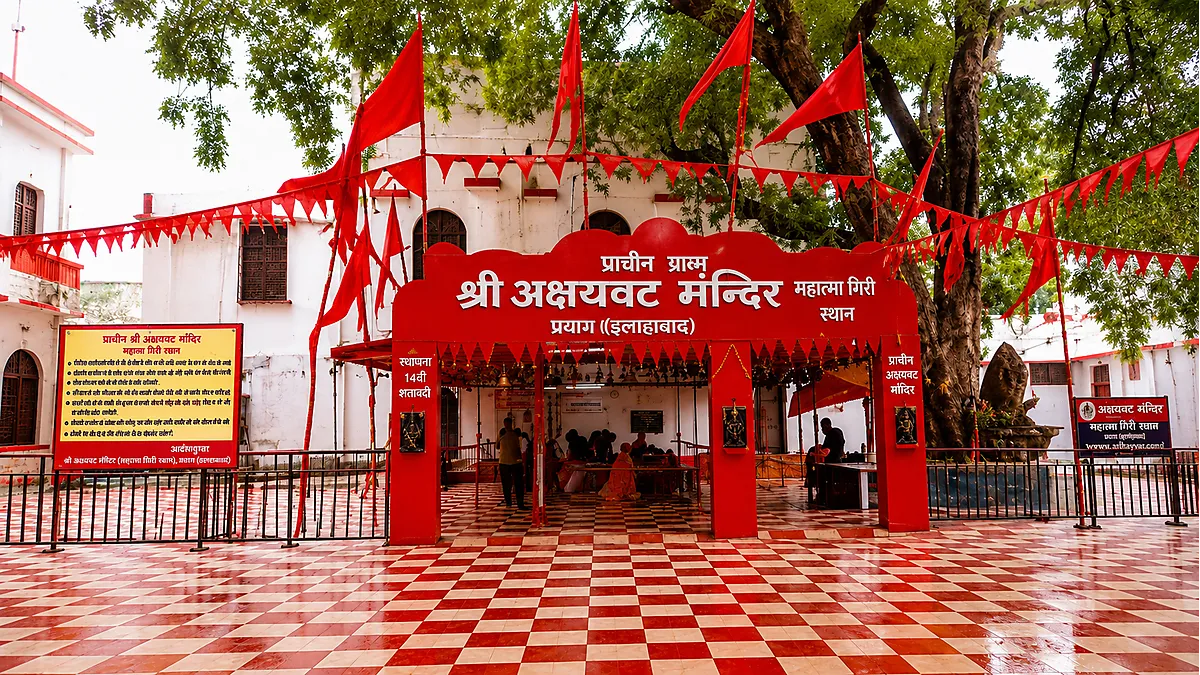
The winter sun has dipped below the horizon, and the last traces of twilight are fading over the sacred confluence. Inside the ancient Allahabad Fort, a hush falls over the Patalpuri temple complex. A pilgrim, having journeyed for days, walks slowly down a dimly lit corridor. The air is cool, the silence broken only by the soft echo of their footsteps on the red stone floor. After a lifetime of hearing stories, they finally stand before it: a massive ancient banyan tree, its roots spreading like the arms of time itself, a silent, sacred witness to the rise and fall of empires. This is the Akshayavat – the Indestructible Banyan Tree.
For millennia, this sacred fig has been more than a tree. It is believed to have witnessed the cosmic dissolution, survived the wrath of emperors, and stood as a silent sentinel over the holy city of Tirtharaj. It is a symbol of eternity, a gateway to liberation, and one of the most revered pilgrimage sites in India. This is the story of the tree that refused to die.
Quick Facts: Akshayavat at a Glance
| Detail | Information |
| Sacred Name | Akshayavat (अक्षयवट) |
| Meaning | Indestructible / Eternal Banyan Tree |
| Location | Patalpuri Temple, Allahabad Fort, Prayagraj |
| Deity Association | Lord Vishnu, Lord Shiva, Lord Brahma (Trinity) |
| Nearby Sacred Site | Triveni Sangam, Patalpuri Temple, Saraswati Koop |
| Primary Significance | Symbol of eternity & spiritual liberation |
| Scriptural Mentions | Padma Purana, Matsya Purana, Mahabharata, Ramayana |
| Historical Mention | Xuanzang (Hiuen Tsang), 7th century CE |
| Fort Built | 1583 by Emperor Akbar |
| Best Time to Visit | October–March (winter) |
| Visitor Access | Through Akshayavat-Patalpuri corridor (Army jurisdiction) |
| Nearby Attractions | Triveni Sangam, Bade Hanuman Temple, Alopi Devi Mandir |
Table of Contents
What is Akshayavat?
The name itself is a profound declaration. Akshayavat (अक्षयवट) is a Sanskrit compound of two words:
- Akshaya (अक्षय) – eternal, imperishable, indestructible, that which does not decay.
- Vata (वट) – the Banyan tree (Ficus benghalensis), one of the most sacred trees in Hindu tradition.
Together, Akshayavat means the Indestructible Banyan Tree – the tree that cannot be harmed, the tree that time cannot touch, a living symbol of eternal Dharma.
The banyan tree holds a special place in Hindu worship. It is associated with Lord Shiva (who meditates beneath it), Lord Vishnu (who rests on a cosmic banyan leaf), and the Trimurti (Brahma as the roots, Vishnu as the trunk, and Shiva as the branches). Among all the sacred banyan trees in India – at Prayagraj, Vrindavana, Kashi, Gaya, Jagannath Puri, and Kurukshetra – the Akshayavat of Prayagraj is considered the foremost.
Scriptural References to Akshayavat
The Akshayavat is not a tree of local legend alone; it is repeatedly mentioned and glorified in the sacred scriptures of Hinduism.
The Padma Purana
The Padma Purana is the primary scriptural source for glorifying the Akshayavat. It declares that those who venerate the Akshayavata with devotion are freed from sins. Moreover, the Purana explicitly calls the Akshayavat the umbrella spread over the holy city of Prayagraj – a poetic image suggesting that the tree protects the entire pilgrimage site beneath its divine canopy.
The Matsya Purana (Prayag Mahatmya)
The Prayag Mahatmya – a section within the Matsya Purana dedicated entirely to glorifying Prayagraj – specifically describes the tree at Prayag as the Akshayavata. This Puranic endorsement firmly establishes the sacred status of the Akshayavat within the larger pilgrimage tradition of Tirtharaj.
The Mahabharata and Ramayana
The Mahabharata mentions the Akshayavata as a holy site of Gaya, confirming its recognition as a sacred destination across ancient India. The Valmiki Ramayana mentions that Lord Rama, Sita, and Lakshmana saw the Vata (banyan) tree in Prayagraj during their exile. Later tradition identifies that very tree with the Akshayavat we revere today.
Śrīmad Bhāgavad Gītā – The Cosmic Banyan
Although not specifically referring to the physical tree in Prayagraj, the Bhagavad Gītā (Chapter 15) describes the entire material universe as an eternal banyan tree (śvāśvatam aśvattham), with its roots above (the Supreme Lord) and branches spreading below (all created beings). This celebrated metaphor echoes the same theological significance for which the Akshayavat stands – a symbol of the indestructible, all‑pervading divine reality.
Akshayavat as Wish‑Fulfilling Tree and “Umbrella of Prayag”
The Padma Purana also teaches that the Akshayavat acts as a wish‑fulfilling tree (kalpa‑vṛkṣa). It is widely believed that seeing the tree with faith and devotion grants Akshaya Punya – eternal virtue that never diminishes. The same text proclaims:
श्यामो वटो श्यामगुणं वृणोति स्वच्छायया श्यामलया जनानाम्।
श्यामः श्रमं कृन्तति यत्र दृष्टः स तीर्थराजो जयति प्रयागः॥
“In this holy place, Shyam Vata (Akshayavat) bestows upon human beings the quality of goodness through its cool shade, and all sins are destroyed upon having darshan of Lord Madhava here. Victory to Prayag, the King of Tirthas.”
A Prayag Mahātmya Verse on Akshayavat
The scriptural authority for the tree‘s supreme status is overwhelming. The following verse from the Matsya Purana – Prayag Mahatmya explicitly links the Akshayavat with the supreme sacredness of Prayag itself:
देवनागरी
तीर्थकोटिसहस्राणि प्रयागार्धेन तत्फलम्।
प्रयागस्य तु संदर्शनात् पापं नश्यति सर्वदा॥
IAST
Tīrthakoṭisahasrāṇi prayāgārdhena tatphalam |
Prayāgasya tu sandarśanāt pāpaṁ naśyati sarvadā ||
Source
Matsya Purana, Prayag Mahatmya (referencing the Akshayavat)
Word‑by‑Word Meaning
- Tīrtha‑koṭi‑sahasrāṇi – ten million (a crore) sacred sites
- Prayāga‑ardhena – by half of Prayag
- Tat‑phalam – that merit
- Prayāgasya – of Prayag
- Tu – indeed
- Sandarśanāt – from the mere sight
- Pāpam – sins
- Naśyati – are destroyed
- Sarvadā – completely
Translation
“The merit of bathing at ten million sacred sites equals but half the merit of bathing at Prayag. From the very sight of Prayag, all sins are completely destroyed.”
Practical Takeaway
This verse establishes the unmatched spiritual potency of Prayag itself. Since the Akshayavat is the divine “umbrella” of the holy city, its darshan carries the same immense purifying power. It reminds pilgrims that their journey to Prayag is incomplete without honouring the undying tree.
Akshayavat and Cosmic Hindu Philosophy
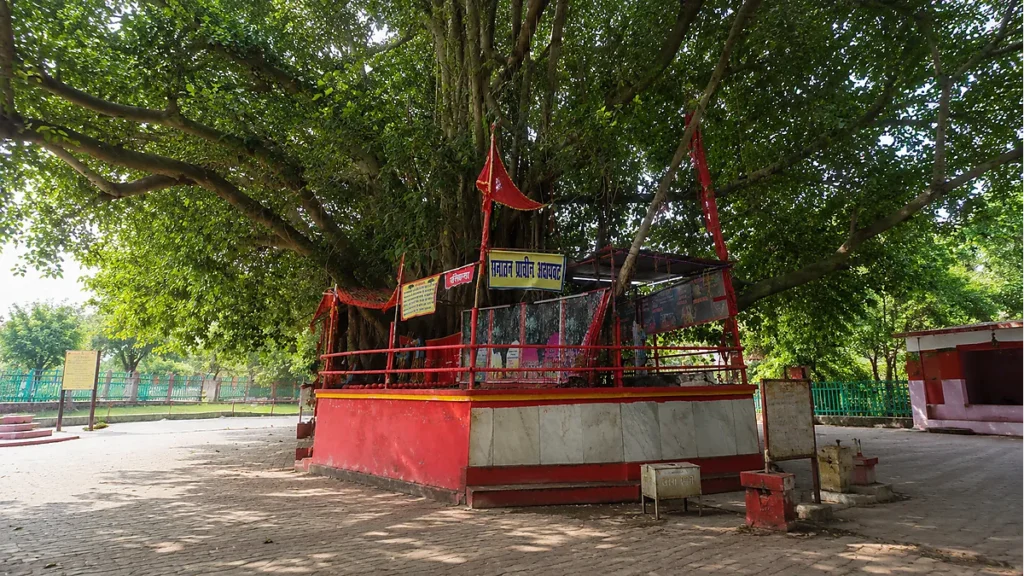
The legend that gives the Akshayavat its name and its power is the story of Sage Markandeya and the cosmic flood. This, perhaps, is the most famous legend associated with this sacred tree.
The Legend of Sage Markandeya and the Cosmic Flood
Once, the great sage Markandeya – renowned for his devotion and his boon of immortality – approached Lord Narayana (Vishnu) with a question. He wished to see a glimpse of the Lord’s divine power, a taste of what cosmic dissolution (pralaya) looks like.
Lord Narayana granted his wish. In an instant, the world began to flood. Waters rose from the depths of the earth and poured from the heavens. Mountains crumbled. Oceans merged. Everything that Markandeya had ever known was swallowed by the relentless flood.
Markandeya swam for what felt like an eternity, struggling to find something – anything – that remained above the water. And then, he saw it. A single banyan tree, standing alone amidst the infinite waters. It was the Akshayavat.
The sage clung to the tree, wondering how it had remained untouched when everything else had been destroyed. Then he heard a voice. Looking toward the tree, he saw a radiant baby gurgling happily on a banyan leaf, sucking its right big toe. The child inhaled deeply, and with each breath, entire universes were created and dissolved.
Markandeya realized that the child was none other than Lord Narayana himself – the eternal, the unborn, the one who exists before creation and after dissolution. The Akshayavat had remained because it was the abode of Vishnu, the witness to all cosmic cycles, untouched by the waters of destruction.
This legend is beautifully captured in the following traditional śloka:
Devanagari
करारविन्देन पदारविन्दं मुखारविन्दे विनिवेशयन्तम्।
वटस्य पत्रस्य पुटे शयानं बालं मुकुन्दं मनसा स्मरामि॥
IAST
Karāravindena padāravindaṁ mukhāravinde viniveśayantam |
Vaṭasya patrasya puṭe śayānaṁ bālaṁ mukundaṁ manasā smarāmi ||
Source
Bālā Mukundāṣṭakam (traditional prayer, widely chanted in Vaishnava tradition)
Word‑by‑Word Meaning
- Karāravindena – with lotus‑like hand
- Padāravindam – lotus‑like foot
- Mukhāravinde – into lotus‑like mouth
- Viniveśayantam – placing / inserting
- Vaṭasya – of the banyan tree
- Patrasya – of the leaf
- Puṭe – in the hollow / fold
- Śayānam – lying down / reclining
- Bālam – the infant
- Mukundam – Lord Mukunda (Vishnu/Krishna)
- Manasā – with the mind
- Smarāmi – I meditate / remember
Translation
“With my mind, I meditate upon that infant Lord Mukunda who, with His lotus‑like hand, places His lotus‑like foot into His lotus‑like mouth, and who lies sleeping on the leaf of a banyan tree.”
Spiritual Significance
This beautiful prayer echoes the Markandeya legend and reminds us that the same Lord who rests on the banyan leaf is the indestructible refuge of all beings. It also conveys that the Akshayavat, as the tree that survived the cosmic flood, is not just a physical object but a living symbol of the eternal, playful presence of the Divine.
The Symbolism of Eternity
The Markandeya legend establishes the Akshayavat as a symbol of survival through cosmic dissolution. In Hindu cosmology, the pralaya is the end of a cosmic cycle, when the entire universe is absorbed back into the formless divine. That a single tree remains visible above the floodwaters signifies that Akshayavat is not merely a physical tree; it is a manifestation of the eternal principle of preservation.
Creation by the Trinity
According to another tradition, Akshayavat originated when Lord Brahma performed the Ashwamedha Yagya at Prayag for the creation of the universe, with himself as the priest, Lord Vishnu as the host, and Lord Shiva as the presiding deity. After the completion of the ‘yagya‘, the three deities manifested Akshayavat on earth to absorb sins. The sage Ved Vyas named this banyan tree.
The Promise of Liberation
The scriptures declare that a single sight of the Akshayavat, a single moment of darshan, grants Akshaya Punya – eternal virtue that never diminishes. The act of seeing the tree with devotion is itself a liberating act, a moment when the veil between the material and the spiritual becomes thin.
The following verse from the Padma Purana – perhaps the most direct blessing associated with the Akshayavat – confirms this promise:
Devanagari
ये पूजयन्ति अक्षयवटं भक्त्या ते मुच्यते पापैः
IAST
Ye pūjayanti akṣayavaṭaṁ bhaktyā te mucyate pāpaiḥ
Source
Padma Purana, Prayag Khand (traditional citation)
Word‑by‑Word Meaning
- Ye – those who
- Pūjayanti – worship / venerate
- Akṣayavaṭam – the Indestructible Banyan Tree
- Bhaktyā – with devotion
- Te – those people
- Mucyate – are freed / liberated
- Pāpaiḥ – from sins
Translation
“Those who venerate the Akshayavat with devotion are freed from sins.”
Practical Takeaway
This verse directly states the central spiritual benefit of coming to Akshayavat. The word bhaktyā (with devotion) is crucial – the tree is not a magic talisman but a sacred presence that responds to the devotee‘s sincerity. When you stand before it, do not merely glance and leave. Offer your heart, not just your eyes.
Akshayavat in the Allahabad Fort
Akbar‘s Fort (1583 CE)
The Allahabad Fort was built by the Mughal emperor Akbar in 1583 on the banks of the Yamuna, near its confluence with the Ganga. The fort, an architectural and military marvel, was constructed in such a way that it enclosed the sacred Akshayavat tree within its walls.
Why did Akbar enclose the tree? Scholars debate his motives. On one hand, his court historian recorded his respect for Prayag as a “place of pilgrimage for the ascetics of that country.” On the other hand, enclosing the tree may have served strategic purposes – controlling the large crowds of pilgrims and possibly collecting taxes. Remarkably, Akbar had abolished pilgrim taxes in 1563, so economic motives are uncertain.
According to a local legend, some sources claim that he did it to prevent people from committing suicide by jumping from the tree to attain salvation.
The Practice of Self‑Sacrifice
Historical accounts, including the writings of the Chinese pilgrim Xuanzang in the 7th century, document a disturbing practice at the Akshayavat. Pilgrims would jump from the tree into a pond below, believing that this act of self‑sacrifice would grant them immediate liberation (moksha). The metal plaque embedded on the fort‘s wall reads: “Built in 1583 by Mughal emperor Akbar, the fort encloses Akshayavat tree (sacred banyan tree) in southeast corner adjacent to Yamuna, where people would commit suicide for salvation.”
This practice was later stopped, reportedly by Akbar, who walled off the tree and the pond to make access impossible.
Jahangir‘s Attempted Destruction
According to regional tradition, the emperor Jahangir saw the Akshayavat as a center of Hindu power and sought to destroy it. He ordered the tree to be cut down to its very roots. When that was done, he had a red-hot iron cauldron hammered onto its stump to ensure that nothing would ever grow from it again. Yet, within a year, the tree began to grow again – sprouting new shoots from the burned stump, as if defying the emperor‘s command.
Other accounts claim that as many as 26 attempts were made to chop down the tree during the reign of Emperor Aurangzeb. Each time, the tree was cut, burned, or hacked – and each time, it grew back.
Akshayavat Through the Centuries
The tree has been a silent witness to the flow of Indian history for over two millennia.
- Legendary Origins (Treta Yuga): According to temple tradition, the tree was present during the Ramayana era. Lord Rama, Sita, and Lakshmana are said to have rested beneath the Akshayavat during their exile and were blessed by Sita, who declared that even when the earth is submerged, the Akshayavat will remain green. After completing 14 years of exile, Sita named the banyan tree as Akshayavat, which meant ‘indestructible tree’.
- Xuanzang (7th Century CE): The Chinese Buddhist pilgrim Hiuen Tsang (Xuanzang) visited India during the reign of Emperor Harshavardhana in AD 644. He chronicled the existence of a magnificent fortified edifice at Prayag (the Allahabad Fort) and documented a temple containing a shrine of Shiva adjacent to a sacred banyan tree. He mentioned the tree as a stump with few branches, indicating that even in the 7th century, the Akshayavat was already ancient and had suffered damage.
- Mughal Period (1583 CE): Akbar built his fort around the tree. Jahangir attempted to destroy it, and Aurangzeb‘s forces made multiple attempts to chop it down. Each time, the tree regrew.
- British Period: During the colonial era, the Akshayavat was locked inside the fort and deprived of darshan for centuries. The British Army maintained control over the fort and restricted access to the holy site. Some believe that the true holy site was hidden by the British for security reasons.
- Modern Period: The tree remained out of bounds for devotees until 2019, since Akbar Fort is under the jurisdiction of the Indian Army Ordnance Depot. In 2024, the Kumbh Mela administration renovated the Akshayavat-Patalpuri temple corridor for pilgrims, illuminating the tunnel and making it more accessible, though the holy tree remains in a restricted area.
Akshayavat in Jain Tradition
The sacredness of the Akshayavat extends beyond Hinduism into Jainism as well.
According to Jain scriptures, the Akshayavat is the place where Rishabhanatha – the first Tirthankara of the current time cycle – attained omniscience (Kevala Jnana) after a thousand years of intense penance. Omniscience in Jainism is considered eternal and universal knowledge that never fades. Hence, the tree was also popularly known as ‘Akṣayavata’. The place where this tree is situated is of great significance to Jains, and a Śvetāmbara Jain shrine housing Rishabhanatha‘s footprints was also built there.
Rishabhanatha‘s attainment of omniscience beneath the Akshayvat tree, the creation of the first Samavasaran of this Avasarpiṇī, and the establishment of the first Chaturvidha Jain Sangh are significant events associated with this place.
The Spiritual Significance of Akshayavat
A Symbol of Eternity in a World of Impermanence
Everything around us changes. Empires rise and fall. Civilizations emerge and dissolve. Even the greatest buildings crumble to dust. But the Akshayavat stands – wounded but alive, burned but growing, cut but renewed. It is a living symbol of eternity, a reminder that beyond the temporary nature of this world, something eternal endures.
Faith That Survives All Attempts to Destroy It
The attempts to destroy the Akshayavat – from Mughal emperors to colonial neglect – are not merely historical footnotes. They are symbols of the forces that have tried, throughout history, to extinguish Sanatana Dharma itself. Yet, like the tree, the faith has survived. Each time it was cut down, it grew again. Each time access was restricted, devotees found new ways to revere it. The Akshayavat teaches that true faith cannot be destroyed – only temporarily hidden.
The Completion of Pilgrimage
For the pilgrim to Prayagraj, the Akshayavat is not an optional stop but an essential destination. A bath at the Triveni Sangam, however powerful, is incomplete without darshan of the Akshayavat and the deities of the Patalpuri Temple. The pilgrimage to Tirtharaj Prayag reaches its fullest expression only when the pilgrim stands before the undying tree and offers prayers.
Why Akshayavat Still Inspires Pilgrims Today
After all the mythology, history, and scripture – after all the legends and the centuries – what is it about the Akshayavat that still draws pilgrims?
Perhaps it is this: we live in a world of impermanence. Everything changes. Everything decays. Everything, eventually, ends. The Akshayavat whispers a different possibility – that something might endure. That some things, touched by the divine, can transcend the ordinary laws of decay and destruction.
When you stand before the Akshayavat – even from a distance, even through a corridor, even with the walls of a fort separating you from its roots – you are standing before a witness. This tree, tradition says, has seen the creation and dissolution of the universe itself. It has seen empires rise and fall. It has seen saints and sinners, kings and beggars, come and go. And still it stands.
The pilgrim comes not merely to see an old tree. The pilgrim comes to touch eternity – to remind themselves that beyond the chaos of daily existence, there is something that remains. The pilgrim comes to stand where Rama stood, to pray where Markandeya prayed, to be blessed where Sita blessed.
And when they return to their ordinary lives – with its challenges, its losses, its inevitable endings – they carry something back with them. The memory of the indestructible tree. The knowledge that some things cannot be destroyed. The faith that, like the Akshayavat, they too can survive being cut down – and grow again.
Among the countless sacred sites of India, Akshayavat occupies a unique place. It is not merely a tree – it is a living witness to history, a symbol of immortality, and a reminder that while human life is fleeting, the eternal truths of Sanatana Dharma endure forever.
Frequently Asked Questions (FAQs) about Akshayavat
Here are 20 frequently asked questions with authentic answers about the sacred Akshayavat tree of Prayagraj, one of the holiest pilgrimage sites in India.
1. What is Akshayavat?
Akshayavat (from Sanskrit Akṣayavaṭa, meaning ‘undecaying banyan’) is a sacred fig tree located within the Patalpuri Temple inside the Allahabad Fort. It is worshipped as the indestructible banyan tree described in ancient Hindu scriptures. It is also the name of a sacred lake mentioned in the Puranas.
2. What does the name ‘Akshayavat’ mean?
‘Akshayavat’ is a Sanskrit compound of Akshaya (‘eternal’, ‘imperishable’, ‘indestructible’) and Vata (‘banyan tree’). Thus, it means ‘the Indestructible Banyan Tree’ — the tree that cannot be harmed, the tree that time cannot touch, a living symbol of eternal Dharma.
3. What is the legend of Sage Markandeya and Akshayavat?
According to legend, Sage Markandeya asked Lord Narayana to show him a taste of his divine power. Narayana caused a pralaya (cosmic dissolution), flooding the entire world for a moment, during which only the Akshayavat could be seen above the water level. Markandeya found shelter in the tree at the time of the Great Deluge.
4. How is Akshayavat associated with the birth of the universe?
According to folklore, Akshayavat originated when Lord Brahma performed Ashwamedha Yagya at Prayag for the creation of the universe, with himself as the priest, Lord Vishnu as the host, and Lord Shiva as the presiding deity. After the completion of the Yagya, the three deities manifested Akshayavat on earth to absorb sins. Sage Ved Vyas named this banyan tree. Even during the cosmic dissolution, neither Prayag nor Akshayavat were destroyed, with Brahma, Vishnu, and Shiva present in the form of the banyan tree.
5. Is Akshayavat mentioned in Hindu scriptures?
Yes. The Padma Purana states that those who venerate the Akshayavata with devotion are freed from sins. The Matsya Purana (Prayag Mahatmya) describes the tree at Prayag as Akshayavata. It is also mentioned as a holy site of Gaya in the Mahabharata. The Ramayana mentions that Lord Rama, Lakshmana, and Sita rested beneath this tree during their exile.
6. What is the connection between Lord Rama and Akshayavat?
According to the Ramayana, Lord Rama, Sita, and Lakshmana rested beneath this banyan tree during their exile from Ayodhya. They are said to have stayed for three days under this tree before heading to Chitrakoot. After completing 14 years of exile, Sita named the banyan tree as Akshayavat, which meant ‘indestructible tree’. Lord Rama also came here from Ayodhya to perform Pind Daan of his father Raja Dashrath after completing 14 years of his exile.
7. Is Akshayavat significant in Jain tradition?
Yes. According to Jain scriptures, the first Tirthankara of the Jains, Rishabhadeva (also known as Rishabhanatha), attained enlightenment (omniscience) under the Akshayavat tree.
8. Did Chinese pilgrim Xuanzang (Hiuen Tsang) mention Akshayavat?
Yes. The Chinese Buddhist pilgrim Xuanzang (Hiuen Tsang) visited India during the reign of Emperor Harshavardhana in AD 644. He chronicled the existence of the sacred banyan tree and the Allahabad Fort. He described a tree (a stump with few branches) which was said to be the home of a man-eating demon.
9. Who built the Allahabad Fort that encloses the Akshayavat?
The Allahabad Fort was built by the Mughal emperor Akbar in 1583. The fort encloses the Akshayavat tree in its southeast corner adjacent to the Yamuna. It is recognised by the Archaeological Survey of India as a monument of national importance.
10. Did Mughal emperors attempt to destroy the Akshayavat tree?
Yes. According to regional tradition, Emperor Jahangir cut the Akshayavata to its roots and hammered a red-hot iron cauldron on its stump so that it would not grow again. However, within a year, the tree began to grow again. During the reign of Emperor Aurangzeb, 26 attempts to chop down the tree failed.
11. Where is Akshayavat located today?
The Akshayavat tree is located within the Patalpuri Temple inside the Allahabad Fort in Prayagraj. The tree is under army jurisdiction (Army Ordnance Depot) and is still out of bounds for the civilian population.
12. Can visitors see Akshayavat today?
Yes. Pilgrims can view the holy tree from a distance while walking through the newly constructed corridors for the Akshayavat Patalpuri temple and Saraswati Koop temple. The corridor culminates with a visit to the Saraswati Koop temple. However, the tree itself remains in a restricted area and cannot be directly accessed.
13. What is the Akshayavat Corridor and when was it renovated?
In 2024, the Kumbh Mela administration renovated the Akshayavat Patalpuri temple corridor for pilgrims. The tunnel of the cavern temple was illuminated and refurbished predominantly with red stones, with wall carvings portraying various Hindu mythological narratives. The corridor is now more easily accessible to pilgrims who come for Sangam snan.
14. What are the darshan timings of Akshayavat?
The Akshayavat corridor is generally open from 7:00 AM to 6:00 PM on all days of the week. It is advisable to check for any changes, especially during festival days like Kumbh Mela or Magh Mela.
15. Is there an entry fee to visit Akshayavat?
There is no entry fee to visit the Akshayavat tree and the Patalpuri Temple. However, given that it is located within an active military area, visitors must comply with security regulations and access restrictions.
16. What is Patalpuri Temple and how is it related to Akshayavat?
Patalpuri Temple is a unique subterranean temple located beneath an elevated mound in the centre of a courtyard. Its name means “beneath the earth”. The temple is located around the roots of the Akshayavat—the undecaying holy banyan tree. The temple has seven rows of pillars, each comprising 12 columns, and houses over 40 exquisitely embellished ancient statues of deities and sages.
17. Why is Akshayavat considered essential for a complete pilgrimage to Prayagraj?
As per folklore, there is no meaning to Sangam snan (holy dip at the confluence) until one visits this temple and prays to all the deities housed within. The journey to Prayag is considered complete only when one takes a bath in the Sangam and offers prayers at Akshayavat Patalpuri Mandir.
18. What is the spiritual significance of Akshayavat?
The tree symbolizes immortality, eternity, and the indestructible nature of faith. Merely witnessing Akshayavat is believed to pave the way for knowledge, penance, liberation, and salvation. A circumambulation path was developed for the parikrama of Akshayavat; one parikrama is believed to be equivalent to one round of the universe.
19. What is the best time to visit Akshayavat?
The best time to visit is during the winter months (October to March) when the weather is pleasant. The Kumbh Mela and Magh Mela periods are especially auspicious, though crowds are much larger and access may be regulated. On the day of the Kumbh Mela, special arrangements are made for public worship.
20. How can I plan my visit to Akshayavat with PrayagTourism.com?
Prayag Tourism — a Prayagraj‑based pilgrimage service — offers guided tours of the sacred sites of Tirtharaj Prayag, including the Akshayavat, Patalpuri Temple, Triveni Sangam, Bade Hanuman Temple, and other attractions. Local guides are familiar with the access procedures and can ensure a smooth and meaningful pilgrimage experience.
📞 Phone/WhatsApp: +91-9555313526
📧 Email: contact@prayagtourism.com
🌐 Website: PrayagTourism.com
This article is part of a series exploring the sacred geography and pilgrimage traditions of Prayagraj.
Prayag Tourism
May your journey be peaceful, safe, and spiritually enriching – and may the eternal shade of the Akshayavat cool your heart with the peace that surpasses all understanding.