
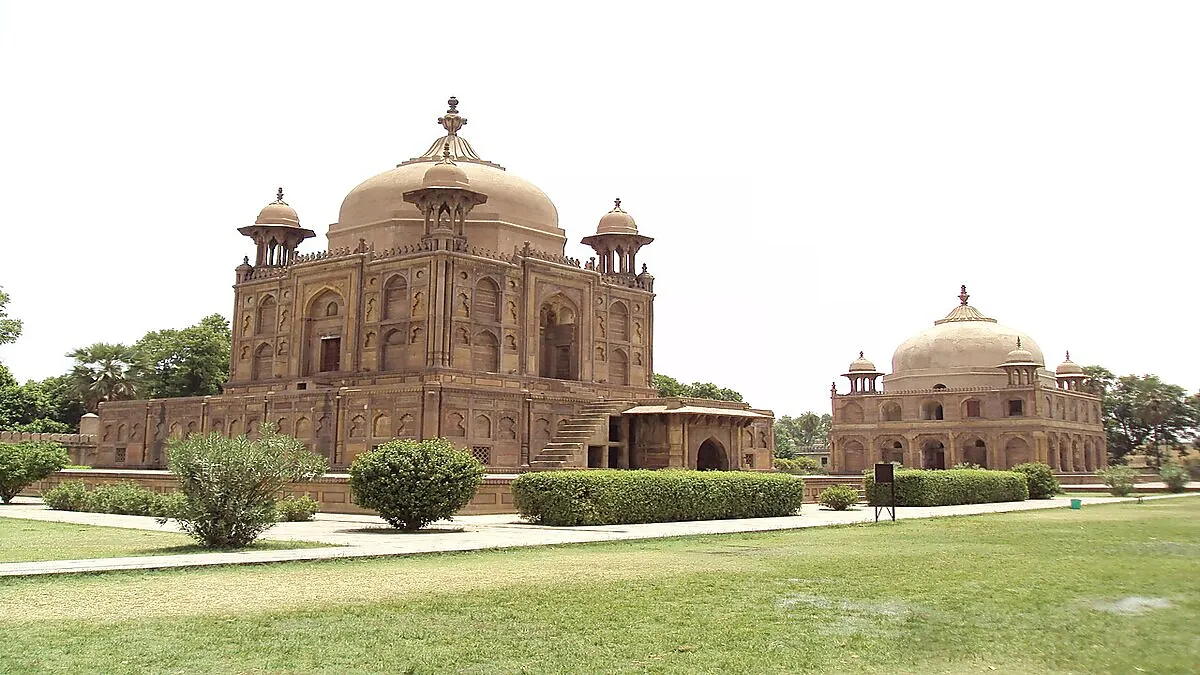
It is late afternoon as you pass through the grand southern gateway of Khusro Bagh Prayagraj. The sun, now softening, casts long shadows from the towering sandstone tombs. The sounds of the city – the honking rickshaws and bustling bazaars – dissolve behind the high stone walls. In their place, you hear only the gentle rustle of leaves from the guava trees overhead and the distant cooing of pigeons.
Before you, three magnificent mausoleums rise from the emerald lawns, each a silent witness to a story of love, ambition, rebellion, and tragedy. This is not merely a garden, but a stage for one of the most poignant sagas of the Mughal court.
The central tomb, with its unique three-tiered terrace, belongs to Shah Begum – a Rajput princess who swallowed poison rather than witness her husband and son tear each other apart. Beside her lies the tomb of Nithar Begum, whose empty mausoleum houses some of the finest frescoes of the Mughal era. And at the far end, beneath a canopy of stone, rests Prince Khusro Mirza – the eldest son of Emperor Jahangir, who dared to rebel and paid the ultimate price.
What secrets do these sandstone walls hold? What artistry lies hidden within their painted ceilings? And how did this peaceful garden become a stage for one of the greatest tragedies of the Mughal Empire? Let us walk together through the gates of Khusro Bagh and uncover the stories that have been waiting for four hundred years.
Quick Facts
| Detail | Information |
| Name | Khusro Bagh (also spelled Khusrau Bagh) |
| Location | Lukarganj / Khuldabad, Prayagraj, Uttar Pradesh |
| Distance from Prayagraj Junction | Approximately 1 km (walking distance) |
| Built | Late 16th – early 17th century (c. 1599 – 1625 CE) |
| Area | Approximately 40 acres |
| Architectural Style | Mughal funerary architecture with Rajput influences |
| Key Monuments | Tomb of Shah Begum, Tomb of Nithar Begum, Tomb of Khusrau Mirza, Bibi Tamolon’s Tomb |
| Known For | Exquisite sandstone carving, star‑painted ceilings, empty mausoleum, tragic royal history |
| Status | Protected Monument of the Archaeological Survey of India (ASI) |
| Entry Fee | Free |
| Timings | Sunrise to sunset (typically 6:00 AM – 7:00 PM) |
| Best Time to Visit | October – March (winter) |
| Recommended Duration | 45 minutes – 1.5 hours |
Table of Contents
What is Khusro Bagh?
Khusro Bagh is a large, walled Mughal garden and funerary complex located in the Khuldabad area of Prayagraj, just a short walk from the Prayagraj Junction railway station. Spread over approximately 40 acres and shaped like a quadrangle, it is one of the finest surviving examples of Mughal garden architecture in North India. The garden houses four sandstone mausoleums dedicated to members of the Mughal imperial family.
Today, Khusro Bagh is a cherished public space. Locals come to stroll beneath the shade of its fruit trees, students find quiet corners to study, and heritage travellers from around the world come to admire its art and to walk where princes once walked. It is listed as an Indian Site of National Importance and is protected by the Archaeological Survey of India.
The Story of Prince Khusro – A Prince Who Dared to Rebel
To understand Khusro Bagh, you must first understand the man whose name it bears: Prince Khusrau Mirza.
Birth and Promise
Khusrau Mirza was born on 16 August 1587 in Lahore. He was the eldest son of Prince Salim (the future Emperor Jahangir) and his first wife, the Rajput princess Manbhawati Bai (later known as Shah Begum). From a young age, Khusrau displayed exceptional promise. He was the favourite grandson of the great Emperor Akbar, who personally groomed the young prince for the throne.
The Succession Crisis
As Akbar aged and his son Salim grew impatient, the Mughal court became a snake pit of intrigue. Salim (Jahangir) was known for his dissolute habits and addiction to opium. Many at court, including Akbar himself, believed that Khusrau – cultured, intelligent and ambitious – would make a better ruler than his father.
When Akbar died in 1605, Jahangir ascended the throne. But the tension between father and son did not end. Jahangir was wary of his popular eldest son and openly favoured a younger son, Prince Khurram (the future Emperor Shah Jahan).
The Rebellion of 1606
In April 1606, just months after Jahangir’s accession, Khusrau decided he could wait no longer. He fled Agra, raised an army, and marched towards Lahore, declaring himself emperor. He was supported by a powerful faction, including Guru Arjan Dev (the fifth Sikh Guru), which led to a dark chapter of religious persecution.
The rebellion failed. Khusrau‘s raw levies were no match for Jahangir’s disciplined imperial army. He was defeated, captured, and brought before his father in chains.
The Horrific Sentence
The punishment was brutal. Khusrau was blinded – a common Mughal punishment designed to disqualify a prince from the throne. According to some accounts, burning oil was poured into his eyes. He was then transferred to the custody of his younger brother, Khurram, who kept him imprisoned.
Death and Legacy
On 26 January 1622, the tragedy reached its final act. According to historical accounts, Khusrau was killed on the orders of Prince Khurram during an attempted escape or while being transferred. The prince‘s death was a source of profound grief for those who had loved him, and a dark stain on the reputation of his brother, who would later rule as the great Shah Jahan.
Khusrau’s body was brought to Prayagraj and interred within the garden that now bears his name. His tomb, the last of the three main mausoleums, was completed in 1622. The garden itself became a permanent monument to his short, tragic life.
Shah Begum – The Tragic Mother
If Prince Khusro‘s story is one of political ambition, his mother’s is one of heartbreak. Shah Begum was born Manbhawati Bai, the daughter of Raja Bhagwant Das of Amber (Amer, Rajasthan).
A Royal Marriage
In 1585, the Rajput princess was married to Prince Salim. She became his first wife and chief consort, known as Zan-i-Kalan – the ‘Principal Lady‘.
For a time, there was happiness. Manbhawati gave birth to a daughter, Sultan-un-Nissa, and a son, Khusrau, who became the apple of his grandfather Akbar‘s eye.
The Poison
But the happiness was not to last. As Khusrau grew older, the rivalry between him and his father intensified. Manbhawati found herself torn between her husband, the emperor, and her own beloved son.
Distressed beyond measure, consumed by despair at the discord, she made a fateful decision. In 1604, she swallowed a fatal dose of opium and died at Allahabad. She was around 35 years old.
Thus, before Khusrau ever raised his sword against his father, the mother who loved them both was already dead by her own hand. Her tomb, built in 1606, was the first of the great mausoleums in Khusro Bagh.
Nithar Begum – The Princess Who Built Her Own Tomb
The third main occupant of Khusro Bagh is Nithar Begum, also known as Sultan-un-Nissa Begum. She was the daughter of Jahangir and Shah Begum, and the sister of Prince Khusro.
An Empty Mausoleum
Unlike the other tombs in Khusro Bagh, Nithar Begum‘s mausoleum is empty. It was built under her own instructions between 1624 and 1625, two years after her brother’s death, but she was not buried here. Historians believe she was interred elsewhere, and the exact location of her grave remains unknown.
Why Build an Empty Tomb?
Why would a princess commission such an elaborate, empty mausoleum? The answer, perhaps, lies in her family‘s tragic history. Nithar had lost her mother to suicide and her brother to political murder. Maybe this empty tomb was a memorial, a cenotaph not to a body but to a family‘s shattered hopes. It may also have been intended as a statement of her own status and independence, a princess powerful enough to build a monument to herself.
Whatever the reason, the result is an architectural wonder. Her tomb is widely considered the most artistically sophisticated and elaborate of the three.
Bibi Tamolon – The Forgotten Fourth Tomb
In addition to the three main royal tombs, there is a fourth mausoleum within the garden: the tomb of Bibi Tamolon. Much less is known about Bibi Tamolon, and it is often overlooked by visitors. It is believed to be the tomb of a woman associated with the royal household, perhaps a nurse or a servant. It is a smaller, simpler structure, but still part of the protected heritage site.
According to some sources, the name “Bibi Tamolon” may be a corruption of Bibi Dil Aram, and the tomb was built by one of Jahangir‘s queens in memory of a lady who held a high position in the zenana (women’s quarters).
Khusro Bagh as a Mughal Garden
Khusro Bagh is more than a burial ground; it is a fine example of the Mughal garden (charbagh) tradition. The garden is laid out as a quadrangle (a four‑sided enclosure), bounded by high stone walls.
The Charbagh Concept
The charbagh, or ‘four‑garden‘, was a Persian garden concept perfected by the Mughals. It symbolised the Islamic vision of paradise: a cool, walled sanctuary divided by water channels, filled with fruit trees and flowers, offering shade and respite from the harsh outside world.
At Khusro Bagh, the central pathways radiate from the tomb of Shah Begum, her mausoleum serving as the symbolic heart of the garden. The grounds were once planted with fruit trees, including mango and guava. They still provide shade and a sense of peace.
Water Features
Originally, the garden boasted water channels and fountains, a hallmark of Mughal landscaping. You can still see raised platforms (chabootaras) near Nithar Begum‘s tomb, which were perhaps used for dance performances or for sitting by the water.
A Pioneer of the Garden‑Tomb Complex
Architecturally, Khusro Bagh is significant. Its design, layout, and construction set in motion a transformative trend in urban landscapes during the Mughal period, representing the beginning of grand garden funerary complexes in the region.
The Tomb of Shah Begum – A Three‑Tiered Masterpiece
The tomb of Shah Begum, located at the centre of the garden, is the first of the three great mausoleums. Built in 1606, it was designed by Aqa Reza, Jahangir’s principal court artist, who is also credited with the garden‘s main entrance and landscaping.
Unique Three‑Tiered Structure
Unlike the typical Mughal tomb with a central dome, Shah Begum‘s tomb is a three‑storey terrace plinth without a main mound, rising in levels without a central dome. This unusual design has invited comparisons with the architecture of Fatehpur Sikri. Where a dome would normally be, a large chhatri (a domed pavilion) surmounts the topmost terrace.
Rajput Influences
The absence of a central dome and the presence of the chhatri point to strong Rajput influences in the design – a fitting tribute to the princess’s heritage. The tomb is a beautiful blend of Islamic and Rajput architectural traditions.
Calligraphic Splendor
The tomb’s decoration is the work of Mir Abdullah Mushkin Qalam, Jahangir‘s most celebrated calligrapher. The arabesque inscriptions that adorn the walls are masterpieces of Islamic calligraphy, with verses from the Quran carved with exquisite precision into the red sandstone.
Four Radiating Walkways
Four walkways emerge like fingers from the central tomb, leading to the main entrance and to the other tombs of the complex. This layout reinforces the tomb’s position as the symbolic centre of the garden.
The Tomb of Nithar Begum – The Crown Jewel
Architecturally speaking, the most stunning and elaborate of the three tombs is that of Nithar Begum.
Exterior Splendor
The two‑storeyed edifice, built of red sandstone, stands on a raised platform right next to the tomb of Shah Begum. It is ornamented with panels depicting the scalloped arch motif – a decorative element derived from mosque architecture.
An Exquisitely Carved Doorway
An intricately carved stone doorway leads to the lower level. This room was originally meant to house the grave, but since the princess was buried elsewhere, the chamber stands empty.
Star‑Painted Ceilings
The real magic of Nithar Begum‘s tomb lies inside. The ceiling of the upper level is embellished with some of the finest frescoes of the Mughal era. The paintings portray stars in concentric circles, creating a stunning cosmic effect.
Floral Paradise
The walls of the central chamber are decorated with floral themes – Persian cypresses, wine vessels, flowers, and plants – all painted in vivid colours that have remarkably survived the centuries. This is a small slice of paradise, a vision of the garden that awaits the faithful.
A Cenotaph Without a Body
Because the tomb is empty, visitors are allowed to stand inside the central chamber and look up at the painted ceiling – a privilege not available in many Mughal tombs.
The Tomb of Prince Khusro – Simplicity and Sorrow
The tomb of Prince Khusro is the simplest of the three. It is a single‑storey structure built from red sandstone around a rubble core.
Nine‑Grid Layout
The tomb follows the typical nine‑grid mausoleum layout commonly associated with Islamic and Mughal architecture. The plan is square, divided into nine smaller compartments, with the central chamber housing the grave.
Fretwork and Jali Screens
The walls feature excellently carved stone jali (fretwork) screens. Light filters through these delicate stone grilles, casting beautiful patterns on the floor inside.
The Grave of His Mare
Right next to the tomb, you will see a smaller grave. According to local accounts, this is the grave of Khusrau‘s favourite mare, buried alongside her master – a moving testament to the bond between the prince and his faithful animal.
An Empty Tomb for a Body That Is There
Unlike his sister‘s cenotaph, Khusrau‘s tomb is not empty. His mortal remains lie here, beneath the stone canopy.
Mughal Art and Decoration – Frescoes, Calligraphy, and Carvings
Khusro Bagh is a showcase of the finest Mughal decorative arts.
Frescoes
The star‑painted ceilings of Nithar Begum‘s tomb are the highlight. Painted in vivid blues, golds, and reds, they remain remarkably well‑preserved after 400 years.
Calligraphy
The walls of Shah Begum‘s tomb bear the work of Mir Abdullah Mushkin Qalam, ‘the painter of fragrance‘. His elegant script is a joy to behold for anyone who appreciates the art of writing.
Stone Carving
All three tombs are adorned with carved stonework, including scalloped arch motifs, floral arabesques, and geometric patterns. The jali screens on Khusrau‘s tomb are particularly fine.
Floral Decoration
The walls of Nithar‘s chamber are painted with Persian cypresses, wine vessels, and flowers – a metaphor for paradise.
The Politics of the Mughal Court – Father Against Son
Khusro Bagh is the final resting place of a family torn apart by the brutal logic of Mughal succession.
A House Divided
The Mughal Empire was not ruled by primogeniture (automatic succession by the eldest son). Instead, each son could legitimately claim the throne upon his father’s death, leading to constant warfare and bloodshed between siblings.
A Wasted Generation
Khusrau was a promising prince, beloved by his grandfather, but his father’s suspicion and a younger brother’s ambition sealed his fate. His mother, broken by the conflict, took her own life. His sister, who survived, was left to build an empty tomb for herself. The garden thus speaks not only of the past but also of the human cost of power.
Khusro Bagh in the First War of Independence (1857)
Khusro Bagh‘s role in Indian history did not end with the Mughals. During the First War of Independence in 1857, the garden became the headquarters of the sepoys (Indian soldiers) who had revolted against the British East India Company.
The rebel forces were led by Maulvi Liaqat Ali, a charismatic leader who fought for the expulsion of the British. The walls that had once confined a rebel prince now sheltered a new generation of freedom fighters. When the rebellion was eventually crushed, the British, in an act of deliberate desecration, reportedly used Khusro Bagh as a stable for their horses. Today, the garden stands as a proud reminder of its double heritage: Mughal art and the spirit of 1857.
Conservation and Preservation
Khusro Bagh is a protected monument of the Archaeological Survey of India (ASI) . Conservation work is attended to regularly, and the site is in a good state of preservation.
In 2021, the ASI undertook a special conservation project, spending over 27 lakh rupees to restore the deteriorating mausoleums. The project involved bringing in specialist stone carvers from Banda and Rajasthan to precisely match the 500‑year‑old stonework.
Today, entry is free. The site is well‑maintained. It is free from the “stray cattle” that once plagued the garden – a far cry from the sorry state of neglect reported by the Times of India in 2015. You can explore the tombs, stroll along the pathways, and sit on the lawns in perfect peace.
Visitor Guide – Timings, Entry, Best Time to Visit
| Detail | Information |
| Location | Lukarganj, Prayagraj, Uttar Pradesh |
| Timings | Sunrise to sunset (approximately 6:00 AM – 7:00 PM) |
| Entry Fee | Free |
| Best Time of Year | October – March (winter) |
| Best Time of Day | Morning (7:00 AM – 9:00 AM) or late afternoon (4:00 PM – 6:00 PM) |
| Recommended Duration | 45 minutes – 1.5 hours |
What to Wear: Comfortable walking shoes and modest attire.- What to Bring: A camera (photography is generally allowed), a water bottle (especially in summer), a hat and sunscreen for sun protection.
- Photography Restrictions: Be respectful when photographing others. Flash photography inside buildings is discouraged to preserve the frescoes.
How to Reach Khusro Bagh
Address: Lukarganj / Khuldabad, near Prayagraj Junction railway station, Prayagraj, Uttar Pradesh.
- By Air: The nearest airport is Prayagraj Airport (Bamrauli), approximately 10‑12 km away. From the airport, you can take a taxi or a ride‑sharing service.
- By Train: Prayagraj Junction is within walking distance (approximately 1 km). You can easily walk, or take a short auto‑rickshaw or cycle‑rickshaw ride.
- By Road: The garden is on Leader Road, well‑connected to all parts of the city. Auto‑rickshaws are the most convenient mode of transport. The nearest bus stand is the Civil Lines Bus Stand, about 4 km away.
- By Car: Parking is available on the street near the entrance, but it can be limited. It is often easier to take an auto‑rickshaw.
Nearby Attractions – Combining Heritage in Prayagraj
Khusro Bagh is centrally located, making it easy to combine with other sights.
- Allahabad Museum & Chandrashekhar Azad Park: A short drive (approx. 3‑4 km). The museum houses the pistol of Chandrashekhar Azad; the park is where he made his last stand.
- Allahabad Fort & Akshayavat: Approximately 4‑5 km. Akbar‘s mighty fort, the Ashokan pillar, and the legendary banyan tree.
- Triveni Sangam: Approximately 5‑6 km. The sacred confluence of the Ganga, Yamuna, and mythical Saraswati.
- Anand Bhavan Museum: Approximately 3‑4 km. The ancestral home of the Nehru family.
- All Saints Cathedral (Patthar Girja): Approximately 3‑4 km. A stunning example of Gothic Revival architecture.
- Suggested Itinerary:
- Morning (8:00 AM): Khusro Bagh (1 hour)
- Late Morning (9:30 AM): Anand Bhavan Museum (1.5 hours)
- Afternoon (12:30 PM): Lunch in Civil Lines
- Afternoon (2:00 PM): Allahabad Museum & Chandrashekhar Azad Park (2 hours)
- Late Afternoon (4:30 PM): Allahabad Fort & Akshayavat (2 hours)
- Evening (6:30 PM): Ganga Aarti at Triveni Sangam
Photography Tips – Capturing the Spirit of Khusro Bagh
Khusro Bagh is a photographer‘s delight.
- Early Morning (7:00 – 9:00 AM): The golden hour light is soft and warm. Best for capturing the overall landscape and the exterior of the tombs. The lower angle of the sun creates long, dramatic shadows.
- Late Afternoon (4:00 – 6:00 PM): The warm light of the setting sun gives the red sandstone a beautiful glow. This is the best time for close‑ups of the stone carvings.
- Avoid Mid‑day: The harsh overhead sun creates unflattering shadows and washes out the colours.
- Close‑ups: Focus on the calligraphy on Shah Begum‘s tomb, the scalloped arches on Nithar Begum‘s, and the jali screens on Khusrau‘s. A telephoto or macro lens is ideal.
- Interiors: You will need to use a high ISO setting, as the interiors can be dark. A tripod is not usually allowed, but you can brace yourself against a wall. For the painted ceilings, lie on your back and point your camera straight up.
- People: Be respectful. Ask permission before taking portraits of other visitors.
Frequently Asked Questions (FAQs)
1. What is Khusro Bagh famous for?
Khusro Bagh is a large Mughal garden famous for its three royal sandstone tombs – those of Prince Khusro Mirza, his mother Shah Begum, and his sister Nithar Begum – and its exquisite Mughal architecture.
2. Who is buried at Khusro Bagh?
Three members of the Mughal royal family are buried here: Prince Khusro Mirza (Jahangir‘s eldest son), Shah Begum (Jahangir’s first wife and mother of Khusro), and Nithar Begum (Khusro‘s sister). There is also a fourth tomb of Bibi Tamolon.
3. Is there an entry fee for Khusro Bagh?
No, entry to Khusro Bagh is free for all visitors.
4. What are the Khusro Bagh timings?
The garden is open from sunrise to sunset, generally around 6:00 AM to 7:00 PM.
5. How far is Khusro Bagh from Prayagraj railway station?
It is very close – approximately 1 km from Prayagraj Junction, easily walkable or a short auto‑rickshaw ride.
6. Why is Nithar Begum‘s tomb empty?
Nithar Begum built the tomb for herself, but for reasons unknown, she was never buried there. It remains a cenotaph (an empty tomb).
7. What is the architectural style of the tombs?
The tombs are excellent examples of Mughal architecture with strong Rajput influences, especially in the design of Shah Begum‘s chhatri.
8. Who designed the gardens and Shah Begum‘s tomb?
The design is attributed to Aqa Reza, Jahangir’s principal court artist.
9. Why is the tomb of Shah Begum unusual?
It has a three‑tiered terrace with a large chhatri on top instead of a central dome – a unique design in Mughal funerary architecture.
10. Are there any frescoes in Khusro Bagh?
Yes, the upper chamber of Nithar Begum‘s tomb has some of the finest Mughal frescoes, including stunning star‑painted ceilings and floral motifs.
11. What is the history of Prince Khusro?
Prince Khusro was the eldest son of Emperor Jahangir. He rebelled against his father in 1606, was defeated, blinded, imprisoned, and ultimately killed on the orders of his brother Khurram (the future Emperor Shah Jahan).
12. How did Shah Begum die?
Distressed by the conflict between her husband and son, she committed suicide by swallowing opium in 1604.
13. Is Khusro Bagh a protected monument?
Yes, it is a protected monument of the Archaeological Survey of India (ASI) and an Indian Site of National Importance.
14. Is there any connection with the 1857 uprising?
Yes, during the First War of Independence in 1857, Khusro Bagh served as the headquarters of the rebel forces led by Maulvi Liaqat Ali.
15. What is the best time of year to visit?
The winter season (October to March) is ideal, with pleasant temperatures for walking around the garden.
16. Is there a fourth tomb in the garden?
Yes, there is a smaller fourth tomb dedicated to Bibi Tamolon, whose identity is less certain.
17. How much time should I spend at Khusro Bagh?
Plan for 45 minutes to 1.5 hours to explore the tombs and gardens at a relaxed pace.
18. Can tourists take photographs inside the tombs?
Yes, but flash photography is generally discouraged, especially inside the tomb of Nithar Begum, to help preserve the delicate frescoes.
19. Is the garden wheelchair accessible?
The main pathways are relatively flat and may be navigable with assistance, but accessing the tombs themselves involves climbing steps.
20. Why is there a small grave next to Khusro‘s tomb?
According to local tradition, it is the grave of Khusro‘s favourite mare, buried beside her master as a mark of loyalty and affection.
Why Khusro Bagh Deserves a Place on Your Prayagraj Itinerary
Khusro Bagh is not merely a collection of Mughal tombs; it is a window into the heart of a dynasty. It is a place where art, history, and human emotion meet. In one afternoon, you can:
- Marvel at the unique three‑tiered architecture of Shah Begum’s tomb, a structure that defies Mughal convention.
- Stand inside Nithar Begum’s empty mausoleum and gaze up at star‑painted ceilings that have survived for four centuries.
- Pay your respects at the grave of Prince Khusro, a prince of great promise who was defeated by the brutal politics of his age.
- Reflect on the tragic story of a mother who chose death over witnessing her family tear itself apart.
- Enjoy a moment of peace in a 40‑acre walled garden, far from the noise of the city.
Whether you are a student of history, a lover of art, or simply a traveller searching for quiet beauty, Khusro Bagh will speak to you. It reminds us that the past is not dead; it lives on in sandstone and paint, in gardens and graves, waiting for those who care to listen. Khusro Bagh is more than a Mughal garden. It is a silent chronicle of love, ambition, tragedy, architecture, and the enduring legacy of one of India’s greatest imperial dynasties.
Related Heritage Journeys
Enhance your exploration of Prayagraj‘s rich history with these related guides:
- Allahabad Fort – The Mughal Citadel at the Confluence – Discover Akbar‘s mighty fort, the Ashokan pillar, and the sacred Akshayavat tree.
- Prayag Prashasti – The Allahabad Pillar Inscription – Uncover the story of Samudragupta‘s conquests on the ancient Ashokan pillar.
- Allahabad Museum – Treasure House of History – See the pistol of Chandrashekhar Azad and a world‑class collection of Gupta art.
- Chandrashekhar Azad Park – From Alfred Park to a Revolutionary Memorial – Explore the largest park in Prayagraj and the site of the revolutionary’s last stand.
- Allahabad Public Library – Thornhill Mayne Memorial – Admire the Scottish Baronial architecture of one of India‘s oldest public libraries.
- Anand Bhavan – Museum of the Freedom Movement – Walk through the ancestral home of the Nehru family and the cradle of Indian independence.
- Triveni Sangam – The Sacred Confluence – Experience the spiritual heart of Prayagraj where three holy rivers meet.
This article is part of a series on the heritage and cultural landmarks of Prayagraj. For more information on planning your heritage tour, please contact us.
Prayag Tourism
📞 Phone/WhatsApp: +91-9555313526
📧 Email: contact@prayagtourism.com
🌐 Website: PrayagTourism.com
May your journey be peaceful, safe, and historically enriching – and may the beauty of Khusro Bagh linger in your memory long after you have left its quiet gardens.