
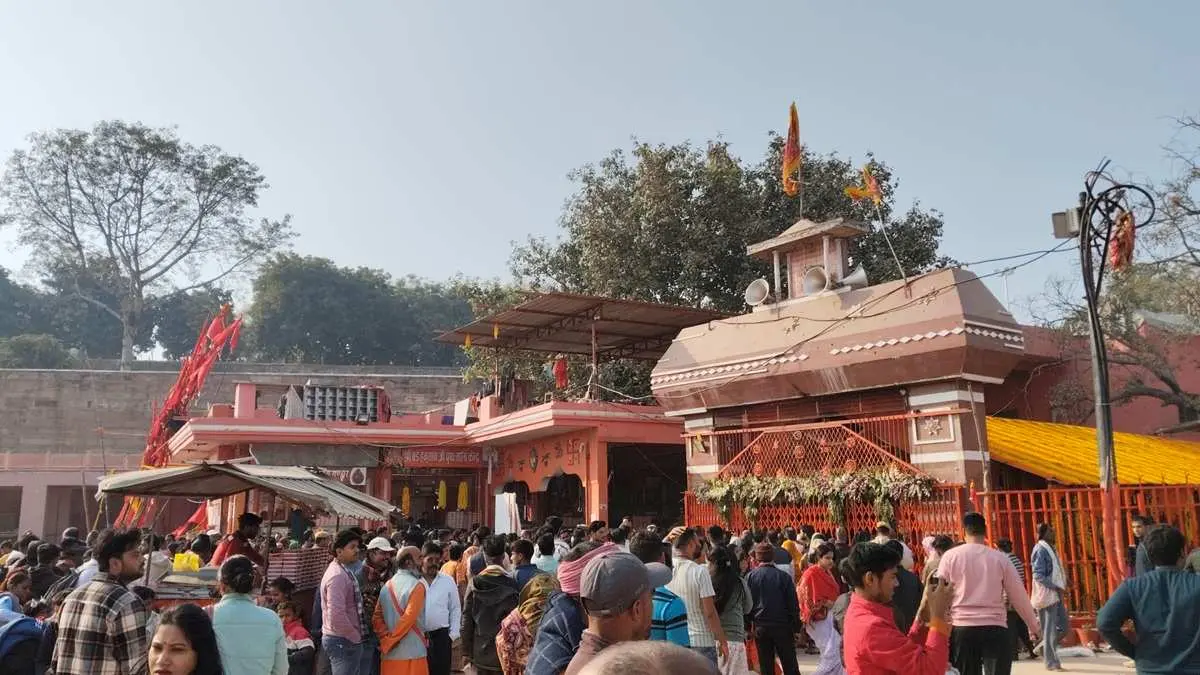
The first light of dawn is just beginning to touch the sky over Prayagraj. The air is cool and filled with the scent of incense as you make your way through the narrow lane leading from the Triveni Sangam. Somewhere ahead, the gentle ring of temple bells mingles with the soft chanting of “Jai Bajrang Bali, Jai Bajrang Bali.”
You step inside the compound and suddenly, the world above fades away. The temple is not built like others—it descends downward, into the earth. You walk down a short flight of stairs, leaving behind the noise of the city. The air grows cooler, quieter. At the bottom, you see it.
A massive, 20-foot-long idol of Lord Hanuman lies before you, in a posture of deep rest. His right hand holds a gada (mace). His other hand holds Ram and Lakshman protectively. His face is peaceful, yet powerful. Devotees stand in hushed reverence, offering flowers, sindoor, and prayers.
This is the Bade Hanuman Ji Mandir—also known as the Lete Hanuman Ji Temple—the only temple in the world where Lord Hanuman is worshipped in a reclining posture. Why is he lying down here, when everywhere else he is depicted standing, flying, or kneeling in devotion? What secret does this temple hold?
Let us journey together into the sacred mystery of this extraordinary shrine.
Table of Contents
📜Quick Facts at a Glance
| Detail | Information |
| Temple Name | Shri Bade Hanuman Ji Mandir |
| Popular Name | Lete Hanuman Ji Temple |
| Location | Near Triveni Sangam, Daraganj, Prayagraj, Uttar Pradesh |
| Deity | Lord Hanuman (Bajrang Bali) |
| Unique Feature | 20‑foot reclining idol — the only one of its kind in the world |
| Idol Orientation | Head pointing north, feet pointing south (guarding Prayag) |
| Nearby Landmark | Triveni Sangam (approx. 1 km); Allahabad Fort (adjacent) |
| Major Festivals | Hanuman Jayanti, Ram Navami, Tuesdays & Saturdays |
| Darshan Timings | 5:00 AM – 2:00 PM; 5:00 PM – 8:00 PM (Tue/Sat till 10:00 PM) |
| Best Season | October–March (winter) |
What Makes Bade Hanuman Ji Temple Unique?
The Bade Hanuman Ji Mandir stands apart from every other Hanuman temple in India for several extraordinary reasons.
The Only Reclining Hanuman in the World: In every other Hanuman temple—from the hilltops of Tirumala to the lanes of Varanasi—Lord Hanuman is depicted either standing (as a vigilant sentinel), kneeling in devotion (Ram bhakt), or flying (carrying the Sanjeevani mountain). Here, and only here, he lies down. This is the only temple dedicated to Lord Hanuman in a reclining posture.
A Colossal 20‑Foot Idol Below Ground: The idol is not towering above you; it lies below the surface. The sanctum is a pit 6–7 feet deep, and the massive idol—20 feet long and 8 feet wide—rests on the floor. As you descend the stairs, you approach the Lord not by looking up, but by standing level with him. The idol is made from Vindhyachal stone and is believed to be 600–700 years old.
The Idol Faces South: Most Hindu temples face east, towards the rising sun. But Bade Hanuman faces south, the direction of Yama, the god of death. Lord Hanuman guards Prayagraj from the south, protecting his devotees from fear, misfortune, and untimely death.
The Land Is Considered Swayambhu (Self‑Manifested): Local tradition holds that the idol of Hanuman Ji appeared on its own at this spot (swayambhu). The temple was built around it after its discovery.
The Legend of Lete Hanuman Ji – Three Sacred Stories
The temple’s origin is woven from several beloved legends, each passed down through generations of devotees.
Legend 1: The Rested Warrior (Ramayana tradition)
After Lord Rama defeated Ravana and won the war in Lanka, his army of vanaras was exhausted. Hanuman, who had played the most crucial role—burning Lanka, finding Sita, carrying the Sanjeevani mountain—was utterly spent. As the army passed through Prayagraj on their return to Ayodhya, the goddess Sita noticed Hanuman’s fatigue. She turned to him and said, “Bajrang Bali, you have served Ram with all your strength. Now, rest.” And so, Hanuman laid down on the banks of the Sangam. To honour that moment of divine rest, a temple was built where he lay.
Legend 2: The Kannauj King and the Divine Dream
A wealthy but childless merchant (or king, according to some versions) from Kannauj longed for a son. His guru advised him to commission an idol of Hanuman from the Vindhyachal hills. The merchant had the idol carved and transported by boat toward Kannauj. When the boat reached Prayagraj, he decided to halt for the night. In the middle of the night, the boat suddenly broke apart, and the massive idol sank into the river, disappearing from sight. The heartbroken merchant returned to Kannauj, believing he had failed. Years later, the waters of the Ganga receded, and a great saint named Baba Balagiri Ji Maharaj, while digging a sacred fire pit (dhuni) near the Sangam, discovered a massive stone idol. It was the long‑lost Vindhyachal statue of Hanuman. The saint established a temple at the site and began worshipping the reclining idol. The merchant, it was said, was eventually blessed with a son.
Legend 3: The Royal Sculpture and the Unmoving Stone
In the 14th century, a King of Kannauj had a massive idol of Lord Hanuman carved in the Vindhyas and placed on a boat. The boat broke near the Sangam, and the idol fell into the river. It remained there, forgotten. Centuries later, the saint Baghambari Baba dreamt of the idol during the Kumbh Mela. Excavations unearthed the 20‑foot statue. When the saint tried to move it to a different location, he discovered that the statue was impossibly heavy and would not budge. The Lord had chosen his spot. The temple was built around him, where he remains today.
Legend 4: Akbar and the Unwilling Deity
When the Mughal Emperor Akbar built his massive fort in Prayagraj in 1582, he attempted to relocate the Hanuman idol. According to legend, the idol would not move—no matter how many men or elephants were used. Seeing this as a sign, Akbar abandoned his plan. Instead, he built the wall of his fort behind the temple and formally dedicated the land to Lord Hanuman.
Why Is Hanuman Lying Down? – Symbolism and Interpretations
The reclining posture of Lord Hanuman here is rich with spiritual meaning. It is not a sign of weakness but of profound wisdom.
The Lord Who Has Completed His Mission: Hanuman is depicted in this posture because his primary mission—the service of Lord Rama—is complete. He succeeded in finding Sita, burning Lanka, carrying the Sanjeevani, and winning the war. His work is done, and now he rests. It is the rest of a warrior after a victorious battle, not the sleep of the lazy.
A Hidden Promise: “I Will Not Leave Prayag”: There is a beautiful local belief that the Ganga floods the temple every year during the monsoon. The river water rises, touches the feet of the idol, and then slowly recedes. This is interpreted as the Ganga coming to bathe Hanuman. But why would the Ganga need to visit Hanuman? Because Hanuman has promised never to leave Prayag. He cannot leave to bathe in her, so she comes to him.
The Symbol of a Completed Pilgrimage: For millions of Kumbh pilgrims, the Sangam snan (holy dip) is their first act. But for many, the darshan of Bade Hanuman is the final act. Seeing Hanuman in rest symbolises their own spiritual journey—the effort of pilgrimage has been made, the purification has been received, and now it is time to rest in the grace of the Lord.
Guarding Prayagraj from the South: The idol faces south—the direction of Yama, the god of death. In Hindu tradition, the south is considered the direction of fear, misfortune, and mortality. Hanuman faces south as the Kotwal of Prayagraj (the guardian), protecting the city and its pilgrims from all harm, disease, and evil influences.
Resting in “Vanar” Form: Unlike most temples where Hanuman is depicted in his divine, awe‑inspiring form, the reclining idol shows him in a more human, approachable state. He is not performing miracles, not flying, not standing guard. He is simply resting. This reminds us that even the greatest of devotees need rest, and that the Divine is not always in grand action—sometimes, it is found in stillness.
The Reclining Idol – Iconography and Sacred Details
The idol of Bade Hanuman is unlike any other. Every detail carries meaning.
Size and Material: The idol is 20 feet long and 8 feet wide, carved from black stone sourced from the Vindhyachal hills. It is one of the largest Hanuman idols in India.
Posture: The idol lies on its back in a straight, relaxed posture—not curled, not turned, but fully stretched out. His head points north, toward the Himalayas (the abode of Shiva), and his feet point south.
Right Hand: His right hand rests beside his body, holding a mace (gada). The mace is not raised in combat; it rests beside him, symbolising that the battle is over and the weapon is now at peace.
Left Hand: His left hand is positioned differently. In the Lete Hanuman tradition, his left arm is bent, holding Lord Ram and Lakshman protectively against his chest. This is the most striking feature of the idol. Even while resting, Hanuman does not let go of his Lord. His service is not a duty—it is his very nature.
Expression: The face is serene, eyes half‑closed, lips carrying a gentle smile—the expression of one who has seen everything, done everything, and now rests in the satisfaction of service fulfilled.
Position: The idol is placed in a sanctum 8.1 feet below the ground level. The low ceiling and confined space create an atmosphere of intimacy and focused devotion. There is no grand hall here—just the devotee and the Lord, face to face.
Other Deities: In the same complex, you will find shrines dedicated to Goddess Janaki (Sita) and a sacred Peepal tree, which is also worshipped by devotees.
According to the Puranas, this is the only place where Hanuman is seen in this unique form. The local saying goes: Har jagah Hanuman khade hain, yahan Hanuman lete hain—”Everywhere Hanuman stands; here, Hanuman lies down.”
Bade Hanuman Ji and Triveni Sangam – The Spiritual Connection
No visit to Bade Hanuman Ji is complete without understanding its inseparable link to the Triveni Sangam.
Location: The temple is located approximately 1 kilometre from the Triveni Sangam, where the Ganga, Yamuna, and mythical Saraswati converge. The proximity is deliberate—pilgrims bathe in the sacred waters and then walk to seek Hanuman’s blessings.
The Sangam-Hanuman Circuit: For Kumbh pilgrims, the ritual often unfolds in three parts:
- Holy Dip at the Sangam — Purification of the body and soul.
- Darshan at Bade Hanuman Ji — Seeking strength, protection, and the grace of the Kotwal of Prayagraj.
- Darshan at Akshayavat or Alopi Devi — Completing the pilgrimage.
Hanuman as “Kotwal” of Prayag: In the sacred geography of Prayag, Bade Hanuman is considered the Kotwal (gatekeeper/protector) of the holy city. As the guardian, he receives all pilgrims and protects them throughout their stay.
Pilgrim Tradition: After taking the holy dip, pilgrims often visit the temple with offerings of sindoor (vermilion) and flowers. The sindoor is placed on the reclining idol’s body, and special prayers are offered for the removal of fear (bhaya nivaran), protection from negative energies (grah dosha), and success in endeavours.
The Famous Flood Tradition – When Ganga Bathes Hanuman
One of the most remarkable features of the Bade Hanuman Ji Temple is its relationship with the Ganga River. During the monsoon season (July–September), the rising waters of the Ganga and Yamuna enter the temple premises and submerge the deity. This is not a disaster or an accident—it is considered a sacred event.
The Annual Flood Ritual: As the floodwaters rise, they first touch the temple steps. Then they enter the sanctum. Devotees do not flee; they gather. They chant “Jai Bajrang Bali” and “Jai Ganga Maiyya” as the water rises higher.
“Ganga Aarti and Abhishek of Lord Hanuman”: Before the water completely submerges the idol, the head priest performs a special Ganga Aarti and Abhishek, honouring both the river and the Lord. The priest has explained: “After the floodwater enters the temple, we perform Ganga aarti followed by abhishek of both Ganga and Lord Hanuman”.
Symbolism: The flood is interpreted in two beautiful ways:
- Mother Ganga bathing her son: As Hanuman is considered the son of Vayu (wind) and Anjani, the Ganga—the mother of all rivers—comes to bathe him affectionately.
- Hanuman’s promise not to leave Prayag: The river cannot come to him every day, but once a year, she rises to touch his feet. The tradition is lovingly called “Ganga ji ka abhishek”
Devotee Experience: Floodwaters can be dangerous, but the temple continues to attract devotees during this period. People come specifically to witness the submergence, believing that a dip in the floodwaters (which are the Sangam itself) combined with a glimpse of the partially submerged Hanuman brings immense spiritual merit.
Recent Incidents (2024, 2025): In August 2024, the waters of the Yamuna and Ganga entered the temple, submerging the 10‑foot‑long statue completely. The temple was closed for public darshan, but the head priest continued the rituals. In July 2025, during the first Tuesday of the auspicious month of Shravan, floodwaters again submerged the deity, and devotees performed Mahasnan in the waters, treating it as a sacred opportunity.
This flood tradition is so well‑known that locals measure the depth of the monsoon by how many times the idol is submerged, saying, “Dekho, Gangaji kitni baar Hanumanji ke paas nahane aayi” (See how many times the Ganga has come to bathe Hanuman).
Worship and Festivals – Tuesday Specials and Grand Celebrations
The Bade Hanuman Ji Mandir is a living, breathing centre of devotion, especially on Tuesdays and Saturdays, which are traditionally dedicated to Hanuman.
Tuesday and Saturday Specials: These days see the largest crowds. The temple stays open until 10:00 PM (instead of the usual 8:00 PM) to accommodate the rush. Special aartis and bhajans are organised throughout the day.
Major Festivals:
- Hanuman Jayanti (Birthday of Hanuman): The grandest celebration of the year. The temple is decorated with flowers and electric lights. A Shobha Yatra (religious procession) is taken out. The priests offer a Chhappan Bhog (56 food items) and perform the Maha Aarti in the evening.
- Ram Navami (Birthday of Lord Rama): Celebrated with great fervour, as Hanuman is the greatest devotee of Ram.
- Narak Chaturdashi (Choti Diwali): Celebrated with special rituals.
- Bada Mangal: During the Hindu month of Jyeshtha (May–June), every Tuesday is celebrated as Bada Mangal, with heightened devotion.
Daily Aarti Schedule:
- Mangala Aarti: Early morning (before the temple opens to the public)
- Shringaar Aarti: After the temple opens (the idol is adorned with flowers and jewellery)
- Sandhya Aarti: Evening aarti (7:00 PM – 8:00 PM)
Offerings (Prasad):
- Sindoor (Vermilion): The most common offering. Devotees apply sindoor to the idol and then take a small amount as prasad.
- Flowers (especially red and orange): Symbolising energy and devotion.
- Laddoos and Sweets: Especially besan ke laddoo, which are believed to be Hanuman’s favourite.
- Chola (Saffron Cloth): Offered as a garment to the deity.
- Coconut: Symbolising the ego that is broken and offered to the Lord.
Unique Practices:
- Touching the Feet: Due to the temple’s layout, devotees can stand beside the idol and touch its feet, a rare privilege in many Hindu temples.
- Abhishek with Oil and Ganga Jal: Devotees often pour oil or Ganga water over the idol as an act of devotion.
- Tying Sacred Threads (Mauli): Tied around the idol or on the temple gates, carrying wishes and prayers.
A Historian’s Note – The Temple Through the Ages
The Bade Hanuman Ji Temple’s history is a blend of archaeological evidence and powerful oral traditions.
The Medieval Origin: The temple dates back approximately 700 years. This period—the 14th century—saw the rise of regional powers and the flourishing of bhakti traditions across North India.
The Kannauj Connection: The persistent legend of a Kannauj king suggests a connection between the temple and the Gahadavala dynasty, which ruled Kannauj in the 11th–12th centuries. Kannauj, once a great imperial capital, had historical ties with Prayag.
The Idol’s Antiquity: The black stone idol is believed to be at least 600–700 years old, based on its iconography and the style of carving. It was likely carved in the Vindhyachal region, known for its stone sculptures.
Akbar’s Role (1582): According to local tradition, when Akbar built the Allahabad Fort, his engineers attempted to move the idol. The legend says the idol would not budge. This suggests that the temple existed before Akbar’s fort, and that the emperor chose to build around it rather than demolish it. This tradition is a powerful testament to the deep reverence for Hanuman across communities.
The Saint Who Rediscovered the Idol: According to local tradition, the idol was discovered by a great saint named Baba Balagiri Ji Maharaj while he was digging a sacred fire pit (dhuni). He was searching for firewood when his shovel struck stone. This discovery led to the establishment of the temple.
Renovation and Recent Developments: The temple has undergone extensive renovations in preparation for the 2025 Maha Kumbh Mela. Initiatives include the expansion of the sanctum sanctorum, construction of a Parikrama Path (circumambulation path), new shops, parking areas, and upgraded entrance gates. The approach road from the Sangam has also been widened to accommodate the millions of pilgrims expected during the Kumbh.
Temple Experience Today – Darshan, Aarti, and Offerings
A visit to Bade Hanuman Ji is an experience that stays with you forever.
The Approach: The temple is located in the Daraganj locality, about 1 km from the Triveni Sangam. The route from the Sangam passes through a narrow lane lined with shops selling offerings: flowers, sindoor, laddoos, and red chola. The air is filled with the aroma of incense and the sound of temple bells in the distance.
Entering the Complex: You will see the temple’s distinctive red‑painted structure. The temple is built on a slightly elevated platform, but the main sanctum is below ground level. You must remove your shoes before entering.
Descending to the Sanctum: You walk down a short flight of stairs. The temperature drops slightly. The noise of the street fades. Ahead, you see the massive reclining figure.
Darshan: Devotees queue up to walk around the idol, touching its feet, offering flowers, applying sindoor to the deity’s body, and whispering prayers. You are allowed a few moments of personal prayer—enough time to fold your hands, close your eyes, and make your manokamna (heart’s wish).
Offerings: You can buy offerings outside the temple or at counters inside. The priests will accept your prasad, offer it to the deity, and return a portion to you as the Lord’s blessing.
Aarti: If you visit during the evening aarti (around 7:00 PM–8:00 PM), the temple is at its most vibrant. Priests wave large brass lamps (aarti) before the deity, and the sanctum resonates with the sound of bells, conch shells, and the singing of “Aarti Kije Hanuman Lala Ki”
Prasad: After darshan, you will receive prasad—often small sweets, coconut pieces, or flowers blessed by the Lord. Many devotees also take a small quantity of sindoor from the deity’s feet to apply on their own foreheads, believing it brings courage and protection.
Visitor Guide – Timings, Best Time to Visit, How to Reach
Temple Timings
Regular Days:
- Morning Darshan: 5:00 AM – 2:00 PM
- Evening Darshan: 5:00 PM – 8:00 PM
Tuesdays and Saturdays:
- Morning: 5:00 AM – 2:00 PM
- Evening: 5:00 PM – 10:00 PM (extended hours for the larger crowd)
Note: The temple closes for a few hours in the afternoon (2:00 PM to 5:00 PM) for the Shringaar Aarti (adorning the deity) and rest. Devotees are not allowed inside during this period.
Best Time to Visit
By Season:
- Winter (October–March): The best time. Pleasant weather, clear skies, and comfortable for walking.
- Summer (April–June): Hot and humid. Visit early morning or evening.
- Monsoon (July–September): Floodwaters may submerge the temple, making darshan difficult or impossible. However, some devotees visit specifically to witness the flood tradition.
By Weekday:
- Avoid Tuesdays and Saturdays if you dislike crowds. These are the busiest days.
- Weekdays (Monday, Wednesday, Thursday, Friday) are relatively quieter.
Best Time of Day:
- Early Morning (6:00 AM – 9:00 AM): Peaceful, fewer crowds, cool weather.
- Late Evening (7:00 PM – 8:00 PM): To experience the spectacular aarti.
How to Reach
Location: Shri Bade Hanuman Ji Mandir, Daraganj, Near Triveni Sangam, Allahabad Fort, Prayagraj, Uttar Pradesh 211006
From Prayagraj Railway Station (7 km):
- Auto‑rickshaw/Taxi: 20–30 minutes. Fare approx. ₹100–150.
- City Bus: Buses are available to Daraganj, from where the temple is a short walk.
From Triveni Sangam (1 km):
- Walking: A pleasant 15‑minute walk along the riverfront lane.
- E‑rickshaw: Readily available for a quick ride (approx. ₹10–20).
From Allahabad Fort (adjacent):
- Many pilgrims visit the fort and Akshayavat first, then walk to Bade Hanuman Ji.
By Air: Prayagraj Airport (IXD) is about 12 km away. Taxis and ride‑sharing services are available.
Parking: Limited parking is available near the temple. During Kumbh Mela and on Tuesdays, parking is extremely congested. Using public transport (e‑rickshaw) is recommended.
What to Wear, Carry, and Expect – A Practical Pilgrimage Guide
Dress Code:
- Modest clothing is essential. As this is a place of active worship, shorts, sleeveless tops, and revealing clothing are not permitted.
- Men: Traditional wear (kurta‑pajama or dhoti) is ideal, but trousers and a shirt are acceptable.
- Women: Saree, salwar‑kameez, or long skirt with dupatta.
What to Carry:
- Small backpack/bag (for offerings and essentials).
- Water bottle (temples can be crowded).
- Offerings: You can buy them outside the temple, but you may bring your own flowers, sindoor, or coconut.
- Small change (coins/notes) for offerings and donations.
- Tissues/wet wipes (for applying sindoor, which can be messy).
What Not to Carry:
- Leather items (belts, wallets, bags) are traditionally not allowed inside.
- Large bags or suitcases (no storage facilities).
- Food items (other than prasad offerings).
Accessibility:
- The temple involves descending stairs to reach the sanctum.
- For elderly or differently‑abled devotees, there may be alternative arrangements (ask a temple volunteer).
- During floods (monsoon), the temple may be closed or difficult to access. Check local conditions before visiting.
Etiquette:
- Remove your shoes before entering the temple premises (shoe storage is available).
- Silence your mobile phone inside the sanctum.
- Do not push or rush. Wait patiently for your turn at darshan.
- Do not touch the idol unless permitted by the priest.
- Photography inside the sanctum is generally not allowed out of respect for the deity. Photography in the outer courtyard may be permitted—ask a priest or volunteer.
The Hidden Wisdom of Lete Hanuman Ji – Life Lessons from the Reclining Lord
Why does a reclining Hanuman still inspire millions? Because his posture holds timeless wisdom.
Rest Is Not Weakness: In a world that glorifies constant activity, Hanuman teaches that true service includes rest. He fought, he served, he achieved—and then he rested. There is a season for action and a season for stillness. Recognising which season you are in is wisdom.
Let Go After You Have Given Your All: Once his mission was complete, Hanuman did not keep running. He let go of the need to do more, to be more. He surrendered the outcome. He lay down, trusting that the work he had done was enough. This is the essence of Karma Yoga—acting without attachment to the fruits of action.
You Are Never Alone: Even while lying down, Hanuman does not let go of Ram and Lakshman. He holds them to his chest. The message is clear: when you feel exhausted, when you feel like you cannot take another step, the Lord is still with you. You do not have to be constantly running to be held by the divine.
Protection Is Not Always Dramatic: The Kotwal of Prayagraj lies down, yet the city is protected. Not all guardianship is loud, aggressive, or visible. Some protection is quiet, steady, and rooted. It comes from presence, not action.
Humility: Hanuman, the mightiest warrior in the Ramayana, lies on the ground. The ground is the leveler of all. No matter how high you rise, remember the ground is where you will eventually rest. Let that memory keep you humble.
Service Out of Love, Not Duty: He holds Ram and Lakshman not because he has to, but because he loves to. Even in rest, he cannot separate himself from them. This is the highest form of devotion—not obligation, but longing.
Timeless Hanuman Verses – From the Hanuman Chalisa and Beyond
The Hanuman Chalisa, composed by the poet‑saint Tulsidas in the 16th century, is the most beloved hymn dedicated to Lord Hanuman. Here are its opening and closing verses, along with a powerful verse from the Ramayana.
Verse 1: The Opening Doha of the Hanuman Chalisa
Devanagari:
श्री गुरु चरन सरोज रज, निज मन मुकुर सुधारि।
बरनउँ रघुबर बिमल जसु, जो दायक फल चारि॥
IAST:
Śrī guru carana saroja raja, nija mana mukura sudhāri |
Baranauṃ raghubara vimala jasu, jo dāyaka phala cāri ||
Source: Hanuman Chalisa (Doha 1)
Word‑by‑Word Meaning:
- Śrī guru — Divine teacher / guru
- Carana — Feet
- Saroja — Lotus (beautiful, pure)
- Raja — Dust / pollen
- Nija mana — My own mind
- Mukura — Mirror
- Sudhāri — Cleanse / purify
- Baranauṃ — I describe / narrate
- Raghubara — The best of the Raghu dynasty (Lord Rama)
- Vimala — Pure / spotless
- Jasu — Glory / fame
- Jo — Which
- Dāyaka — Giver / bestower
- Phala cāri — The four fruits of life (Dharma, Artha, Kama, Moksha)
Translation:
“After cleansing the mirror of my mind with the dust of my guru’s lotus feet, I narrate the pure glory of Lord Rama, which bestows the four fruits of life.”
Traditional Interpretation: Tulsidas begins by bowing to his guru, acknowledging that self‑effort alone cannot purify the mind. The dust of the guru’s feet is the grace that clears the mirror of the heart. Once the heart is clean, the glory of Rama (and Hanuman, who embodies that glory) can be truly seen. The recitation of the Hanuman Chalisa is not mere ritual; it is a practice that can grant the four supreme goals of human life.
Practical Takeaway: Before beginning any spiritual practice—including a pilgrimage to Bade Hanuman Ji—take a moment to purify your intention. Offer your gratitude to your teachers. Let go of the clutter in your mind. Then, approach the divine.
Verse 2: Victory to Hanuman, the Ocean of Wisdom
Devanagari:
जय हनुमान ज्ञान गुन सागर।
जय कपीस तिहुँ लोक उजागर॥
IAST:
Jaya hanumāna jñāna guna sāgara |
Jaya kapīsa tihu~ loka ujāgara ||
Source: Hanuman Chalisa (Chaupai 1)
Word‑by‑Word Meaning:
- Jaya — Victory / glory
- Hanumāna — Lord Hanuman
- Jñāna — Wisdom / knowledge
- Guna — Virtues / qualities
- Sāgara — Ocean
- Kapīsa — Lord of the monkeys (Kapi = monkey, Isa = lord)
- Tihu~ loka — The three worlds (heaven, earth, the netherworld)
- Ujāgara — Illuminated / renowned
Translation:
“Victory to Lord Hanuman, the ocean of wisdom and virtue. Victory to the Lord of the monkeys, whose glory illuminates the three worlds.”
Traditional Interpretation: The first chaupai of the Hanuman Chalisa establishes Hanuman not merely as a vanara (monkey) but as the Kapīsa—the Lord of the vanaras, respected and revered across all realms. He is the “ocean of wisdom,” meaning his knowledge is not shallow or limited but immeasurably deep. The word “ocean” implies both vastness and depth.
Practical Takeaway: When you chant this verse at Bade Hanuman Ji Mandir, do not see Hanuman as only a warrior or a servant. See him as the embodiment of supreme wisdom. Ask not only for protection but for understanding.
Verse 3: The Son of the Wind and the Messenger of Rama
Devanagari:
राम दूत अतुलित बल धामा।
अंजनि पुत्र पवनसुत नामा॥
IAST:
Rāma dūta atulita bala dhāmā |
Añjani putra pavanasuta nāmā ||
Source: Hanuman Chalisa (Chaupai 4)
Word‑by‑Word Meaning:
- Rāma dūta — Messenger / emissary of Lord Rama
- Atulita bala dhāmā — Abode of matchless / incomparable strength
- Añjani putra — Son of Anjani (his mother)
- Pavanasuta — Son of the wind god (Vayu)
- Nāmā — Known as / by name
Translation:
“He is the messenger of Lord Rama, the abode of matchless strength. He is the son of Anjani and is known as the son of the wind.”
Traditional Interpretation: This verse lists four identities of Hanuman: his role (messenger of Rama), his quality (abode of strength), his mother (Anjani), and his father (Vayu, the wind god). The Hanuman Chalisa reminds us that we are defined not by one identity but by many, and the most important of them is our relationship with the divine.
Practical Takeaway: At the temple, reflect on your own multiple identities—parent, child, worker, friend—and which one is most aligned with your highest self. Strive to make “servant of the divine” your primary identity.
Verse 4: The Doorkeeper of Rama’s Kingdom
Devanagari:
राम रसायन तुम्हरे पासा।
सदा रहो रघुपति के दासा॥
IAST:
Rāma rasāyana tumhare pāsā |
Sadā raho raghupati ke dāsā ||
Source: Hanuman Chalisa (Chaupai 32)
Word‑by‑Word Meaning:
- Rāma rasāyana — The essence / elixir of devotion to Lord Rama
- Tumhare pāsā — Is with you / in your possession
- Sadā — Always
- Raho — Remain
- Raghupati — Lord of the Raghu dynasty (Rama)
- Ke dāsā — The servant / devotee
Translation:
“The essence of devotion to Rama is with you. May you always remain the servant of the Lord of the Raghus.”
Traditional Interpretation: Tulsidas declares that the secret of devotion—the “rasayana” or elixir—is held by Hanuman. If you wish to drink that nectar, you must approach Hanuman. And the prayer is that he may always remain a servant, never forgetting his Lord. The highest blessing, in this view, is not to become a king but to remain a devoted servant forever.
Practical Takeaway: When you stand before the reclining Hanuman, ask him not for wealth or power but for the one thing he cherishes most: devotion to the Divine. Ask to remain a servant, even when you rest.
Verse 5: Courage Without Fear – From the Ramayana
Devanagari:
राम सर्व प्रिये सीते सदा त्वामनुवर्तते।
न ते भयं भविष्यन्ति प्रयागे हनुमान्स्थिते॥
IAST:
Rāma sarva priye sīte sadā tvāmanuvartate |
Na te bhayaṁ bhaviṣyanti prayāge hanumānasthite ||
Word‑by‑Word Meaning:
- Rāma — Lord Rama
- Sarva priye — Beloved of all
- Sīte — O Sita
- Sadā — Always
- Tvām — You
- Anuvartate — Follows / accompanies
- Na — Not
- Te — Your
- Bhayam — Fear
- Bhaviṣyanti — Will be
- Prayāge — In Prayag
- Hanumān — Lord Hanuman
- Sthite — Being present / stationed
Translation:
“O Sita, beloved of all, Lord Rama always accompanies you. You will have no fear in Prayag, as Hanuman is stationed here.”
Traditional Interpretation: This beautiful verse (often recited by devotees in Prayag) reassures the pilgrim: you are not alone. Rama is with you, and Hanuman protects you. In the sacred city of Tirtharaj, fear has no place, because the Kotwal himself stands guard.
Practical Takeaway: If you arrive in Prayag with anxiety or fear—of the journey, of the unknown, of life’s challenges—recite this verse. Let it remind you that you are protected. Hanuman is here. He lies down, but he does not sleep; he rests, but he does not abandon.
Frequently Asked Questions (FAQs)
1. Why is Hanuman Ji lying down in this temple?
According to legend, Hanuman was exhausted after the war in Lanka. At the request of Mother Sita, he rested at this spot. Another legend says the idol appeared in this posture and could not be moved.
2. Is this the only reclining Hanuman temple in the world?
Yes. This is the only temple in the world where Lord Hanuman is worshipped in a reclining posture.
3. What is the size of the idol?
The idol is 20 feet long and 8 feet wide, carved from black Vindhyachal stone.
4. Why does the idol face south?
The idol faces south, the direction of Yama (the god of death). Hanuman faces south to guard Prayagraj and its pilgrims from fear, misfortune, and untimely death.
5. What is the flood tradition of this temple?
During the monsoon (July–September), the rising waters of the Ganga and Yamuna enter the temple and submerge the idol. This is seen as the Ganga coming to bathe Hanuman. Special aartis and abhisheks are performed.
6. Why does the idol hold Ram and Lakshman?
Even while resting, Hanuman holds Ram and Lakshman protectively against his chest. This symbolises that his devotion is not a duty but his very nature—he cannot let go of his Lord even at rest.
7. Is the idol swayambhu (self‑manifested)?
Local tradition holds that the idol is swayambhu. It was discovered underground by a saint while he was digging a dhuni (sacred fire pit). The temple was built around it.
8. Where is the Bade Hanuman Ji Temple located?
It is located in Daraganj, Prayagraj, about 1 km from the Triveni Sangam and adjacent to the Allahabad Fort.
9. What are the temple timings?
Morning: 5:00 AM – 2:00 PM; Evening: 5:00 PM – 8:00 PM. On Tuesdays and Saturdays, the temple remains open until 10:00 PM.
10. What is the best time to visit Bade Hanuman Ji Mandir?
Winter (October–March) offers the best weather. Early morning (6:00 AM – 9:00 AM) is less crowded. Avoid Tuesdays and Saturdays if you dislike crowds.
11. How far is the temple from the Triveni Sangam?
Approximately 1 km. It is a pleasant 15‑minute walk.
12. What are the major festivals celebrated here?
Hanuman Jayanti (the grandest), Ram Navami, Narak Chaturdashi, and every Tuesday (especially during Bada Mangal).
13. What offerings are made at the temple?
Common offerings include sindoor (vermilion), flowers (especially red/orange), laddoos, chola (saffron cloth), coconut, and oil for abhishek.
14. Is there a dress code for visitors?
Modest clothing is required. Revealing clothing (shorts, sleeveless tops) is not permitted. Shoes must be removed before entering.
15. Can non‑Hindus visit the temple?
Yes. The temple is open to all visitors regardless of religious background. Respectful behaviour and modest attire are required.
16. Is photography allowed inside the temple?
Photography inside the sanctum is generally not allowed out of respect for the deity. Photography in the outer courtyard may be permitted with permission.
17. Is there any connection between Bade Hanuman Ji and Akbar?
According to tradition, Akbar attempted to move the idol while building his fort. The idol would not move. Akbar then built the fort wall behind the temple and dedicated the land to Hanuman.
18. How old is the temple?
The temple is approximately 700 years old. The idol is believed to be at least 600–700 years old.
19. Why do people offer sindoor to Hanuman?
Sindoor is believed to please Hanuman and remove obstacles, fears, and negative influences. It is also a symbol of energy and auspiciousness.
20. Can elderly or disabled devotees visit?
The temple involves descending stairs. Elderly or disabled devotees may need assistance. During the monsoon flood season, access is restricted or impossible.
21. Is there a car/bike parking facility near the temple?
Yes, but parking is very limited, especially on Tuesdays, Saturdays, and during Kumbh Mela. E‑rickshaws are recommended.
22. Why is Bade Hanuman Ji called the “Kotwal” of Prayagraj?
Because he is considered the guardian of the holy city. He faces south, protecting Prayag from the direction of death and misfortune.
Why Bade Hanuman Ji Continues to Attract Millions
You stand at the end of your darshan, having descended into the quiet sanctum, offered your prayers, touched the feet of the Lord. You climb back up the stairs into the sunlight. The chants of “Jai Bajrang Bali” still echo in your ears.
What did you see? A stone idol, twenty feet long, lying on the ground.
But what did you experience? Perhaps something more. A sense of peace. A reminder that there is a time to act and a time to rest. A feeling that somewhere, someone powerful is watching over you, holding you protectively even when you cannot see them.
This is why millions come. Not because they have heard a legend, but because they have felt something. Bade Hanuman Ji is not merely a temple. It is a spiritual landmark where devotion, faith, and the sacred geography of Prayag come together under the protective grace of Lord Hanuman.
The Ganga will rise again this monsoon. The flood will submerge the idol. And the following year, the waters will recede, and the Lord will emerge again, waiting for the next pilgrim, the next prayer, the next whispered wish.
Whether you come seeking courage to face your battles, peace after long struggle, or simply the grace of being in the presence of the divine—Bade Hanuman Ji welcomes you. Here, the mighty warrior lies down. Here, the guardian rests. And here, you are invited to rest too.
Jai Bajrang Bali.
This article is part of a series on the sacred pilgrimage sites of Prayagraj and the Ramayana tradition. For more information on planning your pilgrimage to Bade Hanuman Ji Temple and the other holy sites of Tirtharaj Prayag, please contact us.
Prayag Tourism
📞 Phone/WhatsApp: +91-9555313526
📧 Email: contact@prayagtourism.com
🌐 Website: PrayagTourism.com
May your journey be peaceful, safe, and spiritually enriching—and may the blessings of Bajrang Bali be with you always.