
A Walk Through the Sacred Hermitage
The morning sun is gentle over Prayagraj. As you walk through the Colonelganj locality, the sounds of the city gradually fade. Ahead, a copper statue of a sage rises above the street — Maharishi Bharadwaj, seated in meditation, his face radiating the calm of countless centuries.
Behind the statue, a narrow lane leads you into a different world. A well‑maintained park unfolds before you, its synchronised fountains dancing to soft music, its flower beds bursting with colour, its trees providing cool shade. Murals on the walls depict scenes from a distant age — a sage teaching thousands of disciples, a prince in humble attire bowing before a guru, a celestial river flowing beside a great centre of learning.
Beyond the park, a small temple complex emerges. At its heart is the Bhardwajeshwar Mahadev Shivling — established, it is said, by Maharishi Bharadwaj himself. Pilgrims offer prayers, their voices merging with the gentle ringing of bells.
You stand here, in this quiet corner of Prayagraj, and the centuries melt away.
Imagine what this place once was. Not a small temple, but a great gurukul spreading over two miles, its thousands of students coming from distant lands to learn the Vedas, the Puranas, Ayurveda, Dhanurveda, and the mysterious Vimana Shastra. The Ganga flowing beside it, the forest thick around it, and at its centre — one of the greatest sages India has ever produced, receiving guests who would become central figures in the Ramayana itself.
This is Bharadwaj Ashram — not merely an ancient hermitage, but a living reminder of wisdom, hospitality, devotion, and the sacred meeting between Lord Rama and one of the greatest sages of Vedic tradition.
Quick Facts at a Glance
| Detail | Information |
| Sacred Site | Bharadwaj Ashram |
| Location | Colonelganj, George Town, Prayagraj, Uttar Pradesh — near Anand Bhavan |
| Associated Sage | Maharishi Bharadwaj (one of the Saptarishis of Kali Yuga) |
| Epic Connection | Ramayana — Lord Rama, Sita, and Lakshmana stayed here during their exile |
| Most Famous Event | Lord Rama‘s first overnight halt after crossing the Ganga, and his conversation with Maharishi Bharadwaj |
| Religious Importance | Ancient Vedic hermitage; centre of learning with over 10,000 students |
| Key Features | Bhardwajeshwar Mahadev Shivling (established by Sage Bharadwaj), statues of Ram‑Sita‑Lakshmana, Durga, Hanuman, and other deities |
| Darshan Timings | Daily from 5:00 AM to 10:00 PM |
| Best Time to Visit | October–March (winter) |
| Distance from Prayagraj Junction | Approximately 4 kilometres |
Table of Contents
Who Was Maharishi Bharadwaj? – The Sage of Immortal Wisdom
To understand the sacredness of Bharadwaj Ashram, we must first know the sage who established it — Maharishi Bharadwaj, one of the most revered sages of ancient India.
Bharadwaj (also spelled Bhardwaj or Bharadvaja) is counted among the Saptarishis — the seven great sages of the current cosmic age (Kali Yuga). His name appears in the Rigveda, the Puranas, the Ramayana, and the Mahabharata, attesting to his profound influence across millennia.
Son of Brihaspati: According to tradition, Maharishi Bharadwaj was the son of Brihaspati — the guru of the gods — and the grandson of the sage Angiras. He thus belonged to the illustrious Angirasa lineage, one of the most respected gotras (clans) among Brahmins.
A Vedic Seer of the Rigveda: Bharadwaj is credited as the author of the sixth mandala (book) of the Rigveda, which contains 58 hymns explicitly ascribed to him and his family members.. The hymns attributed to him cover Agni (the fire god), Indra (the king of gods), the Ashvins (the divine healers), and other deities. His poetic vigour and philosophical depth have earned him a place among the greatest seers of the Vedic age.
Master of Multiple Shastras: The range of Maharishi Bharadwaj’s knowledge was breathtaking. According to tradition, he was a master of:
- Vedas — the foundational scriptures of Sanatana Dharma
- Puranas — the ancient mythological and historical texts
- Ayurveda — the science of life and medicine; he is recognized as one of the early benefactors of Ayurveda
- Dhanurveda — the science of archery and warfare
- Vimana Shastra — the ancient science of aeronautics
This immense learning made his gurukul a beacon of knowledge, attracting students from far and wide. It is said that he taught more than 10,000 disciples at his ashram in Prayag.
Maharishi Bharadwaj in Vedic Tradition
The Rigveda‘s sixth mandala is collectively known as the Bharadvāja Maṇḍala, because the majority of its hymns are attributed to Bharadwaj and his descendants. The seers of this mandala include:
- Bharadwaja Barhaspatya himself (the central seer)
- His sons and disciples, continuing the tradition of Vedic learning within the family lineage
In the later Vedic period, Bharadwaj is mentioned as the purohita (chief priest) of King Divodasa. The Kāṭhaka Samhita states that it was Bharadwaj who helped King Pratardana regain his kingdom — indicating that his influence extended beyond spiritual matters into the political realm as well.
The sage‘s knowledge of Ayurveda is particularly significant. He is believed to have compiled the Bharadvāja Saṃhitā, a medical text that laid the foundation for later Ayurvedic works. His contributions to Dhanurveda — the martial arts tradition of ancient India — and Vimana Shastra — the legendary science of flying machines — have made him a figure of fascination even in the modern age.
Due to the continuous performance of yajnas (sacred fire rituals) at Bharadwaj Ashrama, Prayagraj is referred to in Hindu scriptures as the “land of Yajna.” And because of the high standards of learning maintained at this gurukul, Prayagraj came to be known as the “land of education.”
Why Did Maharishi Bharadwaj Choose Prayag?
The choice of Prayag as the site for his ashram was not accidental. Prayag — the sacred land at the confluence of the Ganga, Yamuna, and the invisible Saraswati — had been considered holy since the dawn of creation.
The Tirtharaj: Prayag is honoured as Tirtharaj — the King of all pilgrimage sites. The Padma Purana declares that the sacredness of the Triveni Sangam is so great that all tirthas gather here. To establish an ashram at Prayag was to place oneself at the spiritual heart of the subcontinent.
A Land of Sages: Prayag has been associated with mythological personalities in Vedic and Buddhist literature. It was the seat of the great sages — Bharadwaj, Durvasa, and Pannas. Bharadwaj lived here approximately five thousand years ago, making the ashram one of the most ancient continuously venerated sites in India.
The Flow of the Ganga: In ancient times, the Ganga is believed to have flowed next to the ashram. Today, the river has changed course and now flows at the Triveni Sangam area. But the memory of the river‘s presence — and the purifying power it bestowed on the ashram — remains strong in the minds of pilgrims.
A Centre of Learning: The ashram quickly grew into a great gurukul. The Valmiki Ramayana regards Bharadwaj as the ‘Chancellor’ of this institution — responsible for overseeing a vast community of scholars and students. The ashram is believed to have covered a radius of approximately 2.25 miles, surrounded by thick forest. A confluence of scholars took place here annually during the Magh Mela, turning the ashram into a meeting point for the brightest minds of ancient India.
Lord Rama‘s Visit to Bharadwaj Ashram – The Ramayana Episode
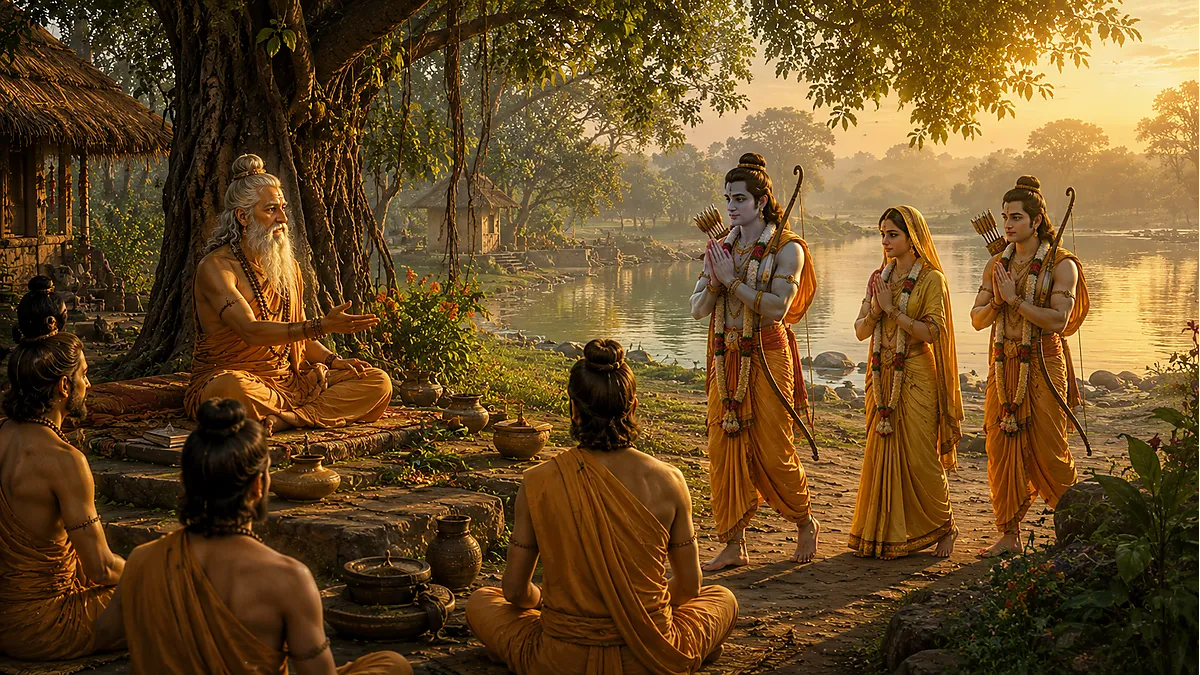
After departing from Ayodhya, Lord Rama, Sita, and Lakshmana began their fourteen‑year exile. They crossed rivers, passed through forests, and visited the hermitages of several sages. The first great sage they met after leaving the kingdom was Maharishi Bharadwaj.
The Arrival at the Hermitage
According to the Valmiki Ramayana, Rama and his companions first crossed the Ganga at Shringverpur, with the help of Nishadraj Guha, the king of the boatmen. The following morning, they proceeded to the hermitage of Sage Bharadwaj, located on the banks of the Yamuna (or, according to some traditions, the Ganga).
As the trio approached the ashram, the omniscient sage — through his divya jnana (divine knowledge) — sensed their arrival. He rose from his meditation and walked to the entrance to welcome them.
The Valmiki Ramayana describes the scene: “Then Rama slowly and reverently entered the hermitage, beholding there the omniscient Sage Bharadwaja of mighty vows, the conqueror of time by sacred discipline. Surrounded by his disciples, seated amidst the deer and birds, he honoured Rama, enquiring as to his welfare.”
The Sage’s Hospitality
Maharishi Bharadwaj received the three exiles with the warmth befitting a great sage. He offered them a seat, gave them Madhuparka (a traditional welcome drink), and arranged for their stay. The sage, who had practiced severe austerities, prepared various kinds of delicacies from wild roots and fruits for the royal guests.
The ashram’s serene, secluded, and spiritually surcharged atmosphere made it an ideal place for meditation and rest. Rama, Sita, and Lakshmana spent the night here, rejuvenated by the sage‘s care and the peaceful environment.
The Conversation and the Guidance to Chitrakoot
Lord Rama had a significant conversation with Maharishi Bharadwaj on spiritual topics. The sage advised Rama that this place was serene and secluded, and suggested that it could serve as his residence during the exile.
But Rama, with his characteristic foresight, declined. He said, “There is no doubt that this place is serene and secluded. However, the residents of Ayodhya are close‑by. They will come here in search of Me. Please suggest Me a place to move forward.”
Understanding Rama’s concern, Maharishi Bharadwaj suggested that he proceed to the Chitrakoot forest, where a mountain closely resembling the Gandha‑maadana mountain would provide the seclusion and natural beauty suitable for his exile. Acting on the sage‘s advice, Rama set out for Chitrakoot the next day — a destination that would become one of the most significant places of his exile.
The Return After Victory
The relationship between Rama and Bharadwaj was not confined to this single meeting. According to tradition, after Lord Rama’s victory over Ravana and the conquest of Lanka, he returned to the ashram to pay his respects. He bowed before the sage, acknowledged the guidance he had received, and offered prayers to the Bhardwajeshwar Mahadev Shivling — which the sage had established in the ashram — further solidifying its significance as a spiritual epicentre.
Bharadwaj Ashram in the Ramayana
The Valmiki Ramayana — the oldest and most authoritative version of the epic — gives considerable importance to Bharadwaj Ashram.
The Kevat Prasang: The famous episode of the boatman (Kevat), where Rama requested the boatman to ferry them across the Ganga, took place at Shringverpur, just before the party reached Bharadwaj Ashram. The Ganga crossing, the boatman’s devotion, and Rama‘s granting of liberation to him set the stage for the meeting with the great sage.
Rama’s Praise of Prayag: According to the Valmiki Ramayana, Rama himself praised the Prayag region for its spiritual powers, which could uplift mankind. He recognised that the sacred energy of the Triveni Sangam was amplified by the presence of sages like Bharadwaj, who had made the banks of the Ganga‑Yamuna their spiritual home.
The Continuing Journey: After leaving Bharadwaj Ashram, Rama, Sita, and Lakshmana proceeded to Valmiki Ashram at Chitrakoot. There, Sage Valmiki advised them to make Chitrakoot their home — a continuation of the guidance that began at Bharadwaj‘s hermitage.
Bharadwaj Ashram in the Ramcharitmanas
Tulsidas’s Ramcharitmanas — the beloved Hindi version of the Ramayana that has shaped the devotional landscape of North India for centuries — also celebrates the significance of Bharadwaj Ashram.
The incident of Kevat Prasang is described in detail, and Rama‘s halt at the hermitage of Sage Bharadwaj is presented as a moment of divine‑human encounter, where the Lord of the Universe bows before a mortal sage, exemplifying the highest ideals of humility and reverence.
The Ramcharitmanas gives a lot of importance to this place, presenting it as a spot where the spiritual power of the Sangam combines with the sanctity of a great sage‘s meditation. For millions of Hindi‑speaking devotees, Bharadwaj Ashram is as sacred as any major temple, because it was touched by the feet of Lord Rama himself.
Bharata’s Visit – Another Sacred Meeting
The ashram witnessed another poignant episode of the Ramayana.
When Bharata — Lord Rama‘s younger brother — learned of the events that had led to Rama’s exile, he set out with an army, accompanied by his mothers and ministers, to find Rama and bring him back.
The inmates of the Bharadwaja Ashram learned of the approaching party. Sage Bharadwaja sent his disciples to Bharata, inviting him to visit the ashram. Interpreting the invitation as a command, Bharata and his entire entourage entered the ashram, where the sage received them with the same warmth he had shown Rama.
During this visit, Bharata learned from the sage the direction in which Rama had proceeded. It was through Bharadwaj‘s guidance that Bharata was able to reach Chitrakoot and meet his elder brother — a meeting that led to the famous conversation where Bharata begged Rama to return, and Rama refused, upholding his father’s word.
Thus, Bharadwaj Ashram became a meeting point between the two branches of the royal family — a place where the sorrow of separation and the duty of exile converged.
Bharadwaj Ashram and the Prayag Mahatmya
The Prayag Mahatmya — the scriptural glorification of Prayag contained in the Puranas — lists Bharadwaj Ashram among the most important sub‑tirthas of Tirtharaj Prayag.
According to the Puranas, the sacred complex of Prayag contains within it numerous sub‑tirthas — individual holy spots that together make up the supreme pilgrimage site. The Mahabharata lists six sub‑tīrthas at Prayāga, the Kūrma Purāṇa refers to eleven, the Agni Purāṇa mentions twelve, and the Nāradīya Purāṇa lists twenty‑one. The Matsya Purāṇa and the Padma Purāṇa contain the names of twenty‑five sub‑tīrthas.. Among these, Bharadwaj Ashram is invariably included.
The sacred geography of Prayag is dense with holy spots — shrines, trees, and the confluence of the rivers — all supported and vivified by the Ganga and Yamuna. Pilgrims who visit Prayag are encouraged to visit these sub‑tirthas in order to fully absorb the sacredness of the place.
The Kurma Purana explicitly lists Bharadwaj Ashram among the holy sites of Prayag, in a verse that runs: “Trivenim Madhavam Somam Bharadwaajam cha Vaasukim, Vande Akshayavatam Sheesham…” — i.e., “I bow to Triveni, to Madhava, to Soma, to Bharadwaj, and to Vasuki. I bow to the Akshayavat and to Lord Shesha.“
Thus, for over two thousand years, Bharadwaj Ashram has been recognised as an integral part of the sacred landscape of Tirtharaj Prayag — not a peripheral site, but a central component of the pilgrimage experience.
Bharadwaj Ashram Today – A Living Heritage
Today, the ancient hermitage of Maharishi Bharadwaj has evolved into a temple complex that continues to attract pilgrims, history enthusiasts, and spiritual seekers.
Location and Accessibility
Bharadwaj Ashram is located in Colonelganj, George Town, Prayagraj, near the famous Anand Bhavan (the Nehru family museum). The address is:
Colonelganj Road, Near Swaraj Bhawan Road, George Town, Prayagraj, Uttar Pradesh, 211002.
The ashram is approximately 4 kilometres from Prayagraj Junction railway station and is easily accessible by taxi, auto‑rickshaw, or local bus.
The Temple Complex and Deities
The ashram complex houses the main temple, a well‑maintained park, and a large copper statue of Sage Bharadwaj marking the entrance.
Inside the main shrine, the primary object of worship is the Bhardwajeshwar Mahadev — a Shivling established, according to tradition, by Maharishi Bharadwaj himself. A sandstone idol of the sage is placed next to the Shivling.
The complex also contains numerous statues of deities, including:
- Lord Rama, Sita, and Lakshmana
- Goddess Durga (Mahishasur Mardini)
- Lord Hanuman
- Lord Ganesha
- Lord Surya
- Sheshnag (the cosmic serpent)
- Nar Varah (the boar incarnation of Vishnu)
- Sages such as Yagyavalkya, Atri, Anusuya, Agastya, and Vashistha
Excavations and Antiquity
Excavations carried out by the celebrated archaeologist B.B. Lal have revealed that the site is as old as at least the eighth century BCE — confirming the ashram’s antiquity as a place of habitation and worship.. The excavations have unearthed several idols of Hindu religious figures dating to the medieval period, indicating continuous veneration of the site for over two thousand years.
The Bharadwaj Corridor – A Major Development
In preparation for the Maha Kumbh Mela, the Government of Uttar Pradesh has undertaken a major renovation and expansion of the ashram. A budget of over ₹13.35 crore was approved for the construction of the Bharadwaj corridor, which encompasses 11 temples located around the ashram.
The project includes:
- The construction of two grand thematic entrance gates, featuring glimpses of Maharishi Bharadwaj‘s aviation knowledge (Vimana Shastra)
- Murals related to Maharishi Bharadwaj and incidents from the Ramayana on both sides of the pathway
- Signage with QR codes in Hindi and English, providing detailed information about the site, temples, and displays for non‑Hindi‑speaking tourists and devotees
- A boundary wall made of red stone mesh
- Proper lighting along the pathway and a floor constructed on the basis of Hindu geometry
The corridor was completed by October 2024, ahead of the Maha Kumbh Mela 2025, transforming the sage‘s abode into a major tourist attraction and spiritual destination.
The Bharadwaj Park
Behind the copper statue of Sage Bharadwaj is a well‑maintained park, recently renovated with murals depicting life at the Bharadwaj Ashram as described in Hindu mythology. The park boasts synchronised fountains, colourful flowers, plentiful trees, and swing sets for children. The park is open from 9:00 AM to 6:00 PM, with a nominal ticket price of ₹10.
A narrow lane behind the park, lined with small, colourful houses, takes visitors to the ancient ashram complex itself.
Timings and Best Time to Visit
- Darshan Timings: The ashram is open daily from 5:00 AM to 10:00 PM
- Best Season: Winter (October–March) offers pleasant weather for walking through the complex and park.
- Special Occasions: The ashram is particularly vibrant during the Magh Mela and Kumbh Mela, when pilgrims flock to Prayagraj. Major festivals such as Mahashivratri, Navratri, and Ram Navami are celebrated with special ceremonies.
The Spiritual Teachings of Maharishi Bharadwaj
The legacy of Maharishi Bharadwaj extends far beyond the walls of his ashram. His teachings — preserved in the hymns of the Rigveda and the traditions of the gurukul — offer timeless lessons for modern seekers.
Knowledge as Liberation: For Maharishi Bharadwaj, true knowledge was not merely intellectual accumulation but a means of liberation. His gurukul taught the Vedas, Puranas, and Shastras not as dry texts but as living wisdom that could transform the student. This emphasis on jnana (knowledge) as a path to moksha (liberation) is one of the central pillars of Sanatana Dharma.
Discipline and Austerity: The sage was a practitioner of severe austerities (tapas), which he viewed as essential for controlling the mind and body, purifying the self, and attaining higher states of consciousness. His example inspires seekers to cultivate self‑discipline in their spiritual practices.
Hospitality as Dharma: The warmth with which Bharadwaj received Rama, Sita, and Lakshmana — and later Bharata and his entourage — sets a powerful example. In Hindu tradition, welcoming a guest is considered a sacred duty (atithi devo bhava — the guest is God). Maharishi Bharadwaj embodied this principle, honouring his royal visitors with the same care regardless of their circumstances.
Service to the Community: The gurukul system of which Bharadwaj was the head was not merely an elite institution. It served the community by producing scholars, priests, and advisors who could guide the rulers of the time. The sage’s role as purohita to King Divodasa and his influence on King Pratardana illustrate how spiritual wisdom was expected to shape political decisions for the benefit of society.
The Unity of Knowledge: Perhaps most remarkably, Bharadwaj‘s mastery of multiple shastras — Vedas, Puranas, Ayurveda, Dhanurveda, Vimana Shastra — reflects a worldview that does not compartmentalise knowledge. For him, medicine, warfare, and spirituality were not separate disciplines but facets of a single, integrated understanding of life and the cosmos.
Bharadwaj Ashram and the Ramayana Circuit
Bharadwaj Ashram occupies a crucial position on the Ramayana Circuit — the network of sites associated with Lord Rama‘s life and journey.
| Location | Distance from Prayagraj | Significance |
| Ayodhya | Approximately 165 km north‑east | Birthplace of Lord Rama; starting point of the exile |
| Shringverpur | Approximately 40 km north | The kingdom of Nishadraj Guha; Lord Rama crossed the Ganga here |
| Bharadwaj Ashram | Within Prayagraj | First overnight halt after crossing the Ganga; meeting with Sage Bharadwaj |
| Chitrakoot | Approximately 125 km south‑west | Place where Lord Rama spent most of his exile |
| Nasik (Panchavati) | Approximately 1,100 km south‑west | Where Lord Rama stayed during the later part of his exile |
| Hampi | Approximately 1,500 km south | Associated with the Kishkindha episode |
| Rameshwaram | Approximately 2,100 km south | Where Lord Rama built the bridge to Lanka |
The Ram Van Gaman Marg — a dedicated route connecting Ayodhya to Chitrakoot via Shringverpur and Prayagraj — is being developed by the Government of Uttar Pradesh. This 210‑kilometre road will make it easier for pilgrims to follow Lord Rama‘s path, with Bharadwaj Ashram serving as one of the key stops along the way.
Pilgrims visiting the ashram as part of the Ramayana Circuit can combine their visit with other sacred sites in Prayagraj, such as the Triveni Sangam, the Allahabad Fort, the Akshayavat, and the Patalpuri Temple.
The Hidden Wisdom of Bharadwaj Ashram
Beyond the stories and the stone, the ashram carries deeper teachings that are relevant to every pilgrim, regardless of faith or background.
The Importance of Seeking Guidance
Rama — the Lord of the Universe, an incarnation of Vishnu himself — did not hesitate to seek the blessings and guidance of a mortal sage. He did not assume that his divine status exempted him from the need for a guru. The humility of Lord Rama before Maharishi Bharadwaj teaches us that no matter how powerful or knowledgeable we become, we always have something to learn from those who have walked the path before us.
The Power of a Sacred Place
The ashram is not merely a geographical location; it is a place where tapas (austerity) has been practised for millennia. The energy generated by the meditations, the yajnas, and the teachings of Maharishi Bharadwaj lingers in the air. To visit a place where such spiritual intensity has been maintained for centuries is to allow oneself to be transformed by that accumulated energy.
Hospitality Without Discrimination
Maharishi Bharadwaj received Rama with the same warmth with which he later received Bharata. He made no distinction between the exile and the king, the dispossessed prince and the royal envoy. In the sage‘s eyes, both were guests deserving of the same honour. This teaching — to see beyond external circumstances and to honour the divine within every person — is one of the highest expressions of Sanatana Dharma.
The Pursuit of Knowledge
The great gurukul that once stood here, with its ten thousand students studying everything from the Vedas to the science of flight, stands as a testament to the value that ancient India placed on education. Knowledge was not seen as a means to a job but as a path to moksha — liberation from ignorance and suffering. The ashram reminds us that learning, at its highest, is a form of worship.
The River of Continuity
The Ganga, which once flowed beside the ashram, has now moved to the Triveni Sangam area. But the memory of the river remains, and the sacredness it bestowed on this place persists. This is a metaphor for tradition itself — the physical form may change, the institutions may evolve, but the spiritual essence, once established, continues to flow through generation after generation.
Visitor Guide – How to Reach and Best Time to Visit
How to Reach
By Air: Prayagraj Airport (IXD) is connected to major cities including Delhi, Mumbai, Kolkata, and Bangalore. From the airport, the ashram is approximately 12 kilometres away; taxis and ride‑sharing services are available.
By Train: Prayagraj Junction (formerly Allahabad Junction) is a major railway station on the Howrah–Delhi route. The ashram is approximately 4 kilometres from the station. Local auto‑rickshaws, cycle‑rickshaws, and taxis can take you to Colonelganj.
By Road: Prayagraj is well connected by national and state highways. Private cars, taxis, and buses from major Uttar Pradesh cities (Lucknow, Varanasi, Kanpur) are available. The ashram is located near Anand Bhavan in the Colonelganj area, a well‑known landmark in the city.
Local Conveyance: Once in Prayagraj, local buses, auto‑rickshaws, and cycle‑rickshaws ply regularly to Colonelganj. Most local drivers will know the Bharadwaj Ashram by name.
Visitor Information
| Detail | Information |
| Address | Colonelganj Road, Near Swaraj Bhawan Road, George Town, Prayagraj, Uttar Pradesh 211002 |
| Darshan Timings | Daily 5:00 AM – 10:00 PM |
| Park Timings | Daily 9:00 AM – 6:00 PM |
| Park Entry Fee | ₹10 per person |
| Best Season | October – March (winter) |
| Best Time of Day | Early morning (peaceful for meditation) or late afternoon (pleasant light) |
| Average Visit Duration | 1–2 hours (including the park and temple) |
| Photography | Permitted in the complex; restrictions may apply inside the main shrine |
| Amenities | Restrooms near the park; small eateries nearby |
What to Bring
- Comfortable walking shoes (the complex involves some walking, especially through the lane to the temple)
- Water bottle
- Sun protection (hat, sunglasses, sunscreen) during warmer months
- Modest clothing (as the site is a place of worship; shoulders and knees should be covered)
- A notebook or audio recorder for those wanting to note the history and legends
Suggested Itinerary for Pilgrims
Morning (2–3 hours):
- Start at the Triveni Sangam for a holy dip and morning prayers.
- Visit the Allahabad Fort to see the Ashokan Pillar (Prayag Prashasti) and the Akshayavat tree.
- Drive to Bharadwaj Ashram (15‑20 minutes from the fort).
- Explore the main temple, offer prayers at the Bhardwajeshwar Mahadev Shivling, and pay respects to the statue of Sage Bharadwaj.
- Walk through the Bharadwaj Park, viewing the murals and fountains.
Afternoon (flexible):
- Visit nearby sites: Anand Bhavan (Nehru museum) for those interested in modern history, or Patalpuri Temple within the fort.
- Have lunch at a restaurant in the Civil Lines or Colonelganj area.
Evening:
- Return to the Triveni Sangam for the Ganga Aarti (if visiting at the right time).
- If time permits, explore the local markets for souvenirs and prasad.
Note to Pilgrims: The ashram is best visited in the morning hours, when the light is soft and the atmosphere most conducive to meditation and quiet reflection.
Timeless Verses on Bharadwaj, Ramayana, and Prayag
The sacredness of Bharadwaj Ashram has been praised in scripture for millennia. Here are some of the most cherished verses that connect Bharadwaj to Prayag and the Ramayana.
Verse 1: The Kurma Purana – Bharadwaj Among the Holy Sites of Prayag
Devanagari:
त्रिवेणीं माधवं सोमं भरद्वाजं च वासुकिम् ।
वन्दे अक्षयवटं शेषं प्रयागं तीर्थनायकम् ॥
IAST:
Triveṇīṁ mādhavaṁ somaṁ bharadvājaṁ ca vāsukim |
Vande akṣayavaṭaṁ śeṣaṁ prayāgaṁ tīrthanāyakam ||
Source:
Kurma Purana, Prayag Mahatmya section
Word‑by‑Word Meaning:
- Triveṇīm – The Triveni Sangam (confluence of three rivers)
- Mādhavam – Lord Madhava (Vishnu)
- Somam – Lord Someshwar (Shiva)
- Bharadvājam – Sage Bharadwaj
- Ca – And
- Vāsukim – King Vasuki (the serpent)
- Vande – I bow to / I praise
- Akṣayavaṭam – The Indestructible Banyan Tree (Akshayavat)
- Śeṣam – Lord Shesha (the cosmic serpent upon whom Vishnu rests)
- Prayāgam – Prayag
- Tīrthanāyakam – The King of Tirthas / Lord of Pilgrimage Sites
Translation:
“I bow to the Triveni Sangam, to Lord Madhava, to Someshwar, to Sage Bharadwaj, and to Vasuki. I bow to the Akshayavat, to Lord Shesha, and to Prayag — the King of all Pilgrimage Sites.”
Traditional Interpretation:
This shloka, originating in the Kurma Purana, presents the sacred geography of Prayag as a constellation of holy entities: the river confluence, the presiding deities, the sages, the sacred tree, and the serpent king. The inclusion of Bharadwaj in this list — alongside the Triveni itself — shows that the sage and his ashram were considered integral to Prayag‘s holiness, not peripheral additions.
Practical Takeaway:
When you visit Prayag, do not limit yourself to the Sangam alone. The pilgrim who bows to the Triveni, the deities, the Akshayavat, and Sage Bharadwaj completes the pilgrimage in its fullest sense.
Verse 2: The Valmiki Ramayana – Rama’s Reverent Entry into the Ashram
Devanagari:
ततस्तु प्राञ्जलिर्भूत्वा रामो धर्मभृतां वरः ।
भरद्वाजमृषिं वन्दे चकार सह सीतया ॥
IAST:
Tatastu prāñjalir bhūtvā rāmo dharmabhṛtāṁ varaḥ |
Bharadvājam ṛṣiṁ vande cakāra saha sītayā ||
Source:
Valmiki Ramayana, Ayodhya Kanda (approximate traditional verse — the exact verse number may vary by recension)
Word‑by‑Word Meaning:
- Tataḥ – Then
- Tu – Indeed
- Prāñjaliḥ – With folded hands
- Bhūtvā – Having become
- Rāmaḥ – Lord Rama
- Dharmabhṛtām – Of the upholders of dharma
- Varaḥ – The best / the foremost
- Bharadvājam – Sage Bharadwaj
- Ṛṣim – The sage / seer
- Vande – Salutations
- Cakāra – Made / performed
- Saha – Together with
- Sītayā – With Sita
Translation:
“Then Lord Rama — the foremost among the upholders of dharma — stood with folded hands together with Sita and bowed in salutation to Sage Bharadwaj.”
Traditional Interpretation:
This verse from the Valmiki Ramayana captures the essence of the meeting: the Lord of the Universe does not assume superiority. Instead, he approaches the sage with humility, his hands folded, accompanied by his consort. The verse is a model of how the divine honours the wise — through reverence, not arrogance.
Practical Takeaway:
When you enter any sacred space — whether a temple, an ashram, or a guru‘s presence — enter with folded hands and a humble heart. This is the attitude that opens the door to grace.
Verse 3: The Ramcharitmanas – Rama’s Arrival at the Ashram
Devanagari:
भरद्वाज आश्रम सुहावना । देखि राम मुनि पूछेउ पावना ॥
IAST:
Bharadvāja āśrama suhāvanā | Dekhi rāma muni pūchheu pāvanā ||
Source:
Ramcharitmanas, Ayodhya Kand (approximately — the exact chaupai number may vary)
Word‑by‑Word Meaning:
- Bharadvāja āśrama – The ashram of Bharadwaj
- Suhāvanā – Beautiful / delightful
- Dekhi – Having seen
- Rāma – Lord Rama
- Muni – The sage
- Pūchheu – Asked / enquired
- Pāvanā – Sacred / holy
Translation:
“Seeing the beautiful ashram of Bharadwaj, Lord Rama asked the sage (about) this sacred place.”
Traditional Interpretation:
Tulsidas presents the ashram not merely as a collection of huts but as a suhāvanā — a delightfully beautiful and spiritually charged space. Rama‘s question to the sage about the ashram reflects his human curiosity and his respect for the sage‘s knowledge.
Practical Takeaway:
Sacred spaces are not only about worship; they also invite contemplation and questions. Do not be afraid to ask, to learn, and to seek understanding when you visit a holy place.
Verse 4: The Rigveda – Bharadwaj as a Vedic Seer (Mandala 6)
Devanagari:
अग्निं दूतं पुरो दधे हव्यवाहमुप ब्रुवे ।
देवान्त्समावसुर्द्विषः ॥ (Rigveda 6.1.1 – opening hymn of Bharadwaj‘s mandala)
IAST:
Agniṁ dūtaṁ puro dadhe havyavāhamupa bruve |
Devāntsamāvasur dviṣaḥ ||
Source:
Rigveda, Mandala 6, Hymn 1, Verse 1
Word‑by‑Word Meaning:
- Agniṁ – The god Agni (fire)
- Dūtaṁ – The messenger
- Puro dadhe – I place (him) in front
- Havyavāham – The carrier of offerings (to the gods)
- Upa bruve – I invoke / call near
- Devān – The gods
- Samāvasuḥ – Being favourable / prosperous
- Dviṣaḥ – The enemies / haters
Translation:
“I place Agni, the divine messenger, in front. I invoke him, the carrier of our offerings to the gods. May the gods, being favourable, destroy our adversaries.”
Traditional Interpretation:
This is the very first hymn of the sixth mandala — the Bharadvāja Maṇḍala — attributed to Sage Bharadwaj himself. The hymn establishes the primacy of Agni as the intermediary between the human and divine realms, a theme that runs through the entire family of hymns attributed to Bharadwaj and his descendants.
Practical Takeaway:
The hymns of Bharadwaj remind us that the Vedic tradition — of which Sanatana Dharma is the living descendant — is not merely a collection of myths but a sophisticated system of connecting the inner and outer worlds through ritual, prayer, and reverence. When you visit the ashram, you are standing on ground that has echoed with these sacred hymns for over three thousand years.
Frequently Asked Questions (FAQs)
1. Who was Maharishi Bharadwaj?
Maharishi Bharadwaj was one of the Saptarishis (seven great sages) of the Kali Yuga. He was the son of Brihaspati (the guru of the gods) and the grandson of Angiras. He is the author of the sixth mandala of the Rigveda, a master of multiple shastras (including Ayurveda and Vimana Shastra), and the founder of the great gurukul at Prayag.
2. Why is Bharadwaj Ashram famous?
The ashram is famous for its connection to the Ramayana — Lord Rama, Sita, and Lakshmana stayed here overnight during their exile. It was also the gurukul of Maharishi Bharadwaj, where thousands of students studied the Vedas and other sacred texts.
3. Did Lord Rama visit Bharadwaj Ashram?
Yes. According to the Valmiki Ramayana and the Ramcharitmanas, Lord Rama, accompanied by Sita and Lakshmana, visited the ashram after crossing the Ganga at Shringverpur. He spent the night here and had a significant conversation with Sage Bharadwaj.
4. Where is Bharadwaj Ashram located?
It is located in Colonelganj, George Town, Prayagraj — near the Anand Bhavan museum. The address is Colonelganj Road, Near Swaraj Bhawan Road, George Town, Prayagraj, Uttar Pradesh 211002.
5. What are the darshan timings of Bharadwaj Ashram?
The ashram is open daily from 5:00 AM to 10:00 PM.
6. Is there any entry fee for Bharadwaj Ashram?
There is no entry fee for the temple complex. The adjoining Bharadwaj Park has a nominal entry fee of ₹10 per person.
7. What deities can be worshipped at the ashram?
The main deity is Bhardwajeshwar Mahadev (a Shivling established by Sage Bharadwaj). The complex also houses statues of Lord Rama, Sita, Lakshmana, Goddess Durga, Lord Hanuman, Lord Ganesha, Lord Surya, Sheshnag, Nar Varah, and several other sages including Yagyavalkya, Atri, and Vashistha.
8. What is the historical significance of the ashram?
The ashram is believed to have been established approximately 5,000 years ago. Excavations by archaeologist B.B. Lal have confirmed that the site dates back to at least the eighth century BCE. It was a great centre of learning, teaching over 10,000 disciples.
9. Is Bharadwaj Ashram mentioned in the Puranas?
Yes. The ashram is listed among the sub‑tirthas of Prayag in the Prayag Mahatmya sections of the Puranas, including the Kurma Purana, the Matsya Purana, and the Padma Purana.
10. What is the Bharadwaj corridor?
The Bharadwaj corridor is a major development project completed ahead of the Maha Kumbh Mela 2025. Built at a cost of over ₹13.35 crore, it encompasses 11 temples, two grand entrance gates, murals depicting scenes from the Ramayana, and QR codes for audio‑visual information in Hindi and English.
11. How can I reach Bharadwaj Ashram from the railway station?
Prayagraj Junction is approximately 4 kilometres from the ashram. Local auto‑rickshaws, cycle‑rickshaws, and taxis are readily available outside the station.
12. What is the best time to visit Bharadwaj Ashram?
The winter season (October–March) offers the most pleasant weather for exploring the complex. Early mornings (just after opening) are ideal for those seeking a quiet, meditative experience.
13. Is the ashram wheelchair accessible?
The main temple area is accessible via a lane leading from the park, which may be uneven in places. The park itself has paved pathways. Visitors with mobility concerns should consider visiting with assistance.
14. Are there any special festivals celebrated at the ashram?
Yes. Mahashivratri, Navratri, and Ram Navami are celebrated with special ceremonies and prayers. The ashram is also an important site during the Magh Mela and Kumbh Mela seasons.
15. Can I combine a visit to Bharadwaj Ashram with other sites?
Absolutely. The ashram is located close to Anand Bhavan, and the Triveni Sangam, Allahabad Fort, Akshayavat, and Patalpuri Temple are within 15–20 minutes‘ drive.
16. What should I wear when visiting the ashram?
Modest clothing is recommended, as the ashram is a place of active worship. Shoulders and knees should be covered out of respect.
17. Are there any accommodations near the ashram?
Prayagraj has a range of accommodations from budget guesthouses to mid‑range hotels, particularly near the railway station and the Civil Lines area. There are no accommodations within the ashram itself.
18. Is photography allowed inside the temple?
Photography is generally permitted in the complex, but restrictions may apply inside the main shrine or near the Shiva Linga. It is advisable to ask the attending priest before taking photographs.
19. What is the connection between Bharadwaj Ashram and the Kumbh Mela?
During the Kumbh Mela and Magh Mela, thousands of pilgrims visit the ashram as part of their pilgrimage. The annual confluence of scholars that took place here during the Magh Mela is a tradition that continues, albeit in modified form, today.
20. Why should I visit Bharadwaj Ashram?
You should visit because it is not merely an ancient hermitage — it is a living reminder of wisdom, hospitality, devotion, and the sacred meeting between Lord Rama and one of the greatest sages of Vedic tradition. It offers a rare chance to walk on ground that has been revered for over two thousand years and to connect with the living heritage of the Ramayana.
Related Sacred Journeys
To deepen your understanding of the sacred sites of Prayagraj and the Ramayana Circuit, we invite you to explore these related guides:
- Triveni Sangam: The Complete Pilgrim Guide – The sacred confluence of the Ganga, Yamuna, and invisible Saraswati.
- Tirtharaj Prayag: Why Prayagraj Is Called the King of Pilgrimage Sites – The scriptural and spiritual basis for Prayagraj’s supreme status.
- Akshayavat: The Indestructible Banyan Tree of Prayagra] – The sacred tree within Allahabad Fort, a symbol of eternity.
- Patalpuri Temple: The Subterranean Shrine – The underground temple within the Allahabad Fort.
- Shringverpur Dham: The Ramayana Connection – The site where Lord Rama crossed the Ganga with the help of Nishadraj Guha.
- Chitrakoot: Where Lord Rama Lived During Exile – The forest destination recommended by Sage Bharadwaj.
- Prayag Prashasti (Allahabad Pillar Inscription) – The historical record of Emperor Samudragupta‘s achievements.
- Magh Mela: The Annual Pilgrimage to Tirtharaj] – The sacred fair that draws millions to the Sangam every winter.
- Kumbh Mela: History, Mythology, Akharas & Significance – The world‘s largest gathering of faith at Prayagraj.
Why Bharadwaj Ashram Still Inspires Pilgrims Today
Let us return to where we began — standing before the copper statue of Maharishi Bharadwaj, the park behind us, the ancient shrine ahead.
In a world of rapid change — of concrete and glass, of emails and instant messages — places like Bharadwaj Ashram serve as anchors. They remind us that there is a deeper current to human existence, one that flows beneath the surface of modern life. The same humility that Lord Rama showed before the sage is available to us. The same hospitality that the sage extended to the exiled prince can be extended to the stranger, the traveller, the one in need.
The ashram teaches that knowledge is not merely information but transformation. The thousands of students who once studied here did not come only to memorise verses; they came to become better human beings — wiser, more disciplined, more compassionate.
It teaches that a place becomes sacred not because of its architecture but because of the tapas performed there — the austerity, the prayer, the selfless service, the search for truth. The energy that Maharishi Bharadwaj and his disciples generated through their meditation and yajnas still lingers, available to anyone who approaches with an open heart.
And it teaches that the Lord himself — whether we understand him as Rama, as Vishnu, or as the Divine in any form — honours the wise. Rama, the king of Ayodhya, did not hesitate to fold his hands before a sage living in a forest hermitage. In that gesture, the highest and the humblest meet — a lesson in humility for all who claim to follow the path of dharma.
When you walk through the Colonelganj lane, when you stand before the Bhardwajeshwar Mahadev Shivling, when you sit for a moment in the shade of the park — you are doing more than sightseeing. You are stepping into a living tradition that connects you to the Rigveda, to the Ramayana, to the gurukul system of ancient India, and to the timeless ideal of the guru‑shishya (teacher‑disciple) relationship.
Bharadwaj Ashram is not merely an ancient hermitage. It is a living reminder of wisdom, hospitality, devotion, and the sacred meeting between Lord Rama and one of the greatest sages of Vedic tradition.
May your journey to this sacred place be peaceful, safe, and spiritually enriching. May the blessings of Maharishi Bharadwaj — the master of the Vedas, the builder of the gurukul, the host of Lord Rama — accompany you on your path.
This article is part of a series on the sacred pilgrimage sites of Prayagraj and the Ramayana Circuit. For more information on planning your pilgrimage to Bharadwaj Ashram and the other holy sites of Tirtharaj Prayag, please contact us.
Prayag Tourism
📞 Phone/WhatsApp: +91-9555313526
📧 Email: contact@prayagtourism.com
🌐 Website: PrayagTourism.com
May your journey be peaceful, safe, and spiritually enriching.