
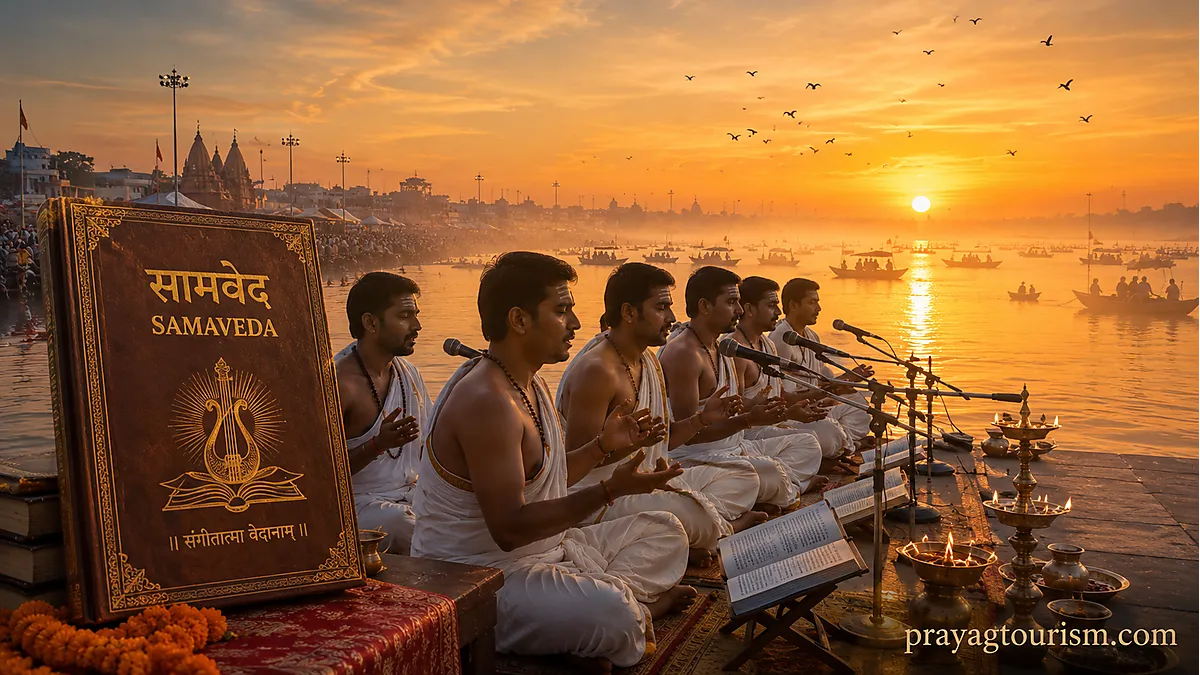
During Kumbh Mela at Prayagraj, visitors can hear Samavedic chants echoing across the Sangam at dawn. The experience is difficult to describe—many pilgrims report a profound sense of calm and spiritual elevation.
“When sound becomes sacred, music becomes prayer, and the human heart becomes a bridge between the earthly and the Divine.”
Have you ever stood at the banks of the Ganga as the first rays of dawn touched the water? The air is crisp, the bells begin to ring, and then—a chant rises. It is not merely a sound. It is a vibration that seems to travel through the body, stirring something ancient and peaceful within.
Long before the world knew the terms raga, tala, or sapta swara, before the first verses of the Bible or the Quran were written, the Sages of India had discovered something profound: the power of sacred sound. They realized that certain melodies, when chanted with perfect devotion and precision, could open doors to higher consciousness.
This knowledge found its most complete expression in one of the most treasured texts of Sanatana Dharma—the Samaveda, the Veda of Sacred Song.
But why is the Samaveda called the Veda of Music? What exactly is Sama Gana? And how does chanting a thousand-year-old mantra in Sanskrit relate to your life today—your stress, your search for peace, your longing for something deeper?
Let us journey together into this world of divine melody. Let us sit beside the sacred rivers, close our eyes, and listen.
Table of Contents
Quick Facts
| Attribute | Detail |
| Name | Samaveda (सामवेद) |
| Meaning | “Veda of Melodies” or “Knowledge of Sacred Chants” |
| Category | Primary Hindu Scripture (Śruti) |
| Position | Third among the Four Vedas |
| Total Verses | 1,875 (of which 1,504 are from the Rigveda) |
| Primary Focus | Melodic chanting (Sama Gana) |
| Core Tradition | Udgata priests chanting at Soma sacrifices |
| Main Shakhas | Kauthuma, Jaiminiya, Ranayaniya |
| Key Upanishads | Chandogya Upanishad, Kena (Talavakara) Upanishad |
| Estimated Reading Time | 15–20 minutes |
What is the Samaveda?
The word Samaveda is a combination of two Sanskrit terms: Sāman (सामन्) meaning “melody” or “song,” and Veda (वेद) meaning “knowledge.” Thus, the Samaveda is often called the “Veda of Melodies” or the “Book of Sacred Chants.”
But it is much more than that.
The Samaveda stands third in the traditional order of the four Vedas, following the Rigveda and the Yajurveda, and preceding the Atharvaveda. Its verses are not meant to be merely recited or read—they are intended to be sung using seven specific notes, creating a powerful fusion of sacred text and divine music.
The great sage Bhagavān Vedavyāsa, who compiled and divided the Vedas for the benefit of humanity, taught the Samaveda to his disciple Jaimini. This initiated an unbroken lineage of sacred chanting that continues even today.
Why is it called the Veda of Music?
Unlike any other scripture in the world, the Samaveda contains notated melodies—quite possibly the world’s oldest surviving musical notation. Using numbers (1 to 7) to represent the seven svara or notes, the Samaveda functions like a musical score sheet.
The hymns are chanted at important Vedic sacrifices, particularly the Soma Yajña, where the juice of the Soma plant—clarified and mixed with milk and other ingredients—was offered in libation to various deities.
The Samaveda took words from the Rigveda and provided them with musical substance, enriching the spiritual recitations with musical depth.
Historical and Scriptural Context
To understand the Samaveda, we must first understand its relationship with the Rigveda.
Relationship with the Rigveda
The Samaveda consists of 1,875 verses. Remarkably, all but 75 of these verses are taken directly from the Rigveda, particularly from the eighth and ninth mandalas (the Soma Book).
However, these verses are not copied mechanically. They are transposed, rearranged, and adapted for a specific purpose: to be sung in the Soma sacrifice by the class of priests called Udgātṛ (the chanters).
Interestingly, some variations in the Samaveda’s text appear older and more original than the corresponding verses in the Rigveda we possess today.
The Four Songbooks (Ganas)
The Samaveda has four Gānas or Songbooks, each serving a different purpose:
- Grāma-geya Gāna – “Village Song-Book,” used in communal sacrifices
- Araṇya-gana – “Forest Song-Book,” containing melodies considered powerful and learned only in the forest
- Uha-gana – Connected with the Grāma-geya Gana
- Uhya-gana – Connected with the Araṇya-gana
These songbooks describe the melodies using notes, showing syllable-expansions, repetitions, and insertions of syllables (called stobhas like hoyi, huva, hoi, etc.).
The Origin of Sacred Chanting
Imagine a time before writing—a time when knowledge was not stored in books but in the very cells of living memory. How would you preserve sacred verses for thousands of years?
This was the challenge faced by the ancient Rishis.
The Guru-Shishya Parampara
The Vedas have been transmitted through an unbroken oral tradition known as the Guru-Shishya Parampara—the lineage of teacher and disciple. This is considered the world’s oldest continuous oral tradition in existence.
Vedic chanting is the world’s oldest oral tradition in vogue. Distilled from a vast body of Sanskrit literature, compiled between 5000 to 1500 years, the chanting tradition was transmitted through the Guru-Shishya parampara as Shruti (heard) and Smriti (remembered) tradition.
Why Music Was Essential
Music was not an artistic addition to the Vedas—it was a technical necessity for preservation.
The systematic musical structure and meter in the Samaveda enabled precise memorization. The patterns were self-realized from the subtle vibrations of the cosmos and facilitated the successful transmission of knowledge from generation to generation without distortion.
Sage Vyasa and the Division of the Vedas
According to tradition, the great sage Parāśaravyāsa (Vedavyāsa) codified, edited, and divided the Vedas into four parts. He taught them to five disciples:
- Paila – Rigveda
- Vaiśampāyana – Yajurveda
- Jaimini – Samaveda
- Subantu – Atharvaveda
- Romaharṣaṇa – Itihāsa and Purāṇa
Thus, the Samaveda as we know it today owes its structure to Vyāsa and his disciple Jaimini.
What is Sama Gana?
Sāma Gāna is the art of chanting the Samaveda in its prescribed melodies. The difference between speaking a mantra and singing it is like the difference between looking at a photograph and standing inside a cathedral of sound.
Chanting vs. Singing
In Sama Gana, the verses are not merely chanted in a monotone. They are sung using seven specific notes (sapta swara), with prescribed prolongations, repetitions, and interpolations of syllables.
The Samaveda mentions the seven svara or notes, which correspond to the following vocal registers:
- Morning chant to Agni (Fire) – bass register
- Noon chant to Indra – middle octave
- Afternoon chant to Viśvadevas – third octave
The Five Parts of a Sāman
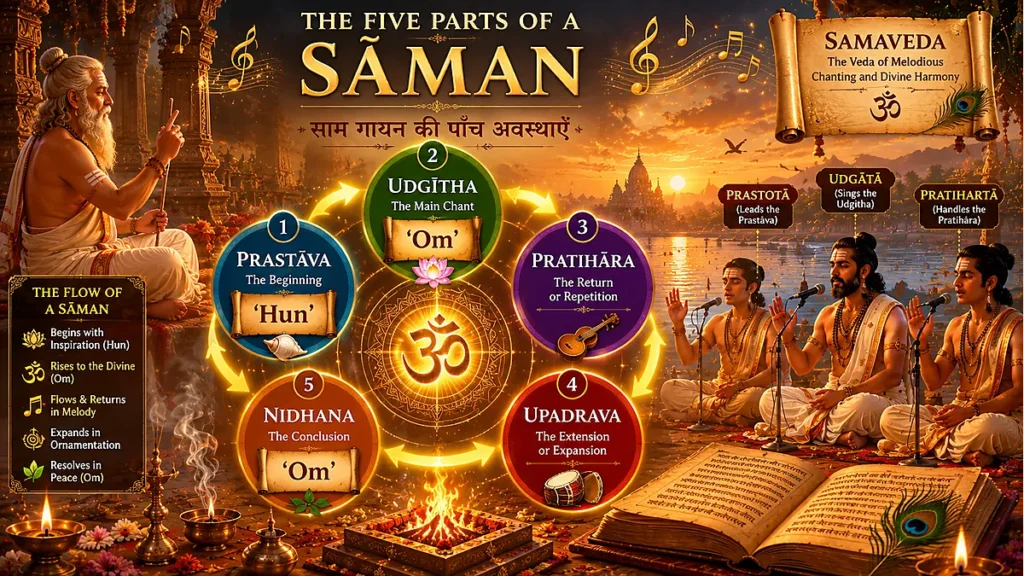
A Sāman (a chanted hymn) is divided into five distinct sections:
| Part | Sanskrit | Meaning |
| 1 | Prastāva | The opening, sung by Prastotā |
| 2 | Udgītha | The main chant, sung by Udgātā |
| 3 | Pratihāra | The joining chant, sung by Pratihartā |
| 4 | Upadrava | Pre-closing chant, sung by Udgātā |
| 5 | Nidhana | The conclusion, sung by all three together |
Example: The First Sāman of the Samaveda
The very first mantra of the Samaveda is addressed to Agni, the Fire God:
1. Devanagari
अग्न आ याहि वीतये गृणानो हव्यदातये । नि होता सत्सि बर्हिषि ॥
2. IAST Transliteration
Aghna ā yāhi vītaye gṛṇāno havyadātaye | ni hotā satsi barhiṣi ||
3. Source Citation
Sāmaveda-Saṃhitā, Pūrvārcika, Āgneya Parva, Prathama Adhyāya, Prathama Khaṇḍa, Mantra 1
4. Word-by-Word Meaning
- Agna – O Agni (Fire)
- Ā yāhi – Come
- Vītaye – For the enjoyment (or to carry the oblation)
- Gṛṇānaḥ – Being praised
- Havyadātaye – To offer the oblation to the gods
- Ni hotā satsi barhiṣi – Sit down as the Hotā priest on the sacred grass
5. Translation
“O Agni, come for the enjoyment (of the offering). Being praised by us, come to offer the oblation to the gods. Sit down as the Hotā priest on the sacred grass.”
6. Traditional Interpretation
This mantra is the fundamental call to Agni, the divine messenger who carries offerings from the earthly realm to the celestial gods. The Udgātā priest would chant this in five parts, transforming the simple words into a powerful vibration that purifies the ritual space and invites the divine presence.
7. Practical Life Lesson
Before beginning any important task—a project, a conversation, or even a day—take a moment to “invite clarity” as Agni is invited. Create a sacred space through breath, intention, or a simple chant. This prepares the mind for focused action.
The Power of Sacred Sound
The sages of India understood something that modern science is only now beginning to validate: sound is not merely heard—it is felt, absorbed, and transformative.
Nada – The Primordial Sound
In Indian philosophy, the entire universe is said to have originated from Nada (sound) and Bindu (point). The first vibration is the unstruck sound—Anāhata Nada—which becomes the audible Āhata Nada that we can perceive.
The Samaveda harnesses this principle. The chants are designed not just to carry meaning but to vibrate the very cells of the body, aligning them with the cosmic rhythm.
Mantra – Vibration for the Mind
A mantra is not a prayer in the Western sense. It is a sound tool—a specific vibration that, when repeated with correct pronunciation and intention, produces a desired effect on the mind and body.
The Samaveda mantras were such that there was hardly any room to meddle. Improvisation in mode of chanting may have occurred decades later but there was never any distortion.
Svara – The Seven Notes
The seven notes of the Samaveda form the basis of all later Indian music. They are:
| Svara | Full Name | Animal Sound Association |
| Sa | Shadja | cry of the peacock |
| Re | Rishabha | bellowing of a bull |
| Ga | Gandhara | bleating of a goat |
| Ma | Madhyama | call of the heron |
| Pa | Panchama | song of the cuckoo |
| Dha | Dhiavata | neighing of a horse |
| Ni | Nishada | trumpeting of an elephant |
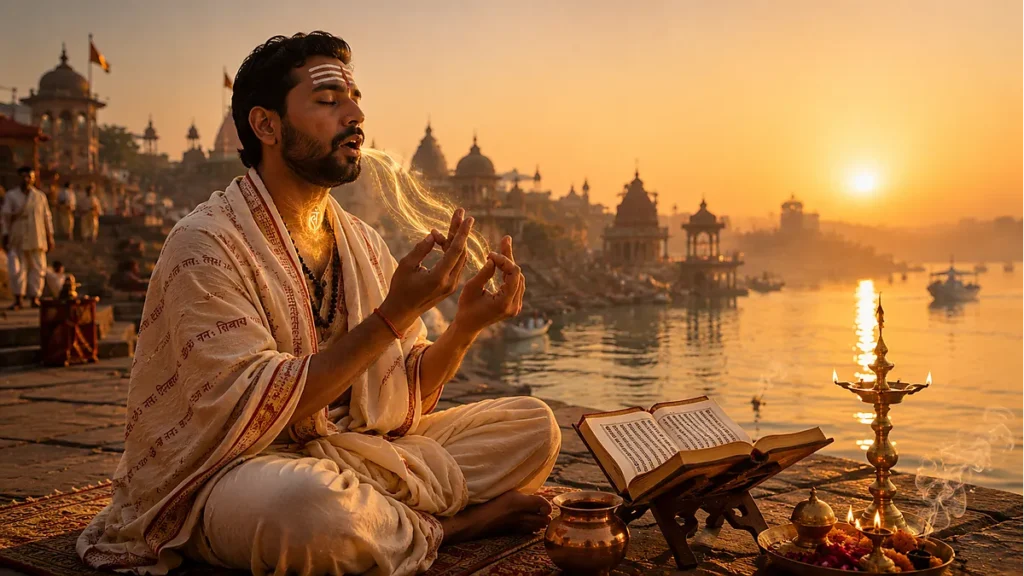
The Samaveda and Indian Music
The influence of the Samaveda on Indian classical music is not an opinion—it is a historical fact.
It has been unanimously acknowledged that the origin of our classical music is Sama Veda or more simply Saman singing. Authentic texts like Bharatha’s Natyasastra and Matanga’s Brihaddeshi attribute the art and science of music to the third Veda (Sama) which is the source of the seven notes/Saptaswara that form the basic scale of musical notation.
From Saman to Raga
The sāman melodies evolved over centuries into jātis (melodic families), which eventually crystallized into the rāgas of Hindustani and Carnatic music.
The raga (tonal framework) developed from a series of rhythmic syllables set to a pattern, which again can be traced to the tradition of Saman chanting.
Hand Signals and Tala
The Samaveda included a system of hand signals (chironomy) to set the speed of recitals. These jātis (finger counting of beats), along with the mudras (finger and palm postures), form the basis of the tāla system used in Indian classical music today.
A Universal Truth
Remarkably, scholars have found striking similarities between Sama recital and Jewish liturgical music. The Emenite song and the Sabbath song at synagogues so closely resemble Sama singing in their use of Ga (gandhara), Ri, and Sa, even in descending order, that it points to music as a universal truth.
The Hidden Wisdom of Music and Chanting
Why does music touch us so deeply? Why can a particular melody bring tears to our eyes without a single word being understood?
The Samaveda offers profound insights.
Emotional Healing
When we chant or listen to sacred music, our brainwaves slow down, stress hormones decrease, and the nervous system enters a state of calm. The Samavedic sages understood this thousands of years ago—they designed chants specifically to create emotional balance and inner peace.
Concentration and Mental Clarity
Chanting requires intense focus. You must coordinate pronunciation, rhythm, melody, and meaning. This training in single-pointed concentration spills over into everyday life, sharpening the mind and improving the ability to focus on tasks.
Community Bonding
When a group chants together, something magical happens. Heartbeats begin to synchronize. Breathing patterns align. A sense of unity and belonging emerges that transcends individual differences. This is why sacred chanting has always been a community activity.
The Ethics of Harmony
The Samaveda teaches not just musical harmony but ethical harmony.
Balance in All Things
Just as a melody must balance its ascending and descending passages, a life must balance effort and rest, giving and receiving, activity and reflection.
Cooperation
In Sama Gana, the three priests (Prastotā, Udgātā, and Pratihartā) must sing in perfect coordination. No single voice can dominate. The beauty arises from the harmony between them.
This is a metaphor for society. Progress is not made by any one individual or group alone—it requires cooperation, listening, and mutual respect.
Discipline
Learning to chant the Samaveda correctly takes years of dedicated practice. This discipline cultivates patience, humility, and perseverance—qualities that serve us in every area of life.
The Samaveda and the Science of Sound
Let us set aside mysticism for a moment and look at the Samaveda through a scientific lens.
Acoustic Properties
The Samavedic chants are designed to produce specific acoustic effects. The elongation and repetition of syllables create resonance chambers within the mouth, throat, and chest, stimulating the vagus nerve and inducing a state of calm.
Memory and Oral Tradition
The musical structure of the Samaveda is not arbitrary—it is a mnemonic device. Setting words to a melody makes them far easier to memorize than plain prose. This was essential for preserving vast amounts of information without writing.
According to UNESCO, the tradition of Vedic chanting is considered a masterpiece of the oral and intangible heritage of humanity.
Pronunciation Precision
The Samaveda, like all Vedas, was transmitted with extraordinary precision. Even a single mispronounced syllable could change the meaning of a mantra. This required the development of elaborate phonetic treatises (Prātiśākhyas) that analyzed sound down to the movement of the tongue and breath.
Sacred Geography of Vedic Chanting
Certain places in India are especially infused with the energy of Vedic chanting. These sacred sites have been centers of learning and spiritual practice for millennia.
Prayagraj (Triveni Sangam)
Prayagraj, the confluence of the Ganga, Yamuna, and the mythical Saraswati rivers, is one of the most sacred cities in India. During the Kumbh Mela, millions gather here, and the air is filled with the sound of Vedic chants from countless akharas and sects.
The energy of the Sangam (confluence) is said to amplify the effects of chanting and meditation. Many believe that a mantra chanted at Prayagraj carries more spiritual weight than one chanted elsewhere.
Ancient Vedic Centers
- Naimisharanya – Where the sages compiled the Puranas
- Kurukshetra – Land of the Mahabharata war
- Kashi – The eternal city of light
- Rishikesh – The yoga capital of the world
- Haridwar – Gateway to the gods
Each of these places has a unique vibrational quality. Pilgrims journey to them not just to see the sights, but to hear—to immerse themselves in the sacred sound that has echoed there for thousands of years.
The Samaveda and the Upanishads
The philosophical teachings of the Samaveda find their highest expression in two major Upanishads: the Chandogya Upanishad and the Kena Upanishad.
Chandogya Upanishad
The Chandogya Upanishad is incorporated into the Samaveda. It has eight sections, the first five dealing with various forms of contemplative worship (upāsanas), and the last three explaining the manner of acquisition of true knowledge.
Key Teachings:
- Tat tvam asi – “That thou art”
- The importance of speech, language, song, and chants in the quest for knowledge and salvation
- The contemplation of Om as Udgitha
In the first chapter of the Chandogya, the upasanas which form part of the Sama-veda are detailed. In the second, the entire ritual of Sama is described.
Kena Upanishad
Also known as the Talavakara Upanishad, the Kena Upanishad is embedded inside the last section of the Talavakara Brahmanam of the Samaveda.
It begins with the profound question:
Keneshitam patati preshitam manah? – “Who impels the mind to alight on its object?”
The Upanishad explores the source of all consciousness and teaches that behind all thought, perception, and life is the supreme reality, Brahman, which cannot be grasped by the mind or senses but is their very basis.
Common Misunderstandings
“Is the Samaveda just about music?”
No. The Samaveda uses music as a vehicle for spiritual elevation. The chants are not entertainment—they are tools for transformation. The melody supports the meaning, and the meaning points toward the Divine.
“Is it the same as Indian classical music?”
The Samaveda is the source and inspiration, but it is not identical to later classical music. The Sama swaras/notes do not sound at the same swarasthanas (note positions) of present-day classical music. The values of śruti are also slightly different.
“Can only priests chant the Samaveda?”
Traditionally, Samavedic chanting required initiation and rigorous training. However, many mantras—particularly peace mantras—can be chanted by sincere seekers under proper guidance. The key is correct pronunciation and reverent attitude.
“Is the Samaveda relevant today?”
Absolutely. In a world filled with noise and distraction, the Samaveda offers a path to inner stillness. Its teachings on harmony, discipline, and the power of sound are more relevant than ever.
Timeless Mantras of the Samaveda
Let us now experience the beauty of the Samaveda directly through some of its most powerful mantras. Each mantra is a seed of wisdom waiting to sprout in the heart.
1. The Sangachchadhvam Mantra – Mantra for Unity and Harmony
1. Devanagari
ॐ संगच्छध्वं संवदध्वं सं वो मनांसि जानताम् । देवा भागं यथा पूर्वे सञ्जानाना उपासते ॥
ॐ शान्तिः शान्तिः शान्तिः
2. IAST Transliteration
Om saṃgacchadhvaṃ saṃvadadhvaṃ saṃ vo manāṃsi jānatām | devā bhāgaṃ yathā pūrve sañjānānā upāsate ||
Om śāntiḥ śāntiḥ śāntiḥ
3. Source Citation
Sāmaveda, Pūrvārcika (associated with the Aitareya Brāhmaṇa)
4. Word-by-Word Meaning
- Saṃgacchadhvam – Move together
- Saṃvadadhvam – Speak together
- Saṃ vo manāṃsi jānatām – May your minds be united
- Devā bhāgam – The gods’ portion
- Yathā pūrve – As in former times
- Sañjānānāḥ upāsate – (The gods) served together in unity
5. Translation
“Move together, speak together, let your minds be united. Just as the gods of old served their portion together in unity, so may we. Om peace, peace, peace.”
6. Traditional Interpretation
This mantra celebrates the power of togetherness. It is often chanted at the beginning of ceremonies, meetings, and community gatherings to invoke harmony and mutual understanding. It recognizes that the highest spiritual goals are achieved not in isolation but in community.
7. Practical Takeaway
Before any group activity—a family dinner, a work meeting, or a social gathering—recite this mantra silently in your heart. It will shift your focus from personal agenda to collective welfare.
2. Agni Mantra (The First Sāman) – Mantra for Invoking the Divine Messenger
1. Devanagari
अग्न आ याहि वीतये गृणानो हव्यदातये । नि होता सत्सि बर्हिषि ॥
2. IAST Transliteration
Aghna ā yāhi vītaye gṛṇāno havyadātaye | ni hotā satsi barhiṣi ||
3. Source Citation
Sāmaveda-Saṃhitā, Pūrvārcika, Āgneya Parva, Prathama Adhyāya, Prathama Khaṇḍa, Mantra 1
4. Word-by-Word Meaning
- Aghna – O Agni
- Ā yāhi – Come
- Vītaye – For the enjoyment / to carry the oblation
- Gṛṇānaḥ – Being praised
- Havyadātaye – To offer the oblation to the gods
- Ni hotā satsi barhiṣi – Sit down as the Hotā on the sacred grass
5. Translation
“O Agni, come for the enjoyment (of the offering). Being praised by us, come to offer the oblation to the gods. Sit down as the Hotā priest on the sacred grass.”
6. Traditional Interpretation
Agni is the divine messenger who carries offerings from the earthly realm to the celestial gods. He is the mouth of the gods. This mantra invites his presence, purifies the ritual space, and establishes a channel for communication between human and divine realms.
7. Practical Takeaway
When you light a lamp or candle for worship, chant this mantra. It transforms a simple flame into a sacred presence, reminding you that divinity is not far away in heaven—it is present here, in the fire of your devotion.
3. Pavamana Mantra – Mantra for Purification and Inner Light
1. Devanagari
पवमानः स्वस्त्ययनिः सुदुघा हि घृतश्रुतः । ऋषिभिः सम्भृतो रसो ब्राह्मणेष्वमृतं हितम् ॥
2. IAST Transliteration
Pavamānaḥ svastyayaniḥ sudughā hi ghṛtaśrutaḥ | ṛṣibhiḥ saṃbhṛto raso brāhmaṇeṣvamṛtaṃ hitam ||
3. Source Citation
Sāmaveda, Uttarārcika
4. Word-by-Word Meaning
- Pavamānaḥ – The self-purifying one
- Svastyayaniḥ – The source of well-being
- Sudughā hi ghṛtaśrutaḥ – Easily yielding, renowned for ghee (nourishment)
- Ṛṣibhiḥ saṃbhṛtaḥ raso – The essence collected by the sages
- Brāhmaṇeṣu amṛtaṃ hitam – Placed as nectar among the Brahmins (those who know Brahman)
5. Translation
“The self-purifying Soma, the source of well-being, easily yielding and renowned for its nourishing essence—this essence collected by the sages is placed as nectar among the knowers of Brahman.”
6. Traditional Interpretation
This mantra speaks of the Soma—not only the plant, but the divine essence that purifies itself and the chanter. It is a prayer for purity, well-being, and the presence of immortal nectar (amṛta) within the heart.
7. Practical Takeaway
Whenever you feel overwhelmed by negativity or impurity—whether physical, emotional, or spiritual—close your eyes and repeat this mantra (or listen to it). Let the sound wash through you like a sacred river, carrying away what no longer serves you.
The Samaveda in Modern Life
How can you incorporate the wisdom of the Samaveda into your daily life, even without formal training?
For Students
- Use chanting to focus. Spend 5 minutes each morning chanting a simple mantra like “Om” or the Samaveda shanti mantra. This trains the mind for concentration.
- Study Vedic math and science. Many of the principles of rhythm and proportion in the Samaveda align with mathematical patterns.
For Musicians
- Explore the roots of raga. Understanding the Samaveda will deepen your appreciation for the classical music you play.
- Practice Nada Yoga. Experience sound not just as performance but as meditation.
For Families
- Chant together before meals. A simple mantra creates a moment of gratitude and togetherness.
- Play recordings of Vedic chants in the home to create a peaceful atmosphere.
For Spiritual Seekers
- Start a daily chanting practice. Even 10–15 minutes of focused chanting can transform your mental state.
- Visit a pilgrimage site like Prayagraj or Kashi to experience chanting in the places where it has been practiced for millennia.
For Everyone
- Listen consciously. In a world filled with background noise, take time to really listen—to birdsong, to wind, to silence. This is the beginning of understanding Nada.
- Find your community. Chanting is most powerful when done together. Seek out a local satsanga, yoga group, or temple where you can chant with others.
Why the Samaveda Still Matters Today
We live in an age of noise. Our ears are constantly bombarded with notifications, advertisements, news alerts, and endless streams of content. Yet, beneath this noise, the human spirit still yearns for harmony.
The Samaveda reminds us that sound is not just information—it is energy. It shapes our mood, our health, our relationships, and our connection to the Divine.
The Samaveda aids in spiritual evolution through music.
A Pilgrimage-Style Meditation
Close your eyes for a moment.
Imagine yourself sitting at the Triveni Sangam in Prayagraj as the sun begins to rise. The water is calm, touched with gold. The air is cool and still.
Then, from across the water, you hear it—a single voice, rising in chant. It is the Udgātā, beginning the Prastāva. Soon, other voices join. The sound grows, fills the air, touches your skin, enters your heart.
You don’t understand every word. But somehow, you understand everything.
The chant rises and falls like the breath. It swirls like the waters of the Ganga. It soars like the morning bird. And in that moment, the boundaries dissolve—between you and the chant, between the chant and the universe, between the universe and you.
You are not listening to the sound.
You are the sound.
The Samaveda is not a relic of the past. It is a living stream of vibration that continues to flow through the hearts of those who chant it and listen to it with reverence.
When sound becomes sacred, music becomes prayer, and the human heart becomes a bridge between the earthly and the Divine.
May this article be the beginning of your journey into the sacred melodies of the Samaveda. May you discover how sound, devotion, harmony, and spiritual awareness come together in one of humanity’s oldest and most beautiful sacred traditions.
And may the peace of the chants—Om Shanti Shanti Shanti—find a home in your heart.
Frequently Asked Questions
1. What is the Samaveda in simple terms?
The Samaveda is the third Veda of Hinduism. It contains hymns from the Rigveda that are set to music and chanted with specific melodies. It is often called the “Veda of Music” or “Book of Sacred Chants.”
2. Why is the Samaveda called the Veda of Music?
Because its verses are not meant to be recited—they are sung using seven musical notes (sapta svara). It contains notated melodies, making it like an ancient musical score sheet. Many scholars consider it the origin of Indian classical music.
3. What is Sama Gana?
Sāma Gāna is the art of chanting the Samaveda in its prescribed melodies. It involves prolongation, repetition, and interpolation of syllables using seven notes. A Sāman has five parts: Prastāva, Udgītha, Pratihāra, Upadrava, and Nidhana.
4. Did the Samaveda influence Indian classical music?
Yes, unanimously acknowledged. The Samaveda is considered the source of the seven notes (saptaswara). The ragas of Hindustani and Carnatic music evolved from the melodies (sāmangāna) of the Samaveda.
5. What Upanishads belong to the Samaveda?
The two primary Upanishads are the Chandogya Upanishad and the Kena Upanishad (also known as the Talavakara Upanishad).
6. How many verses are in the Samaveda?
The Samaveda contains 1,875 verses. Of these, all but 75 are taken from the Rigveda, particularly from its eighth and ninth mandalas (the Soma Book).
7. Who composed the Samaveda?
According to tradition, the great sage Vedavyāsa compiled and divided the Vedas into four parts and taught the Samaveda to his disciple Jaimini.
8. Can beginners learn Samavedic chanting?
Traditionally, chanting required initiation and long training under a guru. However, many peace mantras from the Samaveda can be chanted by sincere seekers with proper guidance. Correct pronunciation and reverent attitude are essential.
9. Why is sacred sound important in Hinduism?
Sound is believed to be the first expression of the Divine. The primordial sound Om is the source of all creation. Sacred chanting (mantra) uses specific vibrations to purify the mind, focus concentration, and connect with higher consciousness.
10. Why is Samaveda called the source of Indian music?
Because it introduced melodic chanting using structured musical notes that later evolved into India’s classical music traditions.
11. What is the main purpose of Samaveda chanting?
To elevate consciousness, preserve sacred knowledge, and create harmony between the individual and the divine.
12. Which Upanishads belong to the Samaveda?
The Chandogya Upanishad and Kena Upanishad are the two principal Upanishads associated with the Samaveda.
13. Can listening to Samaveda chants reduce stress?
Traditional teachings and modern studies suggest that rhythmic chanting can promote relaxation, concentration, and emotional balance.
14. Is the Samaveda still practiced today?
Yes, the Samaveda is still chanted by traditional Vedic priests, especially during Soma sacrifices and other important rituals. There are three surviving recensions (śākhās): Kauthuma, Jaiminiya, and Ranayaniya.
15. What is the connection between the Samaveda and Prayagraj?
Prayagraj (Triveni Sangam) is a major center for Vedic learning and chanting. During the Kumbh Mela, the sacred sound of Vedic chants, including those from the Samaveda, fills the air. The confluence of the rivers is believed to amplify the spiritual effects of chanting.
16. How can I experience the Samaveda today?
You can:
- Listen to recordings of Samaveda chanting online
- Visit a Vedic temple or a Kumbh Mela
- Attend a chanting workshop or course
- Read translations of the Samaveda and its Upanishads
Final Thoughts
The Samaveda is not merely a text. It is a sadhana—a practice, a discipline, a path. It invites you not just to know, but to feel. Not just to think, but to vibrate.
As you go about your day, remember that every sound you hear and every sound you make creates ripples in the universe. Choose those ripples wisely.
May your days be filled with sacred melody.
Om Shanti Shanti Shanti.
This article has been published by PrayagTourism.com to help pilgrims, spiritual seekers, and music lovers understand the timeless wisdom of the Samaveda. We invite you to explore the sacred geography of Vedic chanting and experience the power of sound for yourself.